
- Home
- »
- Next Generation Technologies
- »
-
In-Camera Visual Effects Market Size, Industry Report, 2030GVR Report cover

In-Camera Visual Effects Market (2025 - 2030) Size, Share & Trends Analysis Report By Component (Hardware, Software, Services), By Application, By Technology, By Offering (Pre-production, Production), By Region, And Segment Forecasts
Market Size, 2024
$665.6MMarket Estimate, 2026
$738.8MMarket Forecast, 2030
$1,352.6MCAGR, 2025–2030
12.9%In-Camera Visual Effects Market Summary
The global in-camera visual effects market size was estimated at USD 665.6 million in 2024 and is expected to reach USD 1,352.6 million by 2030, growing at a CAGR of 12.9% from 2025 to 2030. The increasing demand for high-quality, immersive content on film, television, and digital media platforms primarily drives the in-camera visual effects (IC-VFX) industry growth.
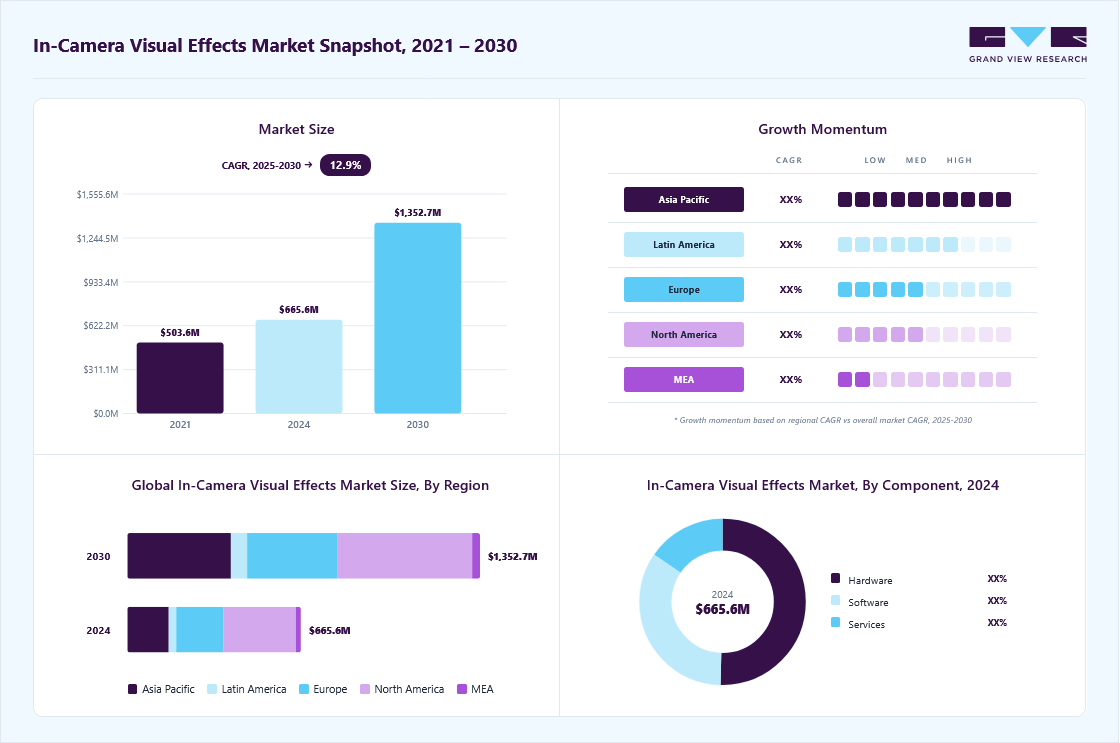 Source: Grand View Research, IR Documents, Primary Interviews, Paid DatabasesTo learn more about this report,
 Download Free Sample Report
 Key Market Trends & Insights
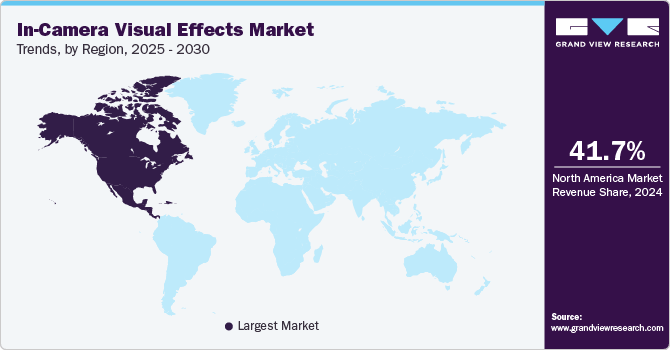
- North America IC-VFX market accounted for the largest revenue share of over 41.7% in 2024.
- By component, the hardware component segment accounted for the largest market share of over 50% in 2024.
- By application, the film and television segment dominated the IC-VFX market in 2024.
- By offering, the production segment dominated the IC-VFX industry in 2024.
- By technology, the LED volume technology segment accounted for a significant share of the industry in 2024.
Market Size & Forecast
- 2024 Market Size: USD 665.6 Million
- 2030 Projected Market Size: USD 1,352.6 Million
- CAGR (2025-2030): 12.9%
- North America: Largest market in 2024
Three ways to get this report
Buy it, customize it, or ask a question.Ask an Analyst
Analyst response in 1 business day
- AccessReport author, directly
- Reply timeWithin 1 working day
- No sales callDirect answer only
- FormatEmail reply
- CostFree, no cost
Get the Full Report
What the study covers
- FormatsPDF · Excel · Dashboard
- Timeline2025–2030 annual, 2024 base
- Coverage20+ countries, 5 regions
- Companies10+ key players profiled
Customize the Report
20% free customization
- IncludeCountries, segments, points
- TailorTo your product definition
- ExtendDeeper competitor detail
- OrA fully bespoke study
- Turnaround5–10 working days
Virtual production methods, such as real-time rendering, LED volumes, and motion tracking, are helping filmmakers produce intricate visual effects with less dependence on conventional post-production techniques. This phenomenon enables more streamlined production cycles, lower costs, and greater creative control while shooting. As the need for immersive experiences increases, sectors such as entertainment, gaming, and advertising are adopting IC-VFX to advance storytelling and streamline production workflows.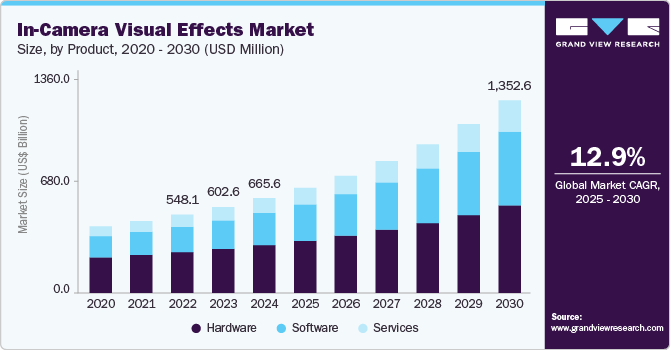 To learn more about this report, Download Free Sample Report
 One of the notable trends in the IC-VFX market is the increasing use of LED wall technology in production studios. LED volumes provide filmmakers with dynamic, real-time backgrounds and lighting, enhancing realism and immersion during shoots. This technology is particularly prominent in big-budget movie productions and television shows. By having photorealistic backgrounds available on set, the reliance on green screens and extensive post-production is reduced, resulting in more efficient shooting schedules and tighter budgets. This trend is expected to continue as studios invest more in LED technology for both mainstream and independent films.
Another significant trend is the growing convergence of game engines and real-time rendering software within virtual production workflows. Tools such as Unreal Engine are increasingly central to IC-VFX pipelines, allowing for real-time modifications of virtual environments during shoots. This convergence provides greater flexibility, enabling filmmakers to make artistic decisions on set and minimizing the time and costs typically associated with post-production. The immediate feedback offered by these tools facilitates quicker iterations and more effective collaboration among directors, VFX artists, and cinematographers, making virtual production a smoother and more adaptable process in the entertainment sector.
Key players in the in-camera visual effects (IC-VFX) industry include well-known organizations such as Sony Corporation, Samsung, Epic Games, Wētā FX, and Industrial Light & Magic (ILM). These companies are pushing the boundaries of virtual production with the latest technologies and services to meet the growing demand for high-quality visual content. Epic Games and its Unreal Engine are at the forefront of the real-time rendering movement, while Wētā FX and ILM are establishing new standards for film visual effects. An increased focus on partnerships, technology integration, and infrastructure expansion reflects the competitive landscape as the industry enhances its capabilities in the IC-VFX sector.
Component Insights
The hardware segment accounted for the largest market share of over 50% in 2024. Rapid advancements in virtual production equipment and infrastructure drive the segment growth. The increasing adoption of LED volume stages, which use massive LED panels to create dynamic, photorealistic backgrounds, is revolutionizing how visual effects are captured on set. These LED walls provide natural lighting and reflections, which significantly enhance realism and reduce the need for extensive post-production compositing. Additionally, innovations in motion capture hardware, virtual camera rigs, and simulation cameras are enabling filmmakers to capture complex performances and environments with unprecedented precision and flexibility. The rising demand for immersive and interactive filming experiences across film, television, and gaming industries is pushing studios to invest heavily in cutting-edge hardware solutions. Moreover, the global push towards remote and hybrid production workflows has increased reliance on portable and scalable hardware setups, further driving market expansion.
The software segment is estimated to record the fastest CAGR of 14.9% from 2025 to 2030, driven by the increasing complexity of visual effects required in modern content, alongside the demand for faster turnaround times. Leading software platforms are integrating artificial intelligence and machine learning algorithms to automate routine tasks such as rotoscoping, tracking, and color correction, thereby enhancing efficiency and creative possibilities. Cloud-based VFX software solutions are gaining traction, enabling distributed teams to collaborate seamlessly and access powerful computing resources on demand. The rise of real-time engines such as Unreal Engine and Unity has transformed traditional post-production workflows by allowing directors and artists to visualize and manipulate scenes live on set. Furthermore, the convergence of software with hardware innovations-such as LED volumes and camera tracking systems-creates a synergistic effect that enhances the quality and realism of in-camera effects. These factors are expected to drive the segmental growth in the coming years.
Application Insights
The film and television segment dominated the IC-VFX market in 2024, primarily due to the insatiable demand for high-quality, visually compelling content. The integration of IC-VFX technologies allows filmmakers to create immersive, photorealistic environments and characters in real-time, significantly reducing reliance on green screens and lengthy post-production processes. Additionally, the proliferation of streaming platforms has led to an unprecedented volume of original content production, with many projects requiring sophisticated visual effects to meet audience expectations. Furthermore, the increasing budgets allocated to blockbuster films and high-end television series have accelerated the adoption of virtual production techniques. The ability to shoot complex scenes in controlled LED volume environments reduces logistical challenges associated with location shooting, such as weather dependency and travel costs. Moreover, IC-VFX facilitates safer production environments, an important consideration in the post-pandemic era. As the industry continues to evolve, the film and television segment is expected to drive substantial revenue growth in the IC-VFX market in the coming years.
On the other hand, the commercials and advertising segment is projected to be the fastest-growing market for in-camera visual effects (IC-VFX) throughout the forecast period. Advertisers are leveraging the flexibility and cost-efficiency of in-camera effects to produce dynamic visuals that can be tailored and adapted quickly for multiple platforms, including social media, television, and digital signage. The ability to generate real-time visual effects on set allows for rapid iteration and experimentation, enabling creative teams to optimize messaging and aesthetics without incurring high post-production costs. This agility is particularly valuable in the fast-paced advertising industry, where time-to-market is critical. Additionally, the rise of experiential marketing and immersive brand experiences is driving the demand for IC-VFX technologies that can create interactive and engaging environments during live events and product launches.
Offering Insights
The production segment dominated the IC-VFX industry in 2024. The growth is driven by the direct application of in-camera effects during filming. The use of LED volumes, real-time rendering engines, and camera tracking systems on set allows for the capture of complex visual effects in real-time, dramatically reducing reliance on traditional post-production workflows. This shift empowers directors and cinematographers to make creative decisions with immediate visual feedback, enhancing artistic control and storytelling impact. The production phase benefits from technological advancements that improve the synchronization and integration of virtual and physical elements, enabling seamless blending of live-action and CGI. The ability to shoot in controlled environments mitigates risks related to weather, location logistics, and safety, which is particularly valuable in the post-pandemic production landscape. Furthermore, the scalability of virtual production setups-from small studios to large sound stages-makes IC-VFX accessible to a wide range of content creators, from independent filmmakers to major studios. These factors are expected to further drive segmental growth.
On the other hand, the pre-production segment is anticipated to grow significantly, as filmmakers and content creators increasingly recognize the value of virtual planning and visualization. Tools such as virtual scouting, pre-visualization (previs), and concept visualization enable creative teams to experiment with camera angles, lighting, and set designs before physical production begins. This early-stage visualization reduces uncertainty, minimizes costly reshoots, and optimizes resource allocation during production. The integration of real-time rendering and virtual reality (VR) technologies in pre-production workflows allows stakeholders to immerse themselves in digital environments, facilitating better communication and decision-making. Additionally, AI-powered analytics and simulation tools help predict potential challenges and suggest creative alternatives, further enhancing efficiency. The rise of decentralized and remote production teams has also increased the demand for cloud-based pre-production platforms that enable seamless collaboration across geographies, further expanding the segmental growth.
Technology Insights
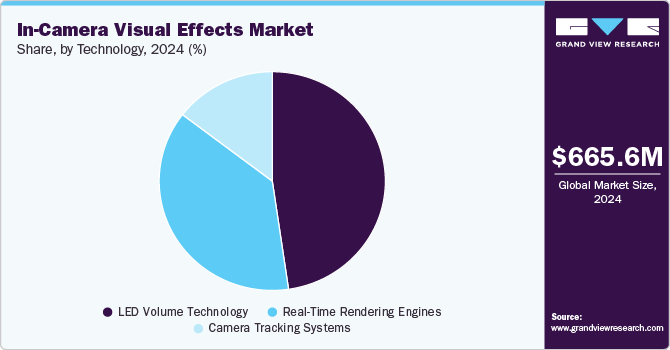
The LED volume technology segment accounted for a significant share of the in-camera visual effects (IC-VFX) industry in 2024. LED volume technology enables filmmakers to capture complex visual effects in-camera, significantly reducing the need for costly and time-consuming post-production compositing. The scalability of LED volumes-from small stages to massive virtual production environments-allows for diverse applications across film, television, commercials, and live events. Advances in LED panel resolution, color accuracy, and refresh rates are enhancing the photorealism and immersion of virtual sets. Additionally, the integration of LED volumes with real-time rendering engines and camera tracking systems creates a seamless production ecosystem that empowers creative teams to visualize and modify scenes instantaneously. The growing investment in large-scale virtual production studios by major studios and independent producers alike is accelerating the adoption of LED volume technology.
 To learn more about this report, Download Free Sample Report
 The real-time rendering engines segment is projected to experience the fastest CAGR during the forecast period. Technologies such as Unreal Engine and Unity have revolutionized content creation by providing powerful, flexible platforms that support photorealistic rendering, complex lighting, and physics simulations in real-time. The continuous improvement in GPU capabilities, coupled with AI-driven optimizations, has increased rendering speed and quality, allowing for more intricate and believable virtual environments. Real-time engines facilitate iterative creative processes, where directors and artists can experiment with lighting, camera angles, and effects during filming, thus reducing costly reshoots and post-production revisions. The integration of these engines with LED volumes and camera tracking systems further enhances the realism and interactivity of in-camera effects. Moreover, the expansion of real-time rendering into other sectors such as gaming, architecture, and automotive visualization is driving cross-industry innovation and investment.
Regional Insights
The North America in-camera visual effects market is growing significantly as studios and production houses more and more incorporate virtual production technologies into their pipelines. The reason behind this is the need for high-end visual effects in film, TV, and digital content on OTT platforms. Real-time rendering, LED volumes, and camera tracking technologies are becoming core parts of production workflows, allowing for more efficient and immersive storytelling. The increasing demand for streaming services and affordability concerns have encouraged growing investments in in-camera visual effects (IC-VFX) infrastructure, setting the stage for North America as a global trendsetter.
 To learn more about this report, Download Free Sample Report
 U.S. In-Camera Visual Effects Market Trends
In the United States, the use of in-camera visual effects (IC-VFX) is being promoted by large film studios, tech firms, and production centers such as Los Angeles, Georgia, and New Mexico. Companies such as Disney and Warner Bros. are more and more embracing virtual production methods to save money and become more creatively agile. The emergence of platforms such as Netflix and Amazon Prime has fueled content demands for premium content that is visually pleasing, thus enhancing the adoption of IC-VFX. Specialized virtual production facilities, such as those at Trilith Studios, have become central to the focus of the American market, involving investments in cutting-edge technology and interactions between filmmakers and technology developers.
Europe In-Camera Visual Effects Market Trends
The Europe in-camera visual effects (IC-VFX) industry is experiencing steady growth as film and television productions incorporate virtual production tools to enhance efficiency and creative freedom. Production houses are spending money on LED volumes, real-time rendering software, and camera tracking technologies to cut down location shooting and make post-production work easier. Increased international co-productions and requirements for scalable solutions on varied projects are fueling demand for IC-VFX techniques. Studios in nations such as the UK, Germany, and France are teaming up with technology suppliers to establish end-to-end production pipelines, and training initiatives are growing to enhance skilled labor development.
The UK in-camera visual effects market is expected to grow during the forecast period. The United Kingdom is a leading in-camera visual effects center in Europe, with top-level studios such as Pinewood, Shepperton, and Leavesden increasingly adding virtual production stages. Market leaders such as DNEG and Framestore are providing IC-VFX services on domestic and international productions. The UK has a good mix of robust technical infrastructure, a rich talent pool, and government incentives in the form of tax relief for high-end TV and film. IC-VFX is being implemented end-to-end from previsualization through production and post, enabling directors to provide real-time creative input on set, which ensures budgets and schedules are kept in check.
The in-camera visual effects market in Germany is changing, as studios try virtual production to address growing demand for high-concept, visually complex storytelling. While adoption is slower than in the UK, interest is increasing among independent studios and broadcasters. Germany's well-developed VFX sector and state-level financial incentives for digital production are stimulating investment in LED stages and real-time rendering platforms. Industry partnerships between media producers, tech companies, and film schools are driving innovation, while training is being adapted to meet the talent gap in virtual cinematography and interactive environment creation.
Asia Pacific In-Camera Visual Effects Market Trends
The Asia Pacific in-camera visual effects (IC-VFX) industry is growing as film and TV production industries throughout the region attempt to upgrade production pipelines and enhance visual storytelling. China, India, South Korea, and Australia are slowly embracing IC-VFX technologies such as LED volumes and real-time rendering engines. The transition is significantly fueled by the growth of digital-first content, streaming services, and the demand to produce high-quality visual effects at an affordable cost. Production houses are looking into virtual production as a means of minimizing dependence on conventional sets and locations, and regional partnerships between studios and technology companies are creating innovation and infrastructure opportunities.
China's in-camera visual effects market is picking up steam as domestic studios attempt to match global production standards. The Chinese movie industry is incorporating more and more real-time technologies in large-budget productions, especially in sci-fi and fantasy films. Some of the state-funded studios have started experimenting with virtual production pipelines, which integrate LED walls with motion tracking and 3D environments. Local companies are also working with game engine firms to tailor tools for film production. While large-scale uptake is in its infancy, China's emphasis on immersive content and investment in studio build-out imply good long-term prospects for IC-VFX integration.
The in-camera visual effects market in India stands at a nascent but optimistic phase, with increasing interest from production houses, OTT players, and advertising agencies. As visually engaging storytelling continues to gain traction, Indian studios are starting to make investments in real-time rendering and LED stage facilities. Local VFX and post-production houses are considering virtual production to control costs, minimize post-production time, and have greater creative control. Though access to infrastructure continues to be uneven, pilot ventures and partnerships with international technology providers establish technical expertise. India's competence in software development and animation services places it favorably for the coming adoption and adaptation of IC-VFX workflows.
Key In-Camera Visual Effects Company Insights
Some of the key players operating in the market are Sony Corporation, SAMSUNG, ROE Visual, Epic Games, Inc., among others.
-
Sony Corporation provides a wide range of imaging and display technology solutions that cater to IC-VFX workflows. Its professional digital cinema cameras, such as the VENICE series, as well as Crystal LED display systems, are often used in virtual production sets. Sony also collaborates with production houses to offer bespoke hardware solutions, calibration tools, and support services adapted for virtual worlds.
-
SAMSUNG offers high-resolution LED display technologies that are increasingly applied in IC-VFX stages. Its MicroLED and fine-pitch LED panels enable precise color reproduction and high brightness levels, which are essential for realistic on-camera visual effects. Samsung also works with partners in the content production industry to provide integrated display systems and infrastructure planning for large-scale virtual sets.
-
ROE Visual is an expert in state-of-the-art LED panel technology and a key supplier for IC-VFX production houses around the world. Its best-selling product ranges, such as the Black Pearl and Ruby series, are optimized to be used within XR stages, LED volumes, and immersive production environments. ROE Visual also offers engineering assistance, system deployment, and calibration services to make it integrate easily with real-time rendering engines and camera tracking systems.
-
Epic Games, Inc. builds Unreal Engine, the popular real-time 3D creation system crucial to IC-VFX. Unreal Engine fuels the live rendering of virtual sets onto LED walls with dynamic camera travel and light matching. Epic Games backs the community with training initiatives, alliances with hardware partners, and versioning focused particularly on virtual production workflows.
Wētā FX Limited, Industrial Light & Magic (ILM), and Pixomondo are some of the emerging participants in the In-Camera Visual Effects (IC-VFX) market.
-
Wētā FX Limited is a post-production visual effects facility that has integrated IC-VFX into its production arsenal. It employs LED wall technology and real-time engines to enable directors and cinematographers to see CG environments in the course of production. Wētā FX continues to spend on hybrid methods of production, which combine physical sets with digital backgrounds for greater efficiency and artistic control.
-
Industrial Light & Magic (ILM) has created its own virtual production system, known as StageCraft, which brings together LED volumes, real-time rendering, and accurate camera tracking. ILM employs StageCraft in its own productions and sells the system to clients as well. The arrangement allows actors to act in real-time settings, minimizing green screen and post-production compositing.
-
Pixomondo provides virtual production and VFX services with an emphasis on IC-VFX stages. Pixomondo has built several LED volume studios and offers both technical consulting and production services. Pixomondo serves television, film, and commercial productions, assisting clients in planning and executing virtual shoots with real-time workflows.
Key In-Camera Visual Effects Companies:
The following are the leading companies in the in-camera visual effects (IC-VFX) market. These companies collectively hold the largest market share and dictate industry trends.
- Wētā FX Limited
- Industrial Light & Magic (ILM)
- Pixomondo
- Sony Corporation
- SAMSUNG
- Epic Games, Inc.
- DNEG
- Framestore Limited
- Moving Picture Company (MPC)
- NEP Group, Inc.
- NantStudios, LLC
- Mo-Sys Engineering Ltd.
- Dimension (Hammerhead Interactive Ltd.)
- ROE Visual
- Megapixel
Recent Developments:
-
In 2024, Samsung Electronics unveiled next-generation display solutions at ISE 2024, including a Transparent MICRO LED display for immersive, 3D-like visuals and the Visual eXperience Transformation (VXT) cloud-native CMS platform. The company also launched SmartThings for Business, enabling advanced automation and connectivity in retail, hospitality, and corporate settings, reinforcing its leadership in commercial display innovation.
-
In 2025, ROE Visual announced a collaborative project with South Korean partners ARK Ventures, CJ Olive Networks, and YoungdoB&C to construct the MunGyeong Virtual Studio (MVS). This partnership involved integrating advanced ROE Visual LED technology, including 1,024 Ruby RB2.6 and 320 Carbon CB5L MKII panels, alongside high-end hardware and software solutions to create a cutting-edge virtual production facility.
-
In 2025, Fivefold Studios announced a major investment in ROE Visual LED technology to establish a new virtual production studio in Wales. This collaboration includes technology integration, training, and R&D support from ROE Visual, alongside a partnership with Sunbelt Rentals UK & Ireland for equipment and technical assistance. The joint effort aims to create a state-of-the-art virtual production facility that will advance innovation in broadcast and film production.
In-Camera Visual Effects Market Report Scope
Report Attribute
Details
Market size value in 2025
USD 738.8 million
Revenue forecast in 2030
USD 1,352.6 million
Growth rate
CAGR of 12.9% from 2025 to 2030
Base year for estimation
2024
Historical data
2018 - 2023
Forecast period
2025 - 2030
Quantitative units
Revenue in USD million/billion, and CAGR from 2025 to 2030
Report Product
Revenue forecast, company ranking, competitive landscape, growth factors, and trends
Segments covered
Component, application, technology, offering, region
Country scope
U.S.; Canada; Mexico; UK; Germany; France; China; Australia; Japan; India; South Korea; Brazil; South Africa; Saudi Arabia; UAE
Key companies profiled
Wētā FX Limited; Industrial Light & Magic (ILM); Pixomondo; Sony Corporation; SAMSUNG; Epic Games, Inc.; DNEG; Framestore Limited; Moving Picture Company (MPC); NEP Group, Inc.; NantStudios, LLC; Mo-Sys Engineering Ltd.; Dimension (Hammerhead Interactive Ltd.); ROE Visual; Megapixel
Customization scope
Free report customization (equivalent to up to 8 analyst’s working days) with purchase. Addition or alteration to country, regional & segment scope.
Pricing and purchase options
Avail customized purchase options to meet your exact research needs. Explore purchase options
Global In-Camera Visual Effects Market Report Segmentation
This report forecasts revenue growth at global, regional, and country levels and provides an analysis of the latest technology trends in each of the sub-segments from 2018 to 2030. For this study, Grand View Research has segmented the global in-camera visual effects (IC-VFX) market report based on component, application, technology, offering, and region:
-
Component Outlook (Revenue, USD Million, 2018 - 2030)
-
Hardware
-
Software
-
Services
-
-
Application Outlook (Revenue, USD Million, 2018 - 2030)
-
Film and Television
-
Commercials and Advertising
-
Live Events and Broadcasts
-
-
Technology Outlook (Revenue, USD Million, 2018 - 2030)
-
LED Volume Technology
-
Real-Time Rendering Engines
-
Camera Tracking Systems
-
-
Offering Outlook (Revenue, USD Million, 2018 - 2030)
-
Pre-Production
-
Production
-
-
Regional Outlook (Revenue, USD Million, 2018 - 2030)
-
North America
-
U.S.
-
Canada
-
Mexico
-
-
Europe
-
UK
-
Germany
-
France
-
-
Asia Pacific
-
China
-
Japan
-
India
-
South Korea
-
Australia
-
-
Latin America
-
Brazil
-
-
Middle East & Africa
-
Saudi Arabia
-
South Africa
-
UAE
-
-
Frequently Asked Questions About This Report
The global in-camera visual effects market size was estimated at USD 665.6 million in 2024 and is expected to reach USD 738.8 million in 2025.
The global in-camera visual effects market is expected to grow at a compound annual growth rate (CAGR) of 12.9% from 2025 to 2030 to reach USD 1,352.6 million by 2030.
The film and television segment dominated the in-camera visual effects (IC-VFX) market in 2024, primarily owing to the insatiable demand for high-quality, visually compelling content.
Some key players operating in the IC-VFX market include Wētā FX Limited; Industrial Light & Magic (ILM); Pixomondo; Sony Corporation; SAMSUNG; Epic Games, Inc.; DNEG; Framestore Limited; Moving Picture Company (MPC); NEP Group, Inc.; NantStudios, LLC; Mo-Sys Engineering Ltd.; Dimension (Hammerhead Interactive Ltd.); ROE Visual; Megapixel.
The key factors driving the in-camera visual effects market growth include the increasing demand for high-quality, immersive content on film, television, and digital media platforms and the increasing use of LED wall technology in production studios.
About the Author(s)
Next Generation Technologies Research Team
Technology · Next Generation TechnologiesThis report was authored by the next generation technologies research team at Grand View Research - comprising two research analysts, one senior research analyst, and one industry expert - with specialized expertise in the next generation technologies segment of the technology industry. All findings are based on proprietary technology databases, executive interviews, and regulatory analysis, subject to internal peer review prior to publication.
Last Updated:
Speak to Analyst

Customize this report to your needs - add regions, segments, or data points, with 20% free customization.
Or view our licence options:


ISO 9001:2015 & 27001:2022 Certified
We are GDPR and CCPA compliant! Your transaction & personal information is safe and secure. For more details, please read our privacy policy.


