
- Home
- »
- Animal Health
- »
-
India Bovine Artificial Insemination Market Report, 2030GVR Report cover

India Bovine Artificial Insemination Market (2025 - 2030) Size, Share & Trends Analysis Report By Solutions (Equipment & Consumables, Services, Semen), Animal (Cow, Buffalo), Distribution Channel, By Region, And Segment Forecasts
Market Size & Trends
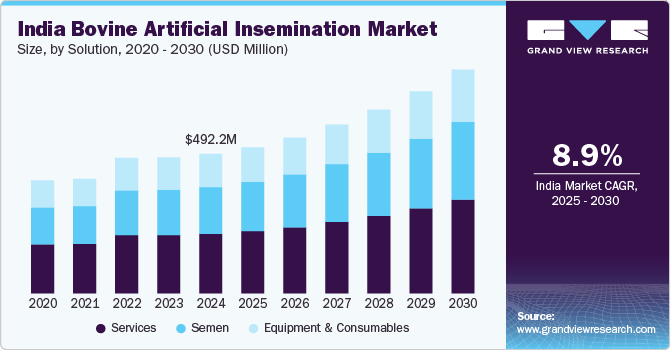
The India bovine artificial insemination market size is estimated at USD 492.22 million in 2024 and is projected to grow at a CAGR of 8.91% from 2025 to 2030. Key factors expected to drive the market include ongoing government initiatives to increase artificial insemination practices in the country, rising government focus on boosting milk production in the country, emerging efforts from the authorities to structure the dairy sector, and increasing technological advancements.
 Source: Grand View Research, IR Documents, Primary Interviews, Paid DatabasesTo learn more about this report,
 Download Free Sample Report
 The Indian government has implemented various initiatives to enhance the bovine artificial insemination industry, including the Rashtriya Gokul Mission and the National Artificial Insemination Programme (NAIP). Under NAIP, AI services are provided free of cost across 605 districts. In 2023-2024, India produced over 10 million doses of sex-sorted semen, with five government-run semen stations in Uttarakhand, Gujarat, Uttar Pradesh, Madhya Pradesh, and Tamil Nadu contributing 4.95 million doses. Additional production by dairy cooperatives, NGOs, and private stations added 4.97 million doses. To boost AI adoption, the government offers a subsidy of INR 750 (USD 8.9) or 50% of the cost of sorted semen upon pregnancy confirmation. These efforts are significantly improving AI penetration among dairy farmers.
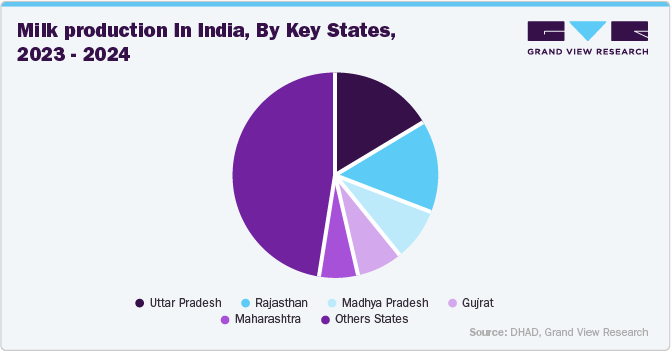
The increasing demand for dairy products is a key driver of the India bovine AI industry. As India's population grows and dietary preferences shift toward higher protein consumption, there is a rising need for enhanced livestock productivity. Bovine AI plays a crucial role in meeting this demand by improving genetic traits, increasing milk yield, and enhancing quality. For instance, according to an article published by The Hindu, in November 2024, The country's milk output increased by 3.78% in 2023-2024 compared to 2022-2023 predictions. Uttar Pradesh leads the nation in milk production, accounting for 16.21% of total milk output. Furthermore, the study estimates that the country produced 239.30 million tons of milk in 2023-2024, representing a compound annual growth of 5.62% over the previous ten years, according to Union Minister Rajiv Ranjan Singh. The total quantity of milk produced in 2022-2023 was 230.58 million tonnes. India is first in the world in terms of milk output.
 To learn more about this report, Download Free Sample Report
 Another crucial driving factor for the market is the launch of innovative technologies to aid the livestock sector in the country. For example, in March 2024, the Press Information Bureau of India (PIB), the Indian government launched Bharat Pashudhan Livestock Data Stack, a digital database for real-time tracking and monitoring of livestock animals in the country using a unique ID number. Through this system, farmers can access and upload veterinary information related to artificial inseminations, vaccinations, new animal registration, ownership change, animal disease diagnostic and treatment data, milk output recording, etc. The PIB further said that as of March 2024, 1.6 million entries per day are being added to this data stack.
Table 1 Establishment of MAITRIs to Extend AI Coverage from 2021-22 to 2023-24
State
Targets (Nos.)
Achievement (Nos.)
Andhra Pradesh
3,500
4,746
Telangana
250
162
Karnataka
2,350
3,139
Kerala
160
139
Gujrat
648
545
Madhya Pradesh
6,770
5,136
Maharashtra
250
220
Rajasthan
1,100
1,315
Jammu & Kashmir
639
848
Punjab
100
-
Haryana
119
-
Himachal Pradesh
50
43
Uttarakhand
225
233
Uttar Pradesh
3,250
2,497
Ladakh
300
75
Assam
1,364
1,012
Arunachal Pradesh
100
37
Manipur
100
100
Meghalaya
535
173
Sikkim
378
378
Nagaland
20
20
Tripura
144
94
Jharkhand
1,539
1,044
Chhattisgarh
425
425
Bihar
5,406
2,733
West Bengal
1,000
1,188
Odisha
1,500
1,341
Total
32,222
27,643
Source: DHAD, Grand View Research
Increasing government initiatives to improve AI coverage across India is expected to boost demand for bovine artificial insemination in India. For instance, Multipurpose AI Technicians in Rural India (MAITRIs) have been established to deliver breeding inputs at farmers' doorstep, according to DAHD, 2023-2024. MAITRIs are trained at accredited AI training institutes over a duration of 3 months (90 days). Grant for equipment at the rate of INR 50,000 (USD 575.31) per MAITRI is made available to the concerned States. After 3 years, MAITRIs are self-sustainable through the recovery of the cost of goods and services.
Market Concentration & Characteristics
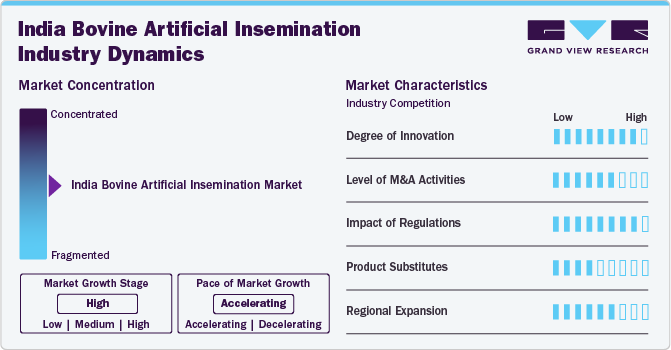
The degree of innovation in this market is estimated to be high. This can be attributed to the fact that the private as well as government players in the country are focusing on developing innovative technologies to become self-reliant in the production of sex-sorted semen. The NDDB, a subsidiary of DAHD, in 2022 developed an indigenous sex-sorting semen technology to decrease reliance on the import of sex-sorted semen. This step will also help boost the proliferation of female calves through AI and ultimately increase milk output across the country.
The moderate to high impact of mergers and acquisitions on the market can be seen owing to the increasing dominance of central government entities spreading their dominance by acquiring dairy cooperatives and other agencies across different states in the country. For example, in March 2024, NDDB completed the acquisition of Mahanand Dairy, a venture of Maharashtra State Cooperative Milk Federation Ltd.
 To learn more about this report, Download Free Sample Report
 The impact of regulations is estimated to be very high in this market. In India, various government schemes like the Rashtriya Gokul Mission and NAIP contribute to higher penetration of AI by providing structured regulatory guidelines and processes to ensure it.
The impact of product substitutes is estimated to be low to moderate. This is due to the fact that the government largely dominates and controls the country’s AI market. With comprehensive infrastructure, including semen stations across the country, regulations and guidelines, government subsidies, trained personnel like MAITRIs, and booming partnerships between the government and private sector, the impact of product substitutes is somewhat limited as farmers are opting to utilize the government benefits.
Market players in this market are fragmented across different states, with each state having its own dominant dairy cooperatives and other agencies. But, in recent years, these leading players have been expanding their business across the country. For example, in July 2023, Amul Dairy expanded into Andhra Pradesh by acquiring Chittoor Dairy by signing a MoU with the Andhra Pradesh Government,
Solution Insights
Based on solution, the services segment led the market with the largest revenue share of 42.71% in 2024. This dominance can be attributed to farmers' growing awareness of the benefits of artificial insemination and the widespread adoption of AI services due to government initiatives. In addition, increased government initiatives to increase AI services across India are contributing to segment growth. For instance, in August 2024, The Tamil Nadu Animal Husbandry Department launched nine mobile veterinary units (MVUs) for Trichy district to provide veterinary services in remote areas. These MVUs will directly address various needs, such as minor surgeries, artificial insemination, vaccinations, and emergency care, at the livestock owners' doorstep. The introduction of MVUs in Tamil Nadu will boost the demand for bovine artificial insemination services, as the units are equipped to offer this service directly to rural and remote areas. This initiative will likely drive market growth by increasing accessibility and convenience for farmers, enhancing the adoption of artificial insemination techniques, and improving livestock productivity.
The semen segment is anticipated to grow at the fastest CAGR of 9.59% over the forecast period. This segment consists of normal & sexed semen. The main driving factor for this segment is the rising use of sex-sorted semen in the country. The adoption of sex-sorted semen in the country was largely dependent on its import from other countries like Brazil. For instance, in July 2024, The Indian government imported 40,000 doses of purebred Gir bull semen from Brazil under its Genetic Improvement Programme to enhance Gir cow milk productivity, which could rise 5-8 times. Managed by NDDB with an INR 6 crore (USD 0.69 Mn) budget, the initiative aims to counter declining Gir populations and improve India’s milk output. A tender for 2.5 lakh more semen doses is also planned. In addition, the government, as well as private players, have taken the initiative to produce sex-sorted semen indigenously, with records from DAHD putting the total production by the government as well as private players in 2023-2024 at more than 8 million doses.
Animal Insights
Based on animal, the cow segment led the market with the largest revenue share of 65.29% in 2024 and is anticipated to grow at the fastest CAGR of 9.26% over the forecast period. This dominance can be mainly attributed to two factors, the population and the contribution to milk production. In addition, government policies and NGO-led breed improvement programs have focused primarily on cows to enhance dairy profitability and rural livelihoods.
For instance, in June 2024, For the first time in Puducherry, the Department of Animal Husbandry will introduce in-vitro fertilization (IVF) embryo transfer technology under the Rashtriya Gokul Mission - Accelerated Breed Improvement Program (ABIP). On July 1, 50 six-day-old embryos from high-genetic-potential Jersey and indigenous breeds will be brought from Rahuri Semen Station (NDDB) to enhance milk production and conserve native breeds. The initiative aims to produce 500 elite breed cattle in Puducherry and Karaikal, with a 100% subsidy covering the INR 16,000 (USD 183.67) farmer share per embryo. The first batch of calves is expected by April 2025. The IVF-ET (Embryo Transfer) technology is revolutionizing the cow segment by enabling 100% genetic progress within one generation.
Distribution Channel Insights
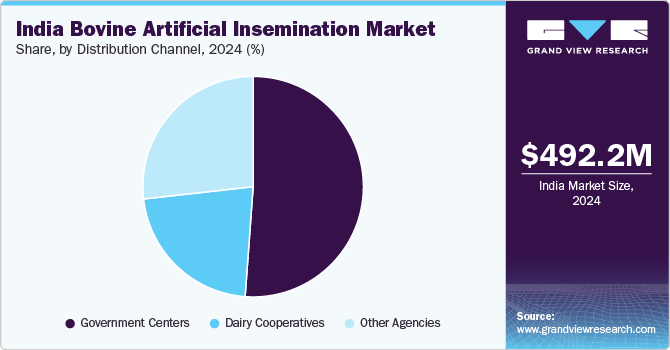
Based on distribution channel, the government centers segment led the market with the largest revenue share of 51.16% in 2024 and is anticipated to grow at the fastest CAGR of 9.48% over the forecast period. This dominance can be attributed to the widespread penetration of government AI services across the country due to benefits like subsidies and free-of-cost AI services, government semen production stations, and partnerships with the private sector to enhance the penetration of bovine AI in the country.
Similarly, growing government initiatives to increase AI coverage across India contribute to segment growth. For instance, in July 2024, The Department of Animal Husbandry & Veterinary Services (AH&VS) launched the Accelerated Breed Improvement Programme - Sex Sorted Semen (ABIP-SS) under the Rashtriya Gokul Mission in the Andaman & Nicobar Islands to improve local cattle breeds. This initiative promotes artificial insemination with superior semen, boosting milk yield from 2.5-3L to 8-10L per day. With a 90% chance of female calves, it reduces stray cattle issues and enhances dairy productivity. The ABIP-SS program in government centers is driving the market by increasing AI adoption in remote areas. The scheme, offering Jersey, Crossbreed Sahiwal, and Crossbreed Gir breeds, targets the production of 2,000 high-yield female calves by 2027, adding 700,000L of milk annually.
 To learn more about this report, Download Free Sample Report
 The revival of dairy cooperatives is fueling bovine AI adoption, enhancing breed improvement and milk productivity. For instance, in September 2024, The government strengthened the cooperative dairy model by bringing more unorganized dairy farmers under structured cooperatives, ensuring better prices and product quality. The National Dairy Development Board (NDDB) provides technical support to revive struggling state cooperatives, including those in Uttar Pradesh, Madhya Pradesh, Maharashtra, and Odisha. Recently, NDDB signed MoUs to professionalize and boost efficiency in cooperatives like Sanchi in Madhya Pradesh without diluting their brand identity.
Regional Insights
Northern Region Market Trends
The Northern Region dominated the India bovine artificial insemination market with the largest market revenue share of 42.80% in 2024. Northern India region is expanding due to technological advancements, government initiatives, rising dairy demand, and improved breeding programs. Several states, including Haryana, Rajasthan, and Madhya Pradesh, are aggressively promoting AI-based breeding to boost milk production and support the dairy economy.
For instance, in July 2024, JK Trust, in partnership with JK Cement, is implementing the Cattle Breed Improvement Program in Rajasthan, Madhya Pradesh, and Haryana through 70 Integrated Livestock Development Centres. A primary assessment survey was conducted to evaluate the project's performance and explore expansion opportunities. So far, the initiative has resulted in the birth of over 65,000 improved breed calves via doorstep artificial insemination services. This has led to higher milk production, increased farmer income, and better livestock management. This initiative will expand AI accessibility, enhance cattle genetics, and boost dairy productivity in northern India.
Southern Region Market Trends
The bovine artificial insemination market in Southern Region is influenced by several key factors, such as a focus on genetic improvement, training and deployment of AI technicians, and government initiatives and support. In addition, the adoption of Sex-Sorted Semen Technology in the region is one of the key factors responsible for market growth. For instance, according to an article published by TELANGANA PUBLICATIONS PVT. LTD, in March 2025, Representatives from the National Bank for Agriculture and Rural Development (NABARD) were pleased with the Karimnagar Dairy's use of sex-sorted semen in the artificial insemination initiative, which aims to boost milk output by allowing female calves to be born under control. It ought to be noticed that NABARD is funding the experiment. Each dose of sex-sorted semen costs INR 900 (USD 10.34), of which INR 450 (USD 5.17) is provided by NABARD and INR 450 (USD 5.17) is provided by Karimnagar Dairy. About 1,200 animals have undergone artificial insemination thus far, and with good results, 70 female calves have been born.
Key India Bovine Artificial Insemination Company Insights
When it comes to market competition in the country, the industry is largely dominated by government entities like semen stations, dairy cooperatives, and government AI centers. This dominance is expected to continue in the future due to the benefits offered by them. When it comes to private players, these players are expanding in the country's market by gaining distributors for their products and partnering with government entities.
Key India Bovine Artificial Insemination Companies:
- National Dairy Development Board (NDDB)
- Genus plc
- Alta Genetics Inc.
- Xcell Breeding & Livestock Services Pvt Ltd
- Accuvance India
- Inguran Sorting Technologies LLP (Stgenetics)
- VikingGenetics
- Verka (MilkFed)
- IMV Technologies
- MINITÜB GMBH
- Paayas Milk Producer Company Ltd.
- Amul Dairy
- Maahi Milk Producer Company Ltd.
Three ways to get this report
Buy it, customize it, or ask a question.Ask an Analyst
Analyst response in 1 business day
- AccessReport author, directly
- Reply timeWithin 1 working day
- No sales callDirect answer only
- FormatEmail reply
- CostFree, no cost
Get the Full Report
What the study covers
- FormatsPDF · Excel · Dashboard
- Timeline2025–2030 annual, 2024 base
- Coverage20+ countries, 5 regions
- Companies10+ key players profiled
Customize the Report
20% free customization
- IncludeCountries, segments, points
- TailorTo your product definition
- ExtendDeeper competitor detail
- OrA fully bespoke study
- Turnaround5–10 working days
Recent Developments
-
In March 2025, The Rajasthan government launched a sex-sorted semen scheme to increase female calf births to 90%, ensuring a steady population of high-yielding cows. The state has procured 1 lakh doses of sex-sorted semen to be produced within Rajasthan in collaboration with NDDB.
-
In January 2025, The Buffalo Breeding Centre in Tegur, Dharwad, is Karnataka’s sole he-buffalo semen production facility, supplying processed semen straws to veterinary institutions and artificial insemination (AI) centers statewide.
-
In June 2024, according to a publication by Indian Express, Amul and Verka, leading milk brands from Gujarat & Punjab, respectively, are actively investing in expanding into newer states to spread their business dominance.
-
In June 2024, the authorities from Puducherry announced plans to launch IVF technology with an aim to boost milk production.
-
In May 2024, NDDB announced that novel and indigenous sex-sorting technology will be available throughout the country in the near future.
-
In January 2024, the NDDB signed an MoU with the Odisha government for the construction of a new GMP facility to boost the production of different veterinary products like medicines and vaccines.
-
In February 2024, AltaGenetics exported over 40,000 semen doses of Gir to India to boost the country's milk production.
India Bovine Artificial Insemination Market Report Scope
Report Attribute
Details
Market size value in 2025
USD 515.25 million
Revenue forecast in 2030
USD 789.57 million
Growth rate
CAGR of 8.91% from 2025 to 2030
Base year for estimation
2024
Historical data
2018 - 2023
Forecast period
2025 - 2030
Quantitative units
Revenue in USD million/billion and CAGR from 2025 to 2030
Report coverage
Revenue forecast, company ranking, competitive landscape, growth factors, and trends
Segments covered
Solutions, animal, distribution channel, region
Country scope
India
Regional scope
Eastern Region; Southern Region; Western Region; & Northern Region
Key companies profiled
National Dairy Development Board (NDDB); Genus plc; Alta Genetics Inc.; Xcell Breeding & Livestock Services Pvt Ltd; Accuvance India; Inguran Sorting Technologies LLP (Stgenetics); VikingGenetics; Verka (MilkFed); IMV Technologies; MINITÜB GMBH; Paayas Milk Producer Company Ltd.; Amul Dairy; & Maahi Milk Producer Company Ltd.
Customization scope
Free report customization (equivalent up to 8 analysts working days) with purchase. Addition or alteration to country, regional & segment scope.
Pricing and purchase options
Avail customized purchase options to meet your exact research needs. Explore purchase options
India Bovine Artificial Insemination Market Report Segmentation
This report forecasts revenue growth at a country level and provides an analysis of the latest industry trends in each of the sub-segments from 2018 to 2030. For this study, Grand View Research has segmented the India bovine artificial insemination market report based on solutions, animal, distribution channel, and region.
-
Solution Outlook (Revenue, USD Million, 2018 - 2030)
-
Equipment & Consumables
-
Semen
-
Normal (Conventional) Semen
-
Sexed Semen
-
-
Services
-
-
Animal Outlook (Revenue, USD Million, 2018 - 2030)
-
Cow
-
Buffalo
-
-
Distribution Channel Outlook (Revenue, USD Million, 2018 - 2030)
-
Government Centers
-
Dairy Cooperatives
-
Other Agencies
-
-
Region Outlook (Revenue, USD Million, 2018 - 2030)
-
Eastern Region
-
West Bengal
-
Bihar
-
Jharkhand
-
Odisha
-
Other States
-
-
Southern Region
-
Tamil Nadu
-
Kerala
-
Telangana
-
Andhra Pradesh
-
Karnataka
-
-
Western Region
-
Maharashtra
-
Gujarat
-
Other States
-
-
Northern Region
-
Haryana
-
Rajasthan
-
Punjab
-
Himachal Pradesh
-
Uttar Pradesh
-
Uttarakhand
-
Madhya Pradesh
-
Chhattisgarh
-
Other States
-
-
Frequently Asked Questions About This Report
Some key players operating in the India bovine artificial insemination market include National Dairy Development Board (NDDB), Genus plc, Alta Genetics Inc., Xcell Breeding & Livestock Services Pvt Ltd, Accuvance India, Inguran Sorting Technologies LLP (Stgenetics), VikingGenetics, Verka (MilkFed), IMV Technologies, MINITÜB GMBH, Paayas Milk Producer Company Ltd., Amul Dairy, & Maahi Milk Producer Company Ltd.
Key factors expected to drive the market include ongoing government initiatives for increasing artificial insemination practices in the country, rising government focus on boosting milk production of the country, emerging efforts from the authorities to structurize the dairy sector, increasing technological advancements.
The India bovine AI market size was estimated at USD 492.22 million in 2024 and is expected to reach USD 515.25 million in 2025.
The India bovine artificial insemination market is expected to grow at a compound annual growth rate of 8.91% from 2025 to 2030 to reach USD 789.57 million by 2030.
By solutions, the services segment accounted for the largest revenue share of 42.72% in 2024. This dominance can be attributed to farmers' growing awareness of the benefits of artificial insemination and the widespread adoption of AI services as a result of government initiatives.
About the Author(s)
Animal Health Research Team
Healthcare · Animal HealthThis report was authored by the animal health research team at Grand View Research - comprising two research analysts, one senior research analyst, and one industry expert - with specialized expertise in the animal health segment of the healthcare industry. All findings are based on proprietary healthcare databases, executive interviews, and regulatory analysis, subject to internal peer review prior to publication.
Last Updated:
Speak to Analyst

Customize this report to your needs - add regions, segments, or data points, with 20% free customization.
Or view our licence options:


ISO 9001:2015 & 27001:2022 Certified
We are GDPR and CCPA compliant! Your transaction & personal information is safe and secure. For more details, please read our privacy policy.


