
- Home
- »
- Next Generation Technologies
- »
-
India Industrial Vibration Equipment Market Size Report 2033GVR Report cover

India Industrial Vibration Equipment Market (2026 - 2033)
Size, Share, & Trends Analysis Report By Product Type (Pneumatic Vibrators, Electric Vibrators), By Application, By End Use Industry (Food & Beverage Processing, Automotive), By Region, And Segment Forecasts
Market Size, 2025
$69.8MMarket Estimate, 2026
$72.1MMarket Forecast, 2033
$99.4MCAGR, 2026–2033
4.7%India Industrial Vibration Equipment Market Summary
The India industrial vibration equipment market size was valued at USD 69.8 million in 2025 and is projected to grow from USD 72.1 million in 2026 to USD 99.4 million by 2033, at a CAGR of 4.7% from 2026 to 2033. Market growth is primarily driven by the -handling processes, rising demand for efficient bulk-material flow and processing, and the adoption of vibration equipment across industries such as food and beverage, automotive, chemicals, pharmaceuticals, mining, and construction. Moreover, the growing emphasis on operational efficiency and resource optimization is expected to accelerate the adoption of advanced vibration equipment across Indian industries.
Key Market Trends & Insights
- By product type: Electric vibrators segment held the largest market share of 42.6% in 2025.
- By application: Material handling & flow assistance segment held the largest market revenue share of 20.9% in 2025.
- By end use industry: Construction & building materials (including cement) segment led the market with the largest revenue share of 22.1% in 2025.
Market Size & Forecasts
- Market size in 2025: USD 69.8 Million
- Estimated market size in 2026: USD 72.1 Million
- Projected market size by 2033: USD 99.4 Million
- CAGR (2026-2033): 4.7%
Prism AI by Grand View Research Free to tryAsk a question about the india industrial vibration equipment marketTry asking✓Every figure cited from GVR research Prefer the report? Download free sample →The manufacturing and process industries remain key drivers of the Indian industrial vibration equipment industry, supported by expanding industrial automation, capacity additions, and modernization of production facilities. Automotive, metals, cement, chemicals, pharmaceuticals, food processing, and general manufacturing facilities increasingly rely on vibration monitoring to identify bearing wear, shaft misalignment, imbalance, looseness, and other mechanical abnormalities before equipment failure occurs.
Additionally, the increasing deployment of automated production lines, motors, pumps, compressors, conveyors, and machine tools is expanding the number of assets that require continuous condition assessment. Procurement strategies increasingly emphasize equipment uptime, maintenance cost reduction, measurement accuracy, remote monitoring, and integration with plant maintenance systems to improve overall operational efficiency.
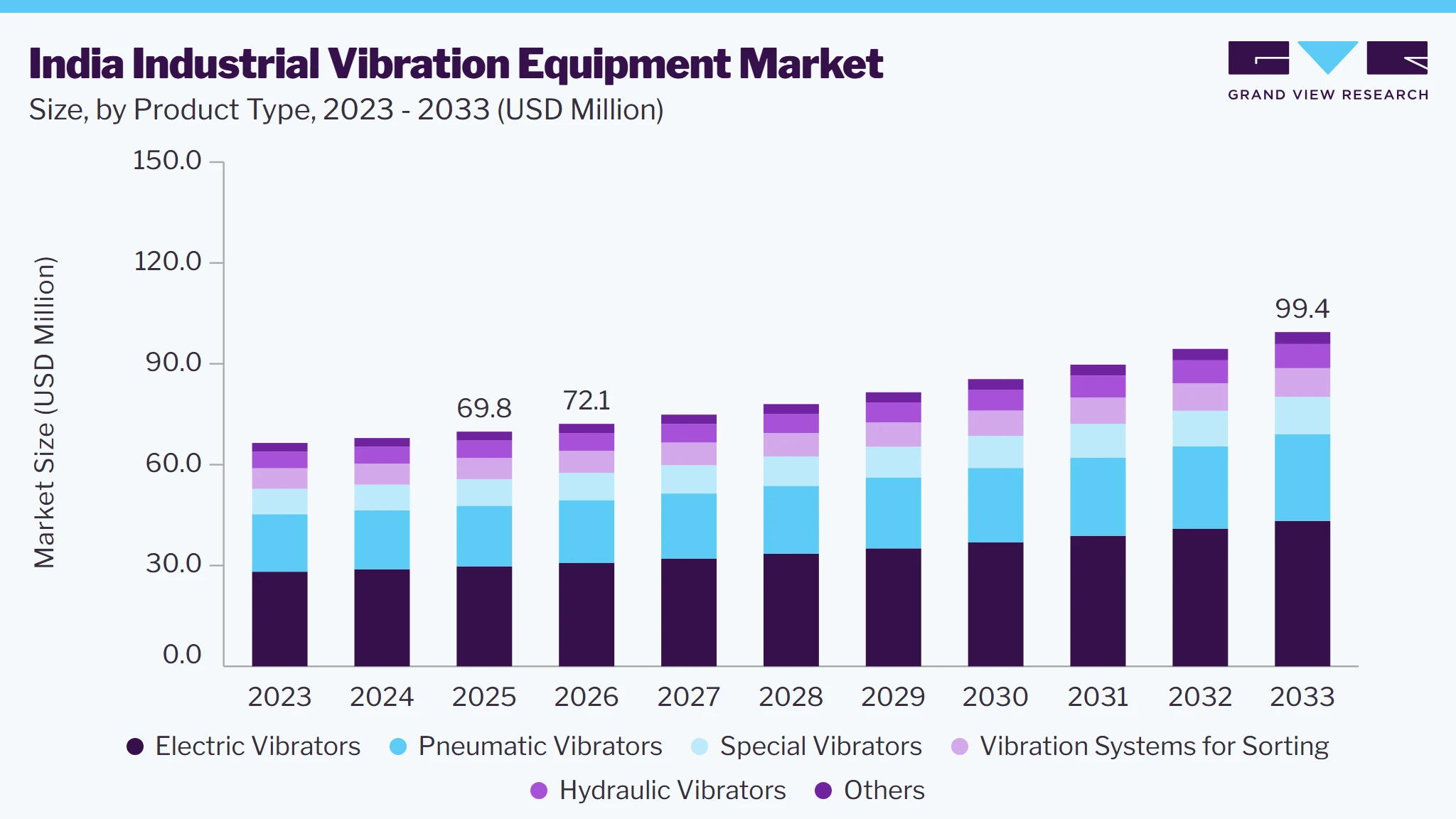 Source: Grand View Research, IR Documents, Primary Interviews, Paid DatabasesTo learn more about this report,
 Download Free Sample Report
Furthermore, increasing adoption of predictive and condition-based maintenance is strengthening demand for industrial vibration equipment industry across India’s power generation, oil & gas, metals & mining, cement, and other heavy industries. These sectors operate large fleets of critical rotating equipment where unexpected failures can result in production interruptions, maintenance expenses, and asset damage. The growing focus on extending equipment life, reducing unplanned downtime, improving plant availability, and optimizing maintenance schedules is encouraging industries to transition from periodic manual inspections to portable and permanently installed vibration monitoring solutions.
Moreover, technological advancements are further enhancing the capabilities and accessibility of industrial vibration equipment industry across India. Integration of IoT connectivity, edge computing, cloud platforms, and AI-based analytics supports real-time collection and interpretation of vibration data, enabling automated fault identification and predictive maintenance. The increasing adoption of Industry 4.0 and smart manufacturing practices is encouraging integration of vibration data with broader asset-performance and plant-monitoring platforms, supporting the continued evolution of the India industrial vibration equipment industry.
Market Dynamics
The India industrial vibration equipment market represents an increasingly technology-driven ecosystem supported by growing emphasis on machinery reliability, condition monitoring, and preventive maintenance across asset-intensive industries. Industrial vibration equipment is widely used to measure, analyze, and monitor vibration generated by motors, pumps, turbines, compressors, gearboxes, bearings, and other rotating machinery. The integration of wireless sensors, IoT connectivity, cloud-based monitoring, and advanced analytics is further improving real-time equipment diagnostics, early fault detection, and maintenance planning, thereby strengthening the role of vibration equipment across Indian industrial facilities.
Increasing investments in cement production, mining, food processing, chemicals, pharmaceuticals, automotive manufacturing, and metal processing are creating demand for industrial vibration equipment used to improve material flow and processing efficiency. Electric and pneumatic vibrators are widely deployed in hoppers, silos, chutes, conveyors, and vibrating screens to prevent material blockages, facilitate controlled discharge, and maintain uninterrupted production operations. Additionally, the expansion of industrial facilities and adoption of automated production lines are encouraging manufacturers to invest in reliable vibration solutions for feeding, dosing, screening, separation, and bulk material handling applications.
The increasing adoption of connected vibration monitoring is creating integration challenges for equipment manufacturers, system integrators, and industrial end users in India. Combining vibration sensors, data collectors, monitoring devices, and existing plant infrastructure requires compatibility across different equipment architectures. Differences in sensor interfaces, communication protocols, machinery configurations, measurement ranges, and legacy systems can complicate installation and commissioning. Industrial facilities, therefore, require specialized condition-monitoring expertise, appropriate sensor placement, accurate calibration, and closer coordination between equipment vendors and maintenance teams to ensure reliable vibration measurement and effective machinery fault detection.
The increasing investment in railways, metro networks, freight corridors, highways, and associated transport infrastructure is creating opportunities for industrial vibration equipment suppliers in India. Rail and metro projects require vibration measurement and monitoring for rolling stock, traction motors, bearings, wheelsets, gearboxes, track systems, bridges, and other infrastructure exposed to dynamic loads. Construction activities associated with large transport projects increase demand for vibration-based equipment used in concrete compaction and construction processes. This creates opportunities for suppliers offering vibration sensors, monitoring instruments, testing systems, and industrial vibratory equipment across project construction, commissioning, and operational maintenance applications
Market Concentration & Characteristics
The India industrial vibration equipment market is moderately fragmented, with domestic and international manufacturers competing through product quality, pricing, technological advancements, and customization capabilities. Competition is driven by developments in electric, pneumatic, and hydraulic vibrators, while distribution partnerships and product portfolio expansions support market presence. Regulatory requirements primarily relate to industrial equipment safety, electrical standards, and workplace safety.
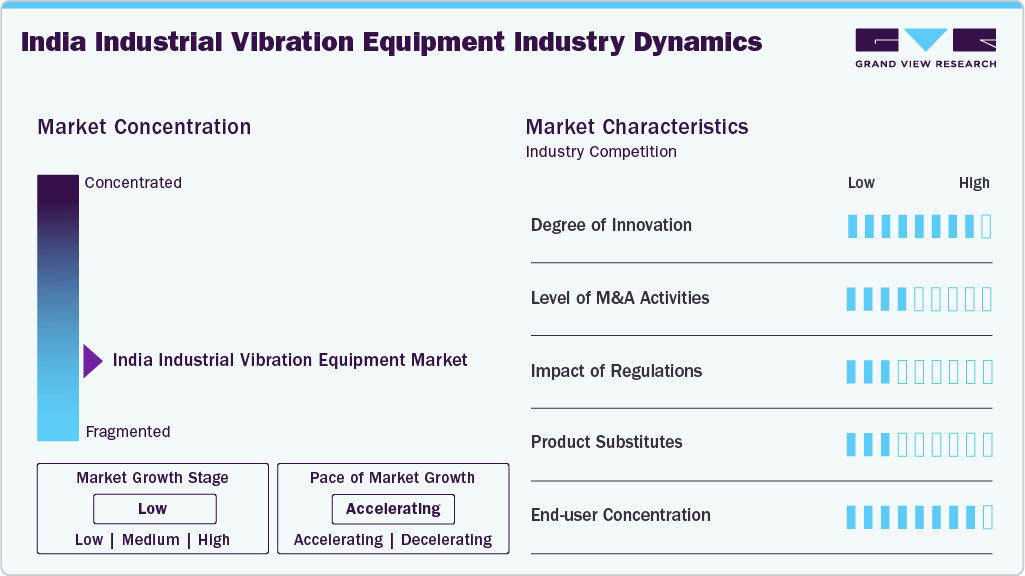 To learn more about this report, Download Free Sample Report
Conventional material handling solutions, air cannons, and mechanical agitators serve as substitutes in certain applications. However, industrial vibrators offer advantages in maintaining material flow, preventing blockages, and improving operational efficiency. Demand is driven by construction and cement, mining, food processing, chemicals, pharmaceuticals, and automotive industries, while high equipment costs, maintenance requirements, and application-specific installation needs remain key adoption barriers.
Analyst Perspective
The market is influenced by the increasing need to manage diverse bulk materials, including cement, coal, minerals, fertilizers, grains, and chemical powders across industrial processing facilities. Equipment demand varies according to material density, moisture content, particle size, operating temperature, and required vibration intensity, encouraging manufacturers to offer application-specific solutions. The market also exhibits demand for customized vibrators compatible with existing hoppers, silos, vibrating screens, and conveyor systems, particularly across cement plants, foundries, and mining operations. Additionally, the availability of locally manufactured equipment and replacement components supports aftermarket demand, while the need for specialized designs for high-temperature, corrosive, and heavy-duty operating environments creates opportunities for product differentiation.
Product Type Insights
Electric vibrators segment dominated the market with a share of 42.6% in 2025. Segmental growth is driven by the widespread use of electric vibrators across industrial applications, and their consistent vibration output, operational reliability, and suitability for continuous-duty operations. Their ability to handle high loads, provide precise vibration control, and support automated material processing makes them suitable for applications across construction, mining, food processing, chemicals, and material handling industries. Additionally, advancements in energy-efficient motors and variable frequency control are supporting their adoption across industrial facilities.
Pneumatic vibratorsis expected to grow at a significant CAGR from 2026 to 2033, propelled by increasing demand for efficient material flow solutions in industries handling bulk solids, powders, and granular materials. Pneumatic vibrators are widely used in hazardous and explosive environments, where compressed-air operation eliminates electrical ignition risks. Their compact design, low maintenance requirements, and suitability for applications involving hoppers, silos, chutes, and conveyors are supporting adoption across food processing, pharmaceuticals, chemicals, and mining industries.
Application Insights
Material handling & flow segment dominated the market with a revenue share of 20.9% in 2025. Segmental growth is driven by the widespread use of industrial vibrators to prevent material blockages, eliminate bridging and rat-holing, and maintain consistent material discharge from storage and processing equipment. Industries such as cement, mining, chemicals, food processing, and construction rely on vibration systems to improve the movement of bulk materials through hoppers, silos, conveyors, and chutes. Increasing automation of material handling operations and the need to minimize production downtime are further supporting demand.
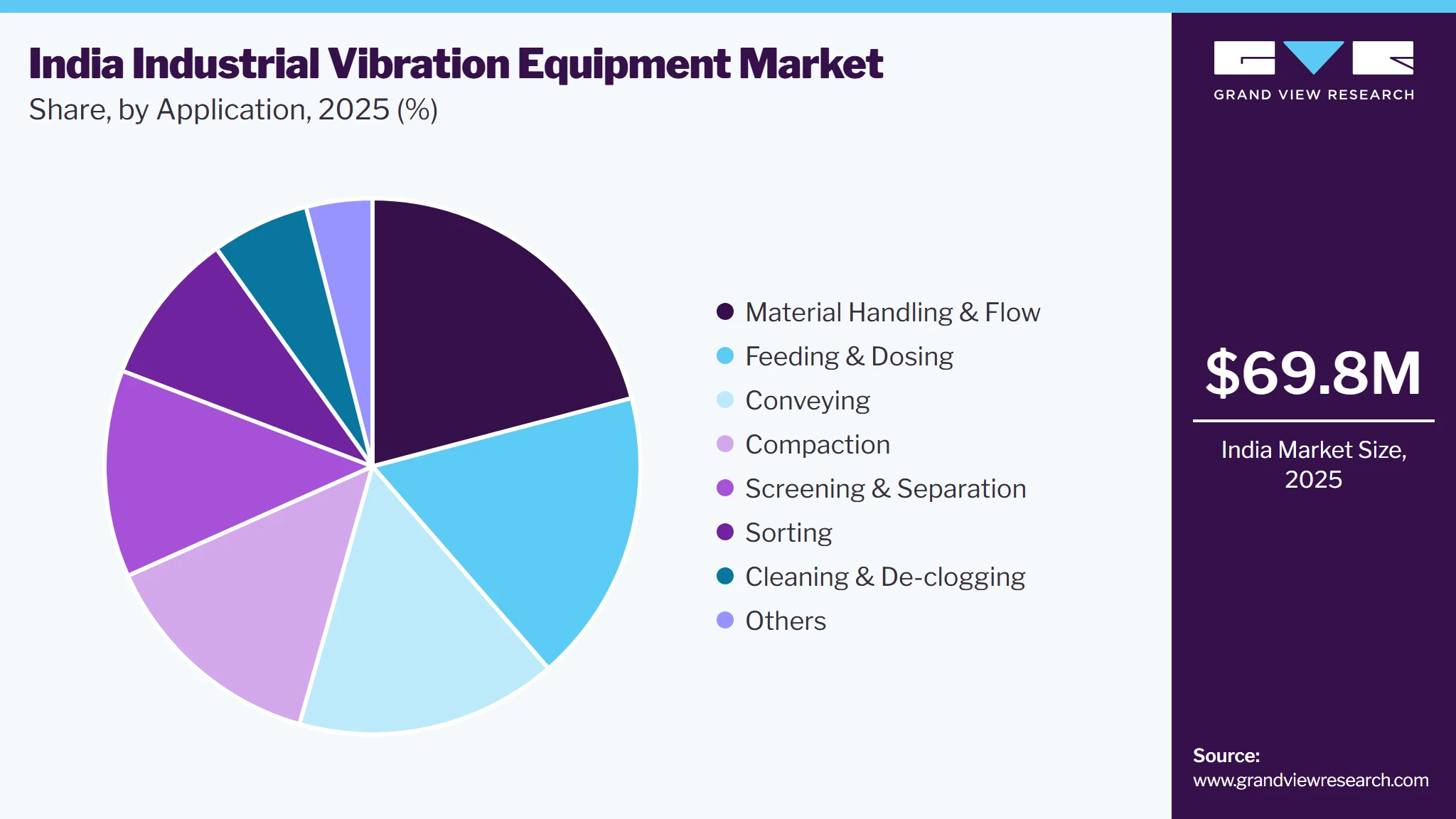 To learn more about this report, Download Free Sample Report
Feeding & dosing segment is expected to grow at a significant CAGR from 2026 to 2033. Segmental growth is driven by increasing demand for accurate, consistent, and controlled material feeding across automated manufacturing and processing operations. Vibratory feeders and dosing systems enable controlled movement and metering of powders, granules, and small components, supporting production accuracy and reducing material wastage. Rising automation across food processing, pharmaceuticals, chemicals, and packaging industries, along with the need for consistent product quality and higher production throughput, is supporting the adoption of vibration-based feeding and dosing equipment.
End Use Industry Insights
The construction & building materials (including cement) segment held the largest market share of 22.1% in 2025, fueled by extensive use of industrial vibrators across cement production, concrete processing, precast manufacturing, and construction material handling operations. Vibrators support material flow through silos, hoppers, and chutes, while concrete vibrators help remove trapped air pockets, improve compaction, and enhance the structural quality of concrete. Expanding infrastructure development, residential and commercial construction, and investments in cement manufacturing capacity are sustaining demand for industrial vibration equipment.
The mining & minerals segment is expected to grow at a significant CAGR from 2026 to 2033. Segmental growth is driven by increasing demand for efficient bulk material handling and processing solutions across mining, mineral extraction, and beneficiation operations. Industrial vibrators support the movement, screening, separation, and discharge of heavy materials such as ores, aggregates, and mineral concentrates through feeders, screens, hoppers, and conveyors. Rising mineral extraction activities, investments in mining infrastructure, and the adoption of automated material handling systems are supporting demand for durable vibration equipment capable of operating under harsh conditions.
Key India Industrial Vibration Equipment Company Insights
Mature players operating in the India industrial vibration equipment market include OLI Vibrators S.p.A.; and Martin Engineering Company, among others.
-
OLIVibrators S.p.A. is an Italian industrial vibration technology company that provides industrial electric and pneumatic vibrators, flow-aid equipment, and concrete-consolidation solutions for material handling, construction, and industrial applications. The company has a dedicated India subsidiary OLI Vibrators India Pvt. Ltd. established in 2016.
-
Martin Engineering Company is a U.S. bulk-material handling technology company that provides conveyor-belt cleaning, material-flow solutions, vibrators, air cannons, and related equipment for improving material movement and reducing blockages in industrial facilities. Its vibration solutions are used for flow promotion and material handling. Martin Engineering Company India Pvt. Ltd., established in Pune in 2011, serves the Indian market through sales, engineering, service and technical support.
Emerging players operating in the India industrial vibration equipment market include Greaves Cotton Limited and, Cosben Engineering Private Limited among others.
-
Greaves Cotton Limited is an Indian engineering and construction equipment company with a portfolio covering construction equipment, engines, and related machinery. Its construction equipment offerings include vibratory compactors and other equipment used in road construction, infrastructure development, soil compaction, and building activities.
-
Cosben Engineering Private Limited is an Indian engineering company providing bulk-material handling and processing equipment. Its product portfolio includes electric vibrators, bin aerators, vibratory equipment, silo accessories, feeders, conveyors, and dust-collection systems designed to support material storage, discharge, transfer, flow control, and processing operations.
Key India Industrial Vibration Equipment Companies
-
AViTEQ Vibrationstechnik
-
BRECON Vibrationstechnik
-
Cosben Engineering Private Limited
-
Elektromag Methods
-
Findeva AG
-
Friedrich Schwingtechnik
-
Greaves Cotton Limited
-
Italvibras
-
Killick Nixon Limited
-
Martin Engineering Company
-
OLI Vibrators S.p.A.
-
Saideep Vibrators Pvt. Ltd.
-
Sinex Primemovers
-
Singold
-
The Cleveland Vibrator Company
-
VIBCO, Inc.
-
VIBRA Maschinenfabrik Schultheis
-
WAMGROUP S.p.A.
-
WEBAC Vibrator
-
Würges
Competitive Benchmarking
Operating Strategies
Competitive Edge
Weaknesses
Mature Players: OLI Vibrators S.p.A., Martin Engineering Company, Italvibras, AViTEQ Vibrationstechnik, WAMGROUP S.p.A., and Saideep Vibrators.
- Mature players operate dedicated manufacturing plants and assembly units across major industrial across India.
- Mature suppliers maintain broad product lines covering heavy-duty electric rotary vibrators, vibrating screens, concrete poker units, and bin activators.
- Their competitive edge lies in established brand equity, deep local infrastructure, and extensive distribution networks.
- They maintain pan-India dealer networks, localized spare-part inventories, and field service teams capable of offering quick site maintenance, minimizing costly plant downtime for heavy industrial customers.
- Mature players face challenges such as slower adoption of Industry 4.0 technologies, and high operational overheads associated with maintaining legacy manufacturing facilities.
- Traditional cost structures and higher operational overhead make mature players vulnerable to aggressive price competition from lean, emerging local manufacturers.
Emerging Players: Greaves Cotton Limited, Cosben Engineering Private Limited, Sinex Primemovers, WEBAC Vibrator, Friedrich Schwingtechnik, BRECON Vibrationstechnik, and Singold.
- Emerging players focus on direct technical engagement with machinery builders, system integrators, and local EPC contractors to secure custom equipment contracts.
- They adopt lean manufacturing practices, digital-first direct sales channels, and highly flexible pricing models to bypass traditional distribution overheads and win price-sensitive regional projects
- Their competitive edge lies in flexible customization, aggressive pricing, and high operational responsiveness to customer requirements.
- They offer highly competitive pricing structures and flexible lead times to attract price-sensitive clients.
- Emerging players face challenges such as limited brand recognition in mega-projects, capital constraints for R&D expansion, and narrower pan-India service networks.
- They also face difficulties in securing long-term supply contracts with conservative tier-1 state-owned enterprises.
Recent Developments
-
In September 2026, WAMGROUP S.p.A. (WAM India) partnered with environmental technology stakeholders at IFAT India 2026 in Mumbai to deliver specialized bulk solids handling and industrial vibration technology.
-
In July 2026, Italvibras released the VBR variable-phase electric vibrator and VE electromagnetic vibrators for precision industrial dosing applications.
-
In May 2026, Martin Engineering Company completed its strategic acquisition of ConveyorTech (CVT), partnering with local Indian operations to integrate non-urethane belt cleaners and tungsten-blade designs directly into its Pune manufacturing and distribution network.
India Industrial Vibration Equipment Market Report Scope
Report Attribute
Details
Market size in 2025
USD 69.8 million
Estimated market size in 2026
USD 72.1 million
Projected market size by 2033
USD 99.4 million
Growth rate
CAGR of 4.7% from 2026 to 2033
Actual data
2021 - 2025
Forecast period
2026 - 2033
Quantitative units
Revenue in USD Million and CAGR from 2026 to 2033
Report coverage
Revenue forecast, company share, competitive landscape, growth factors, and trends
Segments covered
Product type, application, end use industry
Key companies profiled
AViTEQ Vibrationstechnik; BRECON Vibrationstechnik; Cosben Engineering Private Limited; Elektromag Methods; Findeva AG; Friedrich Schwingtechnik; Greaves Cotton Limited; Italvibras; Killick Nixon Limited; Martin Engineering Company; OLI Vibrators S.p.A.; Saideep Vibrators Pvt. Ltd.; Sinex Primemovers; Singold; The Cleveland Vibrator Company; VIBCO, Inc.; VIBRA Maschinenfabrik Schultheis; WAMGROUP S.p.A.; WEBAC Vibrator; Würges
Customization scope
Free report customization (equivalent to up to 8 analyst working days) with purchase. Addition or alteration to country, regional & segment scope.
Pricing and purchase options
Avail customized purchase options to meet your exact research needs. Explore purchase options
India Industrial Vibration Equipment Market Report Segmentation
This report forecasts revenue growth at global, regional, and country levels and provides an analysis of the latest industry trends in each of the sub-segments from 2021 to 2033. For this study, Grand View Research has segmented the India industrial vibration equipment market report based on product type, application, and end use industry.
-
Product Type Outlook (Revenue, USD Million, 2021 - 2033)
-
Pneumatic Vibrators
-
Electric Vibrators
-
Hydraulic Vibrators
-
Special Vibrators
-
Vibration Systems for Sorting
-
Others
-
-
Application Outlook (Revenue, USD Million, 2021 - 2033)
-
Material Handling & Flow Assistance
-
Feeding & Dosing
-
Conveying
-
Sorting
-
Screening & Separation
-
Compaction
-
Cleaning & De-clogging
-
Others
-
-
End Use Industry Outlook (Revenue, USD Million, 2021 - 2033)
-
Food & Beverage Processing
-
Automotive
-
Chemicals
-
Pharmaceuticals
-
Mining & Minerals
-
Construction & Building Materials (Including Cement)
-
Metals & Foundry
-
Packaging
-
Agriculture & Bulk Materials
-
Others
-
Segment Definition
Product Type
Revenue Capture Definition
Pneumatic Vibrators
Revenue is generated through the sale of pneumatic vibrators that use compressed air to generate vibratory force for facilitating material movement, preventing blockages, and ensuring consistent material discharge across industrial applications.
Electric Vibrators
Revenue is generated through the sale of electric vibrators powered by electric motors to generate controlled vibrations for material handling, feeding, screening, compaction, and other industrial processing applications.
Hydraulic Vibrators
Revenue is generated through the sale of hydraulic vibrators that use pressurized hydraulic fluid to generate high-force vibrations for heavy-duty industrial applications, including mining, construction, and bulk material handling.
Special Vibrators
Revenue is generated through the sale of specialized vibration equipment designed for specific industrial requirements, including customized vibration frequencies, force outputs, operating conditions, and application-specific material processing needs.
Vibration Systems for Sorting
Revenue is generated through the sale of integrated vibration-based sorting systems that use controlled vibrations to separate, classify, and distribute materials based on their size, shape, weight, or other physical characteristics.
Others
Revenue is generated through the sale of other industrial vibration equipment and specialized vibratory devices that do not fall under the above product categories.
Application
Revenue Capture Definition
Material Handling & Flow Assistance
Revenue is generated through the sale of industrial vibrators used in hoppers, silos, bins, and chutes to facilitate bulk material movement, prevent bridging and material buildup, and maintain consistent material discharge.
Feeding & Dosing
Revenue is generated through the sale of vibratory feeders and dosing equipment that regulate the controlled delivery and metering of powders, granules, and solid materials into production and processing systems.
Conveying
Revenue is generated through the sale of vibratory conveyors and associated vibration equipment that transport bulk materials, components, and finished products across different stages of industrial production and processing operations.
Sorting
Revenue is generated through the sale of vibration-based sorting equipment that separates and classifies materials according to their physical characteristics, including size, shape, and weight, across recycling, food processing, and manufacturing applications.
Screening & Separation
Revenue is generated through the sale of vibratory screening machines and separation systems that classify materials into different size fractions and separate unwanted particles, contaminants, and oversized materials across industrial processing operations.
Compaction
Revenue is generated through the sale of vibrators and vibration equipment used to compact concrete, powders, aggregates, and other materials by removing trapped air and reducing void spaces to achieve greater density and material stability.
Cleaning & De-clogging
Revenue is generated through the sale of industrial vibrators and vibration-based cleaning equipment used to remove accumulated materials, prevent clogging, and clear blockages from filters, screens, pipes, hoppers, and other processing equipment.
Others
Revenue is generated through the sale of vibration equipment used in other industrial applications, including surface finishing, testing, polishing, and specialized material processing operations.
End Use Industry
Revenue Capture Definition
Food & Beverage Processing
Revenue is generated through the sale of industrial vibrators, vibratory feeders, conveyors, and screening systems used for handling, sorting, dosing, grading, and processing food ingredients and beverage-related materials.
Automotive
Revenue is generated through the sale of vibration equipment used in automotive manufacturing operations, including component feeding, parts handling, surface finishing, casting, assembly line operations, and material processing.
Chemicals
Revenue is generated through the sale of industrial vibrators and vibration systems used for handling, conveying, feeding, screening, and discharging chemical powders, granules, and other bulk materials during chemical manufacturing processes.
Pharmaceuticals
Revenue is generated through the sale of specialized vibration equipment used for handling, sieving, screening, feeding, dosing, and processing pharmaceutical powders, granules, and ingredients while supporting controlled production environments.
Mining & Minerals
Revenue is generated through the sale of heavy-duty industrial vibrators, vibratory feeders, screens, and conveying systems used for ore handling, mineral separation, screening, and transportation across mining and mineral processing operations.
Construction & Building Materials (Including Cement)
Revenue is generated through the sale of industrial vibrators and vibration systems used in cement manufacturing, concrete compaction, aggregate screening, bulk material discharge, and handling of construction materials.
Metals & Foundry
Revenue is generated through the sale of industrial vibrators and specialized vibration equipment used in metal casting, mould compaction, sand reclamation, casting shakeout, material separation, and foundry processing operations.
Packaging
Revenue is generated through the sale of vibratory feeders, sorting systems, and conveying equipment used for product orientation, controlled feeding, counting, filling, and movement of products across automated packaging lines.
Agriculture & Bulk Materials
Revenue is generated through the sale of industrial vibrators and vibration systems used for handling, conveying, screening, sorting, and discharging agricultural commodities, grains, seeds, fertilizers, and other bulk materials.
Others
Revenue is generated through the sale of industrial vibration equipment used across other end-use industries, including textiles, paper and pulp, recycling, and general manufacturing, for material handling and specialized processing requirements.
Estimation Model
Layer
Key Questions
Description
End-User Adoption Layer
Who are the potential adopters?
Identifies construction and cement manufacturers, mining companies, food and beverage processors, automotive manufacturers, pharmaceutical companies, chemical manufacturers, metals and foundry operators, and agricultural processing companies adopting industrial vibration equipment for material handling, feeding, conveying, screening, separation, compaction, and de-clogging applications.
Industrial Vibration Equipment Manufacturers Layer
Who manufactures industrial vibration equipment?
Evaluates manufacturers developing electric vibrators, pneumatic vibrators, hydraulic vibrators, special vibrators, vibration systems for sorting, and customized vibration solutions. These companies focus on vibration force, frequency control, energy efficiency, equipment durability, and application-specific performance to meet industrial processing requirements.
Distribution & Sales Channel Layer
How does industrial vibration equipment reach end users?
Examines direct manufacturer sales, authorized distributors, industrial equipment dealers, engineering contractors, system integrators, and industrial machinery suppliers that provide vibration equipment, installation, commissioning, maintenance, and technical support to industrial customers across India.
Application & Deployment Layer
Where and how is industrial vibration equipment used?
Examines equipment deployment across material handling and flow assistance, feeding and dosing, conveying, sorting, screening and separation, compaction, and cleaning and de-clogging. Industrial vibrators are installed in hoppers, silos, conveyors, feeders, vibrating screens, concrete structures, and processing machinery to improve material movement and production efficiency.
Delivered Customizations
This report has been delivered with the following In-depth customizations
Client Request
Customization Delivered
Value Adds
Market Sizing, Segmentation & Growth Opportunity Assessment
Assessed the India Industrial Vibration Equipment Market size, historical trends, forecast growth outlook, and segmentation by product type, application, and end-use industry. The analysis covered pneumatic vibrators, electric vibrators, hydraulic vibrators, special vibrators, vibration systems for sorting, and other equipment. Applications included material handling and flow assistance, feeding and dosing, conveying, sorting, screening and separation, compaction, and cleaning and de-clogging across food and beverage processing, automotive, chemicals, pharmaceuticals, mining and minerals, construction and building materials, metals and foundry, packaging, and agriculture.
Enables industrial vibration equipment manufacturers, machinery suppliers, distributors, and investors to identify high-growth product categories, prioritize application-specific product development, evaluate end-use demand, and capture opportunities arising from industrial automation, bulk material handling requirements, infrastructure development, and manufacturing expansion in India.
Regional Market Demand & Growth Opportunity Assessment
Assessed demand across India, considering the concentration of cement plants, mining operations, automotive manufacturing hubs, food processing facilities, pharmaceutical clusters, chemical industries, and metal processing units. The analysis examined regional industrial activity, manufacturing investments, infrastructure development, and demand for efficient material handling and processing equipment.
Provides insights into regional demand patterns, geographic growth opportunities, and market-entry priorities, enabling manufacturers and distributors to identify high-potential industrial clusters, strengthen distribution networks, expand service coverage, and align product portfolios with regional manufacturing and infrastructure requirements.
Competitive Landscape & Strategic Positioning Analysis
Evaluated the competitive landscape across domestic and international industrial vibration equipment manufacturers operating in India. The analysis compared company portfolios, product offerings, vibration technologies, application focus, distribution networks, geographic presence, customization capabilities, and recent product developments.
Enables companies to benchmark their competitive positioning, identify product and technology gaps, assess opportunities for product differentiation, evaluate domestic and international competitors, strengthen dealer and distribution networks, and develop strategies to expand their presence across country.
Frequently Asked Questions About This Report
Market growth is primarily driven by the -handling processes, rising demand for efficient bulk-material flow and processing, and the adoption of vibration equipment across industries such as food and beverage, automotive, chemicals, pharmaceuticals, mining, and construction.
The India industrial vibration equipment market size was valued at USD 69.8 million in 2025 and is projected to reach USD 72.1 million in 2026
The India industrial vibration equipment market is expected to grow at a CAGR of 4.7% from 2026 to 2033, reaching USD 99.4 million by 2033
Electric vibrators segment dominated the market with a share of 42.6% in 2025. Segmental growth is driven by the widespread use of electric vibrators across industrial applications, and their consistent vibration output, operational reliability, and suitability for continuous-duty operations.
Material handling & flow segment dominated the market with a revenue share of 20.9% in 2025 while feeding & dosing segment is expected to be the fastest-growing market.
The construction & building materials (including cement) segment held the largest market share of 22.1% in 2025.
Key players include AViTEQ Vibrationstechnik; BRECON Vibrationstechnik; Cosben Engineering Private Limited; Elektromag Methods; Findeva AG; Friedrich Schwingtechnik; Greaves Cotton Limited; Italvibras; Killick Nixon Limited; Martin Engineering Company; OLI Vibrators S.p.A.; Saideep Vibrators Pvt. Ltd.; Sinex Primemovers; Singold; The Cleveland Vibrator Company; VIBCO, Inc.; VIBRA Maschinenfabrik Schultheis; WAMGROUP S.p.A.; WEBAC Vibrator; Würges are the key players operating in market.
About the Author(s)
Next Generation Technologies Research Team
Technology · Next Generation TechnologiesThis report was authored by the next generation technologies research team at Grand View Research - comprising two research analysts, one senior research analyst, and one industry expert - with specialized expertise in the next generation technologies segment of the technology industry. All findings are based on proprietary technology databases, executive interviews, and regulatory analysis, subject to internal peer review prior to publication.
Last Updated:
Speak to Analyst

Customize this report to your needs - add regions, segments, or data points, with 20% free customization.
Or view our licence options:


ISO 9001:2015 & 27001:2022 Certified
We are GDPR and CCPA compliant! Your transaction & personal information is safe and secure. For more details, please read our privacy policy.


