
- Home
- »
- Advanced Interior Materials
- »
-
Industrial Dryer Market Size & Share, Industry Report, 2033GVR Report cover
![Industrial Dryer Market Size, Share & Trends Report]()
Industrial Dryer Market (2026 - 2033) Size, Share & Trends Analysis Report By Technology (Direct Drying, Indirect Drying), By Type (Rotary Dryers, Fluidized Bed Dryers, Spray Dryers, Drum Dryers, Freeze Dryers), By End Use, By Region, And Segment Forecasts
- Report ID: GVR-4-68040-897-4
- Number of Report Pages: 150
- Format: PDF
- Historical Range: 2021 - 2025
- Forecast Period: 2026 - 2033
- Industry: Advanced Materials
- Report Summary
- Table of Contents
- Segmentation
- Methodology
- Download FREE Sample
-
 Download Sample Report
Market Size, 2025$8,239.2MMarket Estimate, 2026$8,469.8MMarket Forecast, 2033$11,298.6MCAGR, 2026 - 20334.2%Industrial Dryer Market Summary
The global industrial dryer market size was estimated at USD 8,239.2 million in 2025 and is projected to reach USD 11,298.6 million by 2033, growing at a CAGR of 4.2% from 2026 to 2033. The market growth is primarily driven by growing demand from key end use industries such as food & beverage, pharmaceuticals, and chemicals.

Key Market Trends & Insights
- Asia Pacific held a 41.9% share of the industrial dryer market in 2025.
- India is witnessing the fastest CAGR of 5.4% over the forecast period in the APAC industrial dryer market.
- By technology, direct drying segment accounted for a revenue share of 63.1% in 2025.
- By end use, textile segment is projected to grow at a CAGR of 5.0% from 2026 to 2033.
Market Size & Forecast
- 2025 Market Size: USD 8,239.2 Million
- 2033 Projected Market Size: USD 11,298.6 Million
- CAGR (2026-2033): 4.2%
- Asia Pacific: Largest market in 2025
Rapid urbanization, changing consumption patterns, and the growing need for processed and packaged food products are significantly increasing the adoption of advanced drying technologies such as spray dryers and fluidized bed dryers. Another major growth driver is the increasing focus on energy efficiency, process optimization, and technological advancements in drying equipment. Manufacturers are increasingly investing in modern dryers equipped with automation, heat recovery systems, and improved thermal efficiency to reduce operational costs and environmental impact. The shift toward sustainable manufacturing practices and stricter environmental regulations is also encouraging industries to adopt energy-efficient and low-emission drying solutions. Furthermore, the expansion of industrial infrastructure in emerging economies, particularly in Asia-Pacific, is boosting demand for cost-effective and high-performance drying equipment across multiple sectors.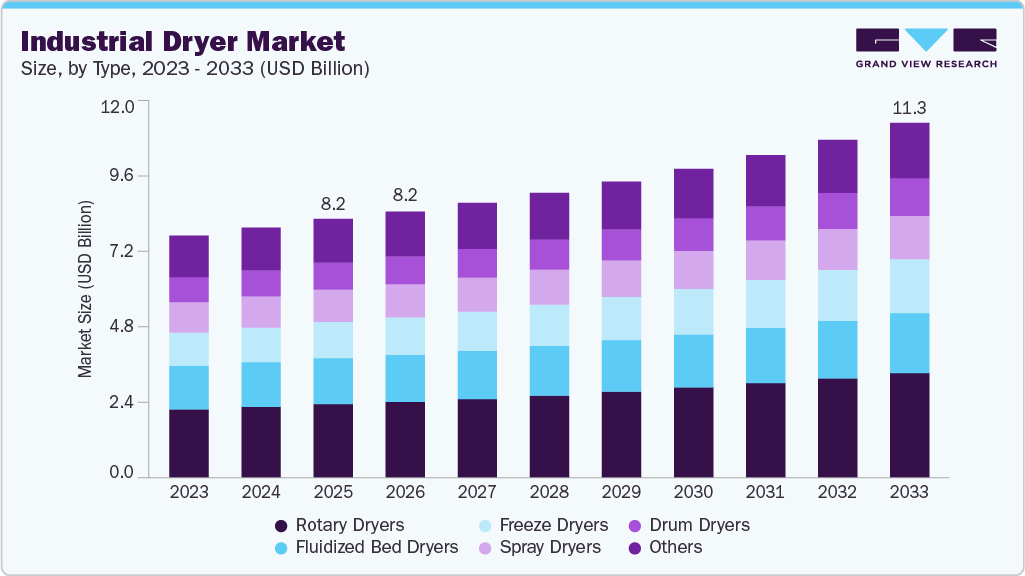
Market Dynamics
The rapid expansion of the food processing industry is one of the strongest growth drivers for the industrial dryer market. Consumers are increasingly preferring ready-to-eat meals, powdered beverages, instant food products, and long-shelf-life packaged foods. Industrial dryers such as spray dryers, freeze dryers, and fluidized bed dryers are widely used to maintain product quality, improve preservation, and reduce moisture content efficiently. Manufacturers are also focusing on maintaining flavor, texture, and nutritional value, which is encouraging investments in advanced drying technologies.
The pharmaceutical sector is creating substantial demand for high-precision drying equipment. Industrial dryers play a critical role in producing active pharmaceutical ingredients (APIs), vaccines, biologics, and granulated formulations. The increasing global production of medicines and biotechnology products is pushing manufacturers toward contamination-free and temperature-controlled drying systems. Freeze drying technology, in particular, is witnessing strong adoption because of its ability to preserve sensitive biological materials and improve product stability.
Industrial dryers require substantial thermal energy for moisture removal, making energy consumption one of the major challenges in the market. Large-scale drying operations in industries such as chemicals, mining, food processing, and construction often result in high electricity and fuel costs, especially when operating continuously. Energy-intensive technologies like rotary dryers and spray dryers can significantly increase operational expenditure for manufacturers, particularly in regions with unstable energy prices.
Market Concentration & Characteristics
The industrial dryer market leans toward a fragmented structure, as it includes international companies alongside numerous regional and local manufacturers. Although a few key players maintain a strong position through advanced technologies and broad product offerings, no single company dominates the market entirely. The need for customized solutions across industries such as food, pharmaceuticals, and chemicals allows smaller firms to stay competitive and capture specific niches. This variety of participants keeps competition active and prevents the market from becoming highly consolidated.
The industrial dryer market is witnessing steady innovation, driven by the need for higher efficiency, automation, and energy savings. Recent developments highlight a shift toward advanced technologies such as ultrasonic drying, AI integration, and smart control systems. For instance, the launch of the SonicDry ultrasonic dryer by Ferlin in September 2025 represents a major breakthrough, using ultrasonic waves to remove moisture directly from materials, resulting in faster drying and reduced energy consumption.
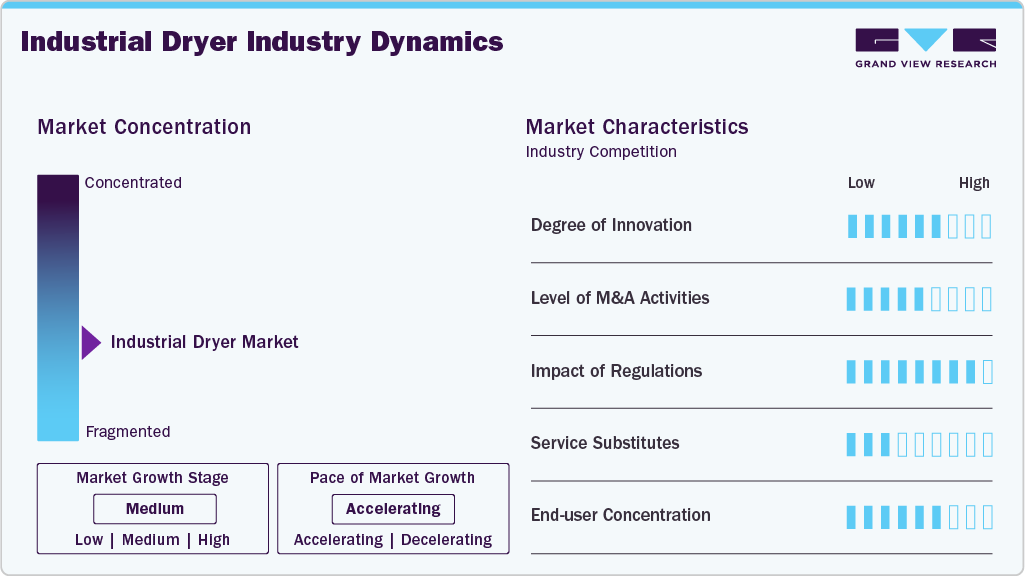
Regulations have a strong influence on the industrial dryer market, especially in sectors such as food processing, pharmaceuticals, and chemicals. Manufacturers must comply with strict standards related to hygiene, product quality, and emissions, which drives the adoption of more advanced and controlled drying systems. Environmental norms are also becoming stricter, encouraging the use of energy-efficient equipment and technologies that reduce carbon output.
The market is supported by a broad range of end-use industries, resulting in a well-diversified demand base. Industries such as food & beverage, pharmaceuticals, chemicals, textiles, and construction all rely on drying processes, but each has different requirements and applications. While food and pharmaceutical sectors contribute significantly due to consistent demand and strict quality standards, no single industry dominates the market entirely. This balanced distribution maintains steady growth and reduces dependency on any one sector.
Technology Insights
Direct drying technology dominated the industrial dryer market, accounting for a 63.1% share in 2025, due to its high efficiency, simplicity, and cost-effectiveness. This method, where hot air or gas comes into direct contact with the material, enables faster moisture removal and supports continuous large-scale operations. It has been widely adopted across industries such as chemicals, construction, and food processing, where high throughput and operational efficiency are critical. Its lower capital and operating costs compared to alternative technologies have further strengthened its leading position in the market.
Indirect drying technology is expected to witness a steady CAGR or 3.5% over the forecast period, driven by increasing demand for controlled and contamination-free drying processes. Since heat is transferred without direct contact, it is particularly suitable for sensitive, hazardous, or high-value materials commonly found in pharmaceutical and specialty chemical industries. Growing regulatory requirements, along with the need for product quality and precision, are encouraging industries to shift toward indirect drying solutions.
Type Insights
Rotary dryers dominated the industrial dryer market and accounted for 28.4% share in 2025, due to their ability to handle high volumes of material and operate continuously with relatively low operating costs. Their robust design and flexibility in processing a wide range of materials, including minerals, chemicals, and construction inputs, made them a preferred choice across heavy industries. The ease of operation and suitability for large-scale applications further strengthened their leading position in the market.
Freeze dryers segment is expected to witness the fastest CAGR of 5.4% from 2026 to 2033, driven by increasing demand for high-quality drying processes that preserve product structure, nutrients, and chemical properties. Their adoption is rising particularly in pharmaceutical, biotechnology, and premium food applications where product integrity is critical. Growing focus on advanced processing techniques, along with rising demand for value-added and sensitive products, is supporting the expansion of freeze drying technology despite its higher cost compared to conventional drying methods.
End Use Insights
The food & beverage segment dominated the industrial dryer market in 2025 and accounted for a share of 26.1% in 2025, supported by strong demand for processed, packaged, and shelf-stable products. Drying plays a critical role in extending product shelf life, reducing moisture content, and maintaining quality in items such as dairy products, coffee, spices, and ready-to-eat foods. The widespread use of technologies such as spray and fluidized bed dryers, along with continuous production requirements, contributed to the segment’s leading position in the market.
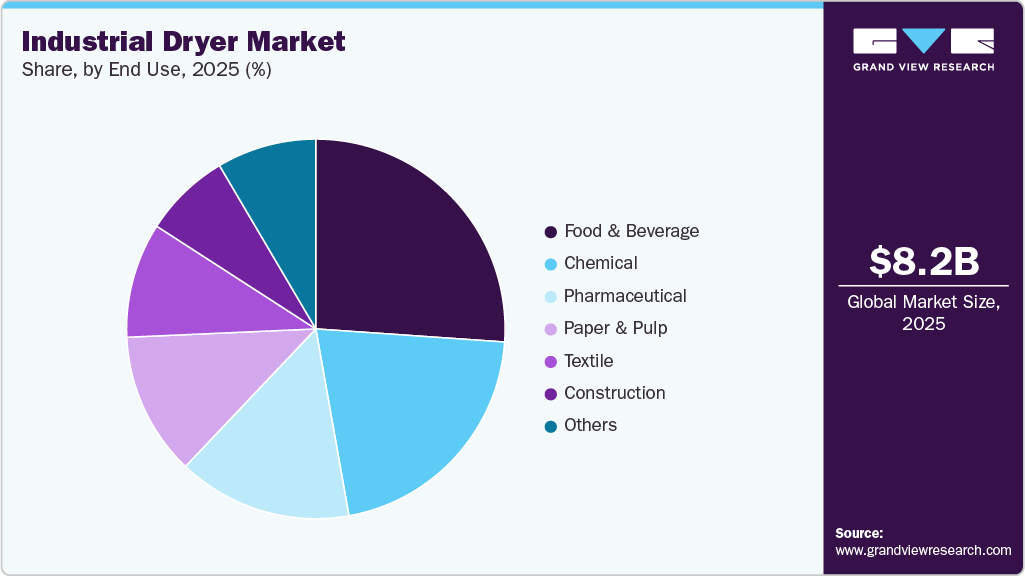
The textile segment is expected to witness the fastest growth, driven by increasing global demand for fabrics, garments, and technical textiles. Drying is an essential step in textile processing, particularly after washing, dyeing, and finishing operations. Rising textile manufacturing activities, especially in emerging economies, along with advancements in energy-efficient drying systems, are supporting the growth of this segment over the forecast period.
Regional Insights
North America is witnessing steady growth, driven by technological advancements and the presence of well-established industries. The region, particularly U.S., shows strong adoption of energy-efficient and automated drying systems. Demand is largely influenced by food processing, pharmaceuticals, and specialty chemicals, where precision, compliance, and product quality are key factors shaping equipment upgrades.
U.S. Industrial Dryer Market Trends
The industrial dryer market in the U.S. is supported by its strong and well-established industrial base, particularly in chemicals, food processing, and pharmaceuticals. According to the International Trade Administration, chemicals rank among the top exporting industries in the country, with exports valued at USD 323 billion in 2024, accounting for nearly 16% of total U.S. exports. This robust chemical production and export activity drives consistent demand for industrial dryers, as drying is a critical step in processing bulk chemicals and specialty materials.
Europe Industrial Dryer Market Trends
Europe continues to grow at a stable pace, supported by strict environmental regulations and a strong focus on sustainability. Countries such as Germany, France, and UK are emphasizing energy-efficient and low-emission technologies in industrial operations. The region also benefits from advanced engineering capabilities and a well-established base of industrial equipment manufacturers.
The industrial dryer market in Germany is experiencing steady growth, supported by its strong industrial and engineering base. The country’s well-established chemical, pharmaceutical, and food processing industries continue to generate consistent demand for advanced drying technologies. Germany’s focus on high-quality manufacturing and process efficiency is encouraging the adoption of energy-efficient and automated drying systems. In addition, increasing emphasis on sustainability and strict environmental standards is pushing industries to upgrade to modern equipment with lower emissions and improved performance.
France industrial dryer market is growing due to expanding food processing and pharmaceutical sectors, along with increasing investments in industrial modernization. The country has a strong presence of agro-based industries, which rely heavily on drying processes for preservation and quality control. Furthermore, regulatory focus on energy efficiency and environmental compliance is driving the shift toward advanced drying solutions. Continued support for industrial development and innovation is expected to sustain demand for efficient and reliable drying technologies across key sectors.
Asia Pacific Industrial Dryer Market Trends
Asia Pacific held the dominant position in the industrial dryer market, supported by its strong manufacturing base and rapid industrial expansion. Countries such as China and India continue to drive demand due to large-scale production in food processing, chemicals, textiles, and construction materials. The region benefits from lower production costs, increasing investments in industrial infrastructure, and rising domestic consumption, all of which contribute to sustained demand for drying equipment.
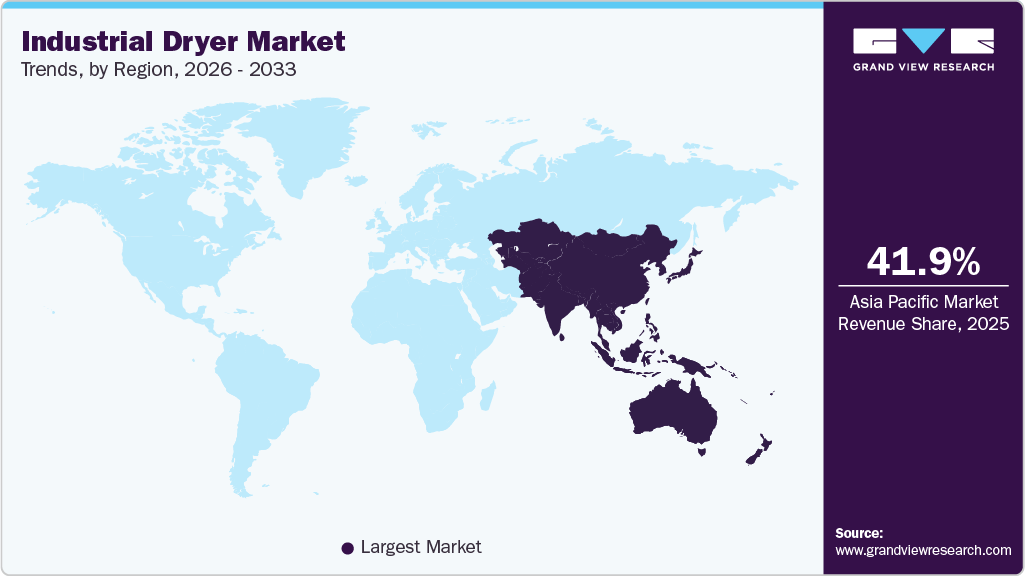
The industrial dryer market in China dominates the Asia Pacific region, supported by its large-scale manufacturing ecosystem and strong presence across industries such as chemicals, food processing, and construction materials. The country’s high production capacity and export-oriented industries continue to generate significant demand for efficient and high-capacity drying equipment. In addition, ongoing industrial upgrades and investments in advanced manufacturing technologies are further strengthening the adoption of modern drying systems across various sectors.
The industrial dryer market in India is witnessing rapid growth, driven by expanding industrialization and increasing demand from sectors such as food processing, pharmaceuticals, and textiles. Rising domestic consumption, along with government initiatives supporting manufacturing and infrastructure development, is encouraging the adoption of advanced drying technologies. Furthermore, the shift toward organized food processing and growing pharmaceutical production are creating strong opportunities for industrial dryer manufacturers in the country.
Latin America Industrial Dryer Market Trends
Latin America is experiencing gradual growth, led by expanding industrial activities and improving economic conditions. Countries such as Brazil and Argentina are seeing increased demand from food processing, agriculture, and mining sectors. Ongoing investments in infrastructure and industrial modernization are creating opportunities for the adoption of efficient drying technologies.
The industrial dryer market in Brazil dominates the Latin American region, supported by its large agricultural base and expanding industrial activities. The country has strong demand for drying equipment in sectors such as food processing, agriculture, and mining, where moisture removal is essential for product quality and storage. Brazil’s growing export of agricultural commodities and processed food products further drives the need for efficient drying systems.
Middle East & Africa Industrial Dryer Market Trends
The Middle East & Africa region is emerging as a growing market, supported by diversification efforts beyond oil-dependent economies. Nations such as Saudi Arabia and South Africa are investing in industries such as chemicals, food processing, and construction. Rising focus on industrial development and increasing infrastructure projects are contributing to the demand for industrial dryers across the region.
The industrial dryer market in Saudi Arabia dominates the Middle East & Africa region, driven by the country’s ongoing industrial diversification and strong investments in non-oil sectors. The expansion of industries such as chemicals, petrochemicals, food processing, and construction is creating steady demand for drying technologies. Government initiatives under industrial development programs are encouraging the establishment of manufacturing facilities, which in turn supports the adoption of modern and energy-efficient drying equipment.
Key Industrial Dryer Company Insights
Some of the key players operating in the market include ANDRITZ AG; GEA Group Aktiengesellschaft; and FLSmidth A/S.
-
ANDRITZ AG is a global engineering and technology provider with a strong presence in industrial processing equipment, including solutions relevant to drying applications. The company offers a broad portfolio of systems and services for industries such as chemicals, pulp and paper, food processing, and environmental solutions, where efficient moisture removal is a critical step. Its expertise in process engineering, automation, and energy-efficient technologies supports the development of advanced industrial drying systems tailored to large-scale operations. With a wide international footprint and continuous focus on innovation, ANDRITZ plays a key role in supplying high-performance and sustainable solutions within the industrial dryer market.
-
GEA Group Aktiengesellschaft is a Germany-based engineering company that delivers process technologies and equipment for industries such as food & beverage, pharmaceuticals, and chemicals. Within the industrial dryer market, the company is well known for its advanced drying and particle processing solutions, including spray dryers and fluidized bed systems used in large-scale and precision applications. Its offerings are designed to improve operational efficiency, ensure consistent product quality, and reduce energy consumption. With a strong focus on innovation and sustainable processing, GEA continues to support industries in optimizing drying operations while meeting evolving performance and environmental requirements.
Key Industrial Dryer Companies:
The following key companies have been profiled for this study on the industrial dryer market.
- ANDRITZ AG
- Metso
- thyssenkrupp
- Anivi
- Yamato Sanko Co., Ltd.
- Buhler Holding AG
- GEA Group Aktiengesellschaft
- SPX FLOW
- FLSmidth A/S
- Carrier Vibrating Equipment Inc.
- FEECO International Inc.
- Allgaier Process Technology GmbH
- Kerone Engineering Solutions LTD
- Dürr Group
- Akona Process Solutions
Competitive Benchmarking
Operating Strategies
Competitive Edge
Weaknesses
Mature Players: ANDRITZ AG, Metso, thyssenkrupp, Buhler Holding AG, GEA Group, Aktiengesellschaft, FLSmidth A/S
- Focus on large-scale industrial projects with integrated drying, thermal processing, and automation solutions across multiple end-use industries.
- Invest heavily in R&D, energy-efficient technologies, and digital monitoring systems to strengthen long-term operational performance.
- Expand through strategic partnerships, acquisitions, and global service networks to maintain strong market penetration.
- Strong global brand recognition and extensive customer base across mining, chemicals, food processing, and pharmaceuticals.
- Broad product portfolios covering rotary, spray, fluidized bed, and indirect drying technologies with customized engineering capabilities.
- High financial strength and technological expertise enable large-scale project execution and advanced process optimization.
- High dependency on capital-intensive industries makes revenue vulnerable to industrial slowdowns and economic fluctuations.
- Complex organizational structures can slow decision-making and limit flexibility in rapidly changing regional markets.
Emerging Players: SPX FLOW, Anivi, Carrier Vibrating Equipment Inc., FEECO International Inc., Allgaier Process Technology GmbH, Kerone Engineering Solutions LTD
- Focus on niche applications, customized drying systems, and region-specific industrial requirements to strengthen market positioning.
- Compete through flexible manufacturing, cost-effective solutions, and faster project delivery timelines.
- Increase investments in specialized thermal processing technologies and localized after-sales support services.
- Greater operational flexibility allows quick customization according to customer-specific production requirements.
- Competitive pricing strategies help attract small and mid-sized industrial customers in developing markets.
- Strong expertise in selected applications such as vibratory drying, rotary drying, and specialty material processing.
- Limited global presence and smaller distribution networks reduce large-scale international market reach.
- Lower R&D budgets compared to established multinational competitors can restrict technological advancements.
Recent Developments
-
In April 2026, ANDRITZ has launched a new range of small-scale spray dryers designed for research, testing, and limited production use. These systems bridge the gap between lab trials and full industrial operations by offering controlled and scalable drying conditions. The modular design provides flexibility across different capacities and applications. Additionally, the units are built for easy operation, with a focus on safety, hygiene, and energy efficiency.
-
In January 2025, Bühler Group has acquired puffing technology from CEREX to strengthen its capabilities in food, feed, and pet food processing. This technology applies controlled heat and pressure to expand raw materials, enabling the production of lighter and more uniform products such as cereals and snacks. It also enhances process efficiency by improving output and lowering energy usage.
Industrial Dryer Market Report Scope
Report Attribute
Details
Market size value in 2026
USD 8,469.8 million
Revenue forecast in 2033
USD 11,298.6 million
Growth rate
CAGR of 4.2% from 2026 to 2033
Historical data
2021 - 2025
Forecast period
2026 - 2033
Quantitative units
Revenue in USD million/billion and CAGR from 2026 to 2033
Report coverage
Revenue forecast, company market position analysis, competitive landscape, growth factors, and trends
Segments covered
Technology, type, end use, region
Regional scope
North America; Europe; Asia Pacific; Latin America; Middle East & Africa
Country Scope
U.S.; Canada; Mexico; Spain; France; Germany; Italy; UK; China; India; Japan; Australia; South Korea; Brazil; Argentina; Saudi Arabia; South Africa; UAE
Key companies profiled
ANDRITZ AG; Metso; thyssenkrupp; Anivi; Yamato Sanko Co., Ltd.; Bühler Holding AG; GEA Group Aktiengesellschaft; SPX FLOW; FLSmidth A/S; Carrier Vibrating Equipment Inc.; FEECO International Inc.; Allgaier Process Technology GmbH; Kerone Engineering Solutions Ltd.; Dürr Group; Akona Process Solutions.
Customization scope
Free report customization (equivalent up to 8 analysts working days) with purchase. Addition or alteration to country, regional & segment scope.
Pricing and purchase options
Avail customized purchase options to meet your exact research needs. Explore purchase options
Global Industrial Dryer Market Report Segmentation
This report forecasts revenue growth at global, regional & country levels, and provides an analysis on the latest trends and opportunities in each of the sub-segments from 2021 to 2033. For this study, Grand View Research has segmented the global industrial dryer market based on technology, type, end use, and region:
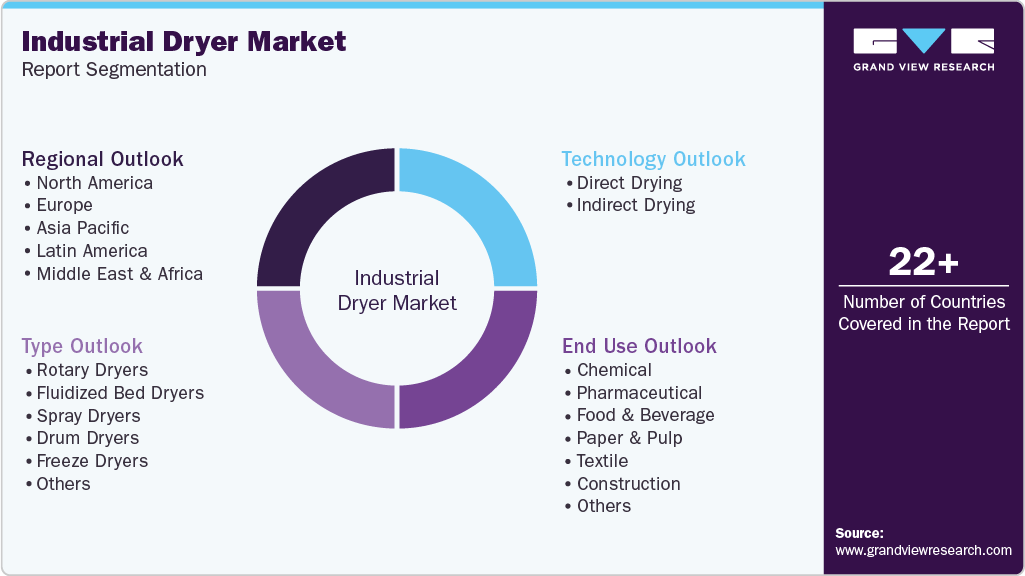
-
Technology Outlook (Revenue, USD Million, 2021 - 2033)
-
Direct Drying
-
Indirect Drying
-
-
Type Outlook (Revenue, USD Million, 2021 - 2033)
-
Rotary Dryers
-
Fluidized Bed Dryers
-
Spray Dryers
-
Drum Dryers
-
Freeze Dryers
-
Others
-
-
End Use Outlook (Revenue, USD Million, 2021 - 2033)
-
Chemical
-
Pharmaceutical
-
Food & Beverage
-
Paper & Pulp
-
Textile
-
Construction
-
Others
-
-
Regional Outlook (Revenue, USD Million, 2021 - 2033)
-
North America
-
U.S.
-
Canada
-
Mexico
-
-
Europe
-
Spain
-
Germany
-
Italy
-
France
-
UK
-
-
Asia Pacific
-
China
-
India
-
Japan
-
Australia
-
South Korea
-
-
Latin America
-
Brazil
-
Argentina
-
-
Middle East & Africa
-
Saudi Arabia
-
South Africa
-
UAE
-
-
Delivered Customizations
This report has been delivered with the following In-depth customizations
Client Request
Customization Delivered
Value Adds
Competitive benchmarking
A detailed competitive benchmarking analysis was delivered covering major industrial dryer manufacturers, their product portfolios, technology capabilities, strategic developments, regional presence, and end-use industry focus. The study also included comparative evaluation of mature and emerging players based on innovation, pricing strategies, operational scale, and market positioning.
Helped identify key competitive gaps, benchmark industry leaders, and understand strategic positioning across the industrial dryer ecosystem. The analysis also supported decision-making related to partnerships, expansion opportunities, and competitor differentiation strategies.
Regional segmentation
A comprehensive regional assessment was provided covering North America, Europe, Asia-Pacific, Latin America, and Middle East & Africa. The customization included demand trends, industrial growth patterns, regulatory environment, end-use adoption, and country-level opportunities for industrial drying technologies.
Enabled identification of high-growth regional markets and investment hotspots driven by food processing, pharmaceuticals, mining, and chemical industries. The study also supported market entry planning and region-specific growth strategy development.
Opportunity assessment
An in-depth opportunity assessment was conducted focusing on high-growth applications, emerging technologies, and future investment areas within the industrial dryer market. The analysis highlighted opportunities in energy-efficient drying systems, smart automation, pharmaceutical freeze drying, and sustainable processing technologies.
Assisted in identifying revenue-generating segments, future technology trends, and untapped application areas. The assessment also helped prioritize strategic investments and evaluate long-term business expansion potential across key industries.
Frequently Asked Questions About This Report
The global industrial dryer market size was estimated at USD 8,239.2 million in 2025 and is expected to reach USD 8,469.8 million in 2026.
The global industrial dryer market is expected to grow at a compound annual growth rate of 4.2% from 2026 to 2033 to reach USD 11,298.6 million by 2033.
Asia Pacific held the dominant position in the industrial dryer market and accounted for 41.9% share in 2025, supported by its strong manufacturing base and rapid industrial expansion. Countries such as China and India continue to drive demand due to large-scale production in food processing, chemicals, textiles, and construction materials.
Some of the key players operating in the industrial dryer market include ANDRITZ AG; Metso; thyssenkrupp; Anivi; Yamato Sanko Co., Ltd.; Bühler Holding AG; GEA Group Aktiengesellschaft; SPX FLOW; FLSmidth A/S; Carrier Vibrating Equipment Inc.; FEECO International Inc.; Allgaier Process Technology GmbH; Kerone Engineering Solutions Ltd.; Dürr Group; Akona Process Solutions.
The industrial dryer market is driven by rising demand from industries such as food & beverage, pharmaceuticals, and chemicals, where efficient moisture removal is essential for product quality and shelf life. Increasing focus on energy-efficient and automated drying systems, along with expanding industrialization in emerging economies, is further supporting market growth.
About the authors:
Author: GVR Advanced Interior Materials Research Team | Last Updated:

Share this report with your colleague or friend.
Need a Tailored Report?
Customize this report to your needs — add regions, segments, or data points, with 20% free customization.


ISO 9001:2015 & 27001:2022 Certified
We are GDPR and CCPA compliant! Your transaction & personal information is safe and secure. For more details, please read our privacy policy.












