
- Home
- »
- Nutraceuticals & Functional Foods
- »
-
Industrial Starch Market Size And Share Report, 2026-2033GVR Report cover

Industrial Starch Market (2026 - 2033)
Size, Share & Trends Analysis Report By Application (Food & Beverage, Feed, Pharmaceuticals), By Source (Corn, Wheat, Cassava, Potato), By Product (Cationic Starch, Ethylated Starch, Oxidized Starch), By Region, And Segment Forecasts
Market Size, 2025
$133.9BMarket Estimate, 2026
$144.1BMarket Forecast, 2033
$229.0BCAGR, 2026–2033
6.8%Industrial Starch Market Summary
The global industrial starch market size was valued at USD 133.9 billion in 2025 and is projected to grow from USD 144.1 billion in 2026 to USD 229.0 billion by 2033, at a CAGR of 6.8% from 2026 to 2033. North America dominated the market, accounting for a revenue share of 47.8% in 2025. The rising demand for convenience foods drives this growth and has significantly increased the need for starch as a gelling, stabilizing, and thickening agent in various processed food products.
 Source: Grand View Research, IR Documents, Primary Interviews, Paid DatabasesTo learn more about this report,
 Download Free Sample Report
 Key Market Trends & Insights
- By product: native starch and starch derivatives & sweeteners segment led the market with the dominating revenue share of 61.6% in 2025.
- By source: Corn segment accounted for the highest revenue share of 76.9% in 2025.
- By application: Food & beverage segment held the largest revenue share of 57.9% in 2025.
Regional Highlights
- Largest regional market: North America (47.8% revenue share, 2025)
- By country: The U.S. held the largest market share in 2025.
Market Size & Forecast
- Market size in 2025: USD 133.9 Billion
- Estimated market size in 2026: USD 144.1 Billion
- Projected market size by 2033: USD 229.0 Billion
- CAGR (2026-2033): 6.8%
Three ways to get this report
Buy it, customize it, or ask a question.Ask an Analyst
Analyst response in 1 business day
- AccessReport author, directly
- Reply timeWithin 1 working day
- No sales callDirect answer only
- FormatEmail reply
- CostFree, no cost
Get the Full Report
What the study covers
- FormatsPDF · Excel · Dashboard
- Timeline2026–2033 annual, 2025 base
- Coverage20+ countries, 5 regions
- Companies10+ key players profiled
Customize the Report
20% free customization
- IncludeCountries, segments, points
- TailorTo your product definition
- ExtendDeeper competitor detail
- OrA fully bespoke study
- Turnaround5–10 working days
In addition, the expansion of the food industry, especially in developing countries, is contributing to the surge in starch demand. The growing awareness of sustainability and the shift towards eco-friendly packaging solutions, such as starch-based bioplastics, are also crucial. To learn more about this report, Download Free Sample Report
 Advancements in starch processing technologies are enhancing starch's efficiency and functionality, enabling its use in a broader range of applications. This technological progress is complemented by the diversification of starch's applications in industries such as paper, where it improves the strength and quality of paper products, textiles, where it is used in fabric finishing and sizing; and pharmaceuticals, where it serves as a binder and disintegrant in tablet formulations.
Market Dynamics
Industrial starch is a versatile carbohydrate-derived material obtained from sources such as corn, wheat, cassava, and potato. It is extensively utilized across food & beverage, feed, pharmaceutical, paper, textile, chemical, and packaging industries due to its thickening, binding, stabilizing, and film-forming properties. Growing demand for bio-based ingredients and expanding industrial applications continue to support market growth globally.
The growing global food processing industry is a major factor driving the industrial starch market. Starch and its derivatives are widely used as thickeners, stabilizers, sweeteners, texture modifiers, and moisture-retention agents in numerous food and beverage products. Rising consumption of processed foods, convenience meals, bakery products, dairy items, and beverages continues to support demand across major consumer markets.
In addition, manufacturers are increasingly utilizing specialty starches to improve product functionality, shelf life, and processing efficiency. Growing consumer demand for clean-label products and innovative food formulations is encouraging investments in starch-based ingredient solutions, further strengthening market expansion.
Fluctuations in the prices of corn, wheat, cassava, potato, and other agricultural feedstocks remain a key challenge for industrial starch manufacturers. Changes in weather conditions, crop yields, trade policies, and global supply-demand dynamics can significantly impact raw material availability and production costs. Also, the competition for agricultural commodities from food, feed, biofuel, and industrial sectors can create pricing pressures throughout the value chain. These factors may affect profitability and introduce uncertainty into long-term procurement strategies.
Increasing emphasis on sustainability is creating significant opportunities for industrial starch producers. Starch-based materials are gaining popularity as renewable alternatives to petroleum-derived ingredients across packaging, adhesives, paper, textiles, and specialty chemicals applications.
Growing investments in biodegradable materials, sustainable packaging solutions, and bio-based industrial products are expected to accelerate demand for starch derivatives. Continuous innovation in modified starch technologies is further expanding commercial opportunities across multiple end-use sectors.
Analyst Perspective
The industrial starch market is increasingly evolving beyond traditional food applications toward a diversified ingredient industry serving paper, pharmaceuticals, textiles, adhesives, and biodegradable materials. While food and beverage applications continue to account for the largest share of consumption, emerging opportunities are developing in sustainable packaging, bio-based chemicals, and environmentally friendly industrial products. Manufacturers are focusing on specialty starch development, functional ingredient innovation, and process optimization to enhance value creation. Additionally, rising demand for renewable and plant-based raw materials is expected to strengthen the strategic importance of industrial starch across multiple end-use industries over the coming years.
Application Insights
Based on application, food & beverage segment held the largest revenue share of 57.9% in 2025 due to the extensive use of starch as a thickening, stabilizing, and gelling agent in various processed food products. Starches are integral in the production of bakery items, snacks, beverages, and confectionery, where they enhance texture, mouthfeel, and shelf stability. The rising demand for convenience foods and the growing preference for clean-label products have further propelled the use of natural and recognizable ingredients such as starch. In addition, the development of gluten-free products has increased the demand for starch-based alternatives, making it a vital component in the food industry.
The pharmaceuticals segment is expected to grow at a CAGR of 9.1% from 2025 to 2030. Starch derivatives, such as dextrins and starch-based excipients, play a crucial role in drug formulation. These ingredients are used as binders, fillers, and disintegrants in the production of tablets and capsules. The increasing demand for pharmaceutical products, coupled with the need for cost-effective and efficient manufacturing processes, is driving the growth of the starch market in this segment. The versatility and functionality of starches make them valuable components in developing various medications.
Source Insights
Based on source, the corn segment accounted for the highest revenue share of 76.9% in 2025 due to corn's high yield, versatile applications, and well-established supply chains. Corn starch is widely utilized in food products, pharmaceuticals, and industrial applications, making it a staple ingredient in many sectors. The increasing demand for processed foods and a rising preference for natural and plant-based ingredients has bolstered the corn segment's growth. Moreover, innovations in corn starch processing have improved its functionality and efficiency in various applications, further enhancing its market appeal.
The wheat segment is projected to grow steadily over the forecast period, fueled by the expanding use of wheat starch in the food industry, particularly in baking and confectionery applications, where it serves as a thickening agent and texture enhancer. Moreover, due to its biodegradable properties and performance characteristics, wheat starch is gaining traction in non-food sectors, such as paper and textiles. The increasing awareness of sustainability and the shift towards eco-friendly products could drive demand for wheat starch as manufacturers seek alternative materials that align with environmental goals.
Product Insights
The native starch and starch derivatives & sweeteners segment led the market with the dominating revenue share of 61.6% in 2025. Native starch, extracted from sources such as corn, potato, and tapioca, is widely used in food processing, textile manufacturing, and paper production due to its natural thickening and stabilizing properties. Starch derivatives, such as maltodextrin, glucose syrups, and modified starches, expand the range of applications by offering enhanced functionality such as improved solubility and stability under various conditions.
These derivatives are crucial in producing sweeteners, which are extensively used in the food and beverage industry for their taste-modifying properties and in non-food sectors for fermentation processes and pharmaceuticals. The broad applicability and versatile nature of native starch and its derivatives ensure their significant share in the market.
 To learn more about this report, Download Free Sample Report
 The cationic starch segment is projected to grow at a CAGR of 8.0% over the forecast period. Cationic starches are primarily used in the paper industry to improve paper strength, retention, and drainage during the papermaking process. The positive charge of cationic starches allows them to bond more effectively with the negatively charged fibers, fillers, and other additives in paper pulp, enhancing the overall quality of the paper. In addition, the growing demand for high-quality packaging materials and the need for sustainable and recyclable packaging solutions are driving the adoption of cationic starches. The segment is also seeing increased use in the textile industry for warp sizing and in wastewater treatment as flocculants.
Regional Insights
North America dominated the global industrial starch market with the highest revenue share of 47.8% in 2025 due to the high demand for starch in various industries, such as food and beverages, paper, and pharmaceuticals. The robust agricultural sector in North America, particularly the extensive cultivation of corn and wheat, provides a steady supply of raw materials for starch production. In addition, advancements in starch processing technologies and the presence of major market players have further strengthened North America's position in the global market. The emphasis on sustainability and the development of bio-based products are also driving the demand for industrial starch in the region.
 To learn more about this report, Download Free Sample Report
 U.S. Industrial Starch Market Trends
The U.S. accounted for 77.0% of the North American industrial starch market in 2025, driven by the extensive use of starch in various applications, including food processing, paper manufacturing, and textiles. The U.S. market benefits from a well-established infrastructure, strong agricultural output, and significant investments in research and development. The increasing demand for convenience foods and the growing awareness of eco-friendly packaging solutions are key factors contributing to the market's growth. In addition, the presence of major starch manufacturers and continuous innovation in starch products enhance the market's expansion in the U.S.
Europe Industrial Starch Market Trends
Europe accounted for a significant market share in the global industrial starch market in 2024 driven by the well-established food and beverage industry, which is one of the largest consumers of industrial starch. The region's stringent regulations on food quality and safety also drive the demand for high-quality, functional ingredients such as starches. Moreover, the presence of major starch manufacturers in countries such as Germany, France, and the Netherlands supports the robust market growth.
Asia Pacific Industrial Starch Market Trends
The industrial starch market in Asia Pacific is anticipated to grow the fastest over the forecast period. This rapid growth is attributed to the burgeoning food and beverage industry in countries such as China and India, where rising incomes and changing dietary habits are increasing the demand for processed foods. Furthermore, the expanding paper and packaging industries in the region are driving the need for starch as a key raw material. The presence of a large agricultural base also ensures a steady supply of raw materials for starch production.
Key Industrial Starch Company Insights
Some of the key companies in the Industrial Starch market include Cargill, Incorporated, Archer Daniels Midland Company, Ingredion Incorporated, Tate & Lyle PLC, AGRANA Beteiligungs-AG, and others.
-
Cargill Incorporated provides a wide range of starch products derived from corn, wheat, and tapioca, catering to various industries such as food and beverage, pharmaceuticals, and paper.
-
Tate & Lyle PLC offers a diverse range of starches and sweeteners. Its products are used in the food, beverage, pharmaceutical, and personal care industries.
Key Industrial Starch Companies
The following key companies have been profiled for this study on the industrial starch market.
-
Cargill, Incorporated
-
Archer Daniels Midland Company
-
Ingredion Incorporated
-
Tate & Lyle PLC
-
AGRANA Beteiligungs-AG
-
Grain Processing Corporation
-
Roquette Frères
-
Tereos Group
-
Royal Cosun
-
Altia Industrial
-
Global Bio-chem Technology Group Company Limited
-
General Starch Limited
-
Eiamheng
-
Coöperatie Koninklijke Avebe U.A.
-
Galam Group
Competitive Benchmarking
Category
Operating Strategies
Competitive Edge
Weakness
Established Players (Cargill, Incorporated, Archer Daniels Midland Company, Ingredion Incorporated, Tate & Lyle PLC, AGRANA Beteiligungs-AG, Roquette Frères, Tereos Group, Royal Cosun, Coöperatie Koninklijke Avebe U.A.)
- Expanding specialty starch portfolios to address evolving requirements across food and industrial applications.
- Investing in production capacity expansions and sustainable processing technologies to improve operational efficiency.
- Extensive global manufacturing networks ensure reliable supply across diverse end-use industries.
- Strong research capabilities support development of value-added starch solutions with enhanced functionality.
- Exposure to agricultural commodity price fluctuations can significantly impact production economics.
- Regulatory and sustainability compliance requirements may increase operational and capital expenditure.
Emerging Players (Grain Processing Corporation, Altia Industrial, Global Bio-chem Technology Group Company Limited, General Starch Limited, Eiamheng, Galam Group)
- Strengthening regional market presence through targeted capacity expansions and customer-focused product offerings.
- Developing specialized starch products tailored to application-specific performance requirements.
- Strong regional expertise enables effective servicing of local food and industrial customers.
- Flexible operational structures support quicker adaptation to changing market demands and customer preferences.
- Limited global presence may restrict access to multinational customers and large-volume contracts.
- Smaller production scale can reduce economies of scale compared to established market leaders.
Recent Developments
-
In July 2024, Cryopak invested in its Atlanta facility, adding a high-volume, low-cost starch manufacturing department. This expansion enables Cryopak to offer starch as a new, sustainable insulation substrate alongside its existing PUR, paper, cotton, fiber, and EPS options. This innovative starch technology is the first to rival traditional materials such as EPS in terms of cost, performance, and scalability, while significantly improving sustainability.
-
In August 2024, Al Ghurair Foods initiated the construction of an advanced corn starch manufacturing plant within the Khalifa Economic Zones Abu Dhabi. This state-of-the-art facility marks a regional milestone and plays a crucial role in enhancing local food production capacities. It aligns strategically with the UAE's National Strategy for Food Security, emphasizing the importance of self-sufficiency in the agricultural sector and the development of sustainable food supply chains.
Industrial Starch Market Report Scope
Report Attribute
Details
Market size in 2025
USD 133.9 billion
Estimated market size in 2026
USD 144.1 billion
Projected market size by 2033
USD 229.0 billion
Growth rate
CAGR of 6.8% from 2026 to 2033
Base year for estimation
2025
Historical data
2021 - 2024
Forecast period
2026 - 2033
Quantitative units
Revenue in USD million/billion, Volume in Kilotons and CAGR from 2026 to 2033
Report coverage
Revenue forecast, company ranking, competitive landscape, growth factors, and trends
Segments covered
Product, source, application, region
Regional scope
North America; Europe; Asia Pacific; Latin America; MEA
Country scope
U.S.; Canada; Mexico; Germany; UK; France; Italy; Denmark; China; Japan; India; Australia; Brazil; Argentina; Saudi Arabia
Key companies profiled
Cargill, Incorporated; Archer Daniels Midland Company; Ingredion Incorporated; Tate & Lyle PLC; AGRANA Beteiligungs-AG; Grain Processing Corporation; Roquette Frères; Tereos Group; Royal Cosun; Altia Industrial; Global Bio-chem Technology Group Company Limited; General Starch Limited; Eiamheng; Coöperatie Koninklijke Avebe U.A.; Galam Group.
Customization scope
Free report customization (equivalent up to 8 analysts' working days) with purchase. Addition or alteration to country, regional & segment scope.
Pricing and purchase options
Avail customized purchase options to meet your exact research needs. Explore purchase options
Global Industrial Starch Market Report Segmentation
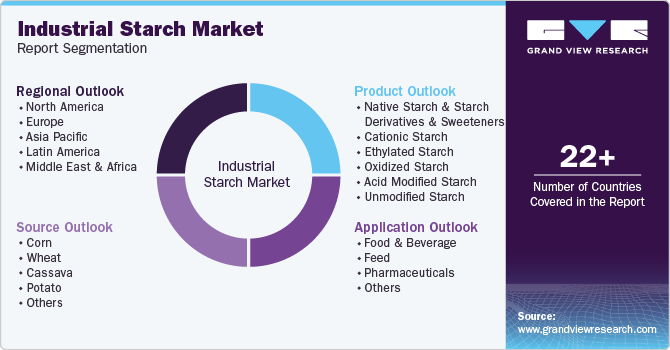
This report forecasts revenue growth at global, regional, and country levels and provides an analysis of the latest industry trends in each of the sub-segments from 2021 to 2033. For this study, Grand View Research has segmented the global industrial starch market report based on application, source, product, and region:
 To learn more about this report, Download Free Sample Report
 -
Application Outlook (Volume, Metric Tonnes; Revenue, USD Million, 2021 - 2033)
-
Food & Beverage
-
Feed
-
Bakery & Confectionery
-
Dairy & Frozen Desserts
-
Beverages
-
Convenience Foods
-
Others
-
-
Pharmaceuticals
-
Others
-
-
Source Outlook (Volume, Metric Tonnes; Revenue, USD Million, 2021 - 2033)
-
Corn
-
Wheat
-
Cassava
-
Potato
-
Others
-
-
Product Outlook (Volume, Metric Tonnes; Revenue, USD Million, 2021 - 2033)
-
Native Starch and Starch Derivatives & Sweeteners
-
Cationic Starch
-
Ethylated Starch
-
Oxidized Starch
-
Acid Modified Starch
-
Unmodified Starch
-
-
Regional Outlook (Volume, Metric Tonnes; Revenue, USD Million, 2021 - 2033)
-
North America
-
U.S.
-
Canada
-
Mexico
-
-
Europe
-
UK
-
Germany
-
France
-
Italy
-
Denmark
-
-
Asia Pacific
-
Japan
-
China
-
India
-
Australia
-
-
Latin America
-
Brazil
-
Argentina
-
-
Middle East and Africa (MEA)
-
Saudi Arabia
-
-
Research Methodology
The industrial starch market figures in this report are based on a proven research process that combines executive interviews with secondary research from proprietary databases, company filings, and recognized regulatory and institutional sources. Market size is built through value-chain sizing - reconciling supply-side and demand-side estimates - and triangulated with bottom-up and top-down approaches. Every estimate passes multiple levels of expert validation before publication, with each industrial starch segment quantified using the revenue-capture definitions in the table below.
Segment Definition
Segment - Type
Revenue capture definition
Native Starch and Starch Derivatives & Sweeteners
As the dominant product segment, revenue is generated through the sale of native starches, modified starches, glucose syrups, sweeteners, and specialty derivatives utilized across food processing, pharmaceuticals, paper manufacturing, and industrial applications requiring functional ingredient solutions.
Cationic Starch
Revenue is supported by applications in paper manufacturing, wastewater treatment, and industrial processing where positively charged starch molecules improve retention, strength, and process efficiency. Demand is closely linked to paper and industrial production activity.
Ethylated Starch
Market value is derived from specialty starch formulations utilized in food processing and industrial applications requiring enhanced stability and functional performance. Product demand is influenced by formulation requirements and specialty ingredient adoption trends.
Oxidized Starch
Revenue capture is driven by utilization in paper coatings, adhesives, textiles, and food applications where improved viscosity control and film-forming properties are required. Industrial manufacturing activity remains a key demand driver.
Acid Modified Starch
Revenue is generated through starch products processed to achieve specific viscosity and functional characteristics. Adoption is supported by applications across food processing, confectionery production, and industrial manufacturing operations.
Unmodified Starch
Market revenue is supported by direct utilization of natural starches in food, feed, pharmaceutical, and industrial applications. Demand is influenced by raw material availability, processing economics, and growing preference for minimally modified ingredients.
Segment - Source
Revenue capture definition
Corn
As the dominant source segment, revenue is generated through large-scale processing of corn into starches, sweeteners, and derivative products. High starch yield, broad industrial applicability, and established supply chains support significant commercial value.
Wheat
Revenue is supported by starch extraction and processing for food, industrial, and specialty applications. Demand is influenced by regional crop availability, ingredient requirements, and utilization within bakery and food manufacturing sectors.
Cassava
Market value is derived from cassava-based starch production serving food processing, adhesives, textiles, and industrial applications. Growing demand for alternative starch sources and expanding production in tropical regions support segment growth.
Potato
Revenue capture is driven by starch products offering unique viscosity and functional properties suitable for food, pharmaceutical, and industrial applications. Specialty product demand and premium application areas contribute to commercial consumption.
Other Sources
This segment captures revenue from starch production utilizing rice, peas, and other agricultural feedstocks. Product diversification and specialty application requirements continue to create niche growth opportunities.
Segment - Application
Revenue capture definition
Food & Beverage
As the largest application segment, revenue is generated through the use of industrial starches as thickeners, stabilizers, sweeteners, binders, and texture modifiers in processed foods, beverages, dairy products, bakery products, and confectionery applications.
Feed
Revenue is supported by starch utilization within livestock, poultry, aquaculture, and pet nutrition formulations. Demand is influenced by animal feed production volumes, nutritional requirements, and global protein consumption trends.
Pharmaceuticals
Market value is derived from starch applications as excipients, binders, disintegrants, and functional ingredients in pharmaceutical manufacturing. Growing healthcare demand and increasing drug production continue to support segment growth.
Other Applications
Revenue capture is driven by starch utilization across paper manufacturing, textile finishing, adhesives, organic chemicals, and industrial processing applications. Expanding industrial activity and sustainability initiatives continue to support demand.
Estimation Model
Layer Name
Key Question
Description
Feedstock Availability Layer
What forms the addressable base?
Identify global production volumes of corn, wheat, cassava, potato, and other starch-rich crops utilized as raw materials for industrial starch manufacturing.
Processing Adoption Layer
Where is starch utilized?
Estimate the proportion of extracted starch directed toward food & beverage, feed, pharmaceutical, paper, textile, chemical, and other industrial applications based on end-use requirements.
Consumption Intensity Layer
How much starch is consumed?
Analyze formulation inclusion rates, manufacturing volumes, industrial processing requirements, and application-specific usage patterns to determine annual industrial starch consumption.
Revenue Layer
How is market revenue generated?
Market revenue is quantified through the sale of native starches, modified starches, sweeteners, and specialty starch derivatives supplied to food manufacturers, pharmaceutical companies, feed producers, and industrial users worldwide.
Delivered Customizations
This report has been delivered with the following In-depth customizations
Client Request
Customization Delivered
Value Adds
Regional Segmentation
The study delivers detailed regional analysis across additional countries such as Turkiye, UAE, Indonesia, etc., evaluating industrial starch demand, production trends, feedstock availability, trade dynamics, and end-use industry developments.
Enables stakeholders to identify high-growth regional markets, assess demand-supply dynamics, understand feedstock advantages, and formulate expansion strategies aligned with regional industry trends.
Cross-Segmentation Analysis
The study delivers detailed cross-segmentation analysis assessing industrial starch demand across major applications by source type, highlighting consumption patterns, performance requirements, market attractiveness, and growth trends across end-use industries.
Helps companies identify the most attractive source-application combinations, optimize product portfolios, target high-value customer segments, and improve strategic decision-making based on application-specific demand dynamics.
Competitive Benchmarking
The study delivers comprehensive benchmarking of leading and emerging manufacturers based on production capacity, product portfolio strength, geographic presence, starch processing expertise, innovation initiatives, and strategic developments within the industrial starch value chain.
Assists stakeholders in evaluating competitive positioning, identifying market gaps, benchmarking operational capabilities, and supporting informed decisions related to investments, partnerships, and expansion strategies.
Frequently Asked Questions About This Report
The global industrial starch market was estimated at USD 133.9 billion in the year 2025 and is expected to reach USD 144.1 billion in 2026.
The global industrial starch market is expected to grow at a compound annual growth rate of 6.8% from 2026 to 2033 to reach USD 229.0 billion by 2033.
North America emerged as a dominating region with a value share of 47.8% in the year 2025 owing to the high production of packaged food products in the U.S., Canada and Mexico.
The native starch and starch derivatives & sweeteners segment dominated the industrial starch market in 2025, accounting for 61.6% of market revenue, owing to its extensive use across food processing, paper, textile, and adhesive manufacturing applications.
The corn segment led the industrial starch market in 2025, capturing 76.9% of market revenue, due to its abundant availability, cost-effectiveness, and high starch yield for diverse industrial applications.
The food & beverage segment dominated the industrial starch market in 2025, accounting for 57.9% of market revenue, driven by the widespread use of starch as a thickening, stabilizing, sweetening, and texturizing ingredient in food products.
The key market player in the global industrial starch market includes Cargill, Incorporated, Archer Daniels Midland Company, Ingredion Incorporated, Tate & Lyle PLC, AGRANA Beteiligungs-AG, Grain Processing Corporation, Roquette Frères, Tereos Group, Royal Cosun, Altia Industrial, Global Bio-chem Technology Group Company Limited, General Starch Limited, Eiamheng, Coöperatie Koninklijke Avebe U.A., Galam Group.
The growth of the food & beverage industry and rising applications of starch in pharmaceutical, paper, and textile products is expected to drive the global industrial starch market.
About the Author(s)
Nutraceuticals & Functional Foods Research Team
Consumer Goods · Nutraceuticals & Functional FoodsThis report was authored by the nutraceuticals & functional foods research team at Grand View Research - comprising two research analysts, one senior research analyst, and one industry expert - with specialized expertise in the nutraceuticals & functional foods segment of the consumer goods industry. All findings are based on proprietary consumer goods databases, executive interviews, and regulatory analysis, subject to internal peer review prior to publication.
Last Updated:
Speak to Analyst

Customize this report to your needs - add regions, segments, or data points, with 20% free customization.
Or view our licence options:


ISO 9001:2015 & 27001:2022 Certified
We are GDPR and CCPA compliant! Your transaction & personal information is safe and secure. For more details, please read our privacy policy.


