
- Home
- »
- Next Generation Technologies
- »
-
Industry 5.0 Market Size, Share & Trends Report, 2026-2033GVR Report cover

Industry 5.0 Market (2026 - 2033)
Size, Share & Trends Analysis Report By Component (Hardware, Software, Services), By Technology (3D Printing, Robotics, Industrial Sensors, Cloud Computing), By End Use, By Region, And Segment Forecasts
Market Size, 2025
$85.0BMarket Estimate, 2026
$108.5BMarket Forecast, 2033
$676.5BCAGR, 2026–2033
29.9%Industry 5.0 Market Summary
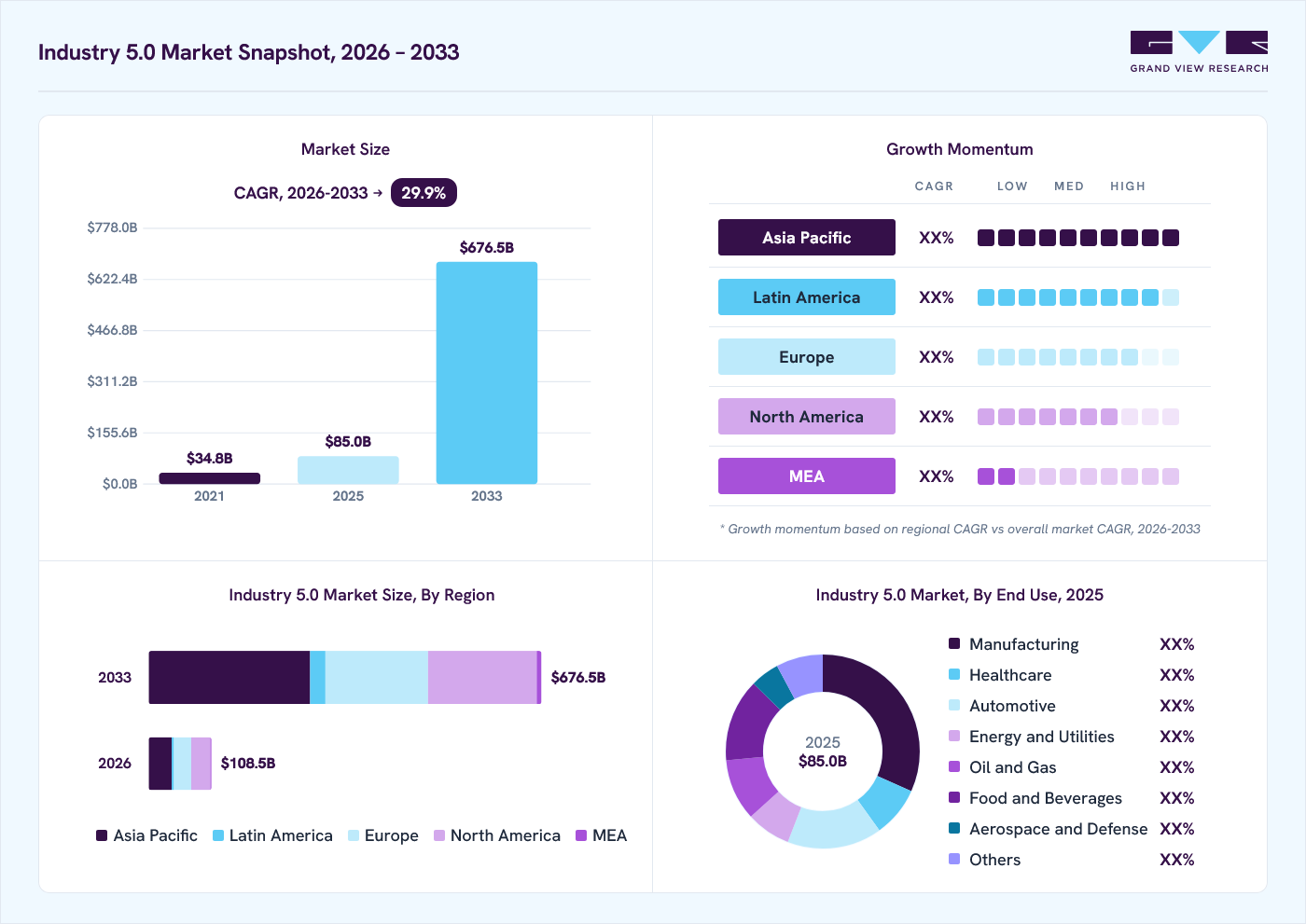
The global industry 5.0 market size was valued at USD 85.0 billion in 2025 and is projected to grow from USD 108.5 billion in 2026 to USD 676.5 billion by 2033, at a CAGR of 29.9% from 2026 to 2033. Asia Pacific dominated the global market with the largest revenue share of 36.1% in 2025. The Industry 5.0 Market is driven by rising adoption of human-centric manufacturing, increasing investments in AI-powered collaborative robotics, and growing implementation of smart production systems.
 Source: Grand View Research, IR Documents, Primary Interviews, Paid DatabasesTo learn more about this report,
 Download Free Sample Report
 Key Market Trends & Insights
- By component: Hardware segment dominated the market, with a share of 50.1% in 2025.
- By technology: Robotics segment accounted for the largest market share of 17.1% in 2025.
- By end use: Manufacturing segment accounted for the largest market share in 2025.
Regional Highlights
- Largest regional market: Asia Pacific (36.1% revenue share in 2025)
- By Country: China held the largest market share in 2025.
Market Size & Forecast
- Market size in 2025: USD 85.0 Billion
- Estimated market size in 2026: USD 108.5 Billion
- Projected market size by 2033: USD 676.5 Billion
- CAGR (2026-2033): 29.9%
Three ways to get this report
Buy it, customize it, or ask a question.Ask an Analyst
Analyst response in 1 business day
- AccessReport author, directly
- Reply timeWithin 1 working day
- No sales callDirect answer only
- FormatEmail reply
- CostFree, no cost
Get the Full Report
What the study covers
- FormatsPDF · Excel · Dashboard
- Timeline2026–2033 annual, 2025 base
- Coverage20+ countries, 5 regions
- Companies10+ key players profiled
Customize the Report
20% free customization
- IncludeCountries, segments, points
- TailorTo your product definition
- ExtendDeeper competitor detail
- OrA fully bespoke study
- Turnaround5–10 working days
Unlike the automation of previous industrial revolutions, Industry 5.0 emphasizes the synergy between humans and machines, where robots assist with repetitive tasks while humans focus on complex decisions. Cobots are designed to work side by side with human workers, boosting productivity and ensuring a safer work environment. This collaboration creates a more efficient and fulfilling workplace, aligning with the human-centric goals of Industry 5.0. As a result, businesses in Industry 5.0 can achieve higher production rates without losing the touch of human creativity and decision-making.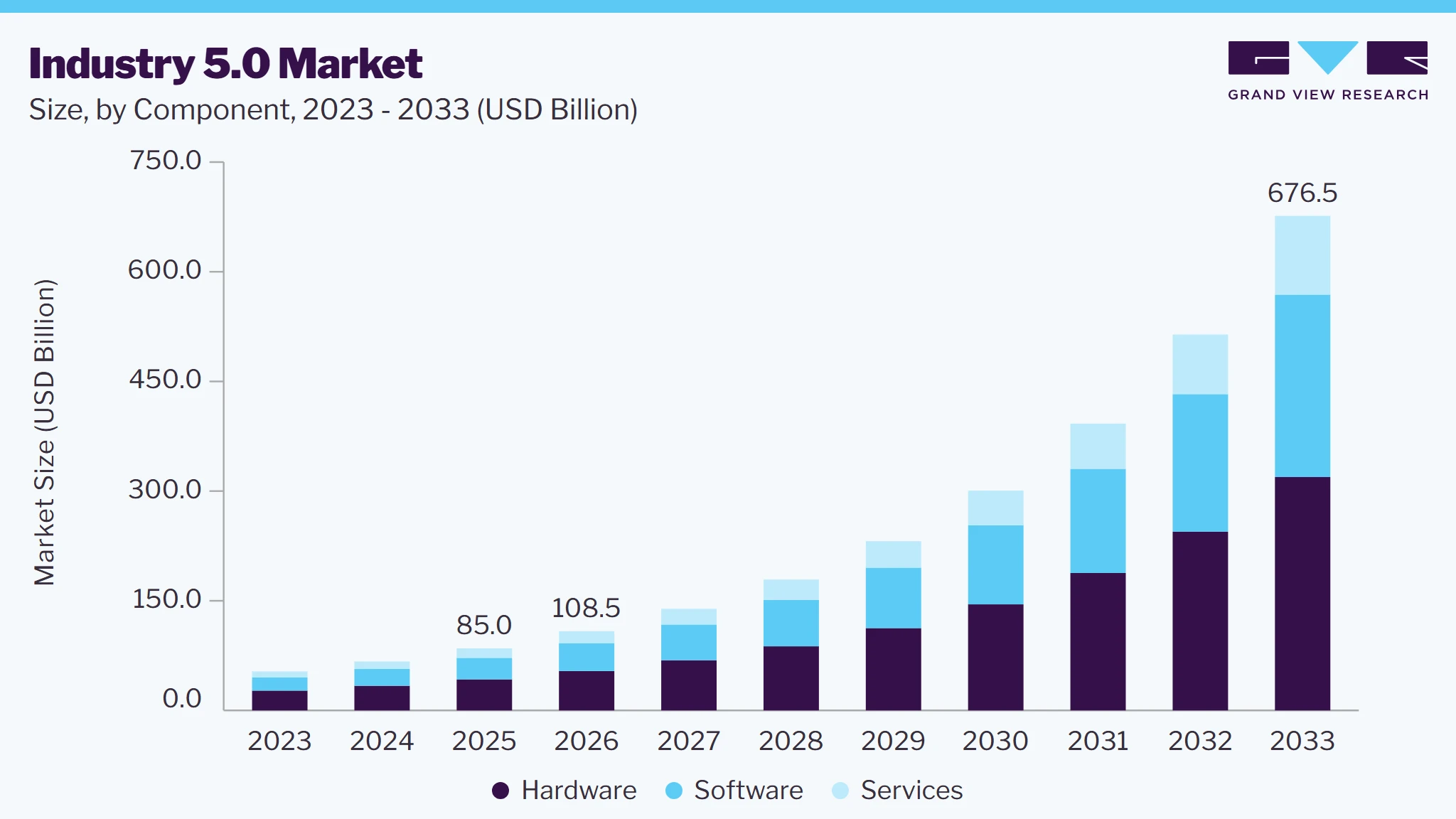 To learn more about this report, Download Free Sample Report
 In Industry 5.0, AI is not just used to automate tasks but also to assist human decision-making. AI-powered tools provide insights and predictions, helping workers in Industry 5.0 make faster, data-driven decisions. This AI integration boosts the human role by empowering them with real-time information to solve complex problems. Instead of replacing human intelligence, Industry 5.0 harnesses the power of AI to enhance it, making collaboration between machines and humans more seamless. This trend also extends to predictive maintenance, which is crucial in Industry 5.0 for ensuring optimal system performance and reducing unplanned downtime.
Industry 5.0 emphasizes the trend of mass personalization, where manufacturers create products tailored to the unique preferences of individual customers. With flexible production systems and the advent of 3D printing, Industry 5.0 makes it possible to offer personalized products on a scale, something that was previously reserved for high-cost luxury goods. This shift allows businesses to meet the rising consumer demand for personalized experiences, while also maintaining operational efficiency. The use of AI and advanced manufacturing techniques will empower businesses in Industry 5.0 to offer customization without compromising on speed or cost. The ability to mass-produce individualized products will become a hallmark of Industry 5.0, allowing brands to offer truly unique solutions.
Sustainability is a major driver in Industry 5.0, with companies focusing on reducing environmental impacts through green technologies and eco-friendly practices. A shift toward a circular economy, central to Industry 5.0, involves reusing materials, recycling, and creating products designed for long-term durability and reuse. Manufacturers in Industry 5.0 are increasingly adopting energy-efficient processes and reducing waste, aligning with consumer expectations and regulatory pressures. Industry 5.0 also encourages innovation in the use of renewable energy sources and sustainable materials to reduce the carbon footprint of production. By prioritizing sustainability, Industry 5.0 fosters responsible growth and aligns industrial advancements with global environmental goals.
Edge computing is critical in Industry 5.0, as it enables real-time data processing closer to the source, allowing for faster and more efficient decision-making. In Industry 5.0, IoT devices generate enormous amounts of data, and edge computing ensures that critical insights can be acted upon immediately, without delay. This capability enhances operational efficiency and ensures the production line is constantly optimized for peak performance. By reducing the reliance on centralized servers, Industry 5.0 also lowers latency and improves the security of sensitive data. The widespread adoption of edge computing will be a key enabler of Industry 5.0 as it powers smarter, more responsive manufacturing systems.
Industry 5.0 is transforming traditional manufacturing through decentralized production systems powered by technologies such as 3D printing. This shift enables localized production, significantly reducing supply chain complexity and costs, while also allowing for faster responses to changing market demands. Manufacturers in Industry 5.0 will leverage Artificial Intelligence (AI) & Machine Learning (ML) to produce goods on demand, minimizing excess inventory and waste. The ability to print products directly from digital models will enable mass customization, a hallmark of Industry 5.0, offering consumers more personalized choices. This decentralization, powered by digital tools, makes Industry 5.0 more agile, reducing reliance on centralized factories and streamlining production processes.
Market Dynamics
The Industry 5.0 Market is experiencing growth, driven by increasing investments in resilient manufacturing ecosystems, rising demand for human-machine collaboration, and the expanding adoption of intelligent production technologies. Growing investments in smart factories, connected supply chains, sustainable manufacturing initiatives, and next-generation industrial infrastructure are accelerating the deployment of collaborative robots, AI-driven production systems, and digital engineering platforms. The integration of cyber-physical systems, industrial metaverse applications, edge intelligence, and autonomous quality management enhances production flexibility, workforce productivity, operational resilience, and sustainable resource utilization, creating significant long-term opportunities for the global Industry 5.0 market.
The transition toward human-centric manufacturing is a key factor accelerating the adoption of Industry 5.0 principles across industrial sectors. Manufacturers are increasingly combining collaborative robots, artificial intelligence, advanced analytics, and intelligent automation with human expertise to improve productivity while maintaining workforce involvement. This balanced approach enables faster decision-making, higher production accuracy, improved workplace safety, and greater flexibility in handling complex manufacturing operations.
Organizations are modernizing production environments to support customized manufacturing, resilient operations, and sustainable industrial practices. Investments in collaborative workstations, intelligent process control, digital twins, and connected factory technologies enable employees to work efficiently alongside advanced automation systems. As manufacturers prioritize workforce empowerment together with operational excellence, demand for Industry 5.0 technologies continues to expand across diverse production environments.
Many manufacturers continue to rely on legacy production equipment that was not designed to support intelligent, connected manufacturing environments. Integrating advanced technologies such as artificial intelligence, collaborative robots, industrial IoT, and digital twins with existing infrastructure often requires significant engineering modifications, specialized expertise, and operational adjustments. These challenges increase implementation complexity while extending deployment timelines across manufacturing facilities.
The transition requires interoperability between multiple software platforms, industrial communication protocols, and production assets from different vendors. Ensuring seamless data exchange, cybersecurity compliance, and uninterrupted production during modernization can be difficult, particularly for organizations operating large or aging manufacturing plants. These integration challenges may delay digital transformation initiatives and reduce the pace of Industry 5.0 implementation.
Increasing emphasis on sustainable manufacturing is creating new opportunities for advanced production ecosystems that combine intelligent automation with environmental responsibility. Organizations are adopting AI-enabled energy management, predictive maintenance, circular manufacturing practices, and resource optimization technologies to improve operational efficiency while reducing environmental impact. These initiatives align with evolving sustainability objectives and corporate environmental commitments across industrial sectors.
The development of intelligent manufacturing ecosystems also supports greater supply chain resilience, real-time production visibility, and efficient utilization of industrial resources. Advanced digital technologies enable manufacturers to minimize material waste, optimize energy consumption, improve equipment performance, and enhance product traceability throughout production processes. These capabilities are encouraging broader investments in Industry 5.0 solutions across both established manufacturing enterprises and emerging industrial facilities.
Market Concentration & Characteristics
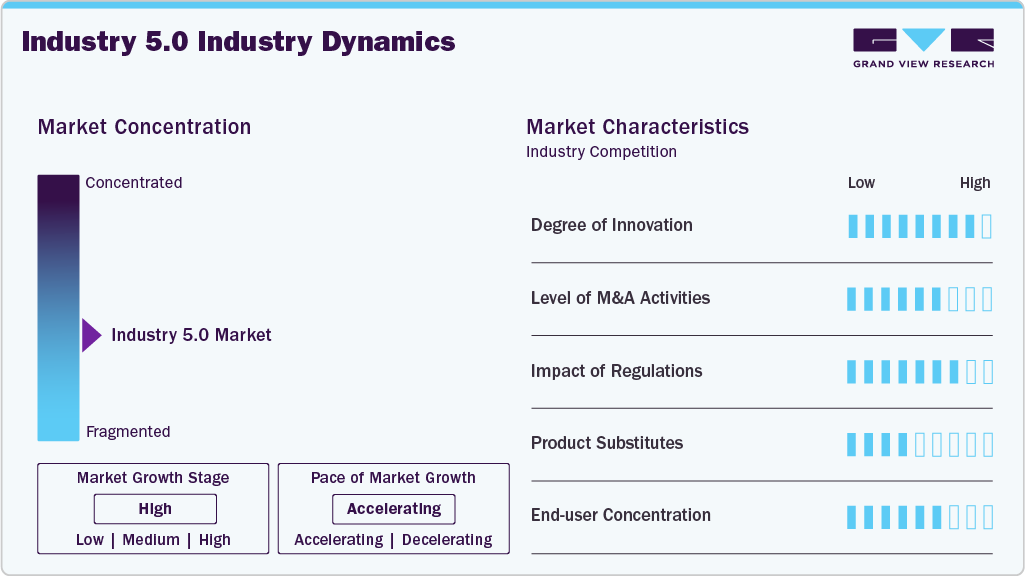
The Industry 5.0 market is moderately fragmented, with leading industrial automation companies, collaborative robotics manufacturers, industrial software providers, AI solution developers, digital engineering firms, and system integration companies competing across manufacturing, automotive, electronics, aerospace, pharmaceuticals, food processing, and energy sectors. Increasing emphasis on resilient production, human-machine collaboration, and sustainable manufacturing practices is accelerating market adoption. Companies are strengthening their competitive positions through strategic partnerships, technology acquisitions, platform innovation, and continuous investments in collaborative robotics, industrial artificial intelligence, cyber-physical systems, intelligent edge computing, and adaptive manufacturing technologies.
 To learn more about this report, Download Free Sample Report
 The market is characterized by a very high degree of innovation, supported by continuous advancements in collaborative robotics, industrial AI, digital thread architectures, edge intelligence, autonomous process optimization, and human-centric production ecosystems. Merger and acquisition activity remains high as companies expand intelligent manufacturing capabilities and strengthen digital industrial portfolios. Regulatory impact is significant due to evolving industrial safety standards, AI governance frameworks, sustainability mandates, and cybersecurity requirements. The threat of substitutes remains low because conventional automation systems and traditional manufacturing processes cannot deliver the adaptive, resilient, personalized, and human-centric capabilities enabled by Industry 5.0 technologies.
Analyst Perspective
The Industry 5.0 Market is experiencing rapid expansion, driven by increasing investments in resilient manufacturing infrastructure, growing demand for human-centric industrial operations, and accelerating adoption of intelligent production technologies across global manufacturing sectors. The expanding integration of collaborative robotics, cyber-physical systems, industrial artificial intelligence, edge computing, advanced connectivity, and autonomous production management is enhancing operational resilience, workforce productivity, production flexibility, and resource efficiency. Organizations are increasingly prioritizing sustainable manufacturing, personalized production, and intelligent decision-making to remain competitive in rapidly evolving industrial environments. Technology providers are well-positioned to capitalize on these transformation initiatives, thereby strengthening long-term market adoption and sustainable revenue generation across the global industrial ecosystem.
Component Insights
Based on component, the hardware segment led the market with the largest revenue share of 50.1% in 2025 and is expected to grow at a considerable CAGR over the forecast period. The collaborative robot (cobots) market is one of the fastest-growing segments in Industry 5.0. Cobots are designed to work alongside humans, enhancing productivity while performing tasks such as repetitive assembly, packaging, and testing. Unlike traditional industrial robots, cobots are equipped with advanced sensors and AI algorithms, allowing them to interact with human workers safely and efficiently. The growing demand for automation in manufacturing coupled with the human-centric focus of Industry 5.0 is driving rapid adoption of these robots. As industries strive for more personalized products, cobots in Industry 5.0 enable seamless integration into flexible production lines that require both human creativity and robotic precision.
The software segment is expected to witness the highest CAGR of around 30.8% from 2025 to 2030. Digital twin technology is playing an increasingly vital role in Industry 5.0, enabling companies to create virtual replicas of physical assets, production lines, or entire factories. These virtual models help simulate and predict the behavior of physical systems, providing insights that allow businesses to optimize performance and troubleshoot potential issues before they occur. Software for digital twins integrates AI, machine learning, and IoT data to monitor, analyze, and improve real-time processes. In Industry 5.0, this trend will enhance human-machine collaboration by giving operators and engineers a dynamic, data-driven platform to make informed decisions. As digital twin software evolves, it will enable businesses to rapidly adapt to changing demands while ensuring the efficiency and sustainability of their operations.
Technology Insights
Based on technology, the robotics segment dominated the market with the largest revenue share of 17.1% in 2025. Modern robots in Industry 5.0 leverage advanced sensors for precision, safety, and adaptability in industrial environments. LiDAR, 3D visions, and haptic sensors allow robots to navigate complex environments with minimal human intervention. These technologies enhance object recognition, avoidance, and real-time decision-making, making robotics more dependable. Smart sensors integrated with IoT systems enable remote monitoring and autonomous adjustments in real time. As industries prioritize precision and worker safety, sensor-driven robotics is expected to see rapid adoption.
The Artificial Intelligence (AI) & Machine Learning (ML) segment is expected to witness the highest CAGR from 2025 to 2030. Industry 5.0 focuses on mass customization powered by AI and ML. Manufacturers are using AI-driven analytics and machine learning algorithms to create highly personalized products in real-time. AI-powered production lines can adapt to customer preferences and modify product designs dynamically. The use of digital twins and generative AI helps manufacturers optimize customized production while maintaining efficiency. AI-driven customization is enhancing customer satisfaction and creating new business models.
End Use Insights
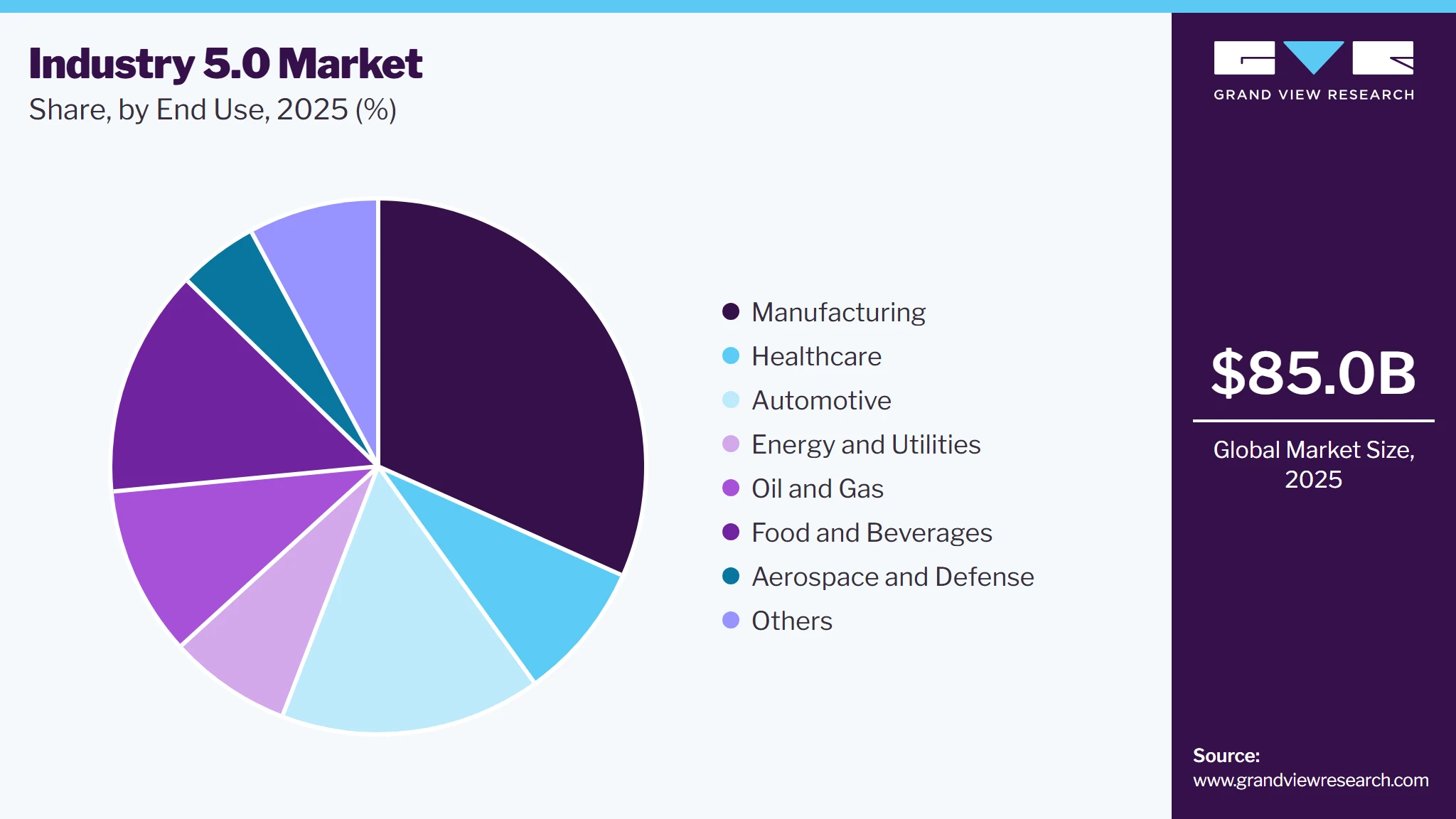
Based on end use, the manufacturing segment dominated the market with a revenue share of 31.6% in 2025. Manufacturers are moving towards hyper-personalized production, where AI-driven analytics help create customized products on a scale. Smart factories equipped with AI and digital twins analyze customer preferences and adapt production in real time. Additive manufacturing (3D printing) plays a crucial role by enabling rapid prototyping and on-demand production. AI-powered supply chains ensure just-in-time delivery of raw materials, reducing waste and inventory costs. This shift towards customization is enhancing customer satisfaction and opening new revenue opportunities.
 To learn more about this report, Download Free Sample Report
 Automotive segment is expected to witness CAGR of around 21.0% through 2030. The automotive industry is one of the sectors experiencing significant growth in the Industry 5.0 market. This growth is driven by various technological advancements that enable businesses to operate more efficiently, reduce costs, and improve customer experience. The key technology driving the growth in the automotive industry is IoT. IoT-enabled sensors monitor equipment performance and identify potential issues before they become serious problems.
Regional Insights
The Industry 5.0 market in North America generated the highest revenue share, accounting for approximately 30.0% in 2024. The region is a global leader in Industry 5.0 adoption, driven by innovative advancements in artificial intelligence (AI), robotics, and digital twin technologies. Rapid automation across key sectors, particularly manufacturing and logistics, is enhancing operational efficiency, productivity, and sustainability. Supportive government policies and increased investments in smart factories are further accelerating the shift toward human-centric automation and innovation.
U.S. Industry 5.0 Market Trends
The U.S. Industry 5.0 market held a dominant position in 2024, fueled by substantial investments in AI-powered robotics, edge computing, and smart manufacturing technologies. U.S. companies are increasingly adopting digital twins and augmented reality (AR) to optimize production processes, improve predictive maintenance, and reduce downtime. The resurgence of reshoring initiatives, coupled with government incentives for smart factory development, is driving significant growth in industrial automation and technological innovation.
Europe Industry 5.0 Market Trends
The Europe Industry 5.0 market was identified as a lucrative region in 2024, characterized by a strong emphasis on sustainability, workforce collaboration, and smart manufacturing. The European Union’s strategic policies are promoting AI-driven automation, circular economy practices, and digital transformation across industries such as automotive and aerospace. Significant investments in industrial IoT (IIoT) and cyber-physical systems are further propelling market growth, positioning Europe as a key player in the global Industry 5.0 landscape.
The UK the integration of AI and robotics into the manufacturing sector is gaining momentum, aimed at boosting efficiency and reducing reliance on offshore production. The country’s Industry 5.0 strategy prioritizes human-robot collaboration, advanced analytics, and sustainable industrial practices. Government-backed digitalization programs and investments in 5G-enabled smart factories are driving productivity and fostering innovation across the industrial sector.
Germany, a prominent leader in industrial automation, is advancing its Industry 5.0 initiatives with a focus on AI-driven smart manufacturing and digital twin technologies. Building on its strong Industry 4.0 foundation, Germany is leveraging its engineering expertise to pioneer intelligent automation solutions. Increased research and development in cyber-physical systems and IIoT are driving the next phase of manufacturing evolution, solidifying Germany’s position as a key innovator in the Industry 5.0 market.
Asia Pacific Industry 5.0 Market Trends
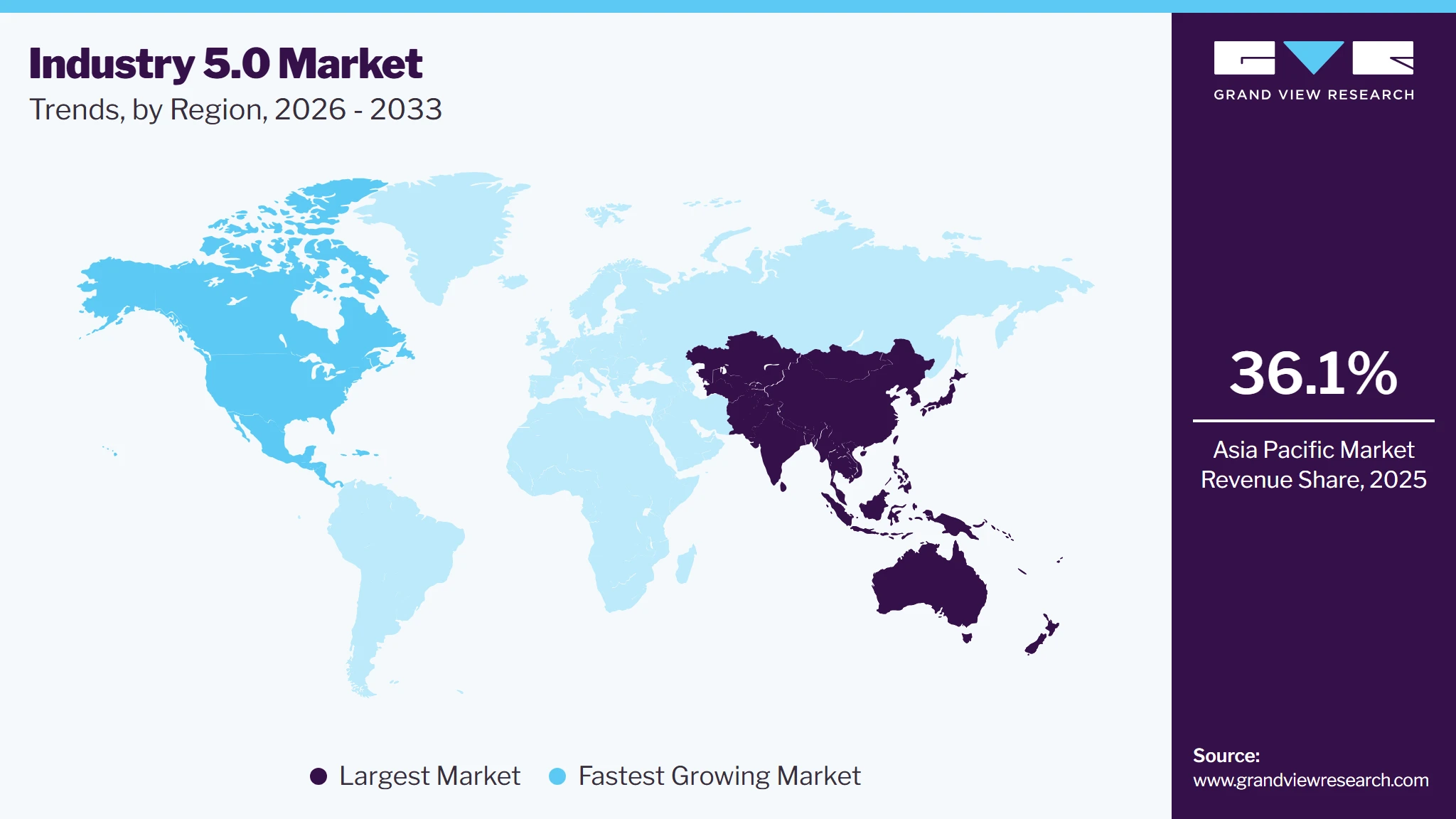
Asia Pacific dominated the Industry 5.0 market with the largest revenue share of 36.1% in 2025. Asia Pacific is witnessing significant growth in Industry 5.0 adoption, led by technological advancements in robotics, AI, and cloud computing. The region’s manufacturing powerhouses are investing heavily in smart factories, autonomous systems, and real-time data analytics. Rising demand for industrial automation in automotive, electronics, and healthcare sectors is propelling market expansion.
 To learn more about this report, Download Free Sample Report
 The Industry 5.0 market in China held the largest share in the Asia Pacific region in 2025. China is at the forefront of Industry 5.0 adoption, with aggressive investments in robotics, AI, and smart manufacturing technologies. The government’s “Made in China 2025” initiative is accelerating large-scale automation, reducing dependency on manual labor, and enhancing supply chain efficiency. The integration of AI-powered predictive maintenance and digital twin solutions is further optimizing industrial productivity and positioning China as a global leader in advanced manufacturing.
Japan continues to lead in robotics and AI-driven automation, with Industry 5.0 initiatives centered on human-machine collaboration. The country’s advanced robotics ecosystem and expertise in cyber-physical systems are shaping the future of smart manufacturing. Investments in 6G, edge computing, and IoT-based industrial solutions are enhancing operational efficiency and scalability across diverse industries, reinforcing Japan’s role as a key innovator in the Industry 5.0 market.
Key Industry 5.0 Company Insights
Some of the key players operating in the market include ABB and Siemens
-
Siemens is a global leader in industrial automation, digitalization, and smart manufacturing solutions, offering technologies such as digital twins, IoT platforms, and AI-driven analytics. Their solutions enable manufacturers to create highly efficient, sustainable, and human-centric production systems. Siemens is at the forefront of integrating AI and machine learning into industrial processes, enhancing predictive maintenance and operational efficiency. As a key player in Industry 5.0, Siemens is driving the convergence of physical and digital systems to foster collaboration between humans and machines.
-
ABB is a powerhouse in robotics, automation, and electrification, providing advanced solutions for industrial applications. Their collaborative robots and energy-efficient systems are transforming manufacturing by enabling flexible and sustainable production. ABB is investing heavily in AI-powered automation and digital twins to optimize industrial processes and improve productivity. In the context of Industry 5.0, ABB is focused on creating adaptive, human-centric ecosystems that prioritize safety, efficiency, and innovation.
Universal Robots A/S, and Nexus Integra are some of the emerging participants in the Industry 5.0 market.
-
Universal Robots is a pioneer in collaborative robots (cobots), designed to work safely alongside humans in industrial environments. Their cobots are known for their flexibility, ease of use, and ability to adapt to various tasks, making them ideal for small and medium-sized enterprises (SMEs). The company is driving the adoption of human-robot collaboration, enabling more personalized and efficient manufacturing processes. With the integration of AI and machine learning, Universal Robots is expanding its applications into healthcare, logistics, and other non-traditional sectors.
-
Nexus Integra provides an open IoT platform that integrates data from multiple sources to enable real-time decision-making and predictive maintenance in industrial settings. Their platform supports smart factory solutions, helping manufacturers achieve greater efficiency and sustainability. By focusing on interoperability and data-driven insights, Nexus Integra is playing a key role in the transition to Industry 5.0. Their solutions empower businesses to create adaptive, human-centric production systems that prioritize collaboration and innovation.
Key Industry 5.0 Companies
The following key companies have been profiled for this study on the industry 5.0 market.
-
ABB
-
Honeywell International Inc.
-
3D Systems
-
Rockwell Automation
-
Siemens
-
Emerson Electric Co
-
Piher Sensing Systems
-
Stratasys
-
Schneider Electric
-
Cisco Systems, Inc.
-
FANUC CORPORATION
-
Yaskawa Electric Corp
-
Kuka AG
-
Universal Robots A/S
Competitive Benchmarking
Category
Operating Strategies
Competitive Edge
Weakness
Established Players (ABB, Honeywell International Inc., Siemens)
- Focus on expanding human-centric manufacturing ecosystems through AI, robotics, industrial software, and automation partnerships.
- Invest heavily in intelligent factory platforms, digital engineering, sustainability solutions, and global industrial transformation initiatives.
- A strong global manufacturing presence, extensive industrial expertise, and a diversified automation portfolio strengthen competitive leadership.
- Ability to deliver integrated Industry 5.0 solutions combining AI, cobots, digital twins, and industrial IoT.
- Dependence on legacy industrial platforms increases integration complexity across modern intelligent manufacturing environments.
- Large organizational structures may reduce deployment agility and slow response to emerging industrial technology trends.
Emerging Players (Yaskawa Electric Corp, Kuka AG, Universal Robots A/S)
- Emerging players focus on developing niche AI, collaborative robotics, and digital manufacturing solutions for specialized industrial applications.
- Expand market presence through strategic collaborations, pilot projects, and cloud-based industrial software innovation.
- High innovation agility enables the rapid development of specialized Industry 5.0 technologies to meet evolving manufacturing requirements.
- Flexible business models support faster customization and deployment across diverse industrial production environments.
- Limited financial resources constrain global expansion and large-scale Industry 5.0 deployment.
- A smaller customer base reduces market visibility against established industrial automation and technology providers.
Recent Developments
-
In January 2024, Siemens introduced groundbreaking innovations at CES 2024, the world’s premier technology event, aimed at bridging the physical and digital worlds to redefine industrial reality. The company unveiled advancements in AI and immersive engineering designed to accelerate the adoption of the industrial metaverse. Siemens also showed how these technologies are empowering global innovators through its open digital business platform, Siemens Xcelerator, enabling greater efficiency and transformation across industries.
-
In April 2023, Stratasys launched GrabCAD Print Pro software, featuring integrated quality assurance capabilities from Riven. This advanced solution optimizes print preparation for Stratasys 3D printers, catering to manufacturers aiming for efficient large-scale production of end-use parts. The software enhances print accuracy, minimizes material waste, and accelerates time-to-market, driving greater efficiency in additive manufacturing.
Industry 5.0 Market Report Scope
Report Attribute
Details
Market size in 2025
USD 85.0 Billion
Estimated market size in 2026
USD 108.5 Billion
Projected market size by 2033
USD 676.5 Billion
Growth rate
CAGR of 29.9% from 2026 to 2033
Base year for estimation
2025
Historical data
2021 - 2024
Forecast period
2026 - 2033
Quantitative units
Revenue in USD Billion, and CAGR from 2026 to 2033
Report coverage
Revenue forecast, company ranking, competitive landscape, growth factors, and trends
Segments covered
Component, technology, end use, and regional
Regional scope
North America; Europe; Asia Pacific; Latin America; MEA
Country scope
U.S.; Canada; Mexico; U.K.; Germany; France; China; Japan; India; South Korea; Australia; Brazil; Saudi Arabia; UAE; South Africa
Key companies profiled
ABB; Honeywell International Inc.; 3D Systems; Rockwell Automation; Siemens; Emerson Electric Co.; Piher Sensing Systems; Stratasys; Schneider Electric; Cisco Systems, Inc.; FANUC CORPORATION; Yaskawa Electric Corp; Kuka AG
Customization scope
Free report customization (equivalent up to 8 analysts' working days) with purchase. Addition or alteration to country, regional & segment scope.
Pricing and purchase options
Avail customized purchase options to meet your exact research needs. Explore purchase options
Global Industry 5.0 Market Report Segmentation
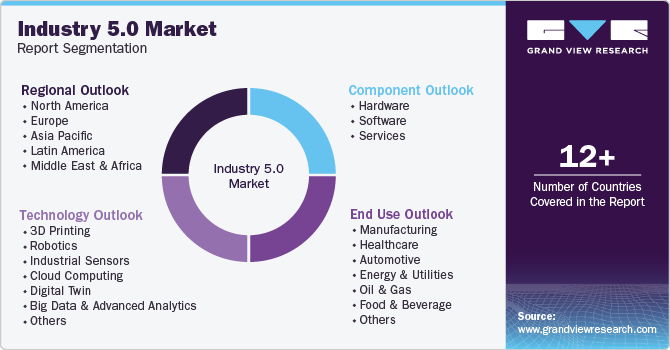
This report forecasts revenue growth at the regional and country levels and provides an analysis of the latest industry trends and opportunities in each of the sub-segments from 2018 to 2030. For this study, Grand View Research has segmented the Industry 5.0 market report based on component, technology, end use, and region:
 To learn more about this report, Download Free Sample Report
 -
Component Outlook (Revenue, USD Million, 2018 - 2030)
-
Hardware
-
Software
-
Services
-
-
Technology Outlook (Revenue, USD Million, 2018 - 2030)
-
3D Printing
-
Robotics
-
Industrial Sensors
-
Cloud Computing
-
Artificial Intelligence (AI) & Machine Learning (ML)
-
Augmented Reality (AR) & Virtual Reality (VR)
-
Digital Twin
-
Big Data & Advanced Analytics
-
Others
-
-
End Use Outlook (Revenue, USD Million, 2018 - 2030)
-
Manufacturing
-
Healthcare
-
Automotive
-
Energy & Utilities
-
Oil and Gas
-
Food & Beverage
-
Aerospace and Defense
-
Others
-
-
Regional Outlook (Revenue, USD Million, 2018 - 2030)
-
North America
-
U.S.
-
Canada
-
Mexico
-
-
Europe
-
Germany
-
UK
-
France
-
-
Asia Pacific
-
China
-
Japan
-
India
-
South Korea
-
Australia
-
-
Latin America
-
Brazil
-
-
Middle East and Africa
-
UAE
-
Saudi Arabia
-
South Africa
-
-
Research Methodology
The industry 5.0 market figures in this report are based on a proven research process that combines executive interviews with secondary research from proprietary databases, company filings, and recognized regulatory and institutional sources. Market size is built through value-chain sizing - reconciling supply-side and demand-side estimates - and triangulated with bottom-up and top-down approaches. Every estimate passes multiple levels of expert validation before publication, with each industry 5.0 segment quantified using the revenue-capture definitions in the table below.
Segment Definition
Segment - Component
Revenue capture definition
Hardware
Revenue is generated through intelligent hardware supporting collaborative manufacturing, connected production environments, and real-time industrial automation. This segment is driven by increasing deployment of collaborative robots, industrial sensors, edge devices, smart controllers, and advanced production equipment across modern manufacturing facilities.
Software
Revenue is captured through industrial software platforms enabling intelligent production planning, process optimization, predictive analytics, digital engineering, and connected factory operations. This segment is propelled by the growing adoption of AI-driven applications, digital twins, manufacturing execution systems, and industrial data management solutions.
Services
Revenue is generated through consulting, system integration, deployment, maintenance, workforce training, and managed services supporting Industry 5.0 implementation. This segment is driven by increasing demand for customized digital transformation strategies, technology integration, and continuous operational optimization across industrial enterprises.
Segment – Technology
Revenue capture definition
3D Printing
Revenue is generated through additive manufacturing solutions supporting rapid prototyping, customized production, spare parts manufacturing, and lightweight component fabrication. This segment is driven by increasing demand for flexible production processes, material efficiency, and personalized manufacturing capabilities.
Robotics
Revenue is captured through collaborative robots, autonomous robotic systems, and intelligent automation solutions supporting human-machine collaboration across industrial operations. This segment is propelled by rising investments in flexible manufacturing, worker safety, precision assembly, and productivity enhancement.
Industrial Sensors
Revenue is generated through smart sensing technologies enabling real-time equipment monitoring, predictive maintenance, environmental sensing, and production quality control. This segment is driven by the increasing adoption of connected manufacturing systems requiring accurate operational data and continuous asset monitoring.
Cloud Computing
Revenue is captured through cloud-based industrial platforms supporting remote monitoring, production management, industrial data storage, and enterprise-wide collaboration. This segment is propelled by growing demand for scalable digital infrastructure, centralized analytics, and connected manufacturing ecosystems.
Artificial Intelligence (AI)
& Machine Learning (ML)
Revenue is generated through AI-powered solutions supporting predictive maintenance, quality inspection, production scheduling, demand forecasting, and intelligent process optimization. This segment is driven by the increasing adoption of autonomous decision support and data-driven manufacturing operations.
Augmented Reality (AR) &
Virtual Reality (VR)
Revenue is captured through immersive technologies supporting workforce training, remote maintenance, equipment visualization, and digital work instructions. This segment is propelled by increasing focus on operational efficiency, employee assistance, and real-time industrial collaboration.
Digital Twin
Revenue is generated through virtual production models supporting equipment simulation, process optimization, asset lifecycle management, and operational performance analysis. This segment is driven by increasing demand for real-time monitoring, predictive insights, and intelligent manufacturing optimization.
Big Data & Advanced Analytics
Revenue is captured through analytics platforms supporting operational intelligence, production optimization, supply chain visibility, and quality improvement. This segment is propelled by growing volumes of industrial data and increasing reliance on real-time analytical decision-making.
Others
Revenue is generated through emerging Industry 5.0 technologies, including blockchain, edge intelligence, autonomous systems, advanced connectivity, and cyber-physical platforms. This segment is driven by continuous technological innovation and expanding industrial digitalization initiatives.
Segment – End Use
Revenue capture definition
Manufacturing
Revenue is generated through Industry 5.0 solutions supporting collaborative production, intelligent automation, quality optimization, and sustainable manufacturing operations. This segment is driven by increasing investments in smart factories, workforce collaboration, and resilient production systems.
Healthcare
Revenue is captured through intelligent manufacturing technologies supporting medical device production, pharmaceutical manufacturing, laboratory automation, and personalized healthcare solutions. This segment is propelled by growing demand for precision manufacturing, regulatory compliance, and production traceability.
Automotive
Revenue is generated through connected production systems supporting vehicle assembly, component manufacturing, predictive maintenance, and flexible production lines. This segment is driven by increasing adoption of collaborative robotics, digital engineering, and customized vehicle manufacturing.
Energy & Utilities
Revenue is captured through intelligent industrial solutions supporting power generation, grid infrastructure, renewable energy equipment manufacturing, and asset performance optimization. This segment is propelled by increasing focus on operational resilience, energy efficiency, and predictive asset management.
Oil and Gas
Revenue is generated through Industry 5.0 technologies supporting equipment manufacturing, refinery operations, predictive maintenance, and industrial asset monitoring. This segment is driven by increasing demand for operational efficiency, workforce safety, and intelligent process automation.
Food & Beverage
Revenue is captured through connected manufacturing systems supporting food processing, packaging automation, quality assurance, and production traceability. This segment is propelled by rising emphasis on product consistency, regulatory compliance, and efficient resource utilization.
Aerospace and Defense
Revenue is generated through advanced manufacturing technologies supporting aircraft production, defense equipment manufacturing, precision engineering, and supply chain optimization. This segment is driven by increasing demand for high-quality production, digital design integration, and intelligent manufacturing processes.
Others
Revenue is captured through Industry 5.0 solutions supporting electronics, chemicals, consumer goods, logistics, mining, and industrial equipment manufacturing. This segment is propelled by the expanding adoption of human-centric automation, intelligent production systems, and sustainable industrial operations across diverse industries.
Estimation Model
Layer No.
Layer Name
Key Question
Description
01
Enterprise Adoption Layer
Who are the potential adopters?
Identifies the primary organizations adopting Industry 5.0 solutions, including manufacturing companies, automotive manufacturers, aerospace firms, electronics producers, pharmaceutical companies, energy and utility providers, logistics companies, and industrial enterprises seeking human-centric production, intelligent automation, operational resilience, sustainability, and mass customization.
02
Technology Enablement Layer
Who can deploy Industry 5.0 solutions?
Deployment depends on the availability of collaborative robots, industrial artificial intelligence, industrial IoT infrastructure, digital twin platforms, edge computing, cloud connectivity, industrial sensors, cybersecurity frameworks, advanced analytics, skilled personnel, and integrated automation systems supporting connected, intelligent manufacturing environments.
03
Application Layer
Where are Industry 5.0 solutions actively utilized?
Industry 5.0 solutions are deployed across smart manufacturing, assembly operations, quality inspection, predictive maintenance, warehouse automation, supply chain optimization, energy management, digital engineering, customized manufacturing, and industrial workforce collaboration, supporting intelligent, flexible, and sustainable production operations.
04
Revenue Generation Layer
How is revenue generated?
Revenue is generated through industrial hardware sales, software licensing, cloud-based manufacturing platforms, system integration, consulting services, deployment, workforce training, maintenance contracts, predictive analytics solutions, digital twin implementation, AI-enabled automation platforms, and recurring revenue from software subscriptions, upgrades, and managed industrial services.
Delivered Customizations
This report has been delivered with the following In-depth customizations
Client Request
Customization Delivered
Value Adds
Human-Centric Manufacturing Transformation Assessment
Conducted detailed assessment of human-centric manufacturing initiatives across production facilities, integrating collaborative robots, AI-enabled decision support, workforce augmentation technologies, digital workstations, and intelligent process optimization frameworks to improve operational resilience, employee productivity, and manufacturing efficiency.
Improves workforce collaboration, increases productivity, enhances operational resilience, supports intelligent manufacturing, and strengthens sustainable industrial performance.
Smart Factory Digitalization & Intelligent Automation Strategy
Evaluated deployment of smart factory technologies integrating industrial IoT, digital twins, edge computing, predictive maintenance, connected production systems, and real-time analytics to optimize manufacturing operations, equipment utilization, production flexibility, and process visibility across industrial environments.
Enhances factory intelligence, improves asset utilization, increases production flexibility, enables predictive operations, and reduces operational inefficiencies.
Sustainable Manufacturing & Industrial AI Implementation Strategy
Assessed implementation of industrial artificial intelligence, energy optimization platforms, autonomous quality management, intelligent production planning, and sustainability-focused manufacturing solutions to improve environmental performance, operational efficiency, and resilient industrial operations.
Optimizes resource efficiency, improves sustainability performance, enhances production quality, enables intelligent operations, and supports regulatory compliance.
Frequently Asked Questions About This Report
The Asia Pacific is the fastest-growing region with a CAGR of over 32% from 2026 to 2033.
The hardware segment dominated with a 50.1% revenue share in 2025.
The robotics segment dominated the market with a share of 17.1% in 2025.
The manufacturing segment accounted for the largest share, with 31.6% of revenue in 2025.
The global Industry 5.0 market size was estimated at USD 85.0 billion in 2025 and is expected to reach USD 108.5 billion in 2026.
Asia Pacific dominated the Industry 5.0 market with a share of 36.1% in 2025.
Some key players operating in the Industry 5.0 market include ABB, Honeywell International Inc., 3D Systems, Rockwell Automation, Siemens, Emerson Electric Co., Piher Sensing Systems, Stratasys, Schneider Electric, Cisco Systems, Inc., FANUC CORPORATION, Yaskawa Electric Corp, and Kuka AG
Key factors that are driving the market growth include the integration of artificial intelligence for automation, the rise of advanced robotics for enhanced productivity, and the growing demand for personalized, human-centric solutions in manufacturing processes.
The global Industry 5.0 market is expected to grow at a compound annual growth rate of 29.9% from 2026 to 2033 to reach USD 676.5 billion by 2033.
About the Author(s)
Next Generation Technologies Research Team
Technology · Next Generation TechnologiesThis report was authored by the next generation technologies research team at Grand View Research - comprising two research analysts, one senior research analyst, and one industry expert - with specialized expertise in the next generation technologies segment of the technology industry. All findings are based on proprietary technology databases, executive interviews, and regulatory analysis, subject to internal peer review prior to publication.
Last Updated:
Speak to Analyst

Customize this report to your needs - add regions, segments, or data points, with 20% free customization.
Or view our licence options:


ISO 9001:2015 & 27001:2022 Certified
We are GDPR and CCPA compliant! Your transaction & personal information is safe and secure. For more details, please read our privacy policy.


