
- Home
- »
- Next Generation Technologies
- »
-
Integration Platform as a Service Market Size Report, 2033GVR Report cover

Integration Platform as a Service Market (2026 - 2033) Size, Share & Trends Analysis Report By Service (Cloud Service Orchestration, Data Transformation, API Management), By Deployment (Public Cloud, Private Cloud, Hybrid Cloud), By Enterprise Size, By End Use, By Region, And Segment Forecasts
Market Size, 2025
$12.9BMarket Estimate, 2026
$15.9BMarket Forecast, 2033
$55.5BCAGR, 2026–2033
19.6%Integration Platform as a Service Market Summary
The global integration platform as a service market size was valued at USD 12.9 billion in 2025 and is projected to grow from USD 15.9 billion in 2026 to USD 55.5 billion by 2033, at a CAGR of 19.6% from 2026 to 2033. The market in North America dominated with a revenue share of 36.3% in 2025. Integration Platform as a Service (iPaaS) is a comprehensive platform designed to streamline the management of integrations and data flows across cloud and on-premises applications.
 Source: Grand View Research, IR Documents, Primary Interviews, Paid DatabasesTo learn more about this report,
 Download Free Sample Report
 Key Market Trends & Insights
- By service: The cloud service orchestration segment held the largest revenue share of 26.3% in 2025.
- By deployment: The public cloud segment held the largest revenue share in 2025.
- By enterprise size: The large enterprises segment held the largest revenue share in 2025.
Regional Highlights
- Largest regional market: North America (36.3% revenue share, 2025)
- Fastest-growing regional market: Asia Pacific (highest CAGR, 2026-2033)
- By country: The U.S. held the largest market share in 2025.
Market Size & Forecast
- Market size in 2025: USD 12.9 Billion
- Estimated market size in 2026: USD 15.9 Billion
- Projected market size by 2033: USD 55.5 Billion
- CAGR (2026-2033): 19.6%
Three ways to get this report
Buy it, customize it, or ask a question.Ask an Analyst
Analyst response in 1 business day
- AccessReport author, directly
- Reply timeWithin 1 working day
- No sales callDirect answer only
- FormatEmail reply
- CostFree, no cost
Get the Full Report
What the study covers
- FormatsPDF · Excel · Dashboard
- Timeline2026–2033 annual, 2025 base
- Coverage20+ countries, 5 regions
- Companies10+ key players profiled
Customize the Report
20% free customization
- IncludeCountries, segments, points
- TailorTo your product definition
- ExtendDeeper competitor detail
- OrA fully bespoke study
- Turnaround5–10 working days
iPaaS enables modern enterprises to seamlessly connect to and use data in real time across multi-cloud and hybrid environments by providing a single, reliable source of data. However, the increasing complexity of IT ecosystems and the widespread use of diverse applications, both on-premises and in the cloud, have created a critical need for seamless connectivity. Integration Platform as a Service (iPaaS) can address this need by simplifying integration processes, enabling businesses to connect disparate systems and applications more easily. This improves operational efficiency and speeds up the time-to-market for new projects. To learn more about this report, Download Free Sample Report
 The rising demand for real-time data access and analytics is also a key driver for the iPaaS market. Businesses increasingly rely on real-time insights to make informed decisions and respond quickly to market changes. iPaaS platforms enable real-time data integration and streaming across different systems, ensuring that decision-makers have access to up-to-date information. This is particularly important in industries such as finance, retail, and healthcare, where timely data can affect operational outcomes. By enabling faster data flow and analysis, iPaaS solutions enhance business agility and responsiveness. As data-driven decision-making becomes a core strategy, the need for real-time integration capabilities continues to rise.
Another important driver is the growing emphasis on digital transformation initiatives across industries. Organizations are investing in digital technologies to improve customer experience, streamline operations, and create new business models. iPaaS plays a critical role in these initiatives by enabling integration between legacy systems and modern digital applications. It allows businesses to modernize their IT infrastructure without completely replacing existing systems. This reduces costs and accelerates the pace of digital transformation. Additionally, iPaaS supports the integration of emerging technologies such as artificial intelligence and IoT. As digital transformation becomes a strategic priority, the demand for integration platforms continues to expand.
The growing adoption of hybrid and multi-cloud strategies is driving the growth of the iPaaS market. Many organizations are using a combination of public, private, and on-premises systems to meet their specific needs. Managing integration across these diverse environments can be challenging without a unified platform. iPaaS solutions provide the flexibility to connect and manage data across multiple environments seamlessly. They also support scalability and adaptability, allowing businesses to expand their IT infrastructure as needed. As hybrid and multi-cloud adoption continues to rise, the demand for robust integration platforms is expected to grow steadily.
Market Dynamics
The growing focus on real-time data integration and analytics is a major driver for the market, as enterprises increasingly rely on instant access to accurate data for faster decision-making and operational efficiency. Organizations generate massive volumes of data across cloud applications, IoT devices, customer platforms, and enterprise systems, creating a need for seamless real-time synchronization. iPaaS solutions enable continuous data exchange, event-driven workflows, and automated processing across distributed environments without delays. This helps businesses improve customer experiences, optimize supply chains, detect risks quickly, and support AI-driven analytics. The rising demand for real-time business intelligence and agile operations is significantly accelerating the adoption of advanced cloud integration platforms globally.
High initial integration and migration costs remain a significant restraint for the market, particularly for large enterprises with complex IT infrastructures. While iPaaS solutions help reduce long-term operational and infrastructure expenses, organizations often face substantial upfront costs during implementation. These expenses include system assessment, consulting services, workflow customization, API development, data migration, security configuration, and integration with legacy applications. Additionally, enterprises must invest in employee training and change management programs to ensure smooth adoption of new cloud-based integration environments. For businesses operating across multiple regions and applications, deployment complexity further increases costs and implementation timelines, limiting adoption among cost-sensitive organizations and small to medium-sized enterprises.
Market Concentration & Characteristics
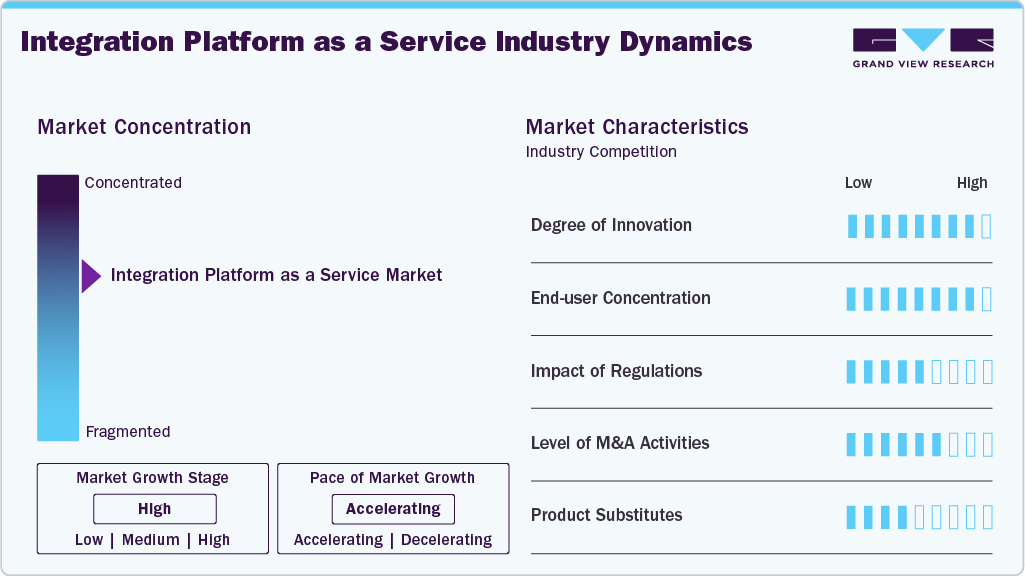
The integration platform as a service market is moderately concentrated, with a combination of large global cloud and enterprise software providers alongside specialized integration and automation vendors shaping the competitive landscape. Major players maintain substantial market share through comprehensive cloud integration portfolios, extensive partner ecosystems, strong enterprise customer bases, and continuous investments in AI-driven automation and hybrid integration capabilities. These vendors typically offer unified platforms encompassing application integration, API management, workflow orchestration, data integration, B2B/EDI integration, and low-code automation, creating significant barriers to entry for new participants due to complex enterprise integration requirements, high reliability expectations, compliance standards, and the need for deep interoperability across multi-cloud and legacy environments.
 To learn more about this report, Download Free Sample Report
 In terms of market characteristics, the industry is highly technology-driven and rapidly evolving, with strong emphasis on cloud-native architectures, artificial intelligence, low-code/no-code development, API-led connectivity, and real-time data orchestration. Demand is primarily fueled by accelerating digital transformation initiatives, increasing adoption of SaaS applications, hybrid and multi-cloud deployments, and the growing need for seamless data synchronization across distributed enterprise ecosystems. Additionally, the market is characterized by recurring subscription-based revenue models, high integration complexity, and strong customer retention, as enterprises often embed iPaaS solutions deeply into mission-critical workflows and operational processes, resulting in relatively high switching costs once deployments are fully implemented. The industry also experiences continuous innovation around event-driven integration, embedded AI assistants, cybersecurity enhancements, and industry-specific integration templates to support evolving enterprise automation requirements.
Service Insights
The cloud service orchestration segment accounted for the largest market share of 26.3% in 2025. As companies scale their operations, they require more agile and scalable solutions to manage complex integrations across diverse applications and data sources. Cloud service orchestration provides the flexibility to automate workflows, optimize resource utilization, and ensure consistency in data handling across the hybrid IT landscape. Moreover, the growing complexity of IT environments and the need for real-time data processing and analytics drive the demand for efficient orchestration tools that can streamline operations and enhance overall business agility.
The application programming interfaces (API) management segment is projected to be the fastest-growing segment from 2026 to 2033. APIs are crucial connectors that enable seamless communication and integration between various applications, systems, and services. As businesses increasingly adopt cloud-based solutions and diverse software environments, efficient API management becomes crucial. Organizations seek to streamline their operations by securely exposing, managing, and monetizing APIs, enhancing agility and scalability while maintaining robust security measures. Additionally, the proliferation of microservices architecture further drives the demand for API management within iPaaS, as it facilitates modular development and accelerates time-to-market for new applications and services.
Deployment Insights
The public cloud segment dominated the integration platform as a service market in 2025. Public cloud offerings provide scalability and flexibility, enabling businesses to easily scale their integration needs as demand changes without the heavy upfront infrastructure investment. This scalability is crucial in today's dynamic business environment. Public cloud platforms offer a wide array of integration tools and services, often including pre-built connectors and APIs that facilitate rapid integration across various applications and systems. This reduces time-to-market for new integrations and enhances operational efficiency. The cost-effectiveness of public cloud solutions appeals to businesses looking to optimize IT spending by paying only for the resources they use.
The hybrid cloud segment is projected to be the fastest-growing segment from 2026 to 2033. The demand for the hybrid cloud segment in the iPaaS industry is anticipated to rise primarily due to its ability to offer greater flexibility and scalability to businesses. Hybrid cloud environments allow companies to integrate and manage data and applications across both on-premises infrastructure and public or private cloud platforms. This flexibility is crucial for enterprises looking to optimize their IT infrastructure while maintaining control over sensitive data and applications that require on-premises hosting.
Enterprise Size Insights
The large enterprises segment dominated the integration platform as a service industry in 2025. Large enterprises typically have complex IT environments with diverse applications, systems, and data sources across various departments and locations. iPaaS solutions offer these enterprises a centralized platform to seamlessly integrate and manage their disparate systems, improving operational efficiency and data visibility. Scalability is essential for large enterprises as they often experience rapid growth or need to accommodate fluctuating demand. iPaaS provides scalability by allowing enterprises to easily scale up or down their integration capabilities based on business needs without significant upfront investments in infrastructure.
The small & medium enterprises (SMEs) segment is projected to be the fastest-growing segment from 2026 to 2033. The highly competitive market environment has driven small and medium-sized enterprises (SMEs) to invest in iPaaS solutions to reach their target audience effectively. By adopting cloud storage, SMEs can increase revenue, achieve their goals, and enhance overall business efficiency. SMEs often need help managing capital, hiring skilled employees, and ensuring scalability. To address these issues, SMEs opt for a pay-as-you-go model that enables them to enhance business performance, make informed decisions, and streamline as needed at a lower cost.
End Use Insights
The BFSI segment dominated the market in 2025. The BFSI industry operates in a highly regulated environment, subject to numerous data privacy and security standards. iPaaS solutions offer robust integration capabilities that help streamline operations across various systems and applications while ensuring compliance with stringent regulations. With increasing competition, BFSI firms seek to optimize costs and improve agility. iPaaS solutions provide scalable, cost-effective integration that reduces time-to-market for new products and services, which is crucial for staying competitive in the dynamic financial services landscape.
-market-share.webp "Integration Platform as a Service (iPaaS) Market Revenue Share") To learn more about this report, Download Free Sample Report
To learn more about this report, Download Free Sample Report The retail segment is projected to be the fastest-growing segment from 2026 to 2033. Retailers increasingly adopt digital transformation strategies to enhance operational efficiencies and improve customer experiences. iPaaS solutions are crucial in integrating disparate systems and applications within retail operations, including e-commerce platforms, inventory management systems, CRM software, and more. This integration helps streamline workflows, facilitate real-time data exchange, and improve decision-making processes. The shift towards omnichannel retailing requires seamless connectivity between online and offline channels, which iPaaS platforms can efficiently manage.
Regional Insights
The North America integration platform as a service (iPaaS) industry dominated with a market share of 36.3% in 2025. North American enterprises increasingly adopt cloud-based solutions to streamline operations and enhance scalability. iPaaS offers a centralized platform that facilitates seamless integration of diverse applications and data sources across cloud and on-premises environments. This is crucial in a market characterized by rapid digital transformation. Moreover, the region's robust regulatory environment and stringent data protection laws require secure, compliant data integration solutions, further driving the adoption of iPaaS. Additionally, North American businesses focus on improving agility and time-to-market by leveraging iPaaS to integrate new technologies and applications quickly, without lengthy development cycles.
-market-trends-by-region.webp "Integration Platform as a Service (iPaaS) Market Trends, by Region, 2026 - 2033") To learn more about this report, Download Free Sample Report
To learn more about this report, Download Free Sample Report U.S. Integration Platform as a Service (iPaaS) Market Trends
The integration platform as a service industry in the U.S. is projected to grow during the forecast period. Businesses across various sectors are increasingly adopting cloud-based solutions to streamline operations and enhance agility. iPaaS offers a centralized platform that enables seamless integration of disparate applications and data sources, which is crucial for businesses aiming to achieve digital transformation goals. The rise of hybrid IT environments, where organizations use both on-premises and cloud-based systems, necessitates the robust integration capabilities that iPaaS provides.
Asia Pacific Integration Platform as a Service (iPaaS) Market Trends
The integration platform as a service industry in the Asia Pacific is expected to exhibit the fastest growth with a CAGR of 22.1% over the forecast period. Asia-Pacific countries are experiencing rapid digital transformation across various retail, manufacturing, healthcare, and finance sectors. These industries increasingly adopt cloud-based solutions to streamline operations, improve efficiency, and enhance customer experiences. Secondly, there is a growing trend towards hybrid IT environments, where businesses integrate on-premises systems with cloud applications to leverage both on-premises and cloud benefits. Lastly, the proliferation of mobile devices and internet connectivity across the Asia-Pacific has fueled the demand for iPaaS solutions to support seamless integration across multiple platforms and devices, enabling real-time data access and analytics.
The China integration platform as a service (iPaaS) industry is witnessing significant growth. China's digital transformation has resulted in a surge in the use of cloud services, highlighting the importance of iPaaS for smooth data integration. The growing industrial and manufacturing sectors depend on effective data workflows, creating a need for iPaaS solutions. In addition, the expanding Small and Medium-sized Enterprises (SMEs) sector in China views iPaaS as a versatile, scalable solution for optimizing workflows and connecting applications. Moreover, China's digital innovation environment, combined with the adoption of cloud technology, establishes iPaaS as a crucial element of contemporary business infrastructure.
The iPaaS industry in India has gained traction from the digital transformation drive across sectors such as banking, e-commerce, healthcare, and government services, propelling the need for seamless integration of diverse applications, data sources, and systems. This integration enhances operational efficiency, customer experience, and overall business agility. The rise of cloud adoption among Indian enterprises drives the need for iPaaS solutions that securely connect cloud-based and on-premises applications. This shift is driven by cost-effectiveness, scalability, and the flexibility of iPaaS platforms in managing hybrid IT environments.
Europe Integration Platform as a Service (iPaaS) Market Trends
The integration platform as a service industry in Europe is expected to grow robustly during the forecast period. European enterprises increasingly prioritize digital transformation initiatives to enhance operational efficiency and customer engagement. iPaaS solutions offer streamlined integration across diverse applications and data sources, which is crucial for businesses aiming to modernize their IT infrastructure without incurring extensive redevelopment costs. Stringent data protection regulations, such as GDPR, necessitate robust, compliant data integration solutions, driving the adoption of iPaaS platforms with built-in security and compliance features. The proliferation of cloud computing across Europe has driven demand for iPaaS, as organizations seek scalable, agile integration solutions to seamlessly connect on-premises systems with cloud-based applications.
The UK integration platform as a service (iPaaS) industry is witnessing significant growth. Businesses across sectors, including finance, retail, and healthcare, are increasingly adopting cloud-based solutions to streamline operations and improve efficiency. iPaaS provides a centralized platform that facilitates the integration of diverse applications and data sources, a capability that is crucial in the UK's complex regulatory environment. The shift towards digital transformation initiatives has fueled the need for seamless connectivity between on-premises systems and cloud-based applications, enabling companies to enhance customer experiences and operational agility. Moreover, the scalability and cost-effectiveness of iPaaS solutions benefit organizations looking to modernize their IT infrastructure without significant upfront investments.
The iPaaS industry in Germany is seen as lucrative in this industry. The rise of digital transformation initiatives across manufacturing, automotive, and financial services is driving the need for iPaaS solutions that integrate legacy systems with newer technologies such as IoT and AI. This integration enables real-time data sharing and analytics, facilitating better decision-making and enhanced customer service. Stringent data protection regulations in Germany, such as GDPR, require robust data management and security measures, which iPaaS platforms can provide through built-in compliance features.
Key Integration Platform as a Service (iPaaS) Company Insights
Some of the key companies in the integration platform as a service (iPaaS) market include Informatica Inc., Boomi, SAP SE, Oracle Corporation, Salesforce, Inc., Workato, SnapLogic Inc., Software AG, IBM Corporation, and Jitterbit. These companies are focusing on development & to gain a competitive edge in the industry. Therefore, key players are taking several strategic initiatives.
-
Informatica IPaaS delivers a productive data management environment powered by CLAIRE, an AI engine. Its platform enables organizations to achieve end-to-end automation by efficiently managing vast amounts of data and events in real-time. This empowers businesses to create process automation workflows and integration patterns effortlessly.
-
Boomi offers an Integration Platform as a Service (iPaaS) that facilitates the seamless connection of applications and data sources. This platform is designed for low-code development, providing essential features such as API, lifecycle management, and event-driven architecture for cloud integration.
Key Integration Platform as a Service (iPaaS) Companies:
The following key companies have been profiled for this study on the integration platform as a Service (iPaaS) market.
- Boomi
- IBM Corporation
- Informatica Inc.
- Jitterbit
- Oracle Corporation
- Salesforce, Inc.
- SAP SE
- SnapLogic Inc.
- Software AG
- Workato
Competitive Benchmarking
Operating Strategies
Competitive Edge
Weakness
Mature Players: Microsoft Corporation; Salesforce; Informatica; Boomi; SAP; Oracle; IBM Corporation
- Expanding from standalone integration tools toward unified cloud ecosystems combining API management, workflow automation, data integration, AI orchestration, and application connectivity.
- Investing heavily in AI-enabled automation, low-code/no-code development, and industry-specific integration templates to simplify enterprise deployment.
- Leveraging hyperscale cloud infrastructure and extensive partner ecosystems to support hybrid and multi-cloud enterprise environments globally.
- Acquiring niche API management, automation, and data orchestration firms to strengthen end-to-end enterprise integration capabilities.
- Deep enterprise relationships and long-term contracts with large organizations create high customer retention and switching costs.
- Extensive connector libraries, developer ecosystems, and interoperability support across thousands of enterprise applications and legacy systems.
- Strong scalability, cybersecurity capabilities, compliance certifications, and global cloud infrastructure support mission-critical enterprise workloads.
- Ability to offer integrated platforms that combine analytics, AI, ERP, CRM, and cloud services within a single ecosystem.
- Legacy integration architectures and complex product portfolios can increase deployment complexity and implementation timelines.
- Premium pricing models and consumption-based costs can become expensive for mid-sized enterprises with high integration volumes.
- Large organizational structures may slow innovation cycles and limit agility in adopting emerging technologies such as GenAI-native automation.
- Vendor lock-in concerns due to proprietary ecosystems and tightly integrated cloud service portfolios.
Emerging Players: Workato; SnapLogic; Celigo; Tray.io; Jitterbit; Zapier
- Building API-first, low-code/no-code integration platforms designed for rapid deployment and ease of use.
- Targeting underserved mid-market and departmental use cases with faster deployment models and lower upfront integration costs.
- Offering specialized SaaS connectors and embedded integration capabilities tailored for modern cloud-native applications.
- Faster product innovation cycles and quicker rollout of automation and AI-driven features.
- Flexible subscription pricing and lightweight architectures appeal strongly to SMEs and digital-native organizations.
- Strong specialization in workflow automation, embedded integration, and SaaS application connectivity.
- Limited global service and support capabilities compared to large enterprise vendors.
- Smaller partner ecosystems and fewer enterprise-grade integrations for highly complex legacy environments.
- Dependence on third-party cloud infrastructure and external SaaS ecosystems can create scalability or interoperability limitations.
- Limited brand recognition and financial scale may create concerns around long-term platform stability for large enterprises handling mission-critical workloads.
Recent Developments
-
In May 2024, Boomi announced the acquisition of the federated API management business from APIIDA AG. This acquisition aims to introduce the federates API management capabilities of APIIDA to the Boomi enterprise platform. This will increase the scalability and security of the Boomi platform.
-
In June 2024, IBM announced the acquisition of StreamSets and webMethods, enhancing its automation, data integration, and AI capabilities. This acquisition strengthens IBM's portfolio by integrating StreamSets' data integration technology and webMethods' integration capabilities.
Integration Platform as a Service (iPaaS) Market Report Scope
Report Attribute
Details
Market size in 2025
USD 12.9 billion
Estimated market size in 2026
USD 15.9 billion
Projected market size by 2033
USD 55.5 billion
Growth rate
CAGR of 19.6% from 2026 to 2033
Actual data
2021 - 2025
Forecast period
2026 - 2033
Quantitative units
Revenue in USD million/billion and CAGR from 2026 to 2033
Report coverage
Revenue forecast, company share, competitive landscape, growth factors, and trends
Segments covered
Service, deployment, enterprise size, end use, region
Regional scope
North America; Europe; Asia Pacific; Latin America; MEA
Country scope
U.S.; Canada; Mexico; UK; Germany; France; China; India; Japan; Australia; South Korea; Brazil; UAE; Saudi Arabia; South Africa
Key companies profiled
Boomi; IBM Corporation; Informatica Inc.; Jitterbit; Oracle Corporation; Salesforce, Inc.; SAP SE; SnapLogic Inc.; Software AG; Workato
Customization scope
Free report customization (equivalent to 8 analysts working days) with purchase. Addition or alteration to country, regional & segment scope.
Pricing and purchase options
Avail customized purchase options to meet your exact research needs. Explore purchase options
Global Integration Platform as a Service Market Report Segmentation
This report forecasts revenue growth at global, regional, and country levels and provides an analysis of the latest industry trends in each of the sub-segments from 2021 to 2033. For this study, Grand View Research has segmented the global Integration Platform as a Service (iPaaS) market report based on service, deployment, enterprise size, end use, and region:
-
Service Outlook (Revenue, USD Billion, 2021 - 2033)
-
Cloud Service Orchestration
-
Data Transformation
-
API Management
-
Data Integration
-
Real-Time Monitoring and Integration
-
Others
-
-
Deployment Outlook (Revenue, USD Billion, 2021 - 2033)
-
Public Cloud
-
Private Cloud
-
Hybrid Cloud
-
-
Enterprise Size Outlook (Revenue, USD Billion, 2021 - 2033)
-
Small & Medium Enterprises
-
Large Enterprises
-
-
End Use Outlook (Revenue, USD Billion, 2021 - 2033)
-
IT & Telecommunication
-
BFSI
-
Healthcare
-
Retail
-
Manufacturing
-
Government
-
Energy and Utilities
-
Others
-
-
Regional Outlook (Revenue, USD Billion, 2021 - 2033)
-
North America
-
U.S.
-
Canada
-
Mexico
-
-
Europe
-
Germany
-
UK
-
France
-
-
Asia Pacific
-
China
-
India
-
Japan
-
South Korea
-
Australia
-
-
Latin America
-
Brazil
-
-
Middle East & Africa
-
UAE
-
Saudi Arabia
-
South Africa
-
-
Delivered Customizations
This report has been delivered with the following In-depth customizations
Client Request
Customization Delivered
Value Adds
iPaaS market opportunity assessment for a cloud integration and enterprise software provider
- Assessment of integration platform demand across major countries in APAC.
- Analysis of adoption trends for API integration, workflow automation, hybrid integration, and low-code/no-code platforms
- Benchmarking of key vendors, deployment models, pricing strategies, and platform capabilities
- Identified high-growth integration and automation segments
- Supported product positioning and competitive differentiation strategy
- Highlighted major adoption drivers, enterprise integration challenges, and cloud migration trends
Customized cross-segmentation analysis for the iPaaS market by deployment model and service outlook
- Conducted cross-segmentation analysis based on public cloud, hybrid cloud, and private cloud deployments across various service models
- Evaluated key solution categories such as cloud service orchestration, data transformation, API management, data integration, real-time monitoring and integration, and others
- Identified high-adoption software types driving digital transformation
- Highlighted end-user segments with the strongest demand
- Supported strategic understanding of technology penetration differences across agencies and jurisdictions
Regional market attractiveness analysis for iPaaS expansion
- Analysis of regional cloud infrastructure growth, enterprise SaaS adoption, and digital transformation investments across the Middle East and Latin America
- Assessment of regulatory considerations, localization requirements, and enterprise IT spending patterns
- Evaluation of demand from sectors such as BFSI, telecom, government, and retail
- Identified high-potential regional markets for expansion
- Supported investment prioritization and regional GTM planning
- Highlighted region-specific adoption drivers, barriers, and competitive intensity
Frequently Asked Questions About This Report
The global integration platform as a service market size was estimated at USD 12.9 billion in 2025 and is expected to reach USD 15.9 billion in 2026.
The global integration platform as a service market is expected to grow at a compound annual growth rate of 19.6% from 2026 to 2033 to reach USD 55.5 million by 2033.
Key factors that are driving the market growth include growing awareness about Ipaas among enterprises, reduced cost of ownership, and need for business agility, faster deployment, and scalability.
The cloud service orchestration segment accounted for the largest market share of 26.3% in 2025.
Key players include Boomi, IBM Corporation, Informatica Inc., Jitterbit, Oracle Corporation,Salesforce, Inc., SAP SE, SnapLogic Inc., Software AG, Workato.
The large enterprises segment dominated the market in 2025, while small & medium enterprises is the fastest-growing segment.
The public cloud held the largest revenue share in 2025, while hybrid cloud is the fastest-growing area.
North America dominated with a 36.3% revenue share in 2025.
Asia Pacific is the fastest-growing region over the forecast period.
About the Author(s)
Next Generation Technologies Research Team
Technology · Next Generation TechnologiesThis report was authored by the next generation technologies research team at Grand View Research - comprising two research analysts, one senior research analyst, and one industry expert - with specialized expertise in the next generation technologies segment of the technology industry. All findings are based on proprietary technology databases, executive interviews, and regulatory analysis, subject to internal peer review prior to publication.
Last Updated:
Speak to Analyst

Customize this report to your needs - add regions, segments, or data points, with 20% free customization.
Or view our licence options:


ISO 9001:2015 & 27001:2022 Certified
We are GDPR and CCPA compliant! Your transaction & personal information is safe and secure. For more details, please read our privacy policy.


