
- Home
- »
- Next Generation Technologies
- »
-
Intelligent Document Processing Market Report, 2026-2033GVR Report cover

Intelligent Document Processing Market (2026 - 2033)
Size, Share & Trends Analysis Report By Component (Solution, Services), By Technology (ML, NLP), By Deployment, By Organization Size, By End-use (Manufacturing, Retail), By Region, And Segment Forecasts
Market Size, 2025
$3.0BMarket Estimate, 2026
$3.9BMarket Forecast, 2033
$29.7BCAGR, 2026–2033
33.8%Intelligent Document Processing Market Summary
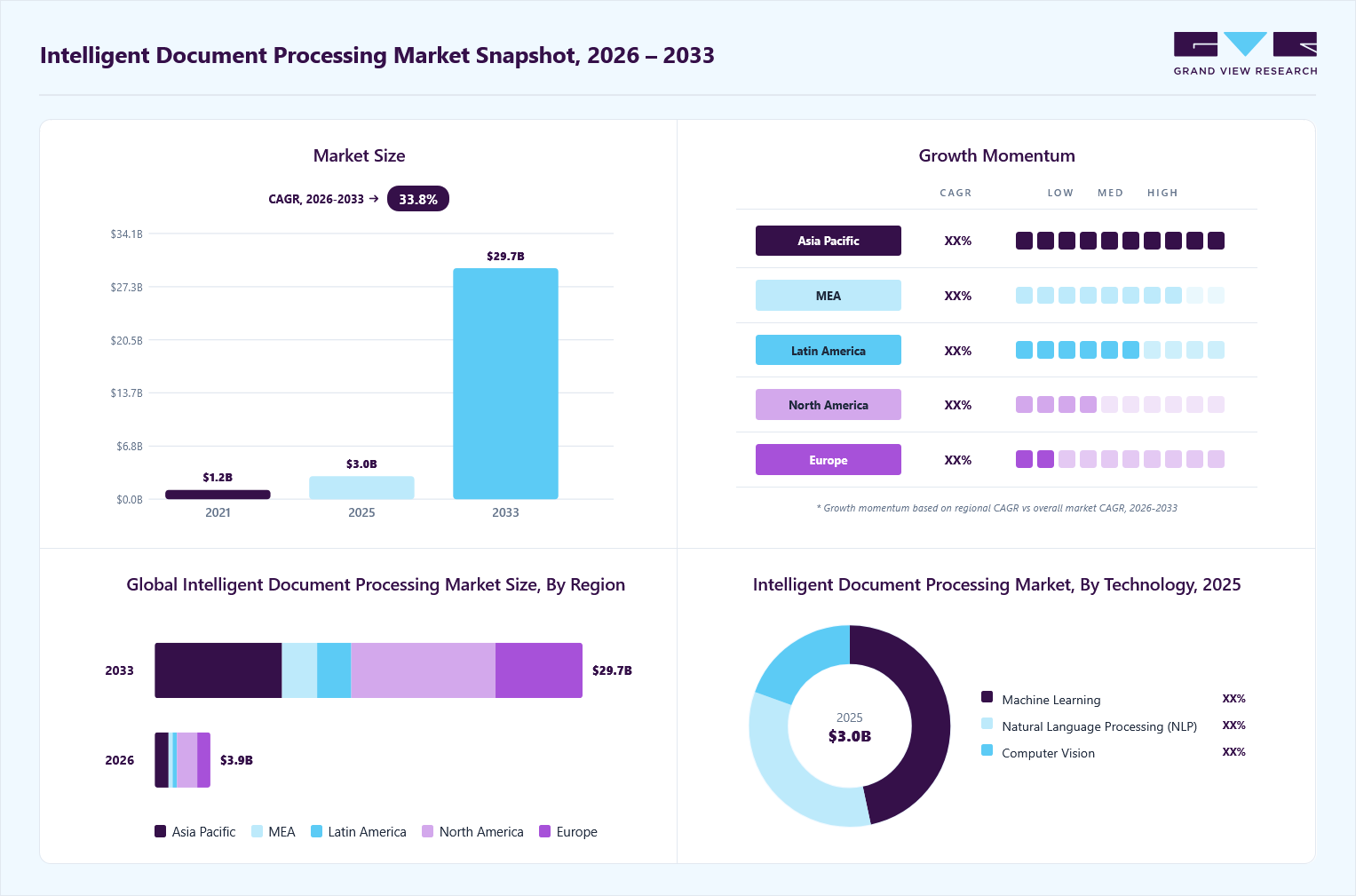
The global intelligent document processing market size was valued at USD 3.0 billion in 2025 and is projected to grow from USD 3.9 billion in 2026 to USD 29.7 billion by 2033, at a CAGR of 33.8% from 2026 to 2033. North America dominated the intelligent document processing market with the largest revenue share of 36.8% in 2025. Factors driving the market growth include the increasing digital transformation investments and the need for cost-effective and efficient document processing solutions.
 Source: Grand View Research, IR Documents, Primary Interviews, Paid DatabasesTo learn more about this report,
 Download Free Sample Report
 Key Market Trends & Insights
- By component: Solution segment dominated the market, with a revenue share of 63.2% in 2025.
- By technology: Machine learning segment held the largest market share of 46.6% in 2025.
- By deployment: Cloud segment held the largest revenue share of 63.3%in 2025.
- By organization size: Large Size Enterprises segment held the largest revenue share of 71.6% in 2025.
- By end-use: BFSI segment accounted for the largest revenue share of 25.0% in 2025.
Regional Highlights
- Largest regional market: North America (36.8% revenue share, 2025)
- Fastest growing regional market: Asia Pacific (highest CAGR, 2026-2033)
- By country: The intelligent document processing market in the U.S. held the largest share in the North America region in 2025.
Market Size & Forecast
- Market size in 2025: USD 3.0 Billion
- Estimated market size in 2026: USD 3.9 Billion
- Projected market size by 2033: USD 29.7 Billion
- CAGR (2026-2033): 33.8%
Three ways to get this report
Buy it, customize it, or ask a question.Ask an Analyst
Analyst response in 1 business day
- AccessReport author, directly
- Reply timeWithin 1 working day
- No sales callDirect answer only
- FormatEmail reply
- CostFree, no cost
Get the Full Report
What the study covers
- FormatsPDF · Excel · Dashboard
- Timeline2026–2033 annual, 2025 base
- Coverage20+ countries, 5 regions
- Companies10+ key players profiled
Customize the Report
20% free customization
- IncludeCountries, segments, points
- TailorTo your product definition
- ExtendDeeper competitor detail
- OrA fully bespoke study
- Turnaround5–10 working days
Moreover, increasing digitalization in developing nations offers significant growth opportunities for the market. IDP solutions use technologies such as machine learning (ML), natural language processing (NLP), optical character recognition (OCR), and computer vision to capture data from documents, classify, and then extract relevant data for further integration and processing.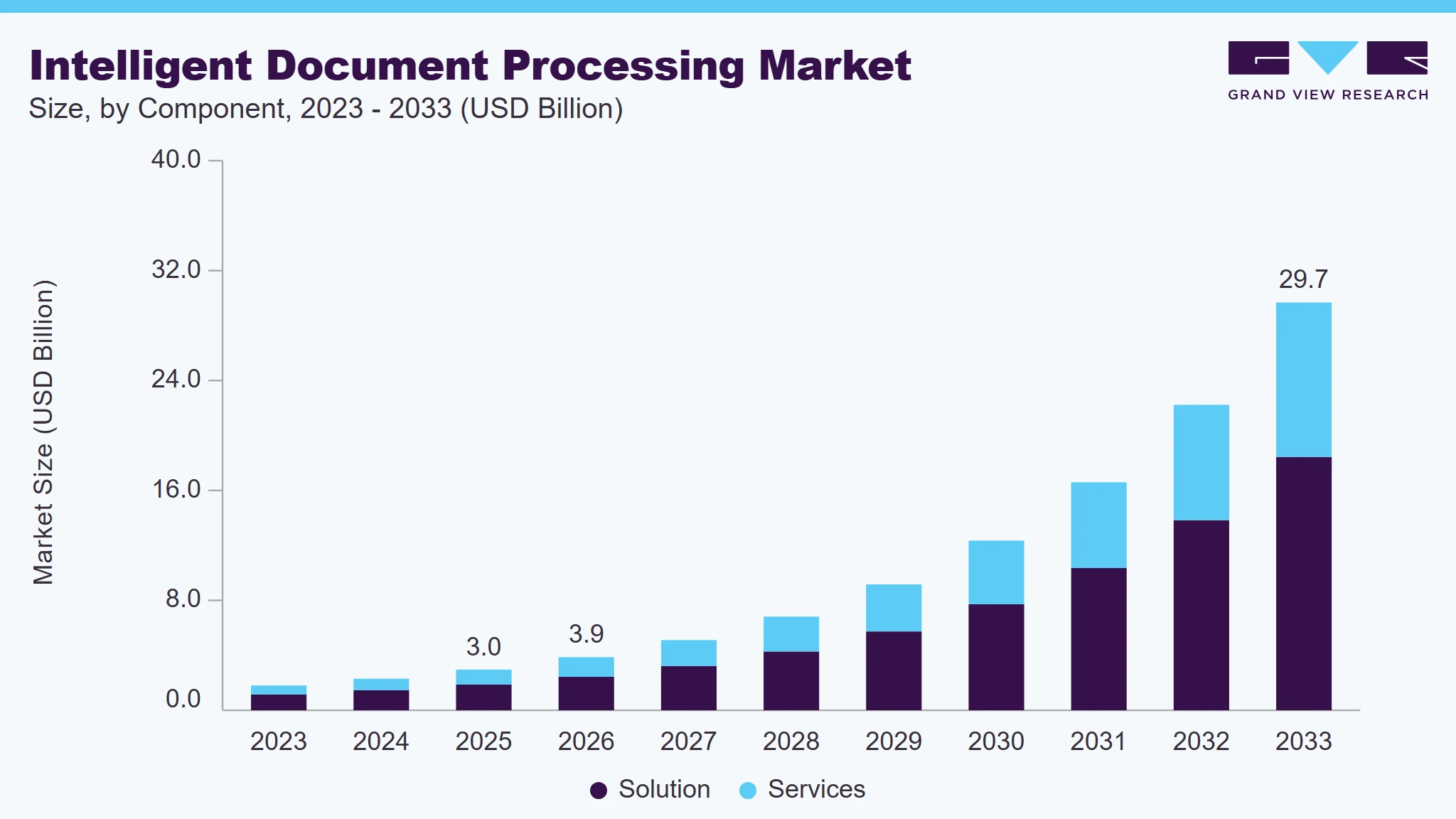 To learn more about this report, Download Free Sample Report
 The advantages of intelligent document processing solutions include reductions in operational costs & errors and improved data quality & usability for analysis. Some of the use cases of the solution include invoice processing, fraud detection, and customer onboarding. IDP technology is used to improve the efficiency and effectiveness of operations.
Automated document processing and data extraction through Intelligent Document Processing (IDP) enhance workflow efficiency, minimize errors, and bolster compliance. For instance, the United States Department of Defense utilizes IDP to streamline the handling of military contracts, resulting in substantial savings and a decreased likelihood of fraud. Moreover, the UK’s National Health Service employs IDP to automate patient record processing, leading to improved accuracy in records and a reduction in medical errors.
The increasing adoption of technology and digitalization in developing countries such as, India, South Africa, and Indonesia is expected to create substantial growth opportunities for the market. However, data privacy issues pose a challenge, as documents often contain sensitive personal information, and any potential data breaches could hinder market expansion. As technology advances, IDP is becoming more cost-effective and accessible, allowing businesses of all sizes to implement it more easily.
There are various factors driving the growth of IDP market such as regulatory compliance, enhanced customer service, and improved business decision-making. In consequence, the adoption of IDP is anticipated to rise as businesses increase their awareness of its benefits, which include increased efficiency, cost reductions, compliance, customer support, and data-driven strategies. As technology continues to evolve and become more accessible, IDP is likely to become a fundamental component of document processing in various industries.
Market Dynamics
The intelligent document processing (IDP) market is witnessing significant growth driven by the accelerating demand for digital transformation, intelligent automation, and enterprise-wide workflow optimization. Organizations are increasingly deploying AI-powered document processing solutions that integrate optical character recognition (OCR), natural language processing (NLP), machine learning (ML), generative AI, and robotic process automation (RPA) to automate data extraction, document classification, content validation, and decision-making processes while improving accuracy, compliance, and operational productivity. Furthermore, the rising volume of unstructured enterprise data, growing adoption of cloud-based automation platforms, increasing regulatory compliance requirements, and continuous advancements in artificial intelligence, hyper automation, and intelligent business process management are driving widespread adoption of IDP solutions and supporting sustained market expansion.
The increasing adoption of AI-powered business process automation is a major growth driver for the Intelligent Document Processing (IDP) market. Enterprises are under growing pressure to streamline operations, reduce manual workloads, and improve process efficiency across document-intensive functions. IDP solutions enable organizations to automate document capture, classification, data extraction, and validation processes, significantly reducing processing times and operational costs. As businesses continue to prioritize digital transformation initiatives, demand for intelligent automation technologies is expanding across multiple industry verticals. This trend is driving substantial investments in AI-enabled document processing platforms.
Organizations across banking, financial services, insurance, healthcare, government, and logistics sectors are increasingly deploying IDP solutions to improve accuracy, compliance, and customer experience. The integration of artificial intelligence, machine learning, natural language processing, and optical character recognition technologies enables enterprises to process large volumes of structured and unstructured documents with greater efficiency. Businesses are also leveraging IDP platforms to support end-to-end workflow automation and enhance decision-making capabilities. The growing focus on operational agility and workforce productivity is further accelerating market adoption. Consequently, AI-driven business process automation continues to serve as a key catalyst for market growth.
Data security concerns remain a significant restraint for the Intelligent Document Processing market. IDP platforms frequently process sensitive customer information, financial records, healthcare data, legal documents, and confidential enterprise information. As organizations increasingly digitize document workflows, concerns regarding data breaches, unauthorized access, and cyber threats continue to intensify. Enterprises must ensure robust security controls to protect critical business information throughout the document processing lifecycle. These concerns often result in prolonged procurement cycles and cautious adoption strategies.
Regulatory compliance requirements further complicate the deployment of intelligent document processing solutions. Organizations operating in highly regulated industries must comply with stringent data privacy regulations, industry standards, and governance frameworks. Compliance obligations related to data residency, information security, record retention, and auditability can increase implementation complexity and operational costs. In addition, varying regulatory requirements across regions create challenges for multinational enterprises seeking standardized deployments. These factors may limit adoption among organizations with strict compliance and risk management requirements.
The growing integration of generative AI technologies presents a substantial opportunity for the Intelligent Document Processing market. Enterprises are increasingly exploring generative AI capabilities to improve document understanding, contextual interpretation, and intelligent content analysis. Advanced AI models can enhance the extraction of insights from complex and unstructured documents while reducing reliance on rule-based processing systems. This enables organizations to automate a broader range of business processes and improve operational efficiency. As generative AI adoption accelerates, demand for next-generation IDP platforms is expected to rise significantly.
Generative AI is also expanding the strategic value of document processing solutions beyond traditional data extraction functions. Organizations can leverage AI-powered summarization, document search, knowledge retrieval, contract analysis, and decision-support capabilities to generate actionable business insights. Technology enhances multilingual processing, improves adaptability to changing document formats, and supports more sophisticated workflow automation initiatives. As enterprises increasingly invest in AI-driven productivity and hyper automation strategies, the integration of generative AI with IDP platforms is creating new avenues for innovation and market expansion. This trend is expected to unlock significant long-term growth opportunities for solution providers.
Market Concentration & Characteristics
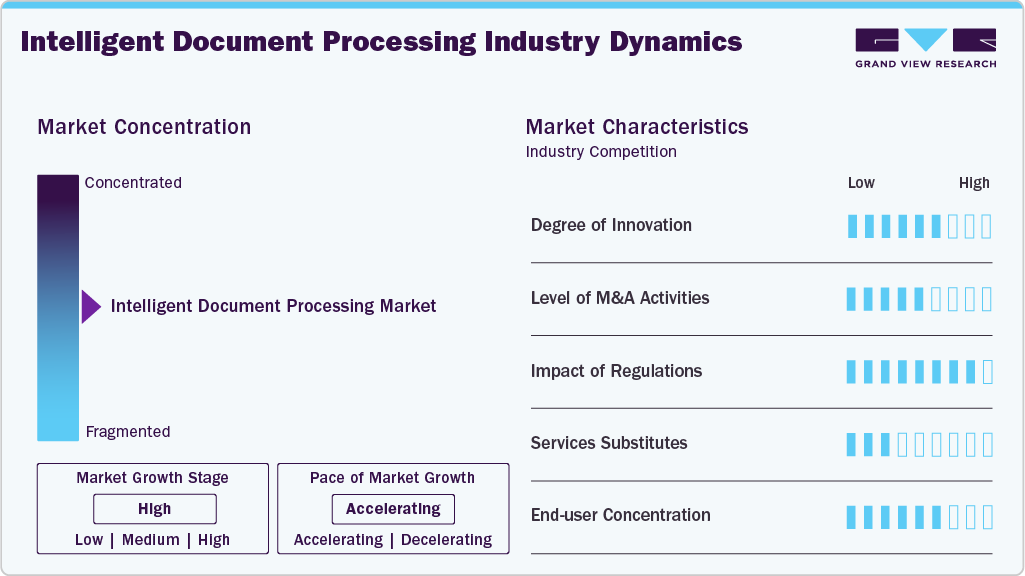
The intelligent document processing (IDP) market remains moderately fragmented, with a diverse ecosystem of intelligent automation providers, optical character recognition (OCR) vendors, artificial intelligence platform developers, enterprise content management solution providers, and cloud-based document processing platform vendors competing across global markets. Rapid adoption of AI-powered document understanding, natural language processing (NLP), machine learning (ML), generative AI, and robotic process automation (RPA) technologies is intensifying competition as vendors focus on improving data extraction accuracy, workflow automation, document classification, and decision intelligence capabilities. Growing investments in digital transformation, enterprise automation, business process optimization, and paperless operations continue to drive innovation and strengthen the long-term growth outlook of the Intelligent Document Processing market.
 To learn more about this report, Download Free Sample Report
 The intelligent document processing market faces moderate competition from traditional document management systems, enterprise content management platforms, business process outsourcing services, and manual data processing workflows that continue to support document-centric operations across organizations. However, increasing demand for operational efficiency, regulatory compliance, faster document turnaround times, enhanced customer experience, and intelligent workflow automation is accelerating the adoption of advanced IDP solutions. The convergence of generative AI, large language models (LLMs), intelligent automation, and cloud-based document processing platforms, combined with growing requirements for unstructured data management and real-time business insights, is creating significant opportunities for sustained market expansion and enterprise-wide automation initiatives.
Analyst Perspective
The intelligent document processing market is experiencing accelerated growth as organizations increasingly prioritize digital transformation, intelligent automation, and AI-driven workflow optimization to improve operational efficiency and reduce manual processing costs. The integration of artificial intelligence (AI), machine learning (ML), natural language processing (NLP), optical character recognition (OCR), and generative AI is transforming how enterprises extract, classify, validate, and manage business-critical information from structured and unstructured documents. Demand is particularly strong across BFSI, healthcare, government, manufacturing, and logistics sectors, where regulatory compliance, document accuracy, and process efficiency are key operational priorities. The growing adoption of cloud-based IDP platforms, robotic process automation (RPA), enterprise content management (ECM), and hyper automation solutions is further expanding the addressable market and enabling scalable document-centric workflows. As enterprises continue to invest in document intelligence, AI-powered data extraction, workflow automation, and digital business operations, the market is expected to witness sustained innovation and strong long-term growth opportunities.
Component Insights
Based on component, the solution segment led the market with the largest revenue share of 63.2% in 2025. Enterprises are handling large volumes of unstructured data, such as emails, forms, and scanned documents, requiring advanced tools to process, classify, and extract information effectively. IDP solutions leverage AI and machine learning to manage these data complexities. Moreover, businesses aim to automate routine document processing tasks to reduce manual intervention, errors, and processing times. IDP solutions streamline these workflows, improving operational efficiency, accuracy, and cost savings.
The services segment is predicted to foresee significant growth in the forecast years. IDP services help businesses comply with industry regulations by enabling secure document processing and data management, increasing demand for regulatory and compliance consulting services. Moreover, to ensure optimal utilization of IDP tools, companies invest in training, technical support, and maintenance, driving growth in the managed services and support segment. Furthermore, companies require support for integrating IDP solutions with existing systems such as, CRM, ERP, and data management platforms. This integration need fuels growth in deployment and maintenance services.
Technology Insights
Based on technology, the machine learning segment led the market with the largest revenue share of 46.6% in 2025. This is attributed to the significant use of ML techniques to automate the extraction and processing of information from various documents, such as invoices, purchase orders, contracts, and forms, augmenting market growth. Machine learning is a crucial component that leverages the growth of Intelligent Document Processing (IDP). Machine learning algorithms are trained on large volumes of labeled data to extract information from documents accurately. These models learn from patterns, context, and structures within the documents, improving accuracy in data extraction, reducing errors, and increasing reliability. For instance, ML models learn to distinguish between invoices, receipts, and contracts, allowing the IDP system to handle each document type appropriately.
The Natural Language Processing segment is expected to showcase significant growth over the forecast period. NLP-powered IDP solutions can automate text understanding and interpretation, reducing manual effort. Organizations aiming for cost-efficient and scalable document processing workflows are investing in NLP-based IDP tools. NLP enables IDP systems to work across languages, which is crucial for global businesses managing multilingual documents. The need for localization and accurate processing of international documents boosts NLP demand.
Deployment Insights
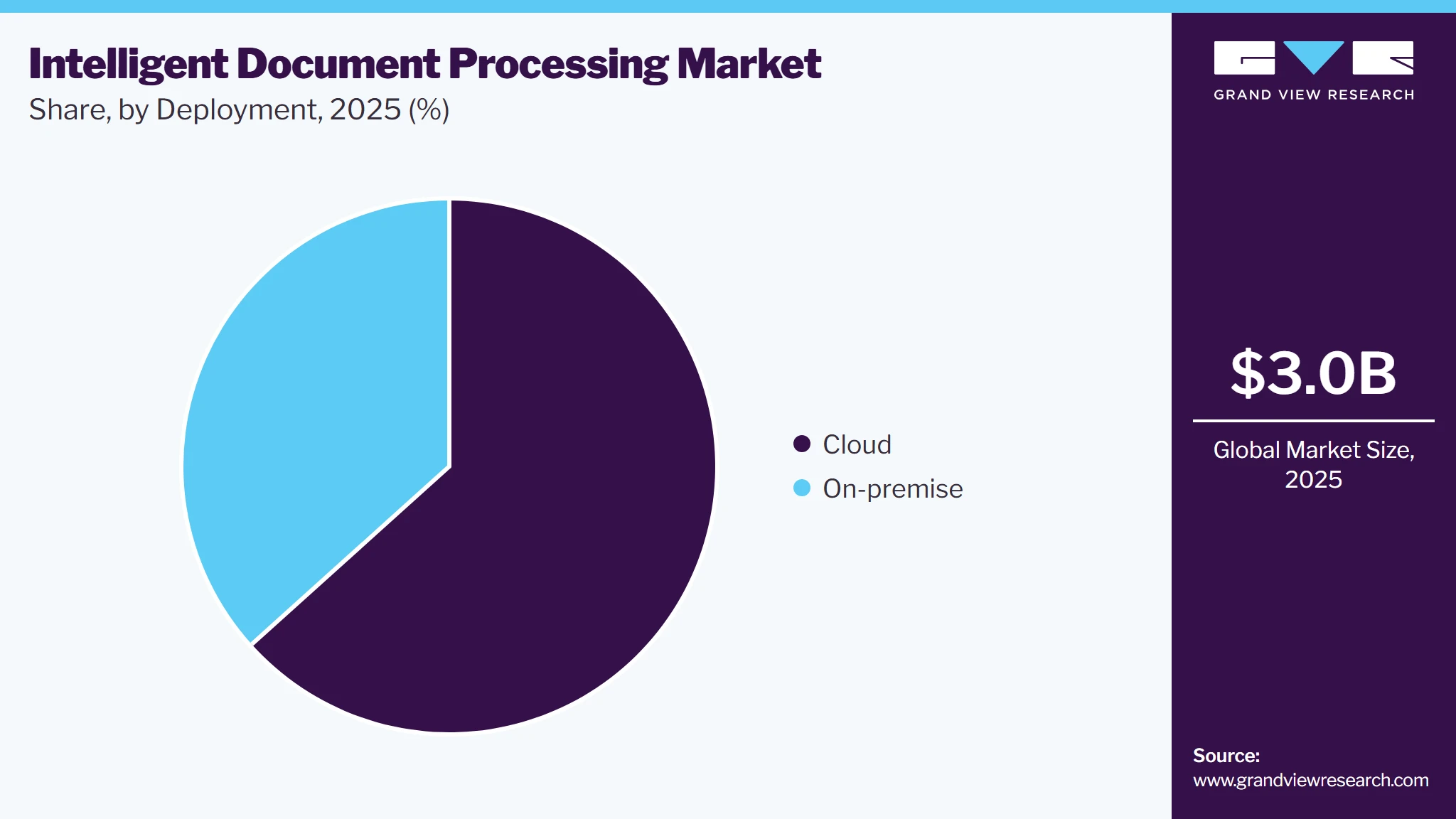
Based on deployment, the cloud segment led the market with the largest revenue share of 63.3% in 2025, due to its scalability, accessibility, and cost-efficiency. By adopting cloud deployment, organizations can avoid the expense and upkeep of dedicated infrastructure, instead utilizing a pay-as-you-go model offered by cloud providers. This approach minimizes initial costs, removes the need for hardware and software maintenance, and enables flexible scaling of IDP systems to fit organizational budgets and requirements.
 To learn more about this report, Download Free Sample Report
 The on-premises segment will witness significant growth in the coming years. This growth is driven by the enhanced security provided by on-premises deployment, particularly in industries such as healthcare and banking, financial services, and insurance (BFSI), which often face stricter compliance requirements. Key advantages of on-premises deployment, such as faster processing times and lower latency than cloud-based solutions, are also fueling market growth. Organizations with high document volumes require a real-time processing, therefore, use of on-premises deployment offers quicker document access and faster processing speeds.
Organization Size Insights
Based on organization size, the large size enterprises segment led the market with the largest revenue share of 71.6% in 2025. This growth is driven by the enhanced security provided by on-premises deployment, particularly in industries such as, healthcare and banking, financial services, and insurance (BFSI), which often face stricter compliance requirements. Key advantages of on-premises deployment, such as faster processing times and lower latency than cloud-based solutions, are also fueling market growth. Organizations with high document volumes or a need for real-time processing benefit from on-premises deployment, as it enables quicker document access and faster processing speeds.
The SMEs segment is expected to grow at the highest CAGR in the coming years. IDP solutions help SMEs ensure compliance by automating the processing and storage of sensitive documents, such as financial records and contracts, in line with regulatory standards. Moreover, SMEs are increasingly investing in digital transformation, and IDP technology supports this shift by digitizing paper-based processes, improving data accuracy, and reducing manual effort.
End-use Insights
Based on end-use, the BFSI segment led the market with the largest revenue share of 25.0% in 2025. The growth is due to the high volume of documents processed within the BFSI sector to deliver products and services. The BFSI industry leverages intelligent document processing (IDP) technology to boost operational efficiency, elevate customer experiences, and maintain compliance standards. IDP extracts essential information from documents such as bank statements, pay stubs, and tax returns to evaluate creditworthiness and eligibility. These advantages drive the adoption of IDP technology within the BFSI sector.
The government & public sector segment is projected to experience significant growth in the coming years. Government agencies handle vast amounts of paperwork, such as applications, licenses, and permits. IDP automates these processes, significantly reducing manual effort, expediting workflows, and minimizing errors. By implementing IDP, government bodies can respond more quickly to public inquiries and provide faster, more accurate services, leading to better citizen engagement and satisfaction. Furthermore,IDP solutions offer high levels of data security and help agencies comply with regulatory standards related to data protection and privacy, essential for managing sensitive public data.
Regional Insights
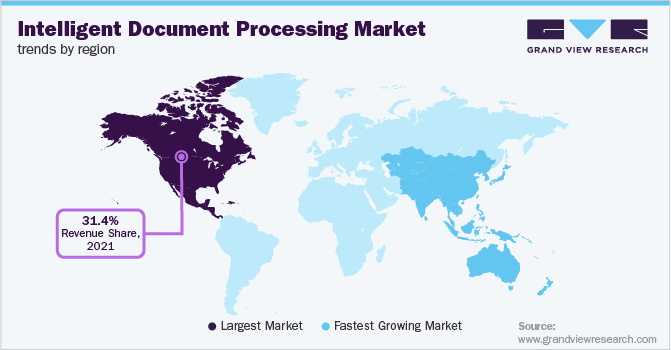
North America dominated the intelligent document processing market with the largest revenue share of 36.8% in 2025. Organizations across sectors in North America are prioritizing digital transformation, and IDP solutions play a crucial role in digitizing and automating document-intensive processes. Moreover, Industries such as, BFSI, healthcare, and government rely on IDP to manage large volumes of documents securely and efficiently, which is fueling market growth.
 To learn more about this report, Download Free Sample Report
 U.S. Intelligent Document Processing Market Trends
The intelligent document processing market in the U.S. held the largest share in the North America region in 2025. U.S. technology sector is at the forefront of AI and machine learning innovation, which is enhancing IDP solutions by improving document classification, data extraction, and accuracy in information processing. Moreover, organizations are leveraging IDP to streamline customer-facing processes such as onboarding, loan applications, and claims processing, enhancing customer satisfaction and driving IDP adoption.
Europe Intelligent Document Processing Market Trends
The intelligent document processing market in the Europe region is expected to witness significant growth over the forecast period. Europe’s strong data protection regulations, including General Data Protection Regulation (GDPR), are prompting businesses to adopt secure and compliant IDP solutions to manage and process sensitive data effectively.The BFSI sector in Europe is one of the largest users of IDP solutions to automate document processing, enhance customer service, and ensure compliance with regulatory standards, such as Know Your Customer (KYC) and Anti-Money Laundering (AML) regulations.
Asia Pacific Intelligent Document Processing Market Trends
The intelligent document processing market in the Asia Pacific region is anticipated to register the highest CAGR over the forecast period. The shift toward cloud computing is allowing organizations in the Asia Pacific to leverage scalable IDP solutions without the need for substantial infrastructure investments, making it more accessible for various business sizes. Companies are identifying that improving customer interactions is crucial for success. IDP enables faster document processing, leading to quicker response times and better overall customer service.
Key Intelligent Document Processing Company Insights
Some key players in the intelligent document processing market are ABBYY, UiPath, and IBM Corporation. These companies are leveraging advanced technologies, providing comprehensive solutions, focusing on specific industry needs, and emphasizing user experience and innovation.
-
ABBYY utilizes advanced optical character recognition (OCR) and machine learning algorithms, enabling it to accurately extract data from a wide range of document types, formats, and layouts. The company's focus on accuracy and efficiency in data processing helps organizations reduce manual effort, minimize errors, and improve overall productivity.
-
UiPath combines IDP capabilities with various robotic process automation (RPA) technology companies, allowing organizations to automate document processing workflows seamlessly alongside other business processes. Moreover, UiPath has built a strong ecosystem of partnerships with other technology providers, enhancing its offerings with complementary tools and services that improve document processing and automation capabilities.
Key Intelligent Document Processing Companies:
The following key companies have been profiled for this study on the intelligent document processing market.
-
ABBYY
-
AntWorks
-
Appian
-
Automation Anywhere, Inc.
-
Datamatics Global Services Limited
-
Hyperscience
-
IBM Corporation
-
Open Text Corporation
-
SHI International Corp
-
UiPath
Competitive Benchmarking
Operating Strategies
Competitive Edge
Weaknesses
Mature Players: ABBYY, IBM Corporation, Open Text Corporation, UiPath, Automation Anywhere, Inc.
- Mature players are focusing on generative AI integration, intelligent document understanding, cloud-based IDP platforms, and end-to-end workflow automation. Their strategies emphasize enterprise-scale deployments, industry-specific solutions, and subscription-based revenue models.
- Their competitive strength comes from large enterprise customer bases, comprehensive automation portfolios, and strong integration capabilities with existing business systems. Global presence and continuous investments in AI and NLP technologies further reinforce their leadership position.
- Slower innovation cycles, complex legacy architectures, and lengthy implementation processes can impact agility. High deployment costs and reliance on large enterprise contracts may also limit flexibility in fast-changing markets.
Emerging Players: Hyperscience, AntWorks, Appian, Datamatics Global Services Limited, SHI International Corp.
- Emerging players are adopting AI-first, cloud-native, and low-code automation strategies focused on intelligent data extraction, document intelligence, and rapid deployment capabilities. Their approach prioritizes scalability, innovation, and flexible pricing models.
- Their advantage lies in agile product development, faster implementation timelines, and strong specialization in AI-driven document processing and workflow automation. User-friendly platforms and advanced automation capabilities support quicker customer adoption.
- Limited brand recognition and smaller global partner ecosystems can restrict access to large enterprise opportunities. Lower financial resources may also constrain R&D investments and international expansion efforts.
Recent Developments
-
In June 2024, Reveille, Enterprise Content Management solutions provider, collaborated with ABBYY, the intelligent automation company, to integrate ABBYY’s FlexiCapture to improve the document automation monitoring processes. ABBYY FlexiCapture utilizes natural language processing, machine learning, and AI to deliver enterprise-level data capture and extraction. Reveille for ABBYY FlexiCapture provides the security, performance, and reliability of IDP operations.
-
In June 2024, Automation Anywhere, Inc., AI-based automation company, collaborated with Microsoft, technology company, to incorporate the Microsoft Azure OpenAI Service into Automation Anywhere Inc.’s AI + Automation Enterprise System, enabling enterprises to automate intricate end-to-end processes across various applications with the assistance of AI Agents.
-
In May 2024, Mphasis, customized technology solutions provider, launched DeepInsights Doc AI, an intelligent document processing solution using generative AI technology. This platform enables Mphasis to assist enterprise clients in extracting context-specific information from documents of any format or layout and integrating it with downstream IT systems to produce actionable insights. DeepInsights Doc AI provides a customized large language model (LLM) solution tailored to the specific needs of enterprises in document processing, encompassing information discovery, information extraction, insight generation, and context-aware search with recommendations. The solution can be self-hosted within the enterprise cloud, offering enhanced flexibility.
Intelligent Document Processing Market Report Scope
Report Attribute
Details
Market size in 2025
USD 3.0 billion
Estimated market Size in 2026
USD 3.9 billion
Projected market Size by 2033
USD 29.7 billion
Growth rate
CAGR of 33.8% from 2026 to 2033
Base year for estimation
2025
Historical data
2021 - 2024
Forecast period
2026 - 2033
Quantitative units
Revenue in USD million/billion and CAGR from 2026 to 2033
Report coverage
Revenue forecast, company ranking, competitive landscape, growth factors, and trends
Segments covered
Component, technology, deployment, organization size, end-use, region
Regional scope
North America; Europe; Asia Pacific; Latin America; MEA
Country scope
U.S.; Canada; Mexico; Germany; UK; France; Italy; Netherlands; China; Japan; India; South Korea; Australia; Brazil; Chile; Argentina; Saudi Arabia; South Africa; UAE
Key companies profiled
ABBYY; AntWorks; Appian; Automation Anywhere, Inc.; Datamatics Global Services Limited; Hyperscience; IBM Corporation; Open Text Corporation; SHI International Corp; UiPath
Customization scope
Free report customization (equivalent up to 8 analysts' working days) with purchase. Addition or alteration to country, regional & segment scope.
Pricing and purchase options
Avail customized purchase options to meet your exact research needs. Explore purchase options
Global Intelligent Document Processing Market Report Segmentation
This report forecasts revenue growth at global, regional, and country levels and provides an analysis of the latest industry trends in each of the sub-segments from 2021 to 2033. For this study, Grand View Research has segmented the global intelligent document processing market report based on component, technology, deployment, organization size, end-use, and region:
-
Component Outlook (Revenue, USD Million, 2021 - 2033)
-
Solution
-
Services
-
-
Technology Outlook (Revenue, USD Million, 2021 - 2033)
-
Machine Learning
-
Natural Language Processing (NLP)
-
Computer Vision
-
-
Deployment Outlook (Revenue, USD Million, 2021 - 2033)
-
On-premise
-
Cloud
-
-
Organization Size Outlook (Revenue, USD Million, 2021 - 2033)
-
Small and Medium Sized Enterprises (SMEs)
-
Large Size Enterprises
-
-
End-use Outlook (Revenue, USD Million, 2021 - 2033)
-
BFSI
-
Healthcare
-
Manufacturing
-
Retail
-
Government & Public Sector
-
Transportation & Logistics
-
IT & Telecom
-
Others
-
-
Regional Outlook (Revenue, USD Million, 2021 - 2033)
-
North America
-
U.S.
-
Canada
-
-
Europe
-
U.K.
-
Germany
-
France
-
Italy
-
Netherlands
-
-
Asia Pacific
-
China
-
India
-
Japan
-
Australia
-
South Korea
-
-
Latin America
-
Brazil
-
Mexico
-
Chile
-
Argentina
-
-
Middle East & Africa
-
UAE
-
Saudi Arabia
-
South Africa
-
-
Research Methodology
Segment Definition
Segment - Component
Revenue capture definition
Solution
This segment includes software platforms and applications designed to automate document capture, classification, data extraction, validation, and workflow orchestration. Revenue is generated from licensing, subscriptions, and deployment of intelligent document processing solutions across enterprise environments.
Services
The services segment covers consulting, implementation, integration, customization, training, and ongoing support associated with IDP deployments. Revenue is derived from professional and managed services that help organizations optimize document automation initiatives and maximize solution performance.
Segment - Technology
Revenue capture definition
Machine Learning
This segment comprises IDP technologies that utilize machine learning algorithms to recognize patterns, improve extraction accuracy, and continuously learn from document processing activities. Revenue includes software and platforms that enable adaptive document classification, data validation, and workflow automation.
Natural Language Processing (NLP)
The NLP segment includes technologies that interpret, analyze, and extract meaning from text-based content within documents. Revenue is captured from solutions that support language understanding, entity recognition, document interpretation, and contextual data extraction.
Computer Vision
This segment encompasses technologies that analyze visual document elements such as images, handwritten text, forms, tables, and scanned files. Revenue is generated from platforms that leverage image recognition and visual intelligence to digitize and process document-based information.
Segment - Deployment
Revenue capture definition
On-premise
The on-premise segment includes IDP solutions deployed within an organization's internal IT infrastructure and managed by in-house teams. Revenue is generated from software licenses, implementation projects, maintenance agreements, and infrastructure-related services.
Cloud
This segment covers IDP platforms delivered through cloud environments and consumed on a subscription or usage-based model. Revenue includes SaaS subscriptions and cloud-hosted document processing services that provide scalability, remote accessibility, and simplified deployment.
Segment - Organization Size
Revenue capture definition
Small and Medium Sized Enterprises (SMEs)
This segment consists of small and medium-sized organizations adopting IDP solutions to automate document workflows while minimizing operational costs. Revenue is derived from affordable, scalable, and cloud-based offerings tailored to the automation needs of growing businesses.
Large Size Enterprises
The large enterprise segment includes organizations with complex document ecosystems and high-volume processing requirements across multiple departments and locations. Revenue is generated from enterprise-grade IDP platforms, large-scale deployments, integrations, and long-term service contracts.
Segment - End Use
Revenue capture definition
BFSI
This segment includes banks, insurance companies, financial institutions, and capital market organizations utilizing IDP solutions for customer onboarding, loan processing, claims management, and compliance documentation. Revenue is captured from automating document-intensive financial workflows and regulatory processes.
Healthcare
The healthcare segment covers hospitals, clinics, diagnostic centers, and healthcare payers implementing IDP solutions to process medical records, insurance claims, patient forms, and clinical documentation. Revenue is generated from improving data accessibility, compliance management, and administrative efficiency.
Manufacturing
This segment comprises manufacturers leveraging IDP platforms to manage invoices, procurement records, quality reports, shipping documents, and supplier contracts. Revenue is derived from solutions that streamline document handling and enhance operational productivity across manufacturing operations.
Retail
The retail segment includes retailers and e-commerce companies using IDP technologies to automate invoice processing, vendor documentation, customer records, and inventory-related paperwork. Revenue is generated from improving transaction efficiency and supporting digital retail operations.
Government & Public Sector
This segment encompasses government agencies and public institutions deploying IDP solutions to digitize citizen records, permits, tax documents, legal files, and administrative paperwork. Revenue is captured from initiatives focused on process modernization, transparency, and public service efficiency.
Transportation & Logistics
The transportation and logistics segment includes organizations processing bills of lading, customs forms, shipping records, delivery documentation, and freight-related paperwork. Revenue is generated from automating document workflows that support supply chain visibility and operational accuracy.
IT & Telecom
This segment covers technology companies and telecommunications providers utilizing IDP solutions to manage contracts, customer records, service requests, compliance documents, and operational reports. Revenue is derived from streamlining information management and supporting large-scale digital operations.
Others
The others segment includes education, legal services, energy, utilities, media, real estate, and other industries adopting intelligent document processing technologies. Revenue is generated from diverse use cases involving document digitization, workflow automation, and enterprise content management.
Estimation Model
Layer Name
Key Questions
Description
Document-Intensive Enterprise Layer
Who manages document-intensive operations?
Identify enterprises across industries that process invoices, claims, contracts, forms, records, and compliance documents. This layer defines the total addressable market for IDP solutions.
Digital Document Automation Layer
Who automates document workflows?
Apply adoption rates for document management, workflow automation, and digital transformation solutions. This layer estimates the active base of organizations automating document-centric processes.
Intelligent Document Processing Layer
Who deploys AI-powered document processing?
Apply penetration rates for OCR, NLP, machine learning, computer vision, and generative AI technologies. This layer captures organizations deploying advanced document understanding and automation capabilities.
Revenue Generation Layer
How much revenue is generated?
Multiply active deployments by annual spending on software, cloud services, implementation, integration, and support. This layer estimates the total revenue for the intelligent document processing market.
Delivered Customizations
This report has been delivered with the following In-depth customizations
Client Request
Customization Delivered
Value Adds
Intelligent Document Processing Technology Adoption & Growth Assessment
Performed a comprehensive analysis of Intelligent Document Processing market trends, including AI-powered document understanding, OCR, machine learning, natural language processing, computer vision, and workflow automation technologies across major end-use industries.
This analysis enables stakeholders to identify high-growth opportunities, evaluate technology adoption patterns, prioritize product development initiatives, and strengthen competitive positioning in the evolving IDP market.
Enterprise Automation & Document Transformation Analysis
Assessed demand for intelligent document processing solutions across BFSI, healthcare, government, manufacturing, retail, logistics, and IT & telecom sectors, including document digitization, compliance automation, and workflow modernization initiatives.
Provides strategic insights into enterprise automation spending trends, digital transformation priorities, and long-term market opportunities to support expansion planning and targeted go-to-market strategies.
AI-Powered Document Intelligence & Workflow Automation Opportunity Assessment
Evaluated adoption trends for generative AI, intelligent data extraction, document classification, content understanding, low-code automation, and cloud-based IDP platforms across global markets.
Supports investment and growth strategies by identifying emerging technology opportunities, accelerating innovation roadmaps, and enabling data-driven decisions in high-growth segments of the Intelligent Document Processing market.
Frequently Asked Questions About This Report
The global intelligent document processing market size was estimated at USD 3.0 billion in 2025 and is expected to reach USD 3.9 billion in 2026.
Some key players operating in the intelligent document processing market include ABBYY; AntWorks; Appian; Automation Anywhere, Inc.; Datamatics Global Services Limited; Hyperscience; IBM Corporation; Open Text Corporation; SHI International Corp; and UiPath.
The solution segment led with a 63.2% revenue share in 2025, while services is the fastest-growing segment.
Machine learning segment held the largest market share of 46.6% in 2025 and is projected to grow the fastest.
The large size enterprises segment led with a 71.6% revenue share in 2025, while Small and Medium-Sized Enterprises (SMEs) is the fastest-growing segment.
The BFSI segment led with a 25.0% revenue share in 2025, while the Government & Public Sector is the fastest-growing segment.
The global intelligent document processing market is expected to grow at a compound annual growth rate of 33.8% from 2026 to 2033, reaching USD 29.7 billion by 2033.
North America dominated the intelligent document processing market, accounting for 36.8% in 2025, driven by the rapid adoption of AI-powered document automation, increasing digital transformation investments, and strong demand for operational efficiency across enterprises.
Key factors driving market growth include the increasing adoption of AI-powered automation technologies, rising demand for efficient processing of large volumes of structured and unstructured data, growing investments in enterprise digital transformation initiatives, and the need to enhance operational efficiency, accuracy, and regulatory compliance across industries.
About the Author(s)
Next Generation Technologies Research Team
Technology · Next Generation TechnologiesThis report was authored by the next generation technologies research team at Grand View Research - comprising two research analysts, one senior research analyst, and one industry expert - with specialized expertise in the next generation technologies segment of the technology industry. All findings are based on proprietary technology databases, executive interviews, and regulatory analysis, subject to internal peer review prior to publication.
Last Updated:
Speak to Analyst

Customize this report to your needs - add regions, segments, or data points, with 20% free customization.
Or view our licence options:


ISO 9001:2015 & 27001:2022 Certified
We are GDPR and CCPA compliant! Your transaction & personal information is safe and secure. For more details, please read our privacy policy.


