
- Home
- »
- Homecare & Decor
- »
-
Japan Drinkware Market Size And Share Report, 2027-2035GVR Report cover

Japan Drinkware Market (2027 - 2035)
Size, Share & Trends Analysis Report By Product (Water Bottles, Tumblers, Mugs, Thermos and Flasks), By Material (Water Bottles, Tumblers, Mugs, Thermos & Flasks), By Distribution Channel, And Segment Forecasts
Market Size, 2026
$645.3MMarket Estimate, 2027
$673.1MMarket Forecast, 2035
$934.7MCAGR, 2027–2035
4.2%Japan Drinkware Market Summary
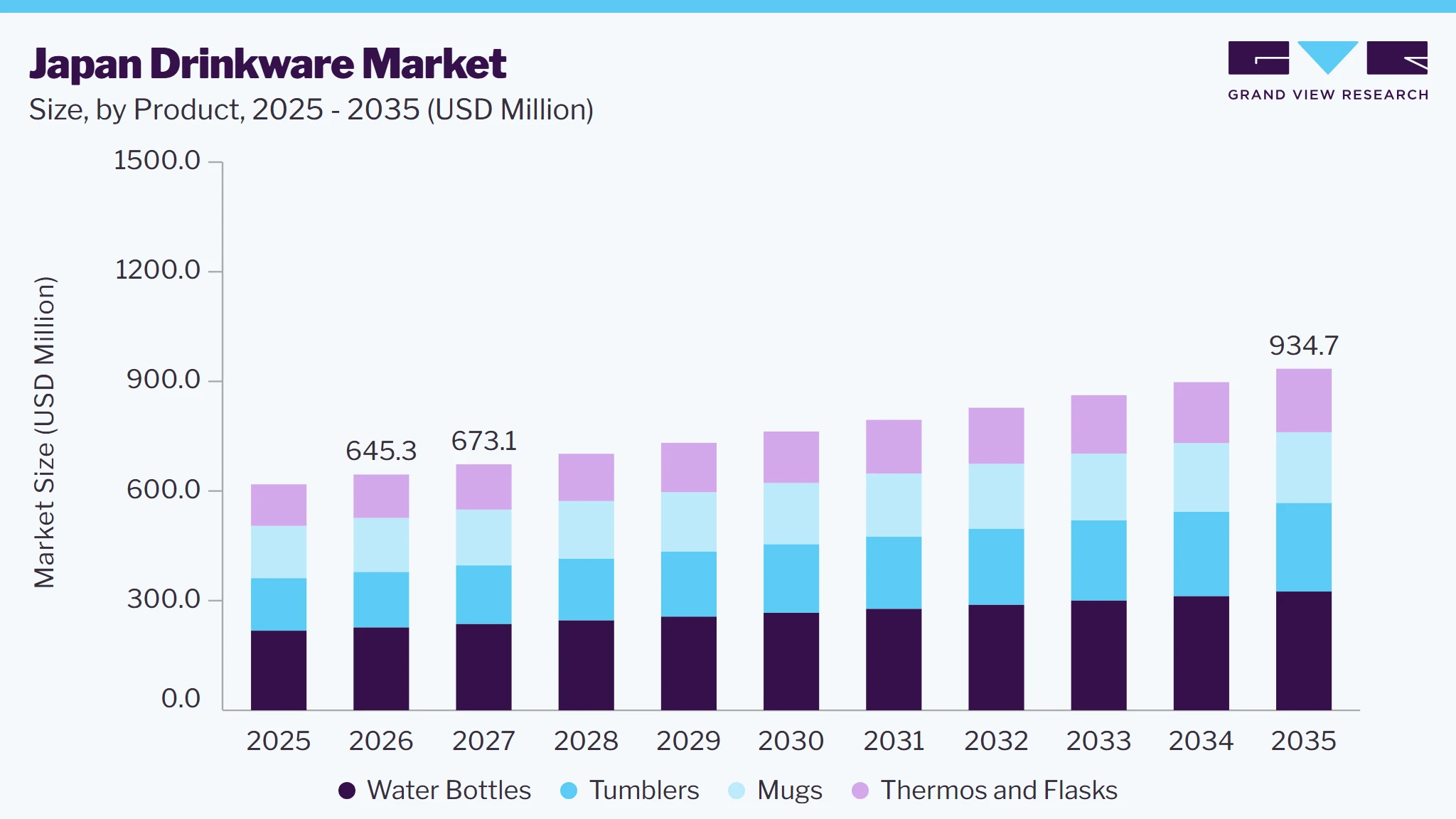
The Japan drinkware market size was valued at USD 645.3 million in 2026 and is projected to grow from USD 673.1 million in 2027 to USD 934.7 million by 2035, at a CAGR of 4.2% from 2027 to 2035. The increasing adoption of reusable water bottles in Japan is supporting demand for convenient and practical drinkware products. According to a survey conducted by Tiger Corporation, 84.3% of respondents used reusable water bottles regularly, representing an increase of 13.1 percentage points over the previous five years.
Key Market Trends & Insights
- By product: Water bottles segment accounted for a share of 35.2% in 2026.
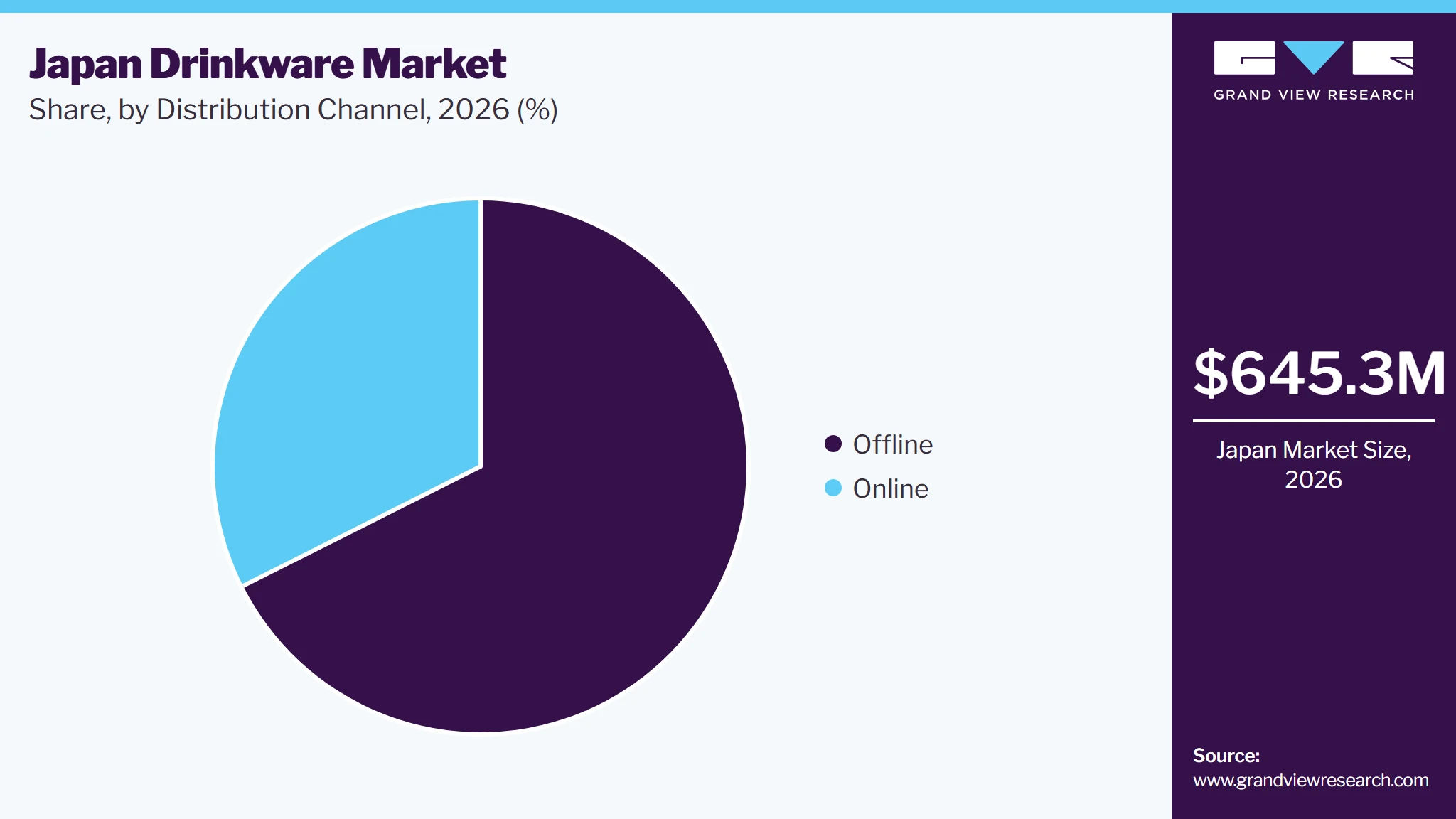
- By distribution channel: Offline channels segment accounted for a market share of 67.6% in 2026.
- By material: Plastic segment accounted for a share of 39.4% in 2026.
Market Size & Forecast
- Market Size in 2026: USD 645.3 Million
- Estimated Market Size in 2027: USD 673.1 Million
- Projected Market Size by 2035: USD 934.7 Million
- CAGR (2027-2035): 4.2%
Prism AI by Grand View Research Free to tryAsk a question about the japan drinkware marketTry asking✓Every figure cited from GVR research Prefer the report? Download free sample →This rising usage indicates that reusable bottles are becoming an integral part of consumers’ daily routines, extending beyond outdoor activities and commuting to indoor settings, workplaces, and homes. As consumers increasingly incorporate personal bottles into everyday activities, the need for durable and portable drinkware is expanding, encouraging manufacturers to strengthen their product offerings.
 Source: Grand View Research, IR Documents, Primary Interviews, Paid DatabasesTo learn more about this report,
 Download Free Sample Report
However, the growing frequency of bottle usage is also increasing consumer expectations regarding product functionality and ease of maintenance. Frequent use requires bottles that can be cleaned conveniently, carried comfortably, and used across different daily settings. Consequently, manufacturers are focusing on user-friendly designs that simplify cleaning and improve portability. Features such as easy-to-clean components, lightweight construction, and convenient bottle designs are becoming important product considerations. These developments are encouraging innovation in reusable water bottles and supporting the broader adoption of functional drinkware in Japan.
The industry is witnessing increasing demand for reusable water bottles that offer convenient cleaning, portability, and improved functionality. According to a survey conducted by Tiger Corporation among 439 vacuum-insulated bottle users aged 20-60 in June 2024, 65% of respondents preferred purchasing bottles with an integrated gasket and stopper, even at a higher price. This preference highlights consumers' willingness to prioritize ease of maintenance and practical product features when selecting reusable drinkware. In response to these requirements, Tiger Corporation introduced five vacuum-insulated bottle models, MCZ-G040, MCZ-G060, MCZ-G080, MTA-J050, and MTA-J080.
The newly launched bottles feature an integrated gasket stopper that eliminates the need to attach and remove a separate gasket, simplifying cleaning and reducing the possibility of component misplacement. Additionally, the Super Clean Plus interior coating helps resist stains and odors, while lightweight construction and easy-grip handles improve portability. Available in capacities ranging from 0.4 L to 0.8 L, the products cater to different daily hydration requirements. Such product innovations are encouraging the development of user-friendly reusable drinkware and strengthening manufacturers' focus on convenience, functionality, and ease of maintenance in Japan.
Market Dynamics
Rising summer temperatures in Japan are increasing awareness of regular hydration, supporting demand for portable and reusable drinkware. According to Japan's Fire and Disaster Management Agency (FDMA), 100,510 people were transported to hospitals due to heatstroke between May and September 2025, the highest figure since records began in 2008. Elderly individuals accounted for 57.1% of these cases, highlighting the importance of convenient access to drinking water across age groups. As prolonged hot weather encourages consumers to carry water during commuting, work, and outdoor activities, demand for reusable water bottles, tumblers, and thermos flasks is gaining relevance. Manufacturers are focusing on lightweight designs, larger capacities, and vacuum-insulated construction to support convenient hydration and maintain beverage temperatures.
The industry faces challenges associated with the cleaning and portability of reusable bottles, which can discourage consistent consumer usage. According to a nationwide survey of 500 Japanese consumers conducted by SAFELY in March 2026, 43.6% of respondents who did not use reusable bottles cited cleaning inconvenience as the primary reason, while 31.3% identified bottle weight and bulkiness as barriers and 13.4% expressed hygiene concerns. The need to clean narrow bottle interiors, remove gaskets, and maintain multiple components increases the effort involved in daily use, while carrying filled or empty bottles can add weight and occupy space in bags. These inconveniences may encourage consumers to purchase ready-to-drink beverages instead of carrying personal bottles, limiting the frequency of reusable drinkware usage. Consequently, manufacturers must invest in lightweight materials, simplified stopper designs, and easy-to-clean components, which can increase product development and manufacturing costs.
Increasing consumer expectations for convenience, portability, and hygiene are creating opportunities for product innovation in Japan's drinkware industry. As reusable bottles and tumblers become part of everyday routines, consumers are seeking products that are lightweight, easy to clean, leakproof, and capable of maintaining beverage temperatures. This is encouraging manufacturers to develop advanced vacuum-insulated stainless-steel bottles, seamless stopper designs, integrated gaskets, dishwasher-safe components, and compact products with improved carrying features. Additionally, opportunities exist in multifunctional tumblers with interchangeable lids, bottles with built-in straws, and insulated mugs designed for both hot and cold beverages. Manufacturers can also differentiate their offerings through varied capacities, ergonomic shapes, and premium finishes to address the requirements of commuters, office workers, students, and outdoor users. Such innovations can strengthen product differentiation, encourage premium-product purchases, and create additional revenue opportunities across the industry.
Analyst Perspective
The market is shaped by increasing adoption of reusable bottles, rising hydration awareness, and demand for convenient beverage storage solutions. Growing consumer preference for lightweight, easy-to-clean, and temperature-retaining products is encouraging manufacturers to introduce innovative designs. Demand for vacuum-insulated water bottles, tumblers, mugs, and thermos flasks is creating opportunities for product differentiation through advanced materials, ergonomic features, and improved portability. Seasonal summer temperatures and everyday commuting further support product adoption. Meanwhile, manufacturers are strengthening brand positioning through functional product innovation, premium designs, material improvements, and expansion across offline retail and e-commerce distribution channels.
Brand Market Share Insights
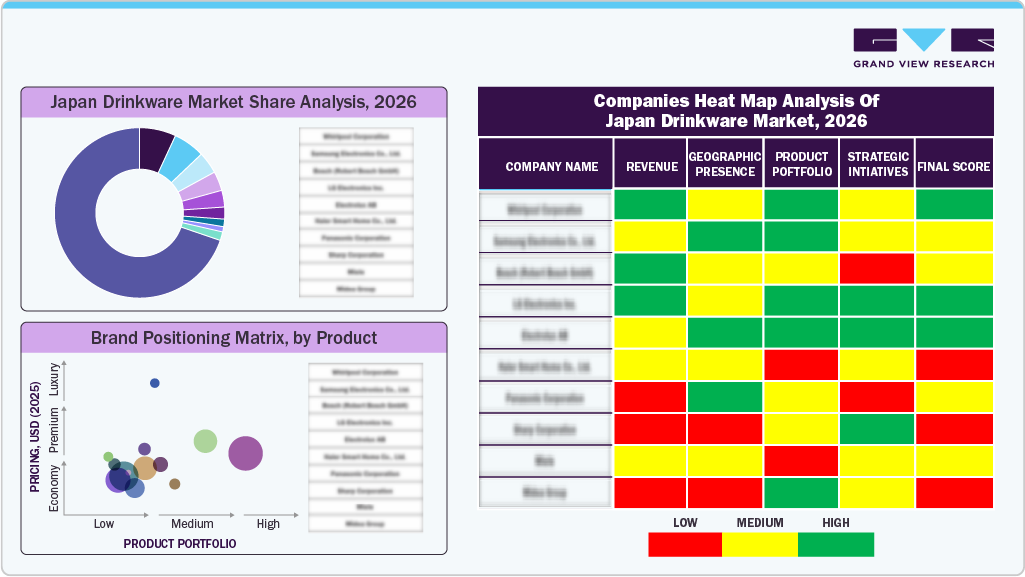
The market is characterized by competition among established domestic manufacturers, international lifestyle brands, and specialized drinkware companies. Brands differentiate their offerings through vacuum-insulation technology, material quality, temperature retention, lightweight construction, and distinctive designs. Established companies such as THERMOS, TIGER, and ZOJIRUSHI maintain strong competitive positioning through broad portfolios of stainless-steel water bottles, tumblers, mugs, and thermos flasks. Meanwhile, brands such as Stanley, Skater, TAKEYA, ASVEL, CB Japan, Kyocera, and HARIO strengthen competition through lifestyle-oriented designs, character-themed products, functional features, and specialized material technologies. Competition is increasingly focused on easy-to-clean designs, portability, durability, and products suited to commuting, workplaces, schools, and outdoor activities.
 To learn more about this report, Download Free Sample Report
For instance, ZOJIRUSHI introduced its SD-KA stainless-steel cool bottle in February 2026, featuring a newly developed Smart Cap for quick hydration and convenient one-handed operation, targeting adult sports and fitness activities. These developments highlight how leading brands are strengthening their competitive positioning through functional improvements, material innovation, and differentiated product designs.
Consumer Insights
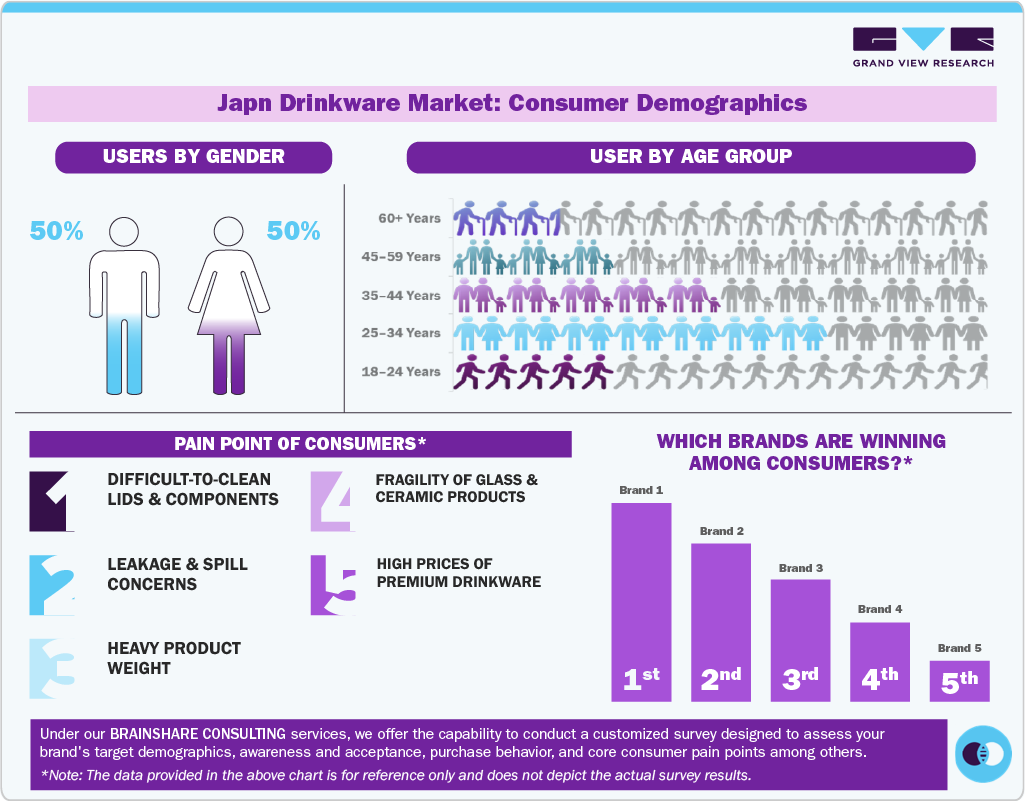
Consumer preferences are primarily influenced by cost savings, convenience, and environmental considerations. According to the survey, 48.6% of respondents used reusable water bottles to save money, while 40.3% cited convenience and 10.9% identified environmental reasons. This indicates that consumers increasingly consider personal bottles a practical alternative to purchasing packaged beverages, particularly for daily commuting, workplaces, and outdoor activities. Consequently, demand for reusable water bottles and tumblers is supported by their cost-saving benefits and convenience in everyday use.
 To learn more about this report, Download Free Sample Report
Product preferences also reflect the importance of material performance, temperature retention, and suitable capacity. Stainless-steel bottles with hot- and cold-temperature retention functions were the most frequently used products, accounting for 75.2% of respondents. Additionally, 46.9% preferred bottles with capacities ranging from 350 ml to less than 500 ml, making this the most used size category. Bottle capacity also tends to decrease with age, with 70.8% of consumers in their 60s using bottles below 500 ml. These preferences are encouraging manufacturers to offer insulated stainless-steel drinkware in varied capacities, lightweight designs, and convenient formats to address different age groups and usage requirements.
Product Insights
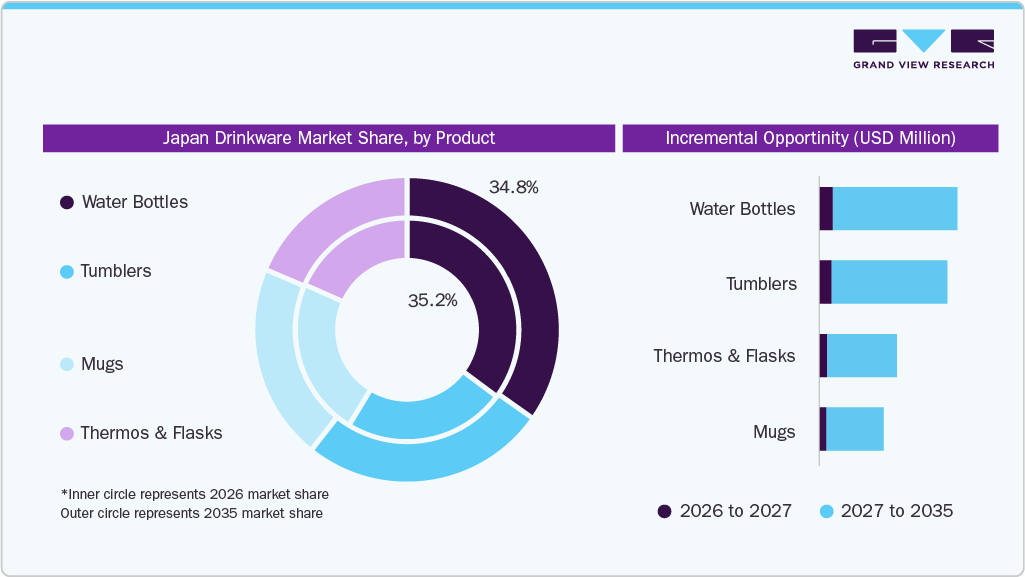
The water bottles segment accounted for the largest market share of 35.2% in 2026, supported by increasing demand for convenient hydration, reusable products, and temperature-controlled beverage storage. Consumers' preference for lightweight, durable, and easy-to-clean bottles is encouraging manufacturers to introduce functional designs with improved insulation and portability. For instance, in October 2026, Kyocera launched its CERAMUG water bottles in 500 ml, 800 ml, and 1,000 ml capacities, featuring an internal ceramic coating designed to preserve beverage taste and vacuum insulation to maintain temperatures. Such innovations are strengthening product differentiation and supporting segment demand.
 To learn more about this report, Download Free Sample Report
Tumblers are anticipated to grow at a CAGR of 5.3% from 2027 to 2035, supported by increasing demand for reusable, portable, and temperature-retaining drinkware in Japan. Consumers' preference for convenient beverage consumption at workplaces, during commuting, and outdoor activities is encouraging manufacturers to introduce functional tumbler designs. These features improve portability and cleaning convenience, catering to everyday beverage consumption requirements. Such product innovations are strengthening the appeal of reusable tumblers and supporting segment growth in Japan.
Material Insights
The plastic segment accounted for a share of 39.4% in 2026, supported by demand for lightweight, durable, and convenient bottles for everyday hydration. Plastic bottles offer portability and ease of handling, making them suitable for commuting, office use, and outdoor activities. For instance, in June 2025, Japan-based CB Japan introduced its SANTECO OURAL Water Bottle 740, featuring a Tritan copolyester body. The bottle offers a lightweight design, glass-like transparency, and a slim shape for convenient carrying. Such product innovations highlight the continued relevance of plastic materials in Japan's reusable water bottle segment.
The metal segment is projected to be the fastest-growing material in the market, registering a CAGR of 6.4% from 2027 to 2035, driven by consumer preference for durable drinkware with temperature-retention capabilities and convenient reusable designs. Stainless steel is gaining relevance in tumblers designed for commuting, office use, and on-the-go consumption. For instance, in July 2026, Zojirushi announced its new SX-NA stainless-steel carry tumbler, available in 0.5-liter and 0.6-liter capacities from September 2026. The product features a wide-mouth design, an integrated stopper and gasket for easier cleaning, and a portable structure. Its launch reflects manufacturers' focus on improving the functionality and convenience of metal tumblers.
Distribution Channel Insights
The offline channels segment accounted for the largest market share of 67.6% in 2026. Offline channels remain an important distribution channel in the market, supported by established retail networks, brand-exclusive stores, and consumers' preference for examining product quality before purchase. Specialty kitchenware stores, department stores, electronics retailers, and variety stores provide access to water bottles, tumblers, mugs, and thermos flasks across different price ranges. For instance, THERMOS operates dedicated Styling Stores at locations such as Futako-Tamagawa Rise and MARK IS Minatomirai. These physical outlets improve product visibility, facilitate product comparisons, and strengthen direct consumer engagement.
 To learn more about this report, Download Free Sample Report
The online channel segment is anticipated to grow at a CAGR of 6.1% from 2027 to 2035. Online channels are gaining traction, supported by brand-owned e-commerce platforms, exclusive online collections, and convenient product comparisons. These platforms allow consumers to explore product specifications, designs, capacities, and prices before purchasing. For instance, in April 2026, THERMOS launched its JOW-series vacuum-insulated bottles exclusively through its directly operated stores and official online shop under the THERMOS Styling Series LOGO. Such initiatives strengthen direct-to-consumer sales and encourage online purchases.
Key Japan Drinkware Companies:
-
THERMOS
-
TIGER
-
ZOJIRUSHI
-
Skater
-
Stanley
-
TAKEYA
-
ASVEL
-
CB Japan
-
Kyocera
-
HARIO
Competitive Benchmarking
Category
Operating Strategies
Competitive Edge
Weakness
Established Players (THERMOS, TIGER, ZOJIRUSHI, Stanley, HARIO)
- These companies focus on maintaining strong brand recognition through extensive drinkware portfolios, product quality, and continuous innovation. Their strategies emphasize vacuum-insulation technology, stainless-steel construction, and improved temperature retention. They offer products targeting everyday consumers, commuters, office workers, and outdoor users. They also leverage established retail networks and e-commerce channels to strengthen market presence.
- Strong brand recognition, established customer loyalty, specialized manufacturing expertise, extensive product portfolios, and established distribution networks provide competitive advantages. THERMOS, TIGER, and ZOJIRUSHI benefit from their long-standing expertise in vacuum-insulated drinkware, while HARIO differentiates itself through heat-resistant glass technology and Stanley through its durable, lifestyle-oriented drinkware positioning.
- Intense competition among established brands, high product-development and marketing costs, and pressure to maintain product differentiation can affect profitability. Dependence on stainless steel and other material inputs exposes manufacturers to raw-material price fluctuations. Additionally, established product designs may require continuous upgrades to address changing consumer preferences for lightweight, easy-to-clean, and multifunctional drinkware.
Emerging and Specialized Players (Skater, TAKEYA, ASVEL, CB Japan, Kyocera)
- These companies concentrate on specialized product categories, distinctive designs, and niche consumer requirements. Their strategies include expanding plastic and lightweight bottles and stylish household mugs. They focus on product differentiation through varied capacities, colors, and practical features. Some companies also leverage specialized manufacturing capabilities and target online and retail distribution to reach specific consumer groups.
- Specialized product offerings, differentiated designs, material expertise, and flexibility in addressing specific consumer preferences provide competitive advantages. Skater benefits from character licensing and a broad range of lifestyle products; TAKEYA focuses on functional hydration products; ASVEL offers a diversified household and drinkware portfolio; and Kyocera brings ceramic-coating technology to bottles and mugs.
- Comparatively narrower brand recognition in certain drinkware categories, limited product specialization across some materials, and competition from established manufacturers can restrict market penetration. Specialized players may also face challenges in expanding distribution networks, maintaining competitive pricing, and investing in product innovation and marketing.
Recent Developments
-
In August 2026,THERMOS launched its JPI-320 and JPI-420 vacuum-insulated portable tumblers in 320 ml and 420 ml capacities. The products feature a locking lid designed to prevent leakage during transportation, a non-slip silicone base, and dishwasher-safe components. The launch addresses demand for drinkware that can be conveniently used at desks, in vehicles, and while commuting.
Japan Drinkware Market Report Scope
Report Attribute
Details
Market size in 2026
USD 645.3 million
Estimated market size in 2027
USD 673.1 million
Projected market size by 2035
USD 934.7 million
Growth rate
CAGR of 4.2% from 2027 to 2035
Base year for estimation
2026
Historical data
2023 - 2025
Forecast period
2027 - 2035
Quantitative units
Revenue in USD million and CAGR from 2027 to 2035
Report coverage
Revenue forecast, company ranking, competitive landscape, growth factors, and trends
Segments covered
Product, material, distribution channel
Country scope
Japan
Key companies profiled
THERMOS; TIGER; ZOJIRUSHI; Skater; Stanley; TAKEYA; ASVEL; CB Japan; Kyocera; HARIO
Customization scope
Free report customization (equivalent to up to 8 analyst working days) with purchase. Addition or alteration to country, regional & segment scope.
Pricing and purchase options
Avail customized purchase options to meet your exact research needs. Explore purchase options
Japan Drinkware Market Report Segmentation
This report forecasts revenue growth at country level and provides an analysis of the latest trends and opportunities in each of the sub-segments from 2023 to 2035. For this study, Grand View Research has segmented the Japan drinkware market report based on product, material, and distribution channel
-
Product Outlook (Revenue, USD Million, 2023 - 2035)
-
Water Bottles
-
Tumblers
-
Mugs
-
Thermos and Flasks
-
-
Material Outlook (Revenue, USD Million, 2023 - 2035)
-
Water Bottles
-
Plastic
-
Metal
-
Glass
-
Silicone
-
Others
-
-
Tumblers
-
Plastic
-
Metal
-
Glass
-
Ceramic
-
Silicone
-
Others
-
-
Mugs
-
Ceramic
-
Porcelain
-
Glass
-
Metal
-
Plastic
-
Silicone
-
Others
-
-
Thermos & Flasks
-
Metal
-
Plastic
-
Glass
-
Ceramic
-
Others
-
-
-
Distribution Channel Outlook (Revenue, USD Million, 2023 - 2035)
-
Water Bottles
-
Offline
-
Brand-Exclusive Stores (Offline DTC)
-
Supermarkets and Hypermarkets
-
Department Stores
-
Specialty Kitchenware & Home Improvement Stores
-
Variety & Discount Stores
-
Traditional/Independent General Retail
-
-
Online
-
Brand-Owned E-Commerce (Online DTC)
-
Online Marketplaces & Retailers
-
-
-
Tumblers
-
Offline
-
Brand-Exclusive Stores (Offline DTC)
-
Supermarkets and Hypermarkets
-
Department Stores
-
Specialty Kitchenware & Home Improvement Stores
-
Variety & Discount Stores
-
Traditional/Independent General Retail
-
-
Online
-
Brand-Owned E-Commerce (Online DTC)
-
Online Marketplaces & Retailers
-
-
-
Mugs
-
Offline
-
Brand-Exclusive Stores (Offline DTC)
-
Supermarkets and Hypermarkets
-
Department Stores
-
Specialty Kitchenware & Home Improvement Stores
-
Variety & Discount Stores
-
Traditional/Independent General Retail
-
-
Online
-
Brand-Owned E-Commerce (Online DTC)
-
Online Marketplaces & Retailers
-
-
-
Thermos and Flasks
-
Offline
-
Brand-Exclusive Stores (Offline DTC)
-
Supermarkets and Hypermarkets
-
Department Stores
-
Specialty Kitchenware & Home Improvement Stores
-
Variety & Discount Stores
-
Traditional/Independent General Retail
-
-
Online
-
Brand-Owned E-Commerce (Online DTC)
-
Online Marketplaces & Retailers
-
-
-
Research Methodology
The Japan drinkware market figures in this report are based on a proven research process that combines executive interviews with secondary research from proprietary databases, company filings, and recognized regulatory and institutional sources. Market size is built through value-chain sizing-reconciling supply-side and demand-side estimates-and triangulated with bottom-up and top-down approaches. Every estimate passes multiple levels of expert validation before publication, with each Japan drinkware segment quantified using the revenue-capture definitions in the table below.
Segment Definition
Segment - Product
Revenue capture definition
Water Bottles
Covers portable, reusable beverage containers designed primarily for carrying and drinking water and other beverages. Includes standard bottles, sports bottles, sipper bottles, insulated water bottles, and specialty bottles made from stainless steel, plastic, glass, or other materials. Examples include stainless-steel vacuum bottles, plastic sports bottles, and reusable bottles for school, work, travel, and outdoor activities.
Tumblers
Covers cup-shaped drinkware generally designed without an integrated handle for individual consumption of hot or cold beverages. Includes standard tumblers, vacuum-insulated tumblers, travel tumblers, and models with lids, straws, or spill-resistant drinking mechanisms. Examples include stainless-steel travel tumblers, insulated coffee tumblers, and cold-drink tumblers with reusable straws.
Mugs
Covers cup-shaped drinkware featuring an integrated handle and designed for individual consumption of hot or cold beverages. Includes ceramic mugs, glass mugs, stainless-steel mugs, plastic mugs, insulated mugs, and travel mugs. Examples include ceramic coffee mugs, porcelain tea mugs, stainless-steel insulated mugs, and handled mugs for everyday household use.
Thermos and Flasks
Covers insulated beverage containers specifically designed to maintain the temperature of hot or cold contents for extended periods. Includes vacuum-insulated thermos bottles, thermal flasks, vacuum flasks, and similar temperature-retaining vessels with stopper, screw-cap, or cup-lid designs. Examples include stainless-steel vacuum flasks, insulated thermos bottles, and thermal beverage containers for work, travel, and outdoor use.
Estimation Model
Consumer Need & Target
Base LayerProduct Availability &
Distribution LayerActive Purchasing &
Engagement LayerMonetisation Layer
Who needs drinkware?
Who can access drinkware?
Who actually purchases and uses drinkware?
How much revenue is generated?
Identify Japanese individuals and households requiring drinkware for daily hydration, beverage consumption, food storage, and on-the-go use. Consider population, household size, commuting patterns, outdoor lifestyles, hydration awareness, seasonal temperatures, and preferences for reusable products. Include consumers purchasing water bottles, tumblers, mugs, and thermos and flasks for personal and household use.
Filter the target population based on access to suitable drinkware products across Japan. Consider product availability, retail distribution, brand presence, regional coverage, and price accessibility. Include supermarkets and hypermarkets, department stores, online marketplaces, and brand-owned e-commerce platforms. Account for availability across plastic, metal, glass, silicone, ceramic, porcelain, and other materials.
Apply consumer adoption and purchasing assumptions to estimate actual product buyers and users. Consider household penetration, gifting purchases, and multi-product ownership. Evaluate preferences for vacuum insulation, lightweight construction, leakproof lids, easy-to-clean designs, portability, durability, and aesthetic appeal. Account for demand across water bottles, tumblers, mugs, and thermos and flasks.
Estimate market revenue by multiplying annual product sales volumes by average selling prices across drinkware categories. Aggregate revenue across water bottles, tumblers, mugs, and thermos and flasks. Adjust for material type, product capacity and replacement purchases. Avoid double-counting consumers purchasing multiple drinkware products.
Delivered Customizations
This report has been delivered with the following In-depth customizations
Client Request
Customization Delivered
Value Adds
Product Segmentation & Consumer Demand Analysis
Conducted an in-depth analysis of the Japan drinkware market across water bottles, tumblers, mugs, and thermos and flasks. Evaluated product innovations, capacity preferences, insulation technologies, portability, durability, ease of cleaning, and evolving consumer preferences. Examined demand drivers such as reusable drinkware adoption, hydration awareness, commuting habits, outdoor activities, and demand for convenient beverage storage solutions.
Enables stakeholders to understand product-level demand, identify high-potential drinkware categories, evaluate consumer preferences, and assess the impact of functional innovation on market development. Supports product development and portfolio strategies aligned with Japanese consumer requirements.
Material Segmentation & Product Innovation Analysis
Assessed the Japan drinkware market across plastic, metal, glass, silicone, ceramic, porcelain, and other materials. Examined material characteristics, product applications, durability, weight, heat-retention capabilities, ease of maintenance, and consumer preferences. Evaluated innovations such as stainless-steel vacuum insulation, ceramic-coated interiors, Tritan plastic, heat-resistant glass, and improved sealing components.
Provides insights into material-specific demand, product differentiation, and emerging innovation opportunities. Helps stakeholders evaluate material suitability across drinkware categories, identify changing consumer preferences, and develop products with improved functionality, durability, and design appeal.
Distribution Channel Assessment
Evaluated the Japan drinkware market across offline and online distribution channels. Examined offline channels, including brand-exclusive stores, supermarkets and hypermarkets, department stores, specialty kitchenware and home improvement stores, variety and discount stores, and traditional/independent general retail. Assessed online channels, including brand-owned e-commerce/online DTC and online marketplaces and retailers. Analyzed retail presence, product accessibility, promotional activities, digital sales strategies, and consumer purchasing behavior.
Helps stakeholders understand channel-level sales opportunities, evaluate retail accessibility, and identify effective routes to market. Supports distribution expansion, e-commerce development, brand visibility, and channel-specific marketing strategies to strengthen market penetration in Japan.
Frequently Asked Questions About This Report
The Japan drinkware market is expected to grow at a compound annual growth rate of 4.2% from 2027 to 2035 to reach USD 934.7 million by 2035.
Water bottles accounted for the largest revenue share of 35.2% in 2026.
The Japan drinkware market size was estimated at USD 645.3 million in 2026 and is expected to reach USD 673.1 million in 2027.
Rising summer temperatures in Japan are increasing awareness of regular hydration, supporting demand for portable and reusable drinkware
Key players: THERMOS; TIGER; ZOJIRUSHI; Skater; Stanley; TAKEYA; ASVEL; CB Japan; Kyocera; HARIO.
Plastic segment accounted for a share of 39.4% in 2026.
Offline accounted for the largest revenue share of 67.6% in 2026.
About the Author(s)
Homecare & Decor Research Team
Consumer Goods · Homecare & DecorThis report was authored by the homecare & decor research team at Grand View Research - comprising two research analysts, one senior research analyst, and one industry expert - with specialized expertise in the homecare & decor segment of the consumer goods industry. All findings are based on proprietary consumer goods databases, executive interviews, and regulatory analysis, subject to internal peer review prior to publication.
Last Updated:
Speak to Analyst

Customize this report to your needs - add regions, segments, or data points, with 20% free customization.
Or view our licence options:


ISO 9001:2015 & 27001:2022 Certified
We are GDPR and CCPA compliant! Your transaction & personal information is safe and secure. For more details, please read our privacy policy.


