
- Home
- »
- Next Generation Technologies
- »
-
LEO Tracking Antenna Market Size Report, 2026-2033GVR Report cover
![LEO Tracking Antenna Market (2026 - 2033)Report]()
LEO Tracking Antenna Market (2026 - 2033)
Size, Share & Trends Analysis Report By Platform (Ground-based Systems, Maritime Platforms, Airborne Platforms, Land Mobile Platforms, Space-based Platforms), By Frequency Band, By Application, By End-use, By Region, And Segment Forecasts
Market Size, 2025
$2.2BMarket Estimate, 2026
$2.6BMarket Forecast, 2033
$8.8BCAGR, 2026–2033
18.9%LEO Tracking Antenna Market Summary
The global LEO tracking antenna market size was valued at USD 2.2 billion in 2025 and is projected to grow from USD 2.6 billion in 2026 to USD 8.8 billion by 2033, at a CAGR of 18.9% from 2026 to 2033. North America dominated the market, accounting for the largest global share of 39.1% in 2025. The LEO tracking antenna market is growing due to the rapid expansion of low earth orbit (LEO) satellite constellations and the increasing demand for high-speed, low-latency satellite communication services.

Key Market Trends & Insights
- By platform: Ground-based systems segment held the largest share of 46.4% in 2025.
- By frequency band: Ka-band segment held the largest share of over 34.3% in 2025.
- By application: Broadband connectivity segment held the largest share of 39.0% in 2025.
- By end use: Commercial Satellite Operators segment led the Market with a share of 46.0% in 2025.
Regional Highlights
- Largest regional market: North America (39.1% revenue share, 2025)
- Fastest growing regional market: Asia Pacific (highest CAGR, 2026 - 2033)
- By country: The U.S. held the largest share of North America in 2025.
Market Size & Forecast
- Market Size in 2025: USD 2.2 Billion
- Estimated market size in 2026: USD 2.6 Billion
- Projected Market Size by 2033: USD 8.8 Billion
- CAGR (2026-2033): 18.9%
As governments, defense organizations, and commercial enterprises invest in satellite-based broadband, earth observation, maritime connectivity, aviation communication, and remote sensing applications, the need for advanced tracking antennas capable of maintaining continuous communication with fast-moving LEO satellites is significantly increasing.
The demand for LEO tracking antennas is increasing as satellite operators, defense organizations, and commercial enterprises seek reliable communication with rapidly moving low earth orbit (LEO) satellites. Users are increasingly adopting advanced tracking antenna systems to enable continuous connectivity, real-time data transmission, and seamless satellite handovers for broadband internet, earth observation, navigation, maritime, and aviation applications. In addition, the growing deployment of large-scale LEO satellite constellations for global connectivity and remote communication is driving the need for high-performance electronically steered and mechanically steered antennas. Advancements in phased array technology, beamforming capabilities, and satellite communication infrastructure are further improving the accuracy, efficiency, and tracking performance of these antennas.
Market Dynamics
The LEO Tracking Antenna Market is witnessing significant growth, driven by the rapid expansion of low Earth orbit (LEO) satellite constellations and the increasing demand for high-speed, low-latency satellite communication across commercial, government, and defense applications. Organizations are adopting advanced LEO tracking antennas to maintain continuous connectivity with fast-moving satellites, enabling reliable broadband services, Earth observation, maritime communications, aviation connectivity, military operations, and remote enterprise networks. Advancements in electronically steered antennas (ESA), phased array technology, beamforming, multi-orbit compatibility, and antenna miniaturization have significantly enhanced tracking accuracy, communication efficiency, and operational flexibility. The growing deployment of satellite internet services, increasing investments in space infrastructure, rising demand for mobility connectivity, and expanding satellite-based IoT applications are further accelerating market growth. However, high deployment costs, complex antenna design, spectrum management challenges, and interoperability issues remain key restraints. At the same time, increasing investments in next-generation satellite networks, defense modernization programs, and integrated multi-orbit communication solutions are creating substantial growth opportunities for market participants.
The LEO tracking antenna market is being driven by the rapid deployment of low earth orbit (LEO) satellite constellations for broadband communication, earth observation, navigation, remote sensing, and defense applications. Increasing demand for high-speed, low-latency satellite communication services across maritime, aviation, military, enterprise, and remote connectivity sectors is encouraging the adoption of advanced tracking antenna systems capable of maintaining seamless communication with fast-moving LEO satellites. These antennas support continuous beam tracking, satellite handovers, and real-time data transmission across dynamic satellite networks.
The growing adoption of satellite-based internet services connected mobility platforms, autonomous systems, and defense surveillance technologies is further increasing demand for electronically steered antennas, phased array systems, and multi-orbit tracking solutions. In addition, advancements in beamforming technology, flat-panel antenna design, AI-enabled signal optimization, and satellite communication infrastructure are improving tracking accuracy, bandwidth efficiency, and operational reliability. Increasing investments by governments, private satellite operators, and aerospace companies in next-generation satellite communication networks are also accelerating market growth. Overall, the expansion of global LEO constellations, rising demand for uninterrupted connectivity, and continuous innovation in satellite communication technologies are driving the growth of the global LEO tracking antenna market.
Despite strong growth potential, the LEO Tracking Antenna Market faces several challenges related to high technology costs, complex integration requirements, and operational limitations. Developing advanced LEO tracking antennas requires sophisticated phased array architectures, precision beam steering systems, high-frequency RF components, and advanced thermal management technologies, which significantly increase manufacturing and deployment costs. These expenses can create barriers for smaller manufacturers and emerging satellite communication providers.
Another major restraint is the technical complexity associated with tracking rapidly moving LEO satellites while ensuring uninterrupted connectivity and low latency. Integrating antennas with multiple satellite constellations, communication protocols, and ground station networks can be highly challenging. Signal interference, spectrum congestion, atmospheric disturbances, and power consumption issues may also affect performance and operational efficiency. In addition, maintaining compact antenna designs for mobility applications such as aircraft, ships, and land vehicles while ensuring high throughput and durability remains a significant engineering challenge. Shortages of skilled RF engineers, satellite communication specialists, and phased array technology experts further limit product innovation and large-scale deployment capabilities.
The rapid advancement of AI-driven beam management, electronically steered antenna technology, and mobility-based satellite communication services is creating substantial opportunities in the LEO tracking antenna market. Companies are increasingly leveraging artificial intelligence, machine learning, and advanced signal processing technologies to improve beam tracking accuracy, optimize satellite handovers, and enhance network performance in real time. AI-powered antenna systems can dynamically adapt to changing satellite positions and environmental conditions, improving communication reliability and bandwidth efficiency. At the same time, the growing integration of LEO tracking antennas into commercial aviation, maritime connectivity, autonomous vehicles, military communication systems, and disaster recovery networks is expanding market opportunities.Market Concentration & Characteristics
The LEO tracking antenna market is moderately concentrated, with competition led by a mix of established aerospace and defense companies, satellite communication equipment manufacturers, and emerging antenna technology providers. The market is characterized by continuous advancements in electronically steered antennas (ESAs), phased array technology, beamforming, multi-orbit compatibility, and high-throughput satellite communication solutions. While technological complexity and high R&D investments create barriers to entry, growing demand for LEO satellite connectivity is encouraging new participants to develop innovative and cost-effective tracking antenna solutions. Established players maintain a competitive advantage through proprietary antenna technologies, strong relationships with satellite operators and government agencies, global distribution networks, and continuous investment in product innovation.
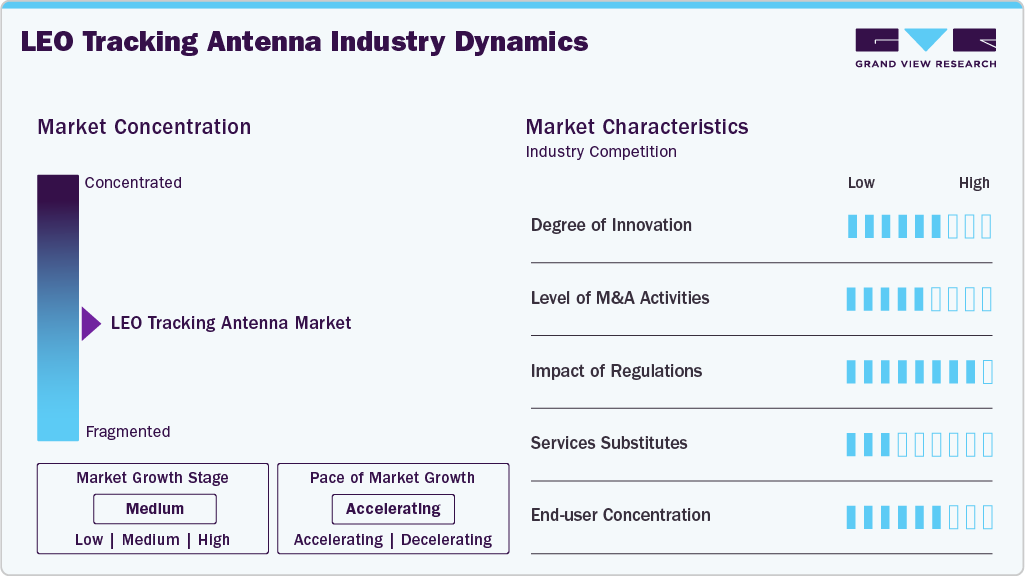
Major players such as L3Harris Technologies, Honeywell International, Ball Corporation, ThinKom Solutions, Intellian Technologies, Cobham Limited, CesiumAstro, Starwin, Viasat, and Kymeta are strengthening their market presence by developing advanced tracking antennas that support high-speed, reliable communication across LEO satellite constellations. These companies are focusing on enhancing antenna performance, reducing size, weight, and power (SWaP), improving multi-orbit interoperability, and expanding applications across defense, maritime, aviation, enterprise, and mobility sectors. As LEO satellite deployments continue to accelerate worldwide, the market is expected to witness increased investments, strategic partnerships, and ongoing technological advancements.
Analyst Perspective
The LEO Tracking Antenna Market is poised for strong growth, driven by the rapid deployment of low Earth orbit (LEO) satellite constellations, increasing demand for high-speed, low-latency connectivity, and rising adoption of satellite communications across commercial, defense, aviation, maritime, and enterprise sectors. Growing investments in next-generation satellite networks and advancements in electronically steered antennas (ESAs), phased array technology, and multi-orbit communication capabilities are enhancing antenna performance, tracking precision, and operational efficiency. The expanding use of satellite broadband, in-flight connectivity, autonomous systems, and remote connectivity solutions is creating significant opportunities for market participants. Although high development costs, technical complexity, and spectrum management challenges remain key concerns, the long-term outlook for the market remains highly positive, supported by continuous innovation in satellite communication technologies and increasing global investments in space infrastructure.
Platform Insights
The Ground-Based Systems segment dominates the LEO tracking antenna market with market share over 46.0% in 2025 due to its critical role in maintaining reliable communication and continuous tracking of rapidly moving low earth orbit satellites. Ground-based tracking systems are widely adopted by satellite operators, defense organizations, telecommunication providers, and space agencies for applications such as satellite communication, earth observation, navigation, and remote sensing. These systems offer high-performance signal reception, precise beam steering, and stable connectivity required for managing large LEO satellite constellations. Additionally, the increasing deployment of satellite ground stations and gateway infrastructure to support global broadband and low-latency communication services is driving segment growth.
The Airborne Platforms segment is also witnessing significant growth in the LEO Tracking Antenna Market due to the increasing demand for high-speed in-flight connectivity, real-time communication, and satellite-based navigation systems in commercial and military aviation. Airlines, defense agencies, and aerospace operators are increasingly adopting advanced LEO tracking antennas to enable seamless broadband connectivity, live data transmission, and low-latency communication during flight operations. These airborne antenna systems support applications such as passenger internet services, aircraft monitoring, surveillance, mission-critical communication, and unmanned aerial vehicle (UAV) operations.
Application Insights
The Broadband Connectivity segment led the LEO Tracking Antenna Market with over 39.0% market share in 2025, due to the rapidly increasing demand for high-speed, low-latency internet services across remote, rural, maritime, aviation, and underserved regions. The growing deployment of low earth orbit satellite constellations by global satellite operators is driving the adoption of advanced tracking antennas capable of maintaining continuous connectivity and seamless satellite handovers. Broadband connectivity applications require highly efficient tracking systems to support real-time data transmission, video streaming, cloud services, and enterprise communication with minimal latency.
The Aviation & Maritime Mobility segment is growing significantly in the LEO Tracking Antenna Market due to the increasing demand for uninterrupted high-speed connectivity and real-time communication across aircraft and maritime vessels. Airlines, commercial shipping operators, cruise lines, and defense fleets are increasingly adopting LEO tracking antennas to support broadband internet access, navigation, operational monitoring, crew communication, and passenger connectivity services. The low-latency capabilities of LEO satellite networks enable seamless communication even in remote oceanic and airspace regions where traditional terrestrial networks are unavailable.
End-use Insights
The commercial satellite operators segment led the LEO Tracking Antenna Market with over 46.0% market share due to the rapid expansion of low earth orbit satellite constellations for broadband internet, earth observation, remote sensing, and global communication services. Commercial satellite companies are heavily investing in advanced tracking antenna systems to maintain continuous communication, enable seamless satellite handovers, and support high-speed data transmission across large-scale satellite networks. The increasing demand for low-latency connectivity in enterprise communication, aviation, maritime, defense, and remote area broadband services is further driving the adoption of high-performance LEO tracking antennas among commercial operators.
The telecom service providers segment is also witnessing substantial growth in the LEO Tracking Antenna Market due to the increasing demand for high-speed satellite-based broadband connectivity and expanding global communication infrastructure. Telecom operators are increasingly adopting LEO tracking antennas to extend network coverage to remote and underserved regions, enhance low-latency communication services, and support next-generation applications such as 5G backhaul, IoT connectivity, and enterprise communication networks.
Frequency Band Insights
The Ka-Band segment led the market in 2025, accounting for over 34.0% share of the revenue. This dominance is attributed to the increasing demand for high-frequency communication solutions that support high-speed data transmission, greater bandwidth capacity, and enhanced connectivity performance. Ka-Band technology is widely adopted in satellite communication, broadband services, defense applications, and advanced tracking systems due to its ability to deliver reliable and low-latency communication.

The Ku-Band segment is also witnessing significant growth due to its increasing adoption in satellite communication, broadcasting, maritime, and airborne connectivity applications. The segment is gaining traction owing to its cost-effectiveness, wide coverage capabilities, and reliable performance in remote and mobile communication environments. In addition, rising demand for high-speed connectivity across commercial aviation, defense, and telecom sectors is further supporting the growth of the Ku-Band segment.
Regional Insights
The North America region dominated the LEO tracking antenna market with over 39.0% market share in 2025, driven by the strong presence of leading satellite communication companies, aerospace manufacturers, and advanced space communication infrastructure across the region. The U.S. and Canada are witnessing increasing deployment of low earth orbit satellite constellations for broadband connectivity, defense communication, earth observation, and remote sensing applications, which is significantly driving demand for advanced tracking antenna systems. The region benefits from substantial investments in satellite communication technologies, defense modernization programs, and next-generation aerospace infrastructure.

U.S. LEO Tracking Antenna Market Trends
The U.S. dominates the LEO tracking antenna market due to its strong presence of leading satellite communication providers, aerospace companies, defense contractors, and space technology innovators. The country is witnessing significant investments in low earth orbit satellite constellations, advanced satellite communication infrastructure, and next-generation defense communication systems, which are driving the demand for high-performance tracking antennas. Increasing deployment of satellite-based broadband services for aviation, maritime, military, enterprise, and remote connectivity applications is further supporting market growth.
Europe LEO Tracking Antenna Market Trends
The Europe LEO tracking antenna market is witnessing steady growth due to increasing investments in satellite communication infrastructure, space research programs, and next-generation connectivity technologies across the region. European countries are increasingly adopting LEO satellite networks to support broadband communication, defense operations, aviation connectivity, maritime communication, and earth observation applications. The growing focus on digital connectivity in remote and underserved areas, along with rising demand for low-latency satellite internet services, is driving the adoption of advanced tracking antenna systems.
Asia Pacific LEO Tracking Antenna Market Trends
The Asia Pacific LEO tracking antenna market is witnessing the fastest growth due to increasing investments in satellite communication infrastructure, expanding space exploration programs, and rising demand for broadband connectivity across emerging economies such as China, India, Japan, and South Korea. Governments and private satellite operators in the region are rapidly deploying low earth orbit satellite constellations to improve internet access in remote and underserved areas, which is driving demand for advanced tracking antenna systems. The growing adoption of satellite communication technologies in aviation, maritime, defense, disaster management, and enterprise connectivity applications is further accelerating market growth.
Key Companies and Market Share Insights
The LEO Tracking Antenna Market features several key players that significantly shape its global landscape through advanced satellite communication technologies, electronically steered antenna systems, phased array innovations, and multi-orbit connectivity solutions.
-
Kymeta is one of the prominent providers of flat-panel and electronically steered antenna solutions for low earth orbit satellite communication. The company focuses on enabling seamless connectivity for mobility applications across defense, maritime, aviation, and land-based communication networks through advanced beam steering and hybrid satellite-cellular technologies.
-
Viasat is a global provider of satellite communication infrastructure and tracking antenna technologies, supporting broadband connectivity, aviation communication, defense networks, and enterprise communication services. The company leverages advanced satellite networking and antenna systems to deliver reliable low-latency connectivity across LEO satellite constellations.
Key LEO Tracking Antenna Companies:
The following key companies have been profiled for this study on the LEO tracking antenna market
-
L3Harris Technologies
-
Honeywell International
-
Ball Corporation
-
ThinKom Solutions
-
Intellian Technologies
-
Cobham Limited
-
CesiumAstro
-
Starwin
Competitive benchmarking
Operating Strategies
Competitive Edge
Weaknesses
Mature Players: Viasat, L3Harris Technologies, Honeywell International, Ball Corporation, Cobham Limited, Intellian Technologies, Calian Group Ltd
- Expand LEO tracking antenna capabilities through strategic partnerships, technology collaborations, and the development of advanced satellite communication solutions for aviation, and enterprise connectivity applications.
- Invest in electronically steered antennas, phased array technologies, AI-enabled beamforming systems and scalable communication infrastructure to improve tracking accuracy, connectivity performance, and low-latency communication capabilities.
- Strong global presence, extensive satellite communication networks, and diversified portfolios spanning tracking antennas, phased array systems, satellite connectivity solutions, and aerospace communication technologies.
- Ability to deliver scalable LEO tracking antenna solutions with real-time satellite tracking, seamless connectivity, low-latency communication, and high-performance beam steering capabilities.
- Dependence on traditional satellite communication infrastructure, legacy ground station networks, and conventional antenna architectures can slow the adoption of advanced electronically steered and AI-enabled LEO tracking technologies.
- Complex operational structures and large-scale communication network integration requirements may reduce deployment flexibility and delay the rollout of next-generation LEO tracking antenna solutions across mobility, defense, and enterprise applications.
Emerging Players: Kymeta, ThinKom Solutions, CesiumAstro, Starwin
- Develop specialized and cost-effective LEO tracking antenna solutions targeting niche applications such as aviation connectivity, maritime communication, defense operations, unmanned systems, and remote broadband access.
- Focus on agility, customization, and rapid innovation to address evolving requirements for electronically steered antennas, AI-enabled beamforming, multi-orbit satellite communication, and real-time high-speed connectivity solutions
- Faster development cycles enable rapid adoption of emerging technologies such as electronically steered antennas, AI-enabled beamforming, phased array systems, and multi-orbit satellite communication solutions.
- Flexible and customer-centric approaches help differentiate solutions in niche applications such as aviation connectivity, maritime communication, defense operations, unmanned systems, and remote broadband communication services.
- Limited financial resources and smaller operational scale may restrict investments in advanced phased array technologies.
- Lower brand recognition and a smaller customer base can hinder market penetration, large commercial contracts, and strategic partnership opportunities with satellite operators.
Recent Development
-
In March 2026, Viasat announced a collaboration with QEST to enhance airborne connectivity solutions in the LEO tracking antenna market. The partnership focuses on advancing next-generation in-flight communication capabilities by integrating advanced satellite communication technologies and high-performance tracking antenna systems. The collaboration aims to improve low-latency broadband connectivity, operational efficiency, and seamless communication services for aviation applications, supporting the growing demand for reliable airborne satellite connectivity across commercial and defense sectors.
-
In October 2025, Honeywell International launched its Honeywell Alternative Navigation Architecture (HANA), a software-based navigation platform designed to support resilient aircraft navigation in GPS-denied or jammed environments. The solution integrates advanced technologies such as vision-aided navigation, magnetic anomaly-aided navigation, and low earth orbit (LEO) satellite navigation to improve positioning accuracy and communication reliability. The platform is designed to enhance navigation resilience for commercial aviation, defense, and unmanned systems, supporting the growing adoption of advanced LEO-enabled aerospace communication and tracking technologies.
LEO Tracking Antenna Market Report Scope
Report Attribute
Details
Market size in 2025
USD 2.2 billion
Estimated market size in 2026
USD 2.6 billion
Projected market size by 2033
USD 8.8 billion
Growth rate
CAGR of 18.9% from 2026 to 2033
Actual data
2021 - 2025
Forecast period
2026 - 2033
Quantitative units
Revenue in USD million/billion, and CAGR from 2026 to 2033
Report coverage
Revenue forecast, company ranking, competitive landscape, growth factors, and trends
Segments covered
Platform, frequency band, application, end-use, region
Regional scope
North America; Europe; Asia Pacific; Latin America; MEA
Country scope
U.S.; Canada; Mexico; Germany; UK; France; China; India; Japan; Australia; South Korea; Brazil; UAE; South Africa; KSA
Key companies profiled
Kymeta Corporation; Viasat Inc.; L3Harris Technologies; Honeywell International Inc.; Ball Corporation; ThinKom Solutions Inc.; Intellian Technologies Inc.; Cobham Limited; CesiumAstro Inc.; Starwin Satellite Communication Technology Co. Ltd.; Gilat Satellite Networks; Hanwha Phasor; CPI International; Hughes Network Systems LLC; Calian Group Ltd
Customization scope
Free report customization (equivalent up to 8 analysts working days) with purchase. Addition or alteration to country, regional & segment scope.
Pricing and purchase options
Avail customized purchase options to meet your exact research needs. Explore purchase options
Global LEO Tracking Antenna Market Report Segmentation
This report forecasts revenue growth at global, regional, and country levels and provides an analysis of the latest industry trends in each of the sub-segments from 2021 to 2033. For this study, Grand View Research has segmented the global LEO tracking antenna market report based on platform, frequency band, application, end use, and region.
-
Platform Outlook (Revenue, USD Million, 2021 - 2033)
-
Ground-based Systems
-
Maritime Platforms
-
Airborne Platforms
-
Land Mobile Platforms
-
Space-based Platforms
-
-
Application Outlook (Revenue, USD Million, 2021 - 2033)
-
Weather Monitoring & Forecasting
-
Disaster Management
-
Emergency Alerts & Public Safety
-
Outdoor Activity Planning
-
Agriculture & Marine Forecasting
-
Others
-
-
Application Outlook (Revenue, USD Million, 2021 - 2033)
-
Cloud
-
On-premises
-
-
End-use Outlook (Revenue, USD Million, 2021 - 2033)
-
Individual Consumers
-
Government & Meteorological Agencies
-
Transportation & Logistics
-
Agriculture Sector
-
Energy & Utilities
-
Media & Broadcasting
-
Others
-
-
Regional Outlook (Revenue, USD Million, 2021 - 2033)
-
North America
-
U.S.
-
Canada
-
Mexico
-
-
Europe
-
UK
-
Germany
-
France
-
-
Asia Pacific
-
China
-
Japan
-
India
-
Australia
-
South Korea
-
-
Latin America
-
Brazil
-
-
Middle East and Africa (MEA)
-
KSA
-
UAE
-
South Africa
-
-
Research Methodology
The LEO tracking antenna market figures in this report are based on a proven research process that combines executive interviews with secondary research from proprietary databases, company filings, and recognized regulatory and institutional sources. Market size is built through value-chain sizing-reconciling supply-side and demand-side estimates-and triangulated with bottom-up and top-down approaches. Every estimate passes multiple levels of expert validation before publication, with each LEO tracking antenna segment quantified using the revenue-capture definitions in the table below.
Segment Definition
Segment - Platform
Revenue capture definition
Ground-Based Systems
Revenue in this segment is generated through the deployment and operation of ground-based systems that support communication with LEO satellites. These systems include fixed ground stations, gateway terminals, tracking antennas, network control infrastructure, and communication hubs used by satellite operators, telecom providers, defense organizations, and government agencies to enable reliable, high-speed satellite connectivity and network management.
Maritime Platforms
Revenue in this segment is generated through the deployment of LEO tracking antennas on commercial and defense maritime vessels to provide continuous satellite connectivity. These systems enable high-speed broadband, navigation support, crew welfare, operational communications, and real-time data exchange across oceans and remote maritime environments.
Airborne Platforms
Revenue in this segment is generated through the deployment of LEO tracking antennas on commercial and military aircraft to enable continuous satellite connectivity. These systems support in-flight broadband, cockpit communications, real-time data transmission, navigation, and mission-critical communication for aviation and defense applications.
Land Mobile Platforms
Revenue in this segment is generated through the deployment of LEO tracking antennas on land-based mobile platforms, including military vehicles, emergency response units, public safety fleets, and commercial transport. These systems provide reliable satellite connectivity for real-time communication, navigation, remote operations, and mission-critical data transmission in areas with limited terrestrial network coverage.
Space-Based Platforms
Revenue in this segment is generated through the deployment of LEO tracking antennas on satellites and other space-based platforms to enable inter-satellite communication, telemetry, tracking, and data transmission. These systems support continuous connectivity, network resilience, and efficient communication within satellite constellations and space missions
Segment - Frequency Band
Revenue capture definition
Ka-Band
Revenue in this segment is generated through the deployment of Ka-band LEO tracking antennas that enable high-speed, high-capacity satellite communication. These antennas are widely used across aviation, maritime, defense, enterprise, and broadband applications to support data-intensive services, low-latency connectivity, and high-throughput communications.
Ku-Band
Revenue in this segment is generated through the deployment of Ku-band LEO tracking antennas that provide reliable satellite communication for commercial and government applications. These antennas are widely used in maritime, aviation, broadcasting, defense, and enterprise connectivity to support broadband access, voice communication, and data transmission over wide geographic areas.
X-Band
Revenue in this segment is generated through the deployment of X-band LEO tracking antennas primarily for defense, government, and aerospace applications. These antennas provide secure, reliable, and resilient satellite communications for military operations, intelligence, surveillance, reconnaissance (ISR), and mission-critical data transmission in challenging environments.
S-Band
Revenue in this segment is generated through the deployment of S-band LEO tracking antennas for satellite telemetry, tracking, command (TT&C), and communication applications. These antennas are widely used in space missions, government, defense, and research applications, offering reliable connectivity for mission control, monitoring, and low-to-medium bandwidth data transmission.
Others
Revenue in this segment is generated through the deployment of LEO tracking antennas operating in other frequency bands, including C-band, L-band, and emerging spectrum bands, depending on application requirements. These antennas support specialized communication, navigation, remote sensing, and scientific research applications across commercial, government, and defense sectors.
Segment - Application
Revenue capture definition
Broadband Connectivity
Revenue in this segment is generated through the deployment of LEO tracking antennas that enable high-speed broadband satellite connectivity for residential, enterprise, aviation, maritime, and remote locations. These systems provide reliable internet access, low-latency communication, and seamless data transmission where terrestrial networks are limited or unavailable.
Earth Observation & Remote Sensing
Revenue in this segment is generated through the deployment of LEO tracking antennas that support communication with Earth observation and remote sensing satellites. These systems enable the reliable transmission of imaging, environmental, weather, and geospatial data for government, commercial, defense, and scientific applications.
Aviation & Maritime Mobility
Revenue in this segment is generated through the deployment of LEO tracking antennas that provide continuous satellite connectivity for aircraft and maritime vessels. These systems support in-flight and onboard broadband, navigation, operational communications, crew and passenger connectivity, and real-time data exchange across global routes.
Scientific & Research Missions
Revenue in this segment is generated through the deployment of LEO tracking antennas for scientific, space exploration, and research missions. These systems support telemetry, tracking, command, and high-reliability data transmission for satellites, research institutions, space agencies, and experimental missions.
Others
Revenue in this segment is generated through the deployment of LEO tracking antennas for specialized applications beyond the primary categories. These include disaster response, public safety, remote industrial operations, humanitarian missions, and other niche commercial, government, and defense communication requirements.
Estimation Model
Layer Name
Key Question
Description
Addressable End-User & Satellite Deployment Base Layer
Which sectors require LEO tracking antennas?
Identify the global addressable base of organizations and platforms requiring LEO tracking antennas, including satellite operators, defense organizations, aviation, maritime, government agencies, telecom providers, enterprise networks, and research institutions utilizing LEO satellite communications.
LEO Tracking Antenna Adoption Layer
Which organizations are adopting LEO tracking antennas?
Apply adoption rates across end-use industries based on the deployment of LEO tracking antennas for satellite broadband, mobility connectivity, Earth observation, defense communications, remote connectivity, and mission-critical communication applications.
Antenna Deployment & Utilization Layer
How extensively are LEO tracking antennas deployed?
Estimate market demand based on the number of installed antennas, deployment across fixed and mobile platforms, electronically steered antenna (ESA) adoption, phased array integration, multi-orbit compatibility, and antenna replacement and upgrade cycles across industry verticals.
Revenue Generation Layer
How much revenue is generated?
Estimate market revenue by multiplying the number of LEO tracking antennas deployed across commercial, defense, aviation, maritime, and enterprise applications by their average selling prices (ASP), installation charges, maintenance contracts, software and network management services, and value-added support offerings.
Delivered Customizations
This report has been delivered with the following In-depth customizations:
Client Request
Customization Delivered
Value Adds
LEO Tracking Antenna Market Entry and Growth Strategy for a Satellite Communication Company or Antenna Manufacturer
Analysis of demand for LEO tracking antennas across aviation, maritime, defense, telecom, and enterprise connectivity applications
Benchmarking of leading antenna providers, phased array technologies, electronically steered systems, and pricing strategies
Identified high-growth application areas and regional expansion opportunities
Supported product positioning, pricing, and go-to-market strategy development
AI-Enabled Beamforming and Satellite Connectivity Solution Assessment for a Satellite Technology Provider or Aerospace Company
Assessment of AI-enabled beam steering, phased array systems, satellite communication infrastructure, and multi-orbit tracking technologies used in LEO connectivity solutions
Analysis of customer requirements for low-latency communication, seamless satellite handovers, and high-bandwidth connectivity
Identified high-value technology investments and feature priorities
Optimized product development and technology roadmap planning
Supported innovation strategies for next-generation satellite communication and tracking antenna solutions
Maritime and Aviation Connectivity Expansion Strategy for a Satellite Service Provider
Analysis of demand for LEO-enabled connectivity solutions across commercial aviation, shipping fleets, cruise operators, and defense mobility applications
Assessment of airborne and maritime antenna performance requirements, bandwidth demand, and coverage optimization strategies
Identified high-growth mobility connectivity opportunities and deployment regions
Supported service expansion and infrastructure investment strategies
Improved customer experience planning through low-latency and high-bandwidth communication capabilitiesFrequently Asked Questions About This Report
The global low earth orbit (LEO) tracking antenna market size was valued at USD 2.2 billion in 2025 and is estimated at USD 2.6 billion in 2026
North America dominated the global LEO tracking antenna market with a share of 39.1% in 2025
U.S. leads the North America leads with revenue share of 71.8% in 2025 in the LEO Tracking Antenna Market.
The global LEO tracking antenna market is expected to grow at a compound annual growth rate of 18.9% from 2026 to 2033 to reach USD 8.8 billion by 2033
Broadband connectivity segment leads the application segment with revenue share of 39.0% in 2025, and the aviation & maritime mobility segment is growing at a significantly CAGR over the forecast period.
Key factors driving the growth of the LEO Tracking Antenna Market include the rapid deployment of LEO satellite constellations, increasing demand for high-speed, low-latency satellite connectivity, and rising investments in space infrastructure and satellite communication networks.
Some key players operating in the market include L3Harris Technologies, Honeywell International, Ball Corporation, ThinKom Solutions, Intellian Technologies, Cobham Limited, CesiumAstro, Starwin, Viasat, and Kymeta.
Ground-based systems leads the platform segment with revenue share of 46.4% in 2025 & is the fastest growing platform segment in the market.
Ka-Band leads the frequency band segment with revenue share of 34.3% in 2025 & is the fastest growing frequency band segment in the market.
About the Author(s)
Next Generation Technologies Research Team
Technology · Next Generation TechnologiesThis report was authored by the next generation technologies research team at Grand View Research - comprising two research analysts, one senior research analyst, and one industry expert - with specialized expertise in the next generation technologies segment of the technology industry. All findings are based on proprietary technology databases, executive interviews, and regulatory analysis, subject to internal peer review prior to publication.
Last Updated:
Speak to Analyst


Customize this report to your needs — add regions, segments, or data points, with 20% free customization.
Or view our licence options:


ISO 9001:2015 & 27001:2022 Certified
We are GDPR and CCPA compliant! Your transaction & personal information is safe and secure. For more details, please read our privacy policy.


