
- Home
- »
- Homecare & Decor
- »
-
Licensed Merchandise Market Size Report, 2026-2033GVR Report cover
![Licensed Merchandise Market (2026 - 2033)Report]()
Licensed Merchandise Market (2026 - 2033)
Size, Share & Trends Analysis Report By Product (Apparel, Toys, Accessories, Home Décor, Entertainment), By Distribution Channel (E-commerce Platforms, Brand Websites, Specialty Stores, Brand Outlets), By Region, And Segment Forecasts
Market Size, 2025
$355.4BMarket Estimate, 2026
$379.9BMarket Forecast, 2033
$613.5BCAGR, 2026–2033
7.1%Licensed Merchandise Market Summary
The global licensed merchandise market size was valued at USD 355.4 billion in 2025 and is projected to grow from USD 379.9 billion in 2026 to USD 613.5 billion by 2033, at a CAGR of 7.1% from 2026 to 2033. The market in North America dominated with a revenue share of 58.7% in 2025. The global demand for licensed merchandise is driven by the growing commercialization of intellectual property (IP), expansion of digital media, and evolving consumer preferences toward branded and character-based products.

Key Market Trends & Insights
- By consumer: Female consumers segment held the largest market share of 52% in 2025.
- By product: Apparel segment held the largest market share of 37.4% in 2025.
Regional Highlights
- Largest regional market: North America (58.7% revenue share, 2025)
- Fastest-growing regional market: Central & South America (highest CAGR, 2026-2033)
- By country: Mexico held the largest market share in 2025
Market Size & Forecast
- Market size in 2025: USD 355.4 Billion
- Estimated market size in 2026: USD 379.9 Billion
- Projected market size by 2033: USD 613.5 Billion
- CAGR (2026-2033): 7.1%
Consumers are increasingly inclined toward merchandise associated with popular franchises, celebrities, and licensed sports merchandise, as these products reflect personal identity and fandom. Licensed merchandise across categories such as apparel, toys, accessories, home décor, and entertainment continues to witness strong demand due to the rising influence of films, streaming platforms, and gaming content, which enhance brand visibility and consumer engagement.
In addition, the rapid growth of e-commerce platforms and organized retail is improving product accessibility and supporting wider market penetration. Strategic collaborations between brand owners and manufacturers are further enabling the introduction of innovative and limited-edition products, thereby strengthening consumer interest. As a result, the market is experiencing steady growth across both developed and emerging economies, supported by increasing disposable incomes and the global expansion of the entertainment and retail sectors.

The expansion of digital commerce channels is playing a crucial role in broadening the market reach, particularly for physical products such as apparel, toys, accessories, and home décor. The increasing penetration of e-commerce platforms and brand websites is enabling companies to directly reach consumers and offer a diverse range of licensed products across regions. Strategies such as limited-edition product launches, exclusive collaborations, and omnichannel retail integration are enhancing product visibility, accessibility, and consumer engagement, thereby driving product-based market growth.
The growing influence of the entertainment and media industry is another key market driver. Film studios, streaming platforms, gaming companies, and licensed football merchandise market organizations are leveraging licensing agreements to extend their brand presence into tangible product categories. Retailers are increasingly integrating licensed merchandise into their product portfolios to capitalize on consumer demand for franchise-based goods. This trend is particularly evident in retail environments where exclusive merchandise collections and themed product assortments enhance consumer appeal and drive sales.
Consumer purchasing behavior in the market is strongly influenced by evolving pop culture and fandom trends. Emotional connections with characters, franchises, licensed football merchandise market, and celebrities are driving demand for physical merchandise, with consumers viewing these products as a means of self-expression and brand affiliation. The rising popularity of anime, gaming, and global entertainment franchises is further amplifying demand for licensed products such as collectibles, apparel, and accessories, particularly among younger demographics.
Rapid urbanization and rising disposable incomes in emerging markets are creating a substantial consumer base for licensed merchandise products. In regions such as Asia-Pacific and Latin America, expanding middle-class populations are increasingly spending on branded and lifestyle-oriented goods. The growth of organized retail and e-commerce infrastructure is further improving product accessibility, while demand for affordable licensed merchandise is encouraging manufacturers to introduce cost-effective and region-specific product offerings tailored to local preferences.
To strengthen their global presence, key market players are actively engaging in strategic partnerships, collaborations, and licensing agreements focused on product expansion. Companies are partnering with entertainment studios, licensed football merchandise market organizations, and fashion brands to develop new product lines and enhance brand visibility. In addition, cross-brand collaborations and exclusive merchandise collections are enabling market participants to attract new consumer segments and reinforce competitive positioning, supporting sustained market growth.
Market Dynamics
The increasing global popularity of anime, gaming franchises, streaming content, and digital fan communities is emerging as a major growth driver for the licensed merchandise market. Consumers, particularly Gen Z and millennial demographics, are increasingly purchasing franchise-based apparel, collectibles, figurines, accessories, and lifestyle products to express fandom identity and emotional engagement with entertainment content. The rapid expansion of streaming platforms, esports ecosystems, and social media fan communities is significantly strengthening real-time consumer interaction and merchandise demand across global markets. In addition, brands are increasingly introducing limited-edition merchandise, exclusive collaborations, and direct-to-consumer product launches to capitalize on rising fan-driven purchasing behavior. According to the article published by Vogue in 2026, the emergence of the “superfan economy” is transforming fan engagement into a major commercial opportunity, with consumers increasingly spending on branded merchandise and exclusive experiences linked to artists, entertainment franchises, and digital communities. Furthermore, the growing mainstream adoption of anime content and international expansion of gaming and entertainment franchises are creating new licensing opportunities across apparel, toys, accessories, and lifestyle product categories, thereby supporting the continued growth of the licensed merchandise market.
The increasing circulation of counterfeit and unauthorized merchandise remains a major challenge restraining the growth of the licensed merchandise market, often leading to revenue losses, brand dilution, and reduced consumer trust in authentic products. Many counterfeit products closely replicate officially licensed apparel, accessories, collectibles, and entertainment merchandise, making it difficult for consumers to differentiate between genuine and fake products. For instance, in 2025, music band Twenty-One Pilots filed a lawsuit against Temu for allegedly selling counterfeit merchandise that closely imitated the band’s official branded products. Similarly, rising instances of fake sportswear, anime collectibles, and celebrity merchandise across online marketplaces continue to create intellectual property concerns for licensors and brand owners. These issues are increasing the need for legal enforcement, anti-counterfeiting measures, and brand protection investments, thereby limiting the overall growth potential of the licensed merchandise market.
Consumer Insights
Licensed merchandise industry user demographics exhibit notable diversity across both age groups and gender segments globally. Female consumers account for a slightly higher share at approximately 52%, compared to male consumers at around 48%, reflecting strong demand among women for apparel, accessories, and home décor, while men continue to drive consumption in sports, gaming, and collectible merchandise. From an age perspective, the market is predominantly led by younger demographics, with the 0-14 years’ segment accounting for around 28%, followed by 15-24 years at 26% and 25-34 years at 22%, driven by strong engagement with entertainment franchises, gaming, and pop culture trends. Participation declines with age, with the 35-44 years’ segment contributing approximately 14% and the 45+ segment around 10%; however, these older groups continue to engage through family-oriented purchases, nostalgia-driven demand, and premium collectibles. Overall, the market demonstrates strong multi-generational appeal, with younger consumers driving volume growth and older segments contributing to value-oriented spending.

Product Insights
The apparel market held the largest revenue market share, accounting for a share of 37.4% in 2025. The demand for licensed apparel is surging due to a combination of factors, including the growing influence of entertainment franchises, sports branding, the licensed football merchandise market, non-licensed sports merchandise, and pop-culture trends. Licensed apparel offers consumers a strong medium for self-expression and brand affiliation, which significantly enhances its appeal across diverse demographic groups. In addition, increasing collaborations between brands, designers, and entertainment companies are driving the introduction of exclusive and limited-edition collections, further strengthening market demand.

The demand for licensed apparel is anticipated to witness a CAGR of 7.2% from 2026 to 2033. The market is benefiting from the rising influence of digital media, streaming platforms, and global entertainment franchises, which are significantly enhancing consumer engagement and driving demand for licensed products across age groups. Apparel remains a key contributor to market growth due to strong brand collaborations and the growing popularity of fashion-driven licensing, supported by increasing consumer preference for identity-based and pop-culture-inspired clothing.
Distribution Channel Insights
The sales through the e-commerce platforms accounted for a market share of 23.73% in 2025. E-commerce platforms and brand websites are emerging as key growth drivers due to increasing consumer preference for convenience, wider product assortment, exclusive online drops, and collaborations tied to entertainment, sports, and gaming franchises. In addition, online marketplaces remain relevant as a multi-brand hub that provides visibility to a broad range of licensed products.
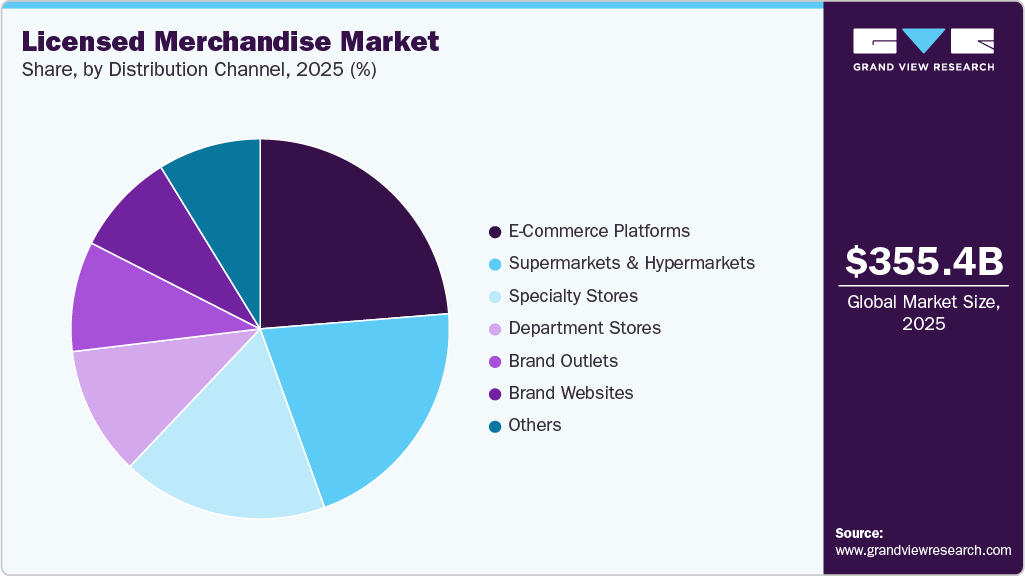
Sales of licensed merchandise products through supermarkets and hypermarkets are projected to register a CAGR of 7.7% during 2026 to 2033, driven by strong in-store visibility, impulse purchasing behavior, and expanding shelf space dedicated to character- and franchise-based products. Growth is further supported by strategic licensing partnerships, frequent product refresh cycles aligned with movie and entertainment releases, and the ability of large-format retailers to offer competitive pricing and bundled promotions, thereby enhancing consumer accessibility and driving volume sales.
Regional Insights
The licensed merchandise market in North America held a 58.7% revenue share of the global market in 2025, with growth largely driven by strong trends in fan-driven consumption and franchise-based product cycles. A key trend in the region is the high demand for event-based and limited-edition merchandise, particularly linked to movie releases, sports seasons, and major entertainment launches, which significantly boosts sales across toys, accessories, home décor, entertainment, and others.

U.S. Licensed Merchandise Market Trends
The U.S. licensed merchandise market witnesses a CAGR of 7.4% from 2026 to 2033, driven by strong trends in franchise-led merchandising and fan engagement. A key market trend in the U.S. is the high demand for limited-edition and event-based licensed sports merchandise, particularly around movie releases, U.S. licensed sports merchandise, and entertainment launches, which significantly boost sales across toys, accessories, home décor, entertainment, and others. In addition, the growing popularity of collectibles and nostalgia-driven products among adult consumers is expanding the customer base beyond traditional segments.
Europe Licensed Merchandise Market Trends
The Europe licensed merchandise market held a revenue share of 22.64% in 2025, reflecting its strong and mature position within the global market. Growth in the region is primarily driven by high demand across key segments, particularly toys, accessories, home décor, and entertainment merchandise, supported by the widespread popularity of Italy's licensed football merchandise market and global entertainment franchises, and Europe's licensed sports merchandise market. The toys and entertainment segments benefit significantly from strong character-based merchandising and media-driven demand, while accessories and home décor are gaining traction due to increasing consumer preference for lifestyle-oriented and branded products. These segments are deeply integrated into consumer purchasing behavior, with licensed football merchandise market products widely available across both premium and mass-market categories.
UK Licensed Merchandise Market Trends
The licensed merchandise market in the UK is anticipated to witness a CAGR of 6.25% from 2026 to 2033, driven by strong demand across key segments such as toys, accessories, home décor, entertainment, and others. Increasing consumer engagement with global entertainment franchises, gaming, and sports properties is significantly boosting demand for licensed toys and entertainment merchandise, while accessories and home décor segments are gaining traction due to the rising preference for branded and themed lifestyle products. The growing influence of digital media consumption and fan-driven purchasing behavior is further supporting market expansion, particularly among younger demographics.
The licensed merchandise market in Germany revenue share of 17.21% in Europe in 2025, driven by strong consumer demand across key segments, including toys, accessories, home décor, entertainment, and others. The market is significantly influenced by Germany’s well-established retail landscape and high affinity for quality, branded products, particularly in toys and entertainment merchandise, supported by popular global franchises, gaming, and licensed football merchandise. Collectible toys and character-based merchandise continue to witness steady demand, while accessories and home décor segments are gaining traction as consumers increasingly adopt themed and lifestyle-oriented licensed products.
Asia Pacific Licensed Merchandise Market Trends
The licensed merchandise market in the Asia Pacific is anticipated to witness a CAGR of 7.2% from 2026 to 2033. Strong growth over the forecast period, driven by increasing demand across toys, accessories, home décor, entertainment, and others. The growing popularity of regional and global entertainment content, along with rising digital engagement, is encouraging consumers to purchase character-based and branded merchandise. In addition, the rapid expansion of e-commerce platforms and the availability of affordable licensed products are making merchandise more accessible to a wider consumer base, supporting market growth across diverse countries in the region.
China licensed merchandise market is anticipated to witness a CAGR of 7.5% from 2026 to 2033, driven by the rapid expansion of digital platforms and changing consumer purchasing behavior. Online ecosystems play a central role in market growth, with e-commerce platforms, live streaming, and influencer-led promotions significantly boosting sales across toys, accessories, home décor, entertainment, and others. Consumers are increasingly engaging with licensed products through social media and digital content, making merchandise purchases more interactive and trend-driven.
The licensed merchandise market in Japan is anticipated to witness a CAGR of 7.1% from 2026 to 2033, strongly influenced by the country’s well-established anime, manga, and gaming industry, which continues to drive demand across toys, accessories, home décor, entertainment, and others. A key market trend in Japan is the high demand for collectible and limited-edition merchandise, where consumers frequently purchase exclusive product releases linked to popular characters and franchises, making repeat buying a common behavior.
Central & South America Licensed Merchandise Market Trends
The licensed merchandise market in CSA is anticipated to witness a CAGR of 8.8% from 2026 to 2033. The expansion of hospitality and wellness tourism across the region is significantly supporting market growth and the spa market, as resorts, boutique hotels, and urban luxury properties increasingly integrate market facilities to enhance guest experiences. Countries such as Brazil, Mexico, and Argentina are leveraging spa market amenities as premium differentiators to attract both domestic and international wellness-focused travelers, positioning heat therapy and relaxation services as key components of modern hospitality offerings.
Middle East & Africa Licensed Merchandise Market Trends
The licensed merchandise market in MEA is anticipated to witness a CAGR of 7.8% from 2026 to 2033, driven by the increasing popularity of global entertainment franchises and rising consumer awareness of branded products. A key market trend in the region is the growing demand for affordable licensed merchandise, particularly across toys, accessories, home décor, entertainment, and others, as consumers remain price-sensitive while seeking branded and character-based products.
Key Licensed Merchandise Company Insights
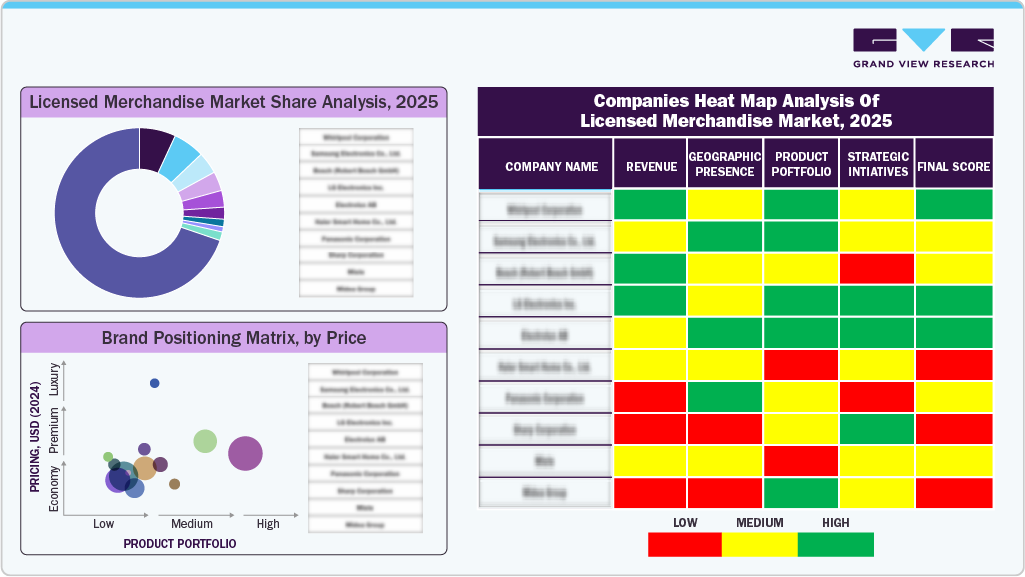
The competitive landscape of the licensed merchandise industry is highly dynamic and characterized by the presence of globally established entertainment companies, toy manufacturers, and specialized merchandise providers competing across multiple product categories, including apparel, toys, accessories, and home décor. Leading players such as The Walt Disney Company, Warner Bros. Discovery, and NBCUniversal dominate the market through their extensive intellectual property portfolios, strong brand recognition, and wide licensing networks in the non-licensed sports merchandise market.
Key Licensed Merchandise Companies:
The following key companies have been profiled for this study on the licensed merchandise market.
- The Walt Disney Company
- Hasbro, Inc.
- The Pokémon Company International
- Fanatics
- NBCUniversal
- Warner Bros Discovery
- Mad Engine
- Funko
- Jazwares
- The Souled Store
- Sanrio Co. Ltd.
Recent Developments
-
In January 2026, French Connection Group signed a new licensing agreement with G-III Apparel Group to develop and distribute men’s and women’s apparel in the United States. The partnership aims to strengthen the brand’s presence in the North American market by leveraging G-III’s design, manufacturing, and distribution capabilities, thereby expanding French Connection’s licensed apparel portfolio and driving revenue growth through enhanced market penetration.
-
In January 2025, Netflix entered into a master licensing agreement with Jazwares to develop a wide range of “Stranger Things” merchandise, including action figures, playsets, plush toys, and costumes. The initiative aims to strengthen the franchise’s presence in the licensed toys and entertainment merchandise segment by leveraging strong consumer engagement, brand recognition, and Jazwares’ global manufacturing and distribution capabilities, thereby supporting category expansion and revenue growth.
-
In October 2025, WWE announced a global licensing partnership with Playmobil to launch a new range of wrestling-themed toy figures featuring popular characters. The collaboration aims to integrate entertainment intellectual property into the toys segment by leveraging Playmobil’s product development and global distribution capabilities, thereby enhancing cross-category merchandise expansion and strengthening global consumer reach.
Licensed Merchandise Market Report Scope
Report Attribute
Details
Market size in 2025
USD 355.4 billion
Estimated market size in 2026
USD 379.9 billion
Projected market size by 2033
USD 613.5 billion
Growth rate
CAGR of 7.1% from 2026 to 2033
Actuals
2021 - 2025
Forecast period
2026 - 2033
Quantitative units
Revenue in USD million/billion and CAGR from 2026 to 2033
Report coverage
Revenue forecast, company ranking, competitive landscape, growth factors, and trends
Segments covered
Product, distribution channel, region
Regional scope
North America; Europe; Asia Pacific; Central & South America; and Middle East & Africa
Country scope
U.S.; Canada; Mexico; UK; Germany; France; Italy; Spain; China; India; Japan; Australia & New Zealand; South Korea; Brazil; South Africa
Key companies profiled
The Walt Disney Company; Hasbro, Inc.; The Pokémon Company International; Fanatics; NBCUniversal; Warner Bros Discovery; Mad Engine; Funko; Jazwares; The Souled Store; Sanrio Co., Ltd.
Customization scope
Free report customization (equivalent up to 8 analysts working days) with purchase. Addition or alteration to country, regional & segment scope.
Pricing and purchase options
Avail customized purchase options to meet your exact research needs. Explore purchase options
Global Licensed Merchandise Market Report Segmentation
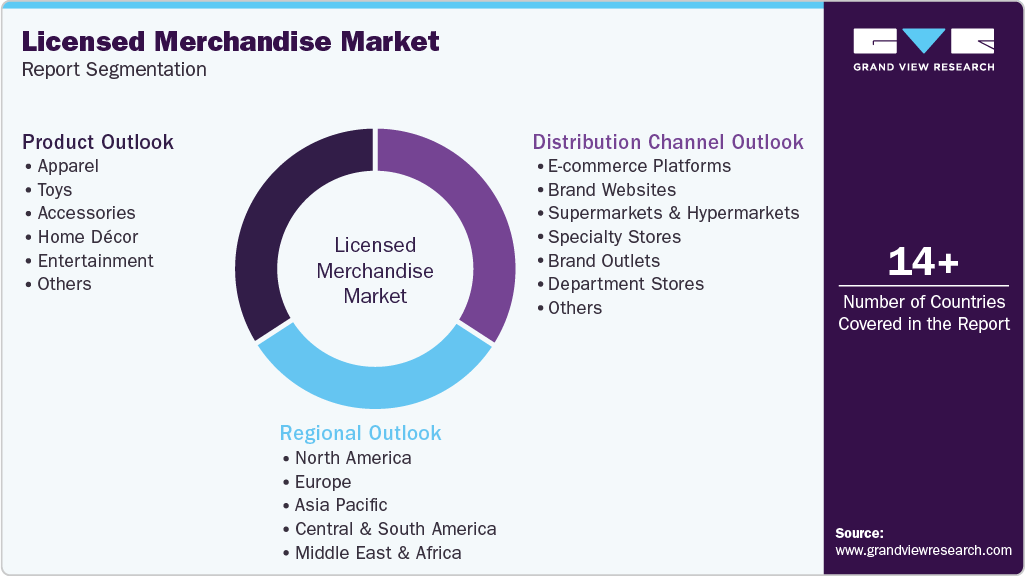
This report forecasts revenue growth at global, regional & country levels and provides an analysis of the latest trends and opportunities in each of the sub-segments from 2021 to 2033. For this study, Grand View Research has segmented the global licensed merchandise market based on product, distribution channel, and region:
-
Product Outlook (Revenue, USD Million, 2021 - 2033)
-
Apparel
-
Toys
-
Accessories
-
Home Décor
-
Entertainment
-
Others
-
-
Distribution Channel Outlook (Revenue, USD Million, 2021 - 2033)
-
E-commerce Platforms
-
Brand Websites
-
Supermarkets & Hypermarkets
-
Specialty Stores
-
Brand Outlets
-
Department Stores
-
Others
-
-
Regional Outlook (Revenue, USD Million, 2021 - 2033)
-
North America
-
U.S.
-
Canada
-
Mexico
-
-
Europe
-
UK
-
Germany
-
France
-
Italy
-
Spain
-
-
Asia Pacific
-
China
-
India
-
Japan
-
Australia & New Zealand
-
South Korea
-
-
Central & South America
-
Brazil
-
-
Middle East & Africa (MEA)
-
South Africa
-
-
Delivered Customizations
This report has been delivered with the following In-depth customizations
Client Request
Customization Delivered
Value Adds
Cross-Segmentation Analysis for Licensed Merchandise Across Channels
Analysis of licensed merchandise categories including apparel, toys, collectibles, gaming merchandise, home décor, and accessories across retail, e-commerce, specialty stores, and entertainment channels. Benchmarking by consumer demographics, pricing tier, fandom trends, and country-level demand.
Identify high-growth merchandise categories and strongest-performing channels. Evaluate revenue contribution by franchise type and support channel expansion, portfolio optimization, and premium merchandise opportunities.
Licensed Merchandise Production & Competitive Analysis
Assessment of key licensors, licensees, and manufacturers covering production footprint, sourcing hubs, licensing partnerships, pricing strategies, and portfolio positioning across premium and mass-market segments.
Benchmark competitor capabilities, manufacturing efficiency, and partnership strategies. Support sourcing optimization, regional expansion, and licensing collaboration decisions.
Licensed Merchandise Price & Consumer Trend Analysis
Analysis of pricing trends, royalty cost impact, packaging formats, and consumer preferences across apparel, collectibles, toys, and gaming merchandise. Evaluation of demand for personalization, sustainability, and limited-edition products
Support region-specific pricing and GTM strategies. Identify premiumization opportunities, pricing elasticity, and innovation potential in sustainable and exclusive merchandise offerings.
Frequently Asked Questions About This Report
North America dominated with a 58.7% revenue share in 2025.
Central & South America is the fastest-growing region over the forecast period.
The female consumers segment led with a 52% revenue share in 2025.
The global licensed merchandise market size was estimated at USD 355.4 billion in 2025 and is expected to reach USD 379.9 billion in 2026.
The global licensed merchandise market is expected to reach USD 613.5 billion by 2033, growing at a CAGR of 7.1% from 2026 to 2033.
The apparel market held the largest revenue share of the licensed merchandise market, accounting for a share of 37.4% in 2025. The demand for licensed apparel is surging due to a combination of factors, including the growing influence of entertainment franchises, sports branding, the licensed football merchandise market, non-licensed sports merchandise, and pop-culture trends
Some key players operating in the licensed merchandise market include The Walt Disney Company; Hasbro, Inc.; The Pokémon Company International; Fanatics; NBCUniversal; Warner Bros Discovery; Mad Engine; Funko; Jazwares; The Souled Store, and Sanrio Co., Ltd.
The global demand for licensed merchandise is driven by the growing commercialization of intellectual property (IP), expansion of digital media, and evolving consumer preferences toward branded and character-based products.
About the Author(s)
Homecare & Decor Research Team
Consumer Goods · Homecare & DecorThis report was authored by the homecare & decor research team at Grand View Research - comprising two research analysts, one senior research analyst, and one industry expert - with specialized expertise in the homecare & decor segment of the consumer goods industry. All findings are based on proprietary consumer goods databases, executive interviews, and regulatory analysis, subject to internal peer review prior to publication.
Last Updated:
Speak to Analyst


Customize this report to your needs — add regions, segments, or data points, with 20% free customization.
Or view our licence options:


ISO 9001:2015 & 27001:2022 Certified
We are GDPR and CCPA compliant! Your transaction & personal information is safe and secure. For more details, please read our privacy policy.


