
- Home
- »
- Consumer Food & Beverages
- »
-
Licorice Extract Market Size And Share Report, 2026-2035GVR Report cover

Licorice Extract Market (2026 - 2035)
Size, Share & Trends Analysis Report By Form (Powder, Liquid, Blocks, Paste), By End Use (Nutraceutical & Dietary Supplements, Cosmetics & Personal Care), By Distribution Channel, By Regional, And Segment Forecasts
Market Size, 2025
$1.9BMarket Estimate, 2026
$2.0BMarket Forecast, 2035
$3.4BCAGR, 2026–2035
6.1%Licorice Extract Market Summary
The global licorice extract market size was valued at USD 1.9 billion in 2025 and is projected to grow from USD 2.0 billion in 2026 to USD 3.4 billion in 2035, at a CAGR of 6.1% from 2026 to 2035. Asia Pacific dominated the market, accounting for a revenue share of 40.0% in 2025. The market is driven by the region’s established licorice cultivation and processing base, traditional use of licorice in herbal medicine, and increasing demand for botanical ingredients across various end-use industries. The growing demand for plant-based ingredients across the food & beverage, pharmaceutical, nutraceutical, and cosmetics industries is supporting market growth worldwide.
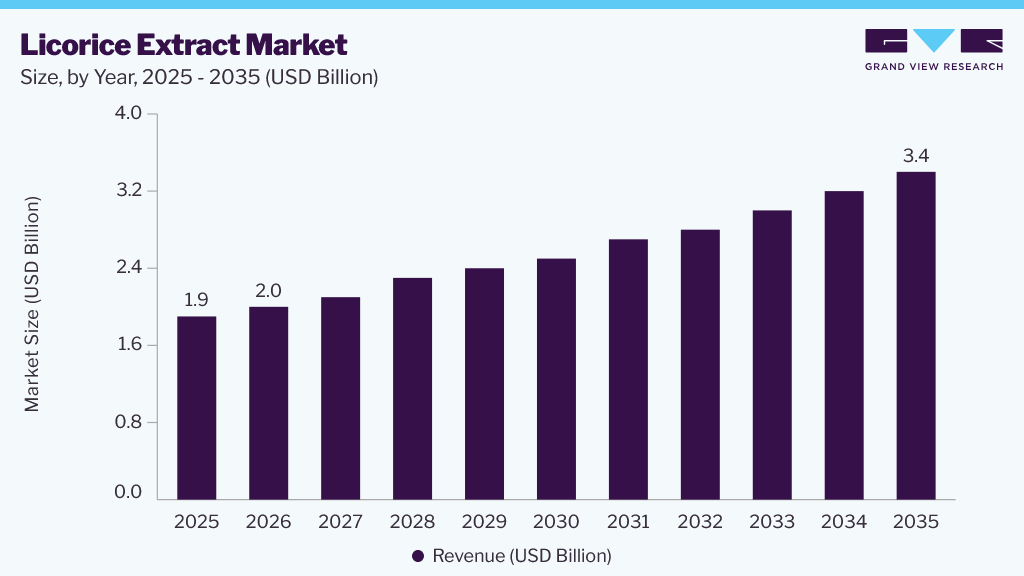 Source: Grand View Research, IR Documents, Primary Interviews, Paid DatabasesTo learn more about this report,
 Download Free Sample Report
 Key Market Trends & Insights
- By product type: Powder segment held the largest market share of around 45.0% in 2025.
- By end use: Pharmaceutical segment held the largest market share of around 30.0% in 2025.
- By distribution channel: Business-to-business (B2B) segment held the largest market share of around 92.0% in 2025.
Regional Highlights
- Largest regional market: Asia Pacific (40.0% revenue share, 2025)
Market Size & Forecast
- Market size in 2025: USD 1.9 Billion
- Estimated market size in 2026: USD 2.0 Billion
- Projected market size by 2035: USD 3.4 Billion
- CAGR (2026-2035): 6.1%
Three ways to get this report
Buy it, customize it, or ask a question.Ask an Analyst
A direct answer, usually in 1 working day
- AccessReport author, directly
- Reply timeWithin 1 working day
- No sales callDirect answer only
- FormatEmail reply
- CostFree, no cost
Get the Full Report
What the study covers
- FormatsPDF · Excel · Dashboard
- Timeline2026–2035 annual, 2025 base
- Coverage20+ countries, 5 regions
- Companies10+ key players profiled
Customize the Report
20% free customization
- IncludeCountries, segments, points
- TailorTo your product definition
- ExtendDeeper competitor detail
- OrA fully bespoke study
- Turnaround5–10 working days
Licorice extract is widely used in food and beverages, confectionery, pharmaceuticals, nutraceuticals, traditional medicine, cosmetics, personal care, and oral care products. Its characteristic sweetness, distinctive flavor profile, and naturally occurring compounds, particularly glycyrrhizin and other phytochemicals, make it a versatile botanical ingredient for different formulations.In addition, there is a rising preference for plant-derived and natural ingredients across consumer and healthcare products. Food and beverage manufacturers use licorice extract for flavoring and sweetness, while pharmaceutical and nutraceutical manufacturers incorporate licorice-derived ingredients into herbal and wellness formulations. Growing interest in botanical products, traditional remedies, functional ingredients, and clean-label formulations is creating additional application opportunities for licorice extract manufacturers. The use of botanical ingredients in personal care and cosmetics is also creating opportunities for specialized licorice-based formulations.
Product quality, extraction efficiency, standardization, and consistency are emerging as increasingly important competitive factors in the licorice extract market. Manufacturers are focusing on controlling the concentration of active compounds, enhancing extraction technologies, developing application-specific grades, and ensuring consistent raw material quality. In addition, safety concerns associated with excessive glycyrrhizin consumption are increasing the emphasis on controlled formulations and the development of low-glycyrrhizin or deglycyrrhizinated licorice extracts, particularly for applications where reduced glycyrrhizin exposure is preferred.
Analyst Perspective
The global licorice extract market is growing steadily as demand for natural, plant-based, standardized, and functional ingredients across pharmaceutical, nutraceutical, food & beverage, confectionery, cosmetics, and personal care applications is increasing. Product innovation is centered on standardized extracts, convenient product forms, application-specific formulations, and improved extraction technologies, with powder-based extracts used widely in commercial practice. However, regulatory requirements, fluctuations in the quality and availability of raw materials, extraction costs, and safety concerns associated with excessive glycyrrhizin consumption remain key market challenges. Ongoing developments in low-glycyrrhizin and deglycyrrhizinated extracts, advanced formulations, and application-specific licorice-derived ingredients are expected to create new growth opportunities over the forecast period.
Form Insights
The powder segment held the largest market share of around 45.0% in 2025. Powdered licorice extract is convenient to handle, transport, store, and incorporate into a wide range of formulations, making it suitable for nutraceutical, pharmaceutical, food, confectionery, and other botanical applications. Its compatibility with capsules, tablets, dry blends, and standardized formulations further supports its widespread adoption among ingredient manufacturers and formulators. For instance, in April 2026, Rohto Pharmaceutical announced that a functional food product containing gliasperin B, a component derived from its proprietary Licorice Extract Powder (Lyconin®), had been approved as Japan's first functional food product to use licorice-derived gliasperin B as a functional ingredient. The development highlights the growing potential of standardized powdered licorice extracts in functional food and nutraceutical applications.
The liquid segment is expected to be the fastest-growing form segment, registering a 7.1% CAGR from 2026 to 2035. Growth is driven by the increasing use of liquid licorice extracts in beverages, liquid dietary supplements, pharmaceutical formulations, and personal care products, where ease of incorporation, rapid dispersion, and formulation flexibility are important considerations. The growing demand for ready-to-use botanical ingredients is further supporting the adoption of liquid extracts among manufacturers seeking to simplify formulation and processing. In addition, increasing consumer preference for liquid supplements and functional beverages is creating opportunities for liquid licorice extracts across nutraceutical and food & beverage applications. Manufacturers are also focusing on improving stability, concentration, and standardization of liquid extracts to expand their use across diverse applications.
End Use Insights
The pharmaceutical segment held the largest market share, at around 30.0%, in 2025. Licorice-derived ingredients have established applications in pharmaceutical and herbal medicine formulations, particularly in traditional medicinal preparations and products targeting respiratory, digestive, and other therapeutic applications. Their established role in medicinal formulations, combined with the continued development of standardized botanical ingredients, supports the prominence of pharmaceutical applications in the licorice extract market.
The nutraceutical & dietary supplements segment is expected to grow at a CAGR of 7.5% over the forecast period. The growing incorporation of licorice extract into dietary supplements and functional food products is creating opportunities for standardized and differentiated licorice-based ingredients. Increasing consumer interest in plant-based supplements, functional nutrition, preventive wellness, and digestive health is expected to support the development of innovative nutraceutical formulations containing licorice extract.
Distribution Channel Insights
The business-to-business (B2B) segment held the largest market share, at around 92.0%, in 2025. Licorice extract is primarily supplied as a botanical, flavoring, and functional ingredient to manufacturers operating across the pharmaceutical, nutraceutical, food & beverage, confectionery, cosmetics, and personal care industries. B2B distribution is particularly important for licorice extract suppliers due to the prevalence of bulk purchases, standardized specifications, technical documentation, repeat orders, and large-scale formulation requirements.
The business-to-consumer (B2C) segment is expected to grow at a CAGR of 7.8% over the forecast period. Growth in this segment is primarily associated with the increasing availability of finished consumer products containing licorice-derived ingredients, including dietary supplements, herbal products, functional foods, teas, confectionery, oral care products, and personal care formulations. Growing consumer interest in botanical and plant-based products, coupled with the expanding availability of such products through e-commerce platforms, direct-to-consumer channels, and specialty retail outlets, is expected to support the growth of B2C sales over the forecast period.
Regional Insights
Asia Pacific dominated the global licorice extract market, accounting for approximately 40.0% of revenue in 2025, and is expected to remain the largest regional market through 2035. The region's leading position is supported by the extensive cultivation and processing of licorice root, particularly in China and India, as well as the long-standing use of licorice in traditional Chinese medicine, Ayurveda, and other herbal medicine systems. In addition, growing demand for natural and botanical ingredients across pharmaceuticals, nutraceuticals, food & beverages, and cosmetics & personal care is supporting regional consumption. China benefits from its large-scale licorice cultivation and extraction infrastructure, while India is witnessing increasing demand from Ayurvedic medicines, herbal supplements, and natural personal care products. Japan and South Korea further contribute to regional demand through pharmaceutical, functional food, and cosmetic applications. The increasing standardization of botanical extracts and expansion of domestic processing capabilities are also supporting the development of higher-value licorice extract products in the region.
North America Licorice Extract Market Trends
North America accounted for around 28.0% of the global licorice extract market in 2025. The demand across the region is underpinned by strong regulatory clarity, especially in the U.S., where the FDA permits licorice extract in liquid, paste/block, and spray-dried powder forms. Similarly, in Canada, Health Canada's Natural Health Products Ingredients Database recognizes Glycyrrhiza glabra (licorice) root extract as an approved herbal substance across dry, standardized dry, liquid, and standardized liquid extract forms. This regulatory acceptance gives manufacturers wide latitude to develop diverse formulations across food, beverage, nutraceutical, and personal care applications. The United States continues to lead regional demand, supported by rising consumer preference for natural and plant-based ingredients, expanding use across food and beverages, cosmetics, and pharmaceuticals, and growing awareness of licorice's potential health benefits.
Key Licorice Extract Company Insights
The licorice extract market is characterized by the presence of global manufacturers, regional producers, and specialized botanical ingredient suppliers competing across a diverse range of applications and geographic markets. Leading companies are strengthening their competitive positions through product portfolio expansion, the development of standardized, high-quality extracts, strategic partnerships, and broader distribution networks. Competition is increasingly centered on product consistency, control of active compound concentrations, extraction efficiency, traceability of raw materials, and the ability to offer application-specific grades for pharmaceutical, nutraceutical, food & beverage, confectionery, cosmetics, and personal care applications.
Key Licorice Extract Companies
The following key companies have been profiled for this study on the licorice extract market:
-
Norevo GmbH
-
MAFCO Worldwide
-
F&C Licorice Ltd.
-
Maruzen Pharmaceuticals Co., Ltd.
-
Qinghai Lake Pharmaceutical Co., Ltd. (QHL)
-
Zagros Licorice Co.
-
ASEH Licorice Manufacturing & Export Co.
-
Sepidan Osareh Co.
-
VPL Chemicals Pvt. Ltd.
-
Bio-Botanica Inc.
Recent Developments
-
In April 2025, Swisseutic SA announced a strategic distribution partnership with Qinghai Lake Pharmaceutical Co., Ltd. (QHL), a manufacturer of licorice derivatives. Under the partnership, Swisseutic expanded the distribution of QHL's licorice-based ingredients, including ammonium glycyrrhizinate, dipotassium glycyrrhizinate, glycyrrhetinic acid, glycyrrhizic acid, glabridin, and licochalcone A, across pharmaceutical, cosmetic, and food applications. The collaboration reflects increasing efforts by licorice ingredient manufacturers to strengthen international distribution networks and expand the commercialization of specialized licorice derivatives
-
In December 2024, BGM Group and Jointown Pharmaceutical Group signed a strategic cooperation agreement covering Qilianshan Pharmaceutical's licorice fluid extract and Gandixin (Compound Licorice Tablets) product portfolio. The collaboration focuses on strengthening market expansion, quality management, sales-channel development, and innovation in licorice-based pharmaceutical products.
Licorice Extract Market Report Scope
Report Attribute
Details
Market size in 2025
USD 1.9 billion
Estimated market size in 2026
USD 2.0 billion
Projected market size by 2035
USD 3.4 billion
Growth rate
CAGR of 6.1% from 2026 to 2035
Base year for estimation
2025
Historical data
2021 - 2024
Forecast period
2026 - 2035
Quantitative units
Revenue in USD billion, and CAGR from 2026 to 2035
Report coverage
Revenue forecast, company ranking, competitive landscape, growth factors, and trends
Segments covered
Product type, end use, extraction method, distribution channel, region
Regional Scope
North America; Europe; Asia Pacific; Latin America; Middle East & Africa
Country Scope
U.S.; Canada; Mexico; UK; Germany; France; Italy; Spain; China; Japan; India; Australia; South Korea; Brazil; Argentina; South Africa; Saudi Arabia; UAE
Key companies profiled
Norevo GmbH; MAFCO Worldwide; F&C Licorice Ltd.; Maruzen Pharmaceuticals Co., Ltd.; Qinghai Lake Pharmaceutical Co., Ltd. (QHL); Zagros Licorice Co.; ASEH Licorice Manufacturing & Export Co.; Sepidan Osareh Co.; VPL Chemicals Pvt. Ltd.; Bio-Botanica Inc.
Customization scope
Free report customization (equivalent to 8 analyst working days) with purchase. Addition or alteration to country, regional & segment scope.
Pricing and purchase options
Avail of customized purchase options to meet your exact research needs. Explore purchase options
Global Licorice Extract Market Report Segmentation
This report forecasts revenue growth at the global, regional, and country levels and provides an analysis of the latest industry trends and opportunities across each sub-segment from 2026 to 2035. For the purpose of this study, Grand View Research has segmented the global licorice extract market report based on form, end use, distribution channel, and region:
- Form Outlook (Revenue, USD Billion, 2021 - 2035)
- Powder
- Liquid
- Blocks
- Paste
- End Use Outlook (Revenue, USD Billion, 2021 - 2035)
- Nutraceutical & Dietary Supplements
- Cosmetics & Personal Care
- Food & Beverages
- Pharmaceuticals
- Others
- Distribution Channel Outlook (Revenue, USD Billion, 2021 - 2035)
- Business-to-Business
- Business-to-Consumer
- Regional Outlook (Revenue, USD Billion, 2021 - 2035)
- North America
- U.S.
- Canada
- Mexico
- Europe
- UK
- Germany
- France
- Italy
- Spain
- Asia Pacific
- China
- Japan
- India
- Australia
- South Korea
- Latin America
- Brazil
- Argentina
- Middle East and Africa (MEA)
- South Africa
- Saudi Arabia
- UAE
- North America
Frequently Asked Questions About This Report
The global licorice extract market size was valued at USD 1.9 billion in 2025 and is estimated at USD 2.0 billion in 2026.
The global licorice extract market is expected to grow at a CAGR of 6.1% from 2026 to 2035, reaching USD 3.4 billion by 2035.
Asia Pacific dominated with approximately 40.0% revenue share in 2025.
The powder segment accounted for the largest revenue share of approximately 45.0% in 2025.
Key players in the market include Norevo GmbH, MAFCO Worldwide, F&C Licorice Ltd., Maruzen Pharmaceuticals Co., Ltd., Qinghai Lake Pharmaceutical Co., Ltd. (QHL), Zagros Licorice Co., ASEH Licorice Manufacturing & Export Co., Sepidan Osareh Co., VPL Chemicals Pvt. Ltd., Bio-Botanica Inc., and others.
About the Author(s)
Consumer Food & Beverages Research Team
Food Beverages & Tobacco · Consumer Food & BeveragesThis report was authored by the consumer food & beverages research team at Grand View Research - comprising two research analysts, one senior research analyst, and one industry expert - with specialized expertise in the consumer food & beverages segment of the food beverages & tobacco industry. All findings are based on proprietary food beverages & tobacco databases, executive interviews, and regulatory analysis, subject to internal peer review prior to publication.
Last Updated:
Speak to Analyst

Customize this report to your needs - add regions, segments, or data points, with 20% free customization.
Or view our licence options:


ISO 9001:2015 & 27001:2022 Certified
We are GDPR and CCPA compliant! Your transaction & personal information is safe and secure. For more details, please read our privacy policy.


