
- Home
- »
- Power Generation & Storage
- »
-
Liquid Air Energy Storage Market Size Report, 2026-2033GVR Report cover

Liquid Air Energy Storage Market (2026 - 2033)
Size, Share & Trends Analysis Report By Capacity (Below 50 MW, 50–100 MW, Above 100 MW), By Application (Utility, Industrial, Commercial), By Region (North America, Europe, Asia Pacific, Latin America), And Segment Forecasts
Market Size, 2025
$195.5MMarket Estimate, 2026
$244.3MMarket Forecast, 2033
$2,676.8MCAGR, 2026–2033
40.8%Liquid Air Energy Storage Market Summary
The global liquid air energy storage market size was valued at USD 195.5 million in 2025 and is projected to grow from USD 244.3 million in 2026 to USD 2,676.8 million by 2033, at a CAGR of 40.8% from 2026 to 2033. Europe dominated the market, accounting for the largest share of 47.2% 2025.
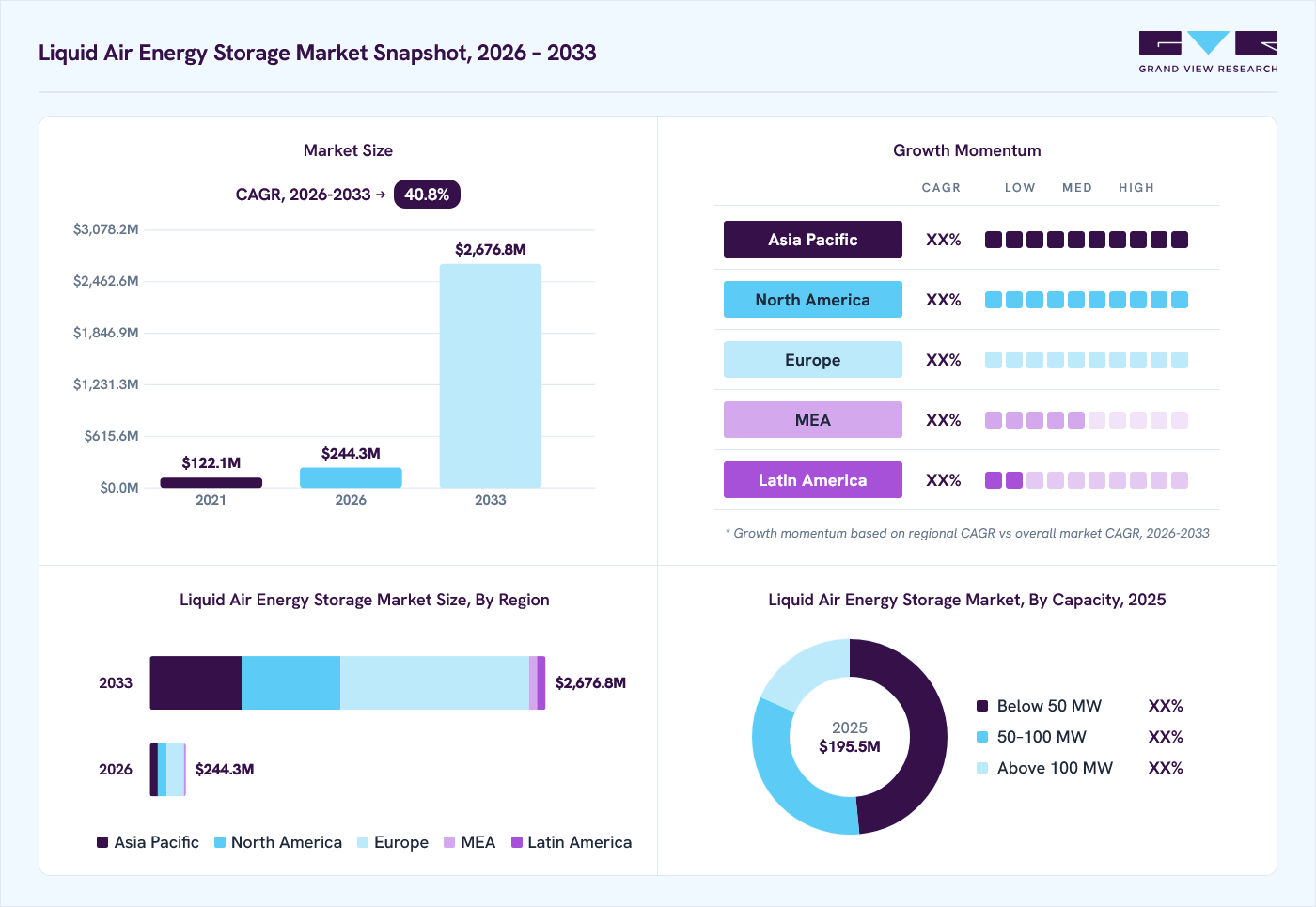 Source: Grand View Research, IR Documents, Primary Interviews, Paid DatabasesTo learn more about this report,
 Download Free Sample Report
Key Market Trends & Insights
- By capacity: Below 50 MW held the largest revenue share of 48.4% in 2025
- By application: Utility held the largest revenue share of 84.4% in 2025.
Regional Highlights
- Largest regional market: Europe (47.2% revenue share, 2025)
- Fastest-growing regional market: Asia Pacific (highest CAGR, 2026-2033)
- By country: The U.S. held the largest market share in 2025.
Market Size & Forecast
- Market Size in 2025: USD 195.5 Million
- Estimated Market Size in 2026: USD 244.3 Million
- Projected Market Size by 2033: USD 2,676.8 Million
- CAGR (2026-2033): 40.8%
Prism AI by Grand View Research Free to tryAsk a question about the liquid air energy storage marketTry asking✓Every figure cited from GVR research Prefer the report? Download free sample → To learn more about this report, Download Free Sample Report
The rising global demand for large-scale, long-duration energy storage solutions to balance renewable energy generation and grid stability drives growth in the liquid air energy storage industry. Technological advancements in cryogenic storage, combined with declining costs and increasing efficiency, have positioned LAES as a promising alternative to conventional energy storage technologies, particularly in integrating intermittent renewable sources such as wind and solar.
Market Dynamics
The liquid air energy storage (LAES) market is driven by the increasing need for long-duration energy storage solutions to support renewable energy integration and grid stability. Growing deployment of intermittent renewable sources such as solar and wind is accelerating demand for large-scale storage technologies capable of balancing supply fluctuations. Advancements in cryogenic energy storage efficiency, coupled with rising investments in energy transition infrastructure, are supporting market growth. However, high capital costs, complex system requirements, and competition from established battery storage technologies remain key challenges.
The LAES market is primarily driven by the increasing need for long-duration energy storage solutions to enhance grid reliability and support the integration of renewable energy sources. As solar and wind generation capacity expands, utilities require scalable storage technologies capable of managing power fluctuations, shifting energy supply, and providing grid balancing services over extended durations. LAES offers advantages such as long operational life, high energy capacity, geographic flexibility, and reduced dependence on critical battery materials, making it an attractive alternative for large-scale energy storage applications.
During 2025–2026, several initiatives highlighted the growing interest in LAES technology as part of global energy transition strategies. In 2025, the UK continued advancing large-scale LAES deployment through projects such as Highview Power’s Carrington liquid air energy storage facility, designed to provide long-duration storage capacity and grid flexibility. Increasing investments in renewable integration and grid-scale storage projects across Europe and Asia Pacific have accelerated the commercialization of cryogenic energy storage technologies, supporting the adoption of LAES as a complementary solution to lithium-ion battery storage systems.
The market is constrained by high capital expenditure, complex engineering requirements, and the need for specialized cryogenic infrastructure, which increase project complexity and deployment costs. Energy conversion efficiency limitations, operational losses, and long project development timelines further challenge widespread adoption. Competition from alternative storage technologies such as lithium-ion batteries, flow batteries, and pumped hydro storage, along with regulatory uncertainties and financing risks, can limit market expansion. Effective grid integration and the development of commercially viable business models remain essential for accelerating LAES deployment.
The market presents significant opportunities through technological advancements aimed at improving efficiency, reducing costs, and enhancing system reliability. Innovations in cryogenic storage systems, air liquefaction processes, and hybrid energy storage solutions are improving performance and energy density. Growing demand for renewable energy integration, industrial decarbonization, and reliable backup power solutions is creating new deployment opportunities. Emerging markets with rising electricity demand and grid stability challenges offer strong potential for LAES adoption, supported by increasing utility and corporate investments in sustainable energy storage technologies.
Analyst Perspective
The liquid air energy storage (LAES) market is expected to gain momentum as utilities and grid operators increasingly seek long-duration storage solutions to manage renewable energy intermittency and enhance grid resilience. A key trend shaping the market is the integration of LAES with renewable energy projects and hybrid storage systems to improve flexibility and optimize energy utilization. While high upfront costs and lower technology maturity compared with lithium-ion batteries remain challenges, ongoing advancements in cryogenic technologies and increasing investments in grid-scale storage infrastructure are expected to strengthen market adoption. The market is likely to witness gradual commercialization, particularly in regions prioritizing energy security and decarbonization
Capacity Insights
The below 50 MW segment dominated the liquid air energy storage market with the largest revenue share of 48.4% in 2025, dominating the capacity segment in the global LAES market. This reflects its suitability for small- to medium-scale grid applications, industrial energy storage projects, and distributed power management requirements. Lower capacity LAES systems require comparatively lower upfront investments and offer greater deployment flexibility, making them attractive for early-stage commercialization and integration with renewable energy sources. Increasing demand for localized energy resilience and backup power solutions is supporting the adoption of smaller-scale LAES installations across emerging and developed markets.
The above 100 MW is expected to register the fastest CAGR of 41.4% for the forecast period. This growth is driven by the increasing deployment of utility-scale, long-duration energy storage projects to support renewable energy integration and enhance grid stability. Large-capacity LAES systems are gaining traction for their ability to deliver high energy storage capacity, long discharge durations, and reliable grid-balancing services. Rising investments in renewable power infrastructure, grid modernization initiatives, and the need for flexible energy storage solutions are expected to accelerate the adoption of LAES installations above 100 MW.
Application Insights
The utility segment dominated the liquid air energy storage industry with the largest share of 84.4% in 2025 within the global LAES market. The dominance of this segment is driven by the growing need for large-scale energy storage solutions to support grid stability, renewable energy integration, and peak demand management. Utilities increasingly rely on LAES systems to store excess renewable energy from solar and wind farms, balance supply-demand fluctuations, and provide ancillary services such as frequency regulation and load shifting. The technology’s ability to deliver long-duration, scalable storage makes it suitable for utility-scale applications.
 To learn more about this report, Download Free Sample Report
The industrial segment is expected to grow at the second-fastest CAGR of 40.6% for the forecast period. The growth is supported by the increasing demand for reliable, long-duration energy storage solutions across energy-intensive industries seeking to improve power reliability, reduce energy costs, and integrate renewable energy into their operations. LAES systems enable industries to manage peak demand, provide backup power, and enhance energy flexibility while supporting decarbonization targets. Growing investments in industrial electrification, clean energy adoption, and sustainable energy management solutions are expected to drive the deployment of LAES technology in industrial applications.
Regional Insights
The Europe liquid air energy storage industry held the largest revenue share of 47.2% in 2025. Ambitious decarbonization targets, stringent emission regulations, and strong investments in long-duration energy storage solutions support the region’s leadership. Countries like Germany, France, the Netherlands, and the UK actively deploy LAES systems to integrate intermittent renewable energy, stabilize power grids, and provide ancillary services. Policy support, including subsidies, research funding, and incentives for energy storage deployment, combined with mature electricity infrastructure, creates a favorable environment for large-scale adoption. Europe’s focus on sustainable energy transition and grid modernization continues to drive market expansion and maintain its leading position globally.
 To learn more about this report, Download Free Sample Report
Uk Liquid Air Energy Storage Market Trends
The UK liquid air energy storage market is witnessing increasing growth due to the country’s strong focus on renewable energy integration, grid flexibility, and long-duration energy storage deployment. The expansion of offshore wind capacity and the transition toward a low-carbon power system are driving demand for large-scale storage technologies capable of balancing intermittent renewable generation. Projects such as Highview Power’s Carrington LAES facility highlight the country’s growing interest in commercializing cryogenic energy storage solutions to enhance grid resilience and support net-zero targets.
North America Liquid Air Energy Storage Market Trends
North America is a key market for LAES, driven by substantial investments in utility-scale storage projects, supportive federal and state policies, and growing corporate commitments to decarbonization. The United States leads adoption with incentives under the Inflation Reduction Act, renewable energy integration programs, and funding for long-duration storage projects. Canada also contributes through provincial energy storage initiatives and clean energy research programs. Strong public-private collaboration, technological innovation, and grid modernization efforts continue to support North America’s role as a significant LAES market.
The United States is the largest single-country LAES market, driven by significant federal and state-level support, corporate decarbonization commitments, and the growing integration of renewable energy into the power grid. Incentives under the Inflation Reduction Act, renewable energy standards, and funding for long-duration energy storage projects have created a favorable investment environment, enabling the rapid scaling of LAES deployments across utilities and industrial users. Demand for grid stabilization, peak load management, and renewable energy integration is particularly strong from the utility sector.
Asia Pacific Liquid Air Energy Storage Market Trends
Asia Pacific is emerging as a high-growth market, driven by rapid industrialization, urbanization, and strong expansion of renewable energy. Countries including China, Japan, India, and South Korea are increasingly investing in large-scale LAES projects to enhance grid stability and integrate growing renewable electricity generation. Government incentives, research programs, and expanding infrastructure for storage deployment are accelerating adoption. Rising electricity demand and the need for energy security further position Asia-Pacific as a key contributor to global LAES market growth.
Latin America Liquid Air Energy Storage Market Trends
Latin America is gradually expanding its liquid air energy storage industry, which is supported by abundant renewable energy resources, particularly in Brazil, Mexico, and Argentina. Investments in large-scale storage systems and energy transition initiatives help balance variable power generation from solar and wind sources. Government policies, regional energy programs, and international partnerships encourage deployment, positioning the region for steady growth over the forecast period.
Middle East & Africa Liquid Air Energy Storage Market Trends
The Middle East & Africa (MEA) region is seeing gradual growth in the LAES market, driven by energy diversification goals and the adoption of renewable energy. Key economies such as the UAE, Saudi Arabia, South Africa, and Egypt are investing in energy storage to support grid reliability, industrial applications, and the integration of renewables. Sub-Saharan Africa relies on off-grid energy solutions and small-scale storage projects to expand energy access. Policy support, international funding, and public-private collaborations enable regional development, with adoption of LAES expected to grow steadily over the forecast period.
Key Liquid Air Energy Storage Company Insights
Some of the key players operating in the global liquid air energy storage market include Highview Enterprises Ltd. and Chart Industries.
-
Highview Enterprises Ltd. is a leading player in the global liquid air energy storage (LAES) market, recognized for developing large-scale cryogenic energy storage solutions based on its proprietary CRYOBattery technology. The company specializes in converting ambient air into liquid form for long-duration energy storage, enabling grid balancing, renewable energy integration, and enhanced energy system flexibility. Highview focuses on advancing commercial-scale LAES projects by integrating cryogenic processes, thermal management, and power-generation technologies. Its pioneering role, dedicated focus on LAES development, and growing portfolio of utility-scale storage projects have positioned it as one of the key technology leaders in the long-duration energy storage market.
-
Chart Industries is a prominent technology provider in the liquid air energy storage market, leveraging its expertise in cryogenic engineering, liquefaction systems, and advanced thermal equipment to support LAES infrastructure development. The company supplies critical components, including cryogenic storage systems, heat exchangers, and process equipment required for efficient liquid air production and energy storage operations. Chart Industries focuses on enabling scalable long-duration energy storage solutions by integrating its industrial gas and cryogenic technology capabilities with emerging clean energy applications. Its established manufacturing capabilities, global presence, and expertise in low-temperature technologies have positioned it as a key enabler in the commercialization of liquid air energy storage systems.
Key Liquid Air Energy Storage Companies:
The following key companies have been profiled for this study of the liquid air energy storage market.
-
Highview Enterprises Ltd.
-
Everllence
-
General Electric Company
-
Linde plc
-
SFW
-
Chart Industries
-
Solveno Technologies
-
Innovatium Group Ltd
-
ALFA LAVAL
-
phelas GmbH
Competitive Benchmarking
Category
Operating Strategies
Competitive Edge
Weakness
Established Players (Highview Enterprises Ltd., Everllence, General Electric Company, Linde plc, Chart Industries, ALFA LAVAL)
- Leverage existing cryogenic, industrial gas, and energy infrastructure capabilities to develop and support LAES projects.
- Focus on large-scale utility applications, long-duration energy storage, and integration with renewable energy systems.
- Expand partnerships with utilities, grid operators, and renewable energy developers to accelerate commercialization.
- Strong technological expertise in cryogenic processes, thermal management, and energy infrastructure.
- Established global presence, financial strength, and ability to execute large-scale projects.
- Extensive manufacturing capabilities and supply chain networks for critical LAES equipment.
- High capital requirements and complex project development cycles for large-scale LAES facilities.
- Dependence on specialized cryogenic infrastructure and availability of suitable project sites.
- Limited focus on modular and distributed LAES solutions compared with newer technology developers.
Emerging Players (Solveno Technologies, Innovatium Group Ltd., phelas GmbH, SFW)
- Focus on developing innovative, modular, and cost-effective LAES technologies for niche and decentralized applications.
- Prioritize technology improvements to enhance efficiency, scalability, and integration with renewable energy sources.
- Collaborate with research institutions, utilities, and technology partners to validate solutions.
- Greater innovation flexibility and ability to develop next-generation LAES architectures.
- Faster decision-making and adaptability compared with larger industrial companies.
- Strong focus on specialized LAES applications and emerging storage requirements.
- Limited financial resources and smaller project execution capabilities.
- Lower brand recognition and fewer large-scale commercial deployments.
- Dependence on partnerships and external funding for technology development and market expansion.
Recent Developments
-
In April 2025, Highview Power announced the commissioning of a new commercial-scale Liquid Air Energy Storage (LAES) facility in the UK. The facility is designed to store up to 250 MWh of energy, providing long-duration, grid-scale storage to balance renewable energy supply and demand. The project is expected to enhance grid stability, support renewable integration, and reduce reliance on fossil-fuel-based peaking power plants, thereby contributing to significant reductions in carbon emissions.
Liquid Air Energy Storage Report Scope
Report Attribute
Details
Market Definition
The global liquid air energy storage (LAES) market refers to the revenue generated from the sales of LAES systems, equipment, and related technologies that store electricity by liquefying air through cryogenic processes and converting it back into power when required across utility, industrial, and commercial applications.
Market size in 2025
USD 195.5 million
Estimated market size in 2026
USD 244.3 million
Projected market size by 2033
USD 2,676.8 million
Growth rate
CAGR of 40.8% from 2025 to 2033
Base year for estimation
2025
Historical data
2021 - 2024
Forecast period
2026 - 2033
Quantitative units
Revenue in USD Million and CAGR from 2025 to 2033
Report coverage
Revenue forecast, competitive landscape, growth factors, and trends
Segments covered
Capacity, application, region
Regional scope
North America; Europe; Asia Pacific; Latin America; Middle East & Africa
Country scope
U.S.; Canada; Mexico; Germany; UK; France; China; India; Japan; South Korea; Brazil; Saudi Arabia; UAE
Key companies profiled
Highview Enterprises Ltd.; Everllence; General Electric Company; Linde plc; Chart Industries; ALFA LAVAL; Solveno Technologies; Innovatium Group Ltd; phelas GmbH; SFW
Customization scope
Free report customization (equivalent up to 8 analysts working days) with purchase. Addition or alteration to country, regional & segment scope.
Pricing and purchase options
Avail customized purchase options to meet your exact research needs. Explore purchase options
Global Liquid Air Energy Storage Market Report Segmentation
This report forecasts revenue growth at the global, regional, and country levels and provides an analysis of the latest industry trends in each of the sub-segments from 2021 to 2033. For this study, Grand View Research has segmented the global liquid air energy storage market report based on capacity, application, and region:
 To learn more about this report, Download Free Sample Report
-
Capacity Outlook (Revenue, USD Million, 2021 - 2033)
-
Below 50 MW
-
50–100 MW
-
Above 100 MW
-
-
Application Outlook (Revenue, USD Million, 2021 - 2033)
-
Utility
-
Industrial
-
Commercial
-
-
Regional Outlook (Revenue, USD Million, 2021 - 2033)
-
North America
-
U.S.
-
Canada
-
Mexico
-
-
Europe
-
Germany
-
UK
-
France
-
-
Asia Pacific
-
China
-
India
-
Japan
-
South Korea
-
-
Latin America
-
Brazil
-
-
Middle East & Africa
-
Saudi Arabia
-
UAE
-
-
Research Methodology
The liquid air energy storage market figures in this report are based on a proven research process that combines executive interviews with secondary research from proprietary databases, company filings, and recognized regulatory and institutional sources. Market size is built through value-chain sizing—reconciling supply-side and demand-side estimates—and triangulated with bottom-up and top-down approaches. Every estimate passes multiple levels of expert validation before publication, with each liquid air energy storage segment quantified using the revenue-capture definitions in the table below.
Segment Definition
Segment – Capacity
Revenue capture definition
Below 50 MW
LAES systems below 50 MW include small- to medium-scale storage installations designed for distributed energy management, commercial facilities, and localized grid support. Revenue is generated from the sale of LAES systems and associated equipment used for renewable energy integration, backup power, and energy flexibility applications.
50–100 MW
LAES systems with capacities ranging from 50 MW to 100 MW are deployed for mid-scale energy storage requirements, supporting grid balancing, peak load management, and renewable power integration. Revenue is generated from the sale of medium-scale LAES solutions, including cryogenic storage units, air liquefaction systems, power conversion equipment, and related infrastructure.
Above 100 MW
LAES systems above 100 MW represent large-scale, utility-oriented storage installations designed for long-duration energy storage and grid stabilization. Revenue is generated from the sale of high-capacity LAES facilities and associated technologies used for managing renewable intermittency, providing grid flexibility, and supporting large-scale energy transition initiatives.
Segment – Application
Revenue capture definition
Utility
LAES systems used in utility applications provide large-scale energy storage for grid operators and power utilities to balance electricity supply and demand, integrate renewable energy sources, and enhance grid reliability. Revenue is generated from the sale of LAES systems deployed for grid-scale storage, frequency regulation, peak shaving, and renewable energy management.
Industrial
LAES systems used in industrial applications support energy-intensive facilities by improving power reliability, optimizing energy consumption, and enabling renewable energy integration. Revenue is generated from the sale of LAES solutions installed in manufacturing plants, processing facilities, and industrial sites for backup power, demand management, and decarbonization initiatives.
Commercial
LAES systems used in commercial applications provide energy storage solutions for commercial buildings and facilities to improve energy efficiency, reduce electricity costs, and enhance power resilience. Revenue is generated from the sale of compact and modular LAES systems used for commercial energy management, backup power, and integration with distributed renewable energy systems.
Estimation Model
Layer Name
Key Question
Description
Liquid Air Energy Storage Technology Layer
What forms the supply base for LAES systems?
Identify the key components and technologies involved in LAES system manufacturing, including air liquefaction units, cryogenic storage tanks, compressors, expanders, turbines, heat exchangers, and power conversion equipment. Assess technology providers, manufacturing capabilities, supply chain availability, and regional production capacities that influence LAES system deployment.
Liquid Air Energy Storage Capacity Layer
How is LAES capacity deployed across the market?
Evaluate LAES deployment based on system capacity ranges, including below 50 MW, 50–100 MW, and above 100 MW installations. Assess factors such as project scale, storage duration requirements, grid requirements, renewable energy integration, and investment trends influencing capacity adoption.
Liquid Air Energy Storage Deployment Layer
How are LAES systems delivered to end users?
Analyze the LAES value chain, including technology providers, EPC contractors, utilities, industrial users, and system integrators. Assess project development, equipment integration, renewable energy coupling, grid connection, and operational requirements supporting market adoption.
Revenue Layer
How is market revenue generated?
Market revenue is quantified through the sales of LAES systems and associated equipment, including cryogenic storage systems, air liquefaction units, compressors, turbines, heat exchangers, and power conversion technologies. Revenue is influenced by installed capacity, application adoption, project investments, technology costs, and pricing trends.
Delivered Customizations
This report has been delivered with the following In-depth customizations
Client Request
Customization Delivered
Value Adds
Capacity-Based Analysis
A detailed assessment was conducted across LAES capacity segments, including below 50 MW, 50–100 MW, and above 100 MW, based on project scale, deployment trends, storage requirements, system economics, and adoption across different energy applications.
Helped identify high-growth capacity segments, evaluate market opportunities across small- and large-scale LAES deployments, and understand the role of utility-scale projects in long-duration energy storage expansion.
Cross-Segmentation Analysis
A comprehensive analysis was conducted by evaluating capacity segments across utility, industrial, and commercial applications to understand deployment suitability, project economics, technology requirements, and demand patterns.
Enabled identification of the most attractive capacity-application combinations based on market potential, scalability, and long-term adoption opportunities.
Competitive Landscape Assessment
Key LAES market participants were benchmarked based on technology capabilities, capacity focus, project portfolio, application coverage, geographic presence, partnerships, and commercialization strategies.
Helped evaluate competitive positioning of established and emerging players and identify companies leading large-scale and application-specific LAES deployments.
Frequently Asked Questions About This Report
Europe dominated with a 47.2% revenue share in 2025.
The key factors driving the liquid air energy storage (LAES) market include the growing need to provide long-duration, large-scale energy storage solutions to support the integration of intermittent renewable energy sources such as wind and solar. Increasing electricity demand, grid modernization efforts, and commitments to decarbonize the power sector are prompting utilities and industrial users to adopt reliable storage technologies.
Asia Pacific is the fastest-growing region over the forecast period.
Below 50 MW segment accounted for largest revenue share of 48.4% in 2025, while above 100 MW is the fastest-growing segment.
Utility segment accounted for largest revenue share of 84.4% in 2025, while industrial segment is the fastest-growing application.
The key players operating in the liquid air energy storage market are Highview Enterprises Ltd., Everllence, General Electric Company, Linde plc, Chart Industries, ALFA LAVAL, Solveno Technologies, Innovatium Group Ltd, phelas GmbH, SFW, and others.
The liquid air energy storage market size was estimated at USD 195.5 million in 2025 and is expected to reach USD 244.3 million in 2026.
The liquid air energy storage market is expected to grow at a CAGR of 40.8% from 2026 to 2033 to reach USD 2,676.8 million by 2033.
About the Author(s)
Power Generation & Storage Research Team
Energy & Power · Power Generation & StorageThis report was authored by the power generation & storage research team at Grand View Research - comprising two research analysts, one senior research analyst, and one industry expert - with specialized expertise in the power generation & storage segment of the energy & power industry. All findings are based on proprietary energy & power databases, executive interviews, and regulatory analysis, subject to internal peer review prior to publication.
Last Updated:
Speak to Analyst

Customize this report to your needs - add regions, segments, or data points, with 20% free customization.
Or view our licence options:


ISO 9001:2015 & 27001:2022 Certified
We are GDPR and CCPA compliant! Your transaction & personal information is safe and secure. For more details, please read our privacy policy.


