
- Home
- »
- Advanced Interior Materials
- »
-
Liquid Desiccant HVAC Systems Market Size Report, 2033GVR Report cover

Liquid Desiccant HVAC Systems Market (2026 - 2033)
Size, Share & Trends Analysis Report By Equipment (Liquid Desiccant Dehumidifier, Liquid Desiccant Heat Pump AC Systems) By Application (Residential, Commercial, Industrial), By Region, And Segment Forecasts
Market Size, 2025
$300.2MMarket Estimate, 2026
$349.3MMarket Forecast, 2033
$1,143.0MCAGR, 2026–2033
18.5%Liquid Desiccant HVAC Systems Market Summary
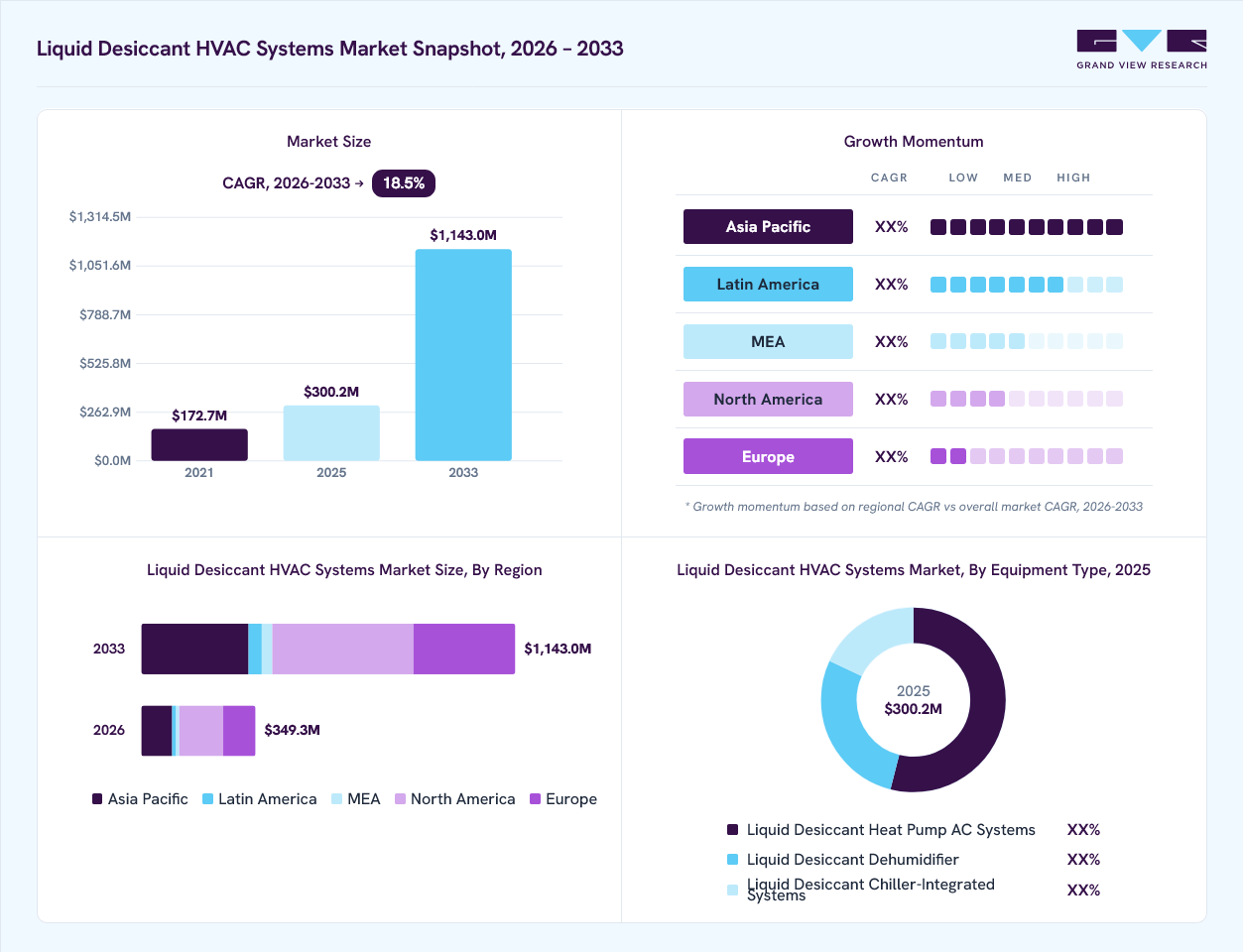
The global liquid desiccant HVAC systems market size was valued at USD 300.2 million in 2025 and is projected to grow from USD 349.3 million in 2026 to USD 1,143.0 million by 2033, at a CAGR of 18.5% from 2026 to 2033. North America dominated the market, accounting for a revenue share of 38.5% in 2025. The market is primarily driven by the increasing need for energy-efficient and sustainable cooling solutions across various sectors.
 Source: Grand View Research, IR Documents, Primary Interviews, Paid DatabasesTo learn more about this report,
 Download Free Sample Report
 Key Market Trends & Insights
- By equipment: Liquid desiccant heat pump ac systems segment dominated the market, with a revenue share of 53.9% in 2025.
- By application: Commercial segment held the largest market share of 69.1% in 2025.
Regional Highlights
- Largest regional market: North America (38.5% revenue share, 2025)
- Fastest-growing regional market: Asia Pacific (highest CAGR, 2026-2033)
- By country: The U.S. held the largest market share in 2025.
Market Size & Forecast
- Market size in 2025: USD 300.2 Million
- Estimated market size in 2026: USD 349.3 Million
- Projected market size by 2033: USD 1,143.0 Million
- CAGR (2026-2033): 18.5%
Three ways to get this report
Buy it, customize it, or ask a question.Ask an Analyst
Analyst response in 1 business day
- AccessReport author, directly
- Reply timeWithin 1 working day
- No sales callDirect answer only
- FormatEmail reply
- CostFree, no cost
Get the Full Report
What the study covers
- FormatsPDF · Excel · Dashboard
- Timeline2026–2033 annual, 2025 base
- Coverage20+ countries, 5 regions
- Companies10+ key players profiled
Customize the Report
20% free customization
- IncludeCountries, segments, points
- TailorTo your product definition
- ExtendDeeper competitor detail
- OrA fully bespoke study
- Turnaround5–10 working days
Governments and industry bodies worldwide are implementing stringent regulations to curb energy consumption and reduce greenhouse gas emissions, prompting the adoption of advanced HVAC technologies.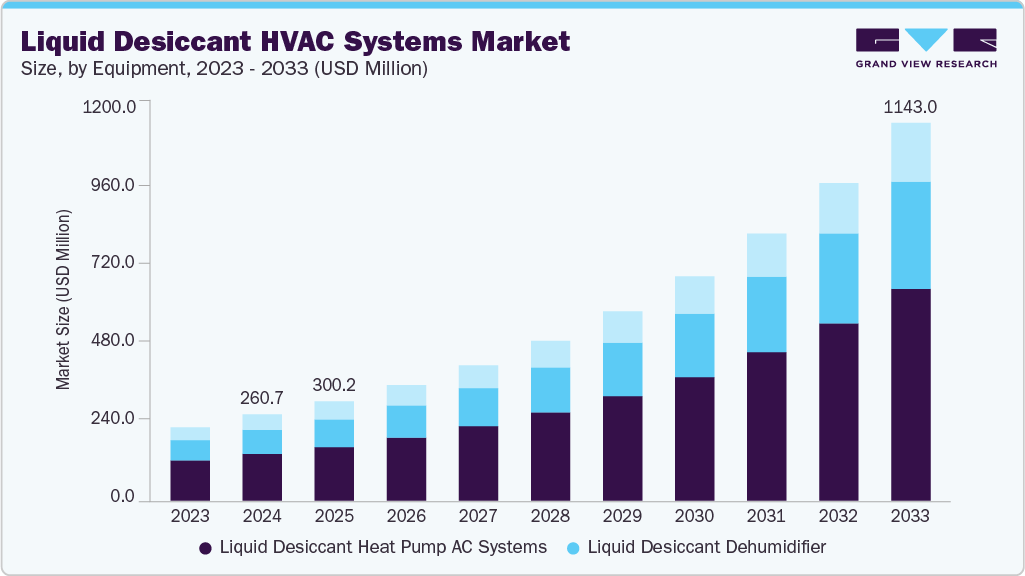 To learn more about this report, Download Free Sample Report
 Liquid desiccant systems stand out for their ability to achieve precise humidity control and significantly enhance energy efficiency when compared to traditional HVAC options, especially in large commercial and industrial applications where operational costs and environmental impact are crucial considerations.
Market Dynamics
The liquid desiccant HVAC systems market is expected to grow due to increasing demand for energy-efficient climate control solutions and rising emphasis on indoor air quality. Growing adoption in commercial buildings, healthcare facilities, industrial plants, and data centers is supporting market expansion. Stringent energy-efficiency regulations and sustainable building initiatives are accelerating deployment. Technological advancements in desiccant regeneration and system integration further enhance market potential. However, high installation costs remain a challenge, while green building projects continue to create long-term growth opportunities.
The growing focus on reducing energy consumption in buildings is a major driver for the liquid desiccant HVAC systems market. These systems efficiently control humidity while lowering cooling loads and improving overall HVAC performance. Increasing adoption of green building standards, stringent energy-efficiency regulations, and the need to reduce operating costs are encouraging deployment across commercial, healthcare, industrial, and institutional facilities. Rising awareness of indoor air quality is further supporting demand for liquid desiccant HVAC technologies.
High initial installation and integration costs remain a key restraint for the liquid desiccant HVAC systems market. These systems require specialized components, desiccant regeneration units, and customized HVAC designs, resulting in higher capital expenditure than conventional HVAC systems. Retrofitting existing buildings can also require significant modifications, increasing project costs. Additionally, limited technical expertise and maintenance requirements may discourage adoption among cost-sensitive customers, particularly in small commercial and residential applications.
The rapid expansion of green buildings and facilities requiring precise humidity control presents significant opportunities for the liquid desiccant HVAC systems market. Hospitals, pharmaceutical plants, food processing facilities, data centers, and cleanrooms increasingly require advanced dehumidification technologies to maintain indoor environmental quality. Growing investments in sustainable construction, net-zero energy buildings, and renewable energy integration are creating demand for liquid desiccant systems that improve energy efficiency while delivering superior humidity control and operational performance.
Market Concentration & Characteristics
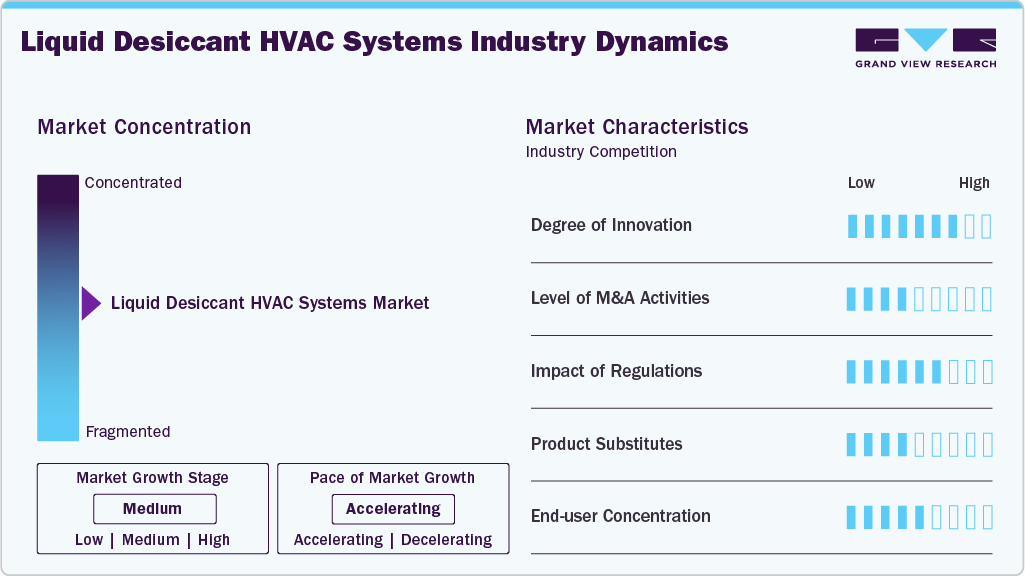
The market is relatively concentrated and demonstrates a high degree of innovation, with ongoing advancements in material science, smart connectivity, and energy system integration transforming the product landscape. The sector witnesses active collaborations, numerous strategic mergers, and steady R&D investment as companies strive to differentiate their offerings and achieve compliance with evolving regulations that guide energy efficiency and air quality standards.
 To learn more about this report, Download Free Sample Report
 Regulatory frameworks play a decisive role, with environmental mandates, health codes, and industry-specific requirements driving product upgrades and adoption rates. Product substitutes such as conventional dehumidifiers and mechanical HVAC units remain prevalent, but liquid desiccant systems are increasingly capturing market share, especially among end users seeking advanced moisture control and sustainability credentials. Concentration among commercial building operators, healthcare facilities, and data center managers is relatively high, while residential uptake remains in its early stages, poised for growth as awareness and cost-effectiveness improve.
Analyst Perspective
The liquid desiccant HVAC systems market is driven by increasing demand for energy-efficient cooling, superior humidity control, and improved indoor air quality. Adoption is rising across commercial buildings, hospitals, pharmaceutical facilities, data centers, and industrial applications where precise environmental control is essential. Manufacturers are focusing on innovative desiccant technologies, smart HVAC integration, and low-energy regeneration systems to enhance performance. North America and Europe lead technology adoption, while Asia Pacific is expected to witness the fastest growth due to rapid infrastructure development.
Drivers, Opportunities & Restraints
A significant market driver is the expansion of high-value industries such as healthcare, pharmaceuticals, data centers, and food processing, which demand stringent moisture control for operational stability and product quality. In these environments, liquid desiccant HVAC systems demonstrate excellent performance by delivering consistent dehumidification and air quality management, meeting both regulatory and process-related requirements. This alignment with critical end-user needs is fostering sectoral adoption and opening new application avenues that extend beyond conventional building cooling.
Opportunities in the global market arise from the evolving integration of liquid desiccant HVAC systems with real-time analytics, smart building technologies, and renewable energy solutions. Enhanced automation, combined with expanded government incentives for energy-efficient technologies, is expected to accelerate deployment in new sectors and regions. Strategic partnerships among manufacturers and service providers further support the evolution of customized solutions that target emerging application needs in modern urban environments.
Market restraints center on high initial investment costs and maintenance complexities, particularly for retrofitting in existing infrastructures. Specialized equipment, installation expertise, and ongoing upkeep, including regular desiccant replacement, contribute to affordability challenges for many potential users, especially in the residential segment, where consumer awareness is still limited. These factors slow the pace of adoption, despite recognized performance advantages.
Equipment Insights
Based on equipment, the liquid desiccant heat pump AC systems segment led the market with the largest revenue share of 53.9% in 2025, primarily due to the rising demand for solutions that combine energy efficiency with effective dehumidification in both commercial and industrial settings. Heat pump-assisted liquid desiccant systems offer superior humidity control, improved indoor air quality, and substantial operational cost savings, making them an attractive choice for end-users facing stringent regulatory and sustainability requirements.
The projected increase in demand for liquid desiccant dehumidifiers is based on a sharp rise in demand for energy-efficient humidity control across industries such as data centers, healthcare, and food processing, driven by stricter environmental regulations and sustainability initiatives. Technological advancements, including improved desiccant materials and integration with smart building systems, have substantially enhanced product performance and operational cost-efficiency. The combined effect of regulatory pressure, expanding industrial applications, and ongoing innovation is setting the stage for robust revenue growth well above the average HVAC segment rate.
Application Insights
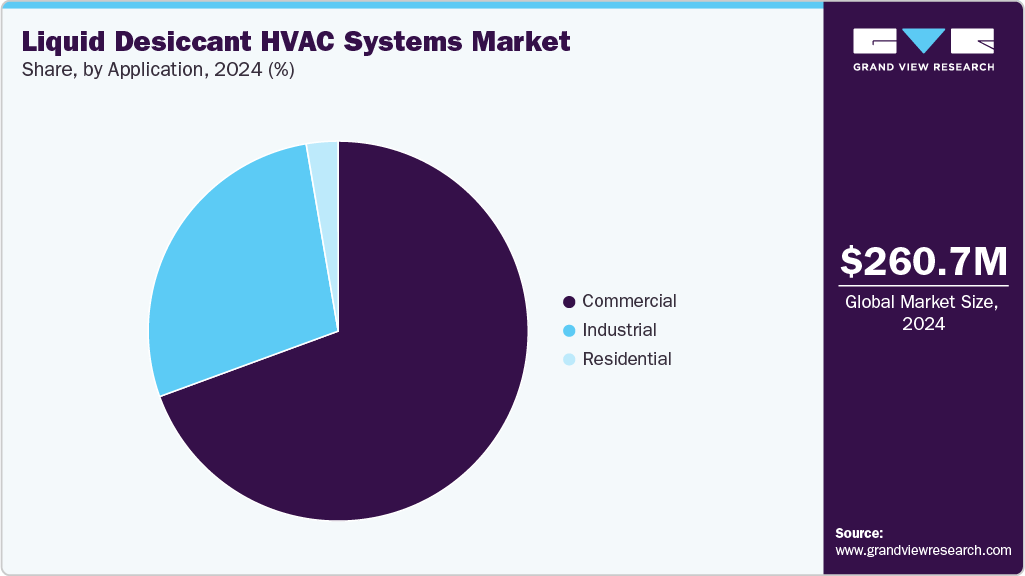
Based on application, the commercial segment led the market with the largest revenue share of 69.1% in 2025, driven by an increasing demand for precise humidity control in office buildings, data centers, museums, and other commercial spaces. Energy efficiency regulations and the need to protect sensitive equipment drive adoption. Technological advancements and sustainability goals are also fueling growth in this segment.
 To learn more about this report, Download Free Sample Report
 The industrial segment is expected to grow at a rapid CAGR of 17.5% from 2025 to 2033 in terms of revenue. The industrial segment’s growth is driven by rising demand for precise humidity control in critical manufacturing sectors such as pharmaceuticals, food and beverage, and electronics. Stringent quality and regulatory standards compel industries to invest in reliable liquid desiccant systems to ensure product quality and operational efficiency.
Regional Insights
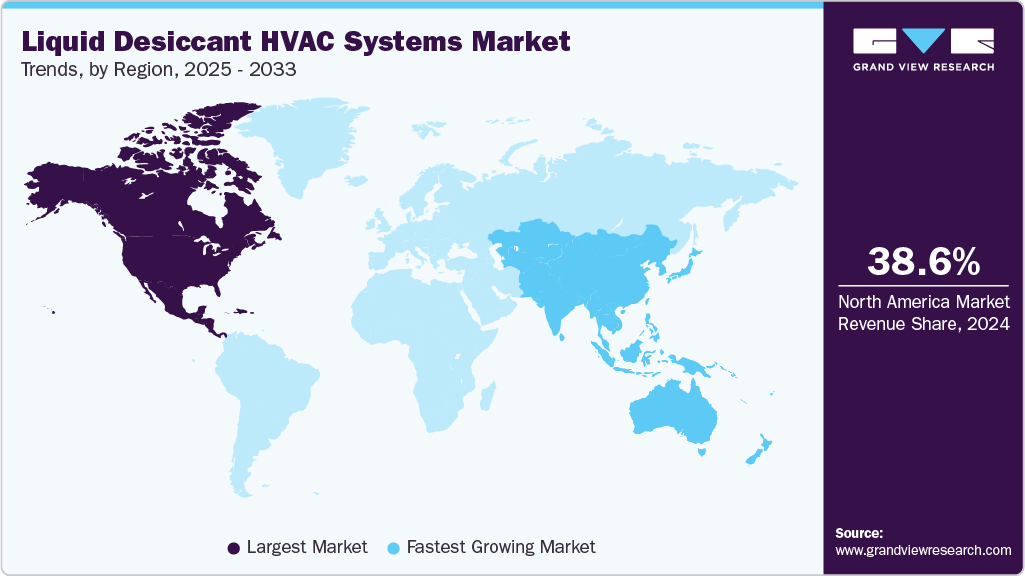
North America dominated the liquid desiccant HVAC systems market with the largest revenue share of 38.5% in 2025. The market is driven by stringent energy efficiency regulations and high demand from the pharmaceutical and data center sectors, with strong adoption of green building practices accelerating market traction. The region’s climate extremes further increase the need for advanced humidity control solutions, making liquid desiccant HVAC systems critical for sustainability goals.
 To learn more about this report, Download Free Sample Report
 The liquid desiccant HVAC systems market in the U.S. held the largest share in the North America region in 2025. expanding steadily with strong momentum from stringent energy efficiency mandates and rising demand in pharmaceuticals and data centers. Adoption of innovative, energy-saving HVAC systems is increasingly common in commercial and industrial sectors. Government incentives further encourage the transition to advanced liquid desiccant systems. Overall, sustainability and operational cost reduction priorities drive robust market growth.
Europe Liquid Desiccant HVAC Systems Market Trends
Europe liquid desiccant HVAC systems industry benefits from comprehensive regulatory frameworks focused on carbon reduction and green building certifications, driving growth in commercial and healthcare HVAC applications. Investments in sustainable infrastructure and energy-efficient technologies are key growth enablers. The shift to smart building standards further supports increased adoption of liquid desiccant systems.
Spain’s liquid desiccant HVAC systems industry growth is supported by government initiatives to enhance energy efficiency in buildings and reduce carbon emissions. Increasing construction and retrofit activities in commercial and healthcare sectors create demand for liquid desiccant HVAC solutions. Public and private investments focused on green building certifications are fueling adoption. Rising awareness of indoor air quality is also a key factor.
Italy liquid desiccant HVAC systems industry experiences market growth driven by stringent environmental regulations and the drive for energy-efficient HVAC solutions in commercial and industrial settings. Projects emphasizing sustainable infrastructure and modernization in urban centers stimulate demand. Adoption is further supported by government subsidies for clean energy technologies. Awareness of energy-saving HVAC systems grows among end users.
Asia Pacific Liquid Desiccant HVAC Systems Market Trends
The liquid desiccant HVAC systems industry in the Asia Pacific is anticipated to grow at the fastest CAGR from 2026 to 2033 The liquid desiccant HVAC systems industry in the Asia Pacific experiences rapid growth fueled by urbanization, industrialization, and government incentives for energy-efficient cooling technologies. Large-scale infrastructure projects and smart city initiatives in countries such as China, India, and Japan contribute significantly. Rising awareness of indoor air quality enhances demand in residential and commercial sectors.
The liquid desiccant HVAC systems industry in China is driven by rapid urbanization, industrial expansion, and government policies promoting energy-efficient technologies, supporting a rapid market growth. Large-scale smart city and infrastructure projects incorporate liquid desiccant HVAC systems for enhanced air quality and energy savings. Environmental regulations and sustainability commitments strongly influence adoption. Increasing industrial applications foster continual expansion.
India's liquid desiccant HVAC systems industry, growing commercial real estate market and industrial sector, combined with supportive government energy efficiency programs, drive demand. Rising awareness of indoor air quality and climate adaptability needs to reinforce interest. Large urban centers embrace smart building and green technology integration. Investment in clean energy initiatives propels market potential.
Middle East & Africa Liquid Desiccant HVAC Systems Market Trends
The Middle East & Africa liquid desiccant HVAC systems industry grows gradually, driven by climatic challenges and increased focus on sustainability in the hospitality, healthcare, and food processing industries. Modernization of urban infrastructure and government initiatives for energy conservation reinforce growth. The region’s need for reliable, energy-efficient humidity control systems is steadily increasing.
Saudi Arabia’s liquid desiccant HVAC systems industry growth is fostered by extreme climatic conditions, driving demand for advanced cooling and dehumidification. Government initiatives promoting sustainable development and smart cities encourage adoption. The hospitality and healthcare sectors increasingly require reliable humidity control. Investments in energy-efficient urban infrastructure underpin steady market expansion.
Latin America Liquid Desiccant HVAC Systems Market Trends
The liquid desiccant HVAC systems industry growth stems from emerging energy efficiency regulations and expanding commercial infrastructure, particularly in Brazil and Mexico. Increasing focus on sustainable development and eco-friendly HVAC solutions supports market expansion. Adoption is also supported by rising construction activity and modernization efforts.
Argentina's liquid desiccant HVAC systems industry grows steadily with the modernization of commercial infrastructure and increased focus on sustainability. Energy efficiency regulations are gradually strengthening and driving demand for liquid desiccant HVAC systems. Expansion in urban developments and government support for eco-friendly solutions contribute.
Key Liquid Desiccant HVAC Systems Company Insights
Some of the key players operating in the market include Mojave Energy Systems and 7AC Technologies, Inc. (Emerson Electric Co):
-
Alfa Laval designs and manufactures equipment for heat transfer, separation, and fluid handling. Its core product range includes plate heat exchangers, centrifugal separators, pumps, valves, and tubular heat exchangers, supported by aftermarket services such as spare parts supply and performance audits. The company is publicly listed on Nasdaq Stockholm.
-
7AC Technologies, Inc., designs membrane-based liquid desiccant HVAC systems for commercial and industrial buildings. The company, formerly known as 7Solar Technologies, created a highly efficient liquid desiccant air-conditioning approach that enables independent control of temperature and humidity within a single device, eliminating the energy losses associated with overcooling and reheat cycles.
Key Liquid Desiccant HVAC Systems Companies
The following key companies have been profiled for this study on the liquid desiccant HVAC systems market.
-
Alfa Laval
-
AirGreen, Inc.
-
Blue Frontier
-
Mojave Energy Systems
-
Copeland LP
-
Ventilex
-
AOLAN
-
7AC Technologies, Inc. (Emerson Electric Co)
Competitive Benchmarking
Category
Operating Strategies
Competitive Edge
Weakness
Established Players (e.g. Alfa Laval; Copeland LP; Ventilex; Emerson Electric Co. (7AC Technologies Inc.))
- Focus on expanding comprehensive liquid desiccant HVAC system portfolios, including dehumidifiers, heat pump air conditioning systems, and chiller-integrated solutions for commercial, industrial, healthcare, and institutional applications.
- Invest in energy-efficient dehumidification technologies, smart HVAC controls, advanced heat recovery systems, and digital monitoring to improve system performance and reduce energy consumption.
- Strengthen partnerships with HVAC contractors, engineering firms, building developers, EPC contractors, and facility owners to support new construction and retrofit projects.
- Strong engineering expertise in HVAC, heat transfer, dehumidification, and energy management technologies.
- Broad product portfolios with advanced humidity control capabilities, high energy efficiency, and compliance with international HVAC and building standards.
- Well-established global manufacturing, distribution, and after-sales service networks with strong brand recognition and customer relationships.
- High research, manufacturing, and installation costs associated with advanced liquid desiccant HVAC technologies.
- Dependence on commercial construction activity, HVAC modernization, and investments in energy-efficient buildings.
- Long project approval and installation cycles may delay purchasing decisions and market adoption.
Emerging & Regional Players (e.g AirGreen, Inc.; Blue Frontier; Mojave Energy Systems; AOLAN)
- Focus on specialized liquid desiccant HVAC systems designed for high-humidity environments, commercial buildings, data centers, healthcare facilities, and industrial applications.
- Expand market presence through innovative product development, regional partnerships, pilot installations, and collaborations with HVAC integrators and technology providers.
- Emphasize compact system designs, energy savings, flexible installation, and sustainable cooling solutions to address evolving customer requirements.
- Competitive product innovation with advanced humidity control and lower energy consumption.
- Greater flexibility in developing customized HVAC solutions for application-specific requirements and regional markets.
- Agile operations enabling faster commercialization of new technologies and quicker response to changing energy-efficiency regulations.
- Limited financial resources for large-scale manufacturing, research, and international expansion.
- Smaller production capacity, distribution networks, and after-sales service capabilities compared to established HVAC manufacturers.
- Lower participation in large commercial infrastructure projects due to limited global presence and brand recognition.
Recent Developments
-
In June 2025, Mojave Energy Systems announced it expanded its sales partner program across 16 U.S. states and five Latin American countries, adding over 20 new partners. These partners will exclusively represent Mojave for commercial air conditioning customers in their regions.
-
In March 2025, Copeland LP partnered with KCC Companies HVAC to develop a new commercial dedicated outdoor air system (DOAS) incorporating Copeland’s HMX liquid desiccant module. The collaboration allows KCC to leverage Copeland’s R&D and innovation capabilities, positioning both companies at the forefront of advanced liquid desiccant technology in the commercial HVAC market.
Liquid Desiccant HVAC Systems Market Report Scope
Report Attribute
Details
Market size in 2025
USD 300.2 million
Estimated market size in 2026
USD 349.3 million
Projected market size by 2033
USD 1,143.0 million
Growth rate
CAGR of 18.5% from 2026 to 2033
Base year for estimation
2025
Historical data
2021 - 2024
Forecast period
2026 - 2033
Quantitative units
Revenue in USD million and CAGR from 2026 to 2033
Report coverage
Revenue forecast, company ranking, competitive landscape, growth factors, and trends
Segments covered
Equipment, application, region
Regional scope
North America; Europe; Asia Pacific; Latin America; Middle East & Africa
Country scope
U.S., Canada, Mexico, Germany, France, UK, Italy, Spain, China, India, Japan, South Korea, Australia, Brazil, Argentina, Saudi Arabia, UAE
Key companies profiled
Alfa Laval; AirGreen, Inc.; Blue Frontier; Mojave Energy Systems; Copeland LP; Ventilex; AOLAN; 7AC Technologies Inc (Emerson Electric Co)
Customization scope
Free report customization (equivalent up to 8 analysts' working days) with purchase. Addition or alteration to country, regional & segment scope.
Pricing and purchase options
Avail customized purchase options to meet your exact research needs. Explore purchase options
Global Liquid Desiccant HVAC Systems Market Report Segmentation
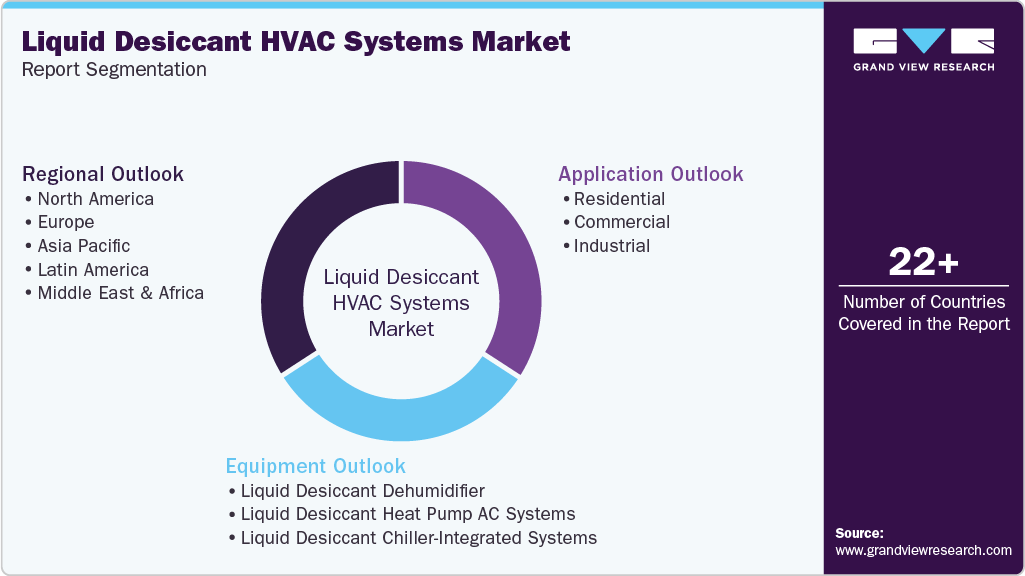
This report forecasts revenue growth at global, regional, and country levels and provides an analysis of the latest industry trends in each of the sub-segments from 2021 to 2033. For this study, Grand View Research has segmented the global liquid desiccant HVAC systems market report based on equipment, application, and region.
 To learn more about this report, Download Free Sample Report
 -
Equipment Outlook (Revenue, USD Million, 2021 - 2033)
-
Liquid Desiccant Dehumidifier
-
Liquid Desiccant Heat Pump AC Systems
-
Liquid Desiccant Chiller-Integrated Systems
-
-
Application Outlook (Revenue, USD Million, 2021 - 2033)
-
Residential
-
Commercial
-
Industrial
-
-
Regional Outlook (Revenue, USD Million, 2021 - 2033)
-
North America
-
U.S.
-
Canada
-
Mexico
-
-
Europe
-
Germany
-
France
-
Italy
-
Spain
-
UK
-
-
Asia Pacific
-
China
-
India
-
Japan
-
South Korea
-
Australia
-
-
Latin America
-
Brazil
-
Argentina
-
-
Middle East and Africa
-
Saudi Arabia
-
UAE
-
-
Research Methodology
The liquid desiccant HVAC systems market figures in this report are based on a proven research process that combines executive interviews with secondary research from proprietary databases, company filings, and recognized regulatory and institutional sources. Market size is built through value-chain sizing-reconciling supply-side and demand-side estimates-and triangulated with bottom-up and top-down approaches. Every estimate passes multiple levels of expert validation before publication, with each liquid desiccant HVAC systems segment quantified using the revenue-capture definitions in the table below.
Segment Definition
Equipment
Revenue Capture Definition
Liquid Desiccant Dehumidifier
Revenue is generated from the sale of liquid desiccant dehumidifiers used for humidity control in residential, commercial, and industrial HVAC systems.
Liquid Desiccant Heat Pump AC Systems
Revenue is generated from the sale of liquid desiccant heat pump air conditioning systems providing energy-efficient cooling and dehumidification solutions.
Liquid Desiccant Chiller-Integrated Systems
Revenue is generated from the sale of liquid desiccant systems integrated with chillers for enhanced cooling efficiency and humidity management.
Application
Revenue Capture Definition
Residential
Revenue is generated from the sale of liquid desiccant HVAC systems installed in residential buildings for improved indoor comfort and humidity control.
Commercial
Revenue is generated from the sale of liquid desiccant HVAC systems deployed in offices, hospitals, hotels, educational institutions, and retail buildings.
Industrial
Revenue is generated from the sale of liquid desiccant HVAC systems used in manufacturing, pharmaceuticals, food processing, and industrial facilities requiring humidity control.
Estimation Model
Layer No.
Layer Name
Key Question
Description
01
Building Construction and HVAC Demand Layer
Which sectors generate demand for liquid desiccant HVAC systems?
The estimation begins by evaluating construction activity across residential, commercial, industrial, healthcare, hospitality, data centers, and institutional sectors. Demand is supported by increasing investments in energy-efficient buildings, green construction initiatives, indoor air quality requirements, and stringent building energy regulations.
02
Equipment Type and Technology Adoption Layer
Which equipment types drive market demand?
This layer refines demand by assessing the adoption of liquid desiccant dehumidifiers, liquid desiccant heat pump AC systems, and liquid desiccant chiller-integrated systems. Energy efficiency, humidity control requirements, technological advancements, HVAC modernization, and integration with renewable energy systems influence equipment adoption across end-use sectors.
03
End-user and Installation Deployment Layer
What determines liquid desiccant HVAC system installations?
Market demand is estimated through the deployment of liquid desiccant HVAC systems across residential buildings, commercial offices, hospitals, hotels, educational institutions, pharmaceutical facilities, food processing plants, manufacturing facilities, and data centers. New construction, HVAC replacement, indoor air quality standards, humidity control requirements, and building modernization projects further support system installations.
04
Revenue Layer
How is total market revenue calculated?
Revenue is estimated by aggregating sales of liquid desiccant HVAC systems across equipment types, applications, and regional markets. Building construction activity, HVAC investments, equipment pricing, energy-efficiency adoption, replacement demand, green building initiatives, regulatory compliance, and manufacturer revenues are incorporated to validate the total market size.
Delivered Customizations
This report has been delivered with the following In-depth customizations
Client Request
Customization Delivered
Value Adds
Regional Segmentation
Detailed regional analysis covered North America, Europe, Asia Pacific, Latin America, and the Middle East & Africa, with country-level assessment of key markets. The study evaluated commercial and residential construction activity, HVAC installations, green building initiatives, climate conditions, energy-efficiency regulations, investments in healthcare, data centers, industrial facilities, and demand from commercial, industrial, and institutional sectors influencing liquid desiccant HVAC systems demand.
Helped identify high-growth regions, country-specific opportunities, and evolving building construction and HVAC trends, supporting market entry strategies, regional expansion planning, and identification of emerging energy-efficient building and infrastructure hubs.
Competitive Benchmarking
Comprehensive benchmarking assessed major participants based on product portfolio, liquid desiccant HVAC technologies, dehumidification performance, energy-efficiency capabilities, manufacturing strength, innovation, regional presence, pricing strategies, aftermarket services, and distribution networks. The study also compared established and emerging players operating in the liquid desiccant HVAC systems market.
Assisted clients in evaluating competitor positioning, technological capabilities, and market gaps while supporting strategic planning, partnership opportunities, product differentiation, and investment decisions across commercial, industrial, healthcare, and institutional HVAC applications.
Opportunity Assessment
In-depth opportunity assessment analyzed green building initiatives, net-zero energy projects, smart building adoption, indoor air quality regulations, expansion of healthcare and data center infrastructure, industrial HVAC modernization, and government energy-efficiency programs. The study identified emerging opportunities in advanced liquid desiccant dehumidification systems, smart HVAC controls, renewable energy-integrated cooling solutions, and high-performance humidity control technologies designed to improve energy efficiency and indoor environmental quality.
Enabled clients to identify high-growth investment areas, prioritize regional expansion, and evaluate future revenue opportunities while supporting product development, technology adoption, and long-term growth strategies in the liquid desiccant HVAC systems market.
Frequently Asked Questions About This Report
Based on equipment, the liquid desiccant heat pump AC systems segment led the market with the largest revenue share of 53.9% in 2025
Based on application, the commercial segment led the market with the largest revenue share of 69.1% in 2025.
Asia Pacific is the fastest-growing region over the forecast period.
Key growth drivers include rising demand for energy-efficient HVAC solutions, stringent energy efficiency regulations, increasing adoption in data centers and healthcare facilities, growing emphasis on indoor air quality, and the need for effective humidity control in industrial and commercial applications.
The global liquid desiccant HVAC systems market size was estimated at USD 300.2 million in 2025 and is expected to be USD 349.3 million in 2026.
North America dominated with a 38.5% revenue share in 2025.
The global liquid desiccant HVAC systems market is expected to grow at a CAGR of 18.5% from 2026 to 2033, reaching USD 1,143.0 million by 2033.
Some of the key players operating in the liquid desiccant HVAC systems market include Alfa Laval, AirGreen, Inc., Blue Frontier, Mojave Energy Systems, Copeland LP, Ventilex, AOLAN, and 7AC Technologies.
The key factors driving the global liquid desiccant HVAC systems market are the increasing demand for energy-efficient and sustainable cooling solutions and the rising need for precise humidity control in commercial and industrial sectors.
About the Author(s)
Advanced Interior Materials Research Team
Advanced Materials · Advanced Interior MaterialsThis report was authored by the advanced interior materials research team at Grand View Research - comprising two research analysts, one senior research analyst, and one industry expert - with specialized expertise in the advanced interior materials segment of the advanced materials industry. All findings are based on proprietary advanced materials databases, executive interviews, and regulatory analysis, subject to internal peer review prior to publication.
Last Updated:
Speak to Analyst

Customize this report to your needs - add regions, segments, or data points, with 20% free customization.
Or view our licence options:


ISO 9001:2015 & 27001:2022 Certified
We are GDPR and CCPA compliant! Your transaction & personal information is safe and secure. For more details, please read our privacy policy.


