
- Home
- »
- Power Generation & Storage
- »
-
Lithium-ion Battery Recycling Market Size Report, 2026-2033GVR Report cover

Lithium-ion Battery Recycling Market (2026 - 2033)
Size, Share & Trends Analysis By Application (Transportation, Consumer Electronics, Industrial), By Region (North America, Europe, Asia Pacific, Middle East & Africa), And Segment Forecasts
Market Size, 2025
$287.3MMarket Estimate, 2026
$416.0MMarket Forecast, 2033
$2,741.5MCAGR, 2026–2033
30.9%Lithium-ion Battery Recycling Summary
The global lithium-ion battery recycling market size was valued at USD 287.3 million in 2025 and is projected to grow from USD 416.0 million in 2026 to USD 2,741.5 million by 2033, at a CAGR of 30.9% from 2026 to 2033. The market in Asia Pacific dominated with a revenue share of 44.1% in 2025. Lithium-ion battery recycling involves the collection, dismantling, and processing of end-of-life batteries to recover valuable materials such as lithium, cobalt, nickel, manganese, copper, and aluminum, which are reused in new battery production.
 Source: Grand View Research, IR Documents, Primary Interviews, Paid DatabasesTo learn more about this report,
 Download Free Sample Report
 Key Market Trends & Insights
- By application: Transportation segment held the largest market share of 70.8% in 2025.
Regional Highlights
- Largest regional market: Asia Pacific (44.1% revenue share, 2025)
- By country: The U.S. held the largest market share in 2025
Market Size & Forecast
- Market size in 2025: USD 287.3 Million
- Estimated market size in 2026: USD 416.0 Million
- Projected market size by 2033: USD 2,741.5 Million
- CAGR (2026-2033): 30.9%
Three ways to get this report
Buy it, customize it, or ask a question.Ask an Analyst
Analyst response in 1 business day
- AccessReport author, directly
- Reply timeWithin 1 working day
- No sales callDirect answer only
- FormatEmail reply
- CostFree, no cost
Get the Full Report
What the study covers
- FormatsPDF · Excel · Dashboard
- Timeline2026–2033 annual, 2025 base
- Coverage20+ countries, 5 regions
- Companies10+ key players profiled
Customize the Report
20% free customization
- IncludeCountries, segments, points
- TailorTo your product definition
- ExtendDeeper competitor detail
- OrA fully bespoke study
- Turnaround5–10 working days
Rising EV adoption, increasing battery waste volumes, and the need to reduce reliance on virgin raw materials are strongly supporting market growth.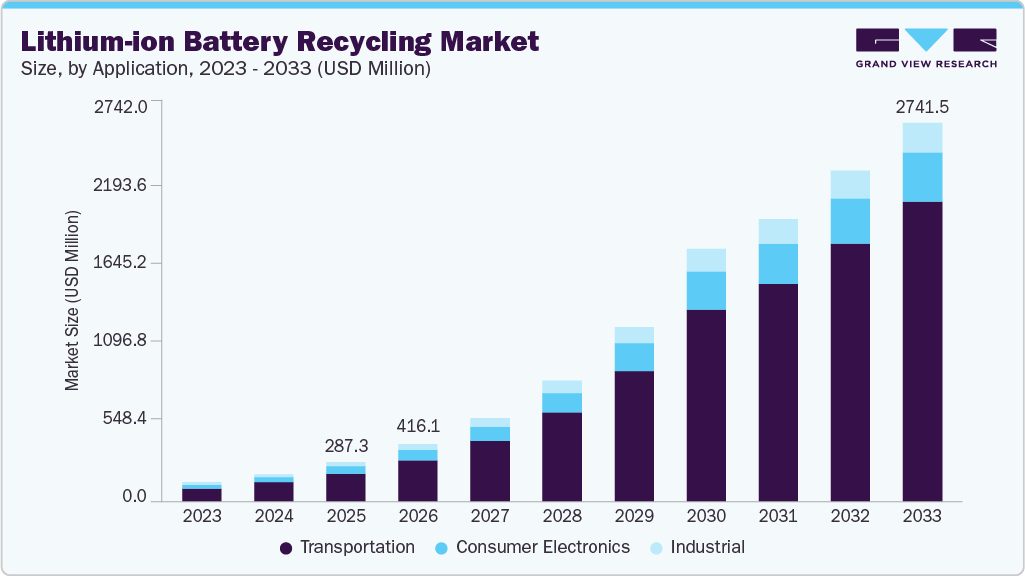 To learn more about this report, Download Free Sample Report
 The global lithium-ion battery recycling market continues to gain traction, driven by the rapid expansion of electric vehicles (EVs), energy storage systems (ESS), and consumer electronics, which is accelerating the generation of spent batteries worldwide. Manufacturers and governments are increasingly focusing on circular economy practices, supply chain sustainability, and regulatory compliance to strengthen recycling infrastructure. In addition, advancements in recycling technologies such as hydrometallurgical and direct recycling methods, along with growing investments in battery collection networks and recycling capacity, are further enhancing the market outlook globally.
Drivers, Opportunities & Restraints
The global lithium-ion battery recycling market continues to expand, driven by the rapid growth of electric vehicles (EVs), energy storage systems (ESS), and consumer electronics, which is significantly increasing the volume of end-of-life lithium-ion batteries. Rising concerns over battery waste management, environmental pollution, and fire risks are pushing governments and industries to strengthen collection and recycling ecosystems. In addition, the growing need to recover critical materials such as lithium, cobalt, nickel, manganese, copper, and aluminium is accelerating market growth, as recycled materials help reduce dependency on mining, stabilize raw material supply chains, and support sustainable battery manufacturing. Supportive regulations, extended producer responsibility (EPR) policies, and corporate commitments toward circular economy models are further strengthening demand for lithium-ion battery recycling globally.
Emerging opportunities are linked to the increasing shift toward localized battery supply chains and the rising focus on securing critical raw materials for next-generation batteries. Growing investments in battery recycling plants, collection networks, and advanced recycling technologies such as hydrometallurgical processing and direct recycling are improving recovery efficiency and overall profitability. In addition, the rise of second-life battery applications before recycling, along with partnerships between automakers, battery manufacturers, and recyclers, is creating new value chains and long-term revenue potential. As battery production scales globally, recycling is expected to become a strategic enabler for cost optimization, sustainability compliance, and long-term material availability.
However, the market faces several restraints, including high capital requirements for setting up recycling facilities, complex dismantling processes, and the need for safe handling of hazardous battery components. Variability in battery chemistries (such as NMC, LFP, and NCA) creates operational challenges and impacts recovery economics. Supply chain issues such as inconsistent battery collection volumes, limited standardized recycling infrastructure, and transportation restrictions for damaged or spent batteries can further limit scalability. In addition, regulatory differences across regions and uncertainties around recycling standards and traceability frameworks may slow adoption, particularly in emerging markets where recycling ecosystems are still developing.
Application Insights
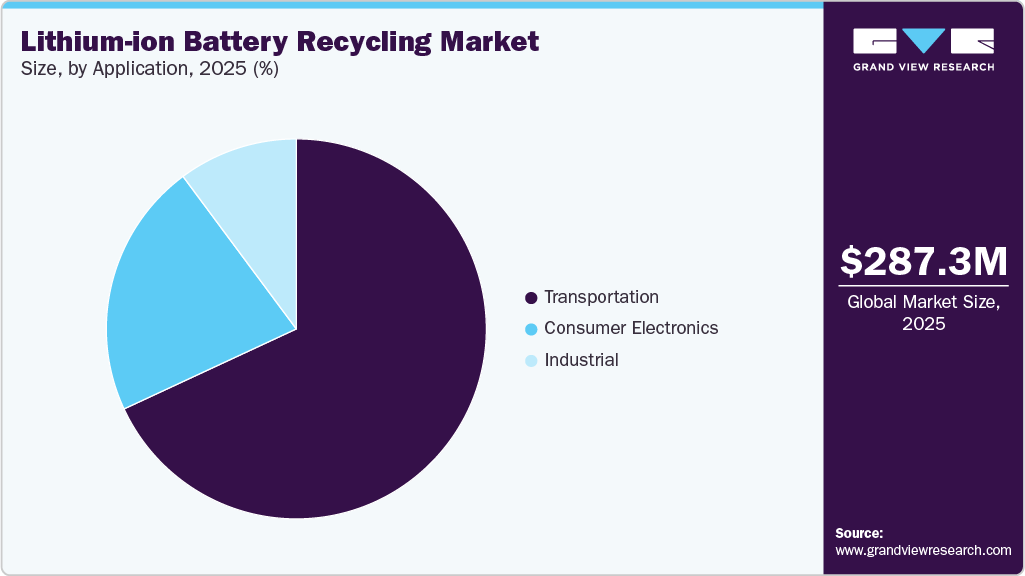
The transportation segment accounted for the largest revenue share of approximately 70.8% in 2025 within the global Lithium-ion Battery Recycling market, primarily driven by the rising adoption of electric vehicles (EVs) across passenger cars, buses, commercial fleets, and two/three-wheelers. The increasing volume of end-of-life EV battery packs, along with growing demand for recovery of critical materials such as lithium, nickel, cobalt, and manganese, is strengthening recycling activity in this segment. Additionally, stricter regulations on battery disposal, extended producer responsibility (EPR) frameworks, and OEM-led take-back programs are accelerating the development of recycling infrastructure focused on transportation batteries, making it the most dominant application area globally.
 To learn more about this report, Download Free Sample Report
 The transportation segment is also expected to register the fastest CAGR of 32.7% over the forecast period, reflecting the rapid scale-up of EV manufacturing and battery deployment worldwide. Expanding EV penetration in emerging markets, increasing investments in gigafactories, and rising efforts to build localized and sustainable battery supply chains are further supporting growth. Moreover, advancements in recycling technologies such as hydrometallurgical and direct recycling methods, along with increasing collaboration between automakers, battery manufacturers, and recycling companies, are improving recovery efficiency and economic feasibility. This positions transportation as both the largest and fastest-growing application segment in the global lithium-ion battery recycling market.
Regional Insights
Asia Pacific Lithium-ion Battery Recycling Market Trends
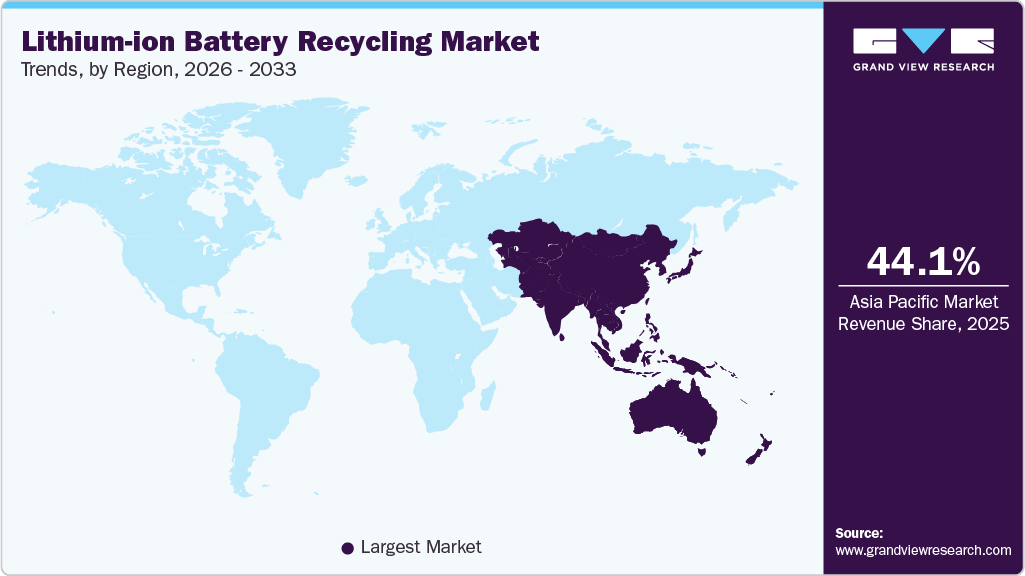
Asia Pacific accounted for approximately 44.1% of the global Lithium-ion Battery Recycling market revenue in 2025, driven by the region’s dominance in EV production, battery manufacturing, and consumer electronics. Countries such as China, Japan, South Korea, and India are generating large volumes of end-of-life batteries, supported by expanding EV adoption and energy storage deployment. Strong government initiatives for battery waste management, domestic material recovery, and supply chain localization are accelerating recycling capacity additions across the region.
 To learn more about this report, Download Free Sample Report
 Asia Pacific is also expected to register the fastest CAGR of 34.1% over the forecast period, supported by rising investments in advanced recycling technologies, expanding collection networks, and increasing partnerships between automakers, battery producers, and recyclers. Growing focus on critical mineral security and circular economy targets is further strengthening long-term market growth across the Asia Pacific.
U.S. Lithium-ion Battery Recycling Market Trends
The U.S. Lithium-ion Battery Recycling market is growing steadily, driven by the rapid scale-up of EV manufacturing, battery gigafactories, and energy storage installations. Increasing volumes of end-of-life EV batteries, along with rising concerns around battery disposal and material security, are supporting recycling investments. In addition, government support for clean energy transition, domestic supply chain development, and strategic mineral recovery is accelerating partnerships between recyclers, automakers, and battery producers, strengthening the U.S. position in the global market.
North America Lithium-ion Battery Recycling Market Trends
North America is witnessing consistent market expansion supported by increasing adoption of EVs and energy storage systems across the U.S. and Canada. The region benefits from growing investments in recycling infrastructure, improving battery collection ecosystems, and increasing focus on circular economy models. In addition, the presence of established industrial players and rising efforts to build localized supply chains for lithium, nickel, and cobalt recovery are enhancing the overall market outlook in North America.
Europe Lithium-ion Battery Recycling Market Trends
Europe represents a key market for Lithium-ion Battery Recycling, supported by strong regulatory frameworks promoting battery collection, recycling efficiency targets, and sustainable sourcing of raw materials. The region is witnessing growing recycling demand due to expanding EV adoption across Germany, France, the UK, and Nordic countries, along with rising battery production investments. In addition, the EU’s focus on reducing reliance on imported critical minerals and strengthening domestic supply chains is encouraging large-scale recycling facility development.
Latin America Lithium-ion Battery Recycling Market Trends
The Lithium-ion Battery Recycling market in Latin America is gradually expanding, supported by rising EV penetration and increasing awareness around sustainable battery disposal. Countries in the region are exploring recycling opportunities to reduce environmental risks and improve recovery of valuable battery metals. Growing private-sector participation and the development of early-stage collection and processing networks are expected to contribute to steady market growth over the forecast period.
Middle East & Africa Lithium-ion Battery Recycling Market Trends
The Middle East & Africa Lithium-ion Battery Recycling market is at an emerging stage, driven by increasing adoption of EVs, renewable energy storage systems, and industrial electrification initiatives. Governments and private players are gradually investing in waste management frameworks and recycling infrastructure to address battery disposal challenges. As regional energy transition goals strengthen, demand for safe and sustainable lithium-ion battery recycling solutions is expected to rise steadily.
Key Lithium-ion Battery Recycling Company Insights
Some of the key players operating in the global Lithium-ion Battery Recycling market include Li-Cycle Corp. and Redwood Materials, Inc., among others.
-
Li-Cycle Corp. is one of the prominent players in the global lithium-ion battery recycling market, known for its integrated recycling solutions that enable recovery of critical battery materials such as lithium, nickel, and cobalt from end-of-life lithium-ion batteries. The company focuses on improving material recovery efficiency and supporting a circular battery supply chain through scalable recycling infrastructure and partnerships across the EV and energy storage ecosystem.
-
Redwood Materials, Inc. is a leading U.S.-based lithium-ion battery recycling company specializing in the collection and processing of battery scrap and end-of-life batteries to produce recycled raw materials for new battery manufacturing. The company’s operations support domestic supply chain development by recovering valuable metals such as copper, nickel, cobalt, and lithium, helping reduce dependence on mined resources while enabling sustainable battery production at scale.
Key Lithium-ion Battery Recycling Companies:
The following key companies have been profiled for this study on the lithium-ion battery recycling market.
- Li-Cycle Corp.
- Redwood Materials, Inc.
- Umicore
- Glencore
- Ecobat
- Cirba Solutions
- American Battery Technology Company (ABTC)
- Fortum
- Retriev Technologies
- GEM Co., Ltd.
Recent Developments
- In August 2025, Glencore completed the acquisition of Li-Cycle Holdings Corp. assets following Li-Cycle’s bankruptcy filing earlier in the year. The deal included Li-Cycle’s recycling facilities across the U.S. and Germany, along with its Rochester Hub project and intellectual property. This development strengthens Glencore’s position in the global lithium-ion battery recycling market by expanding its recycling capacity and supporting recovery of critical battery materials such as lithium, nickel, and cobalt.
Lithium-ion Battery Recycling Market Report Scope
Report Attribute
Details
Market definition
The lithium-ion battery recycling market represents the global revenue generated from the collection, transportation, dismantling, and recycling of end-of-life lithium-ion batteries to recover valuable materials such as lithium, cobalt, nickel, manganese, copper, and aluminum for reuse in new battery manufacturing and other industrial applications.
Market size in 2025
USD 287.3 million
Estimated market size in 2026
USD 416.0 million
Projected market size by 2033
USD 2,741.5 million
Growth rate
CAGR of 30.9% from 2026 to 2033
Base year for estimation
2025
Historical data
2021 - 2024
Forecast period
2026 - 2033
Quantitative units
Revenue in USD million/billion and CAGR from 2026 to 2033
Report coverage
Revenue forecast, competitive landscape, growth factors, and trends
Segments covered
Application and region
Regional scope
North America; Europe; Asia Pacific; Latin America; Middle East & Africa
Country scope
U.S.; Canada; Mexico; Germany; UK; France; Italy; Spain; Poland; Netherlands; China; Japan; South Korea; India; Australia; Brazil; Argentina; UAE; Saudi Arabia; South Africa
Key companies profiled
Li-Cycle Corp.; Redwood Materials, Inc.; Umicore; Glencore; Ecobat; Cirba Solutions; American Battery Technology Company (ABTC); Fortum; Retriev Technologies; GEM Co., Ltd.
Customization scope
Free report customization (equivalent up to 8 analysts working days) with purchase. Addition or alteration to country, regional & segment scope.
Pricing and purchase options
Avail customized purchase options to meet your exact research needs. Explore purchase options
Global Lithium-ion Battery Recycling Market Report Segmentation
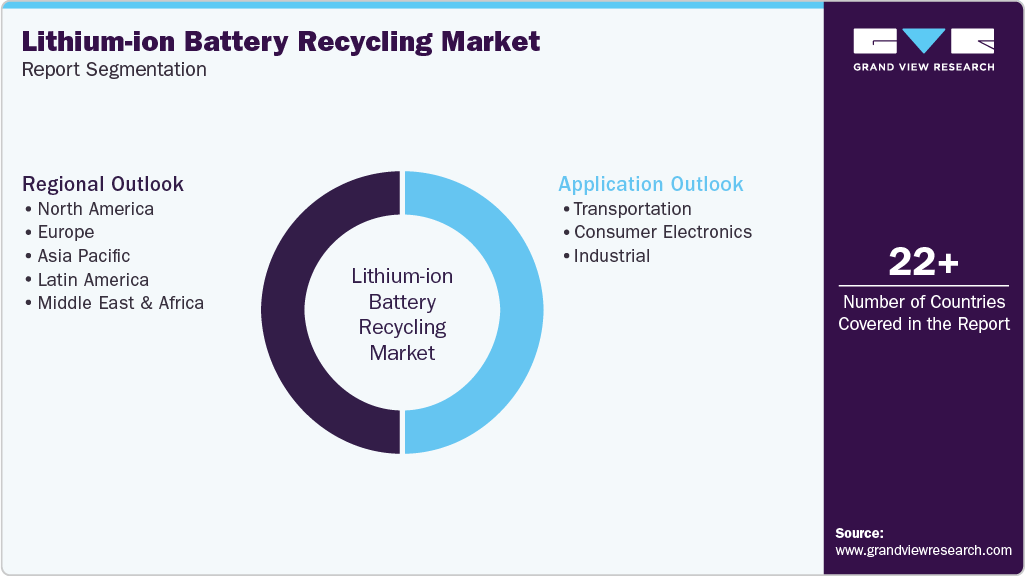
This report forecasts revenue growth at global, regional, and country levels and provides an analysis of the latest industry trends in each of the sub-segments from 2021 to 2033. For this study, Grand View Research has segmented the global lithium-ion battery recycling market report on the basis of application, and region:
 To learn more about this report, Download Free Sample Report
 -
Application Outlook (Revenue, USD Million, 2021 - 2033)
-
Transportation
-
Consumer Electronics
-
Industrial
-
-
Regional Outlook (Revenue, USD Million, 2021 - 2033)
-
North America
-
U.S.
-
Canada
-
Mexico
-
-
Europe
-
Germany
-
UK
-
Italy
-
Spain
-
Netherlands
-
Poland
-
-
Asia Pacific
-
China
-
Japan
-
India
-
South Korea
-
Australia
-
-
Latin America
-
Brazil
-
Argentina
-
-
Middle East & Africa
-
Saudi Arabia
-
UAE
-
South Africa
-
-
Frequently Asked Questions About This Report
The global lithium-ion battery recycling market size was valued at USD 287.3 million in 2025 and is estimated at USD 416.0 million for 2026.
The key factors driving the lithium-ion battery recycling market include the rapid growth of electric vehicles (EVs) and energy storage systems, which is increasing the volume of end-of-life lithium-ion batteries.
The global lithium-ion battery recycling market is expected to grow at a CAGR of 30.9% from 2026 to 2033, reaching USD 2,741.5 million.
Key players include Li-Cycle Corp., Redwood Materials, Inc., Umicore, Glencore, Ecobat, Cirba Solutions, American Battery Technology Company (ABTC), Fortum, Retriev Technologies, and GEM Co., Ltd., among others.
Asia Pacific dominated with a 44.1% revenue share in 2025.
The transportation segment led with a 70.8% revenue share in 2025, while transportation is the fastest-growing segment.
About the Author(s)
Power Generation & Storage Research Team
Energy & Power · Power Generation & StorageThis report was authored by the power generation & storage research team at Grand View Research - comprising two research analysts, one senior research analyst, and one industry expert - with specialized expertise in the power generation & storage segment of the energy & power industry. All findings are based on proprietary energy & power databases, executive interviews, and regulatory analysis, subject to internal peer review prior to publication.
Last Updated:
Speak to Analyst

Customize this report to your needs - add regions, segments, or data points, with 20% free customization.
Or view our licence options:


ISO 9001:2015 & 27001:2022 Certified
We are GDPR and CCPA compliant! Your transaction & personal information is safe and secure. For more details, please read our privacy policy.


