
- Home
- »
- Animal Health
- »
-
Livestock Health Monitoring Sensors Market Report 2025-2030GVR Report cover

Livestock Health Monitoring Sensors Market (2025 - 2033)
Size, Share & Trends Analysis Report By Animal, By Solution (Sensors, Software & Services), By Sector (Dairy, Meat), By Region, And Segment Forecasts
Market Size, 2024
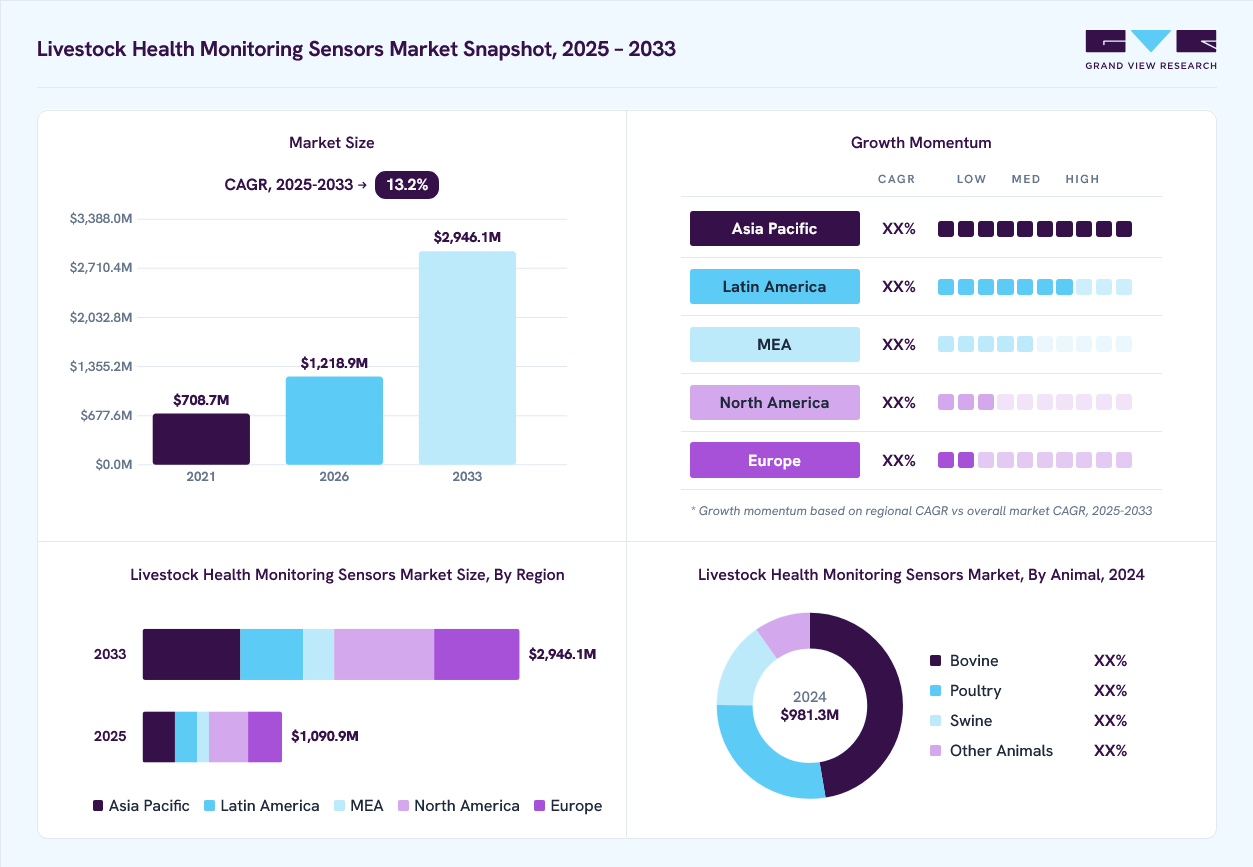
$981.3MMarket Estimate, 2026
$1,218.9MMarket Forecast, 2033
$2,946.1MCAGR, 2025–2033
13.2%Livestock Health Monitoring Sensors Market Summary
The global livestock health monitoring sensors market size was valued at USD 981.3 million in 2024 and is projected to grow from USD 1,218.9 million in 2026 to USD 2,946.1 million by 2033, at a CAGR of 13.2% from 2025 to 2033. North America dominated the market, accounting for a revenue share of 28.2% in 2024. Growth is propelled by the deployment of wearable sensors (collars, limb wearables) and connected platforms for early disease detection and fertility/behavior analytics, cloud-based analytics, and decision-support; as well as regulatory/welfare emphasis, and precision livestock programs across the U.S. and EU that encourage continuous monitoring and traceability.
 Source: Grand View Research, IR Documents, Primary Interviews, Paid DatabasesTo learn more about this report,
 Download Free Sample Report
 Key Market Trends & Insights
- The livestock health monitoring sensors industry in the U.S. accounted for the largest market revenue share in North America in 2024.
- By solution, the software & services segment led the market with the largest revenue share of 56.0% in 2024.
- By animal type, the bovine segment accounted for the largest market revenue share in 2024.
- Based on sector, the dairy segment accounted for the largest market revenue share in 2024.
Market Size & Forecast
- 2024 Market Size: USD 981.3 Million
- 2033 Projected Market Size: USD 2,946.1 Million
- CAGR (2025-2033): 13.2%
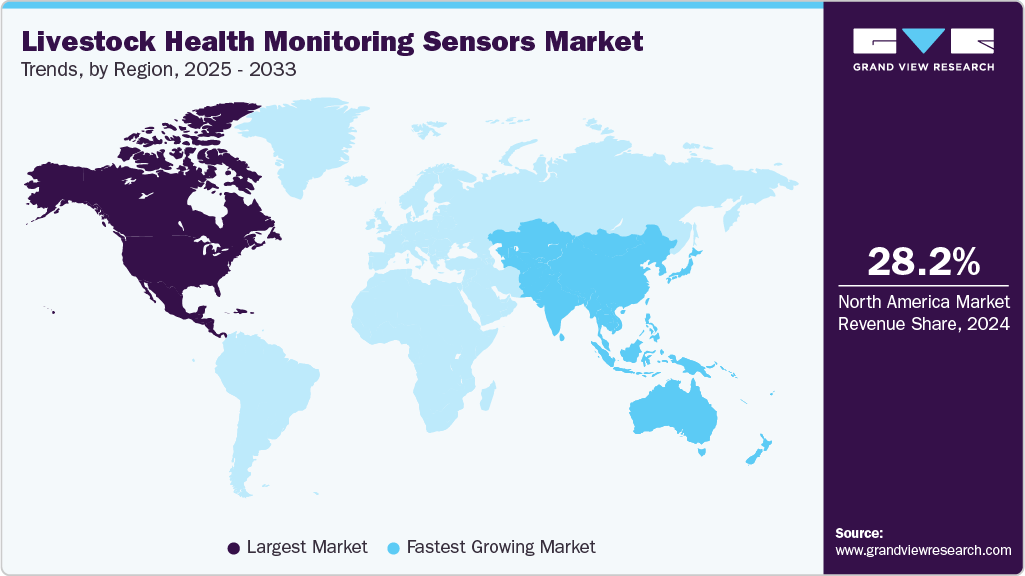
- North America: Largest market in 2024
- Asia Pacific: Fastest growing market
Three ways to get this report
Buy it, customize it, or ask a question.Ask an Analyst
Analyst response in 1 business day
- AccessReport author, directly
- Reply timeWithin 1 working day
- No sales callDirect answer only
- FormatEmail reply
- CostFree, no cost
Get the Full Report
What the study covers
- FormatsPDF · Excel · Dashboard
- Timeline2025–2033 annual, 2024 base
- Coverage20+ countries, 5 regions
- Companies10+ key players profiled
Customize the Report
20% free customization
- IncludeCountries, segments, points
- TailorTo your product definition
- ExtendDeeper competitor detail
- OrA fully bespoke study
- Turnaround5–10 working days
Recent policy and program changes include the EU’s Animal Health Law and the ADIS reporting framework, which strengthen surveillance and early detection mandates, catalyzing the adoption of on-farm sensors. In addition, U.S. federal programs and NIFA-backed precision animal production initiatives highlight health/movement/lameness monitoring as critical to productivity and welfare outcomes.The livestock health monitoring sensors industry has gained a huge momentum in 2025 as farms are proactively responding to rising herd sizes, more frequent disease events and increasing pressure on productivity. For instance, in May 2025, a project at the University of Minnesota utilized collars equipped with microphones and movement sensors to track eating and rumination in dairy cows, enabling more informed treatment decisions.
 To learn more about this report, Download Free Sample Report
 Furthermore, in March 2025, the Wall Street Journal reported that U.S. dairies using wearable sensors caught early signs of illness such as avian influenza‐related infection in cows, supporting faster intervention. In India, the Indian Institute of Information Technology, Allahabad, developed an AI-powered monitoring system in 2025 to detect diseases such as mastitis, lumpy skin disease, and ketosis using sensors and video analytics. Sensor providers are also expanding in February 2025, with Nedap Livestock Management launching a dedicated operations arm in New Zealand to serve 4.5 million dairy cows with collars and cloud software. As these developments indicate, the market is being driven by a combination of larger assets under monitoring, growing urgency for health alerts and welfare compliance, and more mature sensor-cloud ecosystems replacing manual tracking.
Research Study on AI-Powered Visual E-Monitoring System for Cattle Health
Category
Key Points
Purpose / Objective
The study introduces a real-time visual monitoring (“E-monitoring”) system designed to track cattle health using image and video analytics. Its goal is to enable early detection of health and behavioral issues, reducing reliance on manual inspection.
System Architecture / Components
The system consists of:
-
- Camera streaming module for continuous visual data capture in barns or fields.
- Farm-side application for data acquisition and initial processing.
- User-side (remote/cloud) application for analytics, alerts, and dashboard visualization.
- Analytics engine that applies image recognition, motion analysis, and health-indicator extraction.
Data & Analytics
Real-time camera feeds are analyzed to monitor behavioral and physiological parameters such as movement patterns, feeding frequency, posture, activity levels, and coat condition. The analytics engine processes visual data to infer potential health anomalies.
Deployment Context
Designed for cattle farms-particularly dairy and beef operations-where manual observation is difficult or inconsistent. The system supports herd management by detecting illness, lameness, stress, or injury earlier than traditional methods.
Key Benefits
-
- Enables continuous and automated monitoring of herds.
- Detects health issues early, improving animal welfare and reducing treatment costs.
- Enhances overall farm efficiency and decision-making through real-time health insights.
Challenges / Considerations
-
- Variability in lighting and environmental conditions can affect image accuracy.
- Differences in breed appearance, barn layout, and animal behavior require adaptive algorithms.
- Data management, connectivity, and on-farm bandwidth remain practical challenges.
- `System accuracy needs validation against verified health records.
Implementation Insights
Successful deployment depends on optimal camera placement, stable streaming infrastructure, and user-friendly dashboard design. The analytics engine must handle high-volume video streams efficiently and convert outputs into actionable alerts for farm operators.
Implications for Animal Health Market
Represents a major shift toward proactive and data-driven cattle health management. Such AI-based monitoring tools can integrate with existing livestock management platforms, supporting disease detection (e.g., lameness, mastitis, respiratory distress) and improving welfare compliance.
Future Directions / Recommendations
Further development may include scaling the system across larger herds, integrating thermal and motion sensors, refining algorithms for specific diseases, and conducting longitudinal validation to link early behavioral cues with actual health outcomes.
Source: Elsevier
Market Concentration & Characteristics
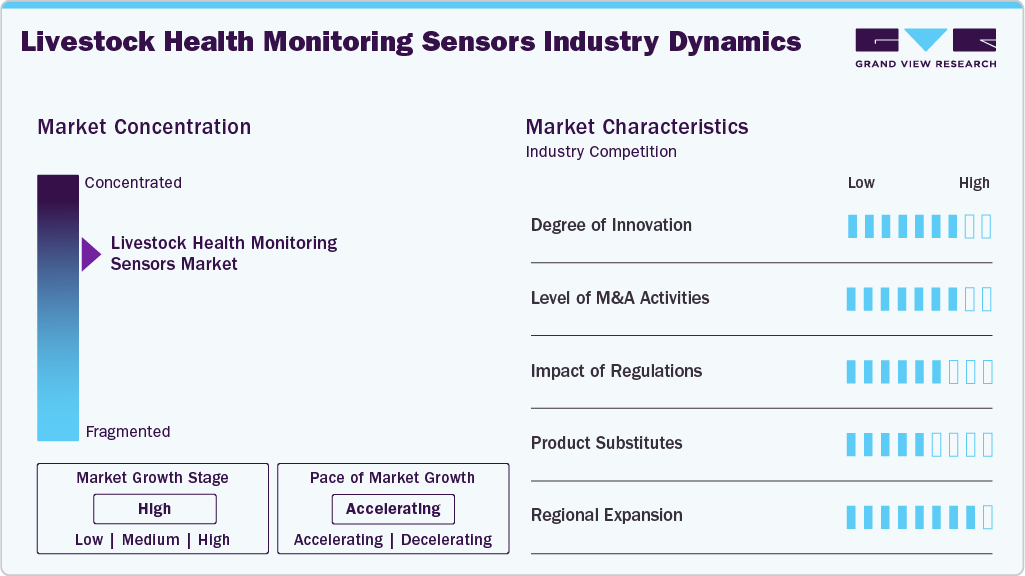
The livestock health monitoring sensors industry is of medium concentration, and it is characterized by an increasing number of device manufacturers, data analytics, software, and animal health companies migrating to precision livestock systems. The regional differences influence the sector structure. In developed markets, a handful of global players control a considerable share of the market because of well-established distribution networks, long-term partnerships with dairy and meat producers, and built-up technical expertise in integrated sensor and software systems. Conversely, the market in developing countries is more fragmented and consists of local hardware manufacturers, agritech startups, and farmers' cooperatives that are using sensors supported by public and private welfare programs.
The digital-native companies are expanding their operations by providing mobile-based herd management dashboards, subscription analytics services, and integrated health alerts through AI-enabled platforms. Although the main international vendors have attempted to establish universal standards for product pricing, connectivity, and customer support, the market has still adapted to local conditions. The pace of adoption, data usage models, and after-sales service ecosystems continue to be impacted by regional and cooperative initiatives.
 To learn more about this report, Download Free Sample Report
 The livestock health monitoring sensors industry is evolving rapidly through stronger integration of IoT, edge computing and artificial intelligence in animal-health management. Wearable collars, ear tags and limb sensors are increasingly used to track parameters such as temperature, activity and rumination, transmitting continuous data to cloud platforms for near-real-time insights. For example, the SenseHub Dairy system from MSD Animal Health supports behavior monitoring via ear-tag and collar devices, as well as mobile/cloud dashboards. The Tru‑Test Active Tag from Datamars offers collar or ear-tag deployment with health/heat detection and cloud-accessible insights. The degree of innovation remains high as companies integrate low-power networks (LPWAN), solar-powered relays, advanced analytics, and machine-learning models for earlier detection of health and fertility events.
Mergers and acquisitions specific to livestock health-monitoring sensors remain moderate, but the industry shows strong levels of partnership-driven integration. Major animal-health companies are investing in or forming strategic alliances with IoT device providers, analytics firms and agritech integrators in order to expand their precision-livestock portfolios. For example, MSD Animal Health has expanded its SenseHub ecosystem in multiple markets. Instead of focusing on headline M&A, the current trend leans toward joint ventures, platform integrations, and ecosystem collaborations that develop data networks, connectivity infrastructure, and service layers.
Animal health monitoring systems receive support from regulations which focus on animal welfare standards and tracking systems. The European Union requires farms to maintain continuous monitoring through its Animal Health Law (EU 2016/429) and Animal Disease Information System (ADIS) which includes electronic identification and digital disease reporting systems. The Farm to Fork Strategy, under the European Green Deal, highlights the use of digital tools for enhancing animal welfare and improving traceability. The Implementing Regulation (EU) 2024/2746 officially recognizes sensor- and camera-based monitoring systems for welfare oversight. The United States Department of Agriculture (USDA) maintains traceability and herd health data management systems, which enable connected monitoring platforms to operate effectively.
Manual observation together with periodic veterinary assessments and barn-level environmental monitoring systems function as alternative methods to individual animal wearables but they lack the detailed monitoring capabilities and quick response times of the latter. Small farmers together with budget-conscious consumers continue to choose these alternatives but they do not work well for larger herds or modern industrial farming operations. Farms now use integrated sensor systems to support veterinary health programs instead of replacing them because this approach allows for both preventive care and immediate diagnostic capabilities.
Market growth shows irregular patterns of development at a steady pace across different geographical regions. Asia Pacific leads the market expansion through its major dairy and poultry digital transformation efforts which focus on Indian and Chinese operations and Australian facilities. North America leads the market because it has developed a full system of sensor providers together with connected dairy infrastructure. The European market expansion depends on strict animal protection measures which include traceability systems that Nordic and Western European countries enforce. The Latin American and Middle Eastern markets are starting to adopt new agricultural methods because Brazil Saudi Arabia and the UAE have launched precision livestock programs. The pilot phase of connected livestock health monitoring solutions evolved into widespread adoption across major production areas during the year 2025.
Animal Insights
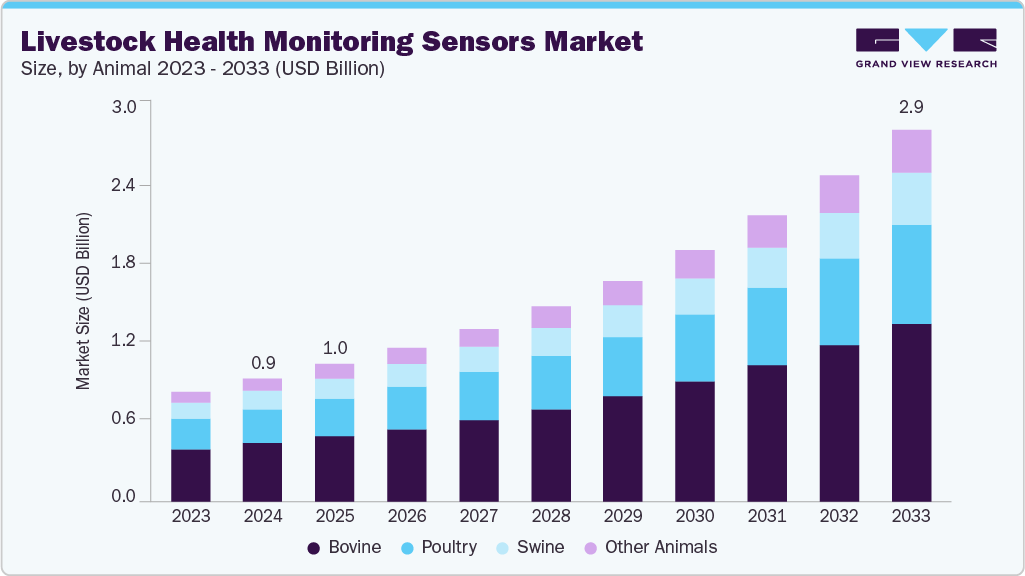
The bovine segment led the market with the largest revenue share of 47.1% in 2024. The primary application area of monitoring cattle encompasses both dairy and beef operations, with dairy and beef operations being the most prominent users, where cattle are the most valuable economically. Companies concentrate on elevating milk quality and productivity. In addition to implementing wearable health devices. In addition, commercial dairy operations in the United States, Europe, and certain regions of the Asia Pacific resort to multi-sensor collars and ear tags for monitoring rumination and fertility, as well as temperature and disease indicators. The programs for dairy digitalization in India, China, and Australia have been the major drivers of the adoption of sensor-based solutions in cattle farms.
The poultry segment is expected to record at the fastest CAGR during the forecast period. The escalating poultry production in the Asia Pacific and Latin America regions, respectively, puts an immense demand for suitable monitoring systems to meet this increasing demand. The industry utilizes barn-based environmental sensors and image-based health monitoring systems, as well as wearable tags for tracking flock movements, monitoring feeding behavior, and detecting diseases in real-time. Datasets from health management systems are of crucial importance to poultry producers, given the high infection rates of diseases such as avian influenza, which require them to observe tighter animal welfare and traceability standards.
Solution Insights
The software and services segment led the market with the largest revenue share of 56.0% in 2024 and is anticipated to grow at the fastest CAGR during the forecast period. The segment’s leadership is attributed to the widespread adoption of cloud-based herd management platforms, predictive analytics, and AI-enabled health monitoring systems. The modern dairy and meat industries rely on these solutions to gather real-time data and make disease predictions, as well as support informed decisions through their integrated dashboard systems. The cloud deployment system enables farmers to monitor multiple locations simultaneously, consolidating data from collars, limb wearables, and barn sensors into a single, centralized platform. Service-based revenue models, which include subscription analytics and remote diagnostics, have seen steady growth among commercial producers across North America and Europe, thus establishing software as the leading market share holder.
The sensors segment is projected to record at a significant CAGR during the forecast period. The implementation of advanced sensor technology, including collars, ear tags, and limb-mounted wearables, for animal behavior monitoring, heat stress detection, and tracking feeding patterns has led to rapid market growth. The combination of smaller sensor sizes with better battery performance and dual wireless capabilities through LPWAN and Bluetooth Low Energy (BLE) has resulted in sensors that deliver dependable performance at affordable prices.
Sector Insights
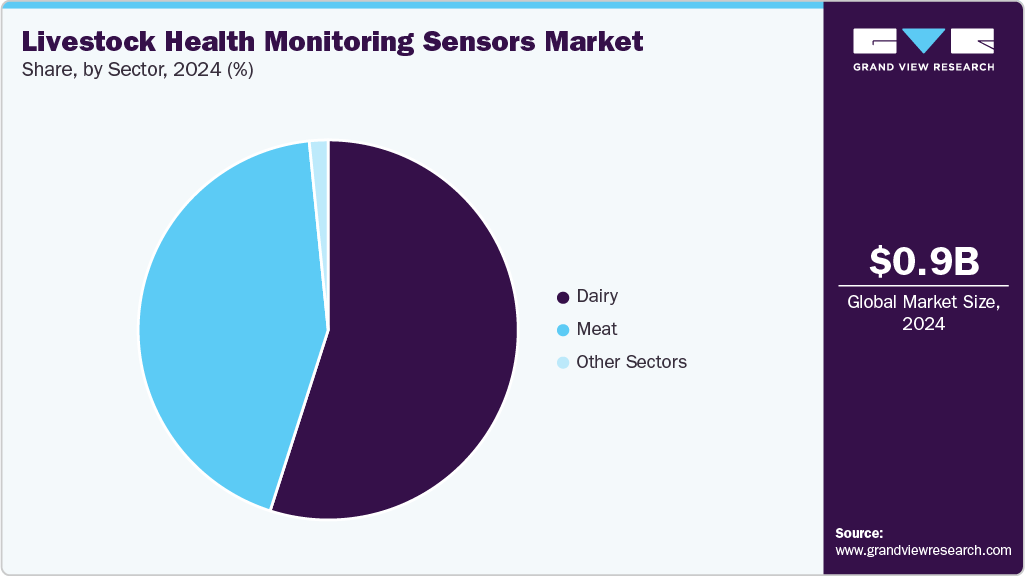
The dairy sector segment led the market with the largest revenue share of 55.0% in 2024. Dairy farms extensively use wearable sensors and data platforms to monitor rumination, fertility, temperature, and activity, boosting productivity and milk output. Large dairies in North America, Europe, and Oceania employ advanced collar and ear tag sensors, while smaller farms in Asia Pacific increasingly adopt cloud-based herd health management supported by government digital dairy programs. Automation in milking, feeding, and disease detection, driven by AI analytics and real-time dashboards, underpins this growth.
 To learn more about this report, Download Free Sample Report
 The meat segment is projected to grow at the fastest CAGR during the forecast period, driven by increased use of monitoring tech in beef, swine, and poultry farms. Feedlots and barns use IoT tracking to monitor behavior, weight gain, and health symptoms. Factors such as welfare compliance, traceability, and food safety, especially in high-value export markets like the U.S., Brazil, and EU, foster adoption. Rising animal health issues like African Swine Fever and heat stress further boost demand for connected sensor technologies.
Theother segment, which includes small ruminants (sheep and goats), equine, camelids, and breeding or research herds, had a smaller share of the revenue in 2024 but is growing gradually. These types of animal care focus on reproductive health, welfare monitoring, and traceability for livestock-giving no milk or meat from non-dairy, non-meat livestock categories. In places like the Middle East, Australia, and some parts of Africa, health monitoring of camels and goats is becoming a significant component of food-security and productivity initiatives. Due to the declining prices of sensors and the expanding connectivity in remote areas, the use of livestock monitoring systems in these sectors is expected to increase significantly by 2033.
Regional Insights
North America dominated the global livestock health monitoring sensors market with the largest revenue share of 28.18% in 2024, driven by large-scale dairy and meat production systems, early technology adoption, and the presence of leading manufacturers such as Allflex (MSD Animal Health), Zoetis, and Datamars. The region benefits from mature digital infrastructure, high awareness of animal welfare standards, and strong regulatory oversight supporting precision livestock management.
 To learn more about this report, Download Free Sample Report
 U.S. Livestock Health Monitoring Sensors Market Trends
The livestock health monitoring sensors market in the U.S. accounted for the largest market revenue share in North America in 2024, primarily due to the extensive use of connected monitoring systems in dairy, beef, and poultry operations. In 2025, smart collars and IoT-based sensors gained even more popularity as dairy producers adopted real-time monitoring tools for detecting diseases and stress situations. In fact, large-scale U.S. farms have successfully incorporated sensor-based health data to pinpoint the onset of respiratory and heat stress, thereby decreasing mortality and stabilizing yields. Developments in 2025, such as the extension of SenseHub and Smartbow platforms, have contributed to the strengthening of the domestic supply of AI-powered livestock monitoring systems. The move towards digital compliance under the USDA traceability and animal health programs is also facilitating the implementation of real-time health monitoring solutions at a faster rate.
The Canada livestock health-monitoring sensors marketis growing due to the development of individual-animal wearable sensors, which have become increasingly popular in dairy herds. This popularity stems from numerous studies that have demonstrated the widespread use of IoT-based monitoring of cow rumination, fertility, and health indicators. Nevertheless, there are still some obstacles: limitations in rural connectivity, doubts about the return on investment, and the targeted and uneven policy focus on digital agriculture. Ontario and Alberta provincial incentive programs and technology funding are gradually getting on board with sensor-based farm systems, thus creating a positive environment for the further expansion of health monitoring solutions.
Europe Livestock Health Monitoring Sensors Market Trends
The livestock health monitoring sensors market in Europe are increasingly governed by regulations that prioritize animal health, welfare, and traceability, especially Regulation (EU) 2016/429 (the 'Animal Health Law') since April 2021. The regulation mandates early detection of transmissible diseases and effective notification systems. In addition, the UK’s Farming and Countryside Programme (2024-25) indicated that expenditure on Animal Health and Welfare initiatives increased from £56 million in 2023-24 to £83 million in 2024-25, reflecting government backing for advances in livestock monitoring.
The UK livestock health monitoring sensors market is anticipated to grow at a significant CAGR during the forecast period. The UK’s national strategy for dairy cattle welfare highlights the growing use of automated detection and welfare-monitoring technologies, citing the "GB Dairy Cow Lameness Manifesto' launched in January 2025, and the expansion of accredited mobility-scorer networks as key progress. Additionally, the UK's Farming and Countryside Programme (2024-25) increased the Animal Health and Welfare budget from £56 million in 2023-24 to £83 million in 2024-25, showing government support for livestock monitoring innovations.
The Germany livestock health monitoring sensors market is rapidly changing. The countrys going to great lengths to implement digital technologies in animal husbandry as well. A 2024 survey by Deutsche Landwirtschafts‑Gesellschaft (DLG) and Bitkom revealed that German farms are progressively engaging smart technologies such as sensors, IoT, and decision-support platforms, which are in line with trends in precision livestock farming. Germany’s rigorous emphasis on traceability, sustainability, and animal welfare through policies also acts as a driving force for sensor utilization in dairy, meat, and mixed-livestock operations.
Asia Pacific Livestock Health Monitoring Sensors Market Trends
The livestock health monitoring sensors market in Asia Pacific is expected to grow at the fastest CAGR during the forecast period, driven by the large dairy and poultry industries, rapid digitization processes, and government programs that encourage on-farm telemetry and traceability. To date, the region has seen various deployments, such as the extension of calf and heifer monitoring and the use of cloud analytics, which empower early-warning and fertility management in dairies across the region. The academic and industry publications from 2024 to 2025 reflect the rapid uptake of sensors for real-time rumination, temperature, and activity tracking as precision livestock farming spreads in the area.
The China livestock health monitoring sensors market is enhancing digital livestock solutions in tandem with other ag-risk and productivity policies. The total value of agricultural insurance premiums was RMB 152.1 billion in 2024, and in 2025, policymakers were advocating for the development of more parametric and data infrastructure that will facilitate sensor-linked monitoring and verification workflows. These measures, coupled with rural digitization, are making remote health monitoring and loss-assessment tools more accessible to swine, poultry, and ruminant operations.
The livestock health monitoring sensors market in India is growing through smart-dairy pilots and public tech transfers focused on 24×7 herd monitoring. In 2025, IIIT-Allahabad unveiled a plan for an AI-based dairy monitoring system that would use video analytics and IoT collars for the early detection of mastitis, lumpy skin disease, and ketosis. On the other hand, MeitY announced the technology transfer of an electronics- and IT-based dairy solution for cattle health monitoring while vendors kept localizing cloud platforms for rumination and behavior monitoring. These activities are raising the uptake of cooperative and private dairies.
Latin America Livestock Health Monitoring Sensors Market Trends
The livestock health monitoring sensors market in Latin America shows steady adoption of livestock insurance as commercial animal farming intensifies, with demand shaped by weather shocks, disease risks, and improving ag-finance structures. Public subsidy programs and export-oriented beef and poultry value chains are supporting uptake, though penetration remains modest and uneven across countries.
The Brazil livestock health monitoring sensors market leads regional growth as large-scale cattle and poultry producers seek protection. Brazil's agricultural sector benefits from the federal Programa de Subvenção ao Prêmio do Seguro Rural (PSR), which helps subsidize insurance premiums for agriculture, livestock, forestry, and aquaculture. The PSR typically covers 30-35% of these premiums and is reaffirmed in the 2024-25 policy documents and budgets. This ensures continued coverage for cattle and poultry producers and ongoing underwriting in regions impacted by climate change. As digital compliance and climate risk models advance, sensor-based herd data is expected to become the primary source for livestock insurance calculations, enrollment, and loss verification.
Middle East & Africa Livestock Health Monitoring Sensors Market Trends
The livestock health monitoring sensors market is still emerging. MEA remains a developing region with rapid growth, driven mainly by drought effects, infectious disease risks, and government food security initiatives. Policy efforts, such as new index products and vaccine campaigns, aim to mitigate systemic shocks and stabilize livestock income. Niche LMIC countries like Nigeria is coming up together with the national climate-risk and insurance-related initiatives. On 24 July 2025, Africa Re unveiled a livestock insurance program based on an index that utilizes satellite-derived vegetation indices (NDVI) to automatically trigger drought compensation for pastoralists, thus covering around 20,000 farmers. Such an undertaking is therefore encouraging the use of digital livestock tracking and health monitoring devices that facilitate data confirmation and provide an instant overview of the herd's condition.
The market in the Middle East & Africa is gradually developing, supported by expanding livestock production systems, government food-security programs, and heightened disease-risk awareness. Markets such as South Africa are seeing demand accelerate amid recurring animal-health crises notably, on 6 June 2025, the government announced procurement of over 900,000 vaccines to contain a Foot-and-Mouth Disease outbreak across multiple provinces, reinforcing the need for disease-loss protection and continuity insurance. East African economies are scaling farmer-protection frameworks as well - for example, on 21 October 2025, Rwanda's “Tekana Urishingiwe Muhinzi-Mworozi” scheme continued to gain adoption, offering subsidized agriculture insurance including livestock coverage and receiving positive feedback from pastoral communities for cushioning losses.
The UAE livestock health monitoring sensors market is expanding steadily, supported by rising investment in commercial dairy, poultry, and camel farming, along with national food-security initiatives. As South Africa's livestock sector enhances its disease-surveillance and biosecurity efforts, the market for livestock health monitoring sensors is gradually expanding. Following the FMD outbreak in June 2025, the government increased investment in herd monitoring and veterinary infrastructure, creating opportunities for digital health and sensor-based systems that enable early detection and welfare tracking.
Key Livestock Health Monitoring Sensors Company Insights
The livestock health monitoring sensors industry is gradually expanding as top industry players enhance their livestock management offerings through innovative solutions and strategic partnerships. Merck & Co., Inc. (Allflex) remains the global leader, expanding its SenseHub ecosystem, which monitored over 2 million cows worldwide in 2025, and launching SenseHub Cow Calf for live monitoring in beef farms.
GEA Group Aktiengesellschaft strengthened its precision livestock solutions by acquiring CattleEye in 2025, integrating AI-based lameness detection into its dairy automation systems. Zoetis continues to diversify in connected health tech by partnering with CowManager to enable the integration of genomics, behavior, and sensor-based herd analytics.
Lely and BouMatic are at the forefront with automation-driven solutions that combine milking, feeding, and health monitoring on a single digital platform. Together, these companies are driving the global shift towards AI-powered, fully integrated livestock monitoring systems, leading to better animal health, welfare, and farm productivity.
Key Livestock Health Monitoring Sensors Companies:
The following are the leading companies in the livestock health monitoring sensors market. These companies collectively hold the largest market share and dictate industry trends.
- Affimilk Ltd.
- BouMatic
- Merck & Co., Inc. (Allflex)
- Zoetis
- Lely
- Moocall
- GEA Group Aktiengesellschaft
- Fullwood JOZ
- Dairymaster
- Fancom BV
- Nysbys
- PsiBorg Technologies Pvt. Ltd
- Boehringer Ingelheim
- Digitanimal
- Stellapps
- Nofence Grazing Technology
Recent Developments
-
In 2025, Merck Animal Health (Allflex) celebrated surpassing 2 million cows monitored globally through its SenseHub platform and launched SenseHub Cow Calf, extending advanced multi-sensor technology into beef operations for early detection of heat stress, fertility, and metabolic disorders.
-
In 2025, GEA Group Aktiengesellschaft acquired CattleEye, a UK-based vision analytics firm, integrating AI-driven lameness detection into its dairy automation systems to enhance precision-livestock and welfare management capabilities.
-
In 2025, Zoetis expanded its connected-animal-health portfolio through its collaboration with CowManager, integrating genomic data and behavioral analytics with wearable sensors to improve herd-level decision support and predictive health modeling.
Livestock Health Monitoring Sensors Market Report Scope
Report Attribute
Details
Market size in 2024
USD 981.3 million
Estimated market size in 2026
USD 1,218.9 million
Projected market size by 2033
USD 2,946.1 million
Growth rate
CAGR of 13.2% from 2025 to 2033
Base year for estimation
2024
Historical data
2021 - 2023
Forecast period
2025 - 2033
Quantitative units
Revenue in USD million/billion and CAGR from 2025 to 2033
Report coverage
Revenue forecast, company ranking, competitive landscape, growth factors, and trends
Solution, animal, sector, region
Regional scope
North America; Europe; Asia Pacific; Latin America; MEA
Country scope
U.S.; Canada; Mexico; UK; Germany; France; Italy; Spain; Denmark; Sweden; Norway; Japan; China; India; Thailand; South Korea; Australia; Brazil; Argentina; South Africa; UAE; Saudi Arabia; Kuwait; Qatar; Oman
Key companies profiled
Affimilk Ltd.; BouMatic; Merck & Co., Inc. (Allflex); Zoetis; Lely; Moocall; GEA Group Aktiengesellschaft; Fullwood JOZ; Dairymaster; Fancom BV; Nysbys; PsiBorg Technologies Pvt. Ltd; Boehringer Ingelheim; Digitanimal; Stellapps; Nofence Grazing Technology
Customization scope
Free report customization (equivalent to 8 analysts working days) with purchase. Addition or alteration to country, regional & segment scope.
Pricing and purchase options
Avail customized purchase options to meet your exact research needs. Explore purchase options
Global Livestock Health Monitoring Sensors Market Report Segmentation
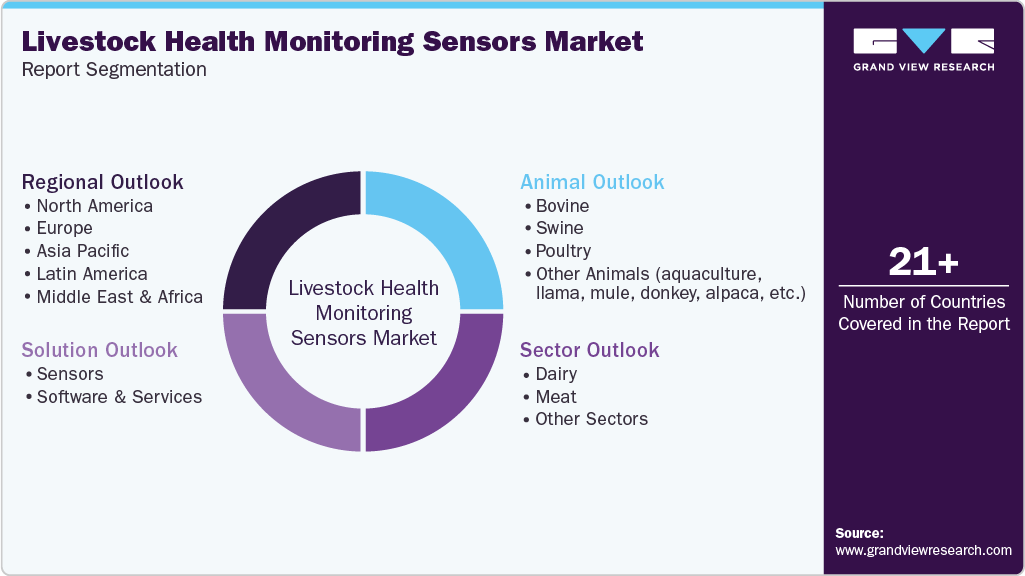
This report forecasts revenue growth at global, regional, and country levels and provides an analysis of the latest industry trends in each of the sub-segments from 2021 to 2033. For this study, Grand View Research has segmented the global livestock health monitoring sensors market report based on animal, solution, sector, and region:
 To learn more about this report, Download Free Sample Report
 -
Animal Outlook (Revenue, USD Million, 2021 - 2033)
-
Bovine
-
Swine
-
Poultry
-
Other Animals (aquaculture, llama, mule, donkey, alpaca, etc.)
-
-
Solution Outlook (Revenue, USD Million, 2021 - 2033)
-
Sensors
-
Collars
-
Limb Wearables
-
-
Software & Services
-
On-Premise
-
Cloud
-
-
-
Sector Outlook (Revenue, USD Million, 2021 - 2033)
-
Dairy
-
Meat
-
Other Sectors
-
-
Region Outlook (Revenue, USD Million, 2021 - 2033)
-
North America
-
U.S.
-
Canada
-
Mexico
-
-
Europe
-
UK
-
Germany
-
France
-
Italy
-
Spain
-
Denmark
-
Sweden
-
Norway
-
-
Asia Pacific
-
Japan
-
China
-
India
-
Australia
-
Thailand
-
South Korea
-
-
Latin America
-
Brazil
-
Argentina
-
-
Middle East & Africa
-
South Africa
-
UAE
-
Saudi Arabia
-
Kuwait
-
Qatar
-
Oman
-
-
Frequently Asked Questions About This Report
The global livestock health monitoring sensors market size was valued at USD 981.3 million in 2024 and is estimated at USD 1,218.9 million for 2026.
The global livestock health monitoring sensors market is expected to grow at a CAGR of 13.2% from 2025 to 2030, reaching USD 2,946.1 million by 2030.
North America dominated with a 28.2% revenue share in 2024.
Key players include Affimilk Ltd.; BouMatic; Merck & Co., Inc. (Allflex); Zoetis; Lely; Moocall; GEA Group Aktiengesellschaft; Fullwood JOZ; Dairymaster; Fancom BV; Nysbys; PsiBorg Technologies Pvt. Ltd; Boehringer Ingelheim; Digitanimal; Stellapps; Nofence Grazing Technology
Key factors include deployment of wearable sensors (collars, limb wearables) and connected platforms for early disease detection and fertility/behavior analytics, cloud-based analytics, and decision-support; as well as regulatory/welfare emphasis, and precision livestock programs across the U.S. and EU that encourage continuous monitoring and traceability.
About the Author(s)
Animal Health Research Team
Healthcare · Animal HealthThis report was authored by the animal health research team at Grand View Research - comprising two research analysts, one senior research analyst, and one industry expert - with specialized expertise in the animal health segment of the healthcare industry. All findings are based on proprietary healthcare databases, executive interviews, and regulatory analysis, subject to internal peer review prior to publication.
Last Updated:
Speak to Analyst

Customize this report to your needs - add regions, segments, or data points, with 20% free customization.
Or view our licence options:


ISO 9001:2015 & 27001:2022 Certified
We are GDPR and CCPA compliant! Your transaction & personal information is safe and secure. For more details, please read our privacy policy.


