
- Home
- »
- Advanced Interior Materials
- »
-
Low Alloy Steel Market Size And Share Report, 2026-2033GVR Report cover

Low Alloy Steel Market (2026 - 2033)
Size, Share & Trends Analysis Report By Product (High-strength Low Alloy Steel, Quenched & Tempered Steel), By End-use (Automotive, Energy & Power), By Region, And Segment Forecasts
Market Size, 2025
$53.3BMarket Estimate, 2026
$54.9BMarket Forecast, 2033
$87.2BCAGR, 2026–2033
6.8%Low Alloy Steel Market Summary
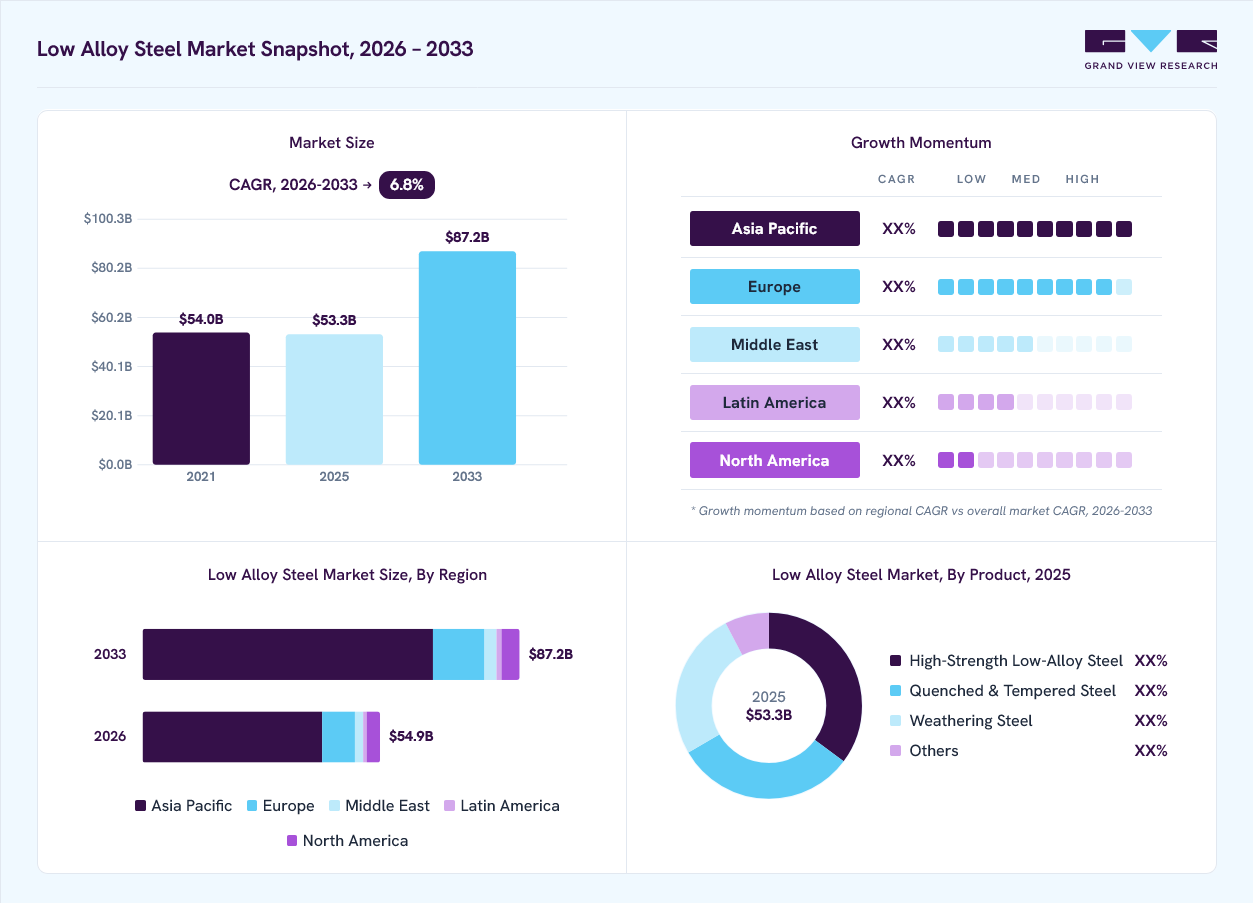
The global low alloy steel market size was valued at USD 53.3 billion in 2025 and is projected to grow from USD 54.9 billion in 2026 to USD 87.2 billion by 2033, growing at a CAGR of 6.8% from 2026 to 2033. Asia Pacific dominated the market, accounting for a revenue share of 75.3% in 2025. As urbanization accelerates globally, the need for robust, durable, and cost-effective materials increases.
 Source: Grand View Research, IR Documents, Primary Interviews, Paid DatabasesTo learn more about this report,
 Download Free Sample Report
Key Market Trends & Insights
- By product: High-strength low-alloy steel segment led the market with the largest revenue share of 35.1% in 2025.
- By end use: Automotive segment led the market with the largest revenue share of 33.8% in 2025.
Regional Highlights
- Largest regional market: Asia Pacific (75.3% revenue share, 2025)
- By country: China held the largest market share in 2025.
Market Size & Forecast
- Market size in 2025: USD 53.3 Billion
- Estimated market size in 2026: USD 54.9 Billion
- Projected market size by 2033: USD 87.2 Billion
- CAGR (2026-2033): 6.8%
Prism AI by Grand View Research Free to tryAsk a question about the low alloy steel marketTry asking✓Every figure cited from GVR research Prefer the report? Download free sample →Low alloy steels, characterized by enhanced strength, toughness, and corrosion resistance, are increasingly preferred for construction applications such as bridges, high-rise buildings, and industrial structures, making them a popular choice for engineers and architects. Low alloy steels are designed to enhance strength, toughness, and durability, making them suitable for demanding applications in various industries. These properties allow to produce lighter and more efficient structures without compromising safety or performance. As industries increasingly seek materials that can withstand extreme conditions while maintaining structural integrity, the demand for low alloy steel continues to rise.
 To learn more about this report, Download Free Sample Report
Governments and private sectors invest heavily in construction projects such as bridges, highways, and buildings to support urbanization and economic growth. For instance, in October 2024, The Biden-Harris Administration announced a significant investment of nearly USD 635 million for 22 bridge projects across the U.S., funded through the Bipartisan Infrastructure Law. This initiative aims to build, repair, and modernize crucial bridges in rural and urban areas from Maine to Alaska. Low alloy steel’s high strength-to-weight ratio makes it an ideal choice for these applications, as it allows engineers to design robust and lightweight structures.
The automotive & aerospace sectors are major consumers of low alloy steel due to their need for lightweight yet strong materials that enhance fuel efficiency and performance. In automotive manufacturing, there is a growing emphasis on reducing vehicle weight to meet stringent emissions regulations and improve fuel economy. Low alloy steels provide an excellent solution by allowing manufacturers to produce components that are both lightweight and strong enough to ensure safety. Similarly, in aerospace applications, low alloy steel’s ability to maintain mechanical properties under high-stress conditions makes it a preferred material for critical components.
Low alloy steels are widely used in the production of pipelines, pressure vessels, and drilling equipment due to their excellent resistance to corrosion and high strength at both high and low temperatures. As oil & gas exploration extends into more challenging environments, such as deep-water drilling and harsh climates, the demand for specialized materials like low alloy steel continues to rise. The increasing investment in energy infrastructure across emerging markets further supports this trend.
Market Dynamics
The growth of the low alloy steel market is primarily driven by increasing demand from the automotive, construction, energy, and heavy machinery industries, where high strength, durability, and cost efficiency are critical. Compared with conventional carbon steel, low alloy steel offers superior mechanical properties, including enhanced tensile strength, wear resistance, and corrosion resistance, while maintaining good weldability and formability. These characteristics make it an ideal material for structural components, bridges, pipelines, industrial equipment, and vehicle chassis that require long service life and reduced maintenance. Growing investments in transportation infrastructure, commercial buildings, and industrial facilities across developing economies continue to accelerate the adoption of low alloy steel in structural applications.
The rapid expansion of infrastructure and construction activities in both developed and emerging economies is a major driver of demand for low-alloy steel. Governments are increasing investments in transportation networks, urban development, industrial parks, bridges, railways, airports, and commercial buildings to support economic growth and urbanization. Low-alloy steel is widely used in these projects because it provides higher strength, improved toughness, and better corrosion resistance than conventional carbon steel, enabling structures to withstand heavy loads and harsh environmental conditions while extending their service life.
The growing focus on sustainable and resilient infrastructure is further accelerating the adoption of low-alloy steel in the construction sector. Engineers and contractors increasingly prefer high-strength materials that reduce overall structural weight while maintaining structural integrity and minimizing maintenance requirements. In addition, the expansion of industrial facilities, energy infrastructure, and smart city projects across regions such as the Asia Pacific, the Middle East, and North America continues to create strong demand for low-alloy steel, supporting long-term market growth.
Volatility in raw material prices remains a significant restraint on the low-alloy steel market, as the production of these steels depends on alloying elements such as chromium, nickel, molybdenum, vanadium, and manganese, whose prices are influenced by global mining output, geopolitical developments, energy costs, and supply chain disruptions. Frequent fluctuations in the cost of these materials increase manufacturing expenses and create uncertainty for steel producers, making it difficult to maintain stable pricing and profit margins. This cost instability can also discourage end-use industries from undertaking long-term procurement commitments, particularly during periods of economic uncertainty, thereby limiting the overall growth of the low-alloy steel market.
Rising investments in renewable energy infrastructure present a significant growth opportunity for the low alloy steel market, as these projects require durable, high strength, and corrosion resistant materials for long term operation. Low alloy steel is extensively used in wind turbine towers, transmission structures, hydroelectric facilities, solar mounting systems, and power generation equipment because of its excellent mechanical properties and ability to withstand demanding environmental conditions. With governments and private organizations increasing investments in clean energy projects to achieve decarbonization goals and enhance energy security, demand for low alloy steel is expected to grow steadily, creating new opportunities for manufacturers to develop specialized grades for renewable energy applications.
Analyst Perspective
The low alloy steel market is well-positioned for sustained growth, driven by rising demand from the automotive, construction, energy, and heavy machinery sectors, where high strength, durability, and corrosion resistance are essential. The increasing development of transportation infrastructure, industrial facilities, renewable energy projects, and electric vehicles is accelerating the adoption of high-strength low-alloy, quenched and tempered, and weathering steel grades that offer superior mechanical performance with reduced maintenance requirements.
Product Insights
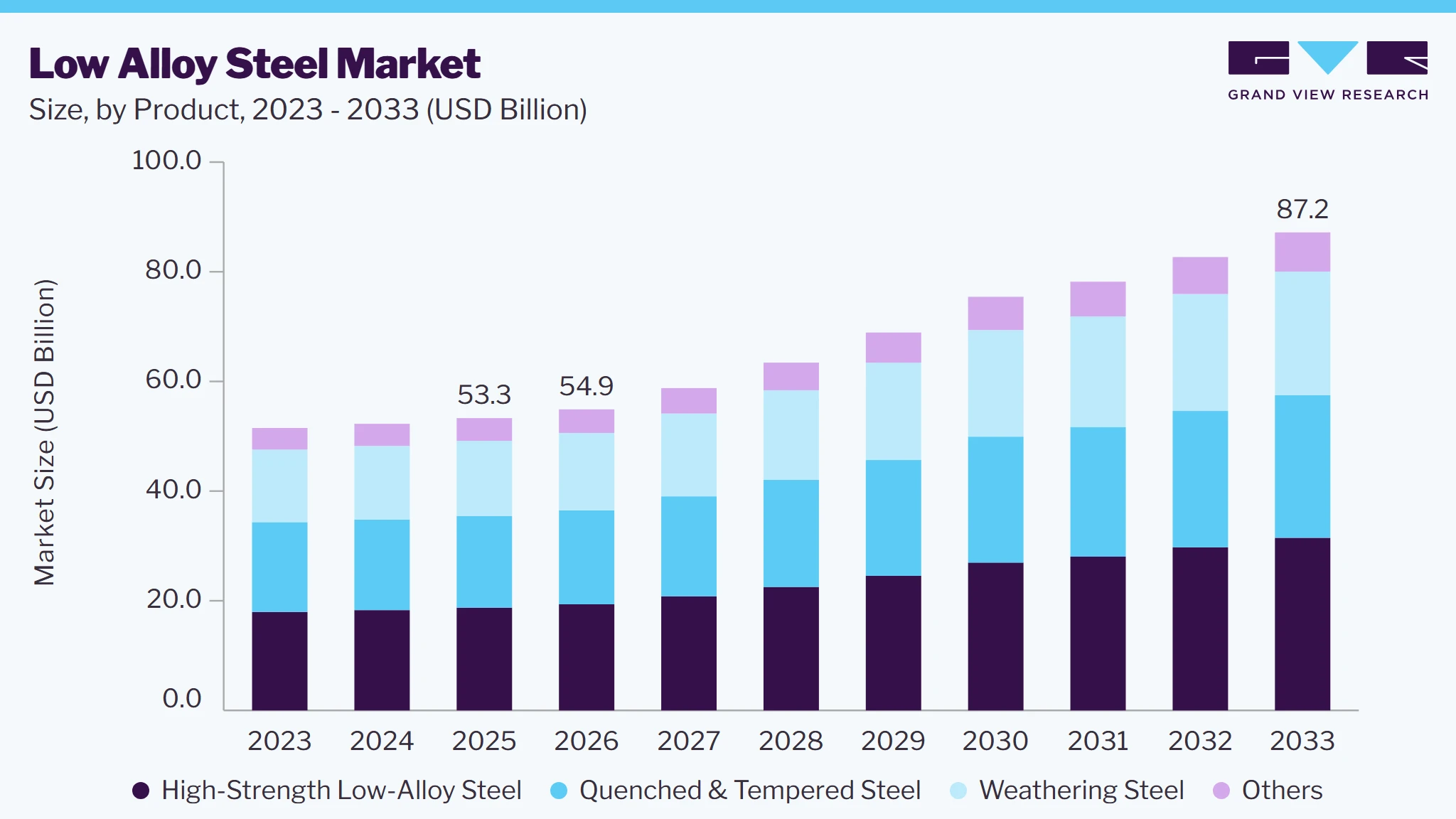
Based on product, high-strength low-alloy steel segment led the market with the largest revenue share of 35.1% in 2025. High-strength low alloy (HSLA) steel has a small number of alloying elements such as manganese, nickel, and copper, imparting strength and durability while maintaining excellent weldability and formability. It offers improved strength and performance, and typically costs less than other high-alloy steel, such as stainless steel. The affordability and its superior mechanical properties makes it an attractive alternative in applications where cost optimization is critical.
 To learn more about this report, Download Free Sample Report
Quenched & tempered (Q&T) steel is anticipated to grow significantly over the forecast period. Q&T steel is specifically engineered to have superior mechanical properties, such as higher tensile strength, toughness, and wear resistance. These characteristics make it an ideal material for components exposed to high stress, such as structural beams, gearboxes, and mining equipment, thereby accelerating its usage in industries that require durable and reliable materials.
End Use Insights
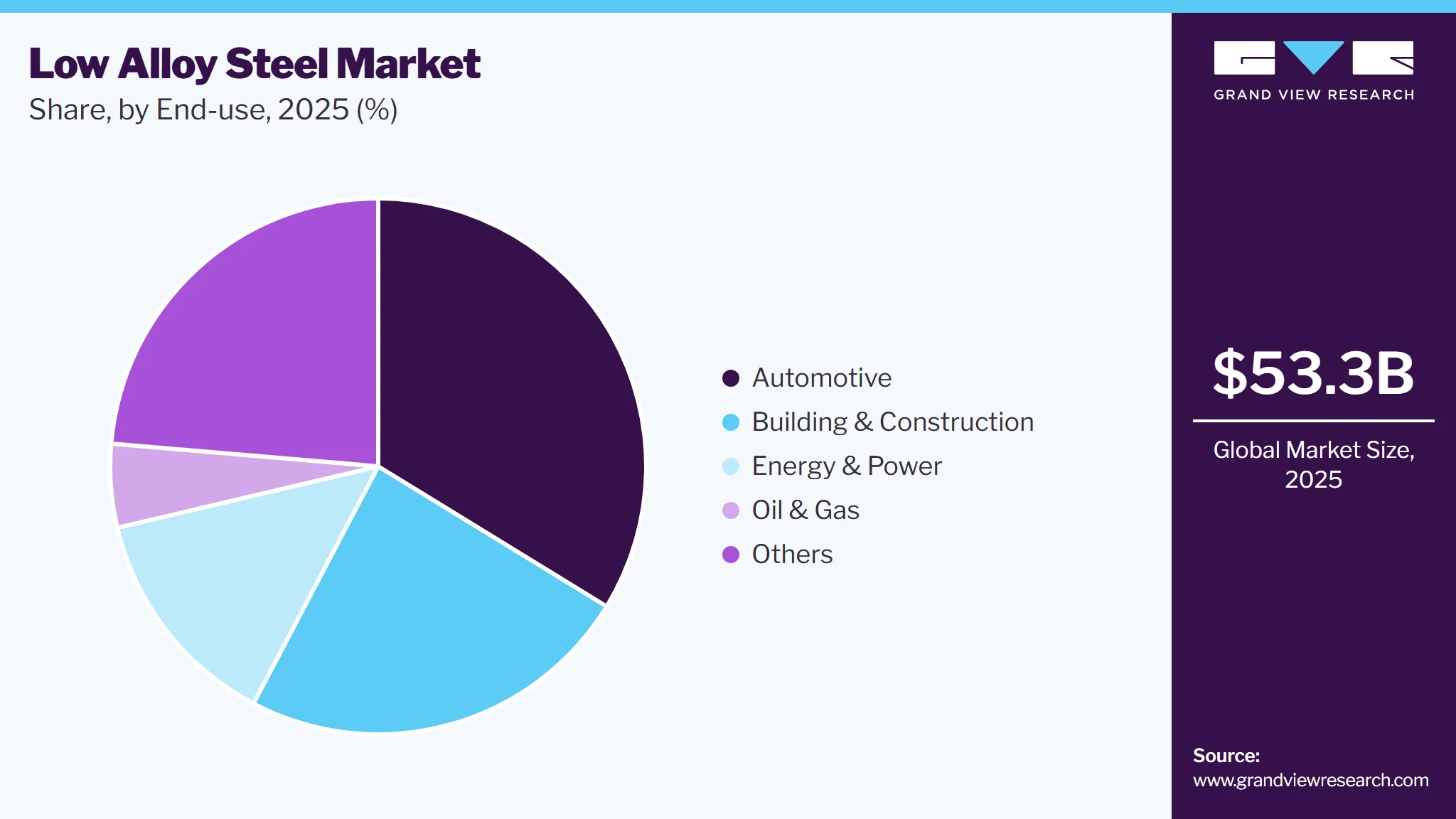
Based on end use, automotive segment led the market with the largest revenue share of 33.8% in 2025. The increasing demand for fuel-efficient and lightweight vehicles has driven automakers to use low alloy steel to produce various vehicle components. This demand is further heightened by stricter emission norms and government regulations that encourage manufacturers to produce eco-friendly vehicles, thus enhancing the appeal of low alloy steel.
Energy & power is anticipated to register the fastest CAGR over the forecast period. The expansion of renewable energy sources, such as wind and solar power, has increased the demand for energy infrastructure, including power plants, turbines, and transmission systems. The growing focus on sustainable and efficient energy solutions further propels the demand for such materials in energy and power applications.
Regional Insights
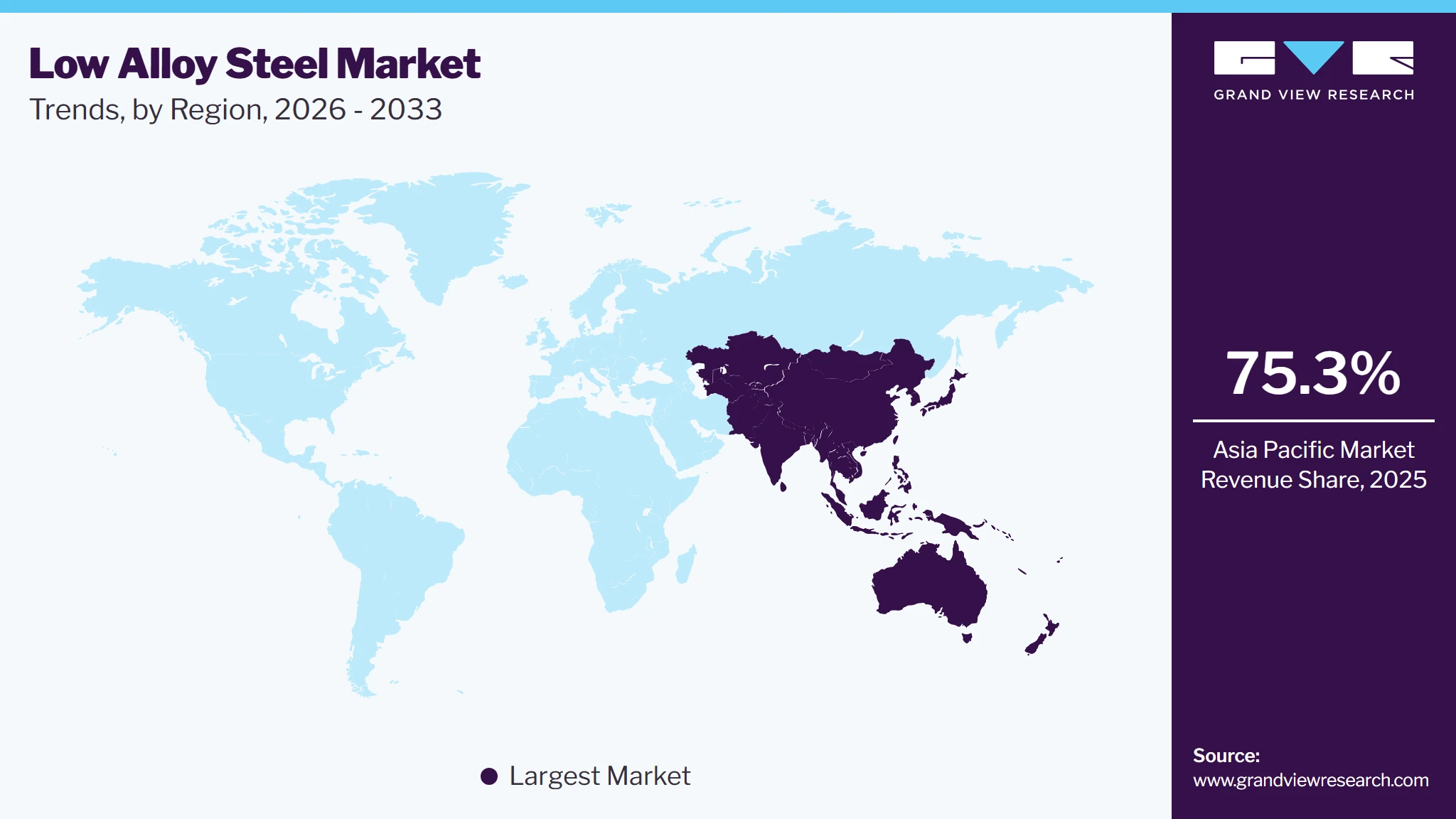
Asia Pacific dominated the low alloy steel market with the largest revenue share of 75.3% in 2025. The low alloy steel market in the China held the largest share in the Asia Pacific region in 2025. The growth of the low alloy steel industry in Asia Pacific is largely driven by economic expansion, particularly in countries such as China, India, and Southeast Asian nations. The demand for low alloy steel, used in various applications, including construction, automotive, and machinery, has surged. This is largely due to the increasing need for durable and cost-effective materials to meet the growing infrastructure and industrial requirements.
 To learn more about this report, Download Free Sample Report
North America Low Alloy Steel Market Trends
North America low alloy steel industry is anticipated to grow significantly over the forecast period. In the U.S. and Canada, major government initiatives and public-private partnerships are focused on upgrading roads, bridges, and utilities. Low alloy steel is a cost-effective material that can withstand the harsh environmental conditions typical of these structures.
U.S. Low Alloy Steel Market Trends
The U.S. government’s focus on infrastructure development, particularly under initiatives such as the Bipartisan Infrastructure Law, has fueled the need for stronger and more resilient materials, further increasing the consumption of low alloy steel in construction projects in the country. Furthermore, the shale oil boom and the expansion of offshore oil exploration in the U.S. have created substantial demand for low alloy steels for these critical applications.
Europe Low Alloy Steel Market Trends
The European Union has invested in large-scale infrastructure renewal programs to modernize transportation systems, including highways, bridges, and railways. For instance, in March 2024, the European Investment Bank announced a significant investment of USD 127 million to construct a new bridge in Bizerte, Tunisia, which is anticipated to propel the demand for low alloy steel.
Central & South America Low Alloy Steel Market Trends
The energy sector, particularly oil, gas, and renewable energy, contributes to the growth of the low alloy steel industry in Central & South America. The region has significant oil & gas reserves, particularly in countries like Venezuela and Brazil. There is a rising demand for materials that can withstand harsh environmental conditions. Low alloy steel is widely used in the construction of pipelines, drilling rigs, and other infrastructure in the oil & gas industry due to its resistance to corrosion, high stress, and extreme temperatures.
Middle East & Africa Low Alloy Steel Market Trends
The oil & gas sector is crucial in driving the low alloy steel industry in the Middle East, especially in countries such as Saudi Arabia, UAE, and Kuwait, among the world's leading oil producers. As exploration and production activities expand, the need for materials capable of performing in challenging environments is growing.
Key Low Alloy Steel Company Insights
Some of the key players operating in the market include Kobe Steel, Outokumpu, and others
-
Outokumpu is a global leader in sustainable stainless steel and has a strong market presence as the leading supplier in Europe. Outokumpu specializes in various low alloy steel grades designed to meet specific industrial requirements. These low alloy steels offer enhanced mechanical properties and corrosion resistance compared to standard carbon steels. They are particularly suitable for applications requiring high strength and durability under extreme conditions, such as those in the mining and mineral processing industries.
-
Kobe Steel is a prominent Japanese steel manufacturer that operates through various segments, including iron and steel, aluminum and copper, machinery, construction machinery, and welding. The company’s low alloy steels are characterized by their superior strength, durability, and resistance to wear and corrosion. These properties make them ideal for critical components such as automotive parts, construction materials, and machinery.
Key Low Alloy Steel Companies:
The following key companies have been profiled for this study on the low alloy steel market.
-
Aperam
-
ArcelorMittal
-
Baoshan Iron Steel
-
HBIS Group
-
Carpenter Technology
-
Hyundai Steel
-
JFE Steel
-
Kobe Steel
-
Nippon Steel
-
Outokumpu
-
POSCO
-
SAIL
-
Tata Steel
-
Thyssenkrupp
Competitive Benchmarking
Category
Operating Strategies
Competitive Edge
Weakness
Established Players (e.g. Kobe Steel, SAIL, Outokumpu)
- Mature participants in the low alloy steel market primarily focus on integrated steel production, product diversification, and long term supply agreements with customers across automotive, construction, energy, heavy equipment, railways, and oil and gas industries.
- Their strategies emphasize production efficiency, capacity optimization, and continuous product innovation to address evolving industrial performance requirements.
- Established players possess significant competitive advantages through their integrated manufacturing infrastructure, advanced metallurgical expertise, and large production capacities.
- Their ability to control the complete production process from raw material procurement to finished alloy steel products enables consistent quality, lower production costs, and reliable supply.
- Despite their strong market positions, mature players face challenges related to high capital intensity, fluctuating raw material prices, and increasing energy costs.
- Producing low alloy steel requires significant investments in steelmaking equipment, heat treatment facilities, rolling mills, and environmental control systems.
Emerging & Regional Players (e.g., Carpenter Technology)
- Emerging participants in the low alloy steel market generally focus on specialized alloy grades, regional manufacturing expansion, and flexible production capabilities.
- Rather than competing directly with established integrated steel producers on production volume, these companies target niche opportunities involving high strength structural steel, wear resistant steel, and application specific alloy products.
- Emerging companies benefit from operational flexibility and the ability to establish manufacturing facilities using modern steelmaking technologies without significant legacy infrastructure constraints.
- Their production systems often incorporate advanced automation, digital process monitoring, and energy efficient equipment that improve productivity, product consistency, and environmental performance.
- Emerging participants face significant challenges related to limited production capacity, lower economies of scale, and restricted financial resources.
- Competing against established steel manufacturers with integrated operations, extensive research capabilities, and strong global distribution networks can be difficult, particularly in highly competitive industrial markets.
Recent Developments
-
In August 2024, Jindal Stainless partnered with BrahMos Aerospace and committed to supplying customized high-end stainless steel and specialty low-alloy steel sheets for various defense projects. The tailored steel products are set to meet the rigorous standards required for defense applications, showcasing Jindal Stainless's capabilities in producing specialized materials.
-
In August 2024, Reliance, Inc. acquired American Alloy Steel, Inc., a prominent specialty carbon and alloy steel product distributor. By integrating American Alloy's expertise in specialty carbon and alloy steels, Reliance aims to strengthen its position in the alloy steel market, which is essential for various industries, including construction, automotive, and energy.
Low Alloy Steel Market Report Scope
Report Attribute
Details
Market definition
The market size represents the apparent consumption of low alloy steel in various applications.
Market size in 2025
USD 53.3 billion
Estimated market size in 2026
USD 54.9 billion
Projected market size by 2033
USD 87.2 billion
Growth rate
CAGR of 6.8% from 2026 to 2033
Base year for estimation
2025
Historical data
2021 - 2024
Forecast period
2026 - 2033
Quantitative units
Revenue in USD million, volume in kilotons, and CAGR from 2026 to 2033
Report coverage
Revenue forecast, volume forecast, company ranking, competitive landscape, growth factors, and trends
Segments covered
Product, end use, region
Regional scope
North America; Europe; Asia Pacific; Latin America; Middle East & Africa
Country scope
U.S., Canada, Mexico, Germany, Italy, Russia, France, China, India, Japan, Indonesia, Brazil, Saudi Arabia
Key companies profiled
Kobe Steel; SAIL; Outokumpu; Thyssenkrupp; Baoshan Iron Steel; HBIS Group; Carpenter Technology; POSCO; JFE Steel; Hyundai Steel; Aperam; Nippon Steel; ArcelorMittal; Tata Steel
Customization scope
Free report customization (equivalent up to 8 analysts' working days) with purchase. Addition or alteration to country, regional & segment scope.
Pricing and purchase options
Avail customized purchase options to meet your exact research needs. Explore purchase options
Global Low Alloy Steel Market Report Segmentation
This report forecasts revenue and volume growth at global, regional, and country levels and provides an analysis of the latest industry trends in each of the sub-segments from 2021 to 2033. For this study, Grand View Research has segmented the global low alloy steel market report based on product, end use, and region:
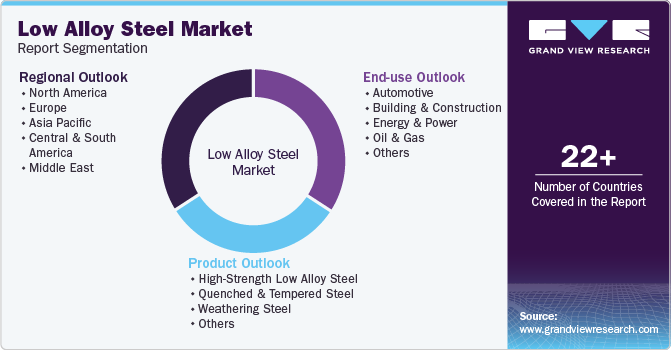 To learn more about this report, Download Free Sample Report
-
Product Outlook (Volume, Kilotons; Revenue, USD Million, 2021 - 2033)
-
High-Strength Low Alloy Steel
-
Quenched & Tempered Steel
-
Weathering Steel
-
Others
-
-
End Use Outlook (Volume, Kilotons; Revenue, USD Million, 2021 - 2033)
-
Automotive
-
Building & Construction
-
Energy & Power
-
Oil & Gas
-
Others
-
-
Regional Outlook (Volume, Kilotons; Revenue, USD Million, 2021 - 2033)
-
North America
-
U.S.
-
Canada
-
Mexico
-
-
Europe
-
Germany
-
France
-
Italy
-
Russia
-
-
Asia Pacific
-
China
-
India
-
Japan
-
Indonesia
-
-
Central & South America
-
Brazil
-
-
Middle East & Africa
-
Saudi Arabia
-
-
Research Methodology
The low alloy steel market figures in this report are based on a proven research process that combines executive interviews with secondary research from proprietary databases, company filings, and recognized regulatory and institutional sources. Market size is built through value-chain sizing - reconciling supply-side and demand-side estimates - and triangulated with bottom-up and top-down approaches. Every estimate passes multiple levels of expert validation before publication, with each low alloy steel segment quantified using the revenue-capture definitions in the table below.
Segment Definition
Product
Revenue Capture Definition
High-Strength Low-Alloy Steel
High strength low alloy steel refers to steel grades containing small amounts of alloying elements that provide enhanced strength, toughness, and corrosion resistance while maintaining good weldability. This segment captures revenue generated from its use in construction, automotive, heavy equipment, pipelines, and structural applications.
Quenched & Tempered Steel
Quenched and tempered steel includes heat treated low alloy steel products designed to deliver superior hardness, strength, wear resistance, and impact toughness. Revenue in this segment is generated from applications in mining equipment, construction machinery, defense, industrial tools, and heavy engineering.
Weathering Steel
Weathering steel consists of low alloy steel grades that develop a protective oxide layer when exposed to atmospheric conditions, reducing the need for protective coatings. This segment captures revenue from its use in bridges, railway infrastructure, architectural structures, transmission towers, and outdoor industrial equipment.
Others
The others segment includes specialty low alloy steel grades developed for application specific performance requirements, such as pressure vessel steel, pipeline steel, and abrasion resistant steel. Revenue is generated from industries including energy, oil and gas, marine, power generation, and industrial manufacturing.
End Use
Revenue Capture Definition
Automotive
The automotive application segment represents revenue generated from low-alloy steel used in passenger, commercial, and electric vehicles, as well as in automotive components. High strength, lightweight properties, and excellent fatigue resistance make it suitable for chassis, suspension systems, gears, and structural parts.
Building & Construction
The building and construction segment captures revenue from low alloy steel used in structural frameworks, bridges, high rise buildings, industrial facilities, and public infrastructure. The material offers superior strength, durability, weldability, and corrosion resistance, making it ideal for demanding construction environments.
Energy & Power
The energy and power segment includes revenue generated from low alloy steel used in power plants, renewable energy installations, transmission infrastructure, boilers, turbines, and pressure vessels. Its ability to withstand high temperatures, pressure, and mechanical stress makes it essential for reliable energy generation and distribution.
Oil & Gas
The oil and gas segment represents revenue from low alloy steel used in pipelines, drilling equipment, offshore platforms, storage tanks, refineries, and processing facilities. Low alloy steel provides high mechanical strength, wear resistance, and excellent performance under harsh operating conditions.
Others
The others segment comprises revenue generated from low alloy steel used in industries such as mining, railways, marine, aerospace, agriculture, industrial machinery, and defense. These applications require specialized steel grades capable of delivering superior toughness, abrasion resistance, and long service life.
Estimation Model
Layer Name
Key Question
Description
Industrial & Infrastructure Demand Base Layer
What forms the demand base?
Identify global demand from major steel consuming industries including construction, automotive, energy, oil & gas, heavy machinery, mining, transportation, and infrastructure. Assess industrial production, capital investments, and infrastructure development to establish the total addressable demand for low alloy steel products.
Low Alloy Steel Application Penetration Layer
Where is low alloy steel utilized?
Estimate the penetration of low alloy steel across key applications including structural components, pressure vessels, pipelines, bridges, heavy equipment, railway infrastructure, automotive components, and power generation equipment. Analyze the adoption of high strength low alloy (HSLA), quenched & tempered, weathering, and other low alloy steel grades across industries and regions.
Low Alloy Steel Consumption Intensity Layer
How much low alloy steel is consumed?
Analyze low alloy steel consumption intensity based on construction activity, industrial equipment production, vehicle manufacturing, energy infrastructure expansion, and engineering requirements. Evaluate material usage according to strength, toughness, corrosion resistance, and wear resistance specifications. Consumption intensity varies according to project scale, industry standards, and technological advancements.
Revenue Layer
How is market revenue generated?
Market revenue is quantified through the sale of low alloy steel products including plates, sheets, bars, structural sections, pipes, tubes, and forgings. Revenue generation is driven by demand from construction, automotive, energy, oil & gas, mining, transportation, and industrial manufacturing sectors. Market value is influenced by alloying element costs, steel prices, production volumes, product grades, and regional supply demand dynamics.
Delivered Customizations
This report has been delivered with the following In-depth customizations
Client Request
Customization Delivered
Value Adds
Regional Segmentation
Detailed regional analysis of the low alloy steel market across North America, Europe, Asia Pacific, Latin America, and Middle East & Africa. Included evaluation of crude steel production, low alloy steel manufacturing capacity, infrastructure investments, automotive production, oil & gas activities, energy projects, industrial machinery demand, and government policies supporting advanced steel applications.
Identified high growth manufacturing hubs and emerging demand centers for low alloy steel. Enabled strategic expansion planning based on infrastructure development, industrialization, and energy sector investments. Supported regional demand forecasting and supply chain optimization.
Cross Segmentation
Comprehensive cross segmentation analysis by product type, application, and region, including high strength low alloy steel in automotive and construction, quenched and tempered steel in mining and heavy equipment, weathering steel in bridges and infrastructure, and other low alloy steel grades across oil & gas, energy, industrial machinery, and transportation sectors. Evaluated regional consumption trends, performance requirements, material substitution patterns, and end use demand dynamics.
Enabled identification of the most attractive product application combinations and high growth market segments. Supported product portfolio optimization, customer targeting, and investment prioritization strategies.
Opportunity Assessment
Identification of high growth opportunities across electric vehicles, renewable energy infrastructure, bridge construction, oil & gas pipelines, heavy equipment manufacturing, railway expansion, mining equipment, defense applications, and green steel production.
Enabled prioritization of high return growth segments and emerging regional opportunities. Supported long term investment planning, capacity expansion decisions, product innovation, and strategic business development initiatives aligned with evolving industrial and infrastructure requirements.
Frequently Asked Questions About This Report
The low alloy steel market size was estimated at USD 53.3 billion in 2025 and is expected to reach USD 54.9 billion in 2026.
The low alloy steel market is expected to grow at a compound annual growth rate of 6.8% from 2026 to 2033 to reach USD 87.2 billion by 2033.
The key factor that is driving the growth of the global low alloy steel market is growing demand from industries like automotive, construction, and aerospace, seeking high-performance materials and technological advancements and the shift towards lightweight, durable materials.
Asia Pacific dominated the market with revenue share of 75.3% in 2025.
China dominated the Asia Pacific market with revenue share of 64.5% in 2025.
Asia Pacific is anticipated to register the fastest CAGR over the forecast period.
Automotive accounted for largest revenue share of 33.8% in 2025.
Based on product, high-strength low-alloy steel segment accounted for a market revenue share of 35.1% in 2025.
The key players operating in the low alloy steel market are Kobe Steel; SAIL; Outokumpu; Thyssenkrupp; Baoshan Iron Steel; HBIS Group; Carpenter Technology; POSCO; JFE Steel; Hyundai Steel; Aperam; Nippon Steel; ArcelorMittal; Tata Steel
About the Author(s)
Advanced Interior Materials Research Team
Advanced Materials · Advanced Interior MaterialsThis report was authored by the advanced interior materials research team at Grand View Research - comprising two research analysts, one senior research analyst, and one industry expert - with specialized expertise in the advanced interior materials segment of the advanced materials industry. All findings are based on proprietary advanced materials databases, executive interviews, and regulatory analysis, subject to internal peer review prior to publication.
Last Updated:
Speak to Analyst

Customize this report to your needs - add regions, segments, or data points, with 20% free customization.
Or view our licence options:


ISO 9001:2015 & 27001:2022 Certified
We are GDPR and CCPA compliant! Your transaction & personal information is safe and secure. For more details, please read our privacy policy.


