
- Home
- »
- Specialty Glass, Ceramic & Fiber
- »
-
LTCC And HTCC Market Size And Share Report, 2026-2033GVR Report cover

LTCC And HTCC Market (2026 - 2033)
Size, Share & Trends Analysis Report By Product (LTCC, HTCC), By Application (Automotive, Telecommunication, Aerospace & Defense, Consumer Electronics), By Region, And Segment Forecasts
Market Size, 2025
$3.4BMarket Estimate, 2026
$3.5BMarket Forecast, 2033
$5.1BCAGR, 2026–2033
5.5%LTCC And HTCC Market Summary
The global LTCC and HTCC market size was valued at USD 3.4 billion in 2025 and is projected to grow from USD 3.5 billion in 2026 to USD 5.1 billion by 2033, at a CAGR of 5.5% from 2026 to 2033. Asia Pacific dominated the market, accounting for a revenue share of 42.6% in 2025. This growth is attributed to the increasing demand for automotive electronics, particularly for advanced driver assistance systems and safety features.
 Source: Grand View Research, IR Documents, Primary Interviews, Paid DatabasesTo learn more about this report,
 Download Free Sample Report
 Key Market Trends & Insights
- By product: LTCC segment led the market with the largest revenue share of 74.0% in 2025.
- By application: automotive segment led the market with the largest revenue share of 41.3% in 2025.
Regional Highlights
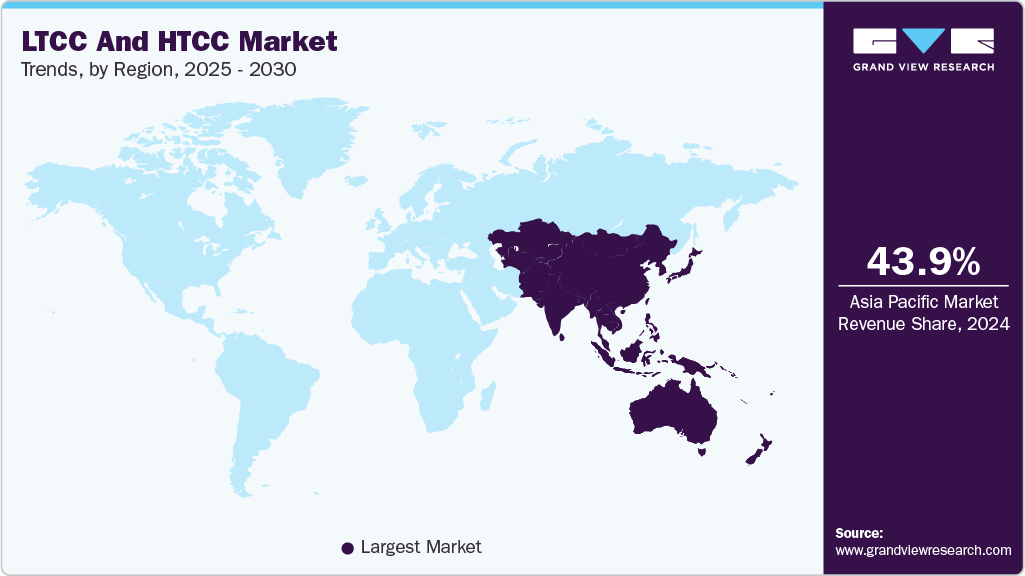
- Largest regional market: Asia Pacific (42.6% revenue share, 2025)
- By country: China held the largest market share in 2025.
Market Size & Forecast
- Market size in 2025: USD 3.4 Billion
- Estimated market size in 2026: USD 3.5 Billion
- Projected market size by 2033: USD 5.1 Billion
- CAGR (2026-2033): 5.5%
Three ways to get this report
Buy it, customize it, or ask a question.Ask an Analyst
Analyst response in 1 business day
- AccessReport author, directly
- Reply timeWithin 1 working day
- No sales callDirect answer only
- FormatEmail reply
- CostFree, no cost
Get the Full Report
What the study covers
- FormatsPDF · Excel · Dashboard
- Timeline2026–2033 annual, 2025 base
- Coverage20+ countries, 5 regions
- Companies10+ key players profiled
Customize the Report
20% free customization
- IncludeCountries, segments, points
- TailorTo your product definition
- ExtendDeeper competitor detail
- OrA fully bespoke study
- Turnaround5–10 working days
In addition, rising investments in wireless communication technologies, including 5G, also enhance the need for high-performance ceramic substrates. Furthermore, the trend towards miniaturization in electronics and the need for efficient thermal management further propels the adoption of LTCC (Low-Temperature Co-fired Ceramic) and HTCC (High-Temperature Co-fired Ceramic) across various industries, including telecommunications and aerospace.LTCC and HTCC are innovative ceramic technologies that play a crucial role in the microelectronics industry, particularly for applications requiring compact and high-performance electronic components. Both types of co-fired ceramics involve firing a ceramic substrate along with conductive, resistive, and dielectric materials in a kiln, but they operate at different temperature ranges-LTCC at temperatures below 900°C and HTCC above 1600°C. This distinction allows LTCC to integrate sensitive components, while HTCC offers enhanced durability and thermal performance.
 To learn more about this report, Download Free Sample Report
 The growing demand for miniaturized electronics is a significant driver of market growth for LTCC and HTCC substrates. Industries such as automotive, telecommunications, and consumer electronics are increasingly adopting these substrates to meet the consumer preference for smaller, lightweight devices without compromising performance. In the automotive sector, the integration of advanced electronics for safety features, connectivity, and autonomous functionalities has led to a heightened demand for reliable substrates such as LTCC and HTCC. These technologies provide exceptional thermal conductivity and mechanical strength, making them ideal for rigorous automotive applications.
Furthermore, the rising investments in wireless communication technology and the increasing penetration of electronics in vehicles are expected to further propel market growth. Applications of LTCC and HTCC include capacitors, inductors, transformers, and hybrid circuits, which are essential in military electronics, Micro Electromechanical Systems (MEMS), microprocessors, and RF applications. As industries continue to evolve towards more sophisticated electronic solutions, the relevance of LTCC and HTCC technologies will only increase.
Market Dynamics
The LTCC (Low Temperature Co-fired Ceramic) and HTCC (High Temperature Co-fired Ceramic) market is growing as industries increasingly demand compact, reliable, and high-performance electronic components. Rising adoption of 5G infrastructure, electric vehicles, automotive electronics, and advanced communication systems is creating strong demand for ceramic-based packaging solutions. LTCC is widely used in high-frequency and miniaturized electronic applications, while HTCC is preferred for environments requiring high thermal and mechanical stability. However, high production costs and complex manufacturing processes remain key challenges for market participants.
The increasing demand for smaller, lighter, and more powerful electronic devices is a major driver for the LTCC and HTCC market. Industries such as automotive, telecommunications, consumer electronics, and medical devices are continuously integrating advanced electronic functionalities into compact form factors, creating strong demand for high-performance ceramic substrates. LTCC and HTCC technologies enable the integration of multiple electronic functions within a limited space while maintaining excellent electrical performance, thermal management, and reliability. Their ability to support high-frequency applications and harsh operating environments makes them essential for next-generation electronic systems, particularly in connected vehicles, 5G infrastructure, and portable consumer devices.
A strong example of the growing need for miniaturized electronics is the rapid global deployment of 5G networks. Modern 5G base stations, antennas, RF filters, and communication modules require highly compact and high-frequency components that can operate reliably while minimizing signal loss. LTCC substrates are increasingly used in these applications because they enable multilayer integration, space-saving designs, and superior electrical performance at high frequencies. As telecom operators continue expanding 5G coverage and investing in next-generation communication infrastructure, demand for LTCC and HTCC substrates is rising significantly to support advanced wireless connectivity solutions.
High production and material costs remain a key restraint for the LTCC and HTCC market. HTCC substrates require extremely high firing temperatures, often exceeding 1,600°C, which increases energy consumption and necessitates the use of costly refractory metal conductors such as tungsten and molybdenum. Although LTCC technology operates at lower firing temperatures and can utilize relatively less expensive conductive materials like silver and copper, the overall manufacturing process still involves significant expenses related to specialized ceramic materials, precision fabrication, multilayer processing, and tooling. These high costs can limit adoption among cost-sensitive end users and create challenges for manufacturers seeking to scale production while maintaining competitive pricing.
The rapid expansion of 5G networks and next-generation telecommunications infrastructure presents a significant growth opportunity for the LTCC and HTCC market. As telecom operators continue investing in high-speed, low-latency connectivity, demand for advanced RF components, antennas, filters, and communication modules is increasing substantially. LTCC and HTCC substrates offer excellent electrical performance, thermal stability, and reliability at high frequencies, making them well-suited for 5G base stations, small cells, satellite communication systems, and network equipment. The ongoing deployment of 5G networks, coupled with the emergence of 6G research and expanding data traffic worldwide, is expected to create long-term demand for high-performance ceramic substrate technologies.
Analyst Perspective
The LTCC and HTCC market is benefiting from the growing complexity of modern electronic systems, where manufacturers need smaller, faster, and more reliable components. Demand is particularly strong from 5G infrastructure, automotive electronics, aerospace, and advanced industrial applications, all of which require high-performance ceramic substrates with excellent thermal and electrical properties. LTCC is seeing wider adoption in high-frequency communication devices, while HTCC continues to be preferred for harsh-environment and high-temperature applications. As electronic devices become more compact and feature-rich, the need for advanced packaging technologies is expected to increase further. However, high production costs and complex manufacturing processes remain important challenges for market participants seeking to scale their operations and maintain competitiveness.
Type Insights
Based on Type, the LTCC segment led the market with the largest revenue share of 74.0% in 2025, primarily driven by the increasing demand for miniaturized electronic devices across various sectors. As industries such as telecommunications, automotive, and consumer electronics strive for smaller, more efficient components, LTCC technology enables the production of compact devices at lower costs. Furthermore, the rise of advanced communication technologies, including 5G, also fuels the need for high-density substrates that can handle complex electronic functions while maintaining thermal stability, further propelling market expansion.
HTCC (High-Temperature Co-fired Ceramic) type is expected to grow at a CAGR of 5.0% from 2025 to 2030, driven by the rising demand for robust electronic components capable of operating in extreme conditions. Industries such as aerospace and automotive require HTCC substrates due to their superior thermal conductivity and mechanical strength. In addition, the increasing integration of advanced electronics in vehicles for safety and connectivity features also drives demand. Moreover, the growing trend toward high-performance applications in military and industrial sectors necessitates reliable HTCC solutions, contributing significantly to market growth.
Application Insights
Based on applications, the automotive segment led the market with the largest revenue share of 41.3% in 2025.. This growth is attributed to the growing demand for advanced wireless communication technologies. In addition, the rise of 5G networks and the increasing need for high-frequency applications, such as RF modules and integrated antenna arrays, are significant contributors to this growth. Furthermore, LTCC technology, with its excellent thermal conductivity and high-frequency performance, is increasingly utilized in devices such as Bluetooth modules and satellite communications, enhancing overall communication efficiency and reliability.
 To learn more about this report, Download Free Sample Report
 The automotive sector is expected to grow at a CAGR of 5.9% over the forecast period, owing to the increasing integration of electronic systems in vehicles for safety, connectivity, and performance enhancement. In addition, Advanced Driver Assistance Systems (ADAS), infotainment systems, and telematics require robust electronic components that can withstand harsh conditions. Furthermore, LTCC and HTCC technologies provide the necessary thermal stability and mechanical strength, making them ideal for automotive applications. As consumers prioritize vehicle safety and manufacturers adopt more sophisticated electronic solutions, the market for LTCC and HTCC in automotive applications is expected to continue its significant growth trajectory.
Regional Insights
Asia Pacific dominated the LTCC and HTCC market with the largest revenue share of 42.6% in 2025. This growth is attributed to the rapid expansion of the microelectronics manufacturing sector. In addition, countries such as China, South Korea, and Japan are at the forefront, benefiting from substantial investments in semiconductor production and consumer electronics. Moreover, the rising demand for electric vehicles (EVs) and advanced telecommunications infrastructure, particularly with the rollout of 5G technology, further fuels market growth. The region's strong manufacturing base and competitive pricing enhance its market position.
 To learn more about this report, Download Free Sample Report
 China LTCC And HTCC Market Trends
The LTCC and HTCC market in China held the largest share in the Asia Pacific region in 2025, driven by significant government support for technological advancements and manufacturing capabilities. In addition, the country's focus on becoming a global leader in semiconductor technologies has led to increased production of high-performance electronic components. Furthermore, the booming automotive sector, particularly in electric and autonomous vehicles, creates a robust demand for reliable substrates such as LTCC and HTCC. This combination of government initiatives and industry growth positions China as a key player in the global market.
North America LTCC And HTCC Market Trends
North America LTCC and HTCC market is expected to grow significantly over the forecast period, primarily driven by the increasing demand for LTCC printed circuit boards (PCBs) across various industries, including automotive, aerospace, and telecommunications. In addition, the flourishing wireless communication sector, particularly with the rollout of 5G technology, further enhances market prospects. Furthermore, the rising interest in power electronic products, known for their compact size and lightweight nature, is expected to create new opportunities for manufacturers in this region.
The LTCC and HTCC market in the U.S. led the North American market and accounted for the largest revenue share in 2024, driven by advancements in emerging technologies such as the Internet of Things (IoT) and 5G networks. In addition, increased research spending on next-generation wireless technologies and collaborations among research institutions are anticipated to fuel market expansion. Furthermore, the growing integration of electronic devices and sensors in vehicles aligns with the demand for high-performance substrates such as LTCC and HTCC.
Europe LTCC And HTCC Market Trends
The growth of Europe LTCC and HTCC market is expected to be fueled by an increasing focus on automotive electronics and smart technologies. The region's commitment to sustainability drives demand for electric vehicles, which require high-performance electronic components. Furthermore, Europe's robust telecommunications infrastructure development supports adopting LTCC and HTCC technologies. As manufacturers seek to enhance product reliability while reducing size and weight, these substrates play a crucial role in meeting industry demands.
Latin America LTCC And HTCC Market Trends
The LTCC and HTCC market in Latin America is expected to grow at a CAGR of 5.0% over the forecast period, owing to increasing investments in telecommunications infrastructure and consumer electronics. The region's expanding automotive industry is also contributing to this growth as manufacturers seek to incorporate advanced electronic components into vehicles. Furthermore, government initiatives aimed at promoting local manufacturing capabilities are expected to enhance market opportunities for LTCC and HTCC technologies in various applications.
Key LTCC And HTCC Company Insights
Key companies in the global LTCC and HTCC industry include Hitachi Metals Ltd., Kyocera Corporation, and others. These companies adopt various strategies to enhance their competitive edge, including new product launches, mergers, and strategic partnerships. By focusing on innovative product development, they aim to meet the evolving needs of diverse industries. In addition, collaborations and agreements with other firms help expand their market reach and technological capabilities. Furthermore, mergers and acquisitions are employed to consolidate resources, streamline operations, and enhance overall market presence, ensuring sustained growth in a competitive landscape.
-
TDK Corporation specializes in the manufacturing of electronic components and materials. The company produces a wide range of products, including filters, antennas, and RF components that utilize LTCC technology for high-frequency applications. TDK operates primarily in the electronics segment, focusing on telecommunications, automotive, and industrial applications.
-
NGK Spark Plug Ltd. manufactures various products, including spark plugs, sensors, and ceramic substrates that leverage HTCC technology for high-performance applications. NGK operates predominantly in the automotive and industrial segments, providing advanced solutions that enhance vehicle performance and reliability.
Key LTCC And HTCC Companies
The following key companies have been profiled for this study on the LTCC and HTCC market.
-
Hitachi Metals Ltd.
-
Kyocera Corporation
-
Murata Manufacturing Co., Ltd.
-
TDK Corporation
-
NGK Spark Plug Ltd.
-
Yokowo Co., Ltd.
-
KOA Corporation
-
Maruwa Co. Ltd.
Competitive Benchmarking
Operating Strategies
Competitive Edge
Weaknesses
Established Players (Kyocera Corporation; Murata Manufacturing Co., Ltd.; TDK Corporation; NGK Spark Plug Ltd.; Maruwa Co. Ltd.)
- Invest heavily in R&D for advanced LTCC/HTCC materials and multilayer packaging technologies.
- Expand production capacity to support growing demand from 5G, automotive electronics, and aerospace applications.
- Focus on product miniaturization, high-frequency performance, and thermal management capabilities.
- Strong brand recognition and extensive industry experience.
- Large-scale manufacturing capabilities and global distribution networks.
- Broad product portfolios covering substrates, packages, RF modules, and advanced ceramic components.
- High operational and manufacturing costs.
- Dependence on cyclical electronics and semiconductor demand.
- Longer product development cycles due to complex qualification requirements.
Emerging Players (Hitachi Metals Ltd.; Yokowo Co., Ltd.; KOA Corporation)
- Focus on specialized applications such as RF communication modules, sensors, industrial electronics, and customized ceramic solutions.
- Develop niche technological capabilities to differentiate from larger competitors.
- Pursue strategic partnerships with OEMs, telecom equipment providers, and automotive suppliers.
- Greater flexibility in addressing customized customer requirements.
- Faster response to emerging technology trends and niche market opportunities.
- Strong expertise in selected application areas such as antennas, RF components, and specialty electronics.
- Smaller production scale and limited economies of scale.
- Lower brand visibility compared to leading global players.
- More limited geographic reach and customer base.
Recent Developments
- In March 2023, Kyocera showcased its advanced solutions for high-speed optics, at OFC 2023, highlighting the role of LTCC (Low-Temperature Co-fired Ceramic) and HTCC (High-Temperature Co-fired Ceramic) technologies. The event featured Kyocera's innovative ceramic packages that support a remarkable increase in optical data rates, exceeding 5,000 times. The company emphasized its contributions to optoelectronics and introduced new ceramics designed for enhanced mechanical reliability in co-packaged optics and silicon photonics applications.
LTCC And HTCC Market Report Scope
Report Attribute
Details
Market Definition
The LTCC and HTCC market represents the revenue generated from the sale of co-fired ceramic substrates, packages, modules, and related components used in electronic packaging applications. The market includes LTCC products designed for high-frequency and miniaturized electronics, as well as HTCC products used in high-temperature and high-reliability environments across telecommunications, automotive, aerospace & defense, semiconductor, medical, and industrial sectors.
Market size in 2025
USD 3.4 billion
Estimated market size in 2026
USD 3.5 billion
Projected market size by 2033
USD 5.1 billion
Growth rate
CAGR of 5.5% from 2026 to 2033
Base year for estimation
2025
Historical data
2021 - 2024
Forecast period
2026 - 2033
Quantitative units
Revenue in USD Million and CAGR from 2026 to 2033
Report coverage
Revenue forecast, company ranking, competitive landscape, growth factors, and trends
Segments covered
Product, applications, region
Regional scope
North America; Europe; Asia Pacific; Latin America; Middle East & Africa
Country scope
U.S., Canada, Mexico, China, India, Japan, Taiwan, Germany, UK, France, Italy, Spain, Benelux, Nordic, Poland
Key companies profiled
Hitachi Metals Ltd.; Kyocera Corporation; Murata Manufacturing Co., Ltd.; TDK Corporation; NGK Spark Plug Ltd.; Yokowo Co., Ltd.; KOA Corporation; Maruwa Co. Ltd.
Customization scope
Free report customization (equivalent up to 8 analysts' working days) with purchase. Addition or alteration to country, regional & segment scope.
Pricing and purchase options
Avail customized purchase options to meet your exact research needs. Explore purchase options
Global LTCC And HTCC Market Report Segmentation
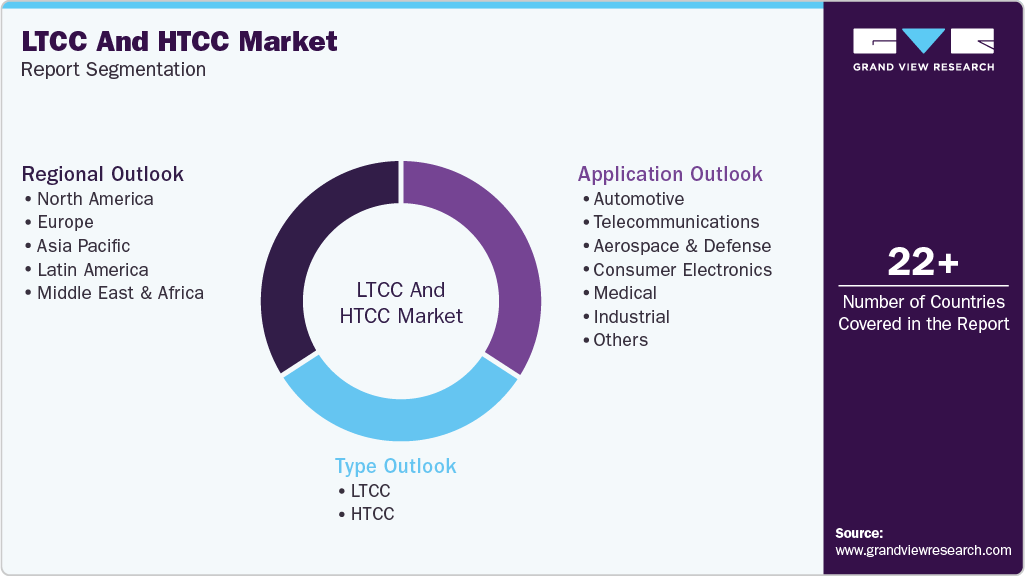
This report forecasts revenue growth at global, regional, and country levels and analyzes the latest industry trends in each sub-segment from 2021 to 2033. For this study, Grand View Research has segmented the global LTCC and HTCC market report based on type, application, and region:
 To learn more about this report, Download Free Sample Report
 -
Type Outlook (Revenue, USD Million, 2021 - 2033)
-
LTCC
-
HTCC
-
-
Application Outlook (Revenue, USD Million, 2021 - 2033)
-
Automotive
-
Telecommunications
-
Aerospace & Defense
-
Consumer Electronics
-
Medical
-
Industrial
-
Others
-
-
Regional Outlook (Revenue, USD Million, 2021 - 2033)
-
North America
-
U.S.
-
Canada
-
Mexico
-
-
Europe
-
Germany
-
UK
-
France
-
Italy
-
Spain
-
Benelux
-
Nordic
-
Poland
-
-
Asia Pacific
-
China
-
India
-
Japan
-
Taiwan
-
-
Latin America
-
Middle East & Africa
-
Research Methodology
The LTCC and HTCC market figures in this report are based on a proven research process that combines executive interviews with secondary research from proprietary databases, company filings, and recognized regulatory and institutional sources. Market size is built through value-chain sizing-reconciling supply-side and demand-side estimates-and triangulated with bottom-up and top-down approaches. Every estimate passes multiple levels of expert validation before publication, with each LTCC and HTCC segment quantified using the revenue-capture definitions in the table below.
Segment Definition
Segment - Product
Revenue capture definition
LTCC
LTCC includes ceramic substrates, modules, packages, filters, antennas, sensors, and other electronic components manufactured at sintering temperatures below 900°C using high-conductivity metals such as gold, silver, and copper. Market revenue is attributed to the manufacturing and sale of LTCC-based products, multilayer ceramic integration solutions, RF and microwave components, advanced packaging technologies, and related electronic assembly applications.
HTCC
HTCC includes ceramic substrates, packages, hermetic enclosures, sensor housings, and electronic components manufactured at temperatures around 1,600°C using ceramic materials such as alumina and aluminum nitride with refractory metal conductors including molybdenum and tungsten. Revenue is generated through the production, supply, and integration of HTCC products used in high-temperature, high-power, and high-reliability electronic applications.
Segment - Application
Revenue capture definition
Automotive
LTCC and HTCC components are widely used in automotive electronics for sensors, radar systems, powertrain controls, battery management systems, ADAS, and vehicle connectivity applications. Revenue capture includes the sale of ceramic substrates and packages, component integration activities, electronic module manufacturing, and related automotive electronics applications.
Telecommunication
The telecommunication segment utilizes LTCC and HTCC technologies in RF modules, antennas, filters, base stations, satellite communication systems, and wireless network infrastructure. Revenue is generated through ceramic substrate sales, high-frequency communication components, packaging solutions, and integration into telecommunications equipment and network systems.
Aerospace & Defense
LTCC and HTCC materials are used in avionics, radar systems, satellite electronics, military communication equipment, navigation systems, and other mission-critical applications requiring high reliability. Revenue includes ceramic component manufacturing, advanced electronic packaging solutions, subsystem integration, and specialized aerospace and defense electronics applications.
Consumer Electronics
Consumer electronics applications include smartphones, tablets, wearable devices, laptops, gaming systems, smart home products, and other compact electronic devices. Market revenue is attributed to ceramic substrate consumption, miniaturized component manufacturing, electronic module integration, and advanced packaging solutions used in consumer products.
Others
This segment includes applications across medical devices, industrial automation systems, optical communication equipment, energy management systems, power electronics, sensors, and other specialized industries. Revenue is derived from ceramic substrate and package sales, electronic component integration, advanced manufacturing activities, and specialized high-performance electronic applications.
Estimation Model
Layer Name
Key Question
Description
Electronics Demand Base Layer
What forms the demand base?
Identify global demand for advanced electronic components requiring high-performance ceramic substrates and packaging solutions. Assess electronic content growth across telecommunications, automotive electronics, aerospace & defense, consumer electronics, medical devices, industrial automation, and semiconductor industries to establish the addressable market opportunity for LTCC and HTCC technologies.
Ceramic Substrate Production & Supply Layer
Where are LTCC and HTCC products manufactured and supplied?
Estimate the production capacity of LTCC and HTCC substrates, packages, modules, and related components across key regions. Analyze the availability of ceramic materials, conductive metals, manufacturing facilities, technology capabilities, and distribution networks to assess supply dynamics and market accessibility.
Application Adoption Layer
How extensively are LTCC and HTCC technologies utilized?
Analyze the adoption of LTCC and HTCC components across automotive, telecommunication, aerospace & defense, consumer electronics, and other industrial applications. Evaluate requirements for miniaturization, high-frequency performance, thermal management, reliability, and advanced electronic packaging that influence ceramic substrate consumption.
Revenue Layer
How is market revenue generated?
Expenditures on LTCC and HTCC substrates, ceramic packages, electronic modules, RF components, and related integration solutions quantify market revenue. Product demand, substrate consumption volumes, component pricing, electronic production activity, and technology adoption across end-use industries drive the overall market value.
Delivered Customizations
This report has been delivered with the following In-depth customizations
Client Request
Customization Delivered
Value Adds
End-Use Industry Opportunity Assessment
Identified growth opportunities associated with telecommunications infrastructure, automotive electronics, aerospace & defense systems, semiconductor packaging, industrial automation, and medical electronics. The study assessed electronic component demand trends, technology adoption rates, investment activity, and emerging application areas driving future consumption of LTCC and HTCC solutions.
Enabled prioritization of high-growth end-use segments, supported market expansion strategies, and provided insights for resource allocation, business development, and long-term investment planning.
LTCC & HTCC Competitive Landscape Assessment
Detailed competitive landscape analysis covering manufacturers of LTCC substrates, HTCC substrates, ceramic packages, RF modules, multilayer ceramic components, and advanced electronic packaging solutions. The study profiled key market participants based on geographic presence, organizational structure, product portfolio, manufacturing capacity, technology capabilities, customer base, strategic partnerships, R&D investments, and expansion initiatives across major end-use industries.
Enabled evaluation of competitive positioning, technology leadership, manufacturing capabilities, customer engagement strategies, and market participation across the LTCC and HTCC value chain.
Technology Benchmarking Assessment
Evaluated LTCC and HTCC technologies based on electrical performance, thermal conductivity, reliability, miniaturization capability, operating temperature range, material composition, manufacturing complexity, and suitability across end-use applications. The assessment included analysis of evolving packaging technologies, substrate innovations, and performance requirements across major industries.
Supported technology selection, product development planning, application suitability analysis, and strategic investment decisions based on evolving performance and reliability requirements.
Frequently Asked Questions About This Report
China dominated the Asia Pacific region market with a revenue share of 46.5% in 2025.
Based on product, the LTCC segment accounted for largest revenue share of 74.0% in 2025.
Based on applications, the automotive segment accounted for largest revenue share of 41.3% in 2025.
The key players operating in the LTCC and HTCC market are Hitachi Metals Ltd.; Kyocera Corporation; Murata Manufacturing Co., Ltd.; TDK Corporation; NGK Spark Plug Ltd.; Yokowo Co., Ltd.; KOA Corporation; Maruwa Co. Ltd.; and others.
The LTCC and HTCC market size was estimated at USD 3.4 billion in 2025 and is expected to reach USD 3.5 billion in 2026.
The LTCC and HTCC market is expected to grow at a CAGR of 5.5% from 2026 to 2033 to reach USD 5.1 billion by 2033.
The LTCC and HTCC market is driven by rising demand for miniaturized high-performance electronics, expanding 5G infrastructure, increasing automotive electronics content, and growing adoption of advanced packaging solutions in aerospace, defense, and industrial applications.
The Asia Pacific region dominated the LTCC and HTCC market with a revenue share of 42.6% in 2025.
About the Author(s)
Specialty Glass, Ceramic & Fiber Research Team
Advanced Materials · Specialty Glass, Ceramic & FiberThis report was authored by the specialty glass, ceramic & fiber research team at Grand View Research - comprising two research analysts, one senior research analyst, and one industry expert - with specialized expertise in the specialty glass, ceramic & fiber segment of the advanced materials industry. All findings are based on proprietary advanced materials databases, executive interviews, and regulatory analysis, subject to internal peer review prior to publication.
Last Updated:
Speak to Analyst

Customize this report to your needs - add regions, segments, or data points, with 20% free customization.
Or view our licence options:


ISO 9001:2015 & 27001:2022 Certified
We are GDPR and CCPA compliant! Your transaction & personal information is safe and secure. For more details, please read our privacy policy.


