
- Home
- »
- Homecare & Decor
- »
-
Luxury MICE Hotels Market Size And Share Report, 2033GVR Report cover

Luxury MICE Hotels Market (2026 - 2033)
Size, Share & Trends Analysis Report By Hotel Type, By Event Type (Meetings, Incentives), By Meeting Size (0 to 50, From 50 to 149), By Event Theme, By Booking Mode, By Region, And Segment Forecasts
Market Size, 2025
$23.8BMarket Estimate, 2026
$25.3BMarket Forecast, 2033
$37.4BCAGR, 2026–2033
5.7%Luxury MICE Hotels Market Summary
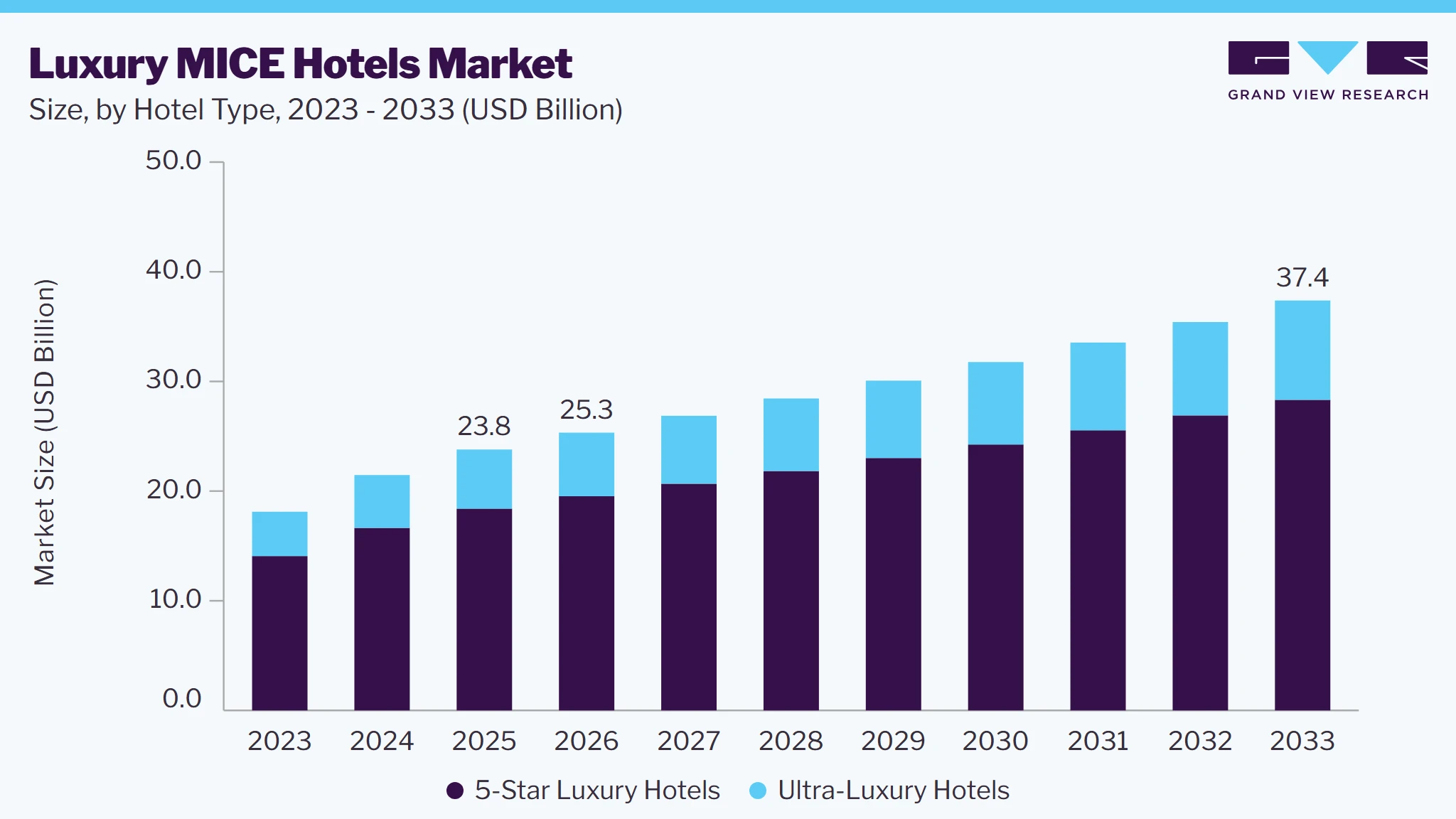
The global luxury MICE hotels market size was valued at USD 23.8 billion in 2025 and is projected to grow from USD 25.3 billion in 2026 to USD 37.4 billion by 2033, at a CAGR of 5.7% from 2026 to 2033. North America dominated the market, accounting for a revenue share of 44.5% in 2025. The market is primarily supported by the rebound in corporate travel and the shift toward higher-value, experience-led business trips, which are increasing the value of each group booking.
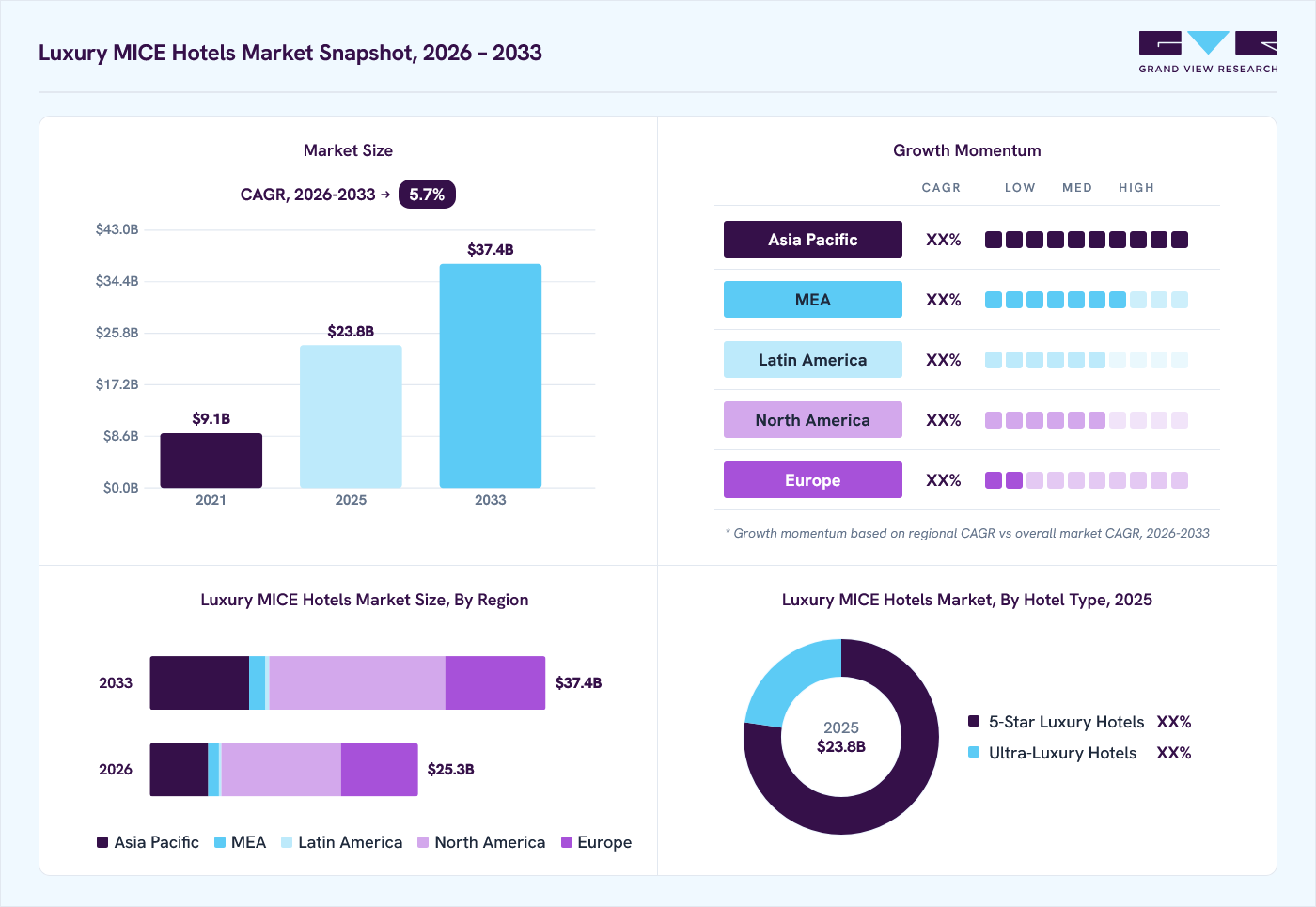 Source: Grand View Research, IR Documents, Primary Interviews, Paid DatabasesTo learn more about this report,
 Download Free Sample Report
 Key Market Trends & Insights
- By hotel type: 5-star luxury hotels accounted for a market share of 77.3% in 2025.
- By event type: Meetings accounted for a market share of 34.3% in 2025.
- By meeting size: 500 to 999 attendees category accounted for a market share of 24.2% in 2025.
- By event theme: Technology & digital innovation accounted for a market share of 18.0% in 2025.
- By booking mode: Direct booking accounted for a market share of 36.6% in 2025.
Regional Highlights
- Largest regional market: North America (44.5% revenue share, 2025)
- Fastest-growing regional market: Asia Pacific (highest CAGR, 2026-2033)
- Leading country: The U.S. held the largest share in 2025.
Market Size & Forecast
- Market Size in 2025: USD 23.8 billion
- Estimated Market Size in 2026: USD 25.3 billion
- Projected Market Size by 2033: USD 37.4 billion
- CAGR (2026-2033): 5.7%
Three ways to get this report
Buy it, customize it, or ask a question.Ask an Analyst
A direct answer, usually in 1 working day
- AccessReport author, directly
- Reply timeWithin 1 working day
- No sales callDirect answer only
- FormatEmail reply
- CostFree, no cost
Get the Full Report
What the study covers
- FormatsPDF · Excel · Dashboard
- Timeline2026–2033 annual, 2025 base
- Coverage20+ countries, 5 regions
- Companies10+ key players profiled
Customize the Report
20% free customization
- IncludeCountries, segments, points
- TailorTo your product definition
- ExtendDeeper competitor detail
- OrA fully bespoke study
- Turnaround5–10 working days
As companies place greater emphasis on face-to-face engagement, luxury properties are benefiting from demand for premium accommodation, sophisticated meeting facilities, and destination-based programs. According to Cvent, in 2025, 63% of planners said events were more valuable than before the pandemic, indicating a greater strategic importance of in-person engagement. This complements the move toward higher-spend corporate and incentive programs, giving the industry a greater scope to monetize guestrooms, meeting spaces, F&B, and experiential services within a single corporate booking.
 To learn more about this report, Download Free Sample Report
 Building on this demand, experiential personalization and technology-enabled sourcing are becoming important growth levers for luxury MICE hotels. Planners increasingly want distinctive venues, flexible formats, and customized proposals rather than standardized meeting packages. In Cvent’s 2025 European sourcing study, 54% of planners were already using AI during venue sourcing, while 93% said they were willing to pay more when booking with hotels or venues where they had trusted staff relationships. These preferences favor luxury properties that combine personalized service with digital responsiveness, immersive venue visualization, and faster RFP conversion, enabling hotels to capture higher-value group business and differentiate beyond room capacity alone. These trends are further reinforced by destination-level investment in MICE infrastructure and sustainability capabilities, which is expanding the pipeline of luxury event-ready locations.
The luxury MICE hotels market is being driven by the sustained return of in-person business events and the increasing recognition of meetings as tools for revenue generation, networking, and relationship development. According to a 2025 Global Cvent Travel Managers Report, 75% of global travel managers expected business travel volume to increase, while 43% identified gaining new customers and 42% identified networking as key reasons for in-person meetings. This is translating into higher activity across conferences, corporate meetings, exhibitions, and incentive programs. Cvent also recorded USD 16.5 billion in MICE business sourced through its Supplier Network in 2024, exceeding pre-pandemic levels for the first time, indicating that renewed corporate engagement is converting into measurable event-sourcing activity globally.
In addition, digitalization of event sourcing and greater investment in event-led business growth are accelerating MICE market penetration. Online platforms are making venue discovery, RFP submission, and supplier comparison more efficient, while companies are increasingly treating events as measurable commercial channels rather than standalone gatherings.
 To learn more about this report, Download Free Sample Report
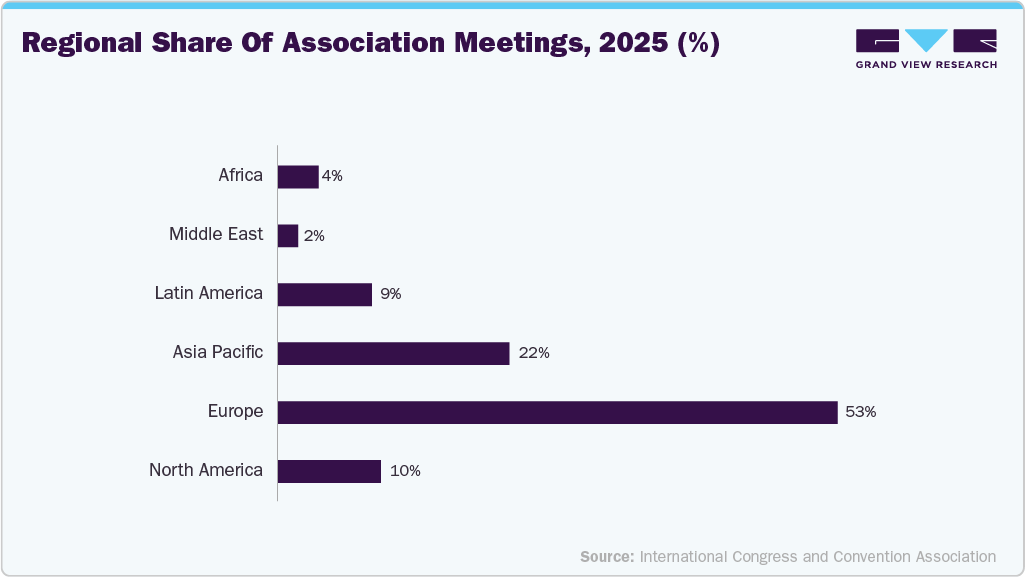
 The regional distribution of association meetings further reinforces the breadth of the luxury MICE opportunity, with established and emerging destinations contributing to a diversified demand base. In 2025, the International Congress and Convention Association (ICCA) recorded 12,438 eligible international and regional association meetings, highlighting the substantial volume of recurring business generated through in-person events.
Additionally, corporate travel is increasingly being protected as a strategic business activity, particularly for client engagement, sales, networking, training, and other activities where physical interaction remains important. According to a 2025 Global Business Travel Association report, 48% of global travel buyers expected their companies to take more business trips, while 57% anticipated higher business travel spending, indicating continued budget expansion beyond the post-pandemic recovery phase. This sustained demand is strengthening international travel across key business hubs and supporting airlines, accommodation providers, and corporate travel suppliers. As companies maintain travel for activities where face-to-face interaction delivers measurable business value, the market is moving from recovery toward structurally higher corporate travel activity.
Market Dynamics
Higher incentive-travel budgets are increasingly supporting premium demand within the luxury MICE hotels market, as companies allocate more money to accommodation, dining, and high-value experiences for qualified employees and partners. The 2024 Incentive Travel Index placed average global incentive-program spending at USD 4,900 per person, with 41% of buyers spending more than USD 5,000 per participant. Importantly for luxury hotels, accommodation accounted for 27% of planned 2025 program budgets, making it the largest spending category. North American buyers already averaged USD 5,400 per person, indicating a stronger willingness to fund premium programs. This progression establishes a higher spending baseline than the earlier post-pandemic incentive environment and directly expands the addressable spend for upscale MICE properties.
Persistent staffing shortages are increasing the cost of delivering luxury MICE hotel services, where high-touch staffing across banquets, housekeeping, concierge, culinary, and event operations is essential. According to the American Hotel & Lodging Association (AHLA), in 2024, 76% of surveyed U.S. hotels reported staffing shortages, while 79% remained unable to fill open positions despite higher wages. AHLA also reported in 2024 that hotels paid more than USD 123 billion in employee compensation, up from USD 118 billion in 2023 and USD 102 billion in 2019. For luxury MICE properties, these pressures raise the cost of servicing group business and constrain margins, making profitable expansion increasingly difficult.
The pressure intensified as MICE demand returned, since group programs require considerably more labor than standard transient stays. In 2024, CBRE found that hotel labor costs increased 11.9% in 2023, while labor costs at convention hotels rose 13.6% and full-service hotels 13.7%. Labor, therefore, grew faster than total hotel revenue, which increased 8.6%, lifting labor's share of revenue from 31.4% to 32.4%. For luxury MICE hotels, higher costs for banquet staffing, event setup, culinary teams, guest services, and coordination can force operators to raise group rates, absorb lower margins, or limit service levels, making premium MICE programs more expensive for corporate buyers.
Saudi Arabia’s Vision 2030 is creating a major pipeline of new MICE demand through the development of large-scale convention centers, luxury hotels, entertainment districts, and destination projects designed to attract international business events. Luxury MICE hotels can capture this opportunity by establishing properties in Riyadh, Jeddah, AlUla, and other Vision 2030-linked destinations, where government-backed infrastructure development is expanding the supply of premium venues and accommodation for international conferences and incentive groups. The opportunity extends beyond hotel rooms, as Saudi Arabia is positioning destinations around integrated MICE experiences combining business events with cultural, entertainment, heritage, and leisure offerings, supporting higher-value group programs and longer stays. The momentum is already visible: Saudi Arabia’s business-event infrastructure expanded by 32% year on year in 2025 across 923 accredited venues, reflecting continued Vision 2030 investment in the Kingdom’s MICE ecosystem.
Rising accommodation, F&B, staffing, and event-production costs are making it harder for luxury MICE hotels to maintain premium service levels without pushing group rates higher or accepting lower margins. Higher operating costs can also reduce corporate buyers’ willingness to upgrade room categories, meeting packages, F&B, and ancillary experiences, forcing luxury hotels to compete more aggressively on value while protecting service quality. The pressure is evident in planner budgets, 71% of global travel managers expected business-travel costs to be higher in 2025, while spending was expected to remain broadly unchanged, increasing pressure on corporate travel programs and hotel negotiations.
Analyst Perspective
The luxury MICE hotels market is expected to witness steady growth as corporations increasingly prioritize premium venues, personalized experiences, and destination-led business events. Demand is moving beyond conventional meetings toward incentive travel, executive retreats, experiential conferences, wellness programs, and exclusive property buyouts. Rising corporate travel, international business activity, and employee engagement initiatives are broadening opportunities for luxury hotels. However, high event costs, economic uncertainty, seasonality, and competition from specialized event venues may constrain growth. From an analyst perspective, competitive advantage will increasingly depend on flexible event infrastructure, bespoke planning, technology integration, sustainability, premium F&B, and distinctive destination experiences, with globally connected luxury hotel groups well positioned to capture high-value corporate demand.
Brand/Company Market Share Insights
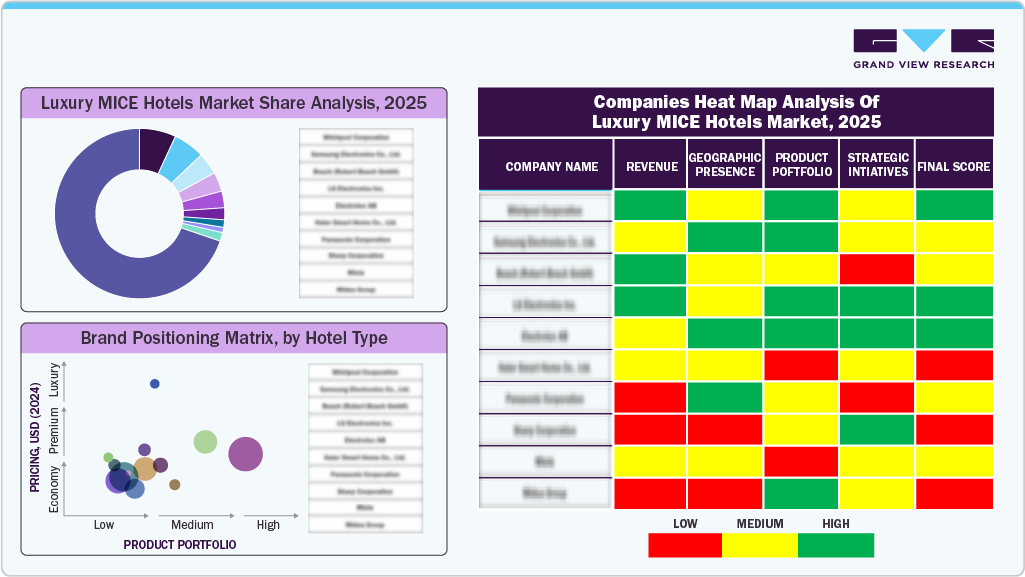
The global luxury MICE market is highly competitive, with competition centered on global hotel presence, luxury service, meeting infrastructure, destination appeal, corporate relationships, event customization, and brand reputation. Marriott International maintains a strong competitive position through its portfolio of luxury brands, including The Ritz-Carlton, St. Regis, and The Luxury Collection, supported by extensive global distribution and established corporate relationships. Hilton competes through Waldorf Astoria and its broader luxury portfolio, leveraging its international sales network, loyalty ecosystem, and destination capabilities.
 To learn more about this report, Download Free Sample Report
 Accor strengthens its position through brands such as Raffles and Fairmont, combining global reach with distinctive properties, sustainability initiatives, and experiential event offerings. Four Seasons, Mandarin Oriental, Rosewood, Auberge, and The Peninsula differentiate through highly personalized service, bespoke event planning, executive retreats, incentive travel, and destination-led experiences. Competition is increasingly shifting from conventional meeting capacity toward experiential MICE programs, wellness, sustainability, premium F&B, private events, technology-enabled meetings, and culturally immersive experiences. Brands combining global corporate reach with flexible, personalized, and differentiated luxury experiences are well positioned to capture high-value MICE demand.
Consumer Insights
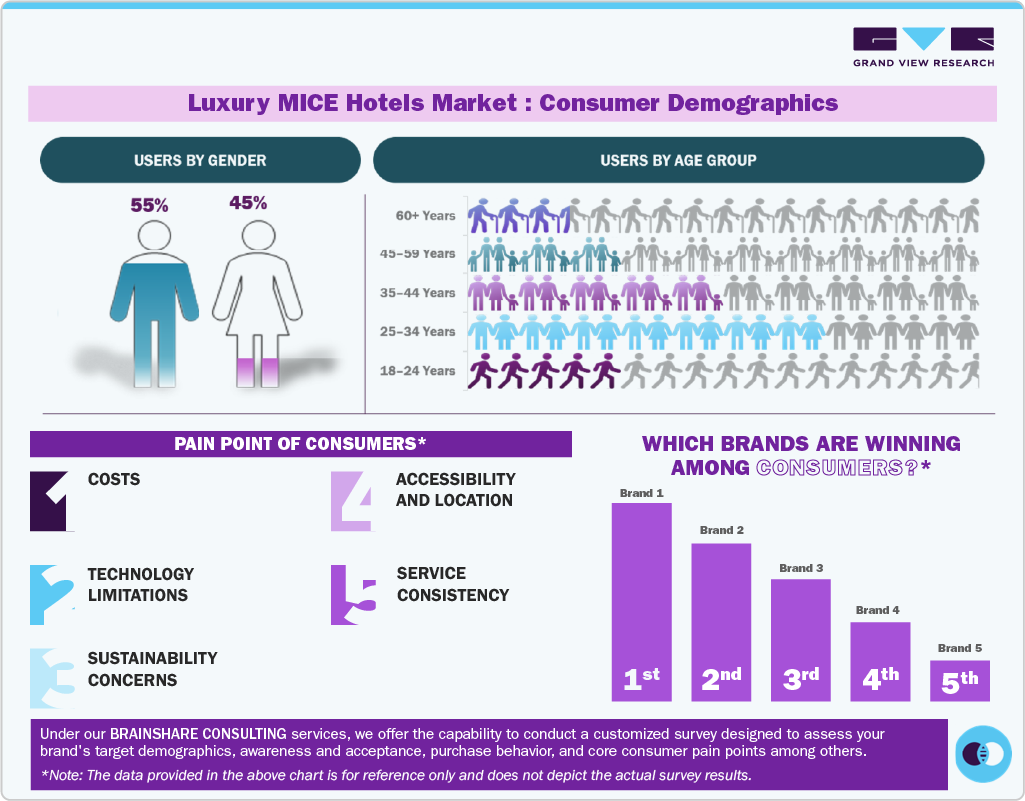
Corporate buyers and event planners prioritize venue quality, service excellence, location, flexibility, and overall event experience when selecting luxury MICE hotels. Travelers with annual household incomes below USD 50,000 are estimated to represent 20% of the luxury MICE hotel audience, below their 33.9% share among U.S. business travelers reported by GBTA in 2024 in business travel data. The lower estimate reflects the premium positioning of luxury MICE accommodation, where corporate-funded travel and higher-value business programs can shift demand toward higher-income travelers. The MICE professional base also provides context. DataUSA reports an average 2024 annual wage of USD 58,381 for meetings, convention, and event planners, indicating that the core occupation itself is concentrated around the middle-income range.
 To learn more about this report, Download Free Sample Report
 Decision-making increasingly extends beyond meeting-room availability toward personalized event planning, premium F&B, advanced technology, wellness facilities, sustainability practices, and distinctive destination experiences. Large corporate groups also value reliable service delivery, convenient accessibility, flexible meeting spaces, and the ability to coordinate accommodation, meetings, dining, and recreational activities through a single hospitality partner. These preferences indicate that luxury MICE buyers evaluate hotels primarily on their ability to deliver seamless, customized, and memorable business events, rather than solely on room quality or meeting capacity.
Hotel Type Insights
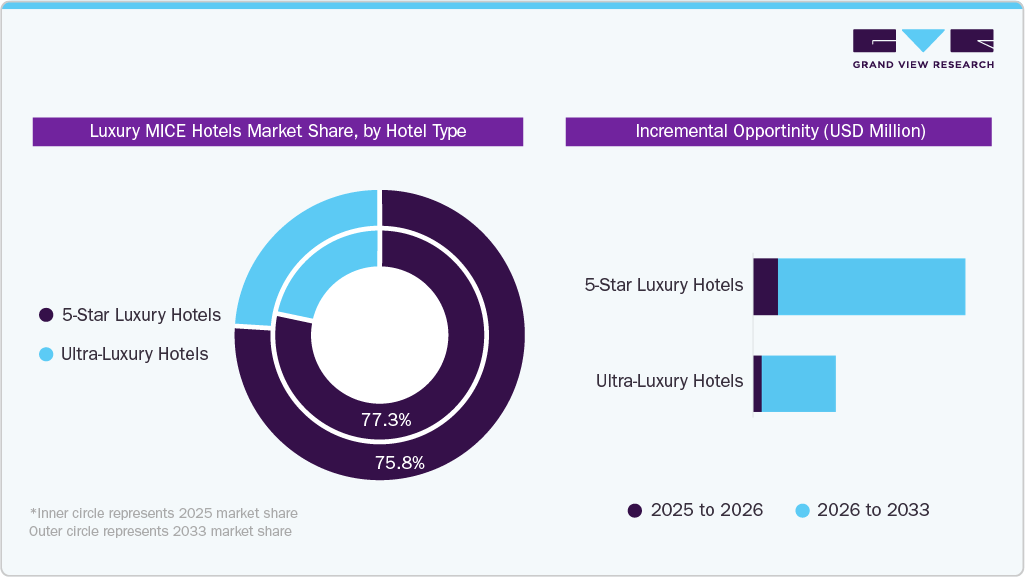
5-star luxury hotels accounted for the largest market share, at 77.3% in 2025. The 5-star luxury hotels cater to corporate and high-value travelers seeking premium accommodation combined with comprehensive facilities for meetings, incentives, conferences, exhibitions, and other large-scale events. These properties typically offer extensive meeting and event infrastructure, including grand ballrooms, flexible conference halls, breakout rooms, executive boardrooms, and outdoor venues, alongside luxury accommodation, fine dining, wellness facilities, concierge services, and personalized event management.
In May 2025, Hyatt Hotels Corporation announced the signing of Grand Hyatt Indore, strengthening the development pipeline for large-scale luxury hotels with dedicated MICE infrastructure in India. The planned 250-room hotel, scheduled to open in 2029, will feature more than 53,000 sq. ft. (approximately 5,000 sq. m.) of meetings and event space, including a 27,986-sq.-ft. (approximately 2,600-sq.-m.) Grand Ballroom. The property will also include five food-and-beverage concepts, a spa, a fitness center, and a swimming pool. This development demonstrates the increasing investment by luxury hotel operators in integrated properties capable of serving corporate meetings, conferences, large social events, and business travelers within emerging commercial destinations.
 To learn more about this report, Download Free Sample Report
 Ultra-luxury hotels are anticipated to grow at a CAGR of 6.6% from 2026 to 2033, supported by increasing demand for exclusive corporate retreats, incentive travel, executive meetings, leadership off-sites, private celebrations, and experience-led business events. Unlike conventional luxury business hotels, ultra-luxury properties increasingly differentiate themselves through highly personalized service, distinctive architecture, private villas or suites, destination-specific experiences, wellness facilities, fine-dining concepts, and bespoke event spaces. The growing preference for memorable and relationship-oriented business gatherings is also supporting this segment. Hilton's 2025 Meetings & Events research found that 82% of attendees preferred going to meetings or events with someone they know, while 71% said they had met someone at a work event who subsequently helped advance their career, highlighting the importance of networking and relationship-building in event design. Ultra-luxury hospitality is increasingly incorporating wellness, privacy, local culture, and experiential programming into the guest proposition. For example, Four Seasons' upcoming AMAALA property in Saudi Arabia is positioned around an ultra-luxury lifestyle combining an expansive spa, health and fitness activities, adventure experiences, private beach access, multiple pools, and six open-air dining venues.
Event Type Insights
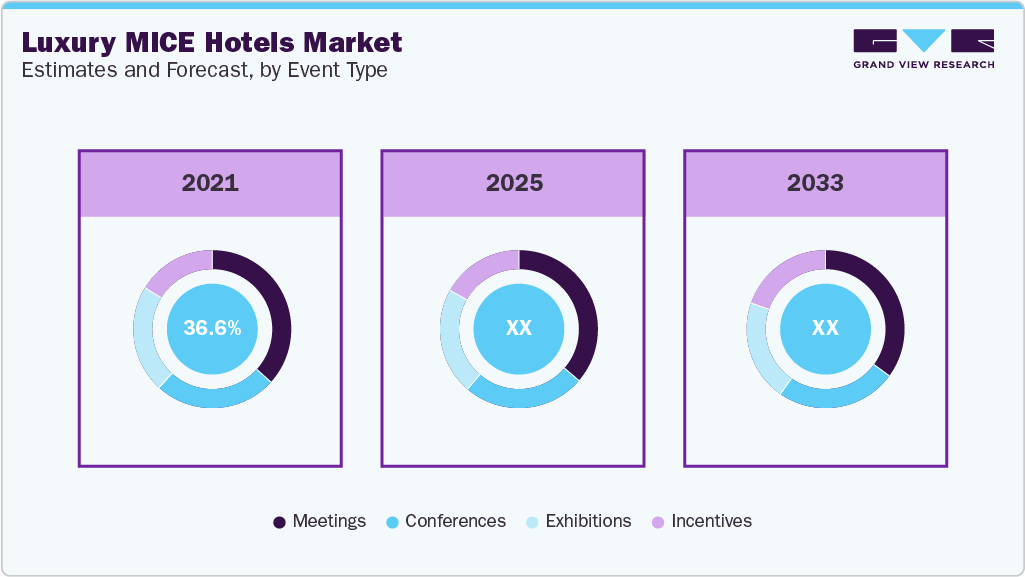
Meetings accounted for the largest market share of 34.3% in 2025. Meetings represent a core event type within the luxury MICE hotels market, encompassing corporate meetings, board meetings, management off-sites, client meetings, workshops, leadership gatherings, training sessions, and small-to-medium-scale business events. Demand is increasingly shifting toward high-quality in-person interactions, with luxury hotels competing through flexible meeting environments, personalized event services, premium audiovisual infrastructure, business connectivity, food and beverage programs, and wellness-oriented breaks. Recent industry data indicates strong underlying demand for in-person meetings. Cvent reported that nearly 90% of planners expected the number of in-person meetings to increase in 2025, while 63% considered events more valuable than before the pandemic.
 To learn more about this report, Download Free Sample Report
 Incentives are anticipated to grow at a CAGR of 7.2% from 2026 to 2033. Incentive travel is an important event type within the luxury MICE hotels market, with companies increasingly using high-end travel experiences to recognize employees, motivate top performers, strengthen relationships, and improve team engagement. The segment is shifting from conventional reward trips toward highly personalized, destination-specific experiences that combine luxury accommodation with cultural activities, wellness, gastronomy, adventure, and exclusive access. Hilton reported a rise in smaller meetings, off-site team gatherings, and incentive travel, with 1 in 4 business travelers expecting team building to be a reason for travel in 2025. Hilton also launched its Incentive Collaborative, offering curated incentive experiences incorporating local culture, such as salsa and merengue lessons, tequila tastings, and Mayan jewelry-making. This demonstrates how luxury hotels are increasingly using destination experiences to differentiate incentive programs.
Meeting Size Insights
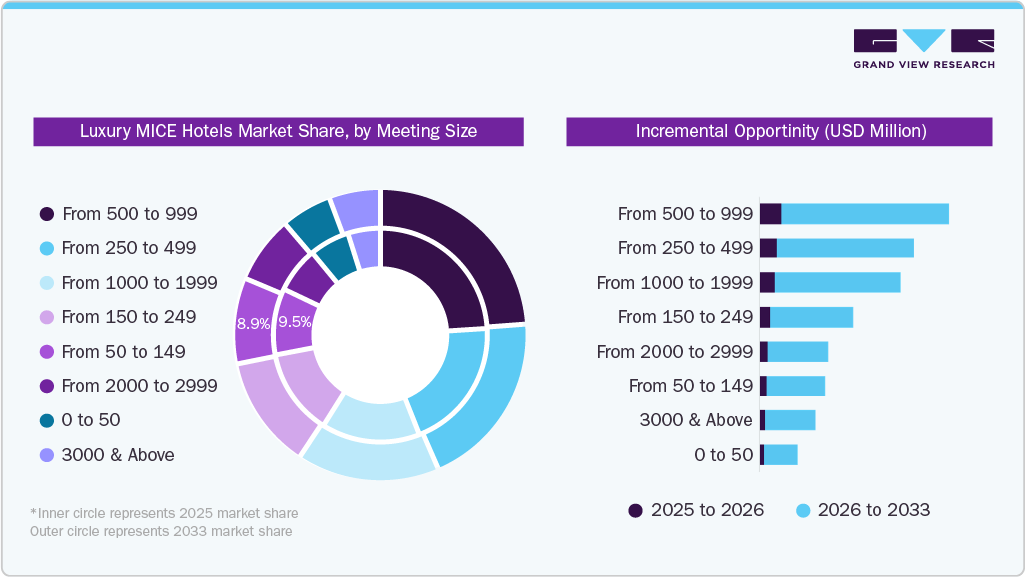
From 500 to 999 attendees accounted for the largest market share of 24.2% in 2025. The 500-999 attendees cater to large corporate gatherings that demand substantial event capacity, flexible room configurations, advanced event technology, and integrated hospitality services. Meetings of this scale typically involve multiple touchpoints, including plenary sessions, networking, dining, and delegate accommodation, increasing the importance of hotels that can manage complex event logistics, seamless guest movement, and consistent service delivery within a single destination. In New Delhi, Taj Palace, New Delhi, reopened its Pavilion at Raja Bagh in July 2026 as an extension of its Convention Center. The approximately 900 sq. m. pillar-free venue accommodates up to 800 guests in reception configuration and 500 in theatre seating, providing a direct example of luxury hospitality infrastructure designed for large-format MICE events.
 To learn more about this report, Download Free Sample Report
 3000 & above are anticipated to grow at a CAGR of 7.7% from 2026 to 2033. Meetings exceeding 3,000 attendees drive demand for destination-scale venues where venue selection increasingly depends on large-scale event orchestration, concurrent-program capacity, delegate movement, and integration with convention infrastructure that can coordinate large delegate volumes across plenary sessions, parallel programs, networking, dining, and accommodation. The ability to integrate extensive event space, advanced technology, high-capacity catering, and efficient delegate movement is becoming a critical consideration for large corporate meeting programs. For example, Clarks Exotica Convention Resort & Spa in Bengaluru, which has expanded its positioning around large-scale MICE events. The property now operates with more than 200,000 sq. ft. of banquet and meeting space, with its convention facilities designed to accommodate up to 3,000 attendees in a single room. The model combines extensive event infrastructure with accommodation and leisure facilities, supporting the growing preference for large meetings hosted within an integrated destination.
Event Theme Insights
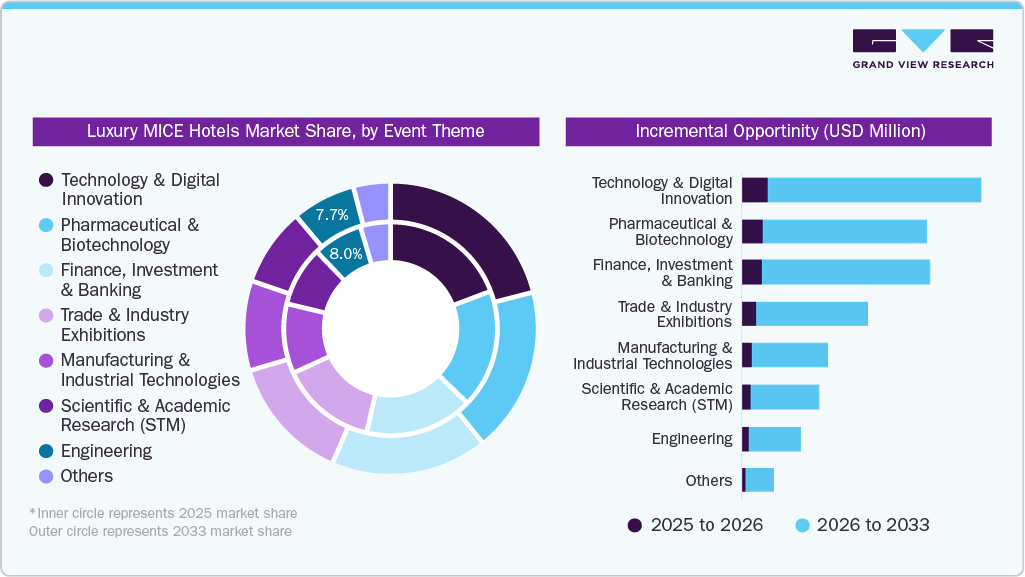
Technology & digital innovation accounts for the largest market share of 18.0% in 2025. The technology & digital innovation theme is reshaping luxury MICE demand as organizations use business events to showcase AI, digital platforms, emerging technologies, automation, and new business models. This increases the value of venues that can support live demonstrations, interactive presentations, hybrid participation, high-speed connectivity, advanced audiovisual production, and technology-enabled networking. Hilton's 2026 Why We Gather research found that 67% of attendees believe AI can personalize their event experience, while 66% say AI-powered networking can help them connect with relevant professionals more easily.
 To learn more about this report, Download Free Sample Report
 Pharmaceutical & biotechnology are anticipated to grow at a CAGR of 6.0% from 2026 to 2033. The pharmaceutical and biotechnology theme is generating demand for MICE venues that can support high-value scientific exchange, business development, regulatory engagement, and technology-led collaboration. Life-sciences events increasingly bring together pharmaceutical companies, biotechnology firms, researchers, investors, regulators, suppliers, and healthcare professionals, creating demand for luxury hotels that can combine formal conference facilities with executive meeting rooms, networking environments, accommodation, and high-quality hospitality. For instance, in 2025, CPHI & PMEC India 2025 attracted 37,148 visitors from 120 countries and more than 2,000 exhibiting companies across 120,000 sq. m. of exhibition space. The event covered the pharmaceutical value chain from APIs and excipients to finished dosage forms, biologics, and specialty manufacturing. The scale and international participation demonstrate the substantial business-travel and accommodation ecosystem generated by pharmaceutical and biotechnology events.
Booking Mode Insights
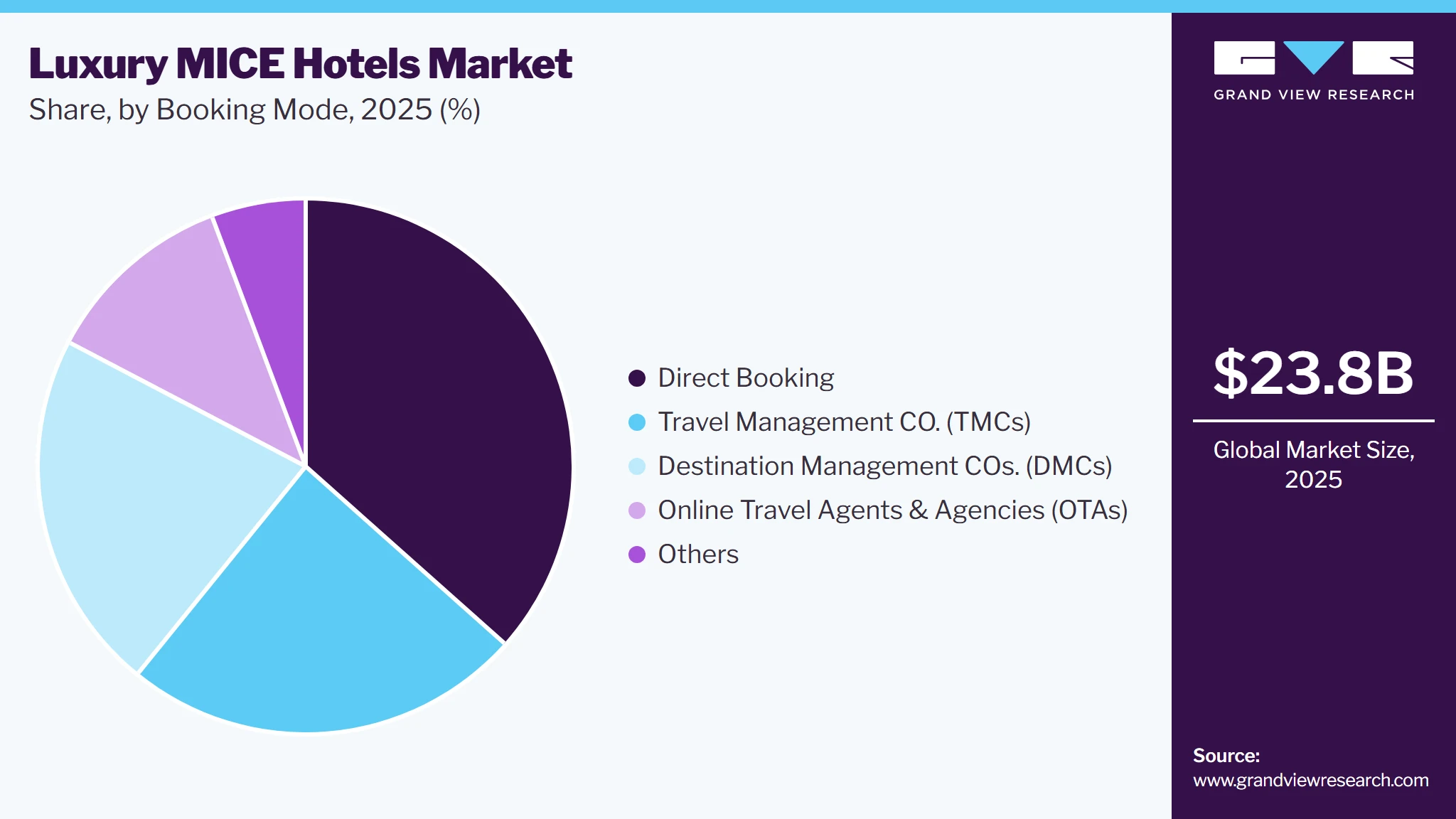
Direct booking accounted for the largest market share of 36.6% in 2025. The direct booking segment is gaining importance within the luxury MICE hotels market as hotel groups increasingly encourage corporate organizers and delegates to book through hotel-owned websites, mobile applications, reservation teams, and dedicated sales channels. Direct channels give luxury MICE properties greater control over the booking journey while enabling them to bundle accommodation, meeting packages, room upgrades, loyalty benefits, dining, and event-related services. A key 2025 indicator comes from SiteMinder's Hotel Booking Trends 2025 report, which analyzed more than 125 million hotel reservations. Hotel websites generated an average of USD 519 per booking in 2024, compared with USD 320 through OTAs, meaning direct website bookings generated approximately 62% higher value per reservation. This is particularly relevant to luxury MICE hotels, where bookings can include higher-value rooms, suites, extended stays, and additional hotel services.
 To learn more about this report, Download Free Sample Report
 Destination management companies (DMCs) are anticipated to grow at the fastest CAGR of 6.4% from 2026 to 2033. Destination management companies (DMCs) play a specialized role in the luxury MICE hotels market by coordinating the destination-level requirements of corporate groups, including hotel selection, room blocks, transfers, venues, local experiences, dining, entertainment, and on-ground event operations. Their value is particularly high for international MICE programs, where organizers require a single local partner capable of integrating the hotel stay with destination experience and event logistics. A notable recent development is Elevate DMC's launch of its Thailand operation in 2025. The company opened its first Bangkok office as part of a broader Southeast Asian expansion strategy and operates with more than 1,000 directly contracted hotels, including Accor, IHG, Marriott, and Hilton properties. Its portfolio also includes CONNECT Business Events, indicating a dedicated focus on corporate and MICE requirements. For luxury MICE hotels, such DMC networks can provide an additional route to international group business by connecting properties with corporate planners and travel intermediaries.
Regional Insights
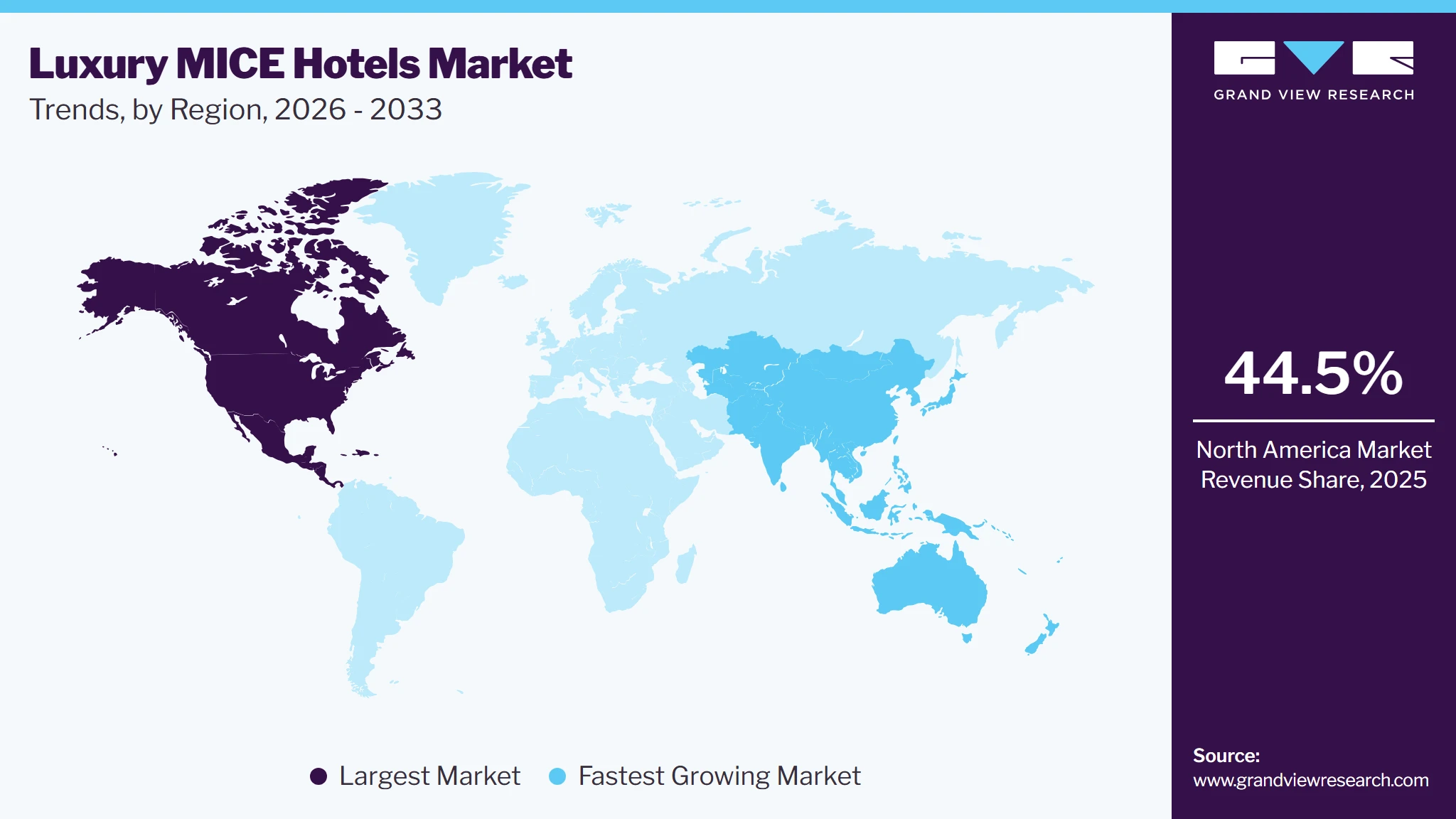
The North American luxury MICE hotels industry accounted for the largest share of 44.5% in 2025. The North American luxury MICE hotels market is increasingly shaped by the demand for high-impact in-person experiences, flexible event infrastructure, and personalized service. Meeting planners are placing greater emphasis on attendee engagement and venue differentiation, with 32% of North American planners identifying attendee engagement as their leading event success metric, while flexibility of event space has emerged as a major venue-selection consideration. This is encouraging luxury hotels to move beyond traditional ballroom-centric offerings and develop adaptable indoor-outdoor venues, experiential F&B programs, advanced event technology, and curated destination experiences.
 To learn more about this report, Download Free Sample Report
 North America's best new MICE hotels, 2026
Rank
Hotel
1
AC Hotel Scottsdale Old Town
2
Casa Mani Resort Napa Valley, Curio Collection by Hilton
3
Hilton Arcadia Los Angeles
4
JW Marriott Reston Station
5
Naples Beach Club, A Four Seasons Resort
6
The Cooper
Source: World MICE Awards - North America's Best New MICE Hotel 2026
Major destinations such as Orlando, Las Vegas, Chicago, Nashville, and San Diego continue to anchor regional MICE activity, supported by extensive hospitality infrastructure and destination appeal. The North American luxury MICE hotels market is evolving toward an experience-centric model, where flexibility, responsiveness, technology, and differentiated guest experiences are becoming increasingly important alongside traditional luxury accommodation and meeting capacity.
U.S. Luxury MICE Hotels Market Trends
The U.S. luxury MICE hotels market accounted for the largest share of 86.9% in 2025. The luxury MICE hotels market is increasingly characterized by higher corporate meeting expenditure, continued reliance on hotel-based events, and growing demand for personalized and experience-led gatherings. The preference for seamless planning and communication is also influencing the MICE experience. In a U.S. survey, 71% of respondents wanted to receive an event agenda in advance, 61% valued a welcome greeting, and 59% preferred the ability to communicate with an event contact through text messaging. These preferences reinforce the role of high-touch service and digital convenience within the luxury hotel segment. Properties are increasingly required to provide dedicated event teams, responsive communication, personalized guest support, and technology-enabled event management throughout the attendee journey.
The Mexico luxury MICE hotels market is expected to grow at a CAGR of 6.5% from 2026 to 2033, supported by proximity to the U.S. and Canada, international connectivity, and established luxury hospitality infrastructure. Key destinations such as Mexico City, Cancún, Riviera Maya, Los Cabos, and Puerto Vallarta attract corporate meetings, conferences, incentive travel, and executive retreats. Luxury hotels differentiate through beachfront venues, wellness, premium F&B, cultural experiences, and customized event programs. Growing demand for experiential incentives and destination-led corporate events supports market opportunities. However, seasonality, accessibility differences between destinations, security perceptions, and event costs remain key considerations for international planners evaluating Mexico for luxury MICE programs.
Asia Pacific Luxury MICE Hotels Market Trends
The Asia Pacific luxury MICE hotels market is expected to grow at a CAGR of 7.9 % from 2026 to 2033, supported by the continued expansion of corporate travel, international business events, incentive programs, and demand for high-quality meeting infrastructure across major business hubs and leisure destinations. In 2025, Asia Pacific business travel was projected to reach USD 679 billion, representing 10.9% growth from 2024, highlighting the region's expanding corporate travel base. China, Japan, South Korea, India, and Australia were among the world's largest business travel markets, while South Korea, India, Australia, and Japan were expected to record some of the strongest growth rates in business travel spending during the year. This expanding volume of corporate travel is supporting demand for luxury hotels that can provide integrated accommodation, executive services, premium meeting facilities, and personalized event experiences. The outlook for the hotel MICE segment was particularly positive in 2025.
The India luxury MICE hotels market is expected to grow at a CAGR of 9.6% from 2026 to 2033. India is emerging as one of the region's most significant growth markets for luxury business and MICE travel. India's business travel spending was projected to reach USD 43.0 billion in 2025, reflecting approximately 15% annual growth, while GBTA's 2026 outlook projected spending to increase further to USD 48.3 billion, representing 12.5% growth. India ranked sixth globally in business travel spending, supported by the expansion of its technology, professional services, manufacturing, and multinational corporate sectors. In addition, 69% of Indian travel buyers reported growth in domestic business travel programs, while 68% indicated growth in international programs, creating opportunities for luxury hotels across major corporate centers such as Mumbai, Delhi NCR, Bengaluru, Hyderabad, and other emerging business destinations.
China luxury MICE hotels market accounted for a revenue share of around 57.2 % of the Asia Pacific market in 2025, supported by its large corporate sector, developed business infrastructure, and extensive luxury hotel supply. Major destinations such as Beijing, Shanghai, Guangzhou, Shenzhen, Chengdu, and Hangzhou attract corporate meetings, conferences, exhibitions, and incentive programs. Luxury hotels increasingly differentiate through premium venues, personalized event planning, fine dining, wellness, cultural experiences, and technology-enabled meetings. China’s expanding international connectivity and continued development of its MICE infrastructure create opportunities for high-value business events. However, regulatory requirements, travel considerations, digital-platform differences, and strong competition among leading cities remain important factors influencing market development.
Europe Luxury MICE Hotels Market Trends
The Europe luxury MICE hotels industry accounted for a revenue share of 29.1% of the global market in 2025. The region combines established financial and commercial centers, extensive air and rail connectivity, sophisticated convention infrastructure, and a high concentration of luxury hospitality assets, enabling hotels to serve corporate meetings, incentive programs, conferences, exhibitions, and executive gatherings. Cvent reported more than USD 18 billion in global MICE sourcing and RFP activity in 2024, including a record USD 16.5 billion through its Supplier Network. In addition, nearly 60% of European meeting planners anticipated an increase in in-person meetings in 2025, supporting continued demand for high-end hotels with integrated accommodation, meeting facilities, dining, and event services. Key destinations, including London, Frankfurt, Paris, Barcelona, and Madrid, remain important business-event markets, strengthening the addressable opportunity for luxury MICE properties.
Germany luxury MICE hotels market accounted for a revenue share of around 20.8 % of the Europe market in 2025. International demand is also strengthening the market opportunity. Germany retained its position as the world’s leading business-travel destination in 2025, with a 10% global market share, while international organizers accounted for 11.7% of event organizers, up from 9.9% in 2024. The UK, Austria, the U.S., Switzerland, and the Netherlands were among the leading source markets for international organizers, supporting demand for internationally oriented luxury hotels with multilingual services, premium meeting infrastructure, and integrated accommodation and event solutions. Italy's luxury hotel market is expanding through new international luxury brands and high-end hotel developments across major business and leisure destinations.
The Italian luxury MICE hotels market is expected to grow at a CAGR of 4.4% from 2026 to 2033, supported by international connectivity, diverse venues, and a strong luxury hospitality base. Rome, Milan, Florence, Venice, and Turin attract corporate meetings, conferences, incentives, and exhibitions. Luxury hotels benefit from Italy’s heritage, fashion, art, wellness, and distinctive venues, enabling personalized and experiential corporate programs. Demand is increasingly shifting toward destination-led incentives, customized experiences, sustainability, and bleisure travel. Italy’s established convention infrastructure and destination-management ecosystem further support international events. However, seasonality, high operating costs, infrastructure constraints in certain destinations, and competition from other European MICE markets remain key considerations for luxury hotels.
Central & South America Luxury MICE Hotels Market Trends
The Central & South America luxury MICE hotels market is expected to grow at a CAGR of 5.8% from 2026 to 2033. The market is increasingly shaped by the concentration of corporate activity in major metropolitan centers and the expansion of international business events. In 2025, Latin America's business travel expenditure was projected to reach USD 63.9 billion, with Brazil ranking among the world's 10 largest business travel markets, highlighting the region's substantial base of corporate travelers. Within Central and South America, cities such as São Paulo, Rio de Janeiro, Buenos Aires, Santiago, Bogotá, and Lima are strengthening their positions as business-event destinations, supported by international connectivity, corporate headquarters, convention infrastructure, and established luxury hotel supply. This environment is encouraging five-star hotels to expand their MICE propositions through larger and more flexible meeting spaces, executive accommodation, advanced audiovisual facilities, customized catering, and dedicated business-event services, particularly for multinational companies, associations, and high-level corporate groups.
The Brazil luxury MICE hotels market is expected to grow at a CAGR of 5.9% from 2026 to 2033. Brazil represents the largest opportunity within the Central and South America luxury MICE hotels market. The country's position has strengthened considerably as international meetings and business events have expanded across several major cities. Brazil rose into the global top 15 destinations for international association meetings, while remaining the leading Latin American destination in the latest ICCA rankings. The country also recorded more than 8 million international visitors in 2025, strengthening the underlying international travel ecosystem supporting business events. São Paulo and Rio de Janeiro remain particularly important because of their large corporate bases, extensive exhibition and convention infrastructure, and concentration of internationally branded luxury hotels.
Middle East & Africa Luxury MICE Hotels Market Trends
The Middle East & Africa luxury MICE hotels market is expected to grow at a CAGR of 6.3% from 2026 to 2033. The Middle East & Africa luxury MICE hotels market is developing rapidly as business-event activity becomes an increasingly important component of the region's hospitality industry. The market is supported by the expansion of international conferences, exhibitions, corporate meetings, incentive programs, government-led events, and large-scale business gatherings. In 2025, the Middle East's business travel spending was estimated at USD 18.1 billion, with spending expected to increase by 6.1% during 2025, creating a favorable demand environment for high-end business hotels with dedicated meeting and event infrastructure.
South Africa luxury MICE hotels market is expected to grow at a CAGR of 5.3% from 2026 to 2033. South Africa is one of the leading MICE markets in Africa, with Johannesburg and Cape Town serving as the country's principal business-event centers. The market is supported by established convention infrastructure, international connectivity, a broad supply of internationally branded luxury hotels, and a growing pipeline of international conferences and corporate events. In 2025, the South African National Convention Bureau had submitted 81 bids for international business events since April 2024 and had secured 53 events scheduled between 2024 and 2029. These confirmed events are expected to generate approximately R617 million in economic impact and attract more than 24,000 delegates, creating sustained demand for high-end accommodation, meeting facilities, catering, and event services. In July 2025, Hyatt expanded its luxury presence in South Africa with the opening of Park Hyatt Johannesburg in the Rosebank district. The opening strengthens the city's high-end hotel offering for executive and corporate travelers and contributes to the development of Johannesburg's luxury hospitality ecosystem serving the MICE segment.
Key Luxury MICE Hotel Companies:
The following key companies have been profiled for this study on the luxury MICE hotels market.
-
Four Seasons Hotels Limited
-
Mandarin Oriental International Limited
-
Auberge Resorts, LLC
-
Banyan Tree Hotels & Resorts Pte. Ltd.
-
Rosewood Hotel Group
-
The Ritz-Carlton Hotel Company, L.L.C.
-
St. Regis Hotels & Resorts
-
Raffles Hotels & Resorts
-
Waldorf Astoria Hotels & Resorts
-
The Peninsula Hotels
-
Fairmont Hotels Limited
-
Hyatt Corporation
-
The Luxury Collection
-
Preferred Travel Group
Competitive Benchmarking
Category
Operating Strategies
Competitive Edge
Weakness
Four Seasons Hotels Limited, Mandarin Oriental International Limited, Rosewood Hotel Group, The Ritz-Carlton Hotel Company, L.L.C., St. Regis Hotels & Resorts, Raffles Hotels & Resorts, Waldorf Astoria Hotels & Resorts, The Peninsula Hotels, Fairmont Hotels Limited, Hyatt Corporation, The Luxury Collection
Focus on expanding and upgrading dedicated MICE infrastructure, including ballrooms, breakout rooms, flexible meeting spaces, premium AV, and business facilities. Strengthen relationships with corporate planners through dedicated sales teams, loyalty programs, planner incentives, group packages, and centralized event-management capabilities
Strong global brand recognition, established corporate relationships, and extensive property networks provide access to multinational meetings, conferences, and incentive programs. Established sales infrastructure, loyalty ecosystems, and long-standing planner relationships generate repeat group business and cross-property opportunities.
Large organizational structures and extensive portfolios can increase operating complexity, coordination requirements, and decision-making time. Premium positioning can make group packages less attractive to price-sensitive corporate clients and smaller organizations.
Auberge Resorts, LLC, Banyan Tree Hotels & Resorts Pte. Ltd., Preferred Travel Group
Focus on differentiated, destination-led MICE propositions that combine boutique luxury accommodation with distinctive venues, local culture, wellness, and experiential activities. Target specialized segments such as incentive travel, executive retreats, corporate offsites, luxury weddings, and small-to-mid-sized meetings.
Greater flexibility enables emerging luxury hotels to customize event programs and respond quickly to client-specific requirements. Distinctive architecture, local experiences, wellness offerings, and destination settings provide differentiation from standardized large hotel venues.
Smaller geographic footprints and room/event inventories can restrict their ability to accommodate large multinational conferences and complex multi-property programs. Dependence on destination appeal and niche positioning increases exposure to seasonality, accessibility constraints, and changes in travel preferences.
Recent Developments
-
In June 2026, Mandarin Oriental announced the opening of Mandarin Oriental Makati, Manila, scheduled for late 2026, marking the brand's return to the Philippine capital. Developed in partnership with Ayala Land, the 275-room luxury hotel will feature versatile event spaces for business gatherings and celebrations. Its MICE facilities will include a 740-sq.-m. Grand Hall with an 8-meter ceiling and capacity for up to 1,000 guests, supported by flexible function rooms, meeting rooms, and a boardroom.
-
In August 2026, Banyan Group announced the opening of Banyan Tree Mount Emei in Sichuan Province, China, expanding its luxury resort portfolio in the region. The resort features more than 1,200 sq. m. of flexible indoor and outdoor event space, including a 500-sq.-m. pillarless ballroom, garden terrace, forest platform, and six multifunctional rooms. The development strengthens Banyan Tree’s luxury MICE offering by providing dedicated facilities for meetings, corporate gatherings, incentive programs, and private events in a destination setting.
-
In December 2025, Mandarin Oriental opened Mandarin Oriental Downtown, Dubai, introducing a new luxury hospitality destination with a strong focus on meetings and events. The property features more than 2,000 sq. m. of flexible indoor event space, including a 1,000-sq.-m. Oriental Ballroom and eight meeting rooms equipped with audiovisual technology. The development strengthens Mandarin Oriental’s luxury MICE offering in Dubai by providing dedicated infrastructure for corporate meetings, conferences, incentive programs, and high-end events.
Luxury MICE Hotels Market Report Scope
Report Attribute
Details
Market size in 2025
USD 23.8 billion
Estimated market size in 2026
USD 25.3 billion
Projected market size by 2033
USD 37.4 billion
Growth rate
CAGR of 5.7% from 2026 to 2033
Base year for estimation
2025
Historical data
2021-2024
Forecast period
2026 - 2033
Quantitative units
Revenue in USD million/billion and CAGR from 2026 to 2033
Report coverage
Revenue forecast, company ranking, competitive landscape, growth factors, and trends
Segments covered
Hotel type, event type, meeting size, event theme, booking mode, region
Regional scope
North America; Europe; Asia Pacific; Central & South America; Middle East & Africa
Country scope
U.S.; Canada; Mexico; UK; Germany; France; Italy; Spain; China; India; Japan; South Korea; Australia & New Zealand; Brazil; South Africa
Key companies profiled
Four Seasons Hotels Limited; Mandarin Oriental International Limited; Auberge Resorts, LLC; Banyan Tree Hotels & Resorts Pte. Ltd.; Rosewood Hotel Group; The Ritz-Carlton Hotel Company, L.L.C.; St. Regis Hotels & Resorts; Raffles Hotels & Resorts; Waldorf Astoria Hotels & Resorts; The Peninsula Hotels; Fairmont Hotels Limited; Hyatt Corporation; The Luxury Collection; Preferred Travel Group
Customization scope
Free report customization (equivalent up to 8 analysts working days) with purchase. Addition or alteration to country, regional & segment scope.
Pricing and purchase options
Avail customized purchase options to meet your exact research needs. Explore purchase options
Global Luxury MICE Hotels Market Report Segmentation
This report forecasts revenue growth at the global, regional & country levels and analyzes the latest trends and opportunities in each sub-segment from 2021 to 2033. For this study, Grand View Research has segmented the luxury MICE hotels market based on hotel type, event type, meeting size, event theme, booking mode, and region.
-
Hotel Type Outlook (Revenue, USD Million, 2021 - 2033)
-
5-Star Luxury Hotels
-
Ultra-Luxury Hotels
-
-
Event Type Outlook (Revenue, USD Million, 2021 - 2033)
-
Meetings
-
Incentives
-
Conferences
-
Exhibitions
-
-
Meeting Size Outlook (Revenue, USD Million, 2021 - 2033)
-
0 to 50
-
From 50 to 149
-
From 150 to 249
-
From 250 to 499
-
From 500 to 999
-
From 1000 to 1999
-
From 2000 to 2999
-
3000 & Above
-
-
Event Theme Outlook (Revenue, USD Million, 2021 - 2033)
-
Pharmaceutical & Biotechnology
-
Scientific & Academic Research (STM)
-
Technology & Digital Innovation
-
Finance, Investment & Banking
-
Engineering
-
Manufacturing & Industrial Technologies
-
Trade & Industry Exhibitions
-
Others
-
-
Booking Mode Outlook (Revenue, USD Million, 2021 - 2033)
-
Direct Booking
-
Online Travel Agents and Agencies (OTAs)
-
Destination Management Companies (DMCs)
-
Travel Management Companies (TMCs)
-
Others
-
-
Regional Outlook (Revenue, USD Million, 2021 - 2033)
-
North America
-
U.S.
-
Canada
-
Mexico
-
-
Europe
-
UK
-
Germany
-
France
-
Italy
-
Spain
-
-
Asia Pacific
-
China
-
India
-
Japan
-
South Korea
-
Australia & New Zealand
-
-
Central & South America
-
Brazil
-
-
Middle East & Africa
-
South Africa
-
-
Research Methodology
The luxury MICE hotels market figures in this report are based on a proven research process that combines executive interviews with secondary research from proprietary databases, company filings, and recognized regulatory and institutional sources. Market size is built through value-chain sizing-reconciling supply-side and demand-side estimates-and triangulated with bottom-up and top-down approaches. Every estimate passes multiple levels of expert validation before publication, with each luxury MICE hotels segment quantified using the revenue-capture definitions in the table below.
Segment Definition
Segment - Event Type
Revenue capture definition
Meetings
This segment includes luxury hotel revenue generated from small- to medium-sized corporate or organizational meetings, including board meetings, executive meetings, business meetings, workshops, training sessions, and similar gatherings that use the hotel's accommodation, meeting spaces, food and beverage, and related services.
Incentives
This segment includes luxury hotel revenue generated from corporate incentive programs and reward trips, including accommodation, private events, gala dinners, exclusive experiences, meetings, and other premium hotel services provided to employees, sales teams, business partners, or clients as part of an incentive program.
Conferences
This segment includes luxury hotel revenue generated from conferences, congresses, conventions, and other structured business or professional gatherings requiring meeting facilities, accommodation, catering, audiovisual services, breakout rooms, and related hotel services.
Exhibitions
This segment includes luxury hotel revenue generated from exhibitions, trade shows, product showcases, industry expos, and related events hosted at or supported by luxury hotels, including accommodation, meeting or event space, catering, and other associated hotel services.
Estimation Model
Layer
Key Question
Description
Relevant Corporate & MICE Demand Layer
Which organizations and business groups generate demand for luxury MICE hotels?
Begin with the relevant corporate and business-event population. Filter based on organizations that conduct meetings, incentive programs, conferences, product launches, and business gatherings. Consider company size, industry, travel budgets, frequency of events, international business activity, and preference for premium hospitality.
Luxury Hotel Accessibility & Venue Availability Layer
Which potential MICE buyers can access suitable luxury hotels and event facilities?
Filter the relevant corporate demand based on access to luxury hotels, resorts, convention facilities, meeting rooms, ballrooms, breakout spaces, and premium F&B, AV infrastructure, and accommodation capacity. Consider destination accessibility, international connectivity, hotel presence, venue capacity, geographic coverage, availability during peak periods, and suitability for different event formats.
MICE Booking & Conversion Layer
Which accessible corporate buyers actually book luxury MICE hotels?
Apply booking and adoption rates to the accessible corporate demand base. Consider event frequency, corporate travel budgets, average group size, destination preference, luxury-hotel preference, booking lead times, repeat-event behavior, and type of MICE activity. Segment demand across meetings, incentives, conferences, exhibitions, executive retreats, and corporate offsites.
Monetisation Layer
How much revenue is generated from luxury MICE hotel bookings?
Multiply the number of MICE bookings or participating delegates by average room revenue, meeting-space revenue, and ancillary spending. Consider event duration, number of delegates, room nights, AV and production services, and premium experiences. Calculate separately by MICE type, hotel category, destination, event size, and corporate customer segment.
Delivered Customizations
This report has been delivered with the following In-depth customizations
Client Request
Customization Delivered
Value Adds
Luxury MICE Hotels Market & Service Trend Analysis
Conducted a detailed assessment of the luxury MICE hotel landscape, covering meetings, incentives, conferences, exhibitions, executive retreats, corporate offsites, and business events. The analysis evaluates luxury hotel positioning, meeting infrastructure, ballroom and breakout capacity, premium F&B, event planning, AV and digital capabilities, wellness offerings, sustainability initiatives, and destination-led experiences.
Helps stakeholders identify high-value MICE opportunities, understand evolving corporate event requirements, evaluate luxury hotel service differentiation, and develop strategies around premium venues, personalized event planning, technology, wellness, sustainability, and experiential offerings.
Corporate & Regional Demand Analysis
Evaluated luxury MICE demand across North America, Europe, Asia Pacific, Central & South America, and Middle East & Africa by assessing corporate activity, business travel, event frequency, destination attractiveness, international connectivity, luxury hotel availability, corporate travel budgets, and demand for meetings, incentives, conferences, and exhibitions. Regional analysis was further developed for key countries and major MICE destinations.
Provides insights into regional and country-level demand opportunities, supports market-entry and expansion strategies, and enables luxury hotel operators to tailor venue capacity, service offerings, pricing, destination experiences, and sales strategies to local corporate-event requirements.
Technology, Distribution & Competitive Landscape Assessment
Assessed developments in digital event planning, hybrid and virtual meeting capabilities, event-management platforms, AV infrastructure, personalized planning tools, sustainability solutions, wellness-led meetings, and premium event experiences. The analysis also evaluated direct hotel sales, corporate travel agencies, TMCs, DMCs, OTAs, and MICE booking platforms, alongside major luxury hotel groups, brand portfolios, venue capabilities, and competitive positioning.
Supports long-term investment and competitive-positioning decisions by identifying technology opportunities, high-potential distribution channels, corporate partnership opportunities, differentiated MICE services, and emerging revenue pools across the luxury hotel market.
Frequently Asked Questions About This Report
Higher incentive-travel budgets are increasingly supporting premium demand within the luxury MICE hotel market, as companies allocate more money to accommodation, dining, and high-value experiences for qualified employees and partners.
Key players in the luxury MICE hotels market are Four Seasons Hotels Limited, Mandarin Oriental International Limited, Auberge Resorts, LLC, and Banyan Tree Hotels & Resorts Pte. Ltd.; Rosewood Hotel Group; The Ritz-Carlton Hotel Company, L.L.C.; St. Regis Hotels & Resorts; Raffles Hotels & Resorts; Waldorf Astoria Hotels & Resorts; The Peninsula Hotels; Fairmont Hotels Limited; Hyatt Corporation; The Luxury Collection; Preferred Travel Group.
Asia Pacific is the fastest-growing region over the forecasted period.
Meetings accounted for the largest market share of 34.3% in 2025, while incentives is the fastest-growing segment.
Technology & digital innovation accounted for the largest market share of 18.0% in 2025, while pharmaceutical & biotechnology is the fastest-growing segment.
The luxury MICE hotels market size was valued at USD 23.8 billion in 2025 and is estimated at USD 25.3 billion in 2026.
The luxury MICE hotels market is expected to grow at a CAGR of 5.7% from 2026 to 2033, reaching USD 37.4 billion by 2033.
5-Star Luxury Hotels accounted for the largest market share of 77.3% in 2025, while ultra-luxury hotels segment is the fastest-growing hotel type.
North America dominated the market, accounting for a revenue share of 44.5% in 2025.
About the Author(s)
Homecare & Decor Research Team
Consumer Goods · Homecare & DecorThis report was authored by the homecare & decor research team at Grand View Research - comprising two research analysts, one senior research analyst, and one industry expert - with specialized expertise in the homecare & decor segment of the consumer goods industry. All findings are based on proprietary consumer goods databases, executive interviews, and regulatory analysis, subject to internal peer review prior to publication.
Last Updated:
Speak to Analyst

Customize this report to your needs - add regions, segments, or data points, with 20% free customization.
Or view our licence options:


ISO 9001:2015 & 27001:2022 Certified
We are GDPR and CCPA compliant! Your transaction & personal information is safe and secure. For more details, please read our privacy policy.


