
- Home
- »
- Next Generation Technologies
- »
-
Maritime Patrol Aircraft Market Size, Share Report 2026-2033GVR Report cover

Maritime Patrol Aircraft Market (2026 - 2033)
Size, Share & Trends Analysis Report By Type (Unarmored, Armored), By Propulsion (Jet Engine, Electric Propulsion), By End-use (Naval Forces, Coast Guards, Government & Security Agencies), By Application, By Region, And Segment Forecasts
Market Size, 2025
$10.2BMarket Estimate, 2026
$10.8BMarket Forecast, 2033
$16.1BCAGR, 2026–2033
5.9%Maritime Patrol Aircraft Market Summary
The global maritime patrol aircraft market size was valued at USD 10.2 billion in 2025 and is projected to grow from USD 10.8 billion in 2026 to USD 16.1 billion by 2033, at a CAGR of 5.9% from 2026 to 2033. North America dominated the market, accounting for the largest revenue share of 36.3% in 2025. The industry’s strong position is driven by growing demand for advanced maritime surveillance and reconnaissance capabilities, increasing procurement of next-generation patrol aircraft, rising adoption of advanced radar, EO/IR, and electronic warfare systems, growing requirements for anti-submarine and anti-surface warfare capabilities, and continued investments by naval and coast guard forces in strengthening maritime domain awareness and protecting territorial waters.
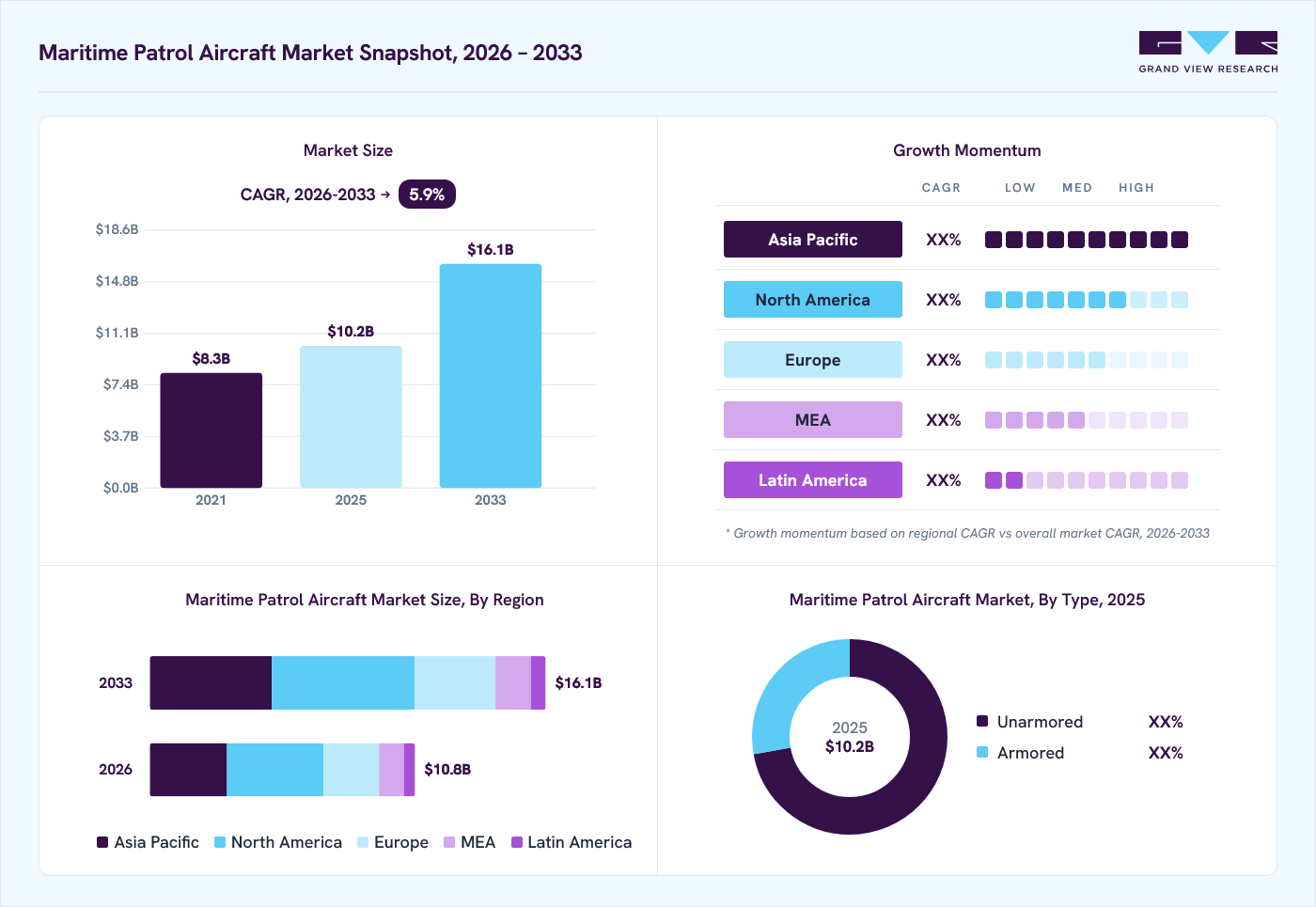 Source: Grand View Research, IR Documents, Primary Interviews, Paid DatabasesTo learn more about this report,
 Download Free Sample Report
Key Market Trends & Insights
- By type: Unarmored segment led the market and held the largest revenue share of over 72.1% in 2025.
- By propulsion: Jet engine segment led the market and held the largest revenue share of over 84.8% in 2025.
- By Application: Anti-Submarine Warfare (ASW) segment dominated with 45.6% share in 2025
- By End use: Naval forces segment contributed 60.6% share in 2025
Regional Highlights
- Largest regional market: North America (36.3% revenue share, 2025)
- Fastest-growing regional market: Asia Pacific (highest CAGR, 2026-2033)
- By country: The U.S. held the largest market share in 2025
Market Size & Forecast
- Market Size in 2025: USD 10.2 billion
- Estimated Market Size in 2026: USD 10.8 billion
- Projected market size by 2033: USD 16.1 billion
- CAGR (2026-2033): 5.9%
Prism AI by Grand View Research Free to tryAsk a question about the maritime patrol aircraft marketTry asking✓Every figure cited from GVR research Prefer the report? Download free sample →
The demand for maritime patrol aircraft is increasing as naval forces, coast guards, and government agencies strengthen maritime surveillance, reconnaissance, anti-submarine warfare, and maritime domain awareness capabilities. Governments are investing in long-range patrol aircraft equipped with advanced radar, electro-optical/infrared (EO/IR) sensors, acoustic systems, magnetic anomaly detectors, electronic support measures, and secure communication systems to enable persistent monitoring of territorial waters, exclusive economic zones (EEZs), and strategic sea lanes.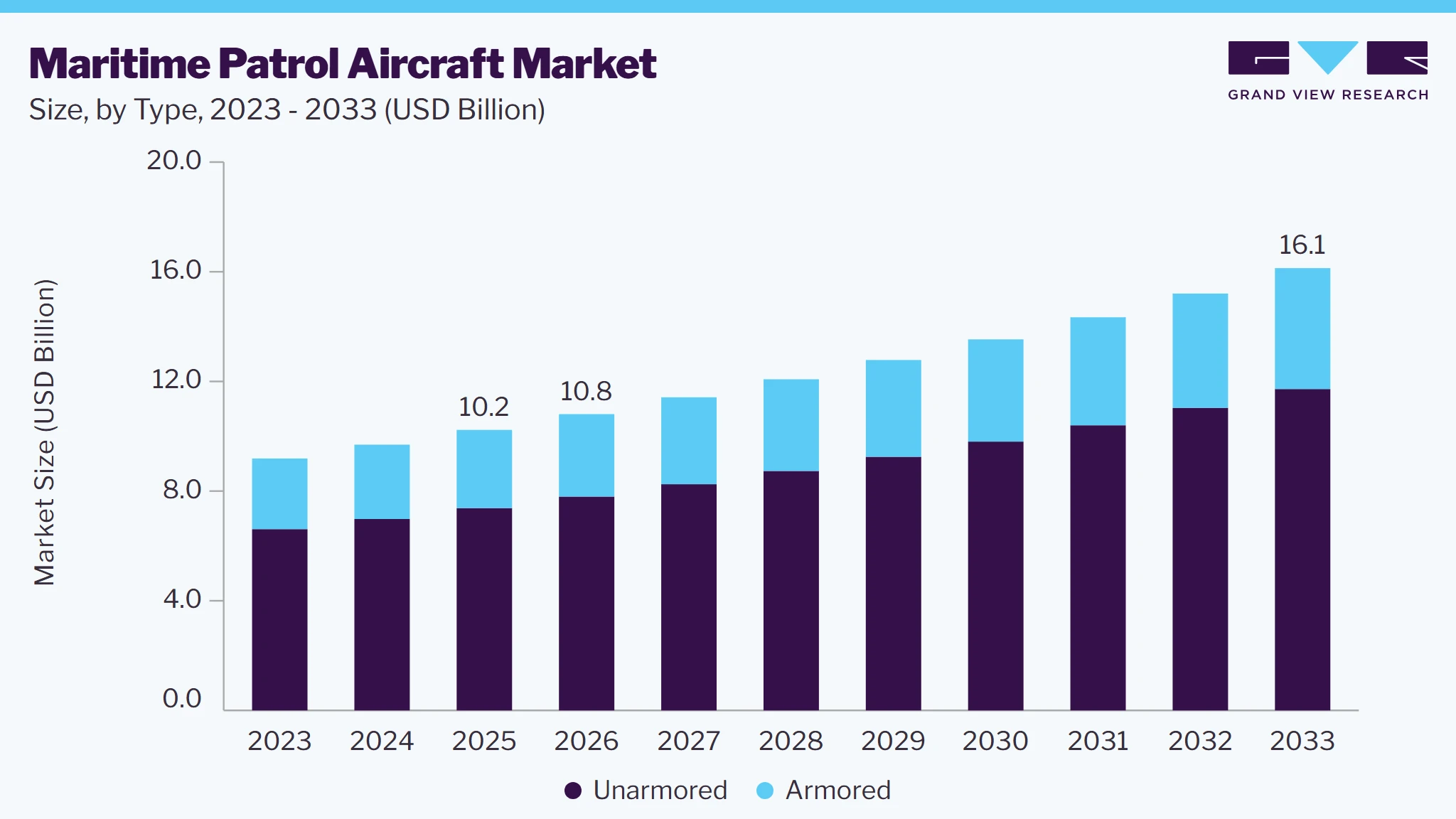 To learn more about this report, Download Free Sample Report
At the same time, the growing adoption of AI, machine learning, sensor fusion, and real-time data processing is enhancing threat detection, target classification, predictive mission planning, and decision-making, while the integration of unmanned systems and network-centric technologies is enabling extended surveillance coverage and coordinated maritime operations. These developments are strengthening demand for advanced, multi-mission, long-endurance, and highly connected maritime patrol aircraft.
Market Dynamics
The maritime patrol aircraft market is experiencing significant growth, driven by rising maritime security requirements, increasing investments in naval modernization, growing demand for persistent maritime surveillance, and the expanding deployment of advanced multi-mission patrol aircraft. Naval forces, coast guards, and government agencies are investing in long-range maritime patrol aircraft equipped with advanced radar, electro-optical/infrared (EO/IR) sensors, electronic support measures (ESM), acoustic systems, secure communications, and mission management systems to strengthen maritime domain awareness. The growing adoption of AI, sensor fusion, unmanned systems, and real-time data processing is further supporting market growth. However, high aircraft procurement and lifecycle costs, complex system integration, lengthy procurement cycles, and stringent regulatory and defense requirements remain key challenges. At the same time, advancements in autonomous systems, AI-enabled mission systems, next-generation sensors, satellite communications, and network-centric warfare are creating significant opportunities for market participants.
The maritime patrol aircraft market is primarily driven by the increasing need for persistent maritime surveillance, reconnaissance, and maritime domain awareness. Naval forces and coast guards are deploying advanced patrol aircraft to monitor territorial waters, exclusive economic zones (EEZs), strategic sea lanes, and offshore assets. Growing concerns over submarine activities, illegal fishing, smuggling, piracy, territorial disputes, and other maritime security threats are prompting governments to strengthen airborne surveillance capabilities. In parallel, the integration of advanced radar, EO/IR sensors, electronic intelligence, acoustic systems, and secure communications enables real-time detection, identification, tracking, and classification of maritime targets, further supporting market expansion.
Despite strong growth prospects, the maritime patrol aircraft market faces challenges stemming from the high acquisition, integration, operational, and lifecycle costs of advanced patrol aircraft. Modern maritime patrol platforms require sophisticated radar systems, EO/IR sensors, electronic warfare equipment, communication systems, acoustic processing systems, mission computers, and other specialized equipment, significantly increasing overall procurement costs. Integrating these systems with existing naval command-and-control networks, weapons systems, communication infrastructure, and legacy platforms can also involve considerable technical complexity. In addition, lengthy defense procurement cycles, stringent certification requirements, limited defense budgets in emerging economies, and high maintenance costs can delay aircraft acquisition and fleet modernization programs.
The increasing adoption of AI, machine learning, autonomous systems, sensor fusion, advanced radar, EO/IR technologies, and real-time data analytics is creating significant opportunities in the maritime patrol aircraft industry. AI-enabled mission systems can process data from multiple sensors to support automated target detection, classification, threat assessment, anomaly detection, and mission planning, enabling faster operational decision-making. The integration of unmanned aerial systems with manned maritime patrol aircraft can further expand surveillance coverage, endurance, and operational flexibility. Additionally, advancements in long-range sensors, satellite communications, secure data links, digital mission systems, and network-centric operations are enabling greater interoperability between maritime patrol aircraft, naval vessels, satellites, UAVs, and command centers, creating long-term opportunities for aircraft OEMs, defense contractors, sensor manufacturers, avionics providers, and mission-system suppliers.
Market Concentration & Characteristics
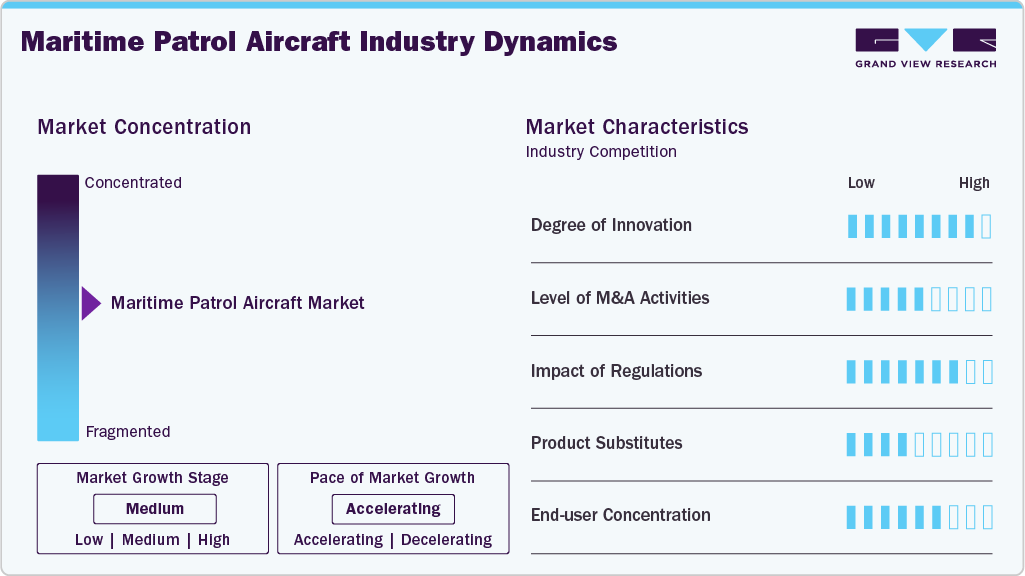
The maritime patrol aircraft market is moderately concentrated, with competition led by established aerospace, defense, aircraft manufacturing, avionics, and mission-system companies. The market is characterized by continuous advancements in maritime surveillance, airborne radar, electro-optical/infrared (EO/IR) sensors, electronic support measures (ESM), acoustic systems, secure communications, mission management systems, and AI-enabled data processing. High aircraft development and integration costs, stringent defense and aviation requirements, complex mission-system integration, long procurement cycles, and the need for advanced technological capabilities create significant barriers to entry. These factors enable established defense and aerospace companies to maintain strong competitive positions through technological innovation, strategic partnerships, government contracts, aircraft upgrades, and long-term defense procurement programs.
 To learn more about this report, Download Free Sample Report
Major players such as the Boeing Company, Lockheed Martin, Airbus, Northrop Grumman, Leonardo, Saab, Dassault Aviation, Embraer, and Kawasaki Heavy Industries are strengthening their positions in the maritime patrol aircraft industry through investments in next-generation patrol aircraft, advanced radar and sensor systems, electronic warfare capabilities, secure communications, and integrated mission systems. Companies are increasingly focused on extending aircraft endurance, improving surveillance range, enhancing target detection and classification, integrating AI-enabled analytics, and enabling real-time data sharing across maritime defense networks. As naval forces and coast guards continue to prioritize maritime domain awareness, anti-submarine warfare, coastal security, and persistent surveillance, the market is expected to witness sustained investment, strategic collaborations, fleet modernization, and technology development.
Analyst Perspective
The maritime patrol aircraft market is poised for strong growth, driven by increasing maritime security requirements, rising demand for persistent surveillance, and growing investments in naval and coast guard modernization programs. Governments are investing in advanced maritime patrol aircraft equipped with long-range radar, electro-optical/infrared (EO/IR) sensors, electronic support measures (ESM), acoustic systems, secure communications, and integrated mission systems to strengthen maritime domain awareness, monitor territorial waters, and address emerging maritime threats. The increasing focus on anti-submarine warfare, anti-surface warfare, coastal security, and exclusive economic zone (EEZ) monitoring is further supporting demand for advanced patrol aircraft. Furthermore, the integration of AI, machine learning, sensor fusion, autonomous systems, real-time data processing, and advanced mission analytics is transforming maritime patrol operations.
Type Insights
The unarmored segment held a significant share of over 72.1% of the maritime patrol aircraft market in 2025, driven by the widespread deployment of specialized maritime surveillance and mission systems, including airborne maritime radar, electro-optical/infrared (EO/IR) sensors, electronic support measures (ESM), acoustic processing systems, magnetic anomaly detection (MAD) systems, mission computers, and secure communication systems. These systems are essential for persistent maritime surveillance, real-time intelligence collection, target detection and tracking, anti-submarine warfare, maritime domain awareness, and monitoring of territorial waters and exclusive economic zones (EEZs).
The armored segment is expected to witness significant growth during the forecast period, driven by increasing demand for maritime patrol aircraft equipped with enhanced protection, integrated weapons systems, and anti-surface and anti-ship engagement capabilities. Rising geopolitical tensions, territorial disputes, and the growing need for aircraft capable of operating in contested maritime environments are encouraging naval forces to invest in armored and combat-oriented patrol platforms.
Propulsion Insights
The jet engine segment accounted for 84.8% revenue share in 2025, making it the dominant propulsion. Its leading position is supported by the widespread use of jet-powered maritime patrol aircraft for long-range surveillance, rapid deployment, anti-submarine warfare, anti-surface warfare, and intelligence, surveillance, and reconnaissance (ISR) missions. Jet engines offer higher cruising speeds, extended operational range, and strong performance for large-area maritime surveillance, supporting their adoption across modern naval and defense fleets.
The electric propulsion segment is expected to grow steadily during the forecast period, supported by increasing investments in hybrid-electric and electric propulsion technologies for next-generation maritime surveillance platforms. These propulsion systems offer potential advantages such as lower operating costs, reduced acoustic signatures, improved endurance, and greater loitering capabilities, making them increasingly attractive for long-duration maritime surveillance missions. Continued R&D in hybrid-electric propulsion and its integration into unmanned and long-endurance platforms is expected to support segment growth.
Application Insights
The Anti-Submarine Warfare (ASW) segment dominated with 45.6% share of the global maritime patrol aircraft industry in 2025, making it the leading application segment. Its strong position is driven by increasing submarine activity, growing investments in naval modernization, and rising requirements for long-range detection and tracking of underwater threats. Maritime patrol aircraft equipped with advanced acoustic systems, sonobuoys, maritime surveillance radar, magnetic anomaly detectors (MAD), and electronic support measures are increasingly deployed for persistent submarine surveillance and threat identification.
The maritime surveillance & reconnaissance segment is expected to grow notably, supported by growing requirements for persistent maritime domain awareness, wide-area surveillance, and real-time intelligence collection. Demand is increasing for patrol aircraft equipped with advanced maritime radar, EO/IR sensors, electronic support measures (ESM), secure communications, AIS, and integrated mission systems to detect, identify, and track vessels and other maritime threats. Rising territorial disputes, illegal fishing, smuggling, piracy, and the need to monitor exclusive economic zones (EEZs) are further strengthening demand for airborne surveillance capabilities.
End Use Insights
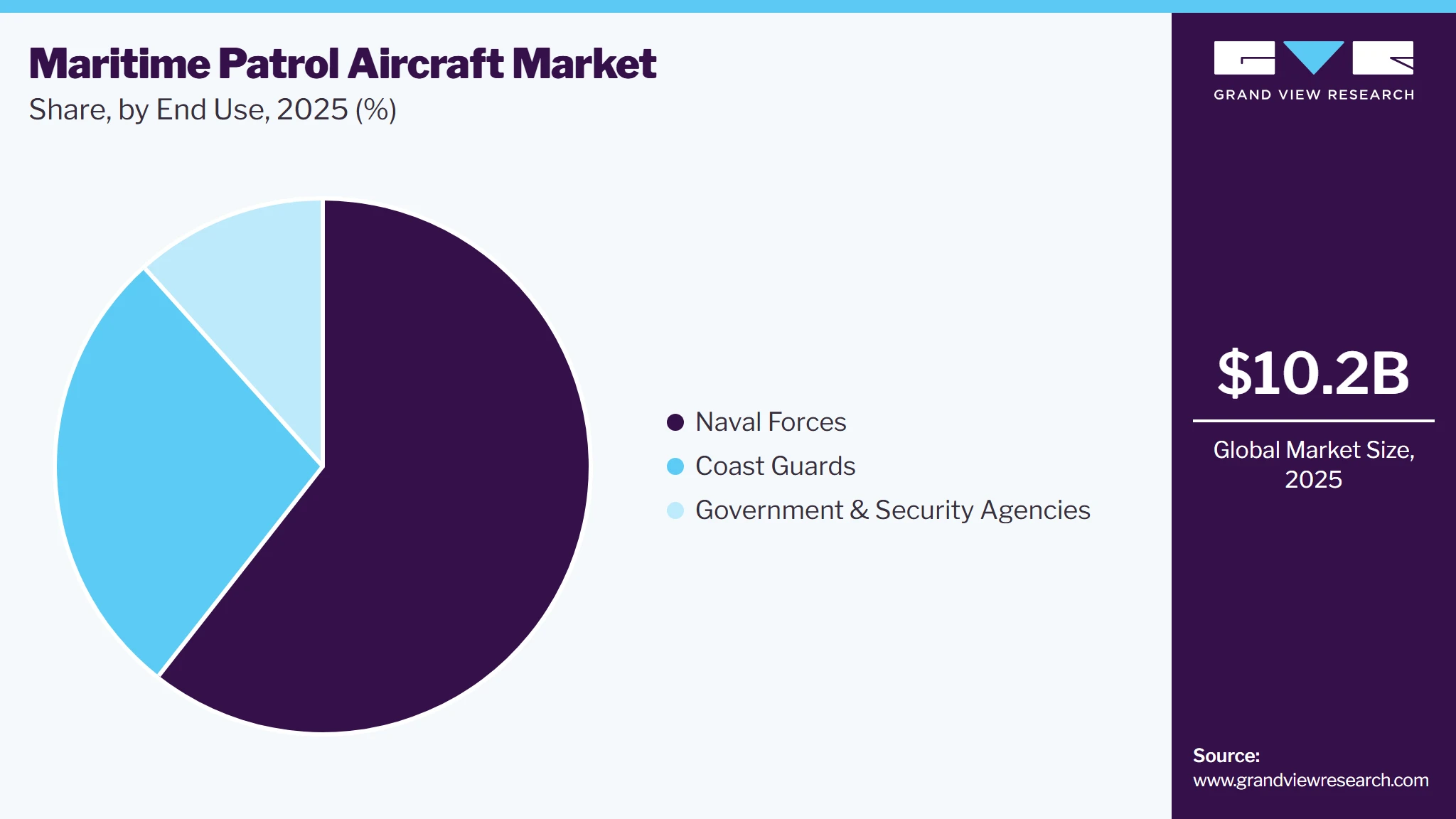
The naval forces segment contributed 60.6% share towards the global maritime patrol aircraft market in 2025, making it the leading end use segment. Its strong position is supported by increasing naval modernization programs, growing requirements for maritime domain awareness, and rising investments in anti-submarine warfare and maritime surveillance capabilities. Naval forces are increasingly procuring advanced maritime patrol aircraft equipped with long-range radar, EO/IR sensors, acoustic systems, electronic support measures, secure communications, and integrated mission systems to monitor territorial waters, detect underwater and surface threats, and protect strategic sea lanes.
 To learn more about this report, Download Free Sample Report
The coast guards segment is expected to grow steadily during the forecast period, supported by increasing requirements for maritime surveillance, coastal security, search and rescue, illegal fishing monitoring, narcotics interdiction, and disaster response. Coast guard agencies are increasingly investing in maritime patrol aircraft equipped with advanced radar, EO/IR sensors, secure communications, and integrated mission systems to strengthen persistent monitoring across territorial waters and exclusive economic zones (EEZs).
Regional Insights
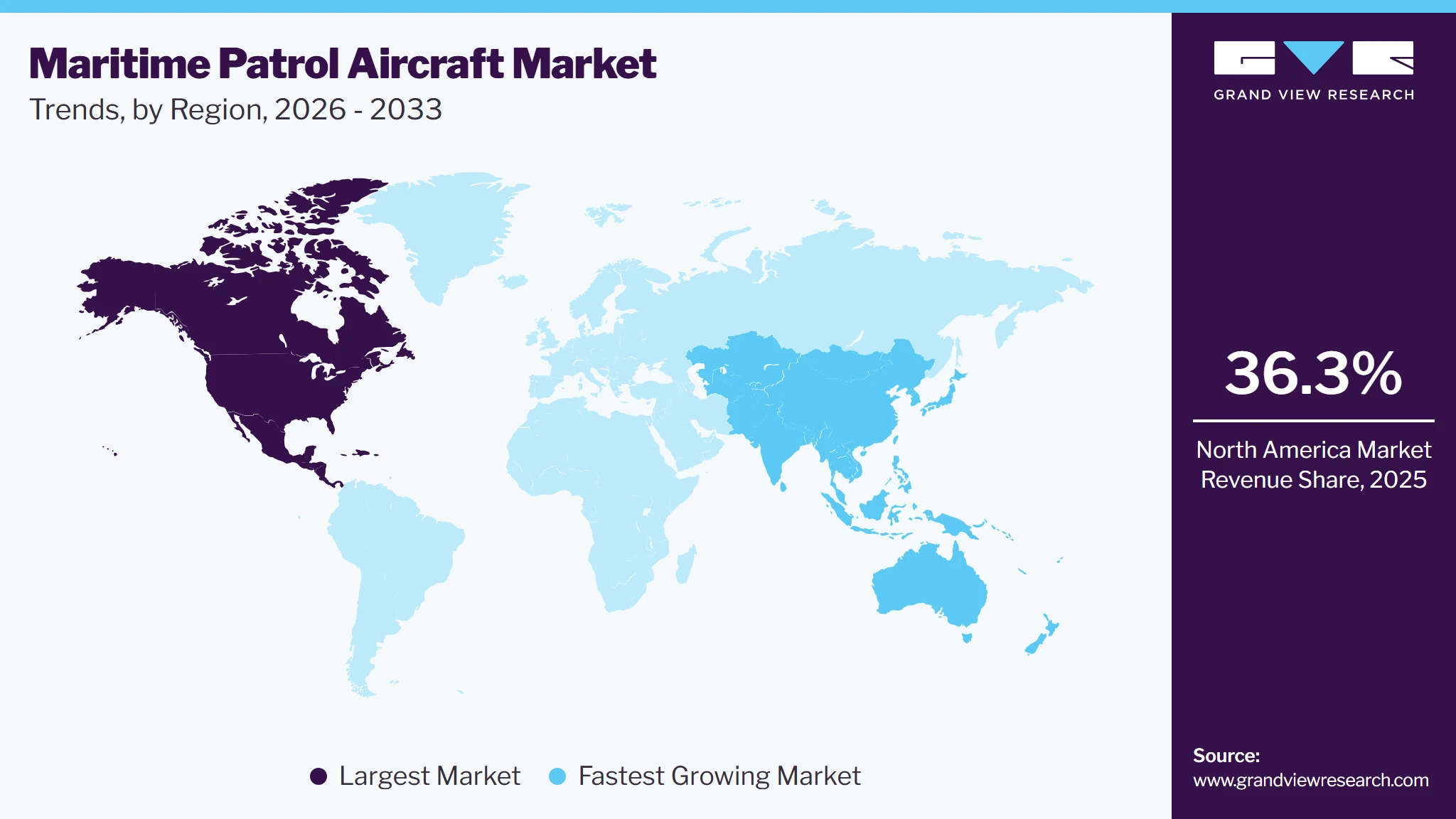
North America led the global maritime patrol aircraft market, accounting for 36.3% of market revenue in 2025, driven by substantial investments in maritime security, naval modernization, advanced surveillance capabilities, and next-generation maritime patrol aircraft. The region, led by the United States, benefits from the presence of major aerospace and defense companies, advanced aircraft manufacturing capabilities, sophisticated naval infrastructure, and strong government funding for maritime defense programs. Increasing investments in long-range maritime patrol aircraft, airborne radar, EO/IR sensors, electronic warfare systems, secure communications, AI-enabled mission systems, and real-time data processing are strengthening the region’s maritime surveillance and maritime domain awareness capabilities.
 To learn more about this report, Download Free Sample Report
U.S. Maritime Patrol Aircraft Market Trends
The maritime patrol aircraft market in the U.S. dominated the North American industry, supported by substantial defense spending, extensive maritime boundaries, and continued investments in advanced naval surveillance and reconnaissance capabilities. The country benefits from a strong ecosystem of aerospace and defense companies, aircraft manufacturers, sensor providers, and mission-system developers. Increasing procurement and modernization of long-range maritime patrol aircraft, advanced airborne radar, EO/IR sensors, electronic warfare systems, secure communications, and AI-enabled mission systems are strengthening U.S. maritime surveillance capabilities. Growing requirements for anti-submarine warfare, maritime domain awareness, coastal security, and monitoring of strategic waterways are further supporting market growth.
Europe Maritime Patrol Aircraft Market Trends
The maritime patrol aircraft market in Europe is witnessing steady growth, driven by increasing maritime security requirements, fleet modernization initiatives, and rising investments in advanced surveillance and reconnaissance capabilities. European countries are upgrading and expanding maritime patrol fleets to strengthen monitoring of territorial waters, EEZs, and strategic sea routes. The growing adoption of advanced radar, EO/IR sensors, electronic support systems, secure communications, and integrated mission systems is enhancing operational capabilities. Increasing emphasis on anti-submarine warfare, border security, and coordinated maritime operations is further supporting regional market development.
The UK maritime patrol aircraft market is experiencing notable growth, driven by increasing focus on maritime security, anti-submarine warfare, and protection of strategic maritime routes. The country is strengthening its maritime surveillance capabilities through investments in advanced patrol aircraft, airborne radar, acoustic sensors, EO/IR systems, secure communications, and integrated mission systems. Growing requirements to monitor the North Atlantic, protect naval assets, and support submarine detection missions are further increasing demand for advanced maritime patrol capabilities.
The maritime patrol aircraft market in Germany is experiencing growth, supported by increasing defense modernization, maritime surveillance requirements, and investments in advanced aerospace and defense technologies. Germany is strengthening its maritime reconnaissance capabilities through the modernization of patrol aircraft and integration of advanced sensors, radar, communications, and mission-management systems. Growing emphasis on maritime domain awareness, naval interoperability, coastal security, and monitoring of critical maritime infrastructure is further supporting market development.
Asia Pacific Maritime Patrol Aircraft Market Trends
The maritime patrol aircraft market in the Asia Pacific is projected to exhibit the fastest CAGR over the forecast period. The growth is spurred by increasing maritime security concerns, territorial disputes, expanding naval capabilities, and rising investments in maritime surveillance infrastructure across countries such as China, India, Japan, South Korea, and Australia. Governments are increasingly procuring long-range maritime patrol aircraft equipped with advanced radar, EO/IR sensors, electronic warfare systems, acoustic sensors, and secure communication technologies to strengthen maritime domain awareness. Growing requirements for anti-submarine warfare, EEZ monitoring, coastal security, and protection of strategic sea lanes are further accelerating regional market growth.
The China maritime patrol aircraft market is expanding due to increasing investments in naval modernization, maritime surveillance, and indigenous aerospace and defense capabilities. China is strengthening its maritime patrol capabilities through the development and deployment of advanced patrol aircraft, surveillance platforms, airborne radar, EO/IR sensors, electronic warfare systems, and secure communications. Growing requirements for monitoring extensive maritime areas, protecting territorial waters, supporting anti-submarine operations, and strengthening maritime domain awareness are further supporting demand for advanced maritime patrol aircraft.
Key Maritime Patrol Aircraft Company Insights
The maritime patrol aircraft market is moderately concentrated, with competition led by established aerospace and defense companies possessing strong capabilities in aircraft manufacturing, mission-system integration, maritime surveillance, radar, EO/IR sensors, electronic warfare, secure communications, and anti-submarine warfare systems. Competition is driven by continuous innovation in long-range patrol aircraft, advanced sensors, AI-enabled mission systems, unmanned platforms, and network-centric maritime operations. Established players maintain strong market positions through extensive R&D capabilities, established government relationships, large installed fleets, aircraft integration expertise, strategic partnerships, and long-term defense procurement programs.
-
The Boeing Company is a leading player in the maritime patrol aircraft market through its P-8A Poseidon, a long-range multi-mission maritime patrol aircraft designed for anti-submarine warfare, anti-surface warfare, maritime surveillance, reconnaissance, and intelligence missions. Its large international customer base and integration of advanced radar, acoustic sensors, electronic support systems, and mission-management technologies strengthen its competitive position.
-
Lockheed Martin Corporation is a major defense and aerospace company with capabilities spanning maritime surveillance aircraft, mission systems, radar, sensors, electronic warfare, and integrated defense solutions. Its maritime patrol capabilities and aircraft modification expertise enable the company to address surveillance, reconnaissance, anti-submarine warfare, and multi-mission requirements across defense customers.
Key Maritime Patrol Aircraft Companies
The following key companies have been profiled for this study on the maritime patrol aircraft market.
-
The Boeing Company
-
Lockheed Martin Corporation
-
Airbus SE
-
Saab AB
-
Leonardo S.p.A.
-
Dassault Aviation
-
Kawasaki Heavy Industries, Ltd.
-
Textron Inc.
-
Israel Aerospace Industries Ltd.
-
Northrop Grumman Corporation
-
Hindustan Aeronautics Limited (HAL)
-
Aviation Industry Corporation of China (AVIC)
-
BAE Systems plc
-
Thales Group
-
Embraer S.A.
Competitive Benchmarking
Category
Operating Strategies
Competitive Edge
Weakness
Mature Players: The Boeing Company, Lockheed Martin Corporation, Airbus SE, Saab AB, Leonardo S.p.A., Dassault Aviation, BAE Systems plc, Northrop Grumman Corporation, Thales Group
- Expand maritime patrol aircraft capabilities through long-term defense contracts, fleet modernization programs, aircraft upgrades, and investments in advanced radar, EO/IR sensors, electronic warfare, secure communications, and integrated mission systems.
- Invest in AI-enabled mission systems, sensor fusion, autonomous technologies, advanced avionics, anti-submarine warfare systems, and network-centric maritime surveillance capabilities.
- Strong expertise in aerospace, defense, aircraft manufacturing, avionics, sensors, mission systems, and electronic warfare.
- Established relationships with naval forces and government agencies, extensive R&D capabilities, global aircraft fleets, and strong defense procurement network
- High R&D, aircraft development, certification, and system-integration costs.
- Long defense procurement cycles, complex platform integration, stringent regulatory requirements, and dependence on government defense budgets can slow market expansion.
Emerging Players: Kawasaki Heavy Industries, Ltd., Textron Inc., Israel Aerospace Industries Ltd., Hindustan Aeronautics Limited (HAL), Aviation Industry Corporation of China (AVIC), Embraer S.A.
- Focus on expanding maritime patrol and surveillance capabilities through cost-effective aircraft platforms, aircraft conversions, indigenous development programs, and advanced mission-system integration.
- Strengthen market presence through government partnerships, domestic defense programs, international exports, aircraft modernization, and investments in sensors, avionics, secure communications, and unmanned systems.
- Strong regional presence and specialized capabilities in aircraft manufacturing, defense systems, surveillance platforms, and mission-system integration.
- Greater flexibility in addressing regional defense requirements and opportunities for cost-competitive maritime patrol platforms
- Smaller global installed base and lower international penetration compared with major established aerospace and defense primes.
- Dependence on government procurement programs, defense budgets, export approvals, and technology-development timelines can constrain international expansion.
Recent Developments
-
In July 2025, Lockheed Martin demonstrated an AI-powered Synthetic Aperture Radar (SAR) technology for maritime surveillance during a flight test in the United States. The technology used embedded AI and sensor-control autonomy to automatically detect, recognize, and classify maritime targets in near real time. The development is intended to improve situational awareness, accelerate threat identification, and support decision-making in maritime operations, strengthening Lockheed Martin’s capabilities in AI-enabled airborne surveillance.
-
In August 2025, Boeing and Terma signed a Memorandum of Understanding to strengthen future collaboration on P-8 Poseidon maritime patrol aircraft. The agreement builds on their decade-long relationship and focuses on strengthening the European industrial base supporting the P-8 program, demonstrating Boeing’s continued emphasis on international partnerships and localized industrial participation.
Maritime Patrol Aircraft Market Report Scope
Report Attribute
Details
Market size in 2025
USD 10.2 billion
Estimated market size in 2026
USD 10.8 billion
Projected market size by 2033
USD 16.1 billion
Growth rate
CAGR of 5.9% from 2026 to 2033
Actual data
2021 - 2025
Forecast period
2026 - 2033
Quantitative units
Revenue in USD billion and CAGR from 2026 to 2033
Report coverage
Revenue forecast, company ranking, competitive landscape, growth factors, and trends
Segments covered
Type, propulsion, end use, application, region
Regional scope
North America; Europe; Asia Pacific; Latin America; MEA
Country scope
U.S.; Canada; Mexico; Germany; UK; France; China; India; Japan; Australia; South Korea; Brazil; UAE; South Africa; KSA
Key companies profiled
The Boeing Company; Lockheed Martin Corporation; Airbus SE; Saab AB; Leonardo S.p.A.; Dassault Aviation; Kawasaki Heavy Industries, Ltd.; Textron Inc.; Israel Aerospace Industries Ltd.; Northrop Grumman Corporation; Hindustan Aeronautics Limited (HAL); Aviation Industry Corporation of China (AVIC); BAE Systems plc; Thales Group; Embraer S.A.
Customization scope
Free report customization (equivalent up to 8 analysts working days) with purchase. Addition or alteration to country, regional & segment scope.
Pricing and purchase options
Avail customized purchase options to meet your exact research needs. Explore purchase options
Global Maritime Patrol Aircraft Market Report Segmentation
This report forecasts revenue growth at global, regional, and country levels and provides an analysis of the latest industry trends in each of the sub-segments from 2021 to 2033. For this study, Grand View Research has segmented the global maritime patrol aircraft market report based on type, propulsion, end use, application, and region:
-
Type Outlook (Revenue, USD Billion, 2021 - 2033)
-
Unarmored
-
Armored
-
-
Propulsion Outlook (Revenue, USD Billion, 2021 - 2033)
-
Jet Engine
-
Turbofan
-
Turboprop
-
Turboshaft
-
-
Electric Propulsion
-
-
End Use Outlook (Revenue, USD Billion, 2021 - 2033)
-
Naval Forces
-
Coast Guards
-
Government & Security Agencies
-
-
Application Outlook (Revenue, USD Billion, 2021 - 2033)
-
Anti-Submarine Warfare (ASW)
-
Border & EEZ Patrol
-
Maritime Surveillance & Reconnaissance
-
Search & Rescue
-
-
Regional Outlook (Revenue, USD Billion, 2021 - 2033)
-
North America
-
U.S.
-
Canada
-
Mexico
-
-
Europe
-
UK
-
Germany
-
France
-
-
Asia Pacific
-
China
-
Japan
-
India
-
Australia
-
South Korea
-
-
Latin America
-
Brazil
-
-
Middle East and Africa (MEA)
-
KSA
-
UAE
-
South Africa
-
-
Research Methodology
The maritime patrol aircraft market figures in this report are based on a proven research process that combines executive interviews with secondary research from proprietary databases, company filings, and recognized regulatory and institutional sources. Market size is built through value-chain sizing-reconciling supply-side and demand-side estimates-and triangulated with bottom-up and top-down approaches. Every estimate passes multiple levels of expert validation before publication, with each maritime patrol aircraft segment quantified using the revenue-capture definitions in the table below.
Segment Definition
Segment - Type
Revenue capture definition
Unarmored
Revenue in this segment is generated through the sale and deployment of unarmored maritime patrol aircraft and their associated mission systems, including maritime surveillance radar, EO/IR sensors, electronic support measures (ESM), acoustic systems, mission computers, secure communication systems, and other surveillance equipment. These aircraft are primarily used for maritime surveillance, reconnaissance, anti-submarine warfare, coastal patrol, search and rescue, and maritime domain awareness missions.
Armored
Revenue in this segment is generated through the sale and deployment of armored maritime patrol aircraft equipped with enhanced protection, combat systems, and specialized mission equipment. These platforms incorporate technologies such as reinforced structures, advanced sensors, secure communications, electronic warfare systems, and weapon integration capabilities to support anti-submarine warfare, anti-surface warfare, maritime surveillance, and operations in higher-threat maritime environments.
Segment - Propulsion
Revenue capture definition
Jet Engine
Revenue in this segment is generated through the sale and deployment of maritime patrol aircraft powered by jet engines, including turbofan, turboprop, and turboshaft propulsion systems. These aircraft are designed to support long-range maritime surveillance, reconnaissance, anti-submarine warfare, anti-surface warfare, and other patrol missions, with jet propulsion offering high speed, extended range, endurance, and operational flexibility.
Electric Propulsion
Revenue in this segment is generated through the sale and deployment of maritime patrol aircraft incorporating electric or hybrid-electric propulsion systems. These propulsion technologies support maritime surveillance, reconnaissance, and long-endurance patrol missions by offering potential benefits such as lower operating costs, reduced emissions, lower acoustic signatures, and improved energy efficiency.
Segment - Application
Revenue capture definition
Anti-Submarine Warfare (ASW)
Revenue in this segment is generated through the sale and deployment of maritime patrol aircraft and associated mission systems used to detect, track, identify, and monitor submarines. These platforms typically integrate maritime surveillance radar, sonobuoys, acoustic processing systems, magnetic anomaly detectors (MAD), EO/IR sensors, and secure communication systems to support submarine detection, tracking, and threat assessment operations.
Border & EEZ Patrol
Revenue in this segment is generated through the sale and deployment of maritime patrol aircraft and associated surveillance systems used to monitor territorial waters, maritime borders, and Exclusive Economic Zones (EEZs). These platforms support vessel detection and tracking, illegal fishing monitoring, smuggling and piracy detection, maritime law enforcement, and protection of offshore assets through integrated radar, EO/IR sensors, AIS, secure communications, and mission-management systems.
Maritime Surveillance & Reconnaissance
Revenue in this segment is generated through the sale and deployment of maritime patrol aircraft and associated mission systems used for persistent monitoring, intelligence collection, vessel detection, and reconnaissance across maritime environments. These platforms integrate maritime radar, EO/IR sensors, electronic support measures (ESM), secure communications, AIS, and mission-management systems to provide real-time situational awareness and support maritime domain awareness, threat detection, and intelligence operations.
Search & Rescue
Revenue in this segment is generated through the sale and deployment of maritime patrol aircraft and associated mission systems used to locate, track, and support the rescue of people, vessels, and aircraft in distress at sea. These platforms utilize radar, EO/IR sensors, communication systems, navigation equipment, and real-time data links to conduct wide-area searches, identify targets, coordinate rescue operations, and support emergency response activities.
Segment - End Use
Revenue capture definition
Naval Forces
Revenue in this segment is generated through the sale and deployment of maritime patrol aircraft and associated mission systems to naval forces for maritime surveillance, anti-submarine warfare, anti-surface warfare, reconnaissance, and maritime domain awareness.
Coast Guards
Revenue in this segment is generated through the sale and deployment of maritime patrol aircraft and associated surveillance systems to coast guard agencies for coastal security, maritime surveillance, border and EEZ patrol, search and rescue, and maritime law enforcement.
Government & Security Agencies
Revenue in this segment is generated through the sale and deployment of maritime patrol aircraft and associated surveillance and mission systems to government and security agencies for maritime security, intelligence, reconnaissance, border monitoring, and emergency response operations.
Estimation Model
Layer Name
Key Question
Description
Addressable Maritime Patrol Aircraft Base Layer
Which aircraft are equipped or require maritime patrol capabilities?
Estimate the global installed base and annual deliveries of fixed-wing, rotary-wing, and unmanned maritime patrol aircraft used by naval forces, coast guards, and government & security agencies. The assessment considers aircraft type, fleet size, mission requirements, replacement cycles, modernization programs, operational deployment, and regional defense requirements
Mission Technology Adoption Layer
Which mission technologies and systems are deployed across maritime patrol aircraft?
Apply adoption rates for maritime surveillance radar, EO/IR sensors, electronic support measures (ESM), acoustic systems, sonobuoys, magnetic anomaly detectors (MAD), secure communication systems, mission computers, electronic warfare systems, and AI-enabled mission technologies based on aircraft type, mission profile, operational requirements, and end-user requirements.
Mission System Content & Deployment Layer
What mission systems and equipment are installed per aircraft?
Estimate the value of maritime patrol aircraft systems based on technology penetration and average equipment content per aircraft. The model considers radar, EO/IR sensors, ESM, acoustic processing systems, MAD, communication systems, mission computers, navigation systems, electronic warfare equipment, and other mission-specific systems.
Delivered Customizations
This report has been delivered with the following In-depth customizations
Client Request
Customization Delivered
Value Adds
Maritime Patrol Aircraft Market Entry & Growth Strategy
Assessment of demand for maritime patrol aircraft across naval forces, coast guards, and government & security agencies.
Analysis of opportunities across Anti-Submarine Warfare (ASW), Border & EEZ Patrol, Maritime Surveillance & Reconnaissance, and Search & Rescue applications.
Identified high-growth aircraft platforms, mission applications, technologies, and geographic markets.
Supported market entry, product positioning, customer targeting, partnership identification, and long-term expansion strategies.
Next-Generation Maritime Patrol Aircraft Technology & Capability Assessment
Assessment of emerging technologies including AI-enabled mission systems, advanced maritime radar, EO/IR sensors, electronic support measures (ESM), acoustic systems, magnetic anomaly detection (MAD), autonomous systems, secure communications, and sensor-fusion technologies.
Identified technology gaps and high-potential innovation areas within the maritime patrol aircraft ecosystem.
Supported technology roadmap development, R&D prioritization, product development, and next-generation mission-system strategies
Maritime Patrol Aircraft Mission System & Equipment Opportunity Assessment
Detailed assessment of demand for maritime surveillance radar, EO/IR systems, ESM, acoustic processing systems, sonobuoys, MAD systems, mission computers, secure communications, electronic warfare systems, and navigation systems across aircraft platforms
Identified high-value mission systems, equipment, and technologies with strong growth potential.
Supported product portfolio optimization, technology investment decisions, customer targeting, and identification of addressable revenue opportunities.
Frequently Asked Questions About This Report
The global maritime patrol aircraft market size was estimated at USD 10.2 billion in 2025 and is expected to reach USD 10.8 billion in 2026.
The global maritime patrol aircraft market is expected to grow at a compound annual growth rate of 5.9% from 2026 to 2033 to reach USD 16.1 billion by 2033.
The unarmored segment dominated with a 72.1% revenue share in 2025.
North America dominated the maritime patrol aircraft market with a share of 36.3% in 2025.
Key factors that are driving the market growth include growing demand for advanced maritime surveillance and reconnaissance capabilities, increasing procurement of next-generation patrol aircraft, rising adoption of advanced radar, EO/IR, and electronic warfare systems, growing requirements for anti-submarine and anti-surface warfare capabilities, and continued investments by naval and coast guard forces in strengthening maritime domain awareness and protecting territorial waters.
Some key players operating in the maritime patrol aircraft market include The Boeing Company, Lockheed Martin Corporation, Airbus SE, Saab AB, Leonardo S.p.A., Dassault Aviation, Kawasaki Heavy Industries, Ltd., Textron Inc., Israel Aerospace Industries Ltd., Northrop Grumman Corporation, Hindustan Aeronautics Limited (HAL), Aviation Industry Corporation of China (AVIC), BAE Systems plc, Thales Group, Embraer S.A.
The Asia Pacific is the fastest-growing region with a CAGR of over 6% from 2026 to 2033.
The anti-submarine Warfare (ASW) segment dominated with a 45.7% revenue share in 2025.
The naval forces segment dominated the market with a share of 60.6% in 2025.
About the Author(s)
Next Generation Technologies Research Team
Technology · Next Generation TechnologiesThis report was authored by the next generation technologies research team at Grand View Research - comprising two research analysts, one senior research analyst, and one industry expert - with specialized expertise in the next generation technologies segment of the technology industry. All findings are based on proprietary technology databases, executive interviews, and regulatory analysis, subject to internal peer review prior to publication.
Last Updated:
Speak to Analyst

Customize this report to your needs - add regions, segments, or data points, with 20% free customization.
Or view our licence options:


ISO 9001:2015 & 27001:2022 Certified
We are GDPR and CCPA compliant! Your transaction & personal information is safe and secure. For more details, please read our privacy policy.


