
- Home
- »
- Automotive & Transportation
- »
-
Material Handling Equipment Telematics Market Report, 2033GVR Report cover

Material Handling Equipment Telematics Market (2026 - 2033) Size, Share & Trends Analysis Report By Product (Aerial Work Platform, Forklift, Cranes, Earthmoving Equipment, Truck, Tractor, Telehandler), By Region, And Segment Forecasts
Market Size, 2025
$7.5BMarket Estimate, 2026
$8.7BMarket Forecast, 2033
$23.8BCAGR, 2026–2033
15.6%Material Handling Equipment Telematics Market Summary
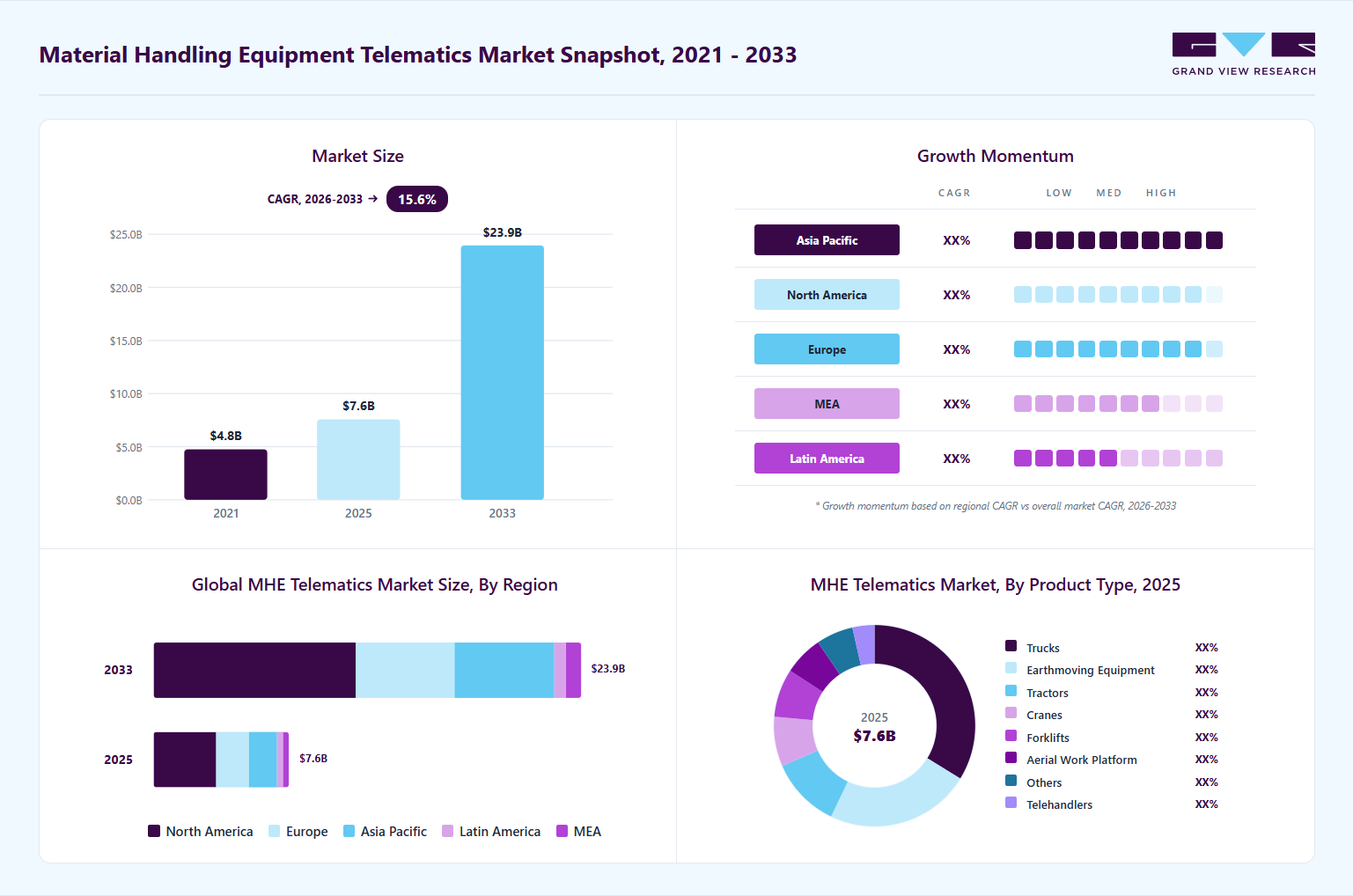
The global material handling equipment telematics market size was valued at USD 7.5 billion in 2025 and is projected to grow from USD 8.7 billion in 2026 to USD 23.8 billion by 2033, at a CAGR of 15.6% from 2026 to 2033. The North America held the largest share of 46.2% of the global market in 2025. This growth is attributed to the increasing demand for operational efficiency across various industries, particularly in logistics and construction.
 Source: Grand View Research, IR Documents, Primary Interviews, Paid DatabasesTo learn more about this report,
 Download Free Sample Report
Key Market Trends & Insights
- By product: Trucks held the largest revenue share of 33.7% in 2025.
Regional Highlights
- Largest regional market: North America (46.2% revenue share, 2025).
- By country: The U.S. held the largest market share in 2025.
Market Size & Forecast
- Market size in 2025: USD 7.5 Billion
- Estimated market size in 2026: USD 8.7 Billion
- Projected market size by 2033: USD 23.8 Billion
- CAGR (2026-2033): 15.6%
Three ways to get this report
Buy it, customize it, or ask a question.Ask an Analyst
Analyst response in 1 business day
- AccessReport author, directly
- Reply timeWithin 1 working day
- No sales callDirect answer only
- FormatEmail reply
- CostFree, no cost
Get the Full Report
What the study covers
- FormatsPDF · Excel · Dashboard
- Timeline2026–2033 annual, 2025 base
- Coverage20+ countries, 5 regions
- Companies10+ key players profiled
Customize the Report
20% free customization
- IncludeCountries, segments, points
- TailorTo your product definition
- ExtendDeeper competitor detail
- OrA fully bespoke study
- Turnaround5–10 working days
As companies strive to optimize their operations, telematics solutions are essential for monitoring equipment performance, enhancing safety, and improving overall productivity. The rise of e-commerce has led to heightened demand for efficient goods transportation and inventory management, further driving the material handling equipment telematics industry. With more businesses relying on automated systems to streamline operations, the need for advanced telematics solutions has surged. For instance, companies are now using telematics to track vehicle location and monitor fuel consumption, thereby reducing operational costs while improving service delivery.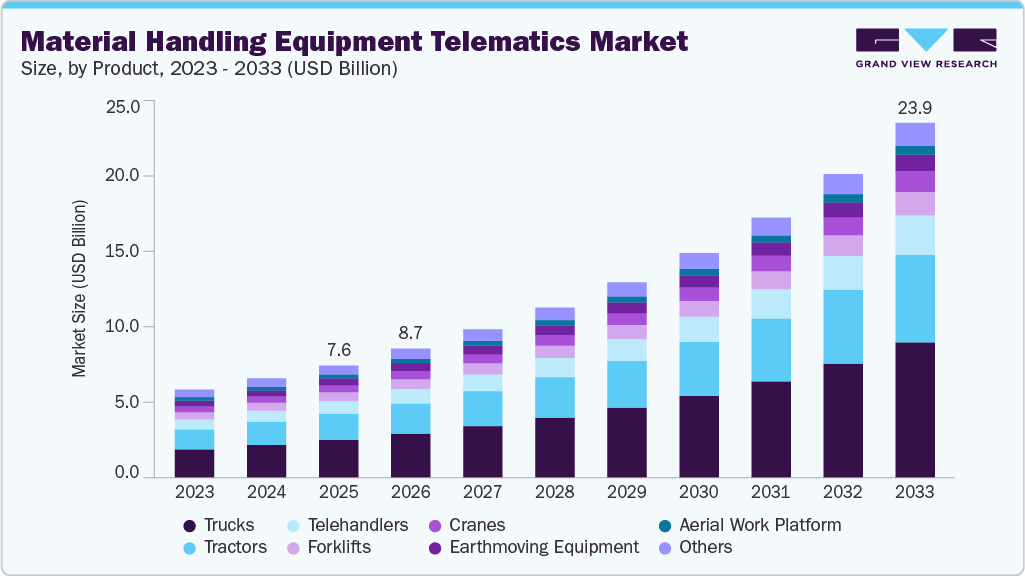 To learn more about this report, Download Free Sample Report
The material handling equipment telematics market is expected to grow significantly, driven by the increasing need for operational efficiency and cost optimization across logistics, warehousing, and manufacturing. Organizations are increasingly focusing on reducing the total cost of ownership while maximizing equipment productivity in highly competitive environments. Telematics solutions enable real-time monitoring of equipment utilization, fuel consumption, and operator performance, thereby supporting data-driven decision-making. Furthermore, the ability to track idle time and optimize fleet deployment helps companies improve asset utilization and reduce unnecessary capital expenditure. The growing emphasis on predictive maintenance to minimize equipment downtime and extend asset lifecycle is further supporting market growth. In addition, companies are leveraging telematics insights to streamline workflows and enhance overall operational transparency. The integration of telematics with fleet management systems is also enabling better scheduling and resource allocation. Moreover, the shift toward lean and efficient supply chain operations is encouraging enterprises to adopt advanced telematics solutions. These combined factors are expected to drive sustained demand for material handling equipment telematics solutions.
The material handling equipment telematics market is witnessing strong growth driven by the rapid expansion of e-commerce and the increasing adoption of warehouse automation technologies. The surge in online retail and omnichannel distribution models has significantly increased the volume and complexity of material handling operations. This has created a strong demand for real-time visibility and efficient fleet management within warehouses and distribution centers. Telematics systems enable precise tracking of equipment location, movement, and performance, thereby improving operational efficiency. Furthermore, the growing deployment of automated guided vehicles (AGVs) and robotics in warehouses is increasing the need for integrated telematics solutions. The rising demand for faster delivery timelines and optimized last-mile logistics is also contributing to market growth. In addition, third-party logistics providers are increasingly adopting telematics to manage large and dispersed fleets more effectively. The ability to centralize operations and improve coordination across supply chain nodes is further supporting adoption. Moreover, the increasing investment in smart warehouses and digital supply chain infrastructure is accelerating the integration of telematics technologies. These trends are expected to significantly boost the growth of the market over the forecast period.
Market Dynamics
The growth of the material handling equipment telematics market is driven by continuous advancements in IoT, connectivity, and data analytics technologies. The proliferation of IoT-enabled sensors and embedded systems has enabled seamless data collection from material handling equipment, such as forklifts and cranes. These technologies allow real-time monitoring of key performance parameters, enhancing operational control and efficiency. Furthermore, improvements in wireless connectivity, including high-speed cellular networks, are facilitating reliable and continuous data transmission. The increasing adoption of cloud-based platforms is enabling organizations to store, process, and analyze large volumes of telematics data. In addition, advanced analytics and artificial intelligence are being integrated to provide predictive insights and automated alerts. These capabilities are helping companies shift from reactive to proactive maintenance strategies.
The global material handling equipment telematics market faces a key restraint in the form of high initial investment costs associated with deployment and integration. Implementing telematics solutions requires installing sensors, connectivity modules, cloud infrastructure, and software platforms, which collectively increase end users' upfront capital expenditure. This cost burden is particularly significant for small and mid-sized enterprises operating with constrained IT and automation budgets.
Rapid transition toward smart warehouses and autonomous intralogistics ecosystems is a key factor expected to create new opportunities in the global material handling equipment telematics market. Enterprises across e-commerce, retail, and manufacturing sectors are increasingly investing in highly automated facilities equipped with robotics, automated guided vehicles (AGVs), and AI-enabled inventory systems. Within such environments, telematics serves as a critical enabler, providing real-time visibility, equipment coordination, and performance optimization across connected assets. The convergence of telematics with IoT, artificial intelligence, and digital twin technologies is further enhancing predictive capabilities, allowing enterprises to simulate and optimize material flow before execution.
Market Concentration & Characteristics
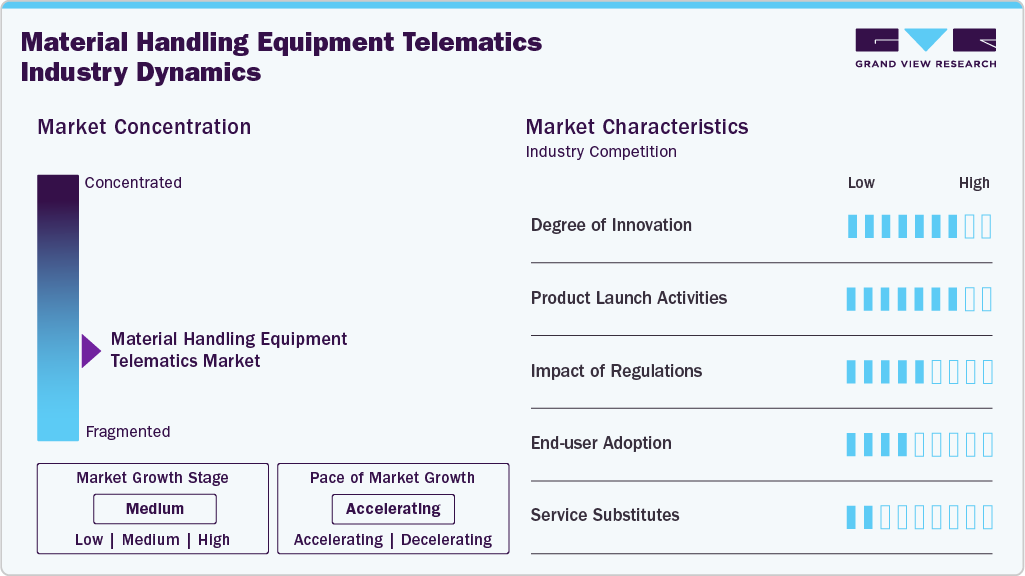
The material handling equipment telematics market is moderately fragmented, with global industrial automation companies, intralogistics solution providers, fleet management software vendors, and specialized telematics technology firms competing across the manufacturing, warehousing, logistics, and e-commerce distribution sectors. Large multinational players hold strong market positions through integrated hardware-software ecosystems, advanced analytics platforms, and long-term enterprise contracts, while a significant number of niche providers focus on specialized telematics solutions for forklifts, warehouse vehicles, AGVs, and robotic systems.
The market is characterized by rapid digitalization of material handling operations, increasing warehouse automation, and rising demand for real-time asset visibility and operational intelligence. Companies are focusing on integrating IoT-enabled sensors, cloud-based fleet management platforms, AI-driven predictive maintenance, and data analytics to optimize equipment utilization, reduce downtime, and improve safety compliance. The growing adoption of smart warehouses and automated fulfillment centers is further accelerating the deployment of telematics solutions across material handling fleets.
 To learn more about this report, Download Free Sample Report
In addition, increasing pressure to improve operational efficiency, reduce logistics costs, and enhance workplace safety is driving strong adoption of telematics-enabled monitoring systems across industrial and logistics environments. The expansion of e-commerce, third-party logistics (3PL) providers, and omnichannel retail networks is further supporting demand for connected material handling ecosystems. Furthermore, the shift toward electrified and automated equipment is enabling deeper integration of telematics platforms with battery management systems, charging infrastructure, and autonomous fleet coordination, thereby enhancing end-to-end operational control and performance optimization.
Product Insights
The trucks segment dominated the material handling equipment telematics industry with the largest revenue share of 33.78% in 2025, owing to the rise of e-commerce, which has significantly increased the demand for efficient goods transportation, leading to higher adoption of telematics solutions in trucks. These solutions enable fleet operators to monitor vehicle performance, optimize routes, and reduce fuel consumption, which is crucial for maintaining competitiveness in a fast-paced market. In addition, advancements in road infrastructure have facilitated smoother logistics operations, further driving the need for telematics in trucks. For instance, companies can now utilize real-time data to improve delivery schedules and enhance customer satisfaction.
The truck segment is expected to grow at a significant CAGR of 17.3% over the forecast period. The segment growth is owing to the increasing need for real-time fleet visibility and operational efficiency across logistics, construction, and distribution industries. Fleet operators are increasingly adopting telematics solutions to monitor vehicle location, driver behavior, fuel consumption, and engine performance in real time. This enables better route optimization, reduced idle time, and improved asset utilization across large and distributed fleets. Furthermore, the rising pressure to reduce transportation costs and improve delivery timelines is accelerating adoption among both large fleet operators and small logistics providers. The integration of telematics with fleet management platforms is also enabling predictive maintenance, thereby reducing breakdowns and unplanned downtime.
Regional Insights
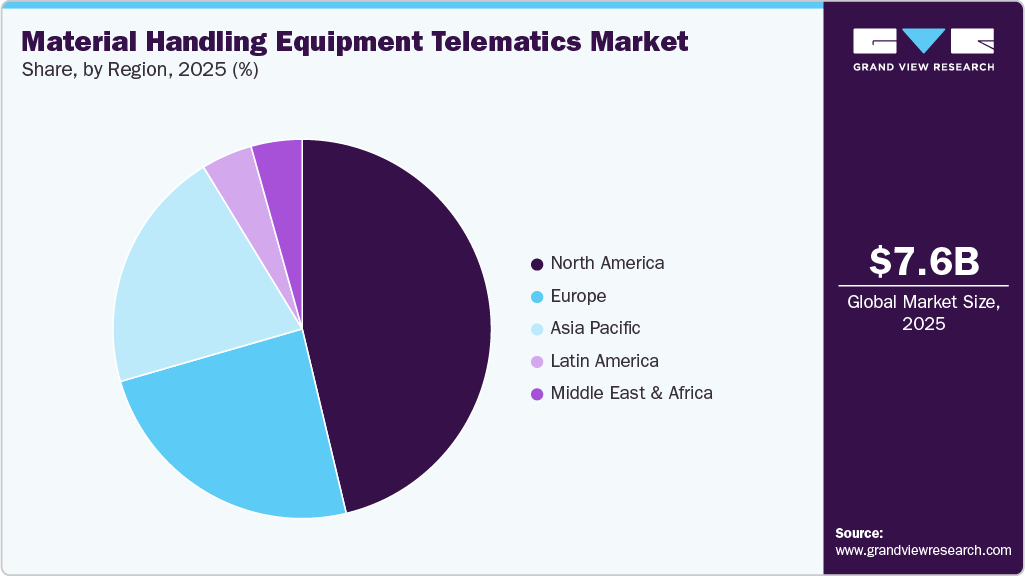
The North America material handling equipment telematics market held a dominant 46.26% share in 2025. The market is expected to witness steady growth driven by the strong presence of advanced logistics and warehousing infrastructure across the region. The rapid expansion of e-commerce and omnichannel retail has significantly increased the demand for real-time fleet visibility and efficient asset management solutions.
 To learn more about this report, Download Free Sample Report
U.S. Material Handling Equipment Telematics Market Trends
The material handling equipment telematics industry in the U.S. held a dominant position in 2025. The market is expected to grow robustly, driven by the increasing digitalization of industrial operations and the widespread adoption of Industry 4.0 practices. The strong presence of large-scale warehouse operators and retail giants is accelerating the deployment of advanced telematics solutions to manage high-volume and high-velocity operations.
Europe Material Handling Equipment Telematics Market Trends
The material handling equipment telematics industry in Europe witnessed significant growth in 2025. The increasing penetration of advanced manufacturing practices, particularly across automotive, aerospace, and heavy engineering sectors, is driving demand for connected equipment monitoring solutions. Furthermore, strict workplace safety standards and regulatory emphasis on reducing equipment-related incidents are encouraging wider adoption of telematics-enabled tracking and compliance systems.
The UK material handling equipment telematics industry is expected to grow steadily, supported by the increasing modernization of logistics and port infrastructure across the country. The expansion of high-throughput distribution centers, particularly driven by e-commerce and retail consolidation, is strengthening demand for advanced fleet monitoring solutions.
The material handling equipment telematics industry in Germany is expected to grow at a steady pace, driven by the country’s strong industrial automation and engineering ecosystem. The dominance of the automotive and machinery manufacturing sectors is creating sustained demand for high-precision equipment monitoring and utilization optimization solutions. Furthermore, the widespread implementation of smart factory concepts under Industry 4.0 is accelerating the integration of telematics with connected production and intralogistics systems.
Asia Pacific Material Handling Equipment Telematics Market Trends
The material handling equipment telematics industry in the Asia Pacific held a significant share in 2025. The market is expected to witness strong growth, driven by rapid industrialization and large-scale expansion of manufacturing hubs across countries such as China, India, and Southeast Asian economies. The increasing development of export-oriented production clusters and free trade zones is accelerating demand for efficient equipment tracking and utilization solutions in high-volume operations. Furthermore, the region is experiencing significant investments in large-scale infrastructure projects, including ports, airports, and logistics corridors, which are boosting the deployment of advanced material handling systems.
The Japan material handling equipment telematics industry held a significant share in 2025. The market is expected to grow steadily, supported by the country’s highly mature manufacturing and precision engineering ecosystem. The widespread use of automation and robotics in production and intralogistics environments is driving demand for advanced equipment monitoring and control solutions. Furthermore, Japan’s aging workforce is accelerating the adoption of telematics-enabled systems to improve labor efficiency and reduce dependency on manual equipment supervision.
The material handling equipment telematics industry in China is expected to grow rapidly, driven by the country’s large-scale industrial base and continuous expansion of domestic manufacturing capabilities. The strong push toward intelligent logistics parks and digitally enabled industrial zones is accelerating the adoption of connected equipment monitoring solutions. Furthermore, government-led initiatives supporting industrial digitalization and smart manufacturing are encouraging enterprises to integrate telematics into material handling fleets. The rapid expansion of domestic e-commerce platforms and associated fulfillment infrastructure is also increasing demand for real-time equipment tracking and optimization.
Key Material Handling Equipment Telematics Company Insights
Some key companies in the material handling equipment telematics industry are Toyota Material Handling, The Raymond Corporation, CLARK, and Konecranes. These companies in the material handling equipment telematics market are leveraging advanced technologies to enhance operational efficiency and improve equipment performance. They focus on integrating telematics solutions with existing systems, enabling real-time monitoring and predictive maintenance capabilities.
-
Caterpillar offers a comprehensive telematics solution that empowers equipment owners with real-time data to enhance operational efficiency. By integrating advanced technologies, Caterpillar enables users to track equipment location, monitor performance, and receive maintenance alerts through an intuitive online dashboard. This system minimizes downtime with remote troubleshooting capabilities and allows customizable reporting and analytics.
-
Toyota Material Handling focuses on providing cutting-edge telematics solutions that enhance fleet management and operational efficiency. Their telematics systems integrate seamlessly with existing equipment, offering real-time insights into machine performance, location tracking, and predictive maintenance alerts. By leveraging advanced data analytics, Toyota empowers businesses to make informed decisions that boost productivity and reduce costs.
Key Material Handling Equipment Telematics Companies:
The following key companies have been profiled for this study on the material handling equipment telematics market.
- Caterpillar
- Toyota Material Handling
- The Raymond Corporation
- CLARK
- MLE B.V.
- Konecranes
- Hiab
- MCE (Mahindra Construction Equipment)
- Doosan Corporation
- HD Hyundai Construction Equipment India Private Limited
- Trackunit Corporation
- JLG Industries
- ZTR Control Systems LLC.
Competitive benchmarking
Operating Strategies
Competitive Edge
Weaknesses
Mature Players: Caterpillar, Toyota Material Handling, The Raymond Corporation, CLARK Material Handling Company
- Mature players typically focus on integrating advanced telematics into OEM equipment portfolios as a bundled offering with forklifts, cranes, and warehouse vehicles. These companies heavily invest in R&D to enhance fleet connectivity, predictive maintenance, and energy efficiency features. They also prioritize strategic partnerships with IoT and cloud service providers to strengthen their digital ecosystems.
- Mature players benefit from strong global distribution networks and established customer relationships across manufacturing, logistics, and warehousing sectors. Their ability to offer end-to-end solutions combining hardware, software, and service contracts provides a strong competitive advantage.
- Additionally, brand trust and installed base advantage enable higher telematics penetration in existing fleets.
- Despite strong positioning, mature players often face slower innovation cycles due to legacy product architectures and complex organizational structures. High dependency on OEM-centric ecosystems can limit flexibility in adopting third-party telematics platforms.
- Additionally, integration across mixed-brand fleets remains a challenge, reducing competitiveness in open digital ecosystems.
Emerging Players: Trackunit Corporation, ZTR Control Systems LLC, MLE B.V.
- Emerging players focus on software-driven telematics platforms that are hardware-agnostic and compatible across mixed material handling fleets. They emphasize cloud-native architectures, AI-based analytics, and subscription-based pricing models to penetrate logistics and warehouse segments.
- Many players are expanding into RTLS (Real-Time Location Systems) and IoT-enabled asset tracking to strengthen positioning.
- Emerging players are highly agile and innovation-driven, enabling rapid deployment of new features such as predictive analytics, geofencing, and automation integration. Their platform-based approach allows seamless scalability across industries without dependence on OEM constraints.
- Emerging players often face limitations in hardware integration depth and lack of direct OEM control over equipment ecosystems. Their dependence on third-party hardware suppliers can create interoperability challenges in complex industrial environments.
Recent Developments
-
In March 2026, Cascade Corporation announced the acquisition of CARGOMETER GmbH, a technology company specializing in real-time freight dimensioning and in-motion measurement systems. The acquisition integrates advanced sensing and data capture technologies into forklift and automated material handling operations, enabling real-time tracking of cargo dimensions, weight, and identity without operational stoppage. This acquisition is expected to help the company strengthen its product portfolio.
-
In February 2025, Platform Science announced the acquisition of Trimble’s global transportation telematics business units, strengthening its position in fleet connectivity and digital logistics ecosystems. The transaction significantly expanded its virtual vehicle platform, enabling fleets to access integrated telematics, driver management, and operational applications through a unified digital architecture. This acquisition is expected to help the company strengthen its position in the market.
Material Handling Equipment Telematics Market Report Scope
Report Attribute
Details
Market size in 2025
USD 7.5 billion
Estimated market size in 2026
USD 8.7 billion
Projected market size by 2033
USD 23.8 billion
Growth rate
CAGR of 15.6% from 2026 to 2033
Base year for estimation
2025
Historical data
2021 - 2025
Forecast period
2026 - 2033
Quantitative units
Revenue in USD million/billion, and CAGR from 2026 to 2033
Report coverage
Revenue forecast, company ranking, competitive landscape, growth factors, and trends
Segments covered
Product, region
Regional scope
North America; Europe; Asia Pacific; Latin America; MEA
Country scope
U.S.; Canada; Mexico; Germany; UK; France; China; Japan; India; South Korea; Australia; Brazil; KSA; UAE; South Africa
Key companies profiled
Caterpillar; Toyota Material Handling; The Raymond Corporation; CLARK; MLE B.V.; Konecranes; Hiab; MCE (Mahindra Construction Equipment); Doosan Corporation; HD Hyundai Construction Equipment India Private Limited; Trackunit Corporation; JLG Industries; ZTR Control Systems LLC
Customization scope
Free report customization (equivalent up to 8 analysts working days) with purchase. Addition or alteration to country, regional & segment scope.
Pricing and purchase options
Avail customized purchase options to meet your exact research needs. Explore purchase options
Global Material Handling Equipment Telematics Market Report Segmentation
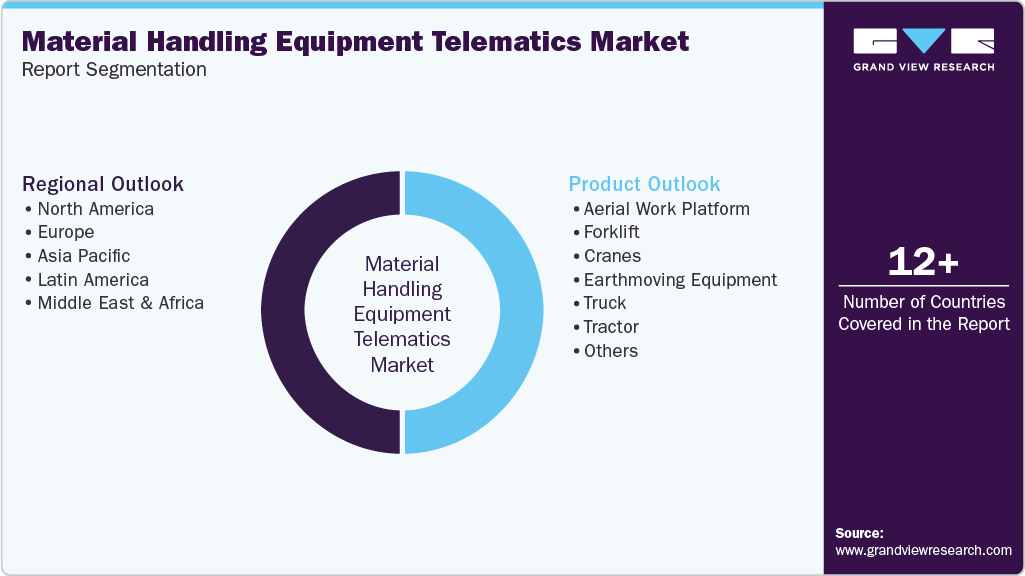
This report forecasts revenue growth at global, regional, and country levels and provides an analysis of the latest industry trends in each of the sub-segments from 2021 to 2033. For this study, Grand View Research has segmented the global material handling equipment telematics market report based on product, and region.
 To learn more about this report, Download Free Sample Report
-
Product Outlook (Revenue, USD Million, 2021 - 2033)
-
Aerial Work Platform
-
Forklift
-
Truck Mounted Forklift
-
Articulated Forklift
-
Side Loader
-
Other
-
-
Cranes
-
Port Crane
-
Truck-mounted Crane
-
Others
-
-
Earthmoving Equipment
-
Spreader
-
Articulated Wheel Loader
-
Farm Implements
-
Road Work Vehicle
-
Self-propelling AG machine
-
Others
-
-
Truck
-
Military Vehicle
-
Trailer
-
Others
-
-
Tractor
-
Terminal Tractor
-
Tow Tractor
-
Others
-
-
Telehandler
-
Others
-
Sweeper & Scrubber
-
Personnel & Burden Carrier
-
Power Generation/Light Station
-
Others
-
-
-
Regional Outlook (Revenue, USD Million, 2021 - 2033)
-
North America
-
U.S.
-
Canada
-
Mexico
-
-
Europe
-
Germany
-
UK
-
France
-
-
Asia Pacific
-
China
-
Japan
-
India
-
South Korea
-
Australia
-
-
Latin America
-
Brazil
-
-
Middle East and Africa (MEA)
-
KSA
-
UAE
-
South Africa
-
-
Delivered Customizations
This report has been delivered with the following In-depth customizations
Client Request
Customization Delivered
Value Adds
Regional Material Handling Equipment Telematics Opportunity Assessment
Country/region-wise market sizing and forecasts
Identification of high-growth regions and investment hotspots
Analysis of demand, adoption trends, and regulatory landscape
Identified region-specific growth opportunities
Enabled informed regional investment decisions
Supported expansion and go-to-market strategy
Product-Level Opportunity Assessment for Material Handling Equipment Telematics
Market analysis across key equipment categories including forklifts, cranes, telehandlers, tractors, sweepers & scrubbers, and aerial work platforms
Demand and adoption analysis by equipment type across regions.
Benchmarking of high-growth product segments and application trends
Identified high-growth equipment categories and adoption trends
Improved product portfolio prioritization
Supported targeted product development and commercialization strategy
Competitive Benchmarking and Strategic Positioning in Material Handling Equipment Telematics
Benchmarking of key competitors across products, pricing, partnerships, and innovation
Analysis of competitive strengths, gaps, and differentiation areas
Comparative assessment of market share, capabilities, and strategies
Identified competitive white spaces and growth gaps
Enabled data-driven competitive strategy development
Supported strategic positioning and differentiation
Frequently Asked Questions About This Report
Key factors include increasing demand for operational efficiency and cost optimization, and rapid expansion of e-commerce & warehouse automation.
North America dominated with a 46.2% revenue share in 2025.
The global material handling equipment telematics market size was valued at USD 7.5 billion in 2025 and is estimated at USD 8.7 billion for 2026.
The trucks segment led with a 33.7% revenue share in 2025.
Key players include Caterpillar; Toyota Material Handling; The Raymond Corporation; CLARK; MLE B.V.; Konecranes; Hiab; MCE (Mahindra Construction Equipment); Doosan Corporation; HD Hyundai Construction Equipment India Private Limited, Trackunit Corporation; JLG Industries; and ZTR Control Systems LLC.
The global material handling equipment telematics market is expected to grow at a CAGR of 15.6% from 2026 to 2033, reaching USD 23.8 billion by 2033.
About the Author(s)
Automotive & Transportation Research Team
Technology · Automotive & TransportationThis report was authored by the automotive & transportation research team at Grand View Research - comprising two research analysts, one senior research analyst, and one industry expert - with specialized expertise in the automotive & transportation segment of the technology industry. All findings are based on proprietary technology databases, executive interviews, and regulatory analysis, subject to internal peer review prior to publication.
Last Updated:
Speak to Analyst

Customize this report to your needs - add regions, segments, or data points, with 20% free customization.
Or view our licence options:


ISO 9001:2015 & 27001:2022 Certified
We are GDPR and CCPA compliant! Your transaction & personal information is safe and secure. For more details, please read our privacy policy.


