
- Home
- »
- Healthcare IT
- »
-
Medical Communication Market Size And Share Report 2033GVR Report cover

Medical Communication Market (2026 - 2033)
Size, Share & Trends Analysis Report By Service (Scientific And Publication Communications, Medical Affairs Communications), By Delivery Mode (Digital, In-person), By End Use, By Region, And Segment Forecasts
Market Size, 2025
$2.8BMarket Estimate, 2026
$3.1BMarket Forecast, 2033
$6.1BCAGR, 2026–2033
10.3%Medical Communication Market Summary
The global medical communication market size was valued at USD 2.8 billion in 2025 and is projected to grow from USD 3.1 billion in 2026 to USD 6.1 billion by 2033, at a CAGR of 10.3% from 2026 to 2033. North America dominated the market, accounting for a revenue share of 44.6% in 2025. The industry is expanding due to growing demand for scientific and clinical information, evidence-based communication, and specialized medical writing.
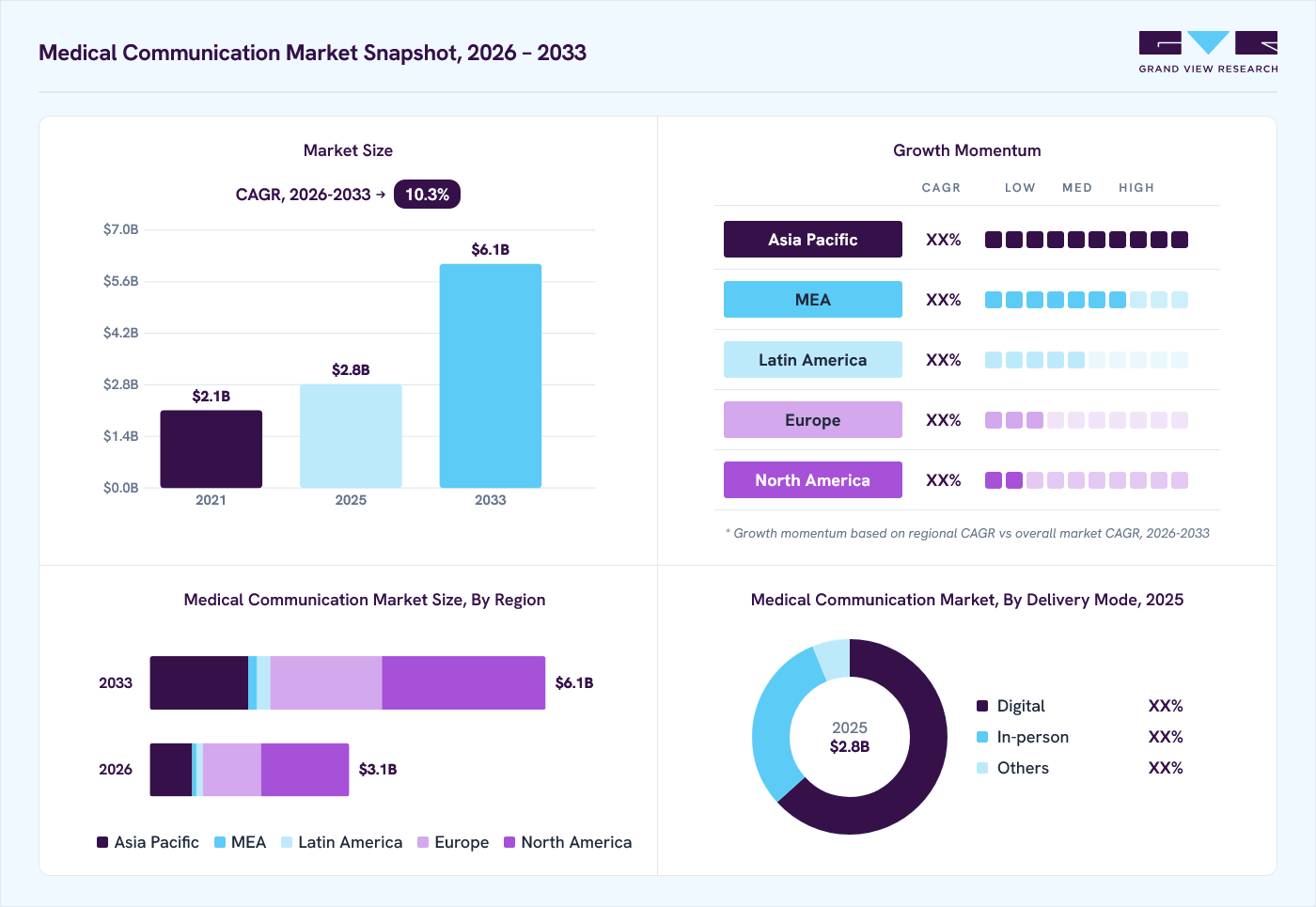 Source: Grand View Research, IR Documents, Primary Interviews, Paid DatabasesTo learn more about this report,
 Download Free Sample Report
 Key Market Trends & Insights
- By service: Scientific and publication communications segment held the largest market share of 27.0% in 2025.
- By delivery mode: Digital segment held the highest revenue share of 63.3% in 2025.
- By end use: Pharmaceutical companies segment held a dominant market share of 59.1% in 2025.
Regional Highlights
- Largest regional market: North America (44.6% revenue share, 2025)
- Fastest-growing regional market: Asia Pacific (highest CAGR, 2026-2033)
- By country: The U.S. held the largest share in 2025
Market Size & Forecast
- Market size in 2025: USD 2.8 Billion
- Estimated market size in 2026: USD 3.1 Billion
- Projected market size by 2033: USD 6.1 Billion
- CAGR (2026-2033): 10.3%
Three ways to get this report
Buy it, customize it, or ask a question.Ask an Analyst
A direct answer, usually in 1 working day
- AccessReport author, directly
- Reply timeWithin 1 working day
- No sales callDirect answer only
- FormatEmail reply
- CostFree, no cost
Get the Full Report
What the study covers
- FormatsPDF · Excel · Dashboard
- Timeline2026–2033 annual, 2025 base
- Coverage20+ countries, 5 regions
- Companies10+ key players profiled
Customize the Report
20% free customization
- IncludeCountries, segments, points
- TailorTo your product definition
- ExtendDeeper competitor detail
- OrA fully bespoke study
- Turnaround5–10 working days
Pharmaceutical and biotechnology companies are relying more on medical communication providers for publications, educational materials, and stakeholder communications. The use of artificial intelligence and digital platforms is enhancing content development, literature analysis, personalization, and communication efficiency.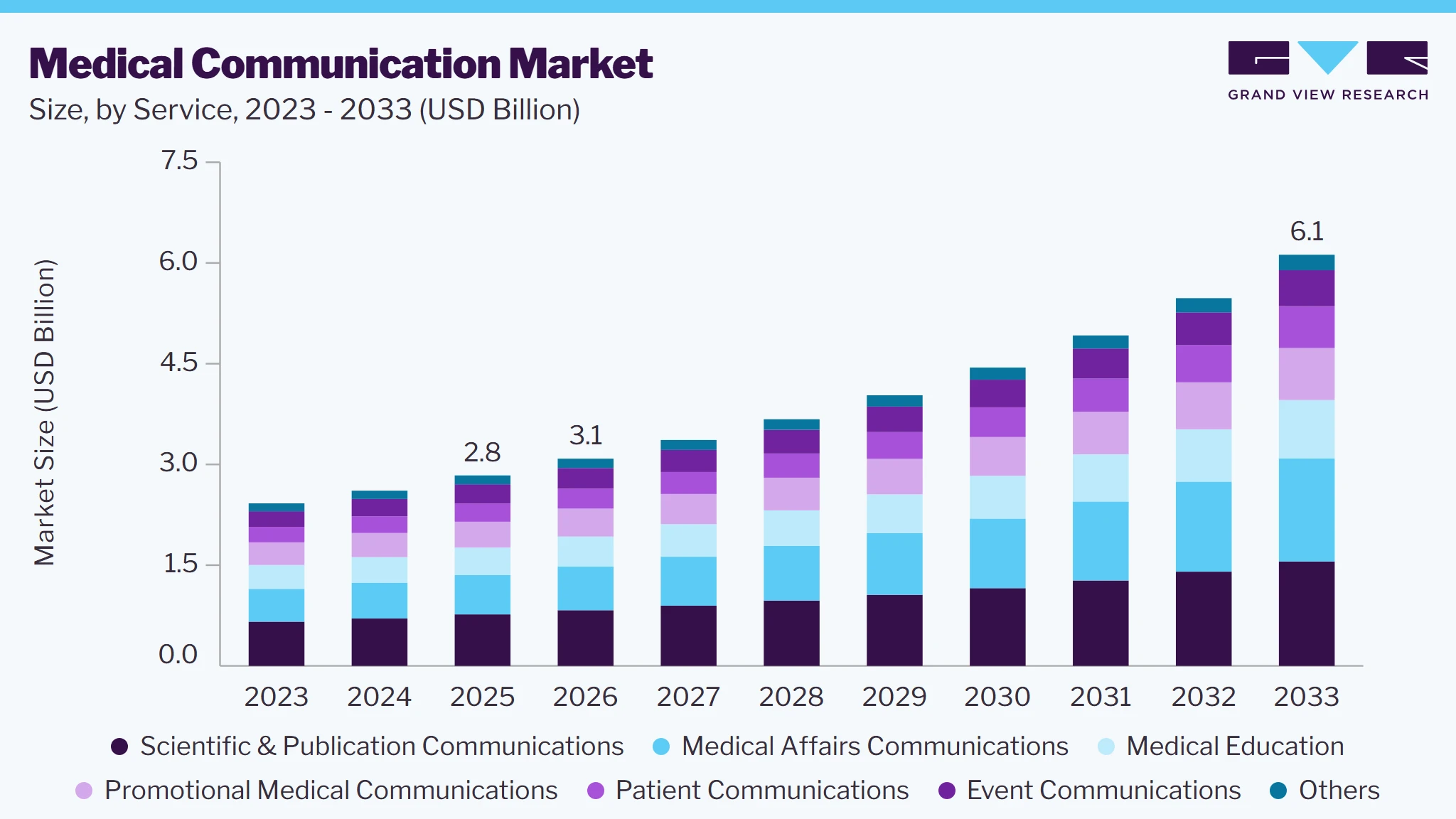 To learn more about this report, Download Free Sample Report
 In addition, the increasing complexity of clinical data and the need for accurate, multi-channel scientific communication are expected to drive ongoing market growth during the forecast period.
Market Dynamic
Complex clinical and scientific evidence requires clear, accurate, and audience-specific communication. Demand for specialized medical writing, publication planning, scientific education, and digital communication is increasing, while evolving regulatory requirements are encouraging providers to strengthen compliance and quality processes. In addition, AI-enabled tools are improving content development, scientific information analysis, and stakeholder engagement. These trends are supporting the shift toward more efficient, evidence-based, and technology-enabled medical communication services.
The growing complexity and volume of medical and scientific information are driving demand for specialized medical communication services. Pharmaceutical and biotechnology companies generate substantial evidence throughout the product lifecycle, including clinical trial findings, real-world evidence, safety data, health economic analyses, and post-marketing studies. This information must be converted into scientifically accurate and audience-specific materials for healthcare professionals, researchers, regulators, patients, and payers.
The increasing adoption of precision medicine, complex trial designs, and specialty therapies has further raised the technical requirements associated with publication planning, medical writing, scientific education, congress communications, and medical affairs content. Companies also need to maintain consistency across manuscripts, presentations, digital assets, medical information responses, and patient-facing materials while adapting the content to different audiences and communication channels.
Enago Life Sciences describes medical communications as undergoing rapid, application-driven development, with the industry moving beyond conventional publication support toward digital and multi-format scientific engagement. This shift requires closer collaboration among medical writers, researchers, statisticians, healthcare professionals, designers, and digital specialists. Consequently, the need to communicate increasingly complex evidence in an accurate, accessible, and engaging manner is expected to support market growth.
Stringent regulatory and compliance requirements are expected to restrain the market by increasing development costs and extending content review timelines. Medical communication materials must comply with requirements governing scientific accuracy, fair balance, product claims, adverse-event reporting, transparency, data disclosure, patient privacy, and the distinction between promotional and non-promotional communication.
The regulatory burden is particularly significant for companies operating across multiple countries, as content frequently requires adaptation to jurisdiction-specific rules, approved product labels, disclosure standards, and local stakeholder expectations. Medical, legal, and regulatory review processes can involve several rounds of assessment before content is approved for publication or distribution. This increases the need for experienced medical writers, compliance professionals, quality-control teams, documentation systems, and employee training.
In March 2026, the Drug Information Association organized a dedicated course on medical communications compliance. The program covered medical inquiry documentation, content development and dissemination, FDA guidance, staff training, monitoring, audit programs, and quality-assurance requirements. The breadth of these obligations illustrates the operational burden associated with compliant communication. Longer review cycles and higher quality-assurance expenses can delay content deployment and limit project volumes, particularly among smaller pharmaceutical and biotechnology companies.
The adoption of artificial intelligence across medical writing, content development, and stakeholder engagement is creating significant growth opportunities for medical communication providers. AI-enabled platforms can support literature review, evidence synthesis, content tagging, document drafting, translation, personalization, and reuse of approved scientific materials. These capabilities can reduce repetitive work and help medical affairs and communication teams manage expanding content requirements across markets and channels.
The opportunity extends beyond content generation. AI and advanced analytics can help identify information gaps, assess healthcare professional interests, recommend relevant content, and adapt communication formats for different stakeholder groups. However, pharmaceutical companies continue to require medical, regulatory, and editorial oversight to verify scientific accuracy, protect confidential information, and ensure that generated content remains compliant. This creates demand for service providers that combine medical expertise with secure technology platforms and established review procedures.
In December 2025, Bristol Myers Squibb and Accenture opened Mosaic, a generative AI-enabled content hub in Mumbai. The hub is designed to identify physicians’ educational needs in real time and accelerate the development of tailored, patient-centric content. Mosaic also forms part of Bristol Myers Squibb’s USD 130 million investment in AI initiatives and AI-enabled marketing capabilities. The development demonstrates how large biopharmaceutical companies are investing in scalable content operations, creating opportunities for medical communication providers offering AI-supported content development, scientific information management, personalization, and compliance services.
“We are using AI tools across our company to work more efficiently, access information better, get more done, and make better decisions - all to help our team change how the pharmaceutical industry works”
Said Anvita Karara, VP of Worldwide Commercialization Excellence.
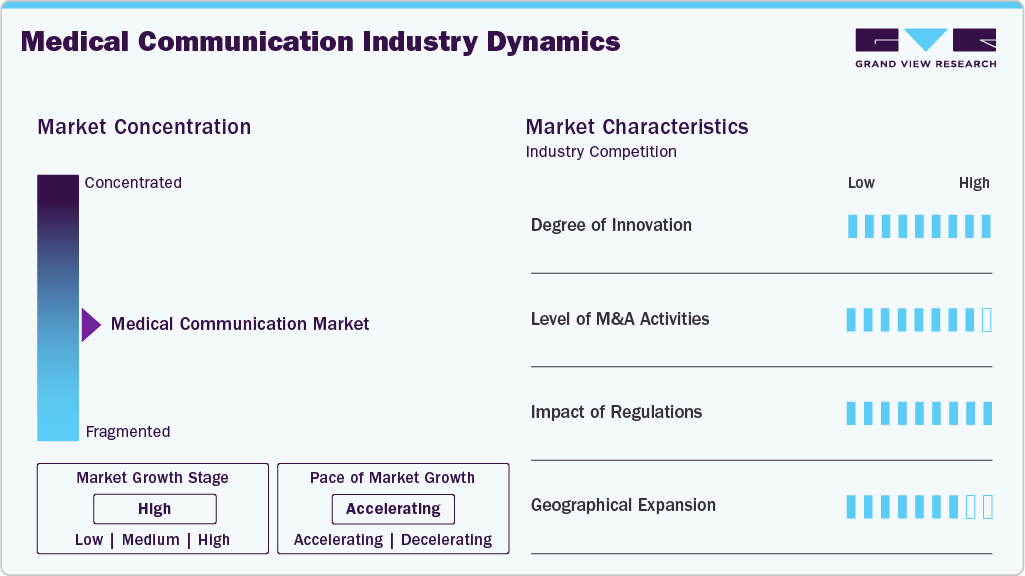
Market Concentration & Characteristics
The industry is highly innovative, with companies adopting artificial intelligence, automation, and digital technologies to enhance medical writing and scientific communication. These tools accelerate content development, improve scientific analysis, and support evidence-based content delivery. For instance, in July 2025, Indegene expanded its NEXT Medical Writing Automation solutions to improve efficiency and support pharmaceutical and life sciences organizations. This reflects the growing role of AI in medical communication and the shift toward technology-driven content creation.
The market is seeing high M&A activity as companies consolidate to enhance medical affairs, scientific communications, and healthcare communication capabilities. Acquisitions expand service portfolios, provide access to specialized expertise, and strengthen market presence. For instance, in June 2026, Klick Health acquired Oxford PharmaGenesis to broaden its medical affairs and life sciences capabilities. This transaction highlights ongoing consolidation as providers pursue more integrated service offerings.
 To learn more about this report, Download Free Sample Report
 Regulations significantly affect the market, as content must comply with data privacy, scientific accuracy, evidence integrity, and responsible information handling standards. For instance, in March 2026, Cactus Communications announced HIPAA readiness for its Paperpal for Life Sciences platform and introduced Business Associate Agreements to ensure secure handling of protected health information. This underscores the increasing importance of privacy, governance, and compliance in AI-enabled medical and scientific communication.
The market is expanding as global providers strengthen their presence in key pharmaceutical and life sciences markets. Companies are establishing regional hubs and growing local teams to address differences in language, healthcare systems, regulations, and stakeholder needs. For instance, in February 2026, Real Chemistry expanded its leadership and regional hubs in Munich, Zurich, and Dubai, as well as its in-market team. This demonstrates the ongoing geographic expansion of healthcare communication capabilities in Europe and the Middle East.
Analyst Perspective
The market is driven by increasing scientific complexity, expanding medical affairs activities, and rising demand for evidence-based communication. Service providers are strengthening their capabilities in medical writing, publication planning, digital engagement, modular content, and AI-enabled workflows. Integrated firms benefit from global reach and multidisciplinary expertise, while specialized agencies compete through scientific knowledge, flexibility, and tailored services. The transition toward personalized, omnichannel, and measurable stakeholder engagement is projected to support market growth through 2033.
Service Insights
The scientific and publication communications segment held the largest market share of 27.0% in 2025, driven by the rising volume of clinical research, scientific publications, and real-world evidence from pharmaceutical and biotechnology companies. Demand for publication planning, medical writing, manuscript development, and scientific evidence dissemination continues to grow as companies aim to communicate complex research findings accurately to healthcare professionals and stakeholders. Inizio Medical has highlighted the growing use of generative AI in medical publications and scientific communications, including manuscript drafting, literature analysis, journal article review, scientific content localization, and communication strategy development.
The medical affairs communications segment is expected to grow at the fastest CAGR of 13.0% during the forecast period. Growth driven by increased pharmaceutical investment in medical affairs, higher demand for evidence-based engagement with healthcare professionals, and a growing need for personalized scientific communication. The adoption of digital platforms and AI-enabled tools is further enhancing the efficiency and reach of medical affairs communications.
Delivery Mode Insights
The digital segment held the largest market share of 63.3% in 2025, fueled by the expanding use of digital scientific platforms, virtual events, webinars, e-learning, online publications, and AI-enabled communication tools. Digital delivery allows providers to reach healthcare professionals and stakeholders through multiple channels, supporting scalable, personalized communication. In June 2025, Syneos Health Communications launched Empathy Engine, a data-driven platform that helps healthcare brands develop more tailored and patient-centered communication strategies. The platform leverages behavioral insights and audience personas to improve engagement and deliver more relevant healthcare communications. This development demonstrates the increasing adoption of digital and data-driven platforms to enhance stakeholder communication.
The in-person segment is expected to maintain steady growth during the forecast period. In-person communication remains vital for scientific congresses, medical education programs, advisory boards, workshops, and direct engagement among healthcare professionals, researchers, and medical experts. These formats support interactive scientific discussions, knowledge exchange, and relationship building, complementing digital channels.
End Use Insights
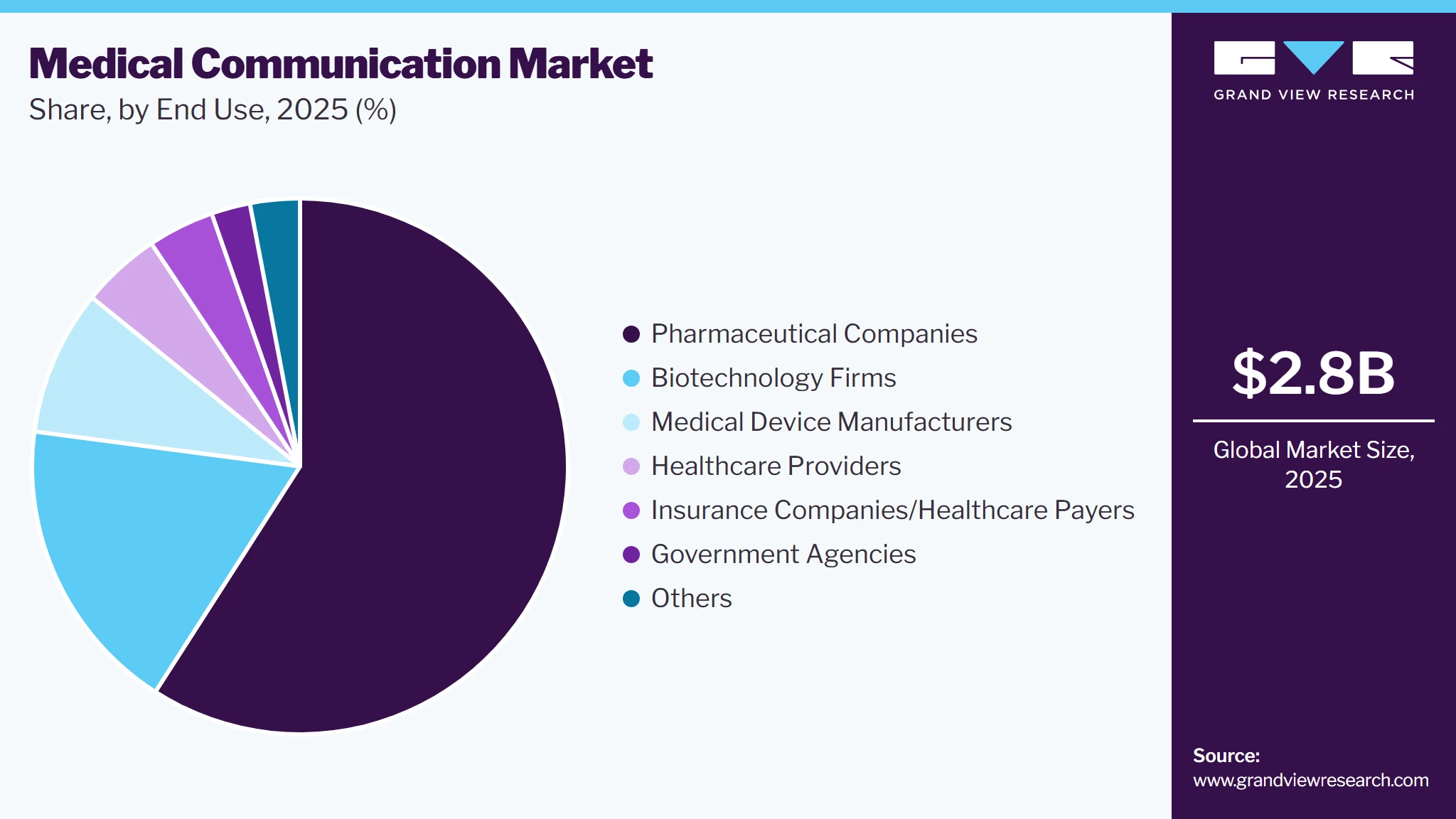
The pharmaceutical companies segment held the largest market share of 59.1% in 2025, supported by significant investment in research and development, clinical trials, medical affairs, product launches, scientific publications, and healthcare professional education. Pharmaceutical companies rely on medical communication services to translate clinical and scientific evidence into accurate, accessible content for healthcare professionals, researchers, patients, and other stakeholders. For instance, in May 2025, Vaniam Group launched Vaniam Intelligence, an AI-powered platform that helps biopharmaceutical companies develop strategies and make evidence-based decisions by analyzing scientific and market information. This development highlights ongoing investment by pharmaceutical and biotechnology companies in technology-enabled medical communication and scientific information management.
 To learn more about this report, Download Free Sample Report
 The biotechnology firms segment is expected to grow at the fastest CAGR of 13.6% during the forecast period, driven by the development of biologics, cell and gene therapies, precision medicines, and other innovative treatments that generate complex scientific evidence requiring specialized communication. These companies need medical writing, publication planning, scientific education, and stakeholder engagement services as their products progress through clinical development and commercialization.
Regional Insights
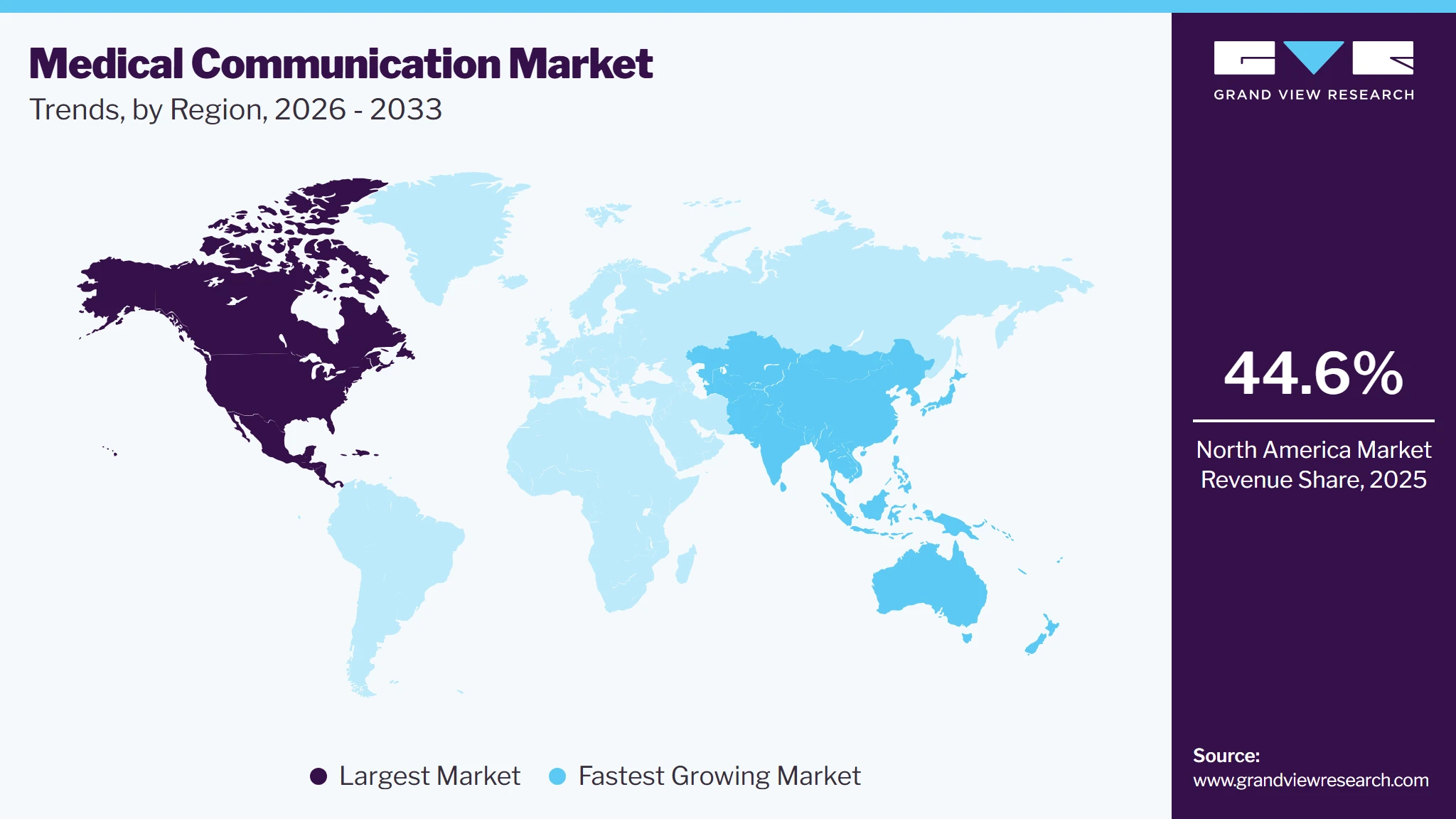
The North America medical communication market held the largest share of 44.6% in 2025, driven by a strong pharmaceutical and biotechnology sector, robust clinical research, and established medical affairs and scientific communication infrastructure. The region hosts many life sciences companies and specialized communication providers supporting clinical development, publications, medical education, and stakeholder engagement. The increasing adoption of digital and AI-enabled communication solutions is driving market growth. For instance, in June 2025, Real Chemistry launched its AI-powered Real Health Engine to help life sciences organizations analyze healthcare data and generate insights for more effective communication and engagement. This development demonstrates the region’s growing investment in technology-enabled healthcare communications.
 To learn more about this report, Download Free Sample Report
 U.S. Medical Communication Market Trends
The medical communication market in the U.S. held the largest share in the North America region in 2025. The medical communication market in the U.S. benefits from significant investment in pharmaceuticals and biotechnology. Rising demand for medical publications, scientific content, medical education, and stakeholder engagement is driving market growth. For instance, in May 2025, OPEN Health participated in the ISMPP Annual Meeting in Washington, D.C., presenting work on visual communication in medical publications and AI applications for manuscript abstract generation. This reflects the ongoing adoption of innovative approaches in U.S. medical and scientific communications.
Asia Pacific Medical Communication Market Insights
The medical communication market in Asia Pacific is projected to grow at the fastest CAGR during the forecast period, driven by growth in the pharmaceutical and biotechnology sectors and rising demand for scientific publications, medical education, and stakeholder engagement. The region is enhancing healthcare communication as life sciences companies produce more clinical and scientific evidence across diverse markets. For instance, in September 2025, Havas Health Network launched Havas Health Taiwan, an integrated healthcare communications hub, to strengthen its presence and capabilities in the Asia Pacific. This expansion demonstrates growing investment in localized healthcare and medical communication across the region.
The China medical communication market is driven by pharmaceutical innovation and the international development of Chinese medicines. Growth in innovative drug pipelines is raising demand for scientific publications, regulatory communication, medical education, and evidence dissemination. For instance, in February 2026, the China Forum on Source Innovation in New Drug Discovery reported that China had become the world's second-largest hub for innovative drug pipelines, supported by regulatory reforms and greater investment in drug development. This expanding pipeline is expected to further increase demand for specialized medical communication services to convey complex scientific and clinical evidence.
The medical communication market in India is expanding due to increasing clinical evidence and the country’s expanding role in global life sciences, which is driving demand for medical writing, scientific publications, regulatory communication, and medical education. For instance, in January 2025, Indegene announced the development of GenAI-powered functional capability centers for life sciences organizations, supporting specialized functions and scalable global operations. This advancement highlights India's growing role in technology-enabled life sciences services and the expansion of specialized medical communication capabilities.
Europe Medical Communication Market Insights
The medical communication market in Europe is supported by a strong pharmaceutical industry and extensive clinical research activity. Increasing demand for scientific publications, medical education, evidence dissemination, and digital engagement is supporting market growth across major European countries. For instance, in June 2025, The Bloc opened a new London office as part of its European expansion, strengthening its scientific communications capabilities across Europe and supporting clients in major healthcare markets. This development reflects continued investment in specialized medical communication capabilities and regional service expansion.
The UK medical communication market is driven by a strong pharmaceutical and life sciences ecosystem, a well-established medical communications industry, and the concentration of scientific and healthcare expertise. Ongoing demand for publication planning, medical education, scientific content, and stakeholder engagement supports market growth. For instance, in June 2025, Ashley Medical Communications was acquired by Hypha Partners to support the agency's growth, expand its services, and reach new global healthcare clients. This acquisition highlights continued investment and consolidation in the UK medical communications sector.
Latin America Medical Communication Market Insights
The medical communication market in Latin America is supported by increased healthcare investment and rising demand for localized scientific and medical communications. Providers are building region-specific capabilities to address diverse healthcare systems, regulatory requirements, and stakeholder requirements. For instance, in June 2025, Speyside Group expanded its healthcare communications practice across Latin America, integrating corporate affairs, patient-focused communication, and both traditional and digital media to address the region’s healthcare environment. This expansion reflects growing demand for specialized and locally adapted healthcare communication services.
Middle East & Africa Medical Communication Market Insights
The medical communication market in the Middle East & Africa is driven by increased healthcare investments and demand for localized scientific and medical communications. Expanding healthcare systems and pharmaceutical markets are boosting demand for medical education, scientific content, and healthcare professional engagement. For instance, in May 2025, Havas Life expanded into the Middle East by opening a new office in Dubai, enhancing its ability to deliver specialized healthcare and medical communication services across the region. This expansion demonstrates growing investment in dedicated medical communications capabilities and supports regional market development.
Key Medical Communication Company Insights
Key companies operating in the global medical communication market are undertaking various initiatives to strengthen their presence and increase the reach of their products and services. Strategies such as expansion activities and partnerships are key to propelling the market growth.
Key Medical Communication Companies
The following key companies have been profiled for this study on the medical communication market.
-
Inizio.
-
Indegene.
-
Costello Medical Consulting Limited
-
Syneos Health.
-
OPEN Health
-
Real Chemistry
-
Health Inc.
-
VML.
-
Amiculum.
-
Cactus Life Sciences.
-
Avalere Health Group.
-
Oxford PharmaGenesis (Klick Inc.)
Competitive Benchmarking
Category
Operating Strategies
Competitive Edge
Weakness
Established Players (Inizio, Indegene, Syneos Health, OPEN Health, Real Chemistry, VML, and Avalere Health)
- Expand end-to-end capabilities across scientific strategy, publication planning, medical affairs, medical education, patient engagement, promotional content, and digital communication.
- Invest in artificial intelligence, data analytics, modular content, omnichannel platforms, and technology-enabled delivery models.
- Broad service portfolios and established relationships with large pharmaceutical and biotechnology companies.
- Extensive geographic reach and access to multidisciplinary medical, scientific, creative, digital, and analytical expertise
- Large organizational structures and multiple service lines can increase operating complexity and slow decision-making.
- Higher service costs can reduce competitiveness among smaller biotechnology companies and regional clients.
Emerging / Specialized Players (Costello Medical, Cactus Life Sciences, Amiculum, Oxford PharmaGenesis (Klick Inc.)
- Focus on specialized medical communications, scientific strategy, publication planning, medical writing, stakeholder engagement, and therapeutic-area expertise to differentiate from larger full-service providers.
- Expand digital communication capabilities, technology-enabled content delivery, and regional operations while developing tailored solutions for pharmaceutical, biotechnology, and healthcare clients.
- Specialized scientific expertise, focused client engagement, agile delivery models, and the ability to provide highly tailored communications programs across selected therapeutic areas.
- Lower global reach, fewer integrated technology and analytics capabilities, and greater dependence on specialized service areas may constrain expansion into large multinational accounts.
- Smaller scale and narrower service portfolios can limit the ability to manage highly complex global programs compared with larger integrated providers.
- Lower global reach, fewer integrated technology and analytics capabilities, and greater dependence on specialized service areas may constrain expansion into large multinational accounts.
Recent Developments
-
In July 2026, Real Chemistry launched Real Chemistry ANATOMI, an AI ecosystem for the healthcare commercialization lifecycle. The platform integrates AI into medical affairs, communications, marketing, and media workflows, offering dedicated solutions for healthcare communications and scientific publication planning. This launch highlights the growing adoption of AI to enhance the speed, scalability, and consistency of medical communications and publication activities.
-
In April 2024, Cactus Life Sciences acquired nspm and eluSCIdate, two Swiss medical communications and publications companies. nspm brings expertise in medical communications, publications, event management, and rare-disease communications, while eluSCIdate focuses on medical and scientific publications. This acquisition enhances Cactus Life Sciences’ global medical communications capabilities and expands its presence in the US, UK, Switzerland, and Japan.
Medical Communication Market Report Scope
Report Attribute
Details
Market size in 2025
USD 2.8 billion
Estimated market size in 2026
USD 3.1 billion
Projected market size in 2033
USD 6.1 billion
Growth rate
CAGR of 10.3% from 2026 to 2033
Actual data
2021 - 2025
Forecast period
2026 - 2033
Quantitative units
Revenue in USD billion and CAGR from 2026 to 2033
Report coverage
Revenue forecast, company ranking, competitive landscape, growth factors, and trends
Segments covered
Service, delivery mode, end use, region
Regional scope
North America; Europe; Asia Pacific; Latin America; MEA
Country scope
U.S.; Canada; Mexico; UK; Germany; Spain; France; Italy; Spain; Denmark; Sweden; Norway; China; Japan; India; Australia; South Korea; Thailand; Brazil; Argentina; Mexico; South Africa; Saudi Arabia; UAE; Kuwait
Key companies profiled
Inizio; Indegene.; Costello Medical Consulting Limited; Syneos Health.; OPEN Health; Real Chemistry; Health Inc.; VML.; Amiculum.; Cactus Life Sciences; Avalere Health Group.; Oxford PharmaGenesis (Klick Inc.)
Customization scope
Free report customization (equivalent to 8 analysts working days) with purchase. Addition or alteration to country, regional & segment scope.
Pricing and purchase options
Avail customized purchase options to meet your exact research needs. Explore purchase options
Global Medical Communication Market Report Segmentation
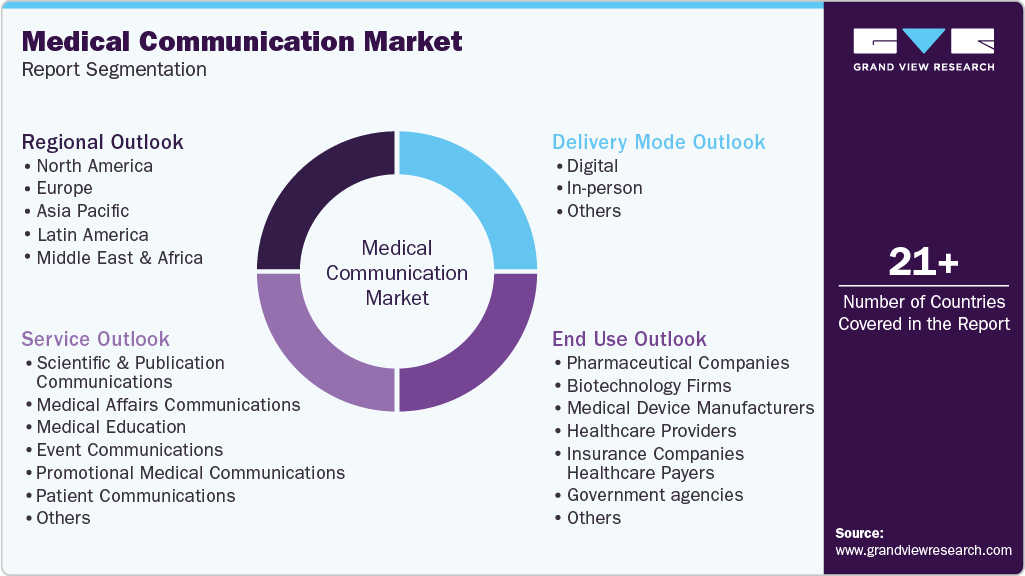
This report forecasts revenue growth at the global, regional, & country levels and provides an analysis of the latest industry trends and opportunities in each sub segment from 2021 to 2033. For this study, Grand View Research has segmented the global medical communication market report based on service, delivery mode, end use, and region:
 To learn more about this report, Download Free Sample Report
 -
Service Outlook (Revenue, USD Billion, 2021 - 2033)
-
Scientific and publication communications
-
Medical affairs communications
-
Medical education
-
Event communications
-
Promotional medical communications
-
Patient communications
-
Others
-
-
Delivery Mode Outlook (Revenue, USD Billion, 2021 - 2033)
-
Digital
-
In-person
-
Others
-
-
End Use Outlook (Revenue, USD Billion, 2021 - 2033)
-
Pharmaceutical companies
-
Biotechnology firms
-
Medical device manufacturers
-
Healthcare providers
-
Insurance companies/Healthcare payers
-
Government agencies
-
Others
-
-
Regional Outlook (Revenue, USD Billion, 2021 - 2033)
-
North America
-
U.S.
-
Canada
-
Mexico
-
-
Europe
-
UK
-
Germany
-
France
-
Italy
-
Spain
-
Denmark
-
Sweden
-
Norway
-
-
Asia Pacific
-
Japan
-
China
-
Australia
-
India
-
South Korea
-
Thailand
-
-
Latin America
-
Brazil
-
Argentina
-
-
Middle East & Africa
-
South Africa
-
Saudi Arabia
-
UAE
-
Kuwait
-
-
Research Methodology
The medical communication market figures in this report are based on a proven research process that combines executive interviews with secondary research from proprietary databases, company filings, and recognized regulatory and institutional sources. Market size is built through value-chain sizing-reconciling supply-side and demand-side estimates-and triangulated with bottom-up and top-down approaches. Every estimate passes multiple levels of expert validation before publication, with each medical communication segment quantified using the revenue-capture definitions in the table below.
Segment Definition
Segment
Segment Definition
Scientific and Publication Communications
The scientific and publication communications segment includes services used to develop, manage, and disseminate scientific and clinical information through peer-reviewed publications, manuscripts, abstracts, posters, congress materials, and publication planning. Revenue is generated through medical writing, publication strategy, editorial support, literature analysis, and related scientific communication services.
Medical Affairs Communications
The medical affairs communications segment includes services that support communication of scientific and clinical evidence to healthcare professionals, researchers, and other medical stakeholders. Revenue is generated through medical strategy, scientific content development, evidence communication, stakeholder engagement, and medical affairs support services.
Medical Education
The medical education segment includes services designed to provide healthcare professionals and other stakeholders with evidence-based information on diseases, treatments, clinical practices, and emerging scientific developments. Revenue is generated through educational content, training programs, e-learning, workshops, and other medical education activities.
Event Communications
The event communications segment includes services supporting scientific congresses, medical meetings, advisory boards, conferences, workshops, and other healthcare-related events. Revenue is generated through event strategy, scientific content development, meeting materials, digital event support, and related communication services.
Promotional Medical Communications
The promotional medical communications segment includes communication services designed to support the appropriate presentation of pharmaceutical, biotechnology, and medical device products to healthcare professionals and other stakeholders. Revenue is generated through promotional content development, scientific messaging, campaign materials, and related communication services.
Patient Communications
The patient communications segment includes services that translate medical and scientific information into accessible and understandable content for patients, caregivers, and patient communities. Revenue is generated through patient education materials, disease awareness content, patient support communications, and digital engagement services.
Others
The others segment includes specialized medical communication services not classified within the major service categories, including medical information services, internal communications, and other scientific or healthcare communication activities. Revenue is generated through customized communication projects and related professional services.
By Delivery Mode:
Digital
The digital segment includes medical communication services delivered through digital platforms and electronic channels, including websites, online publications, webinars, virtual congresses, e-learning platforms, email, social media, and mobile applications. Revenue is generated through digital content development, platform management, virtual engagement, and related communication services.
In-person
The in-person segment includes medical communication activities delivered through physical interactions, including conferences, scientific congresses, advisory boards, workshops, medical education programs, and face-to-face stakeholder meetings. Revenue is generated through event management, educational programs, meeting support, and related communication services.
Others
The others segment includes delivery formats that combine or fall outside conventional digital and in-person communication channels. Revenue is generated through hybrid communication programs, integrated engagement activities, and customized delivery solutions.
Pharmaceutical Companies
The pharmaceutical companies segment includes pharmaceutical manufacturers and drug developers that use medical communication services to support clinical research, scientific publications, medical affairs, product education, stakeholder engagement, and patient communication. Revenue is generated through outsourced communication projects, strategic services, content development, and long-term service contracts.
Biotechnology Firms
The biotechnology firms segment includes companies developing biologics, cell and gene therapies, precision medicines, and other biotechnology products that require specialized scientific and medical communication. Revenue is generated through medical writing, publication planning, scientific education, stakeholder engagement, and related communication services.
Medical Device Manufacturers
The medical device manufacturers segment includes companies developing and commercializing medical devices, diagnostic technologies, digital health solutions, and other healthcare technologies that require scientific, clinical, and product-related communication. Revenue is generated through medical education, scientific content, healthcare professional communication, and related services.
Healthcare Providers
The healthcare providers segment includes hospitals, clinics, specialty care centers, and other healthcare organizations that use medical communication services for healthcare professional education, patient communication, clinical information dissemination, and stakeholder engagement. Revenue is generated through communication programs, educational content, and related professional services.
Insurance Companies/Healthcare Payers
The insurance companies and healthcare payers segment includes insurers, managed-care organizations, and other healthcare payers that use medical communication services to communicate clinical evidence, treatment information, health programs, and healthcare policies to providers, members, and other stakeholders. Revenue is generated through educational materials, evidence communication, patient engagement, and related services.
Government Agencies
The government agencies segment includes public health departments, regulatory authorities, government healthcare organizations, and other public-sector bodies that use medical communication services for health education, scientific information dissemination, public-health programs, and stakeholder engagement. Revenue is generated through communication campaigns, educational content, scientific materials, and related services.
Others
The others segment includes research organizations, academic institutions, contract research organizations, and other life-sciences entities that require medical and scientific communication services. Revenue is generated through research communication, scientific publications, educational content, evidence dissemination, and customized communication programs.
Estimation Model
Estimation Approach
Methodology for Medical Communication Market
Top-Down Approach
The estimation begins with an assessment of the global outsourced life sciences services ecosystem, including healthcare communications, medical affairs outsourcing, scientific publishing, medical education, patient engagement, and pharmaceutical commercialization services. The addressable medical communication market is isolated by evaluating the revenue contribution of scientific and publication communications, medical affairs communications, medical education, event communications, promotional medical communications, and patient communications. The analysis excludes clinical trial execution, field-force deployment, media pass-through expenditure, standalone technology licenses, and general advertising activities that do not involve medical or scientific communication.
Parent Market Identification
The parent markets considered include pharmaceutical commercialization services, outsourced medical affairs services, healthcare communications, scientific publishing, and medical writing services. The addressable demand pool is assessed using pharmaceutical and biotechnology R&D expenditure, clinical trial activity, drug approvals, scientific publication output, evidence-generation requirements, and commercialization expenditure. The contribution of medical communication services is subsequently estimated based on outsourcing penetration, service-provider capabilities, client spending patterns, and regional adoption.
Market Segmentation
The market is segmented by service type, delivery mode, end use, and geography. Service types include scientific and publication communications, medical affairs communications, medical education, event communications, promotional medical communications, patient communications, and others. Delivery modes include digital, in-person, and other formats. End-use segments comprise pharmaceutical companies, biotechnology firms, medical device manufacturers, healthcare providers, insurance companies and healthcare payers, government agencies, and others. Revenue contribution is estimated using service demand, engagement frequency, project complexity, pricing levels, digital adoption, and client outsourcing patterns.
Bottom-Up Validation / Revenue Calculation
The market size is validated through company-level revenue reconstruction. Reported revenues of leading providers are adjusted for the proportion attributable to medical communication activities, geographic exposure, currency conversion, acquisitions, and latest-year growth. For privately held companies with limited financial disclosure, estimates are developed using filed turnover, employee counts, revenue-per-employee benchmarks, service portfolios, and industry rankings. The in-scope revenues of Inizio, Indegene, Costello Medical, Syneos Health, OPEN Health, Real Chemistry, VML, AMICULUM, Cactus Life Sciences, Avalere Health, and Oxford PharmaGenesis are aggregated and grossed up to account for unlisted and regional providers. The result is further validated using client-spending, workforce-capacity, project-volume, and regional demand models.
Forecasting
Historical estimates cover 2021-2024, 2025 is considered the base year, and forecasts are developed for 2026-2033. Forecast assumptions consider pharmaceutical and biotechnology R&D activity, clinical trial pipelines, drug launches, increasing evidence-generation requirements, outsourcing penetration, medical affairs investment, regulatory complexity, and the adoption of digital and AI-enabled communication platforms. Regional and country forecasts incorporate life sciences industry concentration, healthcare expenditure, scientific activity, provider presence, digital readiness, and professional-service pricing. Segment forecasts are calculated using segment-specific growth assumptions and normalized annually to the global market total.
Delivered Customizations
This report has been delivered with the following In-depth customizations
CLIENT REQUEST
CUSTOMIZATION DELIVERED
VALUE ADDS
Service-Type, Delivery-Mode, and End-Use Analysis
Delivered historical and forecast revenue estimates from 2021 to 2033 for scientific and publication communications, medical affairs communications, medical education, event communications, promotional medical communications, patient communications, and other services. The analysis also covers digital, in-person, and other delivery modes, along with pharmaceutical, biotechnology, medical device, healthcare provider, payer, government, and other end users across major regions and countries.
Enables stakeholders to compare service demand, identify the largest and fastest-growing segments, evaluate changes in delivery preferences, and prioritize service portfolios based on revenue potential and client requirements.
Medical Communication Demand and Client-Spending Analysis
Developed a customized demand assessment using pharmaceutical and biotechnology R&D activity, clinical trial pipelines, drug approvals, publication requirements, medical affairs investment, scientific evidence generation, and outsourcing patterns. The analysis evaluates demand across pharmaceutical companies, biotechnology firms, medical device manufacturers, healthcare providers, payers, and government organizations.
Provides insight into the underlying sources of medical communication expenditure and helps identify high-potential client groups, therapeutic areas, and geographic markets. The analysis supports account prioritization, resource planning, business development, and market-entry decisions.
AI-Enabled Cardiac Monitoring & Remote Patient Monitoring Forecasting
Developed a technology-focused assessment covering AI-assisted medical writing, literature review, evidence synthesis, modular content, automated content tagging, translation, personalization, omnichannel engagement, virtual medical education, and digital scientific communication. The forecast evaluates the expected effect of these technologies on service delivery, productivity, pricing, and client outsourcing requirements.
Helps stakeholders assess emerging technology opportunities, plan investments in AI and digital platforms, improve content-development workflows, and evaluate how technology-enabled delivery models could influence competitive positioning and market growth.
Frequently Asked Questions About This Report
Some key players operating in the market include Inizio.; Indegene.; Costello Medical Consulting Limited; Syneos Health.; OPEN Health; Real Chemistry; Health Inc.; VML.; Amiculum.; Cactus Life Sciences.; Avalere Health Group.; Oxford PharmaGenesis (Klick Inc.).
Asia Pacific is projected to grow the fastest CAGR during the forecast period.
The growth of the market is attributed to factors such as increasing complexity of medical and scientific information, growing adoption of AI-enabled medical content and communication platforms.
North America dominated with a 44.6% revenue share in 2025.
Scientific and publication communications segment held the largest market share of 27.0% in 2025 while medical affairs communications segment is expected to be the fastest-growing market.
The digital segment held the largest market share of 63.3% in 2025, fueled by the expanding use of digital scientific platforms, virtual events, webinars, e-learning, online publications, and AI-enabled communication tools.
The pharmaceutical companies segment held the largest market share of 59.1% in 2025 while biotechnology firms segment is expected to be the fastest-growing market.
The global medical communication market size was valued at USD 2.8 billion in 2025 and is estimated at USD 3.1 billion for 2026.
The global medical communication market is expected to grow at a CAGR of 10.3% from 2026 to 2033, reaching USD 6.1 billion by 2033.
About the Author(s)
Healthcare IT Research Team
Healthcare · Healthcare ITThis report was authored by the healthcare it research team at Grand View Research - comprising two research analysts, one senior research analyst, and one industry expert - with specialized expertise in the healthcare it segment of the healthcare industry. All findings are based on proprietary healthcare databases, executive interviews, and regulatory analysis, subject to internal peer review prior to publication.
Last Updated:
Speak to Analyst

Customize this report to your needs - add regions, segments, or data points, with 20% free customization.
Or view our licence options:


ISO 9001:2015 & 27001:2022 Certified
We are GDPR and CCPA compliant! Your transaction & personal information is safe and secure. For more details, please read our privacy policy.


