
- Home
- »
- Medical Devices
- »
-
Medical Writing Market Size And Share Report, 2026-2033GVR Report cover

Medical Writing Market (2026 - 2033)
Size, Share & Trends Analysis Report By Type (Clinical, Regulatory, Scientific), By Application (Medical Journalism, Medical Education, Medico Marketing,), By End Use (Contract Research Organizations & Others), By Region, And Segment Forecasts
Market Size, 2025
$5.1BMarket Estimate, 2026
$5.6BMarket Forecast, 2033
$11.1BCAGR, 2026–2033
10.2%Medical Writing Market Summary
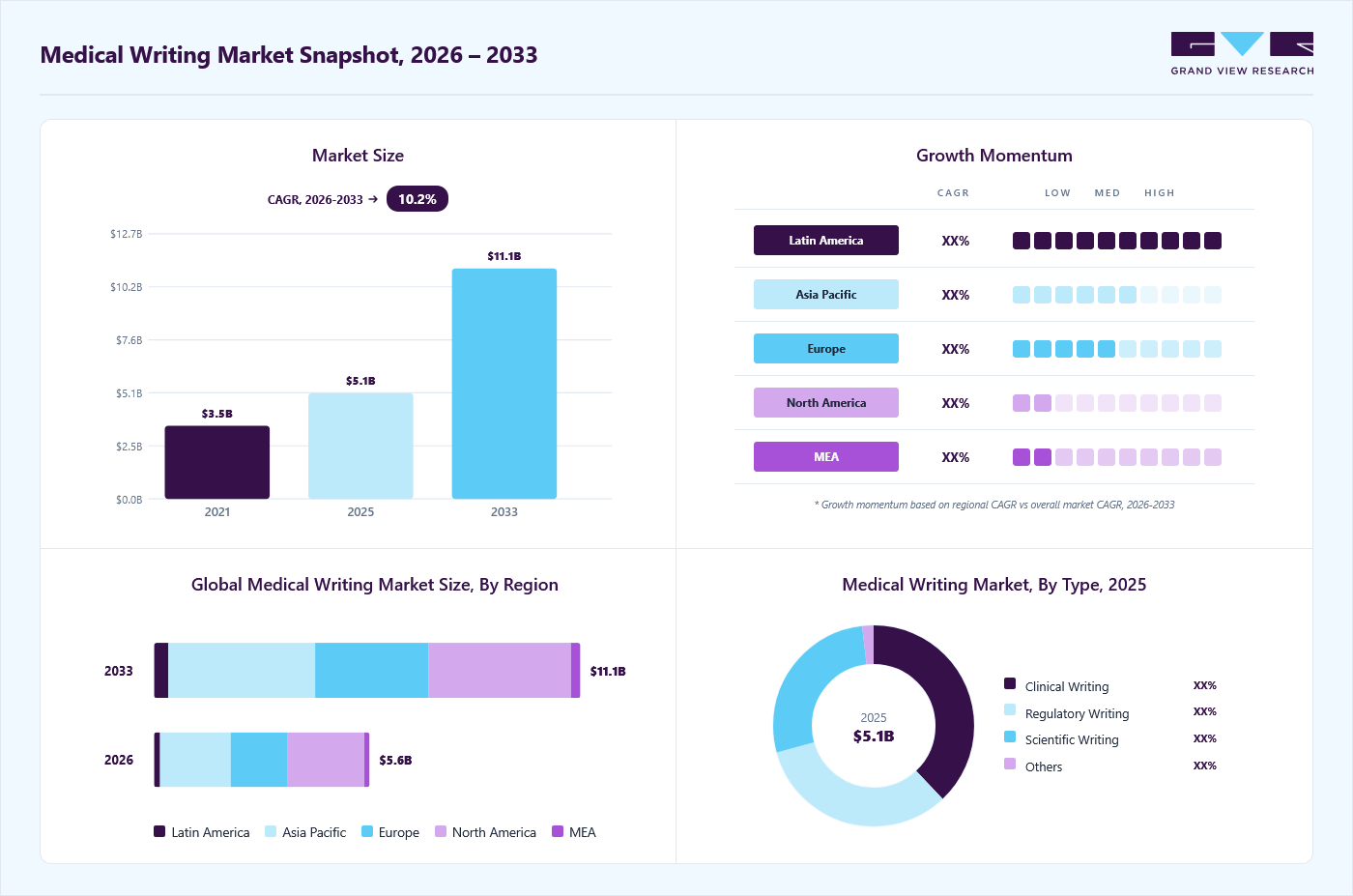
The global medical writing market size was valued at USD 5.1 billion in 2025 and is projected to grow from USD 5.6 billion in 2026 to USD 11.1 billion by 2033, growing at a CAGR of 10.2% from 2026 to 2033. The market in North America dominated with a revenue share of 36.1% in 2025. The high demand for medical writers can be attributed to a rise in CRO outsourcing, increased R&D investments by market players, a favorable environment for clinical study in developing countries, and new medical device regulations.
 Source: Grand View Research, IR Documents, Primary Interviews, Paid DatabasesTo learn more about this report,
 Download Free Sample Report
Key Market Trends & Insights
- By end use: CRO’s and others segment held the largest market share of 68.3% in 2025.
- By application: Medical journalism segment held the largest market share of 38.1% in 2025.
- By type: Clinical writing segment held the largest market share of 37.9% in 2025.
Regional Highlights
- Largest regional market: North America (36.1% revenue share, 2025)
- Fastest-growing regional market: Asia Pacific (highest CAGR, 2026-2033)
- By country: The U.S. held the largest market share in 2025.
Market Size & Forecast
- Market size in 2025: USD 5.1 Million
- Estimated market size in 2026: USD 5.6 Million
- Projected market size by 2033: USD 11.1 Million
- CAGR (2026-2033): 10.2%
Three ways to get this report
Buy it, customize it, or ask a question.Ask an Analyst
Analyst response in 1 business day
- AccessReport author, directly
- Reply timeWithin 1 working day
- No sales callDirect answer only
- FormatEmail reply
- CostFree, no cost
Get the Full Report
What the study covers
- FormatsPDF · Excel · Dashboard
- Timeline2026–2033 annual, 2025 base
- Coverage20+ countries, 5 regions
- Companies10+ key players profiled
Customize the Report
20% free customization
- IncludeCountries, segments, points
- TailorTo your product definition
- ExtendDeeper competitor detail
- OrA fully bespoke study
- Turnaround5–10 working days
In July 2024, Celegence highlighted in The Journal of mHealth that Generative AI (GenAI) could transform pharmaceutical medical writing, with 57% of organizations planning investment. While deployment knowledge is a challenge, controlled experiments and partnerships can boost efficiency, cut costs, and keep companies competitive. Pharmaceutical companies have adapted their advertising strategies to improve patient outreach. In addition, the growing influence of social media on customers’ decisions has compelled pharmaceutical and biotechnology companies to reconsider their marketing strategies. The robust growth of health and wellness-related blogs is expected to boost the demand for scientific writing. In September 2025, an article published in Health Promotion International analyzed the scale of the medical writing industry, identifying 1,148 medical education and communication companies (MECCs) contributing to English-language medical literature. The study found that over 20,000 scientific papers acknowledged medical writing support, with more than 50% sponsored by just ten pharmaceutical companies, highlighting the industry’s size and concentrated funding base.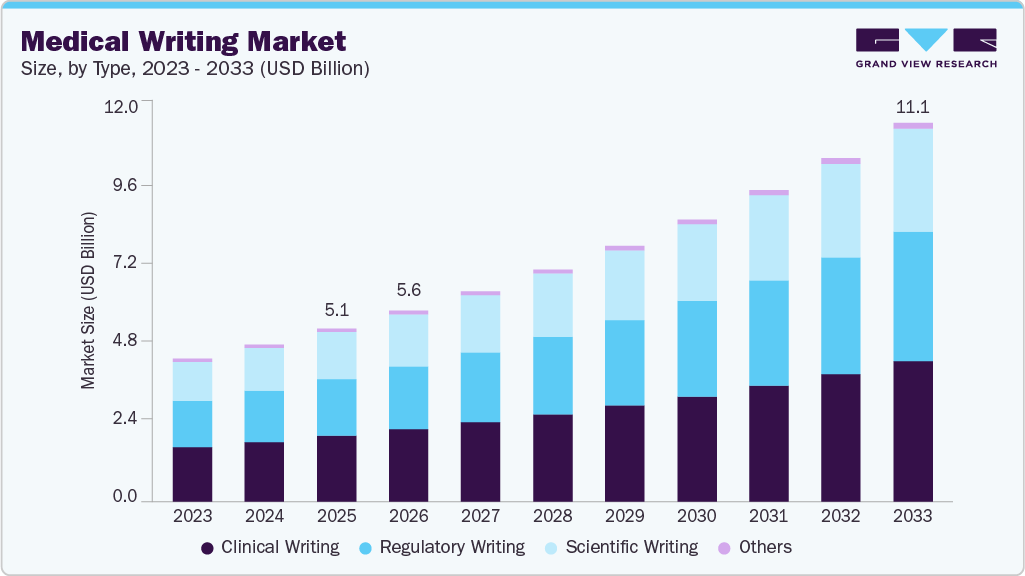 To learn more about this report, Download Free Sample Report
Regulatory authorities want a thorough methodology for all phases of product development, which complicates the approval process boosting the market growth in the coming years. Insurance companies want drug information to establish reimbursement policies. As a result, pharmaceutical companies are finding it difficult to adhere to industry standards. In June 2024, an article published by the American Medical Writers Association (AMWA) Blog highlighted the expanding medical writing profession, citing U.S. Bureau of Labor Statistics projections of 7% growth in technical writing roles by 2032 and industry data showing nearly 8,000 medicines in development and about 900 FDA approvals since 2000, collectively pointing to sustained demand for medical writers across clinical, regulatory, and commercial activities.
There is a new trend in the market of multiple strategic relationships, wherein each CRO provides a single function and multiple service providers are maintained. Clinical trials are increasing in number as a result of increased R&D investments. In September 2024, the European Journal of Internal Medicine highlighted that AI and large language models are rapidly transforming scientific medical writing, aiding literature review, translation, and statistical analysis.
Market Dynamics
The high demand for medical writers is attributed to a rise in CRO outsourcing, increased R&D investments by market players, a favorable environment for clinical study in developing countries, and new medical device regulations.
The increasing complexity of drug development, including more global, multi-site trials, biologics, and advanced therapies, and real-world evidence studies, has driven many pharmaceutical and biotech companies to outsource core functions to Contract Research Organizations (CROs). That means not only data management and monitoring, but also the creation of critical study documents, including protocols, clinical study reports (CSRs), safety narratives, regulatory submissions, and real-world evidence reports. Outsourcing these tasks helps sponsors avoid building large in‑house regulatory‑writing teams, while still ensuring expertise, compliance, and scalability.
For instance, in September 2025, Parexel revealed a partnership with Weave Bio. Under this agreement, Parexel will use Weave’s “AI native regulatory automation” platform to accelerate regulatory submission processes and other document preparation workflows. The firm expects substantial gains in speed and quality for items such as IND applications and regulatory dossiers.
“This partnership represents a significant advancement in Parexel’s vision to leverage AI to speed clinical research processes, enhance first-time quality and accelerate the delivery of life-changing therapies to patients. We’re beginning this partnership by addressing an area where sponsors feel extreme urgency early regulatory authoring and submission preparation. By combining Weave's cutting-edge AI technology with the human-in-the-lead expertise of Parexel Consulting, we're helping teams move faster and with greater confidence while maintaining the highest levels of quality and compliance" -
Paul Bridges, President, Consulting, Parexel
Furthermore, the demand for regulatory, clinical, and scientific documentation continues to drive market dominance. There is a new trend in the market of multiple strategic relationships, wherein each CRO provides a single function and multiple service providers are maintained. Clinical trials are increasing in number as a result of increased R&D investments. For instance, in November 2025, QInscribe unveiled an AI-powered medical writing service aimed at transforming regulatory submissions by cutting clinical study report draft timelines by up to 90%. The new provider combines generative AI with expert medical writers to deliver accurate, submission-ready regulatory documents at scale, reducing traditional 50-100 hour workflows to as little as five hours.
One of the key challenges restraining growth in the medical writing sector is the persistent shortage of skilled professionals. Preparing high-quality regulatory submissions, clinical study reports, and safety narratives requires expertise in scientific writing a deep understanding of evolving regulatory requirements across multiple regions. Many pharmaceutical and biotech companies struggle to find writers with both scientific knowledge and regulatory experience, which can slow project timelines and increase reliance on limited in-house or outsourced talent.
The growing volume and complexity of clinical trials and regulatory documentation further compound this talent gap. As more innovative therapies enter development, the demand for experienced medical writers outpaces supply, creating bottlenecks and limiting scalability for organizations seeking timely submissions. Companies are increasingly turning to training programs, AI-assisted writing tools, and outsourcing solutions to mitigate these challenges; however, the shortage of highly skilled writers remains a significant restraint on the market.
Market Concentration & Characteristics
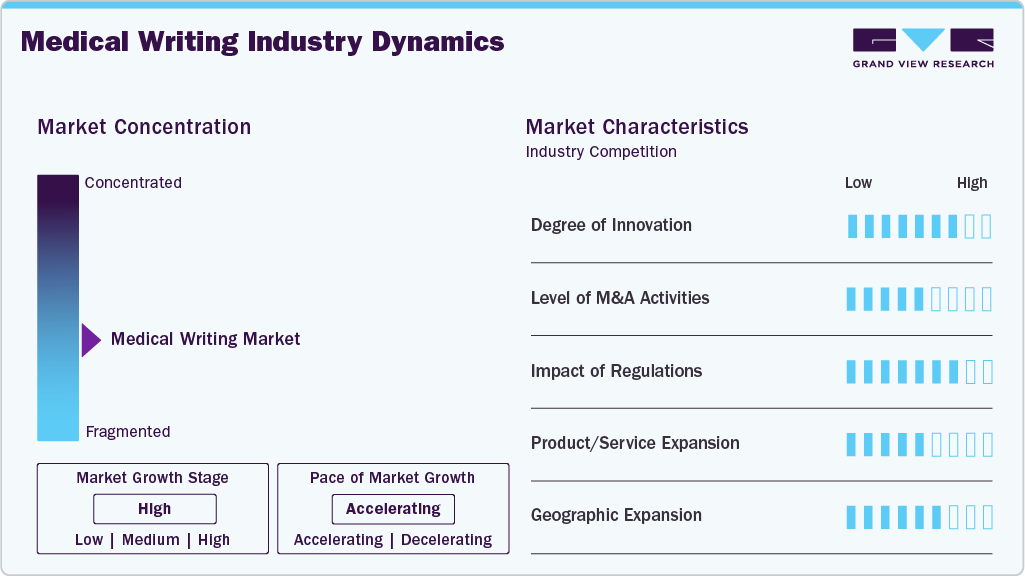
The medical writing industry is experiencing steady innovation, with a strong focus on automation, artificial intelligence enabled content generation, and standardized authoring platforms. Advancements in regulatory intelligence tools, data visualization, and structured authoring are improving efficiency, consistency, and compliance across clinical, regulatory, and scientific documentation.
The market has witnessed selective merger and acquisition activity, as larger contract research organizations (CROs) and life sciences service providers acquire specialized medical writing firms to expand service portfolios, enhance therapeutic expertise, and strengthen global delivery capabilities. M&A is primarily driven by the need for end-to-end regulatory and clinical development solutions.
 To learn more about this report, Download Free Sample Report
Stringent regulatory requirements significantly influence the market, as documentation must comply with evolving global standards set by regulatory authorities such as the U.S. FDA, EMA, and ICH. Frequent updates to clinical trial reporting guidelines, regulatory submission formats, and pharmacovigilance requirements increase demand for specialized medical writing expertise while also extending project timelines.
In-house medical writing teams within pharmaceutical and biotechnology companies act as partial substitutes for outsourced services. In addition, emerging AI-based writing tools may reduce reliance on external providers for routine documentation, although complex regulatory and scientific content continues to require expert human oversight.
Medical writing service providers are expanding geographically by strengthening delivery centers in cost-efficient regions such as Asia-Pacific and Eastern Europe, while maintaining client-facing operations in North America and Europe. This strategy supports scalability, cost optimization, and access to a broader talent pool amid rising global demand for regulatory and clinical documentation.
Analyst Perspective
The global medical writing market is becoming an increasingly important component of the life sciences value chain as pharmaceutical, biotechnology, and medical device companies face growing regulatory complexity and rising clinical development activity. Increasing numbers of clinical trials, expanding regulatory documentation requirements, and growing demand for scientific communication are driving the outsourcing of medical writing services. Organizations are seeking specialized expertise to improve submission quality, accelerate regulatory approvals, ensure compliance, and efficiently manage large volumes of clinical and scientific documentation.
The market’s competitive landscape is shifting toward technology-enabled and strategically integrated service models. Artificial intelligence, natural language processing, automated document generation, and regulatory intelligence tools are helping improve productivity, consistency, and document quality. At the same time, demand is increasing for specialized therapeutic expertise, publication planning, patient-centric communication, and global regulatory support. As clinical research becomes more complex and multinational, medical writing providers that combine scientific expertise, regulatory knowledge, scalable global operations, and advanced technology platforms will be best positioned to capture long-term growth opportunities. Companies capable of delivering high-quality, compliant, and efficient documentation across the entire product lifecycle are expected to strengthen their competitive position in the evolving medical writing market.
Type Insights
Based on type, the clinical writing segment led the market with the largest revenue share of 37.9% in 2025. However, the regulatory writing segment is expected to grow at the fastest CAGR over the forecast period. Clinical writing is used by health professionals on a regular basis and a clinical writer must have a thorough knowledge of the clinical language as well as culture. An understanding of the target reader and the purpose is required for effective clinical writing. It is used in protocols, consent documents, and clinical study reports for all the phases of clinical trials in product development. It mainly focuses on professionals with a sound comprehension of drug/product development processes and analysis of scientific data. In August 2022, AlphaLife Sciences launched AuroraPrime Create 2.0, enhancing clinical document generation with intelligent content recommendations, structured templates, and lifecycle management to streamline and standardize clinical protocol development.
The regulatory writing segment is anticipated to witness the fastest CAGR over the forecast period. It is used throughout the process of product development for clinical documentation. It is required for describing and reporting data from clinical trials for the purpose of regulatory submissions and approvals. When the product or drug receives approval, post-approval regulatory documentation is required. In October 2023, Certara launched CoAuthor, an AI-enabled regulatory and medical writing platform that uses generative AI and structured authoring to streamline clinical trial documentation and cut development timelines by over 20%.
Application Insights
Based on application, the medical journalism segment led the market with the largest revenue share of 38.1% in 2025. However, the medico marketing segment is expected to grow at the fastest CAGR over the forecast period. The segment is mainly concerned with investigating, reporting, and communicating health issues to a wide audience. This type of journalism targets nonprofessional/non-expert audiences, along with healthcare professionals. Based on application, the global market is segmented into medical journalism, medical education, medico marketing, and others. Health-related issues are of common interest to most people, as they have an impact on the behavior of people. In July 2025, the Journal of Health and Allied Sciences NU highlighted that medical journalism is vital in the digital era to bridge the gap between science and public understanding, combat misinformation, and build trust in healthcare.
The medico marketing segment is anticipated to witness the fastest CAGR over the forecast period. Medico-marketing involves designing marketing content for drugs and other products. The ever-changing product mix in the pharmaceutical & biotechnology industry acts as a driving factor for improved marketing practices. For instance, WorkSure provides medico-marketing services in India, helping healthcare organizations enhance product visibility and brand recall through strategic planning, KOL engagement, scientific communications, and content creation such as product videos, promotional literature, and patient education materials.
End Use Insights
Based on end use, the medical device/pharma & biotech companies segment led the market with the largest revenue share of 68.3% in 2025. However, the CROs & others segment is expected to grow at the fastest CAGR over the forecast period. Drug manufacturers are under pressure to replace revenue loss specifically due to the introduction of generics post-patent expiration. CROs conduct clinical trials to introduce new products in the market in given timelines. They have the required expertise and infrastructure that give the benefit of cost, time, and efficiency at the same time. CROs have a separate service section for medical writing. In October 2025 , Merigold and Log10 launched the Bloom AI platform, integrating Everest’s AI to streamline medical writing and documentation for clinical trials in North America, enhancing accuracy and regulatory compliance.
 To learn more about this report, Download Free Sample Report
The medical device/pharma & biotech companies segment is anticipated to register the fastest CAGR over the forecast period. These companies hire writers or journalists frequently. Established pharmaceutical companies have a separate team of medical writers. In addition, various companies outsource writers. For instance, Freyr provides specialized medical writing services across the biopharmaceutical and medical device sectors, covering regulatory submission documents, scientific publications, educational materials, and content for healthcare websites and magazines, with experienced associates supporting a broad range of therapeutic areas.
Regional Insights
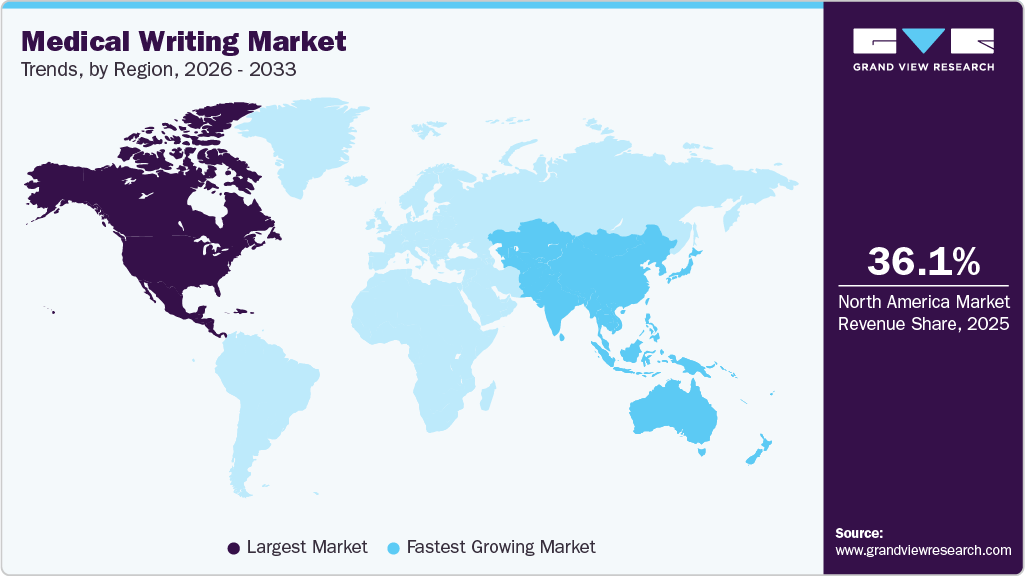
North America dominated the medical writing market with the largest revenue share of 36.1% in 2025. Clinical writing in the U.S. for FDA approval requires an in-depth understanding of the requirements laid down by the regulatory authority. The documents for FDA submission must be succinct and accurate. In February 2025, Woven Health Collective, formerly ClinicalMind, consolidated multiple brands in North America to provide integrated medical writing, scientific communications, and strategy services, strengthening capabilities in publications, patient advocacy, and tech-enabled healthcare solutions.
 To learn more about this report, Download Free Sample Report
U.S. Medical Writing Market Trends
The medical writing market in the U.S. held the largest share in the North America region in 2025. This is supported by a strong presence of pharmaceutical and biotechnology companies, high clinical trial activity, and stringent regulatory requirements. Demand for regulatory, clinical, and scientific documentation continues to drive market dominance. In December 2024, MMS highlighted the evolving role of medical writers, noting an industry-low attrition rate of 3.5%, and emphasized flexible work arrangements, training, and process improvements to enhance retention and efficiency; the article references MMS headquarters in Canton, Michigan, U.S., and notes collaboration across remote and global teams.
Europe Medical Writing Market Trends
Europe medical writing industry is anticipated to register a significant growth rate during the forecast period. The presence of established pharmaceutical companies, increasing cross-border clinical trials, and evolving EMA regulatory requirements support sustained demand for medical writing services. In December 2024, Medical Writing highlighted the global scope and diversity of medical writing, covering cross-border collaboration, remote work, multilingual challenges, and inclusive practices, alongside the 58th EMWA Conference held across 10 countries with workshops, seminars, and networking opportunities for medical writers.
Germany medical writing industry is anticipated to grow considerably during the forecast period. Growth is supported by a strong pharmaceutical manufacturing base, rising R&D investments, and increasing regulatory documentation needs across clinical and post-marketing stages. In March 2024, Indegene acquired Germany-based Trilogy Writing & Consulting GmbH, a medical writing consultancy specializing in clinical, regulatory, and medical content. The acquisition strengthens Indegene’s capabilities in Germany and supports high-quality regulatory submissions across multiple therapeutic areas.
Italy medical writing industry is anticipated to grow considerably during the forecast period.Expansion of clinical trial activities and growing adoption of outsourced medical writing services by mid-sized pharmaceutical companies are key growth drivers. In September 2024, a survey published in Medical Writing highlighted the demographics, compensation, and work practices of Italian medical writers. Among 68 respondents, 84% were female, and 72% reported high job satisfaction, underscoring the need for enhanced professional recognition and training in Italy.
Asia Pacific Medical Writing Market Trends
Asia Pacific medical writing industry is anticipated to be the fastest-growing region, driven by increasing clinical trial outsourcing, expanding pharmaceutical manufacturing, and the availability of cost-effective, skilled medical writing professionals. In September 2025, according to Dr. Julia Cooper of PAREXEL, medical writing in Asia is growing, driven by increasing pharmaceutical research and regulatory demands in China, Japan, and India, with writers taking on leadership roles in clinical documentation and regulatory submissions.
Japan medical writing industry is anticipated to register a significant growth rate during the forecast period. Stringent regulatory requirements and increasing focus on localized clinical documentation are supporting demand for specialized medical writing services. The need for high-quality English-language documents for global submissions is further boosting demand. In November 2025, Biz Hits and Craudia launched a dedicated medical writing service in Japan, focusing on accurate, evidence-based content for the healthcare sector. The service ensures compliance with local pharmaceutical and medical device regulations while producing clear, digestible material for clients.
China medical writing industry is anticipated to register a significant growth rate during the forecast period. Rapid expansion of pharmaceutical R&D, increasing clinical trial approvals, and evolving regulatory standards are driving demand for medical writing support. Growing adoption of CRO outsourcing is also contributing to the market’s expansion. In October 2025, according to Nature Index, China’s research hospitals are increasingly producing high-quality health research, strengthening the country’s presence in global medical research. This rise highlights China’s growing influence, although questions about publishing integrity remain under scrutiny.
Latin America Medical Writing Market Trends
Latin America medical writing industry is anticipated to grow over the forecast period, fueled by increasing clinical trial activity and rising participation in global drug development programs. Demand for regulatory documentation is gradually expanding across the region. In January 2025, PRO PHARMA Research Organization highlighted trends in medical writing for bio-pharma, including regulatory submissions, clinical study reports, scientific publications, and multilingual support. The organization emphasized AI-assisted drafting, patient-focused content, and localized writing for Brazil and LATAM to ensure accuracy, compliance, and cultural relevance.
Brazil's medical writing industry is projected to grow over the forecast period. Growth is supported by expanding pharmaceutical research activities and increasing regulatory compliance requirements. Growth is supported by expanding pharmaceutical research activities and increasing regulatory compliance requirements. Rising demand for patient-centric and multilingual content is driving the need for skilled medical writers. Integration of digital platforms and AI tools is enhancing productivity and quality in medical writing services.
MEA Medical Writing Market Trends
MEA medical writing industry is anticipated to grow over the forecast period, driven by gradual expansion of clinical research infrastructure and increasing adoption of outsourced medical writing services. In September 2025, BMJ expanded its Research to Publication program in the Middle East, providing medical writing training to 14 rheumatologists in the UAE and 99 participants in Qatar on research design, manuscript preparation, and ethical use of generative AI; both sessions received high feedback ratings of 9.5/10, with the program offering over 200 hours of online medical writing courses across 52 modules.
UAE medical writing industry is anticipated to grow over the forecast period. The country’s role as a regional clinical trial hub and increasing regulatory documentation needs are contributing to steady market growth. In January 2025, IROS, an Abu Dhabi-based CRO, and Halia Therapeutics launched a clinical trial in the UAE on obesity, involving 60 patients with type 2 diabetes. The study aims to advance medical knowledge on obesity treatment and generate high-quality clinical data for global research.
Key Medical Writing Company Insights
Key participants in the medical writing industry are focusing on devising innovative business growth strategies in the form of product portfolio expansions, partnerships & collaborations, mergers & acquisitions, and business footprint expansions.
Key Medical Writing Companies:
The following key companies have been profiled for this study on the medical writing market.
-
Parexel International Corporation
-
Premier Research
-
Freyr
-
IQVIA Holdings Inc.
-
Certara Inc.
-
Quanticate
-
Soterius, Inc.
-
Alimentiv
-
Syneos Health
-
EVERSANA
Competitive Benchmarking
Category
Operating Strategies
Competitive Edge
Weakness
Established Players (IQVIA Holdings Inc., Parexel International Corporation, Syneos Health, EVERSANA, Certara Inc.)
- Expand medical writing capabilities through integrated clinical research, regulatory consulting, pharmacovigilance, and market access services. Invest in AI-enabled content development, regulatory intelligence platforms, global delivery centers, and strategic partnerships with pharmaceutical, biotechnology, and medical device companies to strengthen market leadership. Focus on supporting clinical trial documentation, regulatory submissions, scientific publications, risk management reports, and post-marketing documentation across global markets.
- Strong global presence, extensive therapeutic expertise, large teams of experienced medical writers, and established relationships with pharmaceutical and biotechnology companies. Comprehensive service portfolios, regulatory knowledge across multiple jurisdictions, advanced technology infrastructure, and scalable delivery models enable efficient management of complex, multinational projects.
- High operational costs associated with maintaining specialized talent, quality assurance processes, and compliance with evolving regulatory requirements. Large organizational structures may reduce operational flexibility and increase project management complexity for highly customized client requirements.
Emerging & Specialized Players (Premier Research, Freyr, Quanticate, Soterius, Inc., Alimentiv)
- Focus on specialized medical writing services including regulatory writing, clinical study documentation, publication planning, medical communications, and niche therapeutic expertise. Leverage flexible service models, dedicated project teams, customer-centric engagement, and targeted geographic expansion strategies to strengthen competitive positioning and address specific client needs.
- Greater agility in responding to changing regulatory requirements and client demands. Ability to provide personalized service, therapeutic-area specialization, faster turnaround times, and customized documentation solutions for clinical, regulatory, and scientific communication projects.
- Limited global scale, narrower service portfolios, and lower financial resources compared to large multinational CROs and healthcare service providers. Smaller delivery networks and lower brand recognition may restrict access to large enterprise contracts and complex multinational programs.
Recent Developments
- In September 2025, QInscribe unveiled an AI-powered medical writing service aimed at transforming regulatory submissions by cutting clinical study report draft timelines by up to 90%. The new provider combines generative AI with expert medical writers to deliver accurate, submission-ready regulatory documents at scale, reducing traditional 50-100 hour workflows to as little as five hours.
“Medical writing can benefit from the AI revolution that is reshaping industries worldwide. It can still uphold the highest quality standards that you would expect, but in a fraction of the time,”
-Associate Director of Medical Writing at QInscribe
- In July 2025, Indegene launched NEXT Medical Writing Automation, a GenAI-powered platform designed to accelerate the creation of compliant, high-quality medical and regulatory documents across clinical development and submissions.
“We see this platform as more than automation-it’s about elevating the entire practice of medical writing,Writers can now focus on strategic tasks and critical thinking, while the platform manages the heavy lift of data and formatting.”
-Enterprise Medical Solutions, Indegene
- In January 2025, AINGENS introduced the Medical Affairs Content Generator (MACg), an AI-driven platform designed to simplify medical writing, research, and reference management for life sciences teams. Powered by GPT-4, the tool combines writing assistance, PubMed access, and automated citations to reduce content development time and lower medical writing costs.
Medical Writing Market Report Scope
Report Attribute
Details
Market size in 2025
USD 5.1 billion
Estimated Market size in 2026
USD 5.6 billion
Projected Market size by 2033
USD 11.1billion
Growth rate
CAGR of 10.2% from 2026 to 2033
Historical data
2021 - 2024
Forecast period
2026 - 2033
Quantitative units
Revenue in USD million/billion and CAGR from 2026 to 2033
Report coverage
Revenue forecast, company ranking, competitive landscape, growth factors, and trends
Segments covered
Type, Application, End Use, and Region
Regional scope
North America; Europe; Asia Pacific; Latin America; MEA
Country scope
U.S.; Canada; Mexico; Germany; UK; France; Italy; Spain; Norway; Denmark; Sweden; China; Japan; India; South Korea; Australia; Thailand; Brazil; Argentina; Saudi Arabia; South Africa; UAE; Kuwait
Key companies profiled
Parexel International Corporation; Premier Research; Freyr; IQVIA Holdings Inc.; Certara Inc.; Quanticate; Soterius, Inc.; Alimentiv; Syneos Health; EVERSANA
Customization scope
Free report customization (equivalent up to 8 analysts' working days) with purchase. Addition or alteration to country, regional & segment scope.
Pricing and purchase options
Avail customized purchase options to meet your exact research needs. Explore purchase options
Global Medical Writing Market Report Segmentation
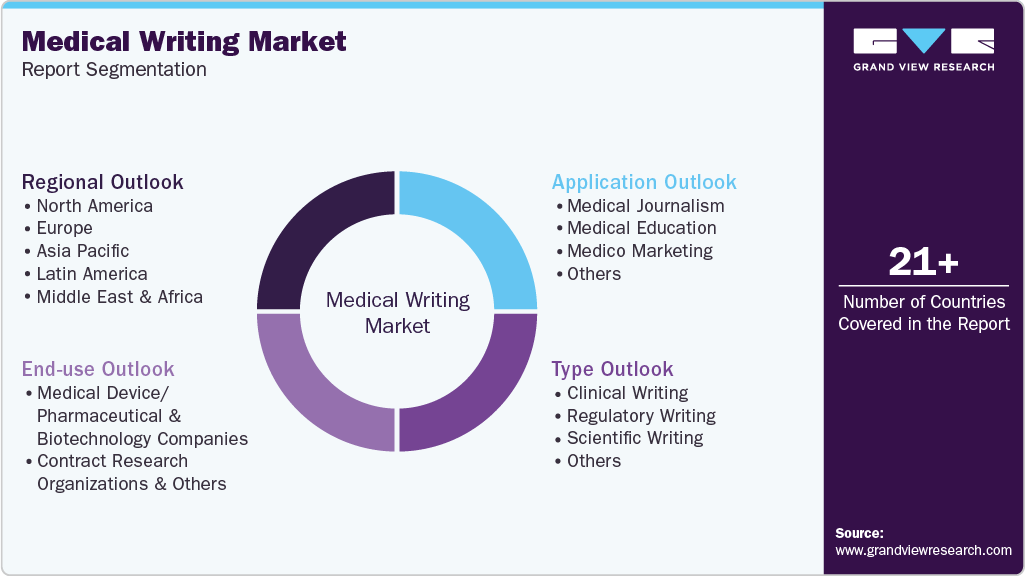
This report forecasts revenue and volume growth at global, regional, and country levels and analyzes industry trends in each sub-segments from 2021 to 2033. For this study, Grand View Research, Inc. has segmented the global medical writing market report based on type, application, end use, and region:
 To learn more about this report, Download Free Sample Report
-
Type Outlook (Revenue, USD Million, 2021 - 2033)
-
Clinical Writing
-
Regulatory Writing
-
Scientific Writing
-
Others
-
-
Application Outlook (Revenue, USD Million, 2021 - 2033)
-
Medical Journalism
-
Medical Education
-
Medico Marketing
-
Others
-
-
End Use Outlook (Revenue, USD Million, 2021 - 2033)
-
Medical Device/Pharmaceutical & Biotechnology Companies
-
Contract Research Organizations & Others
-
-
Regional Outlook (Revenue, USD Million, 2021 - 2033)
-
North America
-
U.S.
-
Canada
-
Mexico
-
-
Europe
-
Germany
-
UK
-
Spain
-
Italy
-
France
-
Denmark
-
Norway
-
Sweden
-
-
Asia Pacific
-
Japan
-
China
-
India
-
Australia
-
Thailand
-
South Korea
-
-
Latin America
-
Brazil
-
Argentina
-
-
MEA
-
South Africa
-
Saudi Arabia
-
UAE
-
Kuwait
-
-
Research Methodology
The medical writing market figures in this report are based on a proven research process that combines executive interviews with secondary research from proprietary databases, company filings, and recognized regulatory and institutional sources. Market size is built through value-chain sizing - reconciling supply-side and demand-side estimates - and triangulated with bottom-up and top-down approaches. Every estimate passes multiple levels of expert validation before publication, with each medical writing segment quantified using the revenue-capture definitions in the table below.
Segment Definition
Segment - Type
Revenue capture definition
Clinical Writing
Medical writing services focused on the preparation of documents related to clinical research and clinical trials. This includes clinical study protocols, clinical study reports (CSRs), investigator brochures, informed consent forms, patient narratives, case report forms, and clinical summaries required to support drug, biologic, and medical device development.
Regulatory Writing
Specialized writing services aimed at preparing documentation required for regulatory submissions and compliance. These documents include Common Technical Documents (CTDs), Investigational New Drug (IND) applications, New Drug Applications (NDAs), Biologics License Applications (BLAs), Medical Device submissions, risk management reports, and responses to regulatory authorities.
Scientific Writing
Preparation of scientific and technical content intended for publication, dissemination, or communication within the scientific community. This includes manuscripts, journal articles, review papers, abstracts, conference presentations, white papers, and scientific reports that communicate research findings and clinical evidence.
Others
Includes additional medical writing services such as health economics and outcomes research (HEOR) documentation, grant proposals, patient education materials, standard operating procedures (SOPs), medical communications, safety reports, and internal scientific documents.
Segment - Application
Revenue capture definition
Medical Journalism
Development of medical and healthcare-related content for news publications, magazines, digital media platforms, healthcare portals, and public information channels. Medical journalism translates complex scientific and medical information into accessible content for healthcare professionals, patients, policymakers, and the general public.
Medical Education
Creation of educational materials designed to support learning and professional development among healthcare professionals, patients, caregivers, and students. Examples include continuing medical education (CME) content, training manuals, educational modules, e-learning programs, clinical reference materials, and patient education resources.
Medico Marketing
Medical writing used to support pharmaceutical, biotechnology, medical device, and healthcare product marketing activities. This includes promotional materials, product monographs, sales aids, brochures, website content, scientific marketing collateral, market access materials, and evidence-based communication tools developed in compliance with regulatory guidelines.
Others
Includes applications such as investor communications, healthcare policy documents, reimbursement dossiers, public health campaigns, grant writing, corporate communications, scientific content management, and medical affairs support materials.
Segment - End Use
Revenue capture definition
Medical Device/Pharma & Biotech Companies
Pharmaceutical companies, biotechnology firms, and medical device manufacturers that utilize medical writing services to support clinical development, regulatory submissions, scientific publications, product commercialization, post-market surveillance, and medical communications throughout the product lifecycle.
Contract Research Organizations (CROs) & Others
CROs, academic research institutions, healthcare organizations, consulting firms, government agencies, non-profit organizations, and medical communication agencies that provide or utilize medical writing services for research, regulatory, educational, and scientific communication purposes.
Estimation Model
Market-specific Research Models:
Consensus-Based Estimates & Forecasting
The medical writing market presents emerging to dominant opportunities, featuring global key players such as Parexel International Corporation; Premier Research; Certara Inc.; Freyr; IQVIA Holdings Inc.; Syneos Health; and EVERSANA. To ensure a holistic approach, the GVR research team adopted a comprehensive methodology, considering multiple companies worldwide and utilizing various variables for data accuracy.
Our methodology included:
Model 1: Commodity Flow Analysis - For public players, annual reports were referenced. For private players, premium paid data sources such as S&P Global, Crunchbase, ZoomInfo, RocketReach, etc., were used for the latest revenue insights.
Model 2: Parent Market Analysis
Model 3: Country-level Multivariate Analysis Assumptions
Model 4: Segment-level Multivariate Analysis Assumptions
Model 5: Medical Writing Market CAGR Calculations
Model 1: Commodity Flow Analysis
Commodity flow analysis was employed to track the movement of medical writing through the value chain, from technology providers to end users. This analysis provided insights into demand generation points, intermediary roles, and ultimate consumption patterns.
Delivered Customizations
This report has been delivered with the following In-depth customizations
Client Request
Customization Delivered
Value Adds
Medical Writing Service Demand & Outsourcing Analysis
Developed a tailored analysis of the global medical writing market focused on clinical writing, regulatory writing, scientific writing, medical communications, publication support, and medico-marketing content development. The study assessed outsourcing trends across pharmaceutical companies, biotechnology firms, medical device manufacturers, contract research organizations (CROs), and healthcare organizations while evaluating regulatory requirements, clinical trial activity, and product development pipelines influencing market growth.
Enables stakeholders to understand evolving outsourcing trends, identify high-growth service categories, assess demand drivers across clinical and regulatory functions, and evaluate the impact of increasing research activity, regulatory complexity, and product innovation on long-term market expansion.
Regulatory Documentation, Clinical Research & Scientific Communication Assessment
Delivered a customized evaluation of medical writing utilization across clinical study protocols, clinical study reports, investigator brochures, regulatory submissions, risk management documentation, scientific publications, manuscripts, conference materials, and educational content. The analysis assessed regulatory compliance requirements, publication standards, clinical trial documentation needs, therapeutic area trends, and demand for specialized scientific communication services.
Provides actionable insights into commercially attractive service segments, evolving regulatory requirements, increasing clinical development activity, and growth opportunities associated with accelerated drug development, global regulatory submissions, scientific dissemination, and evidence-based healthcare communication.
Life Sciences Ecosystem, Technology Integration & Competitive Landscape Assessment
Conducted a focused assessment of the medical writing ecosystem, including pharmaceutical and biotechnology R&D activities, CRO partnerships, regulatory frameworks, document management systems, AI-enabled writing tools, content lifecycle management platforms, and competitive positioning. The analysis evaluated talent availability, quality assurance requirements, outsourcing strategies, operational challenges, technology adoption trends, and competitive differentiation initiatives among medical writing service providers.
Supports strategic planning for service expansion, outsourcing partnerships, technology investments, therapeutic area specialization, geographic growth initiatives, and market entry strategies by identifying demand drivers, regulatory challenges, revenue opportunities, operational efficiencies, and competitive advantages across the global medical writing value chain.
Frequently Asked Questions About This Report
North America dominated with a 36.1% revenue share in 2025.
Asia Pacific is the fastest-growing region over the forecast period.
Clinical writing held the largest revenue share in 2025, while regulatory writing is the fastest-growing area.
Medical journalism held the largest revenue share in 2025, while medico marketing is the fastest-growing area.
The global medical writing market size was estimated at USD 5.1 billion in 2025 and is expected to reach USD 5.6 billion in 2026.
The global medical writing market is expected to grow at a compound annual growth rate of 10.3% from 2026 to 2033 to reach USD 11.1 billion by 2033.
The CRO’s and others segment held the largest share of 68.3% in 2025.
Some of the key players in the medical writing market are Parexel International Corporation, Premier Research, Freyr, IQVIA Holdings Inc., Certara Inc., Quanticate, Soterius, Inc., Alimentiv, Syneos Health, and EVERSANA.
The high demand for medical writers can be attributed to a rise in CRO outsourcing, increased R&D investments by market players, a favorable environment for clinical study in developing countries, and new medical device regulations.
About the Author(s)
Medical Devices Research Team
Healthcare · Medical DevicesThis report was authored by the medical devices research team at Grand View Research - comprising two research analysts, one senior research analyst, and one industry expert - with specialized expertise in the medical devices segment of the healthcare industry. All findings are based on proprietary healthcare databases, executive interviews, and regulatory analysis, subject to internal peer review prior to publication.
Last Updated:
Speak to Analyst

Customize this report to your needs - add regions, segments, or data points, with 20% free customization.
Or view our licence options:


ISO 9001:2015 & 27001:2022 Certified
We are GDPR and CCPA compliant! Your transaction & personal information is safe and secure. For more details, please read our privacy policy.


