
- Home
- »
- Healthcare IT
- »
-
Medical Photo Apps Market Size, Industry Report, 2030GVR Report cover
![Medical Photo Apps Market Size, Share & Trends Report]()
Medical Photo Apps Market (2025 - 2030) Size, Share & Trends Analysis Report By Application (Dermatology, Plastic & Reconstructive Surgery, Orthopedic), By Type, By Platform, By Device, By End Use, By Region, And Segment Forecasts
- Report ID: GVR-4-68040-557-7
- Number of Report Pages: 100
- Format: PDF
- Historical Range: 2018 - 2024
- Forecast Period: 2025 - 2030
- Industry: Healthcare
- Report Summary
- Table of Contents
- Segmentation
- Methodology
- Download FREE Sample
-
 Download Sample Report
Medical Photo Apps Market Summary
The global medical photo apps market was estimated at USD 493.72 million in 2024 and is projected to reach USD 1,110.13 million by 2030, growing at a CAGR of 14.37% from 2025 to 2030. Medical photo apps are increasingly adopted in healthcare setting, driven by several key factors, such as the growing demand for telemedicine and remote consultations, where high-quality medical images aid diagnosis and treatment planning without requiring in-person visits.
Key Market Trends & Insights
- North America dominated the medical photo apps industry with a revenue share of 37.66% in 2024.
- The U.S. dominated the medical photo apps industry in North America region in 2024.
- By type, the medical photos segment dominated the market with the largest revenue share of 43.90% in 2024.
- By application, the dermatology segment dominated the market with the largest revenue share of 34.30% in 2024.
- By platform, the iOS segment dominated the market with a revenue share of 51.04% in 2024.
Market Size & Forecast
- 2024 Market Size: USD 493.72 Million
- 2030 Projected Market Size: USD 1,110.13 Million
- CAGR (2025-2030): 14.37%
- North America: Largest market in 2024
- Asia Pacific: Fastest growing market
The adoption of medical photo apps and telehealth is rising among patients, doctors, and government agencies. These technologies provide access to healthcare through specific applications and video consultations, allowing patients and doctors to communicate remotely. This eliminates the need for in-person visits to hospitals or clinics. Video consultations are becoming increasingly popular as patients receive medical services from their healthcare provider over the phone, avoiding unnecessary visits, appointment bookings, and commuting costs. Telehealth is now legal and regulated in many countries, including the U.S., Canada, Germany, Russia, and other European nations.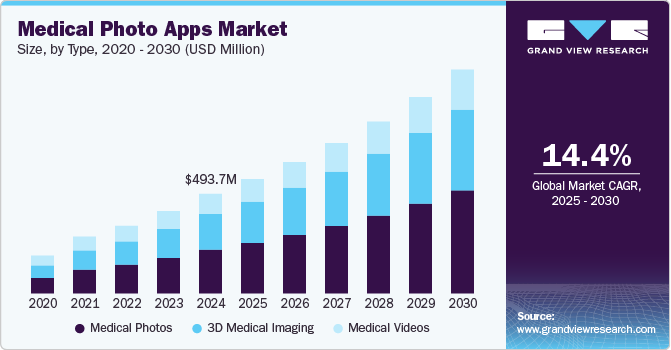
In addition, the need for accurate and efficient documentation in electronic health records (EHRs) is driving clinicians to adopt photo apps that seamlessly integrate with healthcare IT systems. These apps support improved patient monitoring and follow-up, particularly in dermatology, wound care, and post-surgical recovery. For example, the TRUE-See solution, especially for wound care, is used in healthcare to provide consistent and accurate imagery, measurements, and color calibration. It helps with the diagnosis, assessment, and treatment of wounds.
Developed nations are investing in advanced and accessible healthcare services for their residents, which is helping overall market expansion. The rise of artificial intelligence (AI) in medical imaging and photo applications is expected to transform disease detection, diagnosis, and tailored treatment strategies, resulting in a more effective and efficient healthcare system. The following are some of the benefits offered by AI,
-
Breast Cancer Detection: Breast cancer ranks as the second most prevalent cancer among women. However, traditional mammogram screenings fail to identify 1 in 5 cases. A study published in The American Journal of Surgical Pathology highlights that Google’s AI-driven Lymph Node Assistant (LYNA) accurately detects breast cancer metastasis in 99% of instances.
-
Targeted Treatment Recommendations: Research indicates that two experienced pathologists typically agree on a treatment course only about 60% of the time, even when evaluating the same data. Integrating AI in medical imaging eliminates subjective biases through a more quantitative approach, aiding in identifying cancer types and suitable treatment options. This development in precision medicine enables healthcare providers to craft more personalized treatment plans tailored to the specific cancer.
-
Heart Attack Risk Prediction: Moreover, it helps in assessing the risk of future health issues. A recent study demonstrates that combining AI imaging with clinical data enhances predictive models, allowing physicians to determine if a patient is at elevated risk for a heart attack.
-
Enhancing Surgical Outcomes: AI applications in medical imaging significantly enhance surgical results. AI helps minimize operation time and improves overall patient outcomes by assisting healthcare professionals in planning procedures more effectively before surgery.
Funding or Investment Scenario in Medical Photo Apps Market
-
In February 2025, Avandra, a company specializing in medical imaging and clinical data, secured USD 17.75 million to boost the use of imaging-focused data for research and patient care. This funding is anticipated to help further develop Avandra’s platform and enhance its data network through collaborations with top health systems and providers.
-
In January 2025, Quibim, a Spanish startup focused on developing foundational AI models for medical imaging in oncology, immunology, neurology, and metabolic disorders, raised USD 50 million in a Series A funding round. Quibim aims to improve diagnostic precision and disease identification using visual data from X-rays, CT scans, and MRIs.
-
In July 2018, SkinVision, an Amsterdam-based skin cancer screening app, raised USD 7.6 million in funding from existing investors PHS Fund and Leo Pharma. SkinVision's app is available in Australia, the UK, New Zealand, and much of Europe.
The industry's growth is expected to be driven by the rising adoption of smartphones. According to the Mobile Economy 2023 report, smartphone penetration was 76% in 2022 and is projected to reach 92% by 2030. Moreover, ongoing enhancements in network infrastructure and coverage are expected to increase the demand for patient-focused healthcare applications.
Market Concentration & Characteristics
The global medical photo apps market is characterized by a high degree of innovation, owing to the development of technologically advanced solutions driven by factors such as advancements in artificial intelligence (AI) functionalities. For instance, in March 2024, Siemens Healthineers launched an app designed for Apple Vision Pro, allowing medical students, patients, and surgeons to experience immersive, interactive holograms of the human body generated from medical scans within their real-world environment.
The medical photo apps market is characterized by medium merger and acquisition activity, owing to several factors, including the desire to expand the business to cater to the growing demand for advanced solutions to maintain a competitive edge and the desire to gain access to new technologies and advancements and the need to consolidate in a rapidly growing market.
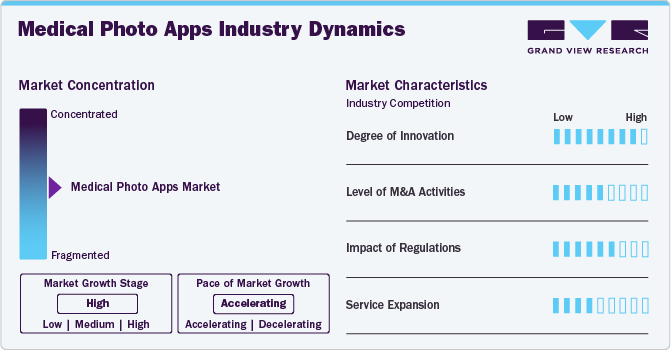
Developing patient-centric healthcare apps and wearables can be expensive, as some apps require regulatory approval from the FDA and government bodies to diagnose diseases. Furthermore, the FDA encourages the advancement of mobile medical apps (MMAs) that have the potential to enhance healthcare and provide patients and healthcare providers with valuable health-related insights. Moreover, mHealth apps must comply with HITECH, HIPAA, FDA regulations for Medical Devices, and GDPR to ensure the security, privacy, and integrity of patient information.
Market players are expanding their business by entering new geographical regions and launching new tools to strengthen their market position and expand their product portfolio. For instance, in March 2024, RxPhoto introduced Version 3 of its mobile medical photography solution, designed for medical practices. This HIPAA-compliant app allows providers to securely capture, manage, and share patient photos and videos using mobile devices. The update introduced digital consent forms and enhanced sharing tools, facilitating better patient education.
Type Insights
By type, the medical photos segment dominated the market with the largest revenue share of 43.90% in 2024 and is anticipated to grow at the fastest CAGR over the forecast period. One of the major drivers is the increasing use of smartphones and tablets by healthcare professionals for clinical documentation, especially in dermatology, wound care, plastic surgery, and telemedicine. When paired with high-resolution cameras and secure apps, these devices allow for fast, accurate, and consistent image capture of patient conditions, streamlining the documentation process and enhancing the quality of care. For example, imito AG, a Software company in Zürich, Switzerland, offers imitoWound, a wound documentation app. It has the following features,
-
Measure wounds faster
-
Save time with standardized documentation
-
Immediately after taking a photo, the app calculates the wound size
Furthermore, there is a rising demand for remote patient monitoring and telehealth services, particularly since the COVID-19 pandemic. Medical photo apps have become essential for clinicians to assess wounds, rashes, surgical sites, and other visible conditions without requiring in-person visits. This improves access to care, especially in rural and underserved regions, and reduces healthcare costs and patient burdens. These apps support real-time consultations and follow-ups, increasing the efficiency of care delivery. Such benefits offered by these apps boost market growth.
Application Insights
By application, the dermatology segment dominated the market with the largest revenue share of 34.30% in 2024. The segment is growing due to the increasing demand for accessible, convenient, and cost-effective healthcare solutions. Technological advancements, such as high-quality imaging and AI, improve diagnosis accuracy and efficiency, while the COVID-19 pandemic accelerated the shift to remote consultations. The shortage of dermatologists and the increasing prevalence of skin disorders such as psoriasis, eczema, and acne drive this demand. According to the British Skin Foundation article published in November 2023, there are approximately 2,000 dermatological conditions, and teledermatology, with the help of medical photo or imaging apps, effectively manages around 90% of them, including skin cancer. In addition, the advantages of convenience, accessibility, and cost savings for patients and healthcare providers are key factors contributing to the segment's growth.
The plastic & reconstructive surgery segment is anticipated to grow at the fastest CAGR over the forecast period. Medical photo apps are used preoperatively to capture standardized images for surgical planning, patient consent, and medical documentation, ensuring clear communication. For example, The RxPhoto app is tailored for med spas, wellness centers, and plastic surgery practices to illustrate treatment success and highlight patient results effectively. It allows physicians and patients to take consistent before-and-after photos and easily store and manage them alongside important client information. Moreover, these apps track healing and detect complications such as infection, hematoma, or poor wound healing. These images can be shared remotely in telehealth consultations.
Platform Insights
By platform, the iOS segment dominated the market with a revenue share of 51.04% in 2024 and. This is attributed to consumers' increasing adoption of iOS-based Apple devices. For instance, according to data published by BankMyCell.com, the market for iOS in the US increased from 61.45% in 2024 to 58.10% in 2023. These numbers demonstrate this segment's growth potential over the forecast period. iOS is a mobile operating system created by Apple Inc. for its devices. For example, RxPhoto and Figure 1 medical photo apps are available on the iOS platform.
The android segment is anticipated to grow at the fastest CAGR over the forecast period. Major factors driving growth in this segment include the increasing adoption of Android-based smartphones and their affordability. The rising number of Android users is projected to accelerate market expansion further, indicating significant growth. For instance, according to BankMyCell.com, by 2024, the global population reached 8.1 billion, with 48.2%, or approximately 3.9 billion people, using Android smartphones. In addition, over 1 billion Android devices were sold in 2021. Thus, owing to such a high penetration rate, the segment is expected to grow significantly over the forecast period.
Device Insights
By device, the smartphones segment dominated the market with a revenue share of 65.97% in 2024. According to the GSM Association (GSMA) report statistics published in the Mobile Economy 2023 report, around 5.4 billion people across the globe subscribed to mobile services in 2022, and the number of unique mobile subscribers is expected to reach 6.3 billion by 2030 (73% of the global population). Moreover, the increasing penetration of smartphones is another key factor expected to facilitate market growth. As per the Mobile Economy 2023 report, smartphone penetration was around 76% in 2022 and is expected to reach 92% by 2030. Thus, the growing adoption of smartphones is expected to drive market growth over the forecast period.
The tablets segment is expected to grow at the fastest rate during the forecast period. The major driver for market growth is the integration of tablets into clinical workflows. Tablets are frequently used in nurse stations, healthcare settings, and mobile medical carts, making them well-suited for the seamless capture and upload of images into electronic health records (EHRs) or other medical information systems. Medical photo apps on tablets enable clinicians to take and upload photos securely, saving time and improving workflow efficiency.
End Use Insights
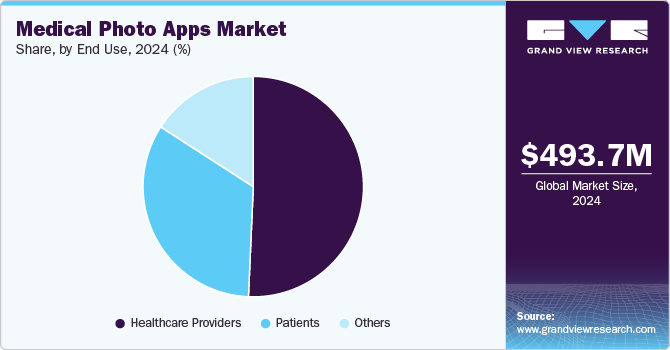
By end use, the healthcare providers segment dominated the market with a revenue share of 50.70% in 2024 and is anticipated to grow at the fastest CAGR over the forecast period. Healthcare providers increasingly adopt medical photo apps to improve patient care and operational efficiency. By integrating mHealth technologies into their workflows, providers enhance patient care and streamline workflows. For example, Mayo Clinic introduced an internal app such as PhotoExam. This iOS-based application allows healthcare providers to store patient photographs in EHR securely. Moreover, Children's Hospital Los Angeles uses ImageInbox to share patient imaging data.
Furthermore, advancements in AI and machine learning are driving innovation in medical photo apps for healthcare providers. Several apps include AI-based features, such as automatic lesion detection, wound measurement, or diagnostic suggestions, which assist healthcare providers in making more precise and timely decisions. These features enhance clinical accuracy, support decision-making, and alert providers to potential complications, thus improving patient outcomes and driving segment growth.
Regional Insights
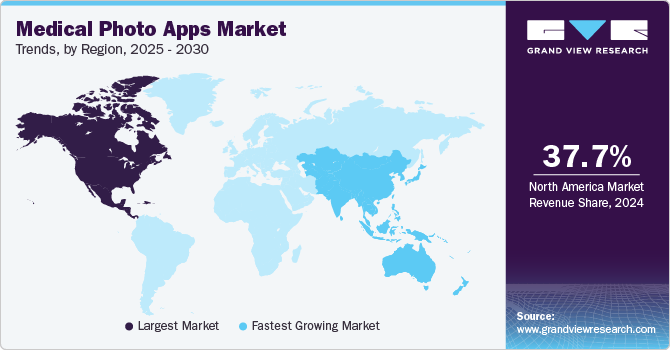
North America dominated the medical photo apps industry with a revenue share of 37.66% in 2024. Various factors, such as growth in coverage networks, rapid smartphone usage, changes in lifestyle, and growing health consciousness among people, are expected to drive the adoption of medical photo apps in North America. One of the major factors contributing to market growth is the high adoption of mHealth apps in North America.
U.S. Medical Photo Apps Market Trends
The U.S. dominated the medical photo apps industry in North America region in 2024, due to innovative software development, advanced healthcare management, and numerous key players operating across segments, such as dermatology and orthopedic. Furthermore, the presence of key market players such as RxPhoto, zScanner, PhotoExam App, and Pim-Your Medical Images boosts market growth.
Europe Medical Photo Apps Market Trends
The medical photo apps market in Europe is expected to grow considerably over the forecast period. The UK, Germany, Norway, and Spain have contributed significantly to market growth and are some of the prominent markets in the region. In October 2020, the American Telemedicine Association (ATA) collaborated with a UK-based digital health evaluator to introduce a tool for healthcare providers, payers, and other interested parties to access recommendations on quality-based mHealth applications.
The medical photo apps industry in the UK is expected to grow significantly during the forecast period, as there is a significant expenditure on health. The increasing demand for mobile healthcare applications among customers in the UK is expected to supplement market growth. Several technology companies are actively working with academic institutes, clinicians, and policymakers to develop solutions that meet the needs of patients and clinicians. By introducing these applications, overseas clients can meet the needs of clinicians, patients, and payers in telehealth, telecare, and mHealth.
Asia Pacific Medical Photo Apps Market Trends
The Asia Pacific medical photo apps industry is expected to register the fastest growth rate over the forecast period. The increasing awareness of health and wellness among the region’s population has driven the demand for mhealth solutions, with apps providing convenient and accessible consultations and diagnoses through photos and images. In addition, the widespread adoption of smartphones and improved Internet connectivity have made medical photos apps more accessible to a broader audience. According to The Mobile Economy 2023 by GSMA, unique mobile subscriptions in Asia Pacific reached 1.73 billion by the end of 2022, estimated to reach 2.11 billion by 2023.
China medical photo apps market is anticipated to register significant growth during the forecast period. The increasing use of smartphones is expected to drive the adoption of mobile platforms for various healthcare services. For instance, according to data from the China Internet Network Information Center (CNNIC), as of December 2022, China has 1.067 billion Internet users, an increase of 35.49 million since December 2021.
Latin America Medical Photo Apps Market Trends
The Latin America medical photo apps industry is anticipated to witness growth over the forecast period. Latin America is considered to have a large pool of healthcare human resources and tech entrepreneurs. This is one of the key factors driving the market in Latin America. In addition, increasing expenditure on electronic & mobile devices by buyers is contributing to market growth.
Argentina medical photo apps market is anticipated to register healthy growth during the forecast period. Increasing smartphone penetration and internet connectivity have made medical photo apps more accessible to a broader population. For instance, GSMA Intelligence’s data published in January 2023 revealed that the number of mobile connections in Argentina reached 133.7% of the total population.
Middle East And Africa Medical Photo Apps Market Trends
The Middle East and Africa medical photo apps market is anticipated to witness considerable growth over the forecast period. With the increasing penetration of smartphones and government initiatives, entrepreneurs and healthcare professionals are inclined toward smartphones for better and healthier lifestyles. In addition, the rising awareness regarding digital health among people has increased the potential for market growth.
UAE medical photo apps market is anticipated to register significant growth during the forecast period. The UAE is one of the most favorable markets for healthcare and digital platforms. Factors such as government aid to innovative startups and high government funding to promote mhealth are propelling market growth in the country. Key players focus on developing newer solutions to meet the growing demand for better care.
Key Medical Photo Apps Company Insights
Key participants in the medical photo apps industry are focusing on devising innovative business growth strategies, such as expanding their product portfolios, partnerships and collaborations, mergers and acquisitions, and expanding their business footprints.
Key Medical Photo Apps Companies:
The following are the leading companies in the medical photo apps market. These companies collectively hold the largest market share and dictate industry trends.
- PatientNow (RxPhoto)
- TRUE-See
- CureCast
- Trice Imaging, Inc.
- TeskaLabs Ltd.
- imito AG
- Pixacare
- TouchMD
- SkinVision
- 3D4Medical Ltd
- Pixmeo
- CaptureProof Inc
- CosmetiSuite
Recent Developments
-
In January 2025, Core Sound Imaging, the medical imaging platform Studycast provider, secured USD 80 million in a growth investment from PSG. This equity firm focuses on collaborating with companies in software and technology-enabled services. The funds are expected to enhance Studycast's growth in its key areas, explore new clinical domains, and expand the integration of AI within its platform.
-
In January 2025, Subtle Medical, an AI-powered company specializing in medical image acquisition based in Menlo Park, CA, secured almost USD 10 million in Series B+ funding. The funds will enhance their sales efforts in the U.S. and globally and expedite the introduction of innovative AI-driven products.
Medical Photo Apps Market Report Scope
Report Attribute
Details
Market size value in 2025
USD 567.30 million
Revenue forecast in 2030
USD 1,110.13 million
Growth Rate
CAGR of 14.37% from 2025 to 2030
Actual data
2018 - 2024
Forecast data
2025 - 2030
Quantitative units
Revenue in USD million/billion and CAGR from 2025 to 2030
Report coverage
Revenue forecast, company ranking, competitive landscape, growth factors, and trends
Segments covered
Type, Application, Platform, Device, End Use, Region
Regional scope
North America; Europe; Asia Pacific; Latin America; MEA
Country scope
U.S.; Canada; Mexico; UK; Germany; Spain; France; Italy; Spain; Denmark; Sweden; Norway; China; Japan; India; Australia; South Korea; Thailand; Brazil; Argentina; South Africa; Saudi Arabia; UAE; Kuwait
Key companies profiled
PatientNow (RxPhoto); TRUE-See; CureCast; Trice Imaging, Inc.; TeskaLabs Ltd.; imito AG; Pixacare; TouchMD; SkinVision; 3D4Medical Ltd; Pixmeo; CaptureProof Inc; CosmetiSuite
Customization scope
Free report customization (equivalent up to 8 analysts working days) with purchase. Addition or alteration to country, regional & segment scope.
Pricing and purchase options
Avail customized purchase options to meet your exact research needs. Explore purchase options
Global Medical Photo Apps Market Report Segmentation
This report forecasts revenue growth and provides at global, regional, and country levels an analysis of the latest trends in each of the sub-segments from 2018 to 2030. For this report, Grand View Research has segmented the global medical photo apps market report based on type, application, platform, device, end use, and region:
-
Type Outlook (Revenue, USD Million; 2018 - 2030)
-
Medical Photos
-
3D Medical Imaging
-
Medical Videos
-
-
Application Outlook (Revenue, USD Million; 2018 - 2030)
-
Dermatology
-
Plastic & Reconstructive Surgery
-
Orthopedic
-
Others (ENT, Dental, Eye Condition)
-
-
Platform Outlook (Revenue, USD Million; 2018 - 2030)
-
Android
-
iOS
-
Others
-
-
Device Outlook (Revenue, USD Million; 2018 - 2030)
-
Smartphones
-
Tablets
-
-
End Use Outlook (Revenue, USD Million; 2018 - 2030)
-
Healthcare Providers
-
Patients
-
Others
-
-
Regional Outlook (Revenue, USD Million; 2018 - 2030)
-
North America
-
U.S.
-
Canada
-
Mexico
-
-
Europe
-
UK
-
Germany
-
France
-
Italy
-
Spain
-
Denmark
-
Sweden
-
Norway
-
-
Asia Pacific
-
Japan
-
China
-
India
-
Australia
-
South Korea
-
Thailand
-
-
Latin America
-
Brazil
-
Argentina
-
-
Middle East & Africa
-
South Africa
-
Saudi Arabia
-
UAE
-
Kuwait
-
-
Frequently Asked Questions About This Report
b. The global medical photo apps market size was estimated at USD 493.72 million in 2024 and is expected to reach USD 567.30 million in 2025.
b. The global medical photo apps market is expected to grow at a compound annual growth rate of 14.37% from 2025 to 2030 to reach USD 1,110.13 million by 2030.
b. North America dominated the medical photo apps industry with a revenue share of 37.66% in 2024, owing to factors such as growth in coverage networks, rapid smartphone usage, changes in lifestyle, and growing health consciousness among people.
b. Some of the key players in the medical photo apps market include PatientNow (RxPhoto), TRUE-See, CureCast, Trice Imaging, Inc., TeskaLabs Ltd., imito AG, Pixacare, TouchMD, SkinVision, 3D4Medical Ltd, Pixmeo, CaptureProof Inc, and CosmetiSuite.
b. Medical photo apps are increasingly adopted in healthcare settings, driven by several key factors, such as the growing demand for telemedicine and remote consultations, where high-quality medical images aid diagnosis and treatment planning without requiring in-person visits.

Share this report with your colleague or friend.
Need a Tailored Report?
Customize this report to your needs — add regions, segments, or data points, with 20% free customization.


ISO 9001:2015 & 27001:2022 Certified
We are GDPR and CCPA compliant! Your transaction & personal information is safe and secure. For more details, please read our privacy policy.
Trusted market insights - try a free sample
See how our reports are structured and why industry leaders rely on Grand View Research. Get a free sample or ask us to tailor this report to your needs.













