
- Home
- »
- IT Services & Applications
- »
-
Micro Mobile Data Center Market Size & Share Report, 2033GVR Report cover

Micro Mobile Data Center Market (2026 - 2033)
Size, Share & Trends Analysis Report By Rack Unit (Up To 20 RU, 20-40 RU, Above 40 RU), By Enterprise Size, By Application (Remote & Temporary Operations, Edge Computing), By End-use, By Region, And Segment Forecasts
Market Size, 2025
$6.0BMarket Estimate, 2026
$6.8BMarket Forecast, 2033
$20.8BCAGR, 2026–2033
17.2%Micro Mobile Data Center Market Summary
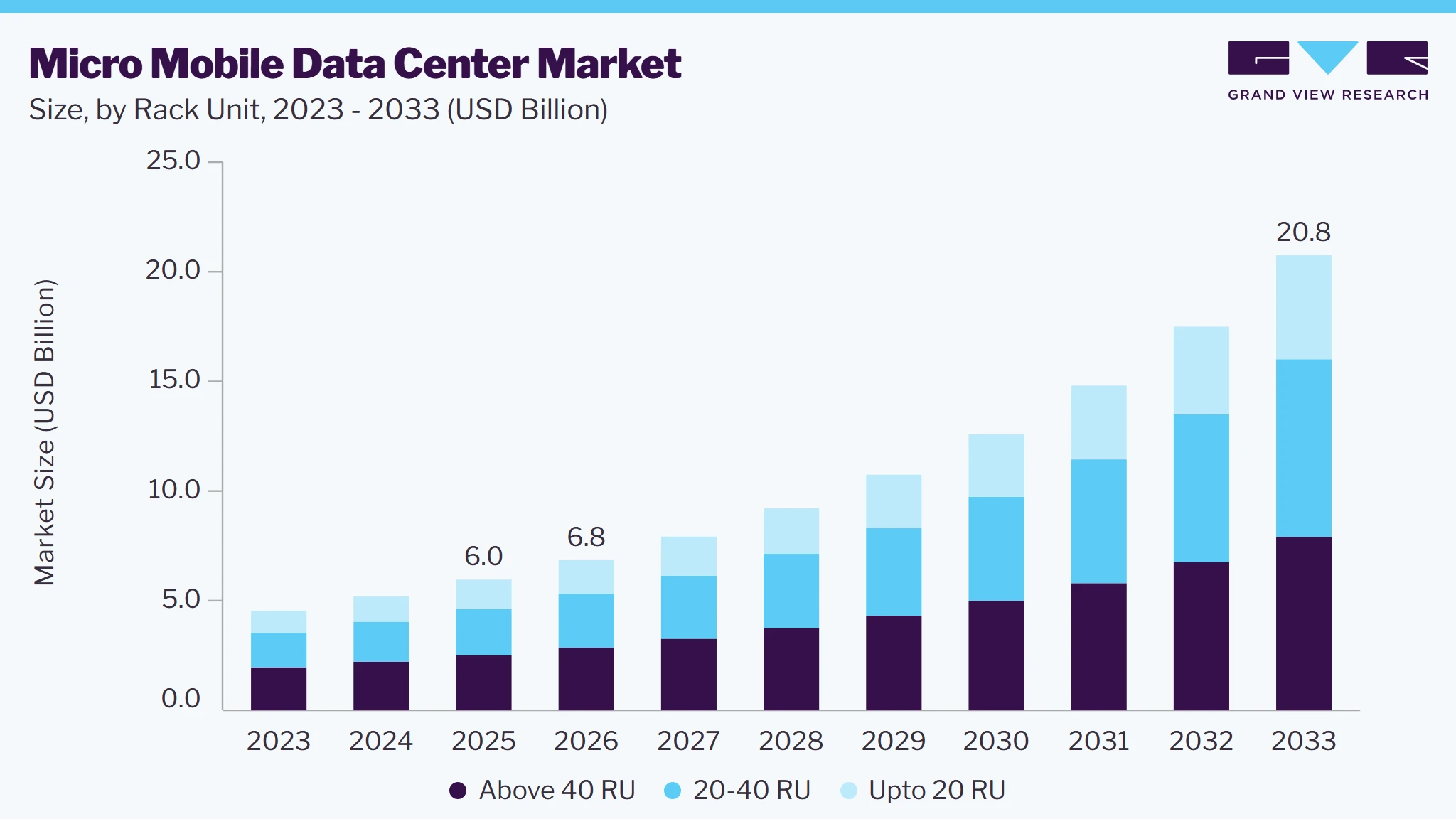
The global micro mobile data center market size was valued at USD 6.0 billion in 2025 and is projected to grow from USD 6.8 billion in 2026 to USD 20.8 billion in 2033, at a CAGR of 17.2% from 2026 to 2033. The market in North America dominated with a revenue share of 40.2% in 2025. The rapid expansion of 5G networks across North America is increasing demand for distributed edge computing infrastructure.
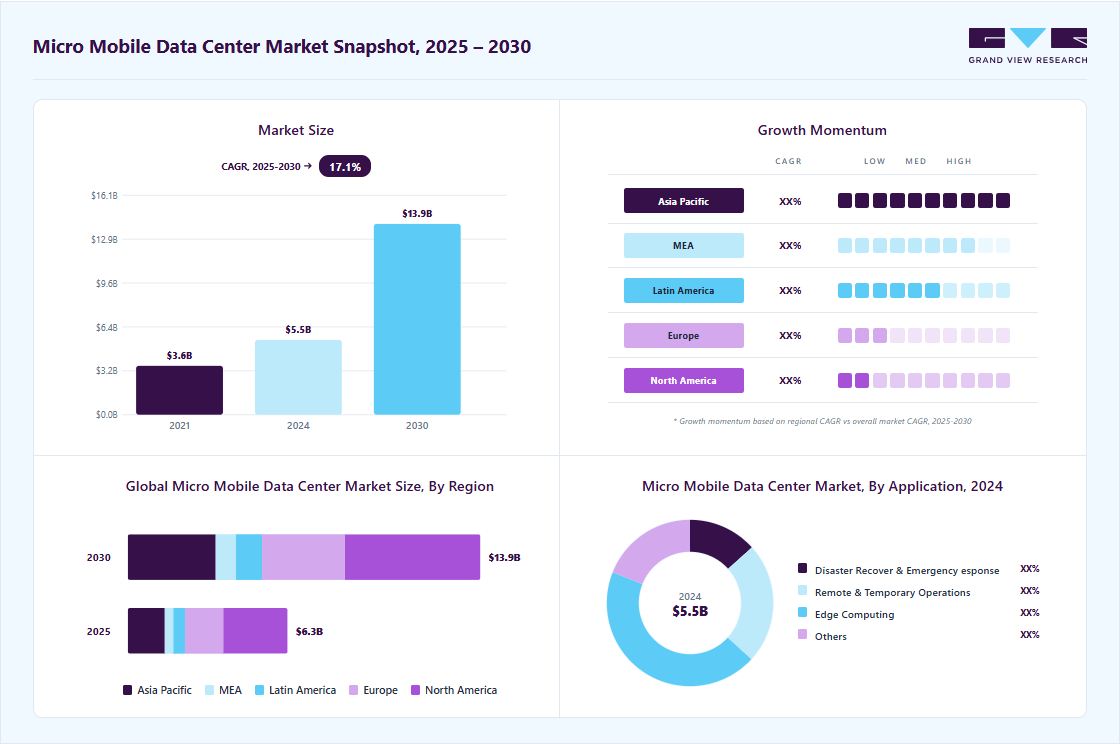 Source: Grand View Research, IR Documents, Primary Interviews, Paid DatabasesTo learn more about this report,
 Download Free Sample Report
Key Market Trends & Insights
- By rack unit: Above 40 RU segment dominated the market, with a revenue share of 42.2% in 2025.
- By enterprise size: Large enterprises segment held the largest market share of 64.7% in 2025.
- By application: Edge Computing segment held the largest revenue share of 44.6% in 2025.
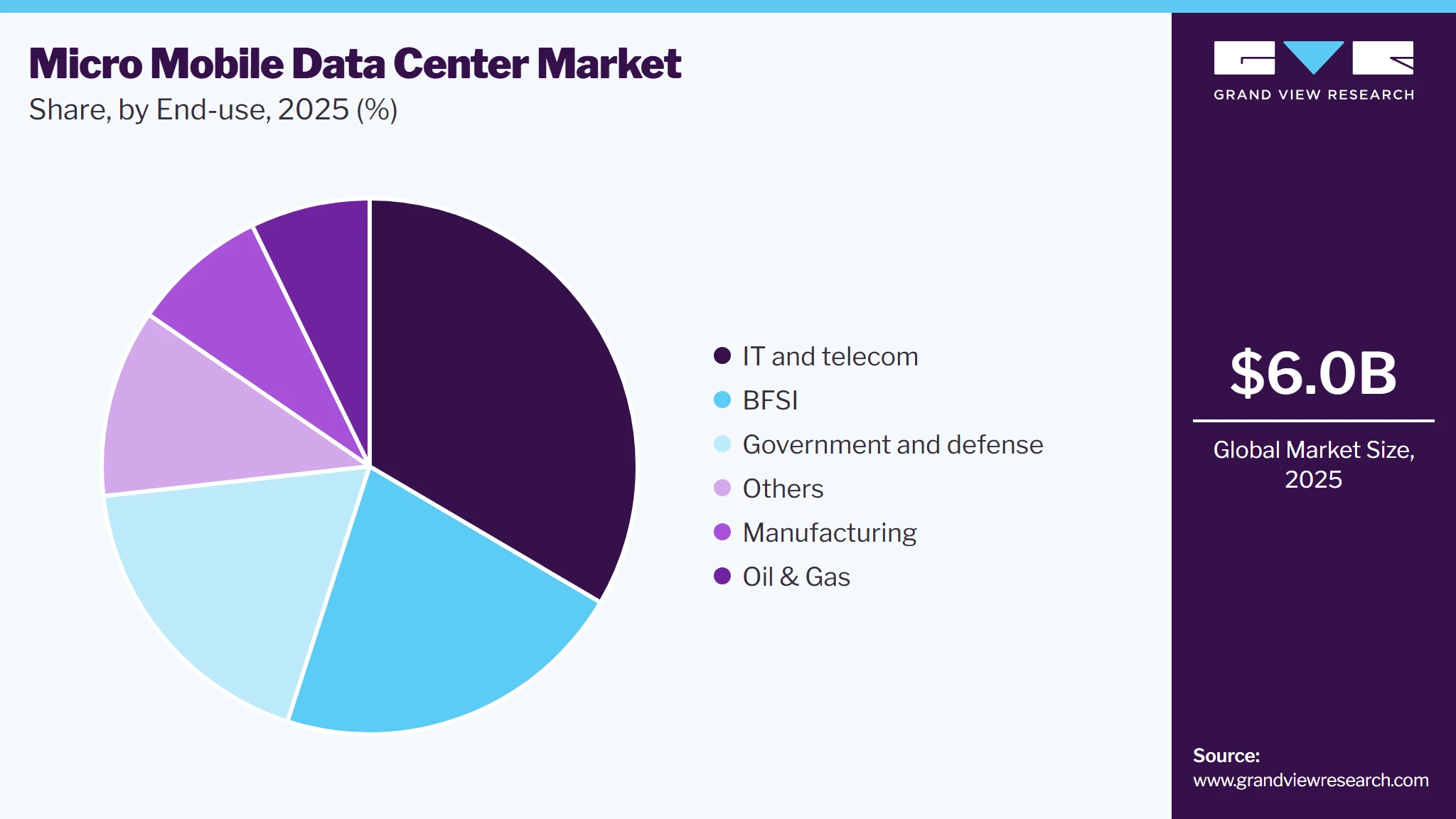
- By end-use: IT and Telecom segment held the largest revenue share in 2025.
Regional Highlights
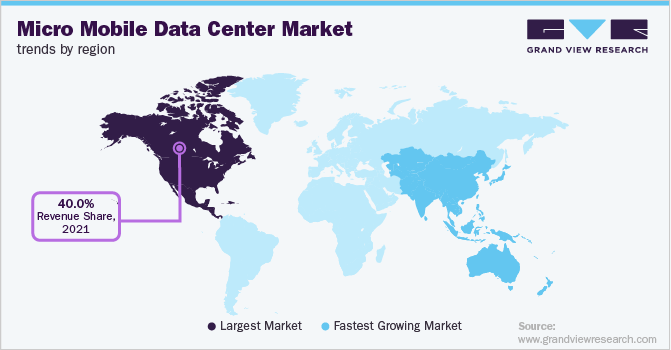
- Largest regional market: North America (40.2% revenue share, 2025)
- Fastest-growing regional market: Asia Pacific (highest CAGR, 2026-2033)
- By country: The U.S. held the largest market share in 2025.
Market Size & Forecast
- Market size in 2025: USD 6.0 Billion
- Estimated market size in 2026: USD 6.8 Billion
- Projected market size by 2033: USD 20.8 Billion
- CAGR (2026-2033): 17.2%
Prism AI by Grand View Research Free to tryAsk a question about the micro mobile data center marketTry asking✓Every figure cited from GVR research Prefer the report? Download free sample →
Micro mobile data centers are deployed near 5G base stations to support ultra-low-latency applications, mobile edge computing (MEC), and network function virtualization (NFV). These compact facilities enable faster data processing, improve network performance, and support bandwidth-intensive applications such as autonomous vehicles, smart cities, industrial IoT, and AI-driven services.The proliferation of IoT devices, coupled with the increasing use of artificial intelligence (AI) and machine learning (ML) technologies, is contributing to an unprecedented surge in data creation in micro mobile data center industry. Traditional data centers, often centralized and large-scale, are becoming overwhelmed by the sheer volume of data being generated, particularly in industries where data collection is continuous, such as in autonomous vehicles, smart cities, and industrial IoT applications. Micro mobile data centers provide a scalable enterprise size to this challenge by enabling real-time data processing and storage closer to the data source, relieving strain on traditional infrastructure. AI and ML applications require immense computational power and rapid data processing capabilities, which micro mobile data centers can provide at the network’s edge. By offering localized processing, these data centers enable AI-driven insights to be generated quickly, facilitating decisions in real-time scenarios, such as predictive maintenance in manufacturing or real-time analytics in retail.
 To learn more about this report, Download Free Sample Report
The global rollout of 5G technology is another key driver of the micro mobile data center industry. 5G promises ultra-low latency, high bandwidth, and the ability to support a vast number of connected devices simultaneously. However, to fully realize the benefits of 5G, data processing must occur as close to the end-user or device as possible, which is where micro mobile data centers excel. These compact and mobile centers can be strategically placed at the edge of the 5G network, enabling real-time data processing required for applications like autonomous vehicles, remote healthcare, and immersive gaming experiences. As reported by 5G Americas, a trade association of wireless cellular network operators, global 5G connections reached nearly 2 billion in the first quarter of 2024, with 185 billion new connections added. It is expected to rise to 7.7 billion by 2028. In North America, 5G adoption accounts for 32% of all wireless cellular connections, double the global average. The region saw an 11% growth, adding 22 billion new 5G connections during this period.
Market Dynamics
The micro mobile data center market is experiencing robust growth as organizations increasingly adopt edge computing, digital transformation, and distributed IT architectures to support low-latency applications, AI-driven workloads, and real-time data processing. The rapid expansion of 5G networks, Industrial IoT (IIoT), and smart infrastructure is driving demand for compact, self-contained data center solutions that can be rapidly deployed at network edge locations. Growing investments in AI inference, autonomous systems, smart manufacturing, and connected healthcare are accelerating the adoption of micro mobile data centers that provide localized compute, storage, networking, power, cooling, and physical security in a single integrated enclosure. The increasing deployment of hybrid and multi-cloud environments is further boosting demand for edge infrastructure capable of seamlessly connecting remote sites with centralized cloud platforms while ensuring business continuity and operational resilience. Advancements in modular and prefabricated data center technologies, intelligent DCIM software, remote monitoring, liquid cooling, and energy-efficient power management are enhancing operational efficiency, scalability, and sustainability. Organizations are increasingly deploying portable micro data centers to support disaster recovery, remote branch offices, military operations, telecommunications, retail stores, healthcare facilities, and temporary industrial sites where conventional data center infrastructure is impractical. In addition, rising investments in hyperscale edge infrastructure, private 5G networks, smart cities, autonomous transportation, and Industry 4.0 initiatives across sectors including IT & telecommunications, manufacturing, healthcare, BFSI, government, energy & utilities, retail, and defense are expected to drive sustained growth in the global micro mobile data center market.
The rapid expansion of edge computing and 5G networks is a major driver of the micro mobile data center market. Enterprises are increasingly deploying compute resources closer to data sources to support latency-sensitive applications such as AI inference, Industrial IoT, autonomous systems, and real-time analytics. Micro mobile data centers provide compact, self-contained infrastructure with integrated power, cooling, networking, and security, enabling rapid deployment at edge locations. As organizations accelerate digital transformation and distributed computing strategies, demand for scalable, modular, and portable micro data centers continues to rise across telecommunications, manufacturing, healthcare, retail, and smart city applications.
The high upfront cost of deploying micro mobile data centers remains a significant restraint to market growth. Organizations must invest in integrated IT hardware, power systems, cooling equipment, physical security, and remote monitoring solutions, increasing capital expenditure. Additionally, integrating micro data centers with existing enterprise IT infrastructure, cloud platforms, and legacy systems can be complex, requiring specialized expertise and ongoing maintenance. Space constraints, power availability, and site-specific environmental requirements further increase deployment complexity, particularly for small and medium-sized enterprises (SMEs) with limited financial and technical resources.
The increasing adoption of AI-powered edge computing, private 5G networks, and distributed digital infrastructure presents significant opportunities for the micro mobile data center market. Organizations are deploying micro mobile data centers to support localized AI processing, autonomous operations, remote industrial facilities, disaster recovery, and mission-critical applications requiring low latency and high availability. Advancements in modular design, intelligent DCIM, liquid cooling, renewable energy integration, and remote infrastructure management are further enhancing operational efficiency and sustainability. As investments in smart manufacturing, connected healthcare, defense, telecommunications, and smart cities continue to expand, demand for intelligent, energy-efficient, and rapidly deployable micro mobile data center solutions is expected to grow substantially.
Analyst Perspective
The micro mobile data center market is emerging as a critical enabler of edge computing, distributed cloud infrastructure, and digital transformation as organizations increasingly prioritize low-latency computing, business continuity, and localized data processing. The rapid expansion of 5G networks, Industrial IoT, AI inference, and smart infrastructure is accelerating demand for compact, prefabricated data center solutions that integrate compute, storage, networking, power, cooling, and physical security within a single deployable unit. Enterprises are increasingly deploying micro mobile data centers to support edge applications, remote operations, disaster recovery, and mission-critical workloads while reducing deployment time and infrastructure complexity. The primary competitive advantage will belong to vendors that can deliver highly modular, energy-efficient, and intelligent infrastructure by combining AI-enabled DCIM, predictive maintenance, remote monitoring, liquid cooling, renewable energy integration, and software-defined management into a unified platform. As organizations continue expanding edge deployments, private 5G networks, autonomous operations, and distributed AI workloads, vendors capable of providing scalable, resilient, and rapidly deployable micro mobile data center solutions with seamless integration across on-premises, cloud, and edge environments will be best positioned to capitalize on long-term market growth opportunities.
Rack Unit Insights
Based on rack unit, above 40 U segment led the market with the largest revenue share of 42.2% in 2025 and is expected to grow at the significant CAGR over the forecast period. The need for edge computing in high-performance environments is a primary driver for the growth of the above 40 RU segment. Applications such as autonomous vehicles, industrial automation, and real-time analytics in manufacturing require substantial processing power, which smaller data centers may struggle to deliver. Above 40 RU micro mobile data centers offer the computing power needed to handle these demanding applications at the network edge, reducing latency and improving response times. As businesses push more workloads to the edge to improve operational efficiency, the demand for larger, more powerful micro mobile data centers grows.
The 20-40 RU segment is expected to grow at the fastest CAGR of 18.6% over the forecast period. The segment offers a cost-effective enterprise size for growing businesses that need more data processing power but cannot justify the investment in larger data centers. Small and medium-sized enterprises (SMEs) are increasingly looking for modular data center enterprise sizes that offer scalability and adaptability without the high costs of larger-scale infrastructure. This segment meets their needs by providing sufficient capacity for growing workloads, while maintaining a relatively low total cost of ownership (TCO).
Enterprise Size Insights
Based on enterprise size, the large enterprises segment led the market with the largest revenue share of 64.7% in 2025. Large enterprises require scalable IT infrastructure to support their growth and expansion into new regions. Traditional data centers can be costly and time-consuming to build and maintain, especially in rapidly changing environments. Micro mobile data centers provide the flexibility and scalability that large enterprises need to quickly adjust their data processing capabilities. These modular enterprise sizes can be deployed in diverse locations and scaled up or down based on demand, which is particularly useful for large companies that need to manage data across multiple global sites. This adaptability reduces the time and cost associated with setting up permanent data centers, enabling large enterprises to remain agile in a competitive business environment.
The SMEs segment is expected to grow at a significant CAGR over the forecast period. The reduced operational and maintenance costs of micro mobile data centers appeal to SMEs. Traditional data centers come with high operational expenses related to power, cooling, and physical security. Micro mobile data centers, with their smaller footprint and energy-efficient designs, help SMEs manage these expenses while ensuring that their data processing needs are met. The combination of low initial investment and manageable ongoing costs makes micro mobile data centers an attractive proposition for resource-constrained SMEs.
Application Insights
Based on application, the edge computing segment led the market with the largest revenue share of 44.6% in 2025, driven by the need for bandwidth optimization and cost reduction. Transmitting vast amounts of data from remote IoT devices or sensors to centralized cloud servers consumes significant bandwidth, leading to high operational costs for businesses. Micro mobile data centers improve this problem by processing data locally and only sending the most critical information to the cloud, thereby reducing bandwidth consumption and lowering costs. This approach allows businesses to manage their data more efficiently while maintaining high performance for mission-critical applications.
The remote & temporary operations segment is expected to grow at a significant CAGR over the forecast period. The defense and military sectors are key drivers for the adoption of micro mobile data centers in remote and temporary operations. Military operations often take place in hostile or remote environments where secure and reliable data infrastructure is essential. Micro mobile data centers offer the mobility and security that defense agencies require, allowing them to set up and manage IT infrastructure on the battlefield or during military exercises. These centers are often equipped with enhanced security features to ensure the protection of sensitive military data.
End-use Insights
Based on end-use, the IT and Telecom segment led the market with the largest revenue share of 33.5% in 2025. The growing demand for cloud application and the shift toward data center decentralization are also key growth drivers in the IT and telecom sector. Enterprises are increasingly adopting hybrid and multi-cloud environments, which require scalable and distributed data infrastructure. Centralized data centers alone are often insufficient to meet the needs of these complex cloud ecosystems, particularly when real-time processing or specific regulatory requirements come into play. Micro mobile data centers help bridge this gap by providing localized, on-premise data processing capabilities that complement cloud application.
 To learn more about this report, Download Free Sample Report
The government and defense segment is expected to grow at a significant CAGR over the forecast period. The ability to rapidly deploy data infrastructure in crisis situations is another key growth driver for the micro mobile data center industry in the government and defense sector. During emergencies, such as natural disasters, military operations, or humanitarian missions, there is often an urgent need for reliable data processing and communication capabilities. Micro mobile data centers can be quickly transported and set up in remote or disaster-stricken areas, providing essential applications such as communications, logistics, and data management.
Regional Insights
North America dominated the micro mobile data center market with the largest revenue share of 40.2% in 2025. The integration of artificial intelligence (AI) and machine learning (ML) technologies is another notable trend shaping the micro mobile data center landscape in North America. As businesses seek to leverage AI and ML for predictive analytics, automation, and enhanced decision-making, the need for localized data processing capabilities becomes paramount. Micro mobile data centers enable organizations to run AI and ML algorithms closer to the data source, ensuring faster processing times and real-time insights.
 To learn more about this report, Download Free Sample Report
U.S. Micro Mobile Data Center Market Trends
The micro mobile data center market in the U.S. held the largest share in the North America region in 2025. The growing adoption of cloud computing has created a surge in data storage and processing requirements. MMDCs offer scalable and flexible infrastructure enterprise sizes, allowing businesses to efficiently handle fluctuating workloads. This adaptability is particularly advantageous for small and medium-sized enterprises (SMEs) seeking to avoid the capital expenditure and operational costs associated with traditional data centers.
Europe Micro Mobile Data Center Market Trends
The micro mobile data center market in Europe is anticipated to grow at a significant CAGR from 2026 to 2033. Sustainability is becoming a key focus for many European organizations, leading to increased interest in energy-efficient and sustainable technologies. Micro mobile data centers, designed for optimal energy consumption, align well with these sustainability goals. These units often incorporate advanced cooling systems, renewable energy sources, and energy-efficient rack units to reduce their carbon footprint and operational costs.
The UK micro mobile data center market is expected to grow at a rapid CAGR during the forecast period. As data privacy and cybersecurity concerns continue to grow, organizations in the UK are increasingly prioritizing secure data management enterprise sizes. Micro mobile data centers can be equipped with advanced security features, such as encryption, access controls, and threat detection systems, to protect sensitive data. This trend is particularly critical in industries such as finance, healthcare, and government, where compliance with data protection regulations is essential.
The micro mobile data center market in Germany held a substantial market share in Europe in 2025. The need for flexible, temporary IT enterprise sizes is driving the adoption of micro mobile data centers across various industries in Germany. Businesses often require quick deployment of data infrastructure for temporary projects, events, or field operations. Micro mobile data centers offer the versatility needed to establish IT capabilities in remote locations or during events without the need for permanent installations.
Asia Pacific Micro Mobile Data Center Market Trends
The micro mobile data center market in Asia Pacific is anticipated to grow at a significant CAGR of 19.0% from 2026 to 2033. Asia Pacific is experiencing rapid digital transformation and urbanization, particularly in countries like China, India, and Southeast Asian nations. As urban populations grow, so does the demand for reliable and scalable data infrastructure to support smart city initiatives, e-commerce, and mobile applications. Micro mobile data centers are increasingly seen as an effective enterprise size for addressing the challenges associated with high data traffic and connectivity in urban environments. Their compact size and modular design allow for easy deployment in densely populated areas, facilitating the development of localized data processing capabilities.
The micro mobile data center market in China held a substantial market share in Europe in 2025.
The Japan micro mobile data center market is expected to grow at a rapid CAGR during the forecast period. The Japanese government has been actively promoting digital transformation and the development of smart cities as part of its economic revitalization strategy. This includes investments in advanced infrastructure, such as micro mobile data centers, which play a crucial role in supporting the technology backbone of smart cities. By facilitating real-time data processing and analytics, micro mobile data centers enable better management of urban resources, transportation systems, and public safety.
The micro mobile data center market in China held a substantial market share in Europe in 2024. Chinese organizations are increasingly adopting hybrid and multi-cloud strategies to optimize their IT infrastructure and enhance flexibility in data management. Micro mobile data centers play a vital role in these strategies by providing localized processing power that complements cloud applications. Businesses can leverage micro mobile data centers to manage workloads that require real-time processing or data sovereignty, ensuring compliance with local regulations while maintaining access to cloud resources.
Key Micro Mobile Data Center Company Insights
Key players operating in the global market includeSchneider Electric, Dell, Inc., Vertiv Group Corp., and IBM Corporation. The companies are focusing on various strategic initiatives, including new product development, partnerships & collaborations, and agreements to gain a competitive advantage over their rivals.
Key Micro Mobile Data Center Companies
The following key companies have been profiled for this study on the micro mobile data center market.
-
Dell, Inc.
-
Eaton
-
Hewlett Packard Enterprise Development LP
-
Huawei Technologies Co., Ltd.
-
IBM Corporation
-
Panduit Corp.
-
Rittal GmbH & Co.
-
Schneider Electric
-
Vertiv Group Corp.
-
Zella DC
Competitive Benchmarking
Category
Operating Strategies
Competitive Edge
Weakness
Established Players (Schneider Electric, Vertiv, Eaton, Hewlett Packard Enterprise (HPE), Dell Technologies, Rittal, Panduit)
- Established vendors focus on delivering fully integrated, prefabricated micro mobile data center solutions combining IT racks, power distribution, UPS, cooling, DCIM software, physical security, and remote monitoring. Their strategies emphasize modular product innovation, AI-enabled infrastructure management, energy-efficient cooling technologies, strategic acquisitions, and partnerships with telecom operators, hyperscale cloud providers, system integrators, and colocation companies to support edge computing, 5G, and Industry 4.0 deployments.
- These companies benefit from strong global distribution networks, extensive installation experience, comprehensive product portfolios, and well-established customer relationships across enterprise, telecom, government, and industrial sectors. Their ability to deliver turnkey solutions, global service capabilities, integrated lifecycle support, and continuous R&D investments enables them to address large-scale edge infrastructure deployments while ensuring reliability, scalability, and operational efficiency.
- Established vendors face challenges including high manufacturing and deployment costs, long enterprise sales cycles, supply chain disruptions, and increasing competition from regional modular infrastructure providers. Integrating legacy infrastructure with modern edge environments, maintaining premium pricing, and addressing rapidly evolving customer requirements for AI-ready, energy-efficient, and software-defined infrastructure may impact growth, particularly in price-sensitive markets.
Emerging Players (Zella DC, PCX Holding, Cannon Technologies Group, ScaleMatrix, Vapor IO)
- Emerging vendors primarily focus on highly modular, portable, and rapidly deployable micro mobile data centers optimized for edge computing, remote industrial operations, private 5G, and AI inference. Their strategies emphasize customizable enclosures, energy-efficient designs, liquid cooling, renewable energy integration, software-defined infrastructure, DCIM platforms, and flexible deployment models tailored to industry-specific applications.
- Emerging companies offer agile product development, faster deployment timelines, customized configurations, and cost-effective solutions for edge locations and remote facilities. Their focus on innovation, modularity, sustainability, and simplified installation enables customers to rapidly expand distributed IT infrastructure while reducing deployment complexity and operational costs. Flexible service offerings and specialized expertise make them attractive for telecom operators, manufacturing facilities, healthcare providers, and SMEs.
- Emerging vendors generally have limited global reach, smaller service and support organizations, and lower brand recognition than established infrastructure providers. Their product portfolios may lack the breadth of integrated hardware, software, and lifecycle services required by large multinational enterprises. Dependence on channel partners, limited production capacity, and increasing competition from established data center infrastructure companies may constrain large-scale expansion and long-term profitability.
Recent Developments
The following are some instances of such initiatives.
-
In October 2024, Zella DC introduced the Zella Outback, an outdoor micro data center tailored for edge computing and optimized for performance in challenging environments. This innovative enterprise size boasts several environmental advantages, including enhanced insulation and modular panels that facilitate easier maintenance and quick replacements during extreme weather conditions. It also features improved security measures, such as upgraded access control with remote pin management and multi-factor authentication, alongside optional fireproofing and a reinforced condenser cage. The Zella Outback is part of a diverse portfolio of micro data center enterprise sizes, all integrated with the Zella Sense intelligence and automation platform.
-
In November 2022, Schneider Electric launched the EcoStruxure Micro Data Center R-Series 42U Medium Density, further enhancing its ruggedized Micro Data Center offerings. This initiative is designed to provide IT professionals and enterprise size providers with a complete, pre-integrated enterprise size that simplifies the ordering and deployment process, ultimately improving operational efficiency.
Micro Mobile Data Center Market Report Scope
Report Attribute
Details
Market size value in 2025
USD 6.0 billion
Market size value in 2026
USD 6.8 billion
Revenue forecast in 2033
USD 20.8 billion
Growth rate
CAGR of 17.2% from 2026 to 2033
Base year for estimation
2025
Historical data
2021 - 2024
Forecast period
2026 - 2033
Quantitative units
Revenue in USD billion, and CAGR from 2026 to 2033
Report coverage
Revenue forecast, company ranking, competitive landscape, growth factors, and trends
Segments covered
Rack unit, enterprise size, application, end-use, region
Regional scope
North America; Europe; Asia Pacific; Latin America; MEA
Country scope
U.S.; Canada; Mexico; Germany; UK; France; China; Japan; India; South Korea; Australia; Brazil; Saudi Arabia; South Africa; UAE
Key companies profiled
Dell, Inc.; Eaton; Hewlett Packard Enterprise Development LP; Huawei Technologies Co., Ltd.; IBM Corporation; Panduit Corp.; Rittal GmbH & Co.; Schneider Electric; Vertiv Group Corp.; Zella DC
Customization scope
Free report customization (equivalent up to 8 analysts' working days) with purchase. Addition or alteration to country, regional & segment scope.
Pricing and purchase options
Avail customized purchase options to meet your exact research needs. Explore purchase options
Global Micro Mobile Data Center Market Report Segmentation
This report forecasts revenue growth at global, regional, and country levels and provides an analysis of the latest industry trends in each of the sub-segments from 2021 to 2033. For this study, Grand View Research has segmented the global micro mobile data center market report based on rack unit, enterprise size, application, end-use, and region.
-
Rack Unit Outlook (Revenue, USD Billion, 2021 - 2033)
-
Up To 20 RU
-
20 - 40 RU
-
Above 40 RU
-
-
Enterprise Size Outlook (Revenue, USD Billion, 2021 - 2033)
-
Large Enterprises
-
Small and Medium-sized Enterprises (SMEs)
-
-
Application Outlook (Revenue, USD Billion, 2021 - 2033)
-
Disaster Recover & Emergency Response
-
Remote & Temporary Operations
-
Edge Computing
-
Others
-
-
End-use Outlook (Revenue, USD Billion, 2021 - 2033)
-
BFSI
-
IT and Telecom
-
Government and Defense
-
Oil & Gas
-
Manufacturing
-
Others
-
-
Regional Outlook (Revenue, USD Billion, 2021 - 2033)
-
North America
-
U.S.
-
Canada
-
Mexico
-
-
Europe
-
UK
-
Germany
-
France
-
-
Asia Pacific
-
China
-
India
-
Japan
-
South Korea
-
Australia
-
-
Latin America
-
Brazil
-
-
Middle East & Africa
-
UAE
-
Saudi Arabia
-
South Africa
-
-
Research Methodology
The micro mobile data center market figures in this report are based on a proven research process that combines executive interviews with secondary research from proprietary databases, company filings, and recognized regulatory and institutional sources. Market size is built through value-chain sizing - reconciling supply-side and demand-side estimates - and triangulated with bottom-up and top-down approaches. Every estimate passes multiple levels of expert validation before publication, with each micro mobile data center segment quantified using the revenue-capture definitions in the table below.
Segment Definition
Segment - Rack Unit
Revenue capture definition
Up to 20 RU
Compact micro mobile data centers with rack capacities of up to 20 rack units (RU). These systems are designed for space-constrained environments and support low-to-moderate IT workloads such as branch offices, retail outlets, remote monitoring stations, and edge computing deployments.
20-40 RU
Medium-capacity micro mobile data centers offering between 20 and 40 rack units. They provide greater compute, storage, and networking capacity, making them suitable for enterprise edge sites, telecom infrastructure, healthcare facilities, manufacturing plants, and regional data processing applications.
Above 40 RU
High-capacity micro mobile data centers with more than 40 rack units, designed to support compute-intensive workloads. These solutions are deployed in industrial facilities, military operations, large telecom edge sites, disaster recovery centers, and high-density edge computing environments requiring greater scalability and redundancy.
Segment - Enterprise Size
Revenue capture definition
Large Enterprise
The Large enterprises segment, with respect to the number of employees, typically comprises organizations employing more than 1,000 employees for multinational corporations.
Small & Medium-sized Enterprises (SMEs)
The SMEs segment, with respect to the number of employees, generally includes organizations employing between 10 and 999 employees.
Segment - Application
Revenue capture definition
Disaster Recovery & Emergency Response
Micro mobile data centers deployed to restore IT operations following natural disasters, cyberattacks, or infrastructure failures. These portable systems provide temporary computing resources, secure data access, and business continuity until permanent facilities are restored.
Remote & Temporary Operations
Deployments supporting temporary or remote locations such as construction sites, mining operations, military bases, events, research stations, and field offices where permanent IT infrastructure is unavailable or impractical.
Edge Computing
Micro mobile data centers installed close to data sources or end users to process data locally, reducing latency and bandwidth consumption while supporting AI inference, IoT devices, autonomous systems, industrial automation, and real-time analytics.
Others
Includes applications such as branch office IT, content delivery, educational campuses, healthcare facilities, retail stores, transportation hubs, smart city infrastructure, and mobile command centers.
Segment - End Use
Revenue capture definition
BFSI
Banks, financial institutions, and insurance companies deploy micro mobile data centers to support secure branch operations, ATM networks, disaster recovery, low-latency transaction processing, and regulatory compliance.
IT and Telecom
Telecommunications operators, internet service providers, and IT organizations utilize micro mobile data centers for 5G edge infrastructure, mobile edge computing (MEC), content delivery, network virtualization, and distributed cloud services.
Government and Defense
Government agencies and defense organizations deploy portable micro data centers for secure communications, tactical operations, emergency response, border security, disaster management, and mission-critical field applications.
Oil & Gas
Energy companies use micro mobile data centers at offshore platforms, drilling sites, refineries, and remote exploration facilities to support operational technology (OT), asset monitoring, predictive maintenance, and real-time data analytics.
Manufacturing
Manufacturers deploy micro mobile data centers to enable Industry 4.0 applications, industrial IoT, robotics, machine vision, predictive maintenance, digital twins, and localized production analytics within factories.
Others
Includes healthcare, retail, transportation & logistics, utilities, education, media & entertainment, mining, and smart city deployments where localized, secure, and rapidly deployable IT infrastructure is required.
Estimation Model
Layer
Question
Analysis
Edge Infrastructure & Digital Transformation Demand Layer
Who can benefit from Micro Mobile Data Center solutions?
Identify organizations requiring low-latency, localized, and resilient IT infrastructure, including telecom operators, hyperscale cloud providers, enterprises, manufacturing facilities, healthcare organizations, BFSI institutions, government agencies, defense organizations, oil & gas companies, utilities, retail chains, and transportation providers. Assess digital transformation initiatives, edge computing adoption, AI workload growth, IoT deployment, private 5G expansion, and business continuity requirements to estimate the Total Addressable Market (TAM).
Edge Computing, Cloud & Network Expansion Layer
Where is the demand for Micro Mobile Data Centers generated?
Evaluate growth in edge computing infrastructure, 5G deployments, distributed cloud architecture, hyperscale edge locations, industrial IoT, smart cities, autonomous systems, and remote enterprise operations. Assess adoption of hybrid cloud, AI inference, data localization requirements, and modular infrastructure expansion to determine the Operationally Reachable Market (ORM).
Micro Mobile Data Center Adoption & Deployment Layer
Who actively adopts Micro Mobile Data Centers?
Analyze adoption across telecom operators, cloud service providers, enterprises, manufacturing plants, hospitals, retail chains, government & defense agencies, energy companies, educational institutions, and transportation hubs. Evaluate deployment for edge computing, disaster recovery, remote offices, temporary operations, branch IT, industrial automation, and mission-critical workloads to identify primary deployment opportunities and end-user segments.
Revenue Generation Layer
How is revenue generated?
Assess revenue generated through sales of prefabricated micro mobile data center enclosures, integrated IT racks, UPS systems, cooling infrastructure, PDUs, monitoring and DCIM software, networking equipment, installation and commissioning services, maintenance contracts, managed services, infrastructure upgrades, and lifecycle support. Estimate recurring revenue from remote monitoring, predictive maintenance, and infrastructure management services.
Delivered Customizations
This report has been delivered with the following In-depth customizations
Client Request
Customization Delivered
Value Adds
Micro Mobile Data Center Vendor Competitive Benchmarking
Assessed leading micro mobile data center vendors based on product portfolio, rack capacity, integrated power and cooling systems, DCIM capabilities, modularity, deployment models, edge computing readiness, energy efficiency, physical security, remote monitoring, pricing strategies, partnerships, geographic presence, innovation roadmap, and market share.
Enables stakeholders to benchmark competitors, identify technology leaders, evaluate product differentiation, assess edge infrastructure capabilities, and formulate competitive product development and go-to-market strategies.
Industry Vertical Adoption Analysis
Assessed adoption trends across BFSI, IT & Telecom, Manufacturing, Healthcare, Government & Defense, Oil & Gas, Retail, Transportation, Utilities, and Education, including deployment use cases and investment priorities.
Helps stakeholders identify high-value customer segments, tailor industry-specific offerings, and optimize vertical-focused sales and marketing strategies.
Rack Capacity & Configuration Assessment
Evaluated demand across Up to 20 RU, 20–40 RU, and Above 40 RU configurations based on compute density, deployment environment, application requirements, and end-user preferences.
Enables vendors to optimize product portfolios, manufacturing strategies, and capacity planning based on evolving customer requirements.
Frequently Asked Questions About This Report
The Above 40 RU segment led with a 42.2% revenue share in 2025, while 20-40 RU segment is the fastest-growing segment.
The large enterprises segment led with a 64.7% revenue share in 2025, while SMEs segment is the fastest-growing segment.
The edge computing segment held the largest share (over 44.0%) in 2025 and is the fastest-growing segment.
Some key players operating in the micro mobile data center market include Dell, Inc., Eaton, Hewlett Packard Enterprise Development LP, Huawei Technologies Co., Ltd., IBM Corporation, Panduit Corp., Rittal GmbH & Co., Schneider Electric, Vertiv Group Corp., and Zella DC
The global micro mobile data center market is expected to grow at a compound annual growth rate of 17.2% from 2026 to 2033 to reach USD 20.8 billion by 2033.
Key factors driving the market growth include the increasing adoption of IoT devices and 5G technology has amplified the need for localized data storage and processing, making micro data centers more relevant.
The global micro mobile data center market size was estimated at USD 6.0 billion in 2025 and is expected to reach USD 6.8 billion in 2026.
North America dominated with 40.2% revenue share in 2025.
Asia Pacific is the fastest-growing region over the forecast period.
About the Author(s)
IT Services & Applications Research Team
Technology · IT Services & ApplicationsThis report was authored by the it services & applications research team at Grand View Research - comprising two research analysts, one senior research analyst, and one industry expert - with specialized expertise in the it services & applications segment of the technology industry. All findings are based on proprietary technology databases, executive interviews, and regulatory analysis, subject to internal peer review prior to publication.
Last Updated:
Speak to Analyst

Customize this report to your needs - add regions, segments, or data points, with 20% free customization.
Or view our licence options:


ISO 9001:2015 & 27001:2022 Certified
We are GDPR and CCPA compliant! Your transaction & personal information is safe and secure. For more details, please read our privacy policy.


