
- Home
- »
- Automotive & Transportation
- »
-
Micro-mobility Market Size, Share, Trends Report, 2026-2033GVR Report cover

Micro-mobility Market (2026 - 2033)
Size, Share & Trends Analysis Report By Vehicle Type (Electric Kick Scooters, Electric Skateboards, Electric Bicycles), By Battery (Li-ion, Sealed Lead Acid), By Voltage, By Region, And Segment Forecasts
Market Size, 2025
$46.3BMarket Estimate, 2026
$52.9BMarket Forecast, 2033
$126.5BCAGR, 2026–2033
13.3%Micro-mobility Market Summary
The global micro-mobility market size was valued at USD 46.3 billion in 2025 and is projected to grow from USD 52.9 billion in 2026 to USD 126.5 billion by 2033, at a CAGR of 13.3% from 2026 to 2033. The Asia Pacific held the largest share of 46.3% of the global market in 2025. The growth of the micro-mobility industry is driven by increasing urbanization, rising traffic congestion, and a growing emphasis on reducing carbon emissions.
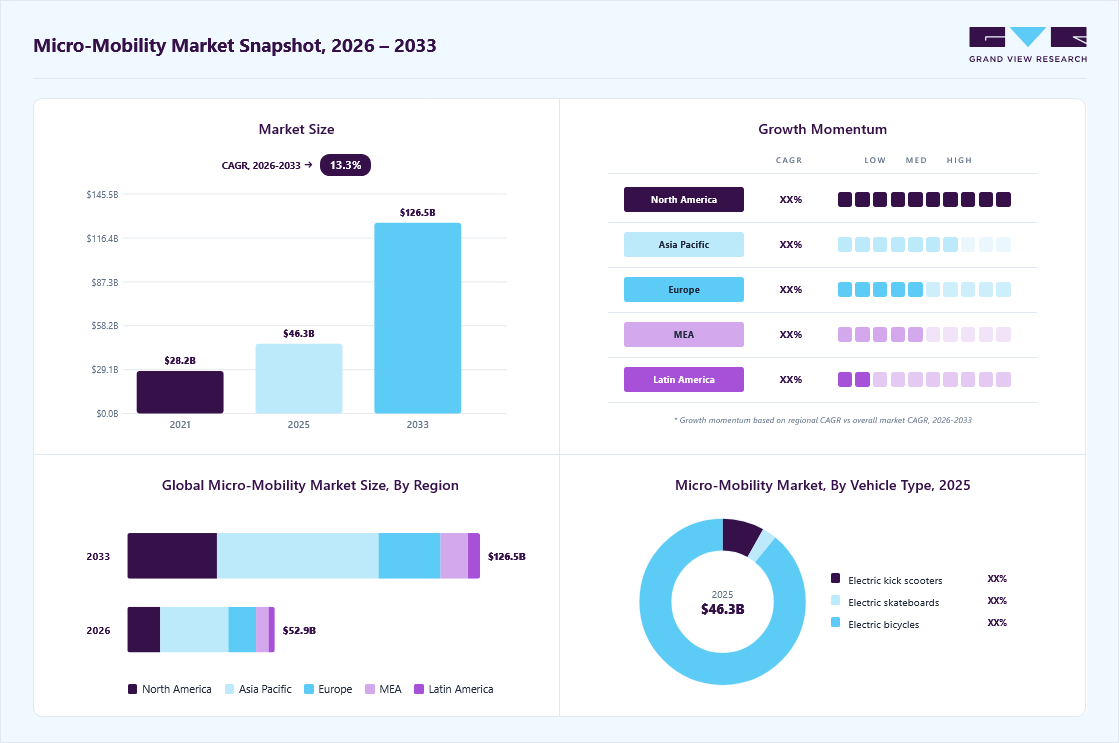 Source: Grand View Research, IR Documents, Primary Interviews, Paid DatabasesTo learn more about this report,
 Download Free Sample Report
 Key Market Trends & Insights
- By vehicle type: Electric bicycles segment held the largest share of 89.1% in 2025.
- By battery: Sealed lead acid segment held the largest market share in 2025.
- By voltage: Below 24V segment dominated the market in 2025.
Regional Highlights
- Largest regional market: Asia Pacific (46.3% revenue share, 2025)
- Fastest-growing regional market: North America (highest CAGR, 2026-2033)
- By country: The China led the Asia Pacific market in 2025.
Market Size & Forecast
- Market size in 2025: USD 46.3 Billion
- Estimated market size in 2026: USD 52.9 Billion
- Projected market size by 2033: USD 126.5 Billion
- CAGR (2026-2033): 13.3%
Three ways to get this report
Buy it, customize it, or ask a question.Ask an Analyst
Analyst response in 1 business day
- AccessReport author, directly
- Reply timeWithin 1 working day
- No sales callDirect answer only
- FormatEmail reply
- CostFree, no cost
Get the Full Report
What the study covers
- FormatsPDF · Excel · Dashboard
- Timeline2026–2033 annual, 2025 base
- Coverage20+ countries, 5 regions
- Companies10+ key players profiled
Customize the Report
20% free customization
- IncludeCountries, segments, points
- TailorTo your product definition
- ExtendDeeper competitor detail
- OrA fully bespoke study
- Turnaround5–10 working days
The transition toward electric-powered micro-mobility solutions such as e-bikes and e-scooters is one of the major drivers behind the micro-mobility market. This shift is driven by growing concerns about carbon emissions, rising fuel costs, and the need for sustainable transportation alternatives. Electric bicycles alone account for a significant share of the market, supported by their affordability, ease of use, and extended range capabilities. Improvements in lithium-ion battery technology have further enhanced performance through faster charging and longer battery life, making electric options more attractive to both individual users and fleet operators. As a result, electrification is expected to remain the cornerstone of market expansion in the coming years.Technological advancements, particularly in IoT, AI, and data analytics, are transforming micro-mobility operations and user experience. Fleet operators are increasingly deploying smart sensors, GPS tracking, and real-time data analytics to monitor vehicle health, optimize routes, and improve safety. Advanced fleet management systems enable predictive maintenance, reducing downtime and operational costs. Furthermore, app-based features such as digital unlocking, navigation, and ride analytics are enhancing customer engagement and convenience. The integration of autonomous and semi-autonomous capabilities is also emerging as a future trend, with companies exploring self-driving micro-mobility solutions. Thus, digitalization is enabling more efficient, scalable, and user-centric mobility ecosystems.
 To learn more about this report, Download Free Sample Report
 Governments across major economies are actively promoting micro-mobility as part of broader sustainable urban transport strategies. Policies such as subsidies for electric vehicles, investment in cycling infrastructure, and implementation of low-emission zones are accelerating adoption. Dedicated bike lanes, parking zones, and smart city initiatives are improving the safety and accessibility of micro-mobility solutions. Regulatory frameworks are also evolving to standardize operations, safety norms, and fleet management practices. These supportive measures are particularly prominent in regions with high traffic congestion and pollution, underscoring the importance of micro-mobility in urban mobility planning.
The increasing need for efficient last-mile connectivity is further driving micro-mobility adoption worldwide. With rapid urbanization and growing population density, traditional transportation systems are struggling to meet demand for short-distance travel. Micro-mobility solutions provide a cost-effective, time-saving, and flexible alternative for commuting between transit hubs and final destinations. This trend is further amplified by changing consumer behavior, including a preference for convenient and personalized mobility options. In addition, the integration of micro-mobility with public transportation networks is enhancing multimodal connectivity. As cities continue to expand, the demand for seamless last-mile solutions is expected to significantly boost market growth.
Factors such as high initial capital investment and ongoing maintenance costs could hamper the growth of the market. Safety, theft, and vandalism concerns are being reported, impacting user confidence and operational sustainability. In addition, regulatory inconsistencies across regions and limited infrastructure in certain areas are being recognized as barriers to widespread adoption. Furthermore, challenges in fleet management efficiency and asset utilization are being observed, leading to increased operational complexity for service providers.
Vehicle Type Insights
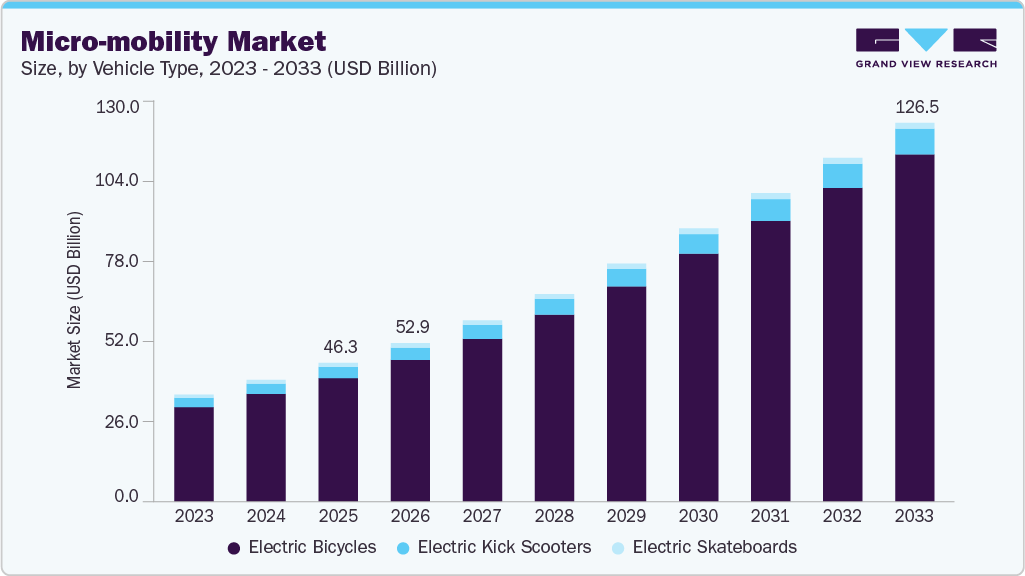
The electric bicycles segment dominated the market in 2025 and accounted for the largest share of 89.1%. The growth is driven by their versatility, comfort, and long-range capabilities compared to other micro-mobility options. E-bikes are ideal for both short commutes and long trips and allow riders to tackle varied terrains easily. Their eco-friendliness, backed by advancements in battery technology, makes electric bicycles a popular choice for urban and suburban transportation. Besides, e-bikes promote healthier, faster, and more efficient commuting, attracting consumers seeking an alternative to traditional vehicles or public transport.
The electric kick scooters segment is expected to grow at a notable CAGR during the forecast period. The growth is attributed to the growing demand for convenient, sustainable transportation in urban areas. Their compact design, speed, and affordability make them ideal for short commutes, while advancements in battery technology provide extended range and improved efficiency. Rising investments in dedicated infrastructure, such as scooter lanes and charging stations, and the expansion of shared scooter services are expected to drive segment adoption. This trend positions electric kick scooters as a leading solution for tackling urban mobility challenges.
Battery Insights
The sealed lead acid segment accounted for the largest market share in 2025, owing to its cost-effectiveness, reliability, and ease of maintenance. Sealed Lead Acid Batteries (SLA) are durable and offer stable performance across a wide temperature range, making them ideal for urban mobility solutions. Their robust design ensures longevity, and their ability to operate across various environmental conditions further enhances their durability. In addition, the widespread availability and recycling infrastructure of SLA batteries have contributed to their dominance in the market, offering a practical solution for both consumers and manufacturers.
The Li-Ion battery segment is expected to grow at the fastest CAGR during the forecast period. Factors such as high energy density, lightweight design, and longer lifespan of Li-ion batteries compared to traditional battery types are expected to contribute to the segment growth. Li-Ion batteries offer enhanced performance, extended range, and faster charging times, making them ideal for electric bikes, scooters, and other personal transport vehicles. As consumer demand for efficient, eco-friendly mobility solutions rises, the adoption of Li-Ion batteries is expected to increase further. Moreover, ongoing advancements in battery technology and decreasing costs are expected to further fuel growth, solidifying the prominence of the Li-Ion segment in the market.
Voltage Insights
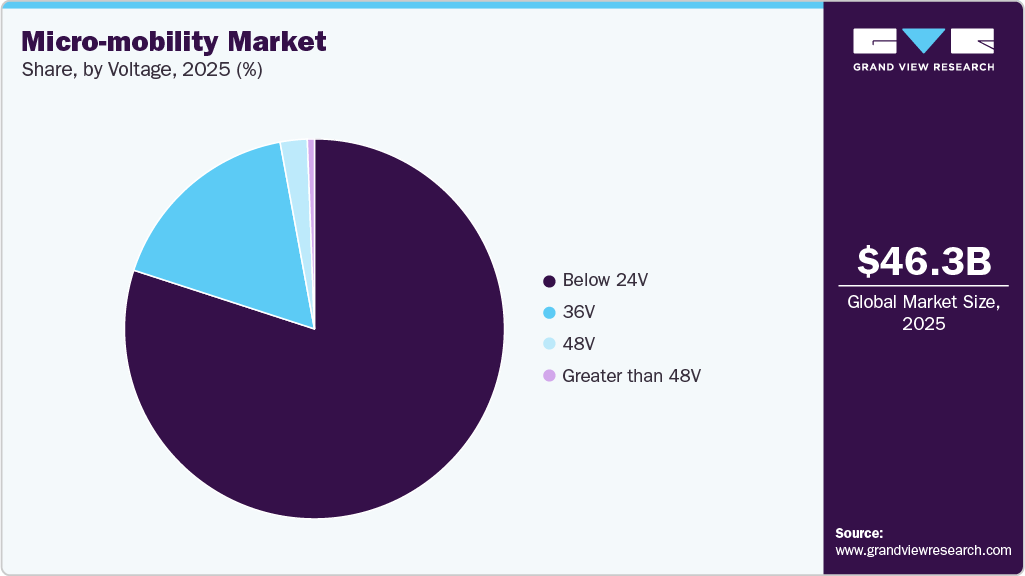
The below 24V segment dominated the market in 2025, driven by its cost-effectiveness, compactness, and suitability for short-distance travel. These low-voltage systems are commonly used in electric scooters, e-bikes, and other micro-mobility vehicles, offering an efficient and affordable solution for urban commuting. Their lightweight design makes them easier to handle, store, and maintain, appealing to budget-conscious consumers. Furthermore, the lower voltage requirements make these vehicles more accessible, leading to widespread adoption, especially in emerging markets.
 To learn more about this report, Download Free Sample Report
 The 36V segment is expected to grow at the fastest CAGR during the forecast period. This growth can be attributed to its ability to balance power, range, and efficiency. These batteries enable electric scooters, e-bikes, and other vehicles to travel longer distances at faster speeds, offering higher performance than the 24V segment. This makes them ideal for users seeking enhanced urban commuting and recreational performance. With growing demand for more powerful, reliable, and efficient micro-mobility solutions, the 36V segment is poised for substantial growth in the coming years.
Regional Insights
Asia Pacific dominated the micro-mobility industry and accounted for a share of 46.3% in 2025. Rising fuel costs and traffic congestion in urban areas are driving the demand for micro-mobility solutions in the region as consumers seek cost-effective, efficient alternatives for short-distance travel. Moreover, advancements in battery technology are improving the performance, range, and affordability of electric vehicles such as e-scooters and e-bikes, making them more attractive to users. In addition, the expansion of charging infrastructure is increasing the convenience and accessibility of micro-mobility options, further fueling market growth across the region and promoting the adoption of eco-friendly transportation.
 To learn more about this report, Download Free Sample Report
 The micro-mobility market in India is expected to grow at a notable rate during the forecast period. Increasing urbanization, rising traffic congestion, and growing environmental awareness are major drivers across metropolitan and tier-2 cities. In addition, a large young population and increasing preference for cost-effective, flexible commuting options are being observed as major contributors to market expansion.
China micro-mobility market held a significant market share in 2025. This share can be attributed to the rapid growth of e-scooter adoption and the dominance of shared mobility services across China. As urban congestion increases, e-scooters offer a fast, efficient, and eco-friendly alternative for short-distance travel. Shared mobility platforms further fuel this growth by offering flexible, affordable, and accessible options for commuters. The rise in preference for convenience and sustainability, supportive government policies, and infrastructure developments position China for substantial growth, driven by rising demand for urban transport solutions.
North America Micro-mobility Market Trends
The micro-mobility market in North America is expected to grow at the fastest CAGR during the forecast period. Regional growth is driven by the expansion of shared micro-mobility services and their integration with public transit systems. As cities adopt more shared electric scooters, bikes, and mopeds, they provide convenient, affordable, and eco-friendly alternatives for short-distance travel. Integrating these services with public transit enhances the convenience of last-mile connectivity, making them an attractive option for daily commuters. This synergy is poised to drive market adoption, fueling growth and shaping the future of urban mobility across North America.
U.S. Micro-mobility Market Trends
The micro-mobility market in the U.S. held a dominant position in the region in 2025. The growing emphasis on reducing carbon emissions and the push for more sustainable transportation solutions are shaping the U.S. market. As cities are investing in better infrastructure, such as dedicated bike lanes and safer pedestrian spaces, micro-mobility options, including electric scooters and bikes, are becoming more viable and appealing. These green alternatives reduce traffic congestion and carbon footprints, making them an attractive option for short-distance travel. With increasing environmental concerns and improving infrastructure, the demand for micro-mobility solutions is set to grow rapidly.
Canada micro-mobility market is driven by increasing urbanization and rising population density in major cities. In addition, integration of micro-mobility with public transport systems and supportive government initiatives are driving market growth in the country.
Europe Micro-mobility Market Trends
The micro-mobility market in Europe is expected to register a moderate CAGR from 2026 to 2033. The emphasis on last-mile connectivity and the shift toward subscription-based services, along with long-term rentals, are propelling the regional market. As cities seek efficient, eco-friendly solutions for short-distance travel, micro-mobility alternatives such as e-scooters and e-bikes become essential. Moreover, subscription models and long-term rentals offer cost-effective, flexible alternatives to ownership, making these services increasingly popular among urban commuters. This shift, along with the push for sustainable transport, is set to expand the market and encourage wider adoption across European cities.
The UK micro-mobility market is expected to grow at the fastest rate during the forecast period. The growth of the micro-mobility market in the UK is being driven by a strong focus on reducing carbon emissions and achieving net-zero transport targets. In addition, supportive pilot programs and growing interest in shared mobility services are contributing to the growth of the market.
The micro-mobility market in Germany held a substantial share in 2025. The micro-mobility industry in Germany is driven by a well-established regulatory framework and high consumer willingness to adopt new mobility solutions. Strong urban density and well-developed public transport systems are supporting the demand for first- and last-mile connectivity solutions.
Key Micro-mobility Companies Insights
Some of the key companies in the micro-mobility industry include Segway Inc., Swagtron, Boosted USA, and Accell Group, among others. These companies are leveraging economies of scale and extensive supply chain networks to offer competitively priced products across global markets. In addition, they are focusing on technology integration, smart features, and brand-driven differentiation to capture urban consumers.
-
Accell Group offers high-quality bicycles, e-bikes, and cycling accessories through brands like Batavus, Koga, and Haibike. It focuses on innovation, sustainability, and performance, catering to both recreational and professional cyclists across Europe and beyond.
-
Segway Inc. offers advanced personal mobility devices and electric scooters. The company is focusing on high-performance, durable, and technologically sophisticated products targeted at both consumers and shared mobility operators.
Key Micro-mobility Companies:
The following key companies have been profiled for this study on the micro-mobility market.
- Yadea Technology Group Co., Ltd.
- Jiangsu Xinri E-Vehicle Co., Ltd
- Xiaomi
- Segway Inc.
- Swagtron
- Boosted USA
- Accell Group
- Kalkhoff Werke
- KugooEU Scooter
- Swifty Scooters
Recent Developments
-
In January 2026, Urlife Bike launched the Urlife E20 Pro electric bike, an upgraded version of its popular E20 commuter model. The E20 Pro is designed to deliver enhanced power, higher speed, extended range, and improved durability, catering to riders seeking superior performance for both daily commuting and adventure rides.
-
In September 2025, Ampler, a prominent European e-bike manufacturer, introduced its first USB-C charging e-bikes, Nova and Nova Pro, across Europe. These advanced models are designed to deliver greater convenience, modern technology, and refined aesthetics, reinforcing Ampler’s position in the evolving e-mobility landscape.
Micro-mobility Market Report Scope
Report Attribute
Details
Market size in 2025
USD 46.3 billion
Estimated market size in 2026
USD 52.9 billion
Projected market size by 2033
USD 126.5 billion
Growth rate
CAGR of 13.3% from 2026 to 2033
Base year for estimation
2025
Historical data
2021 - 2024
Forecast period
2026 - 2033
Quantitative units
Revenue in USD million/billion and CAGR from 2026 to 2033
Report coverage
Revenue forecast, company ranking, competitive landscape, growth factors, and trends
Segments covered
Vehicle type, battery, voltage, region
Regional scope
North America; Europe; Asia Pacific; Latin America; MEA
Country scope
U.S.; Canada; Mexico; Germany; UK; France; China; Japan; India; South Korea; Australia; Brazil; KSA; UAE; South Africa
Key companies profiled
Yadea Technology Group Co., Ltd.; Jiangsu Xinri E-Vehicle Co., Ltd; Xiaomi; Segway Inc.; Swagtron; Boosted USA; Accell Group; Kalkhoff Werke; KugooEU Scooter; Swifty Scooters
Customization scope
Free report customization (equivalent up to 8 analysts working days) with purchase. Addition or alteration to country, regional & segment scope.
Pricing and purchase options
Avail customized purchase options to meet your exact research needs. Explore purchase options
Global Micro-mobility Market Report Segmentation
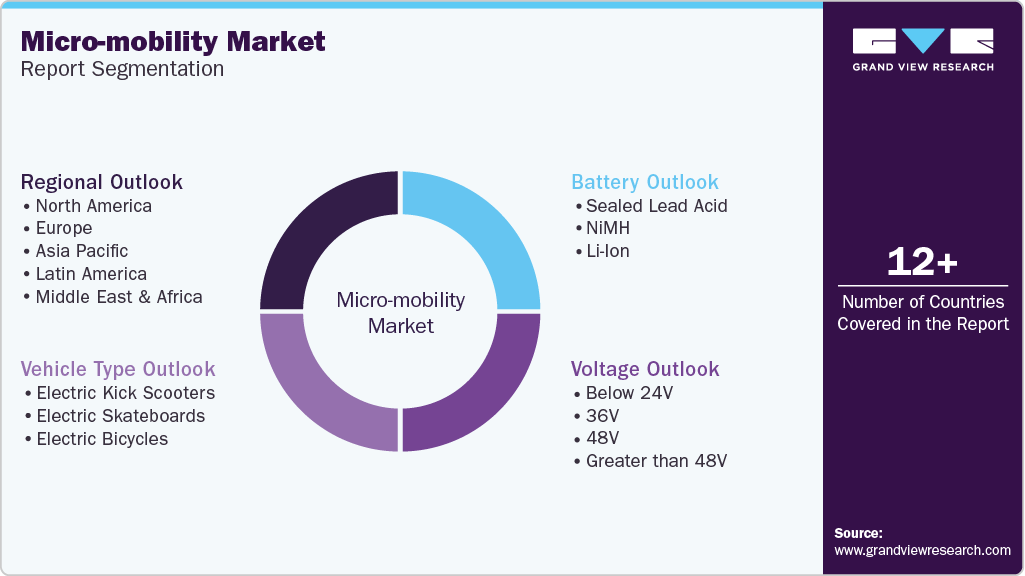
This report forecasts revenue growth at global, regional, and country levels and provides an analysis of the latest industry trends in each of the sub-segments from 2021 to 2033. For this study, Grand View Research has segmented the global micro-mobility market report based on vehicle type, battery, voltage, and region.
 To learn more about this report, Download Free Sample Report
 -
Vehicle Type Outlook (Revenue, USD Million, 2021 - 2033)
-
Electric Kick Scooters
-
Electric Skateboards
-
Electric Bicycles
-
-
Battery Outlook (Revenue, USD Million, 2021 - 2033)
-
Sealed Lead Acid
-
NiMH
-
Li-Ion
-
-
Voltage Outlook (Revenue, USD Million, 2021 - 2033)
-
Below 24V
-
36V
-
48V
-
Greater than 48V
-
-
Regional Outlook (Revenue, USD Million, 2021 - 2033)
-
North America
-
U.S.
-
Canada
-
Mexico
-
-
Europe
-
UK
-
Germany
-
France
-
-
Asia Pacific
-
China
-
India
-
Japan
-
Australia
-
South Korea
-
-
Latin America
-
Brazil
-
-
Middle East & Africa
-
UAE
-
KSA
-
South Africa
-
-
Frequently Asked Questions About This Report
North America is the fastest-growing region over the forecast period.
The below 24V segment held the largest revenue share in 2025, while 36V is the fastest-growing voltage.
The electric bicycles segment led with a 89.1% revenue share in 2025.
The sealed lead acid segment held the largest revenue share in 2025, while Li-Ion battery is the fastest-growing segment.
Key players include Yadea Technology Group Co., Ltd.; Jiangsu Xinri E-Vehicle Co., Ltd; Xiaomi; Segway Inc.; Swagtron; Boosted USA; Accell Group; Kalkhoff Werke; KugooEU Scooter; Swifty Scooters.
Asia Pacific dominated the micro-mobility industry and accounted for a share of 46.3% in 2025. This is attributable to the initiatives taken towards setting up standards and regulations for vehicle charging infrastructure in several economies, including China, Japan, and India.
The global micro-mobility market size was valued at USD 46.3 billion in 2025 and is estimated at USD 52.9 billion for 2026.
The global micro-mobility market is expected to grow at a CAGR of 13.3% from 2026 to 2033, reaching USD 126.5 billion by 2033.
The growth of the micro-mobility market is driven by increasing urbanization, rising traffic congestion, and a growing emphasis on reducing carbon emissions.
About the Author(s)
Automotive & Transportation Research Team
Technology · Automotive & TransportationThis report was authored by the automotive & transportation research team at Grand View Research - comprising two research analysts, one senior research analyst, and one industry expert - with specialized expertise in the automotive & transportation segment of the technology industry. All findings are based on proprietary technology databases, executive interviews, and regulatory analysis, subject to internal peer review prior to publication.
Last Updated:
Speak to Analyst

Customize this report to your needs - add regions, segments, or data points, with 20% free customization.
Or view our licence options:


ISO 9001:2015 & 27001:2022 Certified
We are GDPR and CCPA compliant! Your transaction & personal information is safe and secure. For more details, please read our privacy policy.


