
- Home
- »
- Advanced Interior Materials
- »
-
Middle East Aluminum Casting Market, Industry Report, 2033GVR Report cover
![Middle East Aluminum Casting Market Size, Share & Trends Report]()
Middle East Aluminum Casting Market (2025 - 2030) Size, Share & Trends Analysis Report By Process (Die Casting, Permanent Mold Casting), By End Use (Transportation, Industrial), And Segment Forecasts
- Report ID: GVR-4-68040-750-6
- Number of Report Pages: 80
- Format: PDF
- Historical Range: 2021 - 2023
- Forecast Period: 2025 - 2033
- Industry: Advanced Materials
- Report Summary
- Table of Contents
- Segmentation
- Methodology
- Download FREE Sample
-
 Download Sample Report
Middle East Aluminum Casting Market Summary
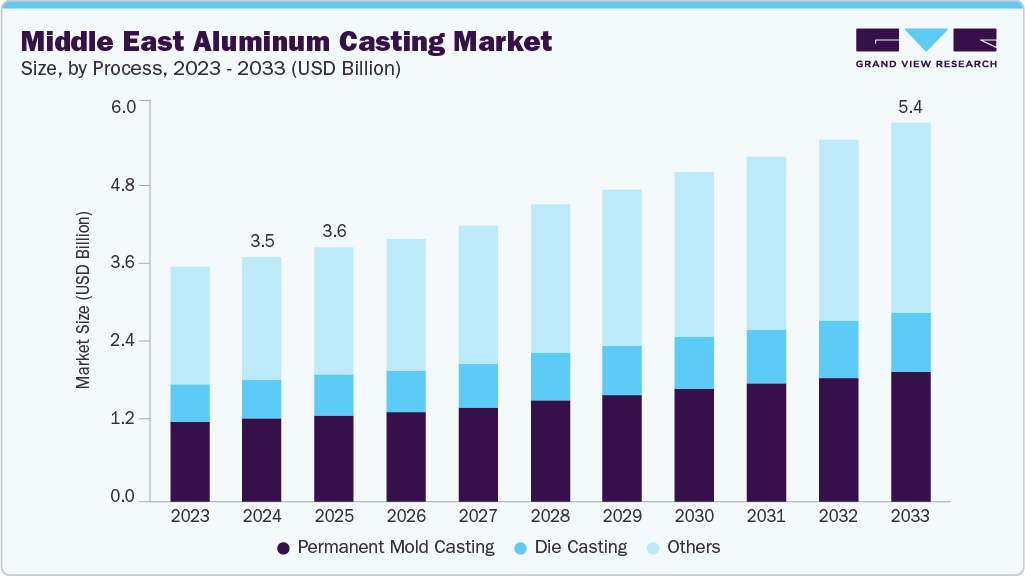
The Middle East aluminum casting market size was estimated at USD 3.49 billion in 2024 and is expected to reach USD 5.41 billion in 2033 and grow at a CAGR of 5.1% from 2025 to 2033. Due to its high strength and lightweight properties, the increasing use of aluminum in automotive manufacturing is expected to be a key driver of market growth in the region.
Key Market Trends & Insights
- The aluminum casting market in the UAE is witnessing steady growth
- By process, die casting dominated the market with a revenue share of over 55.0% in 2024.
- By end use, the transportation segment held the largest share of over 67.0% of aluminum casting revenue in 2024.
Market Size & Forecast
- 2024 Market Size: USD 3.49 billion
- 2033 Projected Market Size: USD 5.41 billion
- CAGR (2025-2033): 5.1%
Rapid infrastructure development and rising demand from electronics and industrial sectors further boost market adoption. Furthermore, the regional focus on sustainable and energy-efficient materials supports the expansion of aluminum casting applications.Rapid economic growth, increasing government infrastructure spending, and rising consumer demand for personal vehicles are key factors driving market growth in the Middle East, thereby boosting aluminum casting demand. The region is seeing a rise in local automotive manufacturing and assembly activities, supported by favorable investment policies and industrial diversification efforts. For example, Saudi Arabia is progressing with its Saudi Vision 2030 plan by developing industrial hubs like NEOM and partnering with global automakers to build vehicle production facilities, which is expected to increase the use of aluminum casting-based products in high-performance tires.
At the same time, the construction sector has become one of the largest consumers of aluminum casting, especially in the form of aluminum casting fumes that improve the strength, durability, and lifespan of concrete. The demand for high-performance building materials is growing as the region undertakes large urban development projects. For instance, in 2024, the United Arab Emirates announced its USD 23 billion Dubai 2040 Urban Master Plan to expand sustainable urban districts, transportation networks, and mixed-use real estate developments, which significantly boosts the use of aluminum casting in concrete, glass, coatings, and related materials.
Furthermore, several Middle Eastern countries are investing heavily in large-scale infrastructure, which is expected further to boost aluminum casting demand in construction and related industries. Major projects like Saudi Arabia’s The Line city and Qatar’s ongoing transport corridor expansions raise the need for advanced building materials. These developments highlight a continued growth trend for aluminum casting in the region, supported by strong infrastructure projects and expanding end-use sectors.
Drivers, Opportunities & Restraints
The aluminum casting industry in the Middle East is gaining momentum due to substantial government-led infrastructure investments and industrial diversification initiatives. For instance, Saudi Arabia’s Vision 2030 has spurred the creation of industrial zones like NEOM, attracting global automakers and increasing the need for aluminum components in vehicles. Similarly, the UAE’s Dubai 2040 Urban Master Plan, worth USD 23 billion, is driving the use of aluminum in construction materials, including concrete, glass, and coatings. The combined effect of supportive policies and an emphasis on sustainability further strengthens market growth.
The market presents considerable opportunities, especially with the rise of electric and hybrid vehicles requiring lightweight yet durable aluminum components. Growing initiatives toward sustainable transportation in the region promote aluminum adoption in the automotive sector. Furthermore, large-scale urban and infrastructure projects, such as Saudi Arabia’s The Line and Qatar’s transport corridor expansions, are expected to increase demand for advanced aluminum materials in construction and allied industries, creating new growth avenues for aluminum casting manufacturers.
Despite its growth prospects, the market faces several challenges. Limited recycling infrastructure and high energy consumption for primary aluminum production remain significant concerns. Water scarcity in the region further complicates recycling efforts, making aluminum production more resource-intensive. In addition, geopolitical tensions and economic uncertainties can disrupt supply chains and investment flows, posing risks to market stability and slowing growth in specific segments. The market is vulnerable to these tensions and fluctuations, which can interrupt raw material supply chains, delay large infrastructure projects, and impact foreign investment. For instance, regional conflicts or sanctions can raise aluminum import costs, while currency volatility can further squeeze manufacturers’ margins. These factors threaten market stability, making it difficult for companies to plan long-term expansions or invest in advanced casting technologies.
Process Insights
By process, die casting dominated the market with a revenue share of over 55.0% in 2024. In the Middle East, pressure die casting is gaining traction due to the region’s expanding automotive and electronics sectors. This method involves injecting molten aluminum into a steel mold under high pressure, enabling the production of complex components with precise dimensions. Its rapid cycle makes it ideal for large-scale production of automotive parts, electronic housing, and intricate machinery components, supporting the region’s push for industrial diversification and localized manufacturing.
Permanent mold casting is also widely used in the Middle East for producing medium-volume, high-strength components. Reusable metal molds allow molten aluminum to be poured by gravity or low pressure, yielding dense and mechanically robust parts. This method suits automotive wheels, engine blocks, and construction-related components, aligning with ongoing infrastructure projects and industrial expansion in Saudi Arabia, the UAE, and Qatar.
End Use Insights
The transportation segment held the largest share of over 67.0% of aluminum casting revenue in 2024. The rising demand for lightweight vehicles and aircraft drives the growth of the transportation segment in the Middle East. Sports vehicles represent a particularly lucrative segment, with increasing interest in automotive sports, rallies, and high-performance vehicles across the region contributing to the demand for aluminum cast components. The aviation sector further supports market growth, as aluminum casting is extensively used in jet and aircraft engine manufacturing. According to a 2024 Airbus study, global demand for new aircraft is projected to reach nearly 42,000 over the next 20 years, which will drive the need for new jet engines and, in turn, bolster aluminum casting consumption in the Middle East’s expanding aviation industry.
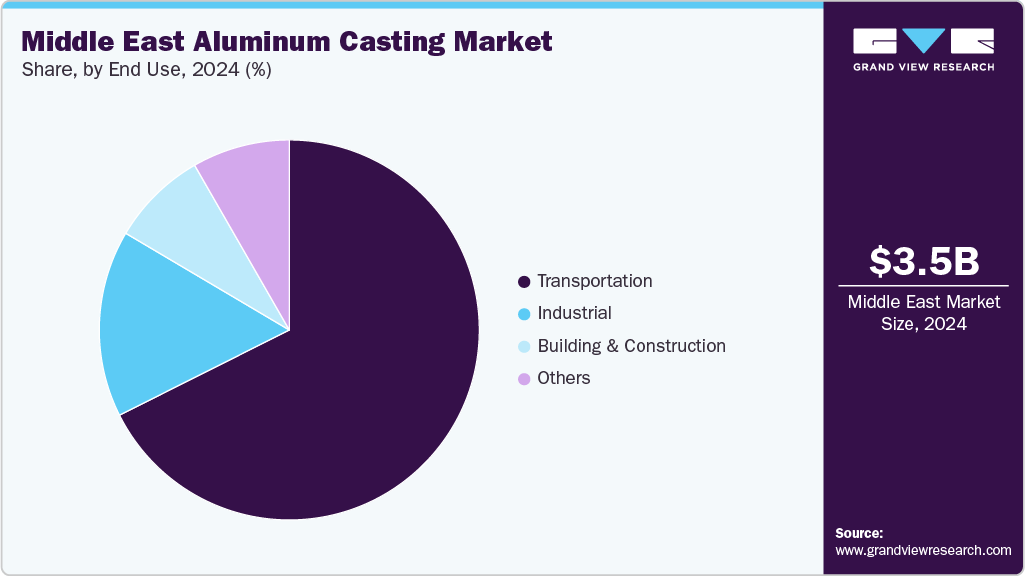
In the industrial segment, construction and heavy equipment manufacturing are anticipated to grow steadily due to ongoing regional infrastructure development. The presence of international construction equipment manufacturers operating in the Middle East is expected to support consistent demand for aluminum cast products. Applications include roofing, windows, door handles, curtain walling, and structural elements. Thanks to its lightweight, durability, and aesthetic appeal, the ongoing replacement of traditional materials like iron and steel with aluminum is expected to drive adoption across Middle Eastern construction projects further.
Regional Insights
The Middle East aluminum casting market is shaped by accelerating infrastructure development, industrial diversification, and expanding automotive and industrial activities. The Middle East is rapidly emerging as a key regional hub. This growth is supported by high government spending on smart cities, tourism infrastructure, and industrial projects. The region’s rising industrialization and the adoption of advanced materials and sustainable construction practices position the Middle East market for sustained growth throughout the forecast period.
Saudi Arabia Aluminum Casting Market Trends
The aluminum casting market in Saudi Arabia is experiencing robust growth driven by extensive infrastructure initiatives under Vision 2030 and mega-projects such as NEOM and The Red Sea Project. These developments significantly increase demand for high-performance construction materials, including aluminum casting-based concrete, mortars, and coatings. In addition, the country’s expanding building and construction sector—fueled by rising construction activity and automotive production—further supports aluminum casting consumption. Ongoing oil and gas drilling activities also sustain demand for specialized aluminum casting products used in hydraulic fracturing operations.
UAE Aluminum Casting Market Trends
The aluminum casting market in the UAE is witnessing steady growth, underpinned by large-scale real estate and infrastructure projects such as Dubai Creek Harbour and Etihad Rail. Growing construction activity is driving the use of aluminum casting in concrete, glass, and specialty coatings, while the expanding automotive and tire manufacturing sector is increasing demand for advanced aluminum casting products. Furthermore, the UAE’s strategic focus on renewable energy and sustainable urban development encourages the adoption of aluminum casting-based materials in green buildings and energy-efficient infrastructure.
Key Middle East Aluminum Casting Company Insights
Some of the key players operating in the market include Gulf Metal Foundry, Al Jaber Iron and Steel Foundry, Al Ain Factory for Metal Casting and Electroplating, and Others.
-
Gulf Metal Foundry specializes in precision aluminum casting for aerospace, automotive, and industrial machinery applications. Its portfolio includes investment castings, sand castings, and gravity die castings, which enhance dimensional accuracy, mechanical strength, and thermal resistance in end-use components. The company emphasizes advanced casting techniques and quality control to meet the growing regional demand for high-performance aluminum parts.
-
Al Jaber Iron and Steel Foundry produces a wide range of aluminum and steel castings for construction, heavy equipment, and oil and gas sectors. Its offerings include structural castings, engine components, and industrial fittings, designed to improve durability, load-bearing capacity, and corrosion resistance. The company leverages modern foundry technologies and sustainable production practices to support regional industrial growth.
-
Al Ain Factory for Metal Casting and Electroplating focuses on aluminum gravity die casting and electroplating solutions for construction, interior design, and automotive industries. Its product range includes gates, windows, decorative fittings, and precision cast components that enhance strength, surface finish, and longevity. The company prioritizes technological innovation and environmentally friendly processes to meet the demands of the Middle East market.
Key Middle East Aluminum Casting Companies:
- Al Ain Factory for Metal Casting and Electroplating
- Al Jaber Iron and Steel Foundry
- Blue Light Industry Foundry
- Emirates Global Aluminium
- Gulf Metal Foundry
- National Metal Manufacturing and Casting Company Maadaniyah
- Oman Aluminium Rolling Company
- Qatar Aluminium Manufacturing Company
- Saudi Arabian Amiantit Company
- Specialized Industrial Casting Company Sicast
Recent Developments
-
In June 2025, Emirates Global Aluminium (EGA) initiated production using its next-generation innovative smelting technology at the Al Taweelah facility. This pilot project marks a significant step toward large-scale industrialization to enhance aluminum production efficiency and reduce environmental impact. Implementing Industry 4.0 capabilities in this pilot sets a global benchmark in aluminum smelting.
-
In May 2025, EGA announced that construction of the UAE's largest aluminum recycling plant had reached the 50% completion milestone. The facility is designed to process both post-consumer and pre-consumer aluminum scrap into low-carbon, high-quality 'premium aluminum.' This development underscores EGA's commitment to sustainable practices and the circular economy.
-
In May 2025, EGA announced plans to construct a USD 4 billion primary aluminum production facility in Inola, Oklahoma. The facility is expected to have a capacity of 600,000 tonnes of primary aluminum annually, nearly doubling the United States' production. The project is anticipated to create approximately 1,000 direct and 1,800 indirect jobs, marking a significant investment in aluminum.
Middle East Aluminum Casting Report Scope
Report Attribute
Details
Market size value in 2025
USD 3.63 billion
Revenue forecast in 2033
USD 5.41 billion
Growth rate
CAGR of 5.1% from 2025 to 2033
Base year for estimation
2024
Historical data
2021 - 2023
Forecast period
2025 - 2033
Quantitative Units
Volume in kilotons, revenue in USD billion, and CAGR from 2025 to 2033
Report coverage
Volume & revenue forecast, competitive landscape, growth factors, and trends
Segments covered
Process, end use
Regional scope
Middle East
Country scope
Saudi Arabia; UAE; Qatar; Oman; Iran
Key companies profiled
Al Ain Factory for Metal Casting and Electroplating; Al Jaber Iron and Steel Foundry; Blue Light Industry Foundry; Emirates Global Aluminium; Gulf Metal Foundry; National Metal Manufacturing and Casting Company Maadaniyah; Oman Aluminium Rolling Company; Qatar Aluminium Manufacturing Company; Saudi Arabian Amiantit Company; Specialized Industrial Casting Company Sicast
Customization scope
Free report customization (equivalent up to 8 analysts working days) with purchase. Addition or alteration to country, regional & segment scope.
Pricing and purchase options
Avail customized purchase options to meet your exact research needs. Explore purchase options
Middle East Aluminum Casting Market Report Segmentation
This report forecasts revenue growth nationally and regionally from 2021 to 2033 and analyzes the latest trends in each sub-segment. For this study, Grand View Research has segmented the Middle East aluminum casting market report by process, and end use:
-
Process Outlook (Volume, Kilotons; Revenue, USD Billion, 2021 - 2033)
-
Die Casting
-
Permanent Mold Casting
-
Others
-
-
End Use Outlook (Volume, Kilotons; Revenue, USD Billion, 2021 - 2033)
-
Transportation
-
Industrial
-
Building & Construction
-
Others
-
-
Regional Outlook (Volume, Kilotons; Revenue, USD Billion, 2021 - 2033)
-
Middle East
-
Saudi Arabia
-
UAE
-
Qatar
-
Oman
-
Iran
-
-
Frequently Asked Questions About This Report
b. The Middle East aluminum casting market size was estimated at USD 3.49 billion in 2024 and is expected to reach USD 3.63 billion in 2025.
b. The Middle East aluminum casting market is expected to grow at a compound annual growth rate of 5.1% from 2025 to 2033, reaching USD 5.41 billion by 2033.
b. By process, die casting dominated the market with a revenue share of over 55.0% in 2024.
b. Some of the key vendors in the Middle East Aluminum Casting market are Al Ain Factory for Metal Casting and Electroplating, Al Jaber Iron and Steel Foundry, Blue Light Industry Foundry, Emirates Global Aluminium, Gulf Metal Foundry, National Metal Manufacturing and Casting Company Maadaniyah, Oman Aluminium Rolling Company, Qatar Aluminium Manufacturing Company, Saudi Arabian Amiantit Company, and Specialized Industrial Casting Company Sicast.
b. The Middle East aluminum casting market is driven by rapid infrastructure development, increasing automotive production, and the growth of electronics manufacturing. Furthermore, rising applications in personal care products and various industrial sectors, and a regional shift toward sustainable and energy-efficient materials, are further boosting demand.


Share this report with your colleague or friend.
Need a Tailored Report?
Customize this report to your needs — add regions, segments, or data points, with 20% free customization.


ISO 9001:2015 & 27001:2022 Certified
We are GDPR and CCPA compliant! Your transaction & personal information is safe and secure. For more details, please read our privacy policy.
Trusted market insights - try a free sample
See how our reports are structured and why industry leaders rely on Grand View Research. Get a free sample or ask us to tailor this report to your needs.













