
- Home
- »
- Power Generation & Storage
- »
-
Middle East Battery Energy Storage Systems Market Report, 2033GVR Report cover
![Middle East Battery Energy Storage Systems Market Size, Share & Trends Report]()
Middle East Battery Energy Storage Systems Market (2025 - 2033) Size, Share & Trends Analysis Report By Type (Lithium Ion Battery, Flywheel Battery), By Application (Industrial, Data Center), By Country, And Segment Forecasts
- Report ID: GVR-4-68040-720-1
- Number of Report Pages: 120
- Format: PDF
- Historical Range: 2021 - 2023
- Forecast Period: 2025 - 2033
- Industry: Energy & Power
- Report Summary
- Table of Contents
- Segmentation
- Methodology
- Download FREE Sample
-
 Download Sample Report
Middle East Battery Energy Storage Systems Market Summary
The Middle East battery energy storage systems market size was estimated at USD 0.66 billion in 2024 and is projected to reach USD 2.60 billion, growing at a CAGR of 14.7% from 2025 to 2033. Battery storage is emerging as a critical enabler of the region’s renewable energy transition, ensuring stability, reliability, and efficient integration of intermittent solar and wind resources into the grid.
Key Market Trends & Insights
- The UAE battery energy storage systems (BESS) market held the largest share of 34.85 % of the Middle East market in 2024.
- The battery energy storage systems (BESS) market in the Middle East is expected to grow significantly over the forecast period.
- Based on application, the industrial segment held the highest revenue share of 71.85% in 2024.
- Based on type, the Lithium-ion Battery segment held the highest revenue share in 2024.
Market Size & Forecast
- 2024 Market Size: USD 0.66 Billion
- 2033 Projected Market Size: USD 2.60 Billion
- CAGR (2025-2033): 14.7%
- UAE: Largest market in 2024
- Oman: Fastest growing market
National strategies such as Saudi Vision 2030, the UAE’s Energy Strategy 2050, and Israel’s Integrated Sustainable Energy Strategy increasingly incorporate large-scale storage projects to balance peak loads, reduce curtailment, and enhance energy security. From grid-scale lithium-ion installations to hybrid renewable-plus-storage projects, the Middle East is positioning itself as a leader in leveraging advanced storage technologies to diversify its energy mix and support sustainable growth.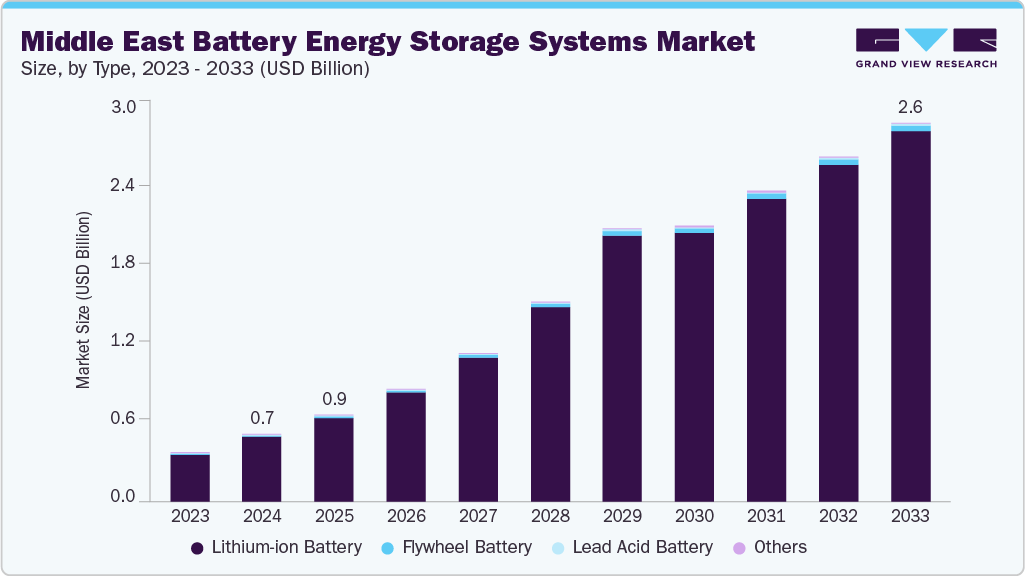
Market growth is supported by rapid renewable capacity additions, falling battery costs, and strong government backing through pilot programs, tenders, and financing incentives. Lithium-ion technology dominates the region due to its high efficiency and scalability, though alternatives such as flow batteries are gaining attention for long-duration applications. The acceleration of green hydrogen initiatives in Oman, Saudi Arabia, and the UAE is further amplifying the role of storage, as hybrid systems integrate batteries for short-term balancing alongside electrolyzers. Moreover, cross-border grid interconnections, GCC-wide smart grid upgrades, and digital monitoring tools are boosting the adoption of energy storage for both utility and commercial uses. With key players such as Tesla, Fluence, and Huawei Digital Power working alongside regional champions like ACWA Power and Masdar, the Middle East BESS market is set to become a cornerstone of the region’s low-carbon and resilient energy ecosystem over the next decade.
Drivers, Opportunities & Restraints
The Middle East battery energy storage systems (BESS) market is primarily driven by the rapid scale-up of renewable energy deployment, the need for grid stability, and strong government support through energy transition strategies. National visions in the UAE, Saudi Arabia, and Israel emphasize energy diversification and resilience, making storage a critical enabler of higher solar and wind penetration.
Declining lithium-ion battery costs and the availability of concessional financing further accelerate adoption. In addition, the region’s rising electricity demand, driven by population growth, urbanization, and industrialization, necessitates robust storage infrastructure to ensure a reliable power supply and reduce curtailment from intermittent resources.
Opportunities are expanding in hybrid renewable-plus-storage projects, utility-scale grid stabilization, and distributed commercial applications. Integrating batteries with green hydrogen production projects in Oman, Saudi Arabia, and the UAE creates new pathways for short-term balancing and long-duration energy management. Advancements in AI-driven energy management systems, predictive analytics, and smart grid technologies also enhance operational efficiency and system optimization.
Moreover, partnerships with global technology providers and regional champions open the door to knowledge transfer and innovative financing structures. However, the market faces restraints such as high upfront capital costs, dependence on imported battery technologies, and the need for improved recycling infrastructure. Limited local manufacturing capacity and policy misalignment across countries may also delay large-scale deployment, while grid bottlenecks in certain areas pose challenges for effective integration of storage assets.
Type Insights
The lithium-ion battery segment held the largest revenue share of over 96.88% in 2024 in the Middle East battery energy storage systems (BESS) market. Lithium-ion has emerged as the dominant technology due to its superior energy density, scalability, and declining costs, making it the preferred choice for grid-scale and distributed applications. Utility-driven storage deployments in Saudi Arabia, the UAE, and Israel are largely anchored in lithium-ion solutions, which support renewable integration, peak load management, and frequency regulation. In addition, the technology’s modularity allows its use across diverse applications ranging from utility-scale plants to commercial and residential storage systems, reinforcing its market leadership.
Strong government-led initiatives, supportive policy frameworks, and partnerships with global storage technology providers such as Tesla, Fluence, and Huawei Digital Power further boost the segment’s prominence. Integration of lithium-ion storage with solar PV and wind projects enhances dispatchability and grid stability, aligning with national clean energy goals. Advancements in battery chemistries, including lithium iron phosphate (LFP), improve safety, lifecycle performance, and cost efficiency, making the technology more attractive for large-scale deployments. While challenges such as recycling infrastructure gaps and supply chain dependencies persist, lithium-ion’s established dominance and continuous innovation position it as the cornerstone of the Middle East’s BESS landscape over the forecast period.
Application Insights
The industrial segment held the largest revenue share of over 71.85% 2024 in the Middle East battery energy storage systems (BESS) market and is expected to maintain its dominance throughout the forecast period. Industrial demand for storage is accelerating as energy-intensive sectors such as oil & gas, petrochemicals, desalination, and heavy manufacturing prioritize decarbonization and energy efficiency. Large-scale BESS deployments are integrated with renewable energy projects to ensure round-the-clock power supply for high-load operations in Saudi Arabia, the UAE, and Oman. Storage systems are particularly critical in stabilizing renewable-powered industrial parks, refineries, and export hubs, where reliability and resilience are paramount.
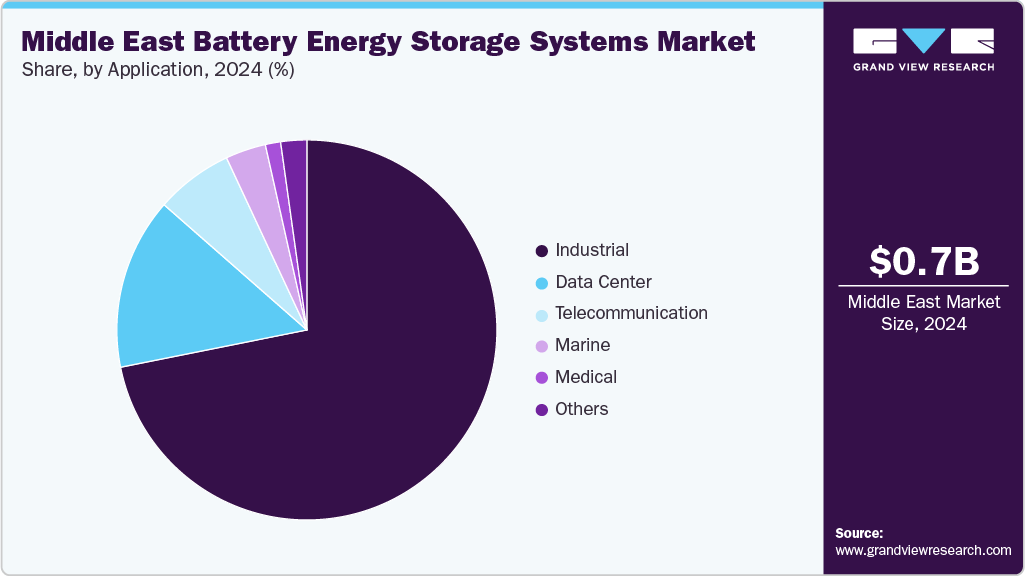
The sector’s growth is also closely tied to the rise of green hydrogen projects, which depend on consistent renewable generation and short-term storage to balance electrolyzer operations. BESS solutions are increasingly being deployed to support mining activities, aluminium smelters, and water desalination plants. Historically reliant on fossil fuels, industries are now transitioning to sustainable alternatives under national energy transition strategies. Moreover, tightening ESG regulations, global carbon emission standards, and cost-reduction pressures drive industries to adopt storage-backed renewable energy systems. With long-term industrial PPAs, government incentives, and advanced hybrid storage solutions, the industrial application segment will remain the cornerstone of BESS adoption in the Middle East over the next decade.
Country Insights
UAE Battery Energy Storage Systems Market Trends
The UAE held the largest revenue share of 34.85% in the Middle East BESS market in 2024, driven by its leadership in renewable deployment and grid modernization under the UAE Energy Strategy 2050. Large-scale storage integration at solar PV and CSP plants, particularly at the Mohammed bin Rashid Al Maktoum Lithium-ion Battery Park and Abu Dhabi’s Sweihan project, positions the country as a regional storage pioneer. Dubai Electricity and Water Authority (DEWA) and Abu Dhabi Energy Department are also advancing storage pilots to enhance grid flexibility, peak demand management, and renewable dispatchability. Moreover, the UAE’s growing green hydrogen ambitions are strengthening the role of batteries as balancing systems for electrolyzer operations, making it a regional hub for storage innovation and investment.
Saudi Arabia Battery Energy Storage Systems Market Trends
Saudi Arabia battery energy storage systems market is rapidly scaling in alignment with Vision 2030 and the integration of gigawatt-scale solar and wind projects across the Kingdom. Storage systems are being deployed to support flagship initiatives such as NEOM and large hydrogen production facilities, ensuring energy reliability and grid stability. The Renewable Energy Project Development Office (REPDO) continues to drive structured auctions, which increasingly integrate storage into renewable tenders. With sovereign-backed funding, strong solar irradiance, and an expanding wind pipeline, Saudi Arabia is positioning BESS as a cornerstone of its clean energy diversification strategy.
Israel Battery Energy Storage Systems Market Trends
Israel battery energy storage systems market is advancing through aggressive renewable energy integration targets and grid resilience needs. With limited land availability, Israel prioritizes distributed solar-plus-storage solutions, supporting urban centers and commercial facilities. The government has launched competitive tenders specifically for storage capacity, encouraging rapid deployment of lithium-ion systems. Israel’s innovation-driven energy ecosystem also fosters R&D collaborations on long-duration storage and advanced energy management systems, enhancing market competitiveness and resilience.
Oman Battery Energy Storage Systems Market Trends
Oman battery energy storage systems market is emerging as a promising, with deployment closely tied to its ambitious Oman Vision 2040 and green hydrogen strategy. Battery storage is being integrated with solar and wind projects in the Dhofar and Al Wusta regions to balance the grid and reliability in remote areas. The government-backed Hydrogen Oman (Hydrom) initiative further accelerates hybrid storage projects to support large-scale hydrogen production. While grid infrastructure and policy execution challenges remain, ongoing regulatory reforms and international partnerships are expected to strengthen Oman’s storage sector over the forecast period.
Qatar Battery Energy Storage Systems Market Trends
Qatar’s battery energy storage systems market is gradually expanding in line with its clean energy ambitions under Qatar National Vision 2030. The country prioritizes storage integration with solar power plants such as the Al Kharsaah project to manage peak demand and improve grid stability. In addition, the government is exploring storage-backed hydrogen and carbon-neutral projects to diversify its energy mix beyond natural gas. While fossil fuels continue to dominate, growing regulatory clarity and sustainability goals are expected to create new opportunities for BESS deployment, particularly in industrial and commercial applications.
Key Battery Energy Storage Systems Company Insights
Some key players operating in the Middle East battery energy storage systems (BESS) market include CATL, BYD, Sungrow, ACWA Power, Tesla, Masdar, EDF Renewables, Huawei Digital Power, Dalia Energy, and Phinergy, among others. These companies are actively engaged in deploying large-scale lithium-ion storage systems, hybrid renewable-plus-storage projects, and advanced grid stabilization solutions across countries such as Saudi Arabia, the UAE, Israel, Oman, and Qatar.
Key Middle East Battery Energy Storage Systems Companies:
- CATL
- BYD
- Sungrow
- ACWA Power
- Tesla
- Masdar
- EDF Renewables
- Huawei Digital Power
- Dalia Energy
- Phinergy
Recent Developments
-
In March 2025, Sungrow secured a contract to supply 7.8 GWh of battery energy storage systems (BESS) to Saudi Electricity Company (SEC) and Al Gihaz Holding, marking one of the largest storage deals in the Middle East to date. The systems will be integrated with large-scale solar and wind projects to enhance grid stability and renewable energy dispatchability.
Middle East Battery Energy Storage Systems Report Scope
Report Attribute
Details
Market size value in 2025
USD 0.87 billion
Revenue forecast in 2033
USD 2.60 billion
Growth rate
CAGR of 14.7% from 2025 to 2033
Base year for estimation
2024
Historical data
2021 - 2023
Forecast period
2025 - 2033
Quantitative Units
Revenue in USD million/billion, and CAGR from 2025 to 2033
Report coverage
Revenue forecast, competitive landscape, growth factors, and trends
Segments covered
Type, application, country
Country scope
UAE; Saudi Arabia; Israel; Oman; Qatar
Key companies profiled
CATL; BYD; Sungrow; ACWA Power; Tesla; Masdar; EDF Renewables; Huawei Digital Power; Dalia Energy; Phinergy
Customization scope
Free report customization (equivalent up to 8 analysts working days) with purchase. Addition or alteration to country, regional & segment scope.
Pricing and purchase options
Avail customized purchase options to meet your exact research needs. Explore purchase options
Middle East Battery Energy Storage Systems Market Report Segmentation
This report forecasts revenue growth at country levels and provides an analysis of the latest industry trends in each of the sub-segments from 2021 to 2033. For this study, Grand View Research has segmented the Middle East battery energy storage systems market report based on the type, application, and country:
-
Type Outlook (Revenue, USD Million, 2021 - 2033)
-
Flywheel battery
-
Lead acid battery
-
Lithium-ion Battery
-
Others
-
-
Application Outlook (Revenue, USD Million, 2021 - 2033)
-
Industrial
-
Telecommunication
-
Data Center
-
Medical
-
Marine
-
Others
-
-
Country Outlook (Revenue, USD Million, 2021 - 2033)
-
Middle East
-
UAE
-
Saudi Arabia
-
Israel
-
Oman
-
Qatar
-
-
Frequently Asked Questions About This Report
b. The Middle East Battery Energy Storage Systems market size was estimated at USD 0.66 billion in 2024 and is expected to reach USD 0.87 billion in 2025.
b. The Middle East Battery Energy Storage Systems market is expected to grow at a compound annual growth rate of 14.7% from 2025 to 2033 to reach USD 2.60 billion by 2033.
b. Based on the application segment, Industrial held the largest revenue share of 71.85% in the Middle East battery energy storage systems (BESS) market in 2024, driven by the rising demand for reliable and flexible power solutions across energy-intensive sectors.
b. Some of the key vendors operating in the Middle East battery energy storage systems (BESS) market include CATL, BYD, Sungrow, ACWA Power, Tesla, Masdar, EDF Renewables, Huawei Digital Power, Dalia Energy, and Phinergy, among others.
b. The key factors driving the Middle East battery energy storage systems (BESS) market include the rising integration of renewable energy, ambitious government decarbonization strategies, and the need for reliable grid stability.


Share this report with your colleague or friend.
Need a Tailored Report?
Customize this report to your needs — add regions, segments, or data points, with 20% free customization.


ISO 9001:2015 & 27001:2022 Certified
We are GDPR and CCPA compliant! Your transaction & personal information is safe and secure. For more details, please read our privacy policy.
Trusted market insights - try a free sample
See how our reports are structured and why industry leaders rely on Grand View Research. Get a free sample or ask us to tailor this report to your needs.













