
- Home
- »
- Biotechnology
- »
-
Middle East Cell Line Development Market Size Report, 2033GVR Report cover
![Middle East Cell Line Development Market Size, Share & Trends Report]()
Middle East Cell Line Development Market (2025 - 2033) Size, Share & Trends Analysis Report By Product & Services (Reagents And Media, Equipment, Accessories and consumables, Services), By Source, By Type of Cell Line, By Source, By Application, By Country, And Segment Forecasts
Middle East Cell Line Development Market Summary
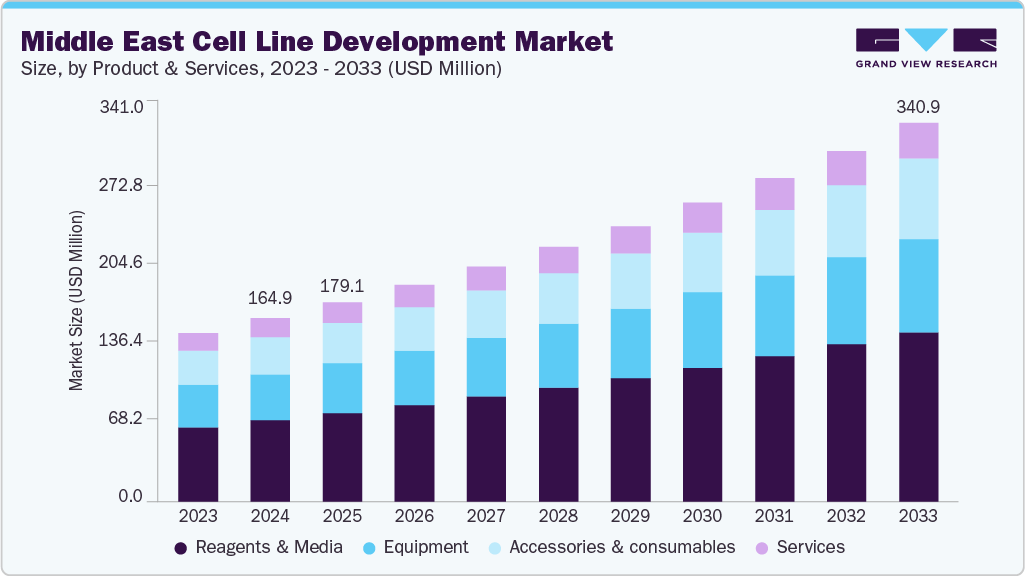
The Middle East cell line development market size was valued at USD 164.9 million in 2024 and is projected to grow to USD 340.9 million by 2033, registering a CAGR of 8.38% between 2025 and 2033. The growth is driven by increasing investments in biopharmaceutical research, expanding contract development and manufacturing services, and rising demand for novel therapeutics and personalized medicine in the region.
Advancements in Bioprocessing Technologies
Rapid advances in bioprocessing technologies are driving the Middle East cell line development market. Automated cell culture, high-throughput screening, and 3D cell culture techniques are increasingly used by research institutions, biotech firms, and pharmaceutical companies, enabling faster, more consistent, and reproducible cell line development. This accelerates the creation of monoclonal antibodies, recombinant proteins, and other biologics to meet growing demand for innovative therapeutics.
A variety of cutting-edge technologies that expedite research, boost productivity, and improve product quality are increasingly influencing the Middle East cell line development market. The development of cell lines is being revolutionized by these important technologies, which allow for quicker optimization, increased reproducibility, and more physiologically relevant outcomes. The main technological forces behind this market's innovation and expansion are listed below.

Integration of these technologies improves operational efficiency and scalability. Together, these advantages are prompting Middle East biotech and pharma companies to adopt advanced bioprocessing methods, boosting the strategic importance of cell line development in the region.
Increasing Clinical Trials and Drug Development
The Middle East is emerging as a hub for clinical trials and drug development, supported by favorable regulations, rising healthcare investments, and advanced research infrastructure. Countries like the UAE, Saudi Arabia, and Qatar are simplifying trial approvals, offering incentives, and investing in laboratories and biobanks, attracting regional and international players, and increasing demand for high-quality cell lines.
Early drug discovery, including compound screening, efficacy testing, and toxicity studies, depends on cell lines. Strong, repeatable cell lines that faithfully replicate human biology are becoming more and more necessary as the number of clinical trials increases. This will speed up research and development processes and enhance the quality of preclinical data. This increase in drug development largely drives the Middle East cell line development market.
Market Concentration & Characteristics
The Middle East cell line development industry is experiencing strong innovation driven by the adoption of automated cell culture systems, high-throughput screening, 3D cell culture models, and CRISPR-based gene editing. Research institutions and biotech companies are using these advanced technologies to produce stable, high-yield, and customized cell lines for biologics, vaccines, and regenerative medicine.
M&A activity in the Middle East cell line development industry remains modest, with most consolidation happening globally rather than within the region. Acquisitions by major players like Thermo Fisher, Danaher, Sartorius, Lonza, and Merck strengthen their global bioprocessing portfolios and indirectly benefit the Middle East through expanded product availability. Direct regional acquisitions are still limited due to the early stage of the biotech ecosystem but rising investments in biomanufacturing and advanced therapies especially in Saudi Arabia, the UAE, and Qatar, are expected to drive more targeted M&A activity in the coming years.
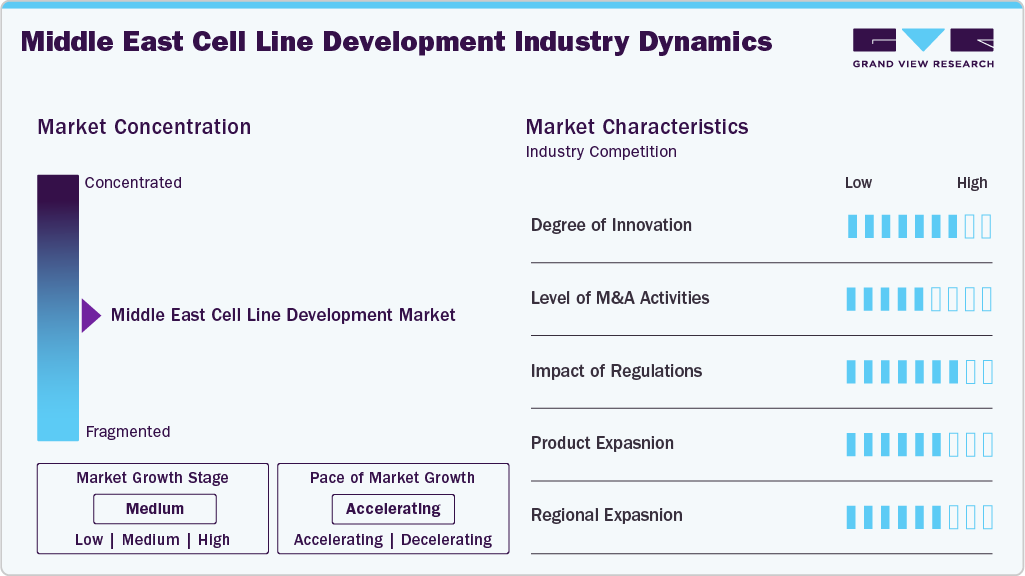
Regulations are positively shaping the Middle East cell line development market as governments streamline approval pathways, enhance biosafety and GMP standards, and introduce incentives to promote biologics and advanced therapy manufacturing.
Product expansion is accelerating in the Middle East cell line development market as global life sciences companies introduce advanced cell culture media, single-use bioreactors, screening tools, and gene-editing platforms to support growing regional demand. The wider availability of specialized and scalable cell line development solutions is enabling faster biologics and vaccine development, and suppliers are increasingly tailoring their offerings to the needs of research and biomanufacturing hubs in Saudi Arabia, the UAE, and Qatar.
Regional expansion is gaining momentum in the Middle East cell line development market as global life sciences and bioprocessing companies strengthen their presence through new distribution networks, technical support centers, and strategic partnerships with research institutes and biomanufacturers.
Product & Services Insights
The reagents and media segment held the largest market share of 44.12% in 2024 due to their crucial role at every stage of cell line development and their frequent replacement needs. Demand was further increased by the growing use of specialized and high-performance media in automated and high-throughput workflows, making this market segment the largest source of revenue.
The services segment is expected to witness the fastest CAGR throughout the forecast period, driven by increasing outsourcing of cell line development activities to specialized providers for more rapid, cost-efficient, and high-quality results. Growing reliance on contract research and development organizations, especially for complex processes such as gene editing, cell line optimization, and regulatory-compliant documentation, is prompting biopharmaceutical companies and research institutions to adopt service-based models rather than expanding in-house capabilities.
Source Insights
The mammalian cell line segment accounted for the largest market share and is expected to grow with the fastest CAGR over the forecast period due to its strong suitability for producing complex therapeutic proteins and monoclonal antibodies, along with increasing biopharmaceutical R&D and biologics manufacturing in the Middle East.
The non-mammalian cell line segment is expected to grow at a significant rate over the forecast period, supported by rising interest in cost-effective and scalable platforms for recombinant protein and vaccine production. Their advantages, such as faster growth rates, lower cultivation costs, and reduced risk of human pathogen contamination, are driving adoption across academic research, industrial bioprocessing, and emerging applications in synthetic biology.
Type of Cell Line Insights
The recombinant cell lines segment held the largest market share of 32.10% in 2024 due to their extensive use in the production of monoclonal antibodies, vaccines, and therapeutic proteins, as well as their high scalability, stability, and suitability for GMP-compliant biomanufacturing.
The hybridomas segment is expected to witness the fastest CAGR throughout the forecast period, driven by increasing demand for monoclonal antibodies, advancements in hybridoma technology, and their critical role in preclinical research and therapeutic development. Growing adoption in diagnostics, immunotherapy, and personalized medicine further supports the rapid growth of this segment in the Middle East cell line development market.
Application Insights
The bioproduction segment held the largest market share of 46.23% in 2024. Growing investments in biopharmaceutical manufacturing facilities and the adoption of advanced production technologies in the Middle East have further strengthened the dominance of this segment in the market.
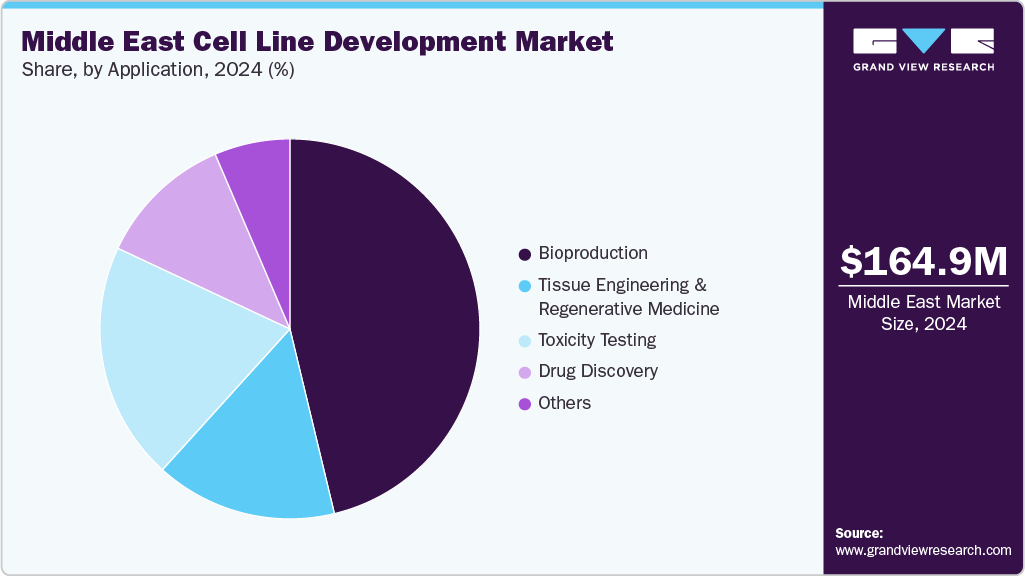
The tissue engineering & regenerative medicine segment is expected to witness the fastest CAGR from 2025 to 2033, driven by rising demand for advanced therapies, increasing investment in regenerative medicine research, and the growing adoption of engineered tissues and stem cell-based treatments in the Middle East. Expanding applications in wound healing, organ repair, and personalized medicine are further fueling the growth of this segment.
Country Insights
The Saudi Arabia cell line development market is experiencing strong growth, driven by investments in biopharmaceutical R&D, advanced research infrastructure, and Vision 2030 initiatives promoting life sciences innovation. Adoption of technologies such as automated cell culture, high-throughput screening, and 3D cell culture, along with collaborations with global biotech firms, is fueling demand. For instance, in November 2025, Saudi Arabia launched a USD 50 million fund via IB Ventures to support biotech companies, further boosting the need for cell line development services in the region.
Kuwait Cell Line Development Market Trends
The market for cell line development in Kuwait is expanding steadily due to rising investments in healthcare facilities and a greater emphasis on biotechnology research. Research capabilities and efficiency are being improved by the increasing use of sophisticated cell culture technologies, such as automated systems and 3D culture models. The nation's need for specialized cell line development services is also being fueled by partnerships with local and foreign biotech companies as well as programs to support regenerative medicine and biopharmaceutical manufacturing.
Key Middle East Cell Line Development Company Insights
A number of well-established companies dominate the Middle East cell line development market due to their robust product lines, clever partnerships, and ongoing R&D expenditures. Prominent corporations like Thermo Fisher Scientific Inc., Danaher, Sartorius AG, Merck KGaA, Corning Inc., and Lonza have maintained a substantial portion of the market because of their sophisticated cell culture technologies, reliable bioprocessing platforms, and wide-ranging distribution networks throughout the region.
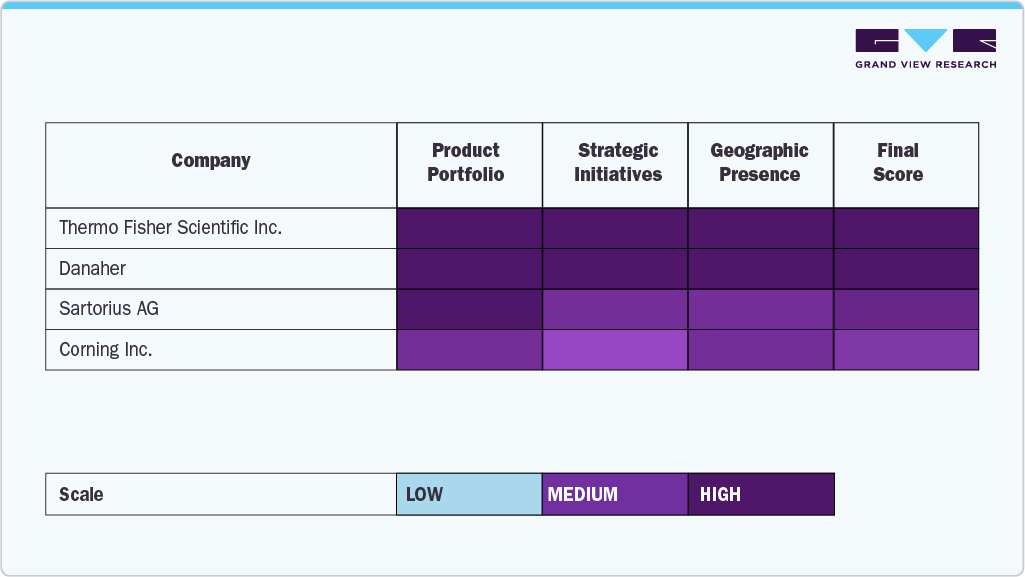
Companies like Creative BioLabs, Advanced Instruments, and Berkeley Lights are expanding their presence by offering innovative solutions and customized cell line development services tailored to the growing needs of research institutions, biopharmaceutical manufacturers, and contract research organizations in the Middle East.
The leading organizations have solidified their leadership by addressing the increasing demand for high-quality, reproducible cell lines used in biologics production, gene therapies, vaccine development, and regenerative medicine.
Key Middle East Cell Line Development Companies:
- Thermo Fisher Scientific Inc.
- Danaher
- Sartorius AG
- Merck KGaA
- Corning Inc.
- Lonza
- Creative BioLabs.
- WuXi PharmaTech
- Advanced Instruments
- Berkeley Lights
Recent Developments
-
In August 2025, Saudi Arabia saw the launch of MS Pharma’s biologics manufacturing hub, the MENA region’s first GMP-approved facility, enhancing local production and boosting demand for cell line development services.
-
In October 2025, WuXi AppTec signed strategic MoUs with NEOM and Saudi Arabia’s Ministry of Health to localize pharmaceutical R&D and manufacturing, enhancing regional biotech capabilities and boosting demand for cell line development in the Middle East.
-
In May 2024, Biocartis expanded its collaboration with Merck KGaA across the Middle East and North Africa to improve access to RAS biomarker testing, support personalized medicine and boosting regional cell line development demand.
Middle East Cell Line Development Market Report Scope
Report Attribute
Details
Market size value in 2025
USD 179.1 million
Revenue forecast in 2033
USD 340.9 million
Growth rate
CAGR of 8.38% from 2025 to 2033
Base year for estimation
2024
Historical data
2021 - 2023
Forecast period
2025 - 2033
Quantitative units
Revenue in USD million and CAGR from 2025 to 2033
Report coverage
Revenue forecast, company ranking, competitive landscape, growth factors, and trends
Segments covered
Product & services, source, type of cell lines, application, country
Country scope
Middle East
Country scope
Saudi Arabia; UAE; Kuwait; Qatar; Oman; Rest of Middle East
Key companies profiled
Thermo Fisher Scientific Inc.; Corning Inc.; Lonza; Creative BioLabs.; WuXi PharmaTech; Sartorius AG; Merck KGaA; Advanced Instruments; Berkeley Lights; Danaher
Customization scope
Free report customization (equivalent up to 8 analyst’s working days) with purchase. Addition or alteration to country, regional & segment scope.
Middle East Cell Line Development Market Report Segmentation
This report forecasts revenue growth and provides an analysis on the latest trends in each of the sub-segments from 2021 to 2033. For the purpose of this report, Grand View Research has segmented the Middle East cell line development market on the basis of product & services, source, type of cell lines, application, and country:
-
Product & Service Outlook (Revenue, USD Million, 2021 - 2033)
-
Reagents and media
-
Equipment
-
Automated Systems
-
Centrifuges
-
Bioreactors
-
Storage equipment
-
Others
-
-
Accessories and consumables
-
Services
-
-
Source Outlook (Revenue, USD Million, 2021 - 2033)
-
Mammalian cell line
-
Non-mammalian cell line
-
Insects
-
Amphibians
-
-
-
Type of Cell Lines Outlook (Revenue, USD Million, 2021 - 2033)
-
Recombinant cell lines
-
Hybridomas
-
Continuous cell lines
-
Primary cell lines
-
-
Application Outlook (Revenue, USD Million, 2021 - 2033)
-
Bioproduction
-
Drug discovery
-
Toxicity testing
-
Tissue engineering & Regenerative Medicine
-
Others
-
-
Country Outlook (Revenue, USD Million, 2021 - 2033)
-
Middle East
-
Saudi Arabia
-
UAE
-
Kuwait
-
Oman
-
Qatar
-
Rest of Middle East
-
-
Frequently Asked Questions About This Report
Some key players operating in the Middle East cell line development market include Thermo Fisher Scientific Inc., Corning Inc., Lonza, Creative BioLabs., WuXi PharmaTech, Sartorius AG, Merck KGaA, Advanced Instruments, Berkeley Lights, and Danaher among others.
The Middle East cell line development market is witnessing growth driven by rising investments in biopharmaceutical manufacturing, national initiatives to build local biologics capacity, and strong government-led funding for life science innovation.
The Middle East cell line development market size was estimated at USD 164.9 million in 2024 and is expected to reach USD 179.1 million in 2025.
The Middle East cell line development market is projected to grow at a compound annual growth rate (CAGR) of 8.38% from 2025 to 2033, reaching USD 340.9 million by 2033.
Saudi Arabia held the largest share, 24.04%, of the overall revenue in 2024, supported by substantial government investments in biopharmaceutical manufacturing, accelerated localization of biologics production, and the expansion of advanced research and innovation hubs under national healthcare transformation programs.
About the Author(s)
Biotechnology Research Team
Healthcare · BiotechnologyThis report was authored by the biotechnology research team at Grand View Research - comprising two research analysts, one senior research analyst, and one industry expert - with specialized expertise in the biotechnology segment of the healthcare industry. All findings are based on proprietary healthcare databases, executive interviews, and regulatory analysis, subject to internal peer review prior to publication.
Last Updated:
Speak to Analyst


Customize this report to your needs — add regions, segments, or data points, with 20% free customization.
Or view our licence options:


ISO 9001:2015 & 27001:2022 Certified
We are GDPR and CCPA compliant! Your transaction & personal information is safe and secure. For more details, please read our privacy policy.


