Middle East Commercial Vehicles Market Summary
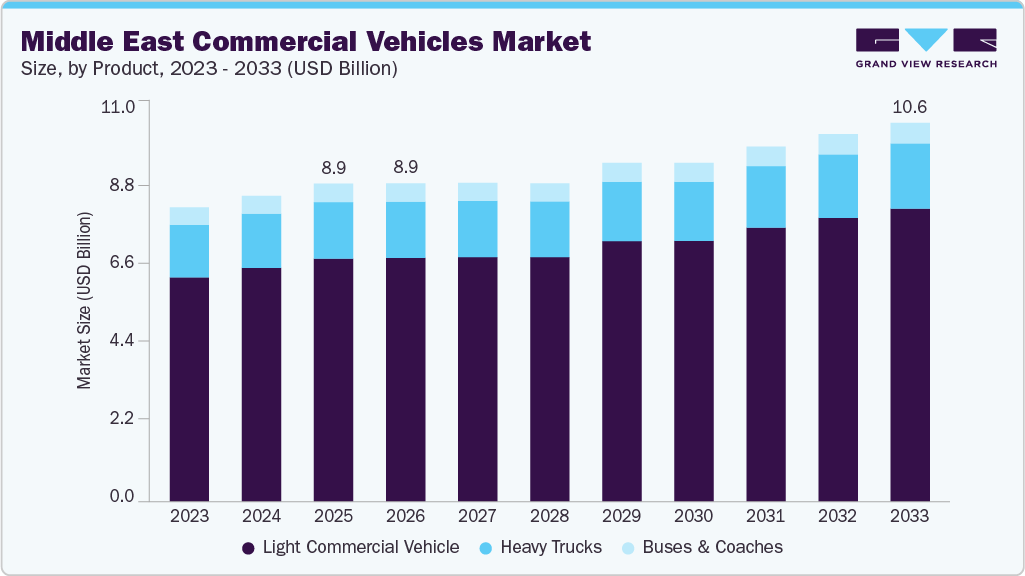
The Middle East commercial vehicles market size was estimated at USD 8,865.0 million in 2025 and is projected to reach USD 10,562.3 million by 2033, growing at a CAGR of 2.5% from 2026 to 2033. Large-scale infrastructure and construction projects are driving the growth of commercial vehicles in the Middle East.
Key Market Trends & Insights
- Saudi Arabia commercial vehicles market accounted for a 38.6% share of the market in 2025.
- By product, the light commercial vehicles (LCVs) segment accounted for the largest share of 76.5% in 2025.
- By end-use, the logistics segment held the largest market share in 2025.
Market Size & Forecast
- 2025 Market Size: USD 8,865.0 Million
- 2033 Projected Market Size: USD 10,562.3 Million
- CAGR (2026-2033): 2.5%
- Saudi Arabia: Largest market in 2025
- Oman: Fastest growing market
Countries such as Saudi Arabia, the UAE, and Qatar are investing heavily in mega infrastructure developments, including smart cities, highways, airports, ports, and tourism projects. Initiatives such as Saudi Vision 2030 have accelerated construction activities and industrial development, creating strong demand for heavy-duty trucks, construction vehicles, and specialized transport fleets. The continuous movement of construction materials, equipment, and workforce significantly increases the need for reliable commercial transportation solutions.
Expansion of logistics, trade, and supply chain networks is also supporting market growth. The Middle East has positioned itself as a global trade and logistics hub connecting Asia, Europe, and Africa. Major ports and logistics centers in cities such as Dubai and Abu Dhabi require large fleets of trucks and delivery vehicles to manage cargo movement. In addition, the rise of e-commerce and cross-border trade further increases the demand for light and medium commercial vehicles used in last-mile delivery and regional freight transport.
Economic diversification strategies across Gulf economies are also fueling increased adoption of commercial vehicles. Governments are actively reducing their dependence on oil revenues by promoting sectors such as tourism, manufacturing, retail, and logistics. These expanding industries require efficient transportation networks for goods distribution and workforce mobility. As industrial zones, free trade areas, and logistics corridors expand, businesses invest in commercial fleets to support operational efficiency and supply chain reliability.
Volatility in oil prices and the region's economic reliance on hydrocarbons restrain the growth of the commercial vehicles market in the Middle East. Many economies in the region, particularly Saudi Arabia, Kuwait, and Oman, remain heavily dependent on oil revenues. Fluctuations in global oil prices directly affect government spending on infrastructure projects and industrial development. When oil prices decline, public investments and construction activities may slow, reducing demand for trucks and other commercial vehicles used in the logistics and construction sectors.
Product Insights
The light commercial vehicles (LCVs) segment accounted for the largest share of 76.5% in 2025. The growth of light commercial vehicles in the Middle East is driven by the rapid expansion of e-commerce and last-mile delivery services. Online retail activity has increased significantly across major markets such as the UAE and Saudi Arabia, creating strong demand for small delivery vans and light-duty trucks used for urban distribution. Retailers, logistics providers, and courier companies rely heavily on LCVs because they offer flexibility, lower operating costs, and easier maneuverability in urban areas. The increasing need for fast delivery services and same-day shipping has further accelerated the adoption of LCV fleets across cities and metropolitan regions.
The heavy trucks segment is expected to grow at a significant CAGR during the forecast period. The expansion of regional logistics and freight transportation networks is driving the growth of the segment. The Middle East serves as a strategic trade corridor connecting Asia, Europe, and Africa, which increases freight movement through ports, logistics parks, and cross-border transport routes. Major logistics hubs in cities such as Dubai and Abu Dhabi require large fleets of heavy trucks to transport cargo between ports, warehouses, and inland distribution centers. As regional trade volumes increase and governments continue to invest in logistics infrastructure, the demand for heavy trucks used in long-distance freight transportation is expected to grow steadily across the Middle East.
End-use Insights
The logistics segment held the largest market share of 27.9% in 2025. The development of logistics corridors, industrial zones, and free trade areas is fueling the adoption of commercial vehicles in the logistics sector. Governments across the Middle East are investing in integrated logistics infrastructure to strengthen regional supply chains and improve trade efficiency. For instance, Saudi Arabia’s economic transformation initiatives under Saudi Vision 2030 emphasize the development of industrial clusters, logistics parks, and transport corridors. These developments increase freight movement between manufacturing facilities, warehouses, and export terminals, thereby increasing the need for heavy-duty trucks and distribution vehicles.
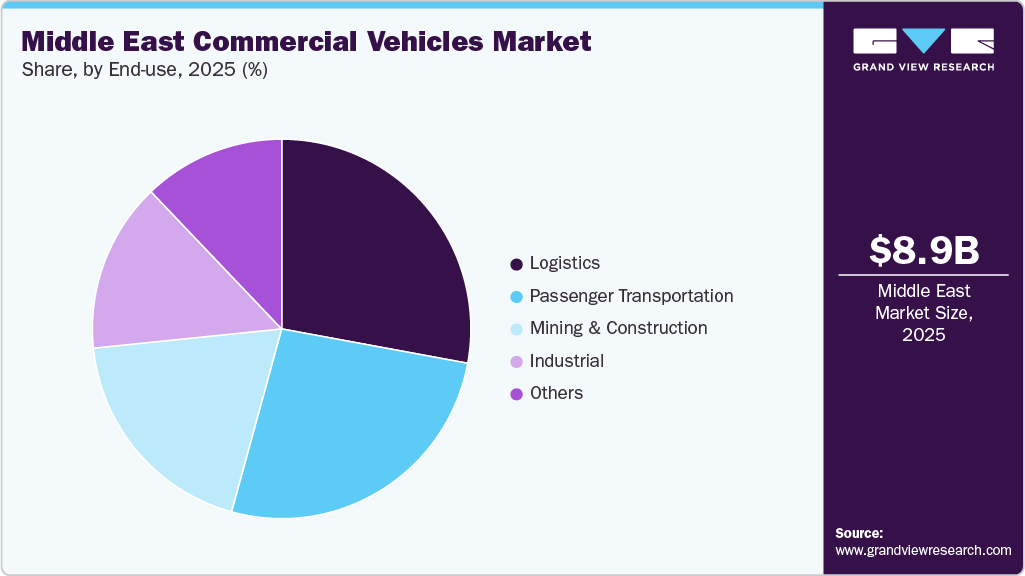
The passenger transportation segment is expected to grow at a significant CAGR during the forecast period. The expansion of employee transportation services is supporting market growth. Many large industries in the Middle East, including construction, oil and gas, manufacturing, and infrastructure development, require daily transportation of workers between residential areas and industrial sites. Companies frequently deploy bus fleets and shuttle vehicles to transport employees efficiently and safely. As industrial activity and large-scale projects increase, the demand for workforce vehicles continues to expand.
Country Insights
Saudi Arabia Commercial Vehicles Market Trends
The Saudi Arabia commercial vehicles market held a dominant position in 2025. Economic diversification and industrial expansion are driving the growth of the commercial vehicle market in Saudi Arabia. Government initiatives to strengthen sectors such as manufacturing, mining, retail, and tourism are generating new commercial activities that require efficient transportation networks. As more industrial zones and economic cities are developed, businesses are expanding their logistics capabilities and commercial vehicle fleets to support goods distribution and operational mobility.
UAE Commercial Vehicles Market Trends
The UAE commercial vehicles market was identified as a lucrative region in 2025. Growth in the tourism and hospitality industries is contributing to increased demand for passenger commercial vehicles in the UAE. The country attracts millions of international visitors each year, which increases the need for transportation services such as tour buses, airport shuttles, and hotel transport fleets. The expansion of tourism infrastructure, including hotels, entertainment destinations, and event venues, further drives demand for commercial vehicles used in passenger transportation and service operations.
Key Middle East Commercial Vehicles Company Insights
Some of the key companies in the Middle East commercial vehicles market include Toyota Motor Corporation, Ford Middle East, Daimler Truck AG, AB Volvo, and others. Organizations are focusing on increasing their customer base to gain a competitive edge in the industry. Therefore, key players are taking several strategic initiatives, such as mergers and acquisitions, and partnerships with other major companies.
-
Toyota Motor Corporation is an automotive manufacturer and a supplier of commercial vehicles across global markets, including the Middle East. In the commercial vehicle segment, the company offers a diverse portfolio of light and medium-duty vehicles designed for logistics, passenger transport, and industrial applications. Popular commercial models such as the Toyota Hilux, Toyota HiAce, and Toyota Coaster are widely used for goods transportation, fleet operations, and passenger mobility across industries.
-
Ford Motor Company operates across the Middle East through its regional division, Ford Middle East, which plays an important role in supplying commercial vehicles for logistics, construction, and passenger transport applications. The company offers a range of light and medium commercial vehicles designed to meet the operational needs of fleet operators, small businesses, and government agencies across the region. Key models such as the Ford Transit and Ford Ranger are widely used for cargo transportation, service operations, and last-mile delivery due to their durability, payload capacity, and fuel efficiency.
Key Middle East Commercial Vehicles Companies:
- Toyota Motor Corporation
- Ford Middle East
- Daimler Truck AG
- AB Volvo
- Scania
- MAN
- ISUZU MOTORS INTERNATIONAL
- Tata Motors
- ASHOK LEYLAND
- Hyundai Motor Company
Recent Developments
-
In March 2025, Al-Futtaim Industrial Equipment partnered with BYD Commercial Vehicles to launch four electric commercial vehicles in the UAE at a Dubai event, marking a major step in green mobility for urban logistics, freight, and public transport. The lineup includes the T4 light truck, T6 mid-sized truck, K6 electric bus, and K8 electric bus, all featuring BYD's Blade Battery technology for safety, rapid charging, zero emissions, and cost savings over diesel fleets. This collaboration aligns with UAE's sustainability goals, building on Al-Futtaim's prior passenger vehicle partnerships with BYD since 2023, and positions the group as a key enabler for businesses reducing carbon footprints while boosting efficiency.
-
In October 2025, Tata Motors launched its new range of Euro 6-compliant trucks and buses tailored for the GCC and MENA regions at a major Dubai event on October 29, 2025, marking one of the company's largest showcases in the Middle East to capitalize on rising transport and infrastructure demands. The lineup includes passenger buses such as the LPO 1622 (11m and 12m models for school/staff transport), Starbus Prime LP 716 (28 seats, 3.3L engine for city use), and Ultra LPO 916 (33 seats for extended routes), all designed for GCC's harsh weather and long hauls.
Middle East Commercial Vehicles Market Report Scope
|
Report Attribute
|
Details
|
|
Market size value in 2026
|
USD 8,872.1 million
|
|
Revenue forecast in 2033
|
USD 10,562.3 million
|
|
Growth rate
|
CAGR of 2.5% from 2026 to 2033
|
|
Base year for estimation
|
2025
|
|
Historical data
|
2021 - 2024
|
|
Forecast period
|
2026 - 2033
|
|
Quantitative units
|
Revenue in USD million/billion, and CAGR from 2026 to 2033
|
|
Report industry
|
Revenue forecast, company ranking, competitive landscape, growth factors, and trends
|
|
Segments covered
|
Product, end-use, region
|
|
Country scope
|
Saudi Arabia; UAE; Kuwait; Oman
|
|
Key companies profiled
|
Toyota Motor Corporation; Ford Middle East; Daimler Truck AG; AB Volvo; Scania; MAN; ISUZU MOTORS INTERNATIONAL; Tata Motors; ASHOK LEYLAND; Hyundai Motor Company
|
|
Customization scope
|
Free report customization (equivalent up to 8 analysts working days) with purchase. Addition or alteration to country, regional & segment scope.
|
|
Pricing and purchase options
|
Avail customized purchase options to meet your exact research needs. Explore purchase options
|
Middle East Commercial Vehicles Market Report Segmentation
This report forecasts revenue growth at regional, and country levels and provides an analysis of the latest industry trends in each of the sub-segments from 2021 to 2033. For this study, Grand View Research has segmented the Middle East commercial vehicles market report based on product, end-use, and region.
-
Product Outlook (Revenue, USD Million, 2021 - 2033)
-
End-use Outlook (Revenue, USD Million, 2021 - 2033)
-
Industrial
-
Mining & Construction
-
Logistics
-
Passenger Transportation
-
Others
-
Regional Outlook (Revenue, USD Million, 2021 - 2033)
-
Middle East
-
Saudi Arabia
-
UAE
-
Kuwait
-
Oman
Frequently Asked Questions About This Report
b. The Middle East commercial vehicles market size was estimated at USD 8,865.0 million in 2025 and is expected to reach USD 8,872.1 million in 2026.
b. The light commercial vehicles (LCVs) segment dominated the market in 2025 and accounted for the largest share of 76.5%. The growth of light commercial vehicles in the Middle East is driven by the rapid expansion of e-commerce and last-mile delivery services.
b. Some key players operating in the Middle East commercial vehicles market include Toyota Motor Corporation; Ford Middle East; Daimler Truck AG; AB Volvo; Scania; MAN; ISUZU MOTORS INTERNATIONAL; Tata Motors; ASHOK LEYLAND; Hyundai Motor Company
b. Large-scale infrastructure and construction projects are driving the growth of commercial vehicles in the Middle East.
b. The Middle East commercial vehicles market is expected to grow at a compound annual growth rate of 2.5% from 2026 to 2033 to reach USD 10,562.3 million by 2033.

 Download Sample Report
















