
- Home
- »
- Distribution & Utilities
- »
-
Middle East Distributed Energy Generation Market, 2033GVR Report cover
![Middle East Distributed Energy Generation Market Size, Share & Trends Report]()
Middle East Distributed Energy Generation Market (2025 - 2033) Size, Share & Trends Analysis Report By Technology (Wind Turbine, Fuel Cells), By Application (Residential, Commercial & Industrial), By Country, And Segment Forecasts
- Report ID: GVR-4-68040-739-5
- Number of Report Pages: 110
- Format: PDF
- Historical Range: 2021 - 2023
- Forecast Period: 2025 - 2033
- Industry: Energy & Power
- Report Summary
- Table of Contents
- Segmentation
- Methodology
- Download FREE Sample
-
 Download Sample Report
Middle East Distributed Energy Generation Market Summary
The Middle East distributed energy generation market size was estimated at USD 44.00 billion in 2024 and is projected to reach USD 99.71 billion by 2033, growing at a CAGR of 8.4% from 2025 to 2033. Deployment in the region spans solar PV, wind, biomass, small gas turbines, and hybrid microgrids, supporting applications across residential, commercial, and industrial sectors.
Key Market Trends & Insights
- Saudi Arabia distributed energy generation market held the largest share of 43.77% of the Middle East market in 2024.
- The distributed energy generation market in the Middle East is expected to grow significantly over the forecast period.
- By technology, Solar Photovoltaic held the highest market share of 72.77% in 2024.
- Based on applications, Commercial & Industrial segment held the highest market share in 2024.
Market Size & Forecast
- 2024 Market Size: USD 44.00 Billion
- 2033 Projected Market Size: USD 99.71 Billion
- CAGR (2025-2033): 8.4%
- Saudi Arabia: Largest market in 2024
- UAE: Fastest growing market
National strategies such as Saudi Vision 2030, the UAE’s Energy Strategy 2050, and Qatar’s National Energy Plan are accelerating investments in decentralized energy systems to strengthen grid resilience, reduce dependence on conventional power plants, and integrate higher shares of renewables. Countries across the Gulf Cooperation Council (GCC), Turkey, Iran, and the Levant are increasingly adopting distributed generation projects to meet rising electricity demand in urban centers, remote areas, and industrial zones, while aligning with regional carbon neutrality and energy diversification goals.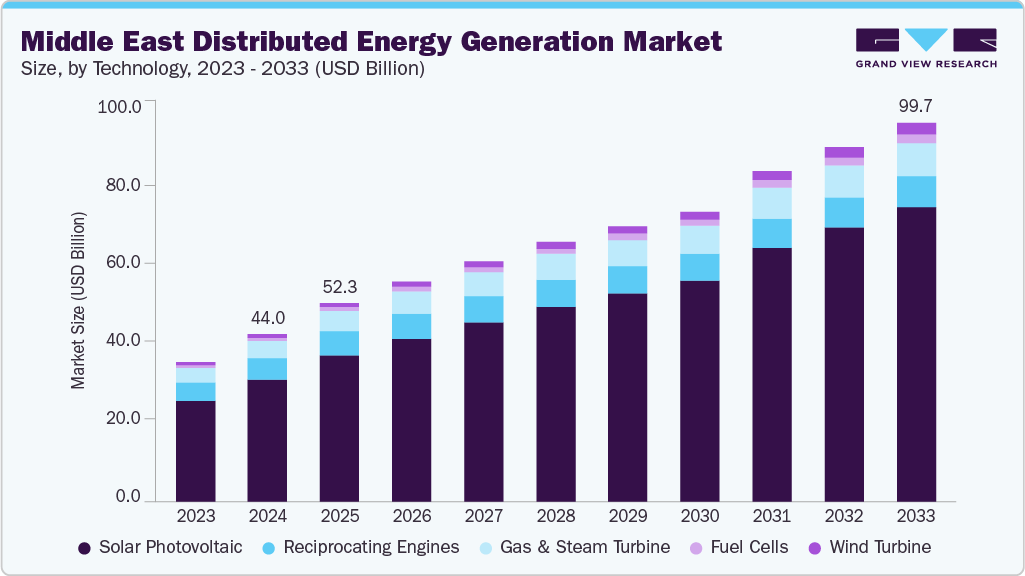
Growth in the market is driven by rapid urbanization, rising electricity consumption, and ambitious renewable energy deployment programs. Advances in solar PV efficiency, battery storage integration, and digital energy management platforms are improving the viability of decentralized systems for households, commercial buildings, and utility-scale hybrid networks. Microgrids and distributed hybrid plants are gaining traction for powering remote oil & gas facilities, islands, and industrial clusters where traditional grid expansion is costly or unfeasible. Regional initiatives, such as cross-border energy collaborations in the GCC, net-metering frameworks, and public-private partnerships with European and Asian technology providers, are expected to enhance distributed generation adoption and reduce reliance on centralized fossil-fuel plants. With leading companies such as ACWA Power, Masdar, Engie, EDF Renewables, and regional utilities spearheading investments in solar rooftops, community grids, and distributed hybrid projects, the Middle East distributed energy generation market is positioned for strong and sustained growth over the coming decade.
Drivers, Opportunities & Restraints
The Middle East distributed energy generation market is driven by rising electricity demand, rapid urbanization, and government-led energy diversification strategies. National frameworks such as Saudi Vision 2030, the UAE Energy Strategy 2050, and Qatar’s National Development Framework emphasize the integration of decentralized solar, wind, and hybrid microgrid systems to reduce dependence on conventional fossil-fuel plants and enhance grid resilience. Distributed generation is further supported by the region’s abundant solar resources, declining technology costs, and the growing need to supply reliable power to remote industrial sites, islands, and off-grid communities. Advances in battery storage, digital grid solutions, and demand-side management are accelerating the adoption of distributed systems across residential, commercial, and industrial segments.
Opportunities in the market lie in expanding rooftop solar programs, community microgrids, and hybrid renewable-plus-storage projects designed to meet local consumption needs while lowering carbon emissions. Cross-border collaborations within the GCC, public-private partnerships, and technology transfer from European and Asian players create avenues for building smart distributed energy hubs. The increasing role of distributed generation in hydrogen production and e-mobility infrastructure presents additional growth potential, aligning with the region’s clean energy transition goals. However, the market faces fragmented regulatory frameworks, grid integration challenges, and high upfront investment costs for advanced storage-backed distributed projects. Dependence on subsidies in certain markets, technical hurdles in managing intermittent renewable generation, and the need for skilled labor to deploy and maintain decentralized systems also pose risks that could affect scalability and private sector participation.
Technology Insights
Solar photovoltaic (PV) segment held the largest revenue share of over 72.77% in 2024. The solar photovoltaic (PV) segment held the largest market share of 72.77% in the Middle East distributed energy generation market in 2024, driven by the region’s abundant solar resources and ambitious national renewable energy targets. Countries such as Saudi Arabia, the UAE, Oman, and Egypt spearhead large-scale solar programs and rooftop initiatives to diversify energy mixes, reduce carbon footprints, and enhance grid resilience. The Middle East’s high solar irradiance levels and rapidly declining module and installation costs position PV as the most commercially viable distributed energy technology. Residential rooftops, commercial buildings, industrial facilities, and hybrid microgrids are increasingly adopting solar PV as a reliable and cost-effective energy source, contributing to its dominance in the regional distributed generation landscape.
Supportive government policies, net-metering frameworks, and investment incentives further boost the deployment of solar PV systems across urban and rural areas. The segment benefits from growing interest in integrating PV with battery storage solutions, enabling a reliable off-grid power supply and enhancing flexibility in grid-connected systems. Technological advancements such as bifacial panels, smart inverters, and digital energy management platforms improve system efficiency and reduce lifecycle costs, making distributed PV more attractive to consumers and utilities alike. However, challenges such as intermittency, grid integration limitations, and high upfront capital costs in certain markets remain barriers to rapid adoption. Despite these hurdles, solar PV continues to form the backbone of the Middle East’s distributed energy generation industry, while emerging distributed technologies such as wind, biomass, and hybrid systems are gaining traction to complement solar and diversify the regional energy mix.
Application Insights
Commercial & Industrial (C&I) held the largest revenue share of over 80.40% in 2024. The commercial & industrial (C&I) segment accounted for the largest revenue share of 80.40% in the Middle East distributed energy generation market in 2024. It is expected to retain its dominance throughout the forecast period. This leadership is driven by the region’s rapidly expanding industrial base, rising electricity demand from oil & gas, manufacturing, construction, retail, and hospitality sectors, and the growing need for reliable and cost-effective power solutions. Distributed generation systems, particularly solar PV combined with storage, are being deployed by industrial plants, business complexes, shopping malls, and hotels to reduce operational costs, enhance energy security, and meet sustainability commitments. Countries such as Saudi Arabia, the UAE, and Oman are witnessing large-scale adoption of distributed PV and hybrid systems by industrial clusters and commercial establishments to offset rising grid tariffs and ensure uninterrupted power supply.
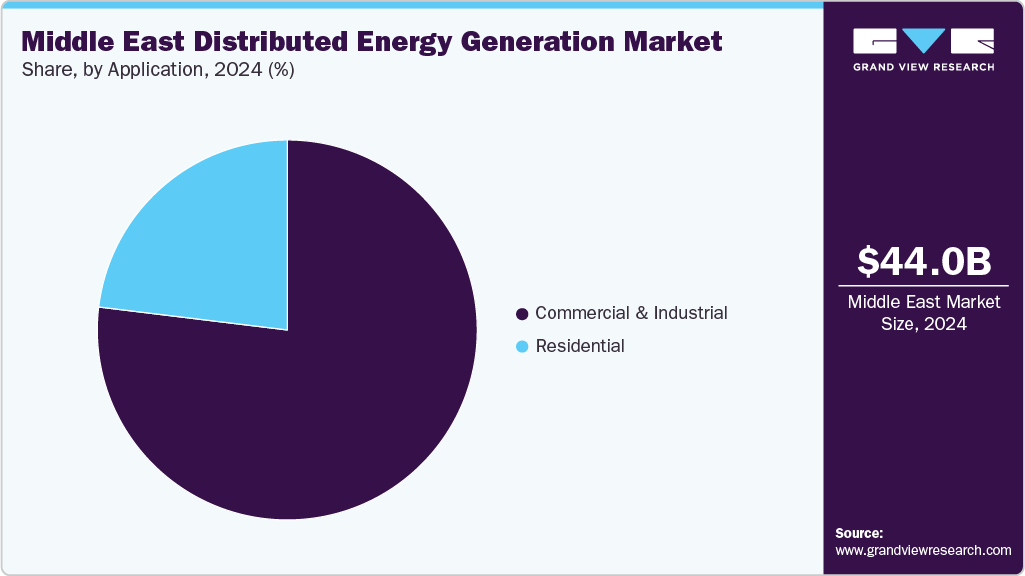
Supportive regulations such as net metering, corporate power purchase agreements (PPAs), and green building codes encourage C&I customers to invest in distributed energy solutions. The segment benefits from integrating rooftop solar with digital energy management platforms, demand response tools, and backup storage systems, allowing businesses to optimize consumption and reduce carbon footprints. Strategic partnerships between utilities, technology providers, and private companies are accelerating project pipelines in industrial zones, business districts, and free trade hubs. However, challenges such as high upfront investment costs, financing barriers for small businesses, and intermittency of renewables pose limitations in certain markets. Despite these hurdles, the C&I sector remains the backbone of distributed energy generation in the Middle East, while residential and government applications are gradually gaining momentum to complement the region’s broader energy transition goals.
Country Insights
Saudi Arabia Distributed Energy Generation Market Trends
Saudi Arabia held over 43.77% revenue share of the Middle East Distributed Energy Generation market. Saudi Arabia accounted for the largest revenue share of the Middle East distributed energy generation market in 2024, holding over 43.77%, driven by its ambitious energy diversification programs under Vision 2030. The Kingdom is rapidly deploying solar PV, hybrid microgrids, and distributed storage systems across industrial hubs, residential communities, and commercial facilities to reduce dependence on oil-based power generation. Large-scale solar rooftop initiatives, coupled with pilot projects in wind and biomass, are accelerating the shift toward decentralized energy. Backed by sovereign wealth funds and leading domestic players, Saudi Arabia is positioning itself as a regional hub for distributed solar PV adoption, supported by strong policy mandates and public-private partnerships.
The government’s focus on energy efficiency, carbon neutrality, and digital grid modernization is further fueling demand for distributed energy systems. Initiatives in industrial cities such as NEOM and the Red Sea Project highlight the integration of renewable-plus-storage microgrids and smart energy management platforms, setting benchmarks for sustainable infrastructure. With international collaborations, strong financial support, and abundant solar resources, Saudi Arabia is expected to maintain its dominant role in the Middle East distributed energy generation market over the forecast period.
UAE Distributed Energy Generation Market Trends
The UAE is emerging as one of the fastest-growing distributed energy generation markets in the Middle East, supported by the UAE Energy Strategy 2050 and sustainability-focused government policies. Large-scale deployment of rooftop solar, net-metering programs in Dubai, and distributed hybrid systems in Abu Dhabi are propelling market growth. Commercial complexes, industrial clusters, and residential projects are actively adopting distributed PV and storage solutions to reduce electricity costs and improve energy security. The presence of global renewable energy leaders such as Masdar and strong private sector participation are reinforcing the UAE’s position as a pioneer in decentralized energy adoption.
Supportive regulations, favorable financing mechanisms, and a strategic location that facilitates regional energy trade further accelerate adoption. The UAE’s distributed energy systems are increasingly being integrated with smart grid technologies and digital energy management platforms, allowing real-time monitoring and optimization. As the country expands its clean hydrogen economy and enhances renewable energy penetration, distributed PV and hybrid generation are expected to form a critical part of its sustainable energy future. With proactive policy backing and international collaborations, the UAE is set to consolidate its leadership in distributed energy generation across the Middle East.
Iran Distributed Energy Generation Market Trends
Iran’s distributed energy generation market is gradually expanding, supported by its abundant solar and wind resources and the government’s efforts to diversify its heavily fossil-fuel-based energy mix. The country has significant potential for rooftop solar adoption, hybrid renewable projects, and small-scale distributed wind systems, particularly in rural and off-grid regions where grid access remains limited. Policy initiatives aimed at reducing reliance on oil-fired generation and improving electricity reliability are encouraging local deployment of solar PV systems. Despite sanctions and financing challenges, Iranian private enterprises and independent power producers (IPPs) are beginning to invest in decentralized solar and wind projects for both residential and commercial applications.
Growing electricity demand from industrial operations, coupled with the need to modernize aging grid infrastructure, is expected to drive the adoption of distributed energy solutions. International collaborations, particularly with Asian technology providers, are introducing advanced inverters, energy storage integration, and smart monitoring systems to improve efficiency. However, barriers such as limited foreign investment, regulatory uncertainty, and economic constraints continue to slow large-scale adoption. Nonetheless, with strong natural resources and rising domestic demand, Iran has the potential to become an important contributor to the Middle East distributed energy generation market in the longer term.
Oman Distributed Energy Generation Market Trends
Oman is emerging as a promising market for distributed energy generation, underpinned by its renewable energy ambitions under Vision 2040. The country is leveraging its solar and wind potential to deploy rooftop solar, hybrid microgrids, and distributed storage systems, particularly in industrial and remote areas. Government-backed initiatives, including net metering and independent power producer (IPP) frameworks, are encouraging businesses and households to adopt decentralized energy systems. Pilot projects in Dhofar and other regions highlight the growing role of distributed PV and hybrid generation in diversifying the country’s power supply mix.
The rapid growth of industrial zones, combined with efforts to enhance energy security and reduce dependency on natural gas, is boosting demand for distributed generation. International partnerships and technology transfer agreements are playing a key role in building Oman’s capacity for decentralized systems. While infrastructure limitations and financing challenges pose short-term barriers, the government’s emphasis on circular economy practices, renewable integration, and hydrogen development will support the long-term growth of distributed energy generation in Oman.
Qatar Distributed Energy Generation Market Trends
Qatar’s distributed energy generation market is still at an early stage but is expanding rapidly under the Qatar National Vision 2030 and the country’s carbon neutrality goals. The development of solar PV systems, particularly rooftop and distributed hybrid solutions, is gaining traction as part of efforts to diversify the energy mix beyond hydrocarbons. Commercial facilities, government buildings, and residential complexes are beginning to integrate solar PV with storage to reduce reliance on centralized power plants and lower emissions.
Government support for clean energy adoption, coupled with rising environmental awareness and international collaborations, is fostering distributed generation deployment. Qatar is also exploring opportunities to integrate distributed energy with its growing green hydrogen economy, creating synergies between decentralized solar generation and hydrogen production. Although the market faces challenges such as regulatory gaps and high upfront costs, strong state-led investment, industrial cluster integration, and partnerships with global renewable energy companies are expected to accelerate growth. Over the coming decade, Qatar is likely to emerge as a significant participant in the Middle East distributed energy generation market.
Key Middle East Distributed Energy Generation Company Insights
Some of the key players operating in the Middle East distributed energy generation market includes Masdar, ACWA Power, TotalEnergies Distributed Generation (MEA), Yellow Door Energy, SirajPower, Enerwhere, Enova, JinkoSolar, First Solar, and Siemens. These companies are actively engaged in deploying solar photovoltaic systems, hybrid microgrids, and other distributed generation solutions to support the region’s energy transition.
Key Middle East Distributed Energy Generation Companies:
- Masdar
- ACWA Power
- TotalEnergies Distributed Generation (MEA)
- Yellow Door Energy
- SirajPower
- Enerwhere
- Enova
- JinkoSolar
- First Solar
- Siemens
Recent Developments
-
In March 2025, Yellow Door Energy commissioned a 40 MW rooftop solar distributed generation project across multiple industrial and commercial sites in Dubai and Abu Dhabi. The project, implemented under long-term solar leasing agreements, is expected to generate over 65 GWh of clean electricity annually, offsetting nearly 28,000 tons of CO₂ emissions.
Middle East Distributed Energy Generation Market Report Scope
Report Attribute
Details
Market size value in 2025
USD 52.35 billion
Revenue forecast in 2033
USD 99.71 billion
Growth rate
CAGR of 8.4% from 2025 to 2033
Base year for estimation
2024
Historical data
2021 - 2023
Forecast period
2025 - 2033
Quantitative units
Volume in MV, revenue in USD million/billion, and CAGR from 2025 to 2033
Report coverage
Revenue forecast, competitive landscape, growth factors, and trends
Segments covered
Technology, application, country
Country scope
UAE; Saudi Arabia; Iran; Oman; Qatar
Key companies profiled
Masdar; ACWA Power; TotalEnergies Distributed Generation (MEA); Yellow Door Energy; SirajPower; Enerwhere; Enova; JinkoSolar; First Solar; Siemens
Customization scope
Free report customization (equivalent up to 8 analysts working days) with purchase. Addition or alteration to country, regional & segment scope.
Pricing and purchase options
Avail customized purchase options to meet your exact research needs. Explore purchase options
Middle East Distributed Energy Generation Market Segmentation
This report forecasts revenue growth at country levels and provides an analysis of the latest industry trends in each of the sub-segments from 2021 to 2033. For the purpose of this study, Grand View Research has segmented the Middle East distributed energy generation market report on the basis of technology, application and country.
-
Technology Outlook (Volume, MV; Revenue, USD Million, 2021 - 2033)
-
Wind Turbine
-
Solar Photovoltaic
-
Reciprocating Engines
-
Fuel Cells
-
Gas & Steam Turbine
-
-
Application Outlook (Volume, MV; Revenue, USD Million, 2021 - 2033)
-
Residential
-
Commercial & Industrial
-
-
Country Outlook (Volume, MV; Revenue, USD Million, 2021 - 2033)
-
Middle East
-
UAE
-
Saudi Arabia
-
Iran
-
Oman
-
Qatar
-
-
Frequently Asked Questions About This Report
b. The Middle East Distributed Energy Generation market size was estimated at USD 44 billion in 2024 and is expected to reach USD 52.35 billion in 2025.
b. The Middle East Distributed Energy Generation market is expected to grow at a compound annual growth rate of 8.4% from 2025 to 2033 to reach USD 99.71 billion by 2033.
b. Based on the technology segment, the solar photovoltaic (PV) sector held the largest revenue share of 72.77% in the Middle East distributed energy generation market in 2024.
b. Some of the key vendors operating in the Middle East battery recycling market include Masdar; ACWA Power; TotalEnergies Distributed Generation (MEA); Yellow Door Energy; SirajPower; Enerwhere; Enova; JinkoSolar; First Solar; and Siemens, among others.
b. The key factors driving the Middle East distributed energy generation market include ambitious national renewable energy strategies, rising electricity demand from commercial and industrial sectors, and the growing need for resilient, decentralized power solutions.


Share this report with your colleague or friend.
Need a Tailored Report?
Customize this report to your needs — add regions, segments, or data points, with 20% free customization.


ISO 9001:2015 & 27001:2022 Certified
We are GDPR and CCPA compliant! Your transaction & personal information is safe and secure. For more details, please read our privacy policy.
Trusted market insights - try a free sample
See how our reports are structured and why industry leaders rely on Grand View Research. Get a free sample or ask us to tailor this report to your needs.













