
- Home
- »
- Advanced Interior Materials
- »
-
Middle East Fire Protection System Pipes Market Report 2033GVR Report cover
![Middle East Fire Protection System Pipes Market Size, Share & Trends Report]()
Middle East Fire Protection System Pipes Market (2025 - 2033) Size, Share & Trends Analysis Report By Material Type (Steel, CPVC, Copper), By End Use (Residential, Commercial, Industrial, Infrastructural), By Country, And Segment Forecasts
- Report ID: GVR-4-68040-715-6
- Number of Report Pages: 107
- Format: PDF
- Historical Range: 2021 - 2024
- Forecast Period: 2025 - 2033
- Industry: Advanced Materials
- Report Summary
- Table of Contents
- Segmentation
- Methodology
- Download FREE Sample
-
 Download Sample Report
Middle East Fire Protection System Pipes Market Summary
The Middle East fire protection system pipes market size was estimated at USD 768.7 million in 2024 and is projected to reach USD 1,123.8 million by 2033, growing at a CAGR of 4.3% from 2025 to 2033. The demand for fire protection system pipes in the Middle East is increasing due to rapid urbanization, large-scale infrastructure projects, and rising investments in oil & gas, commercial, and residential construction.
Key Market Trends & Insights
- Saudi Arabia dominated the Middle East fire protection system pipes market with the largest revenue share of 32.4% in 2024.
- By material type, the CPVC segment is expected to grow at the fastest CAGR of 5.0% from 2025 to 2033.
- By end use, the residential segment is expected to grow at the fastest CAGR of 5.1% from 2025 to 2033.
Market Size & Forecast
- 2024 Market Size: USD 768.7 Million
- 2033 Projected Market Size: USD 1,123.8 Million
- CAGR (2025-2033): 4.3%
- Saudi Arabia: Largest market in 2024
- Egypt: Fastest growing market
High-rise towers, industrial complexes, and mega-projects such as NEOM in Saudi Arabia and Expo-related developments in the UAE have significantly raised the need for advanced fire safety infrastructure. Moreover, stricter safety regulations and insurance requirements are pushing both public and private developers to adopt reliable fire suppression systems. Increasing awareness regarding workplace and residential safety further accelerates the installation of fire protection piping systems.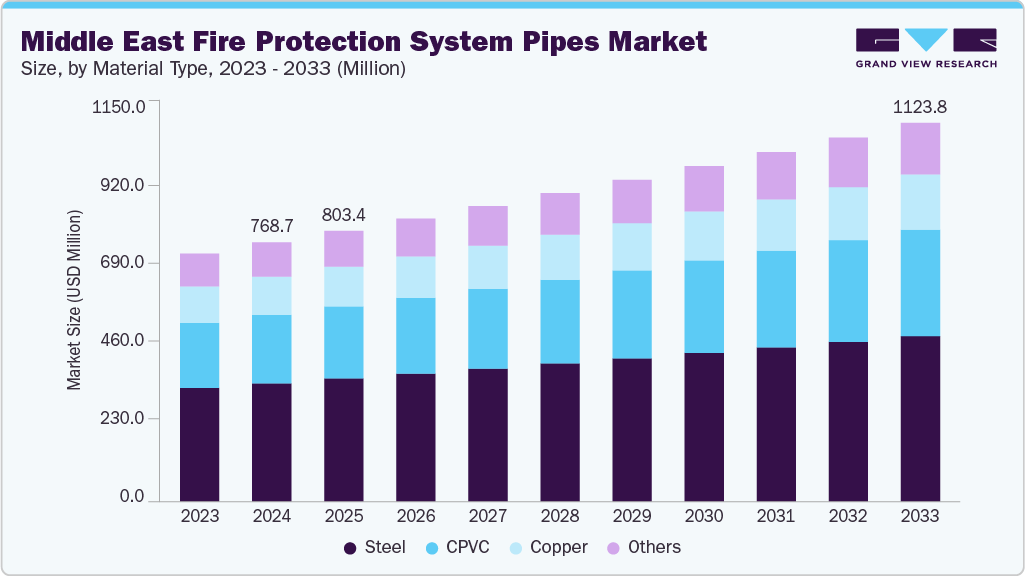
Key demand drivers for the Middle East fire protection system pipes industry include growth in commercial real estate, expansion of oil & gas facilities, and rising demand from industrial applications where fire safety compliance is mandatory. The booming hospitality and tourism sectors are also fueling fire protection adoption in hotels, resorts, and entertainment complexes. With the Middle East experiencing extreme climatic conditions, fire safety becomes critical in infrastructure resilience. Additionally, global players are entering partnerships with local contractors to provide certified fire protection piping solutions, boosting availability and adoption across the region.
Governments across the Middle East have enforced stringent building codes and fire safety standards. The Saudi Civil Defense, Dubai Civil Defense, and Qatar Civil Defense authorities mandate the use of UL/FM-approved fire protection pipes in residential, commercial, and industrial structures. The UAE’s Fire & Life Safety Code of Practice has been updated to align with international NFPA standards, ensuring consistent compliance. Moreover, state-driven projects in Saudi Arabia, Kuwait, and Qatar prioritize fire protection systems in public buildings, transport hubs, and oil refineries. This creates steady procurement opportunities for fire pipe manufacturers and suppliers.
Market Concentration & Characteristics
The Middle East fire protection system pipes market is moderately consolidated, with a mix of global players and regional suppliers catering to oil and gas and construction projects. Large-scale infrastructure projects tend to favor well-established global brands due to certification requirements, while smaller contractors often rely on regional suppliers for cost-effectiveness. Intense competition is observed in the CPVC and steel pipe segments, with companies differentiating through material certification, durability, and pricing. Strategic alliances and distribution networks play a crucial role in capturing project-based contracts.
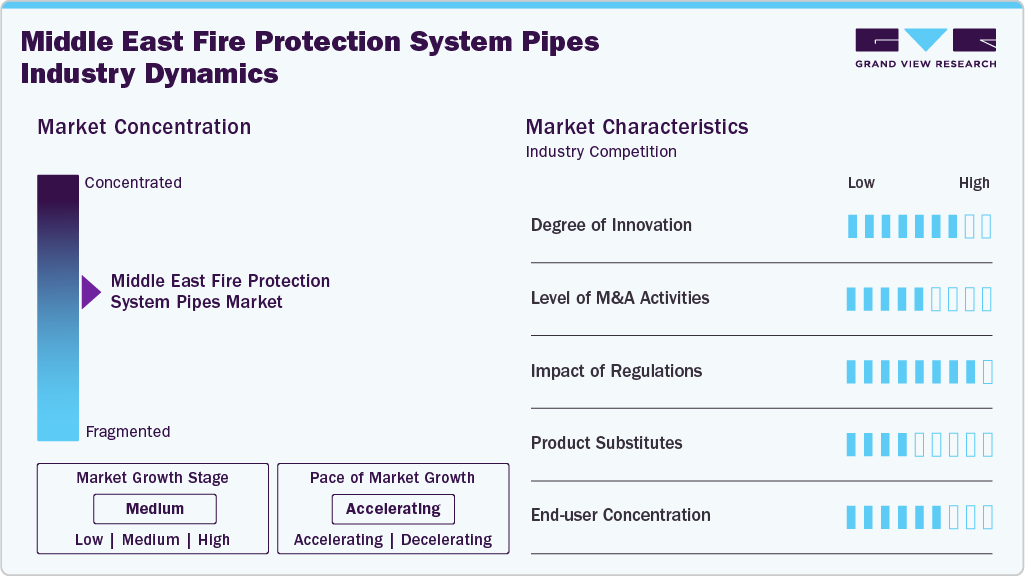
Threat from substitutes is relatively low, as fire protection pipes are mandatory and specialized for safety compliance. However, variations within the category exist, such as CPVC replacing galvanized steel pipes in some applications due to cost and corrosion resistance. While modular fire suppression systems and wireless detection technologies can complement piping systems, they cannot replace them entirely. The main competition comes from different pipe materials rather than alternative technologies. Hence, substitution risk is limited but evolving with innovations.
Material Type Insights
The steel segment led the Middle East fire protection system pipes industry with the highest revenue share of 45.7% in 2024,due to their strength, durability, and compliance with UL/FM standards, making them the preferred choice for large-scale infrastructure and high-rise projects. Their ability to withstand high pressure and temperature fluctuations, along with resistance to external damage, ensures long-term reliability in fire protection networks. With governments in Saudi Arabia, the UAE, and Qatar investing heavily in mega projects such as NEOM, smart cities, and industrial complexes, the demand for steel pipes remains strong. Furthermore, the region’s oil & gas, power, and commercial construction sectors rely heavily on steel-based firewater and sprinkler systems, cementing steel’s dominance in the market.
The CPVC segment is expected to grow at the fastest CAGR of 5.0% over the forecast period, driven by their lightweight, corrosion resistance, and cost-effectiveness compared to steel. These pipes are particularly suitable for residential, commercial, and institutional buildings, where ease of installation and lower maintenance are key factors. Rapid urbanization and the growing preference for affordable yet reliable fire protection solutions are fueling CPVC adoption across the UAE, Saudi Arabia, and Egypt. Moreover, increasing approvals of CPVC systems by regional fire safety authorities and rising demand in high-rise housing and commercial towers are further accelerating their market penetration, making CPVC the fastest-growing pipe material in the region.
End Use Insights
The commercial segment held the highest revenue share of 44.1% in 2024,due to the rapid expansion of shopping malls, office complexes, airports, and hospitality projects across the region. Countries like the UAE, Saudi Arabia, and Qatar are investing heavily in commercial infrastructure as part of their diversification strategies under Vision 2030 and Expo-driven developments. These large-scale projects require high-capacity fire protection networks, where steel and ductile iron pipes are extensively used for sprinkler and hydrant systems. Strict fire safety codes and mandatory compliance in commercial facilities further reinforce the dominance of this segment, as commercial developments continue to represent the largest share of fire protection system pipe demand in the Middle East.
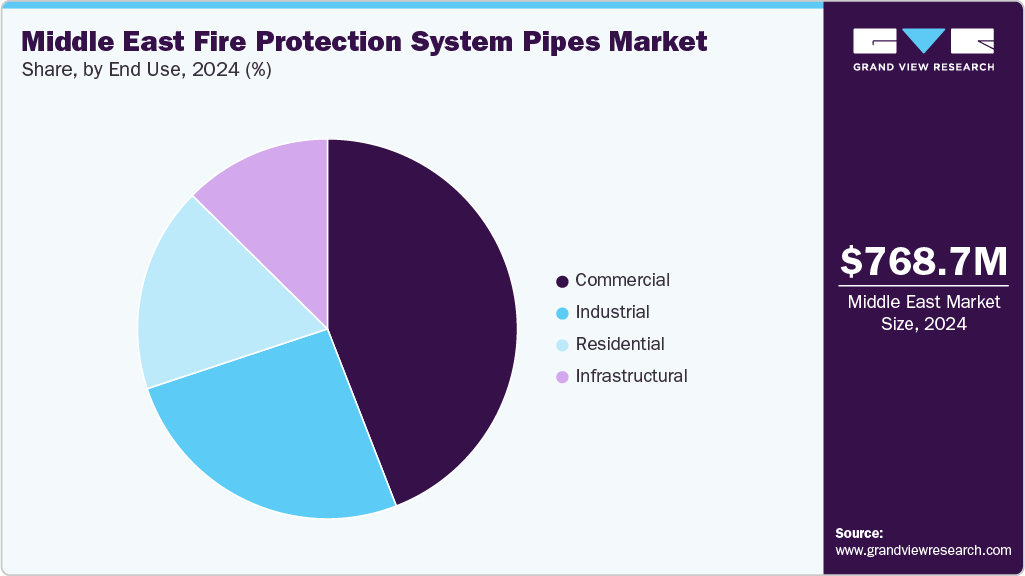
The residential segment is expected to grow at the fastest CAGR of 5.1% over the forecast period, supported by population growth, urbanization, and government-backed housing programs. Rising demand for high-rise residential complexes, affordable housing schemes, and smart city developments in Saudi Arabia, the UAE, and Egypt is driving the installation of advanced fire safety systems. With increasing adoption of CPVC pipes for residential sprinklers due to their cost-effectiveness and easy installation, the sector is witnessing accelerated growth. Additionally, stricter enforcement of fire safety regulations in residential buildings is pushing developers to adopt certified piping systems, making the residential sector the fastest-growing end-user in the region.
Country Insights
The Middle East fire protection system pipes market is witnessing strong growth, driven by mega construction projects, oil & gas investments, and regulatory enforcement. Countries like Saudi Arabia, the UAE, and Qatar are leading adopters due to large-scale infrastructure developments. Demand is also rising in Egypt and Kuwait as modernization initiatives expand. The oil & gas sector remains the largest consumer, while commercial real estate and residential complexes add steady growth momentum.
Saudi Arabia Fire Protection System Pipes Market Trends
Saudi Arabia dominated the Middle East fire protection system pipes industry with the highest revenue share of 32.4% in 2024, supported by Vision 2030 reforms and massive infrastructure spending across urban development, industrial facilities, and oil refineries. The Saudi Civil Defense mandates the use of UL/FM-approved pipes in all major commercial and residential projects, ensuring high material standardization. Mega projects like NEOM, Red Sea Global, and Qiddiya are expected to significantly boost demand for advanced fire protection systems.
UAE Fire Protection System Pipes Market Trends
The UAE is a regional leader in the adoption of fire protection, driven by Dubai’s smart infrastructure plans and Abu Dhabi’s industrial expansion. The UAE Fire & Life Safety Code of Practice, which aligns with NFPA standards, has been a key regulatory driver for demand. Mega projects such as Dubai Creek Harbour, Etihad Rail, and Abu Dhabi Midfield Terminal have fueled the large-scale installation of fire protection piping systems. The real estate boom, supported by tourism and hospitality investments, has further expanded the market. In addition, the push toward sustainable and smart buildings has increased the adoption of CPVC and lightweight fire-resistant pipes.
Egypt Fire Protection System Pipes Market Trends
Egypt is emerging as a fast-growing market for fire protection system pipes, supported by government initiatives such as the New Administrative Capital project and other large-scale housing and industrial park developments. With growing urbanization and industrialization, fire safety compliance has become a top priority for both government-led and private projects. The expansion of oil refineries, manufacturing facilities, and logistics infrastructure also contributes to rising demand. Egypt has been strengthening its regulatory framework to align with international fire safety standards, attracting global suppliers. The preference for cost-effective yet durable CPVC and coated steel pipes is increasing.
Qatar’s Fire Protection System Pipes Market Trends
Qatar’s fire protection system pipes market is supported by post-FIFA World Cup infrastructure projects, legacy investments, and expansion in oil & gas facilities. Fire safety compliance remains a key priority in stadiums, metro systems, commercial complexes, and hospitality establishments. The Qatar Civil Defense mandates the use of internationally certified fire protection pipes, creating strong demand for premium suppliers. LNG projects and industrial facilities are major consumers of steel-based fire piping systems, while commercial real estate is adopting CPVC pipes.
Kuwait’s Fire Protection System Pipes Market Trends
Kuwait’s fire protection system pipes market is expanding steadily, driven by the modernization of oil refineries, public infrastructure, and healthcare facilities. The government has prioritized compliance with NFPA fire safety codes, boosting demand for UL/FM-certified pipes in large-scale projects. The construction of new airports, metro systems, and commercial complexes adds to the growing adoption of advanced fire protection piping networks. Kuwait’s oil & gas sector, being the backbone of its economy, requires extensive fire suppression systems, making it a critical demand driver.
Key Middle East Fire Protection System Pipes Company Insights
Some of the key players operating in the market include NAFFCO, AJ Steel.
-
NAFFCO is a leading UAE-based manufacturer of fire safety solutions, producing a wide range of fire protection systems, including pipes, valves, and fittings designed for sprinkler and fire suppression networks. With UL and FM-certified products, the company caters to commercial, residential, industrial, and oil & gas projects across the Middle East. NAFFCO’s integrated manufacturing capability and adherence to NFPA standards make it a trusted supplier for high-rise buildings, airports, and mega infrastructure projects.
-
AJ Steel is one of the largest ERW steel pipe manufacturers in the UAE, supplying UL 852-listed pipes for fire protection sprinkler systems. Its modern facilities in Abu Dhabi and Dubai serve both regional and international markets, ensuring compliance with international safety and quality standards. The company is a preferred source for contractors seeking certified sprinkler pipes for residential towers, malls, and industrial fire safety networks.
Jazeera Steel and Jindal SAW Gulf LLC are some of the emerging market participants in the fire protection system pipes market.
-
Headquartered in Oman, Al Jazeera Steel is a leading manufacturer of ERW steel pipes widely used in fire protection systems across the Middle East. The company holds UL/FM certifications, making its pipes compliant for fire sprinkler installations in residential, commercial, and industrial facilities. Its strong distribution network across the GCC allows it to supply high-quality fire protection pipes to major infrastructure projects in Saudi Arabia, the UAE, and Qatar.
-
Jindal SAW Gulf, based in Abu Dhabi, is a key producer of ductile iron (DI) and steel pipes used in large-scale firewater networks, industrial facilities, and municipal fire protection systems. Known for its high-strength and corrosion-resistant pipes, the company supports critical fire safety infrastructure such as oil & gas facilities, desalination plants, and urban water-fire networks. Its regional manufacturing base enables it to supply large-diameter firewater mains across the Middle East efficiently.
Key Middle East Fire Protection System Pipes Companies:
- NAFFCO
- Victaulic
- Jazeera Steel
- AJ Steel
- Tenaris Saudi Steel Pipe
- Future Pipe Industries
- Jindal SAW Gulf LLC
- TMK Gulf International Pipe Industry
- Union Pipes Industry
- Arabian Pipes Company
Recent Developments
-
In May 2024, Tenaris officially inaugurated a new production line at its longitudinal submerged arc-welding (LSAW) pipe mill in Jubail 1 Industrial City, Saudi Arabia. This revamping doubles the facility’s production capacity and will foster new employment and training opportunities for the local community.
-
In June 2024, Future Pipe Industries introduced the WAVISTRONG Fire GRE pipe system for offshore and industrial firewater applications. WAVISTRONG Fire Retardant (FR) series is a low flame spread, smoke, and toxicity pipe system with an additional fire barrier integrated in the outer surface of the GRE component.
Middle East Fire Protection System Pipes Market Report Scope
Report Attribute
Details
Market size value in 2025
USD 803.4 million
Revenue forecast in 2033
USD 1,123.8 million
Growth rate
CAGR of 4.3% from 2025 to 2033
Base year for estimation
2024
Actual estimates/Historical data
2021 - 2024
Forecast period
2025 - 2033
Quantitative units
Revenue in USD million and CAGR from 2023 to 2033
Report coverage
Revenue forecast, company ranking, competitive landscape, growth factors, and trends
Segments covered
Material type, end use, region
Regional scope
Middle East
Country scope
Saudi Arabia; UAE; Egypt; Qatar; Kuwait
Key companies profiled
NAFFCO; Victaulic; Jazeera Steel; AJ Steel; Tenaris Saudi Steel Pipe; Future Pipe Industries; Jindal SAW Gulf LLC; TMK Gulf International Pipe Industry; Union Pipes Industry; Arabian Pipes Company
Customization scope
Free report customization (equivalent up to 8 analysts working days) with purchase. Addition or alteration to country, regional & segment scope.
Pricing and purchase options
Avail customized purchase options to meet your exact research needs. Explore purchase options
Middle East Fire Protection System Pipes Market Report Segmentation
This report forecasts revenue growth at the regional & country levels and provides an analysis of the industry trends in each of the sub-segments from 2021 to 2033. For this study, Grand View Research has segmented the Middle East fire protection system pipes market on the basis of material type, end use, and region:
-
Material Type Outlook (Revenue, USD Million, 2021 - 2033)
-
Steel
-
CPVC
-
Copper
-
Others
-
-
End Use Outlook (Revenue, USD Million, 2021 - 2033)
-
Residential
-
Commercial
-
Industrial
-
Infrastructural
-
-
Country Outlook (Revenue, USD Million, 2021 - 2033)
-
Middle East & Africa
-
Saudi Arabia
-
UAE
-
Egypt
-
Qatar
-
Kuwait
-
-
Frequently Asked Questions About This Report
b. The Middle East fire protection system pipes market size was estimated at USD 768.7 million in 2024 and is expected to reach USD 803.4 million in 2025.
b. The Middle East fire protection system pipes market is expected to grow at a compound annual growth rate of 4.3% from 2025 to 2033 to reach USD 1,123.8 million by 2033.
b. The steel segment held the highest revenue market share of 45.7% in 2024 due to its strength, durability, and compliance with UL/FM standards, which make it the preferred choice for large-scale infrastructure and high-rise projects.
b. Some of the key players operating in the Middle East fire protection system pipes market include NAFFCO, Victaulic, Jazeera Steel, AJ Steel, Tenaris Saudi Steel Pipe, Future Pipe Industries, Jindal SAW Gulf LLC, TMK Gulf International Pipe Industry, Union Pipes Industry, and Arabian Pipes Company
b. Strict fire safety regulations, rapid urbanization, mega infrastructure projects, and rising demand for cost-effective piping solutions are the key factors driving the Middle East fire protection system pipes market.


Share this report with your colleague or friend.
Need a Tailored Report?
Customize this report to your needs — add regions, segments, or data points, with 20% free customization.


ISO 9001:2015 & 27001:2022 Certified
We are GDPR and CCPA compliant! Your transaction & personal information is safe and secure. For more details, please read our privacy policy.
Trusted market insights - try a free sample
See how our reports are structured and why industry leaders rely on Grand View Research. Get a free sample or ask us to tailor this report to your needs.













