Middle East Floating Solar Panels Market Summary
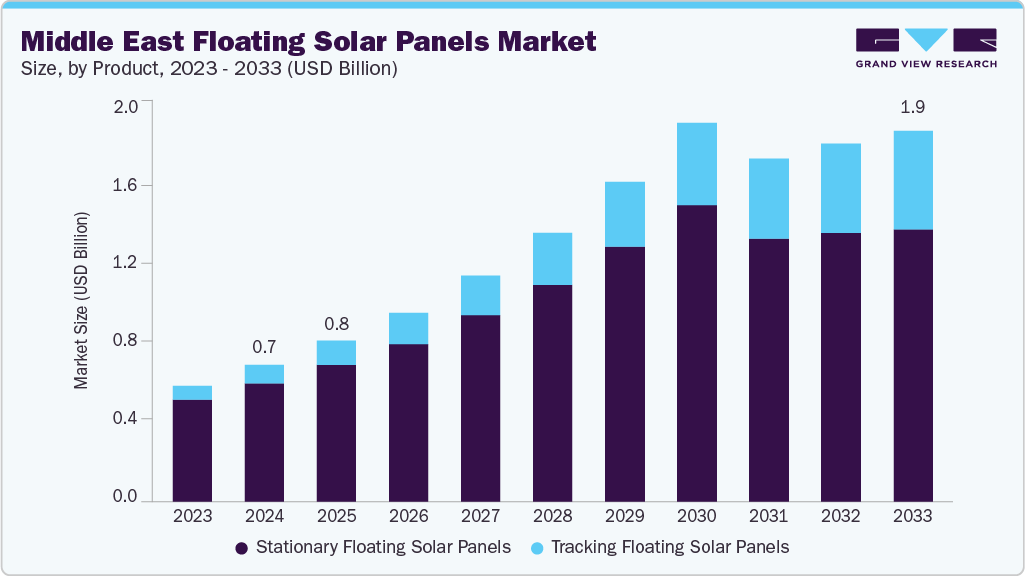
The Middle East floating solar panels market size was estimated at USD 0.72 billion in 2024 and is projected to reach USD 1.95 billion by 2033, growing at a CAGR of 11.0% from 2025 to 2033. Deployment spans utility-scale reservoirs, desalination plants, irrigation canals, and industrial water bodies, enabling grid-connected and off-grid applications.
Key Market Trends & Insights
- UAE floating solar panels market held the largest share of 28.50% of the Middle East market in 2024.
- The floating solar panels market in the Middle East is expected to grow significantly over the forecast period.
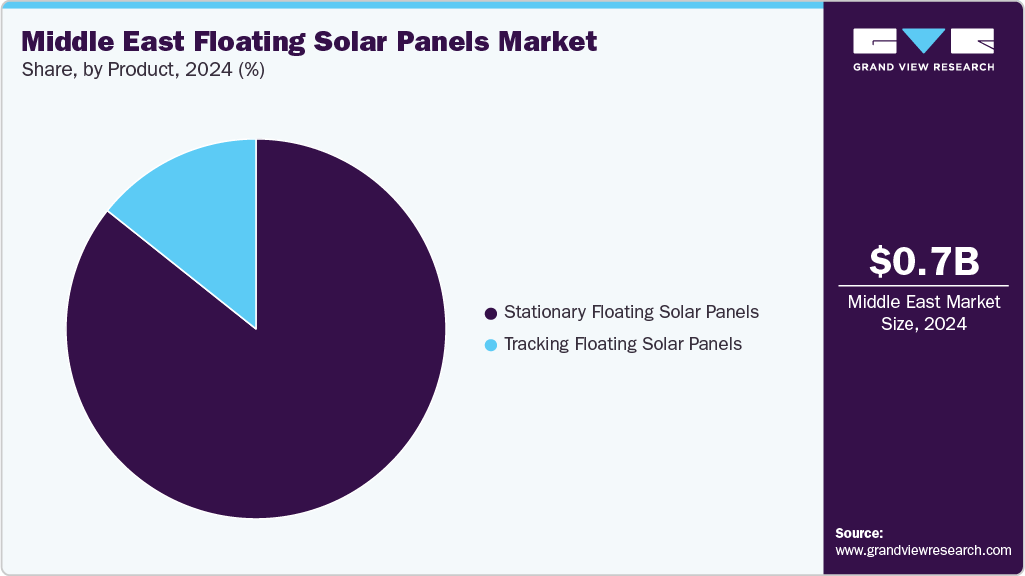
- By product, stationary floating solar panels held the largest market share of 85.70% in 2024.
Market Size & Forecast
- 2024 Market Size: USD 0.72 Billion
- 2033 Projected Market Size: USD 1.95 Billion
- CAGR (2025-2033): 11.0%
National initiatives, including Saudi Vision 2030, the UAE Energy Strategy 2050, and policies in Israel, Qatar, and Oman, drive investment in floating solar to diversify the energy mix, reduce carbon intensity, and optimize land use. Countries including Saudi Arabia, the UAE, Israel, Qatar, and Oman are increasingly exploring floating PV, particularly in water-scarce areas where land for conventional PV is limited. The region’s abundant solar irradiation supports market growth, the rising need to optimize water reservoirs for dual use, and the cost competitiveness of solar technologies. Floating solar panels reduce evaporation losses, improve panel efficiency due to water cooling effects, and open new avenues for integrating solar into existing hydropower and desalination infrastructure.
Hybrid projects combining floating PV with battery energy storage systems (BESS) are gaining momentum to deliver a reliable, round-the-clock energy supply. Opportunities are also emerging in green hydrogen production, where floating solar can supply clean, large-scale input power and cross-border grid connectivity projects that enhance regional energy trade. With global and regional leaders such as Masdar, ACWA Power, EDF Renewables, JinkoSolar, and First Solar piloting and scaling floating solar initiatives, the Middle East floating solar market is positioned to play a pivotal role in advancing renewable capacity, water-energy nexus solutions, and climate resilience strategies over the next decade.
Drivers, Opportunities & Restraints
The Middle East floating solar panels market is driven by the region's growing demand for renewable energy diversification, acute land-use constraints, and the need for sustainable water-energy nexus solutions. Countries such as Saudi Arabia, the UAE, and Egypt actively pursue floating solar projects to complement large-scale ground-mounted PV installations and optimize water reservoirs, irrigation canals, and desalination ponds. The ability of floating PV systems to reduce evaporation, improve panel efficiency through natural cooling, and minimize land conflicts makes them particularly attractive in densely populated urban areas and arid desert environments. Strong policy support under national strategies such as Saudi Vision 2030, the UAE Energy Strategy 2050, and Egypt's Integrated Sustainable Energy Strategy 2035, is accelerating pilot deployments and setting the stage for large-scale adoption across the GCC and wider Middle East.
The market's opportunities lie in hybridizing floating PV with battery energy storage systems (BESS) to ensure round-the-clock energy supply and enhance grid stability, especially in regions facing intermittent renewable output. Integration with desalination facilities, hydropower reservoirs, and smart grid infrastructure creates additional synergies, while floating solar-powered hydrogen production is emerging as a strategic pathway for clean fuel exports. International collaborations with technology providers foster advancements in high-durability floats, bifacial modules, and AI-driven monitoring platforms tailored to harsh marine and desert climates. However, the market faces key restraints such as high initial capital costs, limited regional expertise in large-scale floating solar design, and challenges related to water body suitability, including salinity, sedimentation, and maintenance access. Regulatory uncertainties, financing barriers for early projects, and the need for advanced anchoring and cooling technologies remain critical hurdles that could slow the pace of widespread adoption.
Product Insights
The stationary floating solar panels segment held the largest revenue share of 85.70% in 2024, reflecting the region’s preference for simpler, cost-effective, and scalable floating PV solutions. This dominance is driven by large-scale utility reservoir projects, industrial water bodies, irrigation canals, and desalination plant applications, where stationary systems offer easier deployment, lower maintenance requirements, and reliable energy output. Countries such as Saudi Arabia, the UAE, Israel, Qatar, and Oman spearhead floating PV adoption, implementing projects on large reservoirs and industrial sites to optimize land use while supporting national renewable energy targets. Notable projects include pilot and commercial installations at utility reservoirs in Dubai, Abu Dhabi, and Saudi Arabia’s emerging FPV clusters, which leverage stationary designs to balance cost, efficiency, and durability in challenging environmental conditions.
Government-backed initiatives, competitive tendering, and supportive regulatory frameworks further accelerate the deployment of stationary floating systems. Integrating these systems with grid-connected infrastructure or hybrid configurations enhances energy utilization, reduces land footprint, and allows coupling with water desalination and irrigation networks. While tracking floating solar panels are gradually gaining traction due to their higher energy yield per MW, the stationary segment remains the preferred choice across most Middle Eastern applications because of lower capital expenditure, simpler operation, and faster project execution. This overwhelming dominance of stationary floating PV highlights the region’s strategic approach to leveraging water surfaces for renewable energy generation. It reinforces its commitment to clean power expansion, energy diversification, and efficient land-water use for sustainable development.
Country Insights
UAE Floating Solar Panels Market Trends
The UAE holds the largest revenue share of 28.50% in the Middle East floating solar panels market, reflecting its regional renewable energy adoption leadership. Driven by progressive policy frameworks under the UAE Energy Strategy 2050, which targets 50% clean energy in the national mid-century, the country has become a hub for large-scale floating solar development. Projects such as pilot installations on utility reservoirs in Dubai and Abu Dhabi demonstrate the UAE's commitment to integrating floating PV solutions alongside conventional solar and hybrid systems. Abu Dhabi and Dubai continue to lead in distributed solar deployment, supported by initiatives such as Shams Dubai and coupling floating solar with desalination plants, industrial water bodies, and green hydrogen initiatives. Favorable financing, an open investment environment, and robust infrastructure further strengthen the UAE's position as the primary driver of the Middle East floating solar market.
Saudi Arabia Floating Solar Panels Market Trends
Saudi Arabia is a key regional player, holding a significant share of the Middle East Floating Solar Panels market. The Kingdom's Vision 2030 strategy places renewable energy at the center of diversification efforts, supported by utility-scale floating PV projects on reservoirs and industrial water bodies. Initiatives under NEOM and projects such as the 1.5 GW Sudair Floating Solar Panels plant exemplify the scale and ambition of Saudi Arabia's solar deployment. Transparent auction processes, competitive pricing, and global developer participation under the Renewable Energy Project Development Office (REPDO) accelerate project rollouts. Benefiting from high solar irradiance and strategic green hydrogen linkages, Saudi Arabia is positioned to maintain its leadership in the regional floating solar market.
Israel Floating Solar Panels Market Trends
Israel's floating solar market is steadily growing, propelled by rising energy demand, policy support, and the country's Integrated Sustainable Energy Strategy (ISES), which targets 30% renewable penetration by 2030. Floating PV projects are increasingly deployed on reservoirs, industrial water bodies, and aquaculture facilities, often paired with battery storage for grid reliability. Innovative technology adoption and engagement from Independent Power Producers (IPPs) enhance Israel's capacity to scale floating solar. Cross-border interconnections and international financing further support the expansion of Israel's floating solar footprint in the region.
Oman Floating Solar Panels Market Trends
Oman is emerging as a promising market for floating solar panels under Oman Vision 2040, which targets 30% renewable energy by 2030. Large-scale solar PV projects, such as reservoir-based installations and the operational 500 MW Ibri II Solar Plant, demonstrate the country's increasing adoption of innovative deployment strategies. Floating solar initiatives complement Oman's renewable hydrogen ambitions, while regulatory reforms and pilot programs attract foreign investment. With strong solar irradiance, favorable wind-solar complementarity, and rising regional demand, Oman is expected to expand its floating solar capacity over the forecast period steadily.
Qatar Floating Solar Panels Market Trends
Qatar's floating solar market is gaining momentum with the Qatar National Vision 2030, emphasizing carbon reduction and sustainable energy transition. The 800 MW Al Kharsaah Floating Solar Panels Plant, inaugurated in 2022, marks the country's largest renewable energy development and establishes a foundation for future floating PV expansion. Qatar also explores solar deployment for industrial applications, smart cities, and desalination plants. Government support, international partnerships, and growing investment incentives are expected to drive adoption, gradually positioning solar as a strategic complement to the nation's gas-heavy power generation mix.
Key Middle East Floating Solar Panels Company Insights
Some of the key players operating in the Middle East Floating Solar Panels market include Masdar (Abu Dhabi Future Energy Company), ACWA Power, GCL System Integration Technology Co., Ltd., Ciel & Terre International, Trina Solar, JA Solar Technology Co., Ltd., LONGi Solar, Hanwha Q CELLS, Mibet Energy, SPG Solar, JinkoSolar Holding Co. Ltd., First Solar Inc., Enerwhere Sustainable Energy DMCC, Alsa Solar Systems LLC, Canadian Solar Inc., and Yellow Door Energy. These companies are actively engaged in developing and deploying large-scale floating solar PV projects across the region, supplying advanced photovoltaic modules, floating mounting systems, and integrated clean energy solutions.
Key Middle East Floating Solar Panels Companies:
- Masdar
- ACWA Power
- GCL System Integration Technology Co., Ltd.
- Ciel & Terre International
- Trina Solar
- JA Solar Technology Co., Ltd.
- LONGi Solar
- Hanwha Q CELLS
- Mibet Energy
- SPG Solar
Recent Developments
-
In February 2025, ACWA Power commenced construction of the 2,060 MW Al Shuaibah Floating Solar Panels Independent Power Project (IPP) in Saudi Arabia, marking one of the largest floating solar facilities in the Middle East. Developed in partnership with the Saudi Public Investment Fund (PIF), the project is expected to generate clean electricity for approximately 450,000 households annually, while reducing carbon emissions by over 3 million tons of CO₂ annually.
Middle East Floating Solar Panels Market Report Scope
|
Report Attribute
|
Details
|
|
Market size value in 2025
|
USD 0.85 billion
|
|
Revenue forecast in 2033
|
USD 1.95 billion
|
|
Growth rate
|
CAGR of 11.0% from 2025 to 2033
|
|
Base year for estimation
|
2024
|
|
Historical data
|
2021 - 2023
|
|
Forecast period
|
2025 - 2033
|
|
Quantitative units
|
Volume in MW, Revenue in USD million/billion, and CAGR from 2025 to 2033
|
|
Report coverage
|
Revenue forecast, competitive landscape, growth factors, and trends
|
|
Segments covered
|
Product, Country
|
|
Country scope
|
UAE; Saudi Arabia; Israel; Oman; Qatar
|
|
Key companies profiled
|
Masdar; ACWA Power; GCL System Integration Technology Co., Ltd.; Ciel & Terre International; Trina Solar; JA Solar Technology Co., Ltd.; LONGi Solar; Hanwha Q CELLS; Mibet Energy; SPG Solar
|
|
Customization scope
|
Free report customization (equivalent up to 8 analysts working days) with purchase. Addition or alteration to country, regional & segment scope.
|
|
Pricing and purchase options
|
Avail customized purchase options to meet your exact research needs. Explore purchase options
|
Middle East Floating Solar Panels Market Report Segmentation
This report forecasts revenue growth at country levels and provides an analysis of the latest industry trends in each of the sub-segments from 2021 to 2033. For this study, Grand View Research has segmented the Middle East Floating Solar Panels market report based on product and country:
-
Product Outlook (Volume, MW; Revenue, USD Million, 2021 - 2033)
-
Country Outlook (Volume, MW; Revenue, USD Million, 2021 - 2033)
-
Middle East
-
UAE
-
Saudi Arabia
-
Israel
-
Oman
-
Qatar
Frequently Asked Questions About This Report
b. The Middle East floating solar panels market size was estimated at USD 0.72 billion in 2024 and is expected to reach USD 0.85 billion in 2025.
b. The Middle East floating solar panels market is expected to grow at a compound annual growth rate of 11% from 2025 to 2033 to reach USD 1.95 billion by 2033.
b. Based on the product segment, the Stationary Floating Solar Panels segment held the largest market share of 85.70% in 2024 in the Middle East floating solar market.
b. Some of the key vendors operating in the Middle East floating solar panels market include Masdar; ACWA Power; GCL System Integration Technology Co., Ltd.; Ciel & Terre International; Trina Solar; JA Solar Technology Co., Ltd.; LONGi Solar; Hanwha Q CELLS; Mibet Energy; SPG Solar, among others.
b. The key factors driving the Middle East floating solar panels market include growing water-surface availability, supportive government policies, and the region’s high solar irradiance. Countries such as Saudi Arabia, the UAE, Israel, Oman, and Qatar are accelerating floating solar adoption to optimize land use, complement conventional solar PV, and achieve national renewable energy targets while reducing carbon emissions and enhancing energy security.

 Download Sample Report