
- Home
- »
- Advanced Interior Materials
- »
-
Middle East Granite Market Size, Industry Report, 2033GVR Report cover
![Middle East Granite Market Size, Share & Trends Report]()
Middle East Granite Market (2025 - 2033) Size, Share & Trends Analysis Report By Product (Granite Slabs), By Application (Countertops, Flooring & Wall Cladding, Monuments & Memorials, Infrastructure & Construction), And Segment Forecasts
- Report ID: GVR-4-68040-765-2
- Number of Report Pages: 95
- Format: PDF
- Historical Range: 2021 - 2023
- Forecast Period: 2025 - 2033
- Industry: Advanced Materials
- Report Summary
- Table of Contents
- Segmentation
- Methodology
- Download FREE Sample
-
 Download Sample Report
Middle East Granite Market Summary
The Middle East granite market size was estimated at USD 97.0 million in 2024 and is projected to reach USD 175.7 million by 2033, growing at a CAGR of 6.9% from 2025 to 2033. Market growth is primarily driven by substantial investments in infrastructure projects and the rapid expansion of the construction sector across the region.
Key Market Trends & Insights
- The Middle East granite market is expected to grow at a substantial CAGR of 6.9% from 2025 to 2033.
- By product, granite slabs dominated the market with a revenue share of over 54.0% in 2024.
- The countertops segment held the largest share of over 38.0% of granite revenue in 2024.
Market Size & Forecast
- 2024 Market Size: USD 97.0 Million
- 2033 Projected Market Size: USD 175.7 Million
- CAGR (2025-2033): 6.9%
Owing to its superior durability, aesthetic appeal, and resistance to weathering, granite is widely utilized in developing commercial buildings, luxury residential complexes, and large-scale public infrastructure, including bridges, pavements, and monuments. Granite Slabs dominate the Middle East market due to their superior strength, exceptional durability, and natural aesthetic appeal. Their extensive availability in various colors, patterns, and finishes makes them the preferred choice for regional architectural and structural applications. From high-end flooring and kitchen countertops to building facades and memorial structures, granite slabs are widely used in residential, commercial, and public projects where visual appeal and long-term performance are crucial.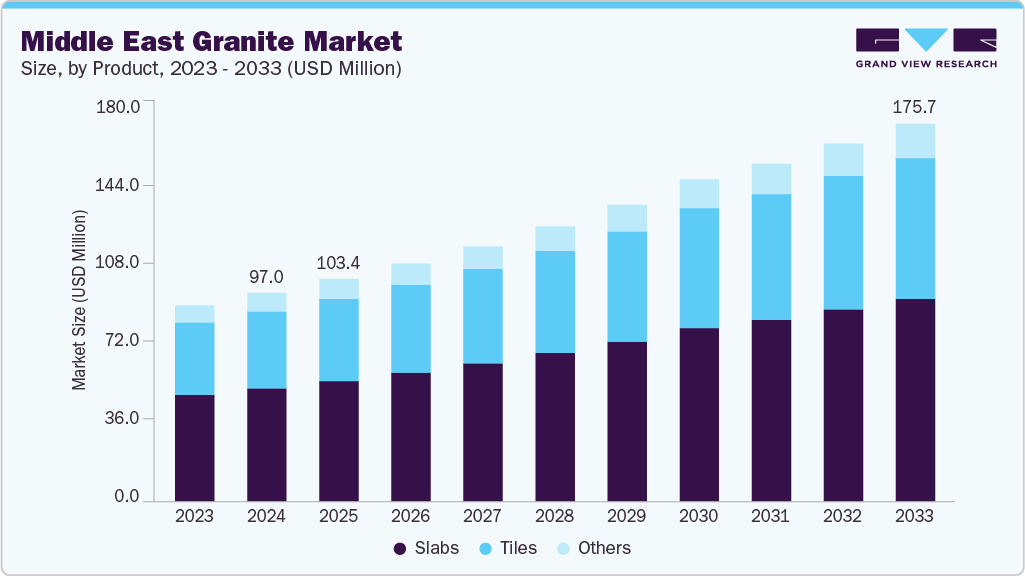
The rapid expansion of large-scale construction, including high-rise buildings, urban infrastructure, and luxury real estate, drives demand for granite slabs. Their durability against harsh weather, heavy loads, and environmental wear makes them ideal for demanding applications such as pavements, bridges, railway platforms, and busy public areas in Middle Eastern cities. As sustainability becomes a crucial aspect of regional construction practices, granite’s reputation as a natural, eco-friendly material with a long lifespan and low maintenance further strengthens its market position compared to synthetic options.
Moreover, technological advancements in fabrication and surface finishing have significantly expanded granite's design versatility, allowing architects and developers to integrate it into modern projects with greater precision and creativity. This combination of structural resilience, timeless elegance, and environmental compatibility ensures that granite slabs remain integral to shaping contemporary architecture and premium interior spaces across the Middle East.
Drivers, Opportunities & Restraints
Rapid urbanization, large infrastructure projects, strong construction, and real estate growth mainly drive the Middle East granite market. Governments across the region are investing heavily in commercial, residential, and public infrastructure to diversify their economies and boost tourism. For example, Saudi Arabia’s Vision 2030 initiatives, including significant projects such as NEOM, The Line, and Qiddiya, create high demand for quality natural stones like granite for building facades, interior finishes, pavements, and landscaping. The increasing demand for durable, weather-resistant, and attractive materials in luxury real estate and hospitality projects further speeds up market growth.
The growing focus on sustainable building practices and eco-friendly materials offers significant opportunities for the Middle East granite suppliers and manufacturers. Granite, a natural material with a long lifespan, low maintenance needs, and recyclability, fits well with the region’s developing green building standards and certification programs. Additionally, improvements in quarrying, cutting, and surface treatment technologies allow for creating innovative finishes and personalized designs, broadening granite’s use in modern architecture. Projects like Dubai Creek Harbour and Lusail City in Qatar show a trend toward premium, sustainable materials, opening new opportunities for suppliers and fabricators to meet changing design preferences and environmental regulations.
Despite strong growth prospects, the region faces high production and transportation costs, fluctuating raw material prices, and competition from engineered stone alternatives. Imported granite often incurs significant logistics and tariff expenses, which can limit its adoption in cost-sensitive projects. Additionally, engineered materials like quartz and porcelain slabs are gaining popularity due to their lower installation costs and customizable aesthetics, posing a competitive threat to natural granite. For example, several commercial developments in the UAE have recently chosen engineered stone for interior applications to balance performance with budget constraints, highlighting a key obstacle to granite’s market expansion.
Product Insights
Granite slabs represent the most dominant product segment in the Middle East market, widely preferred for premium construction and interior design projects. These large, polished stone pieces are extensively used in high-end applications such as kitchen countertops, bathroom vanities, flooring, and wall cladding due to their seamless appearance, superior strength, and luxurious finish. When adequately sealed, their excellent heat and scratch resistance and a non-porous surface make them ideal for spaces exposed to moisture and temperature variations. Creating continuous, grout-free surfaces enhances aesthetics and hygiene - a key factor driving their adoption in luxury villas, upscale hotels, and premium commercial developments across the region.
Granite tiles, on the other hand, provide a cost-effective and versatile alternative to slabs, making them highly suitable for a wide range of residential and commercial uses. Their smaller, pre-cut size simplifies transportation, installation, and replacement, leading to faster project completion and lower labor costs. Granite tiles are commonly used for flooring, bathroom walls, and kitchen surfaces, available in various finishes such as polished, flamed, and honed to fulfill both functional and aesthetic purposes. Their anti-slip features and easy upkeep make them ideal for high-traffic areas like lobbies, hallways, and public buildings. As a result, granite tiles are a popular choice for mid-range construction, renovations, and large-scale real estate developments throughout the Middle East.
Application Insights
Countertops are expected to maintain their dominant position throughout the forecast period, accounting for a double-digit revenue share. Granite is highly preferred in this segment because of its non-porous surface, resistance to heat and acids, and ability to resist scratches and stains, making it perfect for food prep areas and moisture-prone spaces. The wide range of colors, patterns, and finishes available in slabs allows homeowners and designers to match various interior styles, combining practicality with elegance. This versatility and its premium look have made granite countertops a staple in luxury homes and upscale commercial projects throughout the region.
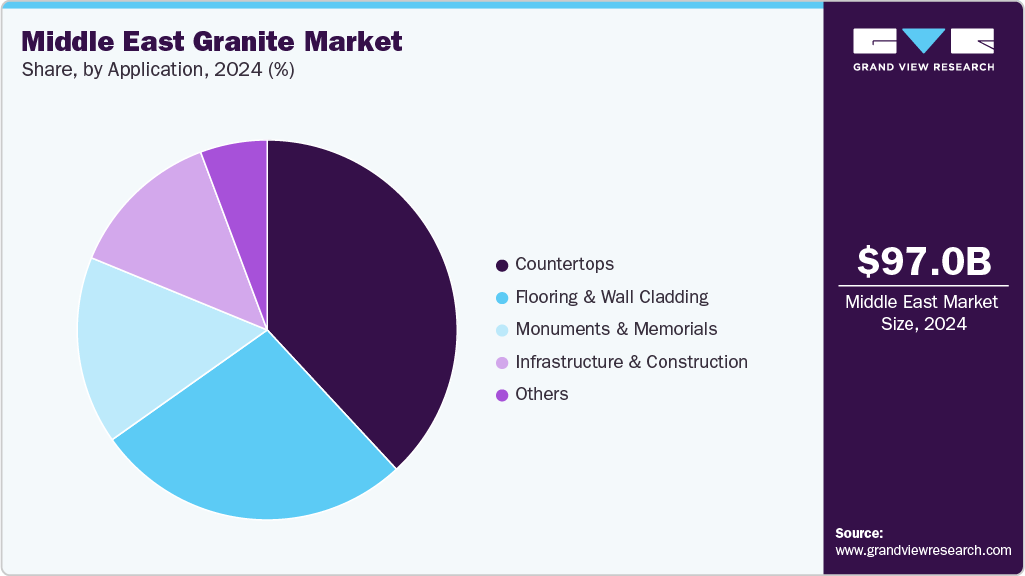
The infrastructure and construction sector is a rapidly growing segment for granite in the Middle East, fueled by significant investments in public works and urban development projects. Granite is commonly used in bridges, railway platforms, airport terminals, curbstones, and building facades because of its exceptional strength, low maintenance requirements, and resistance to environmental stresses such as extreme heat, cold, and pollution. Although the initial installation cost is higher than some alternatives, its long-lasting durability and minimal upkeep make granite a cost-effective option for high-traffic and high-exposure infrastructure projects, boosting its adoption in regional construction efforts.
Flooring and wall cladding are major applications of granite in the Middle East, especially in commercial buildings, luxury homes, and public spaces. Granite’s outstanding durability under heavy foot traffic, moisture resistance, and wide variety of finishes make it a perfect option for flooring in busy areas such as hallways, entrances, hotel lobbies, and shopping centers. For wall use, granite enhances appearance, adding a sense of permanence and luxury, commonly seen in institutional buildings, upscale office interiors, and high-end residential developments. Its combination of practicality and aesthetic appeal continues to support its popularity in the region's modern and traditional architectural styles.
Regional Insights
The Middle East granite industry is experiencing a shift toward premium, sustainable, and visually unique natural stones, especially for luxury interiors and large infrastructure projects. The mix of government-supported urban development, tourism-driven construction, and rising renovation activities is boosting the widespread use of granite slabs and tiles. In addition, advancements in fabrication and surface finishing technologies allow for more versatile and customized applications, increasing the material’s attractiveness in modern and traditional architectural designs.
Saudi Arabia granite industry is a key market in the region, driven by strong demand in residential, commercial, and infrastructure sectors. Granite slabs are widely favored for upscale kitchen countertops, flooring, and wall cladding because of their durability, heat resistance, and natural elegance. Significant investments in public infrastructure, including transport terminals, government buildings, urban landscaping, and monuments, have further boosted the use of granite in pavements and facades. The trend toward sustainable construction and high-end interior design continues to support the adoption of natural stone materials, while ongoing real estate developments and luxury projects in cities such as Riyadh, Jeddah, and Dammam maintain market growth.
The UAE granite industry is one of the fastest-growing sectors in the Middle East, driven by rapid urbanization, high disposable incomes, and significant investment in large-scale infrastructure and luxury real estate projects. Granite is increasingly used in upscale residential housing, commercial developments, airports, railways, government buildings, hotels, and shopping malls. The region’s focus on premium construction materials and a rising emphasis on aesthetics and durability in interior and exterior applications fuels the demand for slabs and tiles. Furthermore, the UAE’s strategic location as a trading hub allows access to high-quality granite from Asia Pacific producers, strengthening its position as a major player in the global market.
Key Middle East Granite Company Insights
Some of the key players operating in the market include Al Ajmi Marble LLC, Al Harbi Group, and Golden House Marble, among others.
-
Al Ajmi Marble LLC is a Muscat-based flagship manufacturer and exporter of natural Omani marble. Established in 1997, the company operates quarries in Sohar, Ibri, and Al Mudhaibi. Utilizing the latest Italian technologies, Al Ajmi Marble processes slabs, tiles, and cut-to-size products, exporting to over 45 countries worldwide.
-
Founded in 1991 as part of the Al Harbi Group, SMG is a leading natural stone producer in Saudi Arabia. The company manages 24 quarries within 800 km of its facilities and has an annual granite production capacity of 5 million square meters. It offers slabs, tiles, and customized granite products for commercial, residential, and infrastructure projects.
-
Golden House Marble, based in the UAE, supplies high-quality granite, marble, and sandstone. The company provides slabs, tiles, and finished stone products for luxury residential, commercial, and public projects, focusing on premium finishes and contemporary designs.
Key Middle East Granite Companies:
- Al Ajmi Marble LLC
- Al Hadaba Marble & Granite
- Al Rawas Marble & Granite
- Al Takadom
- East Marble FZCO
- Fair Deal Marble & Granite Ind. LLC
- Golden House Marble (GHM)
- Legend Granite LLC
- Marmara Marble & Granite
- Saudi Marble & Granite Factory Company (SMG)
Recent Development
-
In 2025, Golden House Marble launched a new line of premium granite products, including "Nairoby Crema" and "Marmara Crema" slabs, targeting luxury residential and commercial projects in the UAE. The company emphasized that these products combine durability, heat, scratch resistance, and aesthetic elegance, catering to the growing preference for high-quality natural stone in upscale interiors and facades. GHM also invested in advanced finishing technologies to offer customized textures and polished surfaces, allowing architects and designers greater flexibility in creating visually striking spaces. This product expansion strengthens GHM’s market presence amid rising competition and increasing demand for distinctive, sustainable construction materials in the Middle East.
Middle East Granite Market Report Scope
Report Attribute
Details
Market size value in 2025
USD 103.4 million
Revenue forecast in 2033
USD 175.7 million
Growth rate
CAGR of 6.9% from 2025 to 2033
Base year for estimation
2024
Historical data
2021 - 2023
Forecast period
2025 - 2033
Quantitative Units
Volume in kilotons, revenue in USD million, and CAGR from 2025 to 2033
Report coverage
Revenue forecast, competitive landscape, growth factors, and trends
Segments covered
Product, application, country
Regional scope
Middle East
Country scope
Saudi Arabia; UAE; Qatar; Oman
Key companies profiled
Al Ajmi Marble LLC; Al Hadaba Marble & Granite; Al Rawas Marble & Granite; Al Takadom; East Marble FZCO; Fair Deal Marble & Granite Ind. LLC; Golden House Marble (GHM); Legend Granite LLC; Marmara Marble & Granite; Saudi Marble & Granite Factory Company (SMG)
Customization scope
Free report customization (equivalent up to 8 analysts working days) with purchase. Addition or alteration to country, regional & segment scope.
Pricing and purchase options
Avail customized purchase options to meet your exact research needs. Explore purchase options
Middle East Granite Market Report Segmentation
This report forecasts regional and country revenue growth and analyzes the latest trends in each sub-segment from 2021 to 2033. For this study, Grand View Research has segmented the Middle East granite market report by product, application, and country.
-
Product Outlook (Volume, Kilotons; Revenue, USD Million, 2021 - 2033)
-
Granite Slabs
-
Granite Tiles
-
Other
-
-
Application Outlook (Volume, Kilotons; Revenue, USD Million, 2021 - 2033)
-
Countertops
-
Flooring & Wall Cladding
-
Monuments & Memorials
-
Infrastructure & Construction
-
Others
-
-
Country Outlook (Volume, Kilotons; Revenue, USD Million, 2021 - 2033)
-
Middle East
-
Saudi Arabia
-
UAE
-
Qatar
-
Oman
-
-
Frequently Asked Questions About This Report
b. The Middle East granite market size was estimated at USD 97.0 million in 2024 and is expected to reach USD 103.4 million in 2025.
b. The Middle East granite market is expected to grow at a compound annual growth rate of 6.9% from 2025 to 2033, reaching USD 175.7 million by 2033.
b. By product, granite slabs dominated the market with a revenue share of over 54.0% in 2024.
b. Key global granite vendors are Al Ajmi Marble LLC, Al Hadaba Marble & Granite, Al Rawas Marble & Granite, Al Takadom, East Marble FZCO, and Fair Deal Marble & Granite Ind. LLC, Golden House Marble (GHM), Legend Granite LLC, Marmara Marble & Granite, and Saudi Marble & Granite Factory Company (SMG).
b. The Middle East granite market is primarily driven by rapid urbanization and large-scale infrastructure development, including commercial complexes, luxury hotels, airports, and residential projects. Rising investments in tourism, hospitality, and real estate fuel demand for premium construction materials like granite.


Share this report with your colleague or friend.
Need a Tailored Report?
Customize this report to your needs — add regions, segments, or data points, with 20% free customization.


ISO 9001:2015 & 27001:2022 Certified
We are GDPR and CCPA compliant! Your transaction & personal information is safe and secure. For more details, please read our privacy policy.
Trusted market insights - try a free sample
See how our reports are structured and why industry leaders rely on Grand View Research. Get a free sample or ask us to tailor this report to your needs.













