Middle East Heat Pump Market Summary
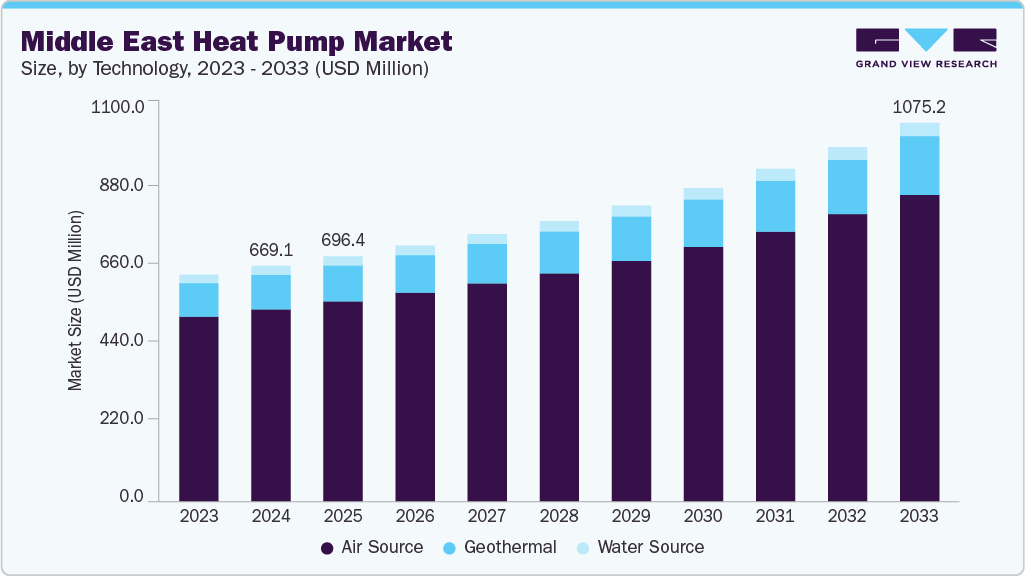
The Middle East heat pump market size was estimated at USD 669.1 million in 2024 and is projected to reach USD 1,075.2 million by 2033, growing at a CAGR of 5.6% from 2025 to 2033. The market is growing steadily due to increasing demand for energy-efficient cooling and heating solutions.
Key Market Trends & Insights
- Saudi Arabia dominated heat pump market over the forecast period accounting for 50.5% market share in 2024.
- By technology, geothermal segment is expected to grow at a considerable CAGR of 6.4% from 2025 to 2033 in terms of revenue.
- By capacity, upto 10 kW segment is expected to grow at a considerable CAGR of 6.8% from 2025 to 2033 in terms of revenue.
- By operation type, electric heat pumps dominated the market in 2024, accounting for the highest revenue share at 88.0%.
- By application, the residential segment dominated the heat pump market in 2024, holding the largest revenue share at 82.5%.
Market Size & Forecast
- 2024 Market Size: USD 669.1 Million
- 2033 Projected Market Size: USD 1,075.2 Million
- CAGR (2025-2033): 5.6%
Government initiatives promoting sustainability, coupled with rising construction activity and awareness of environmental benefits, are driving adoption. Heat pumps offer a viable, eco-friendly alternative to traditional HVAC systems as temperatures rise and electricity costs climb. Innovations such as smart controls, inverter compressors, and hybrid systems allow for better energy management and integration with renewable sources. These advancements make heat pumps more reliable and cost-effective, encouraging wider adoption in both residential and commercial sectors across the region.
Market Concentration & Characteristics
The heat pump market in the Middle East is relatively fragmented. It features a mix of international manufacturers, regional suppliers, and local installers competing across various segments. While global brands dominate high-end and technologically advanced products, many small and medium-sized companies serve niche markets and provide tailored solutions, resulting in a diverse and competitive landscape.
Middle East heat pump market is experiencing significant innovation, driven by advancements in smart technology integration, inverter-driven systems, and hybrid solutions. These innovations enhance energy efficiency and adaptability to the region's extreme climates, making heat pumps more viable for both residential and commercial applications.
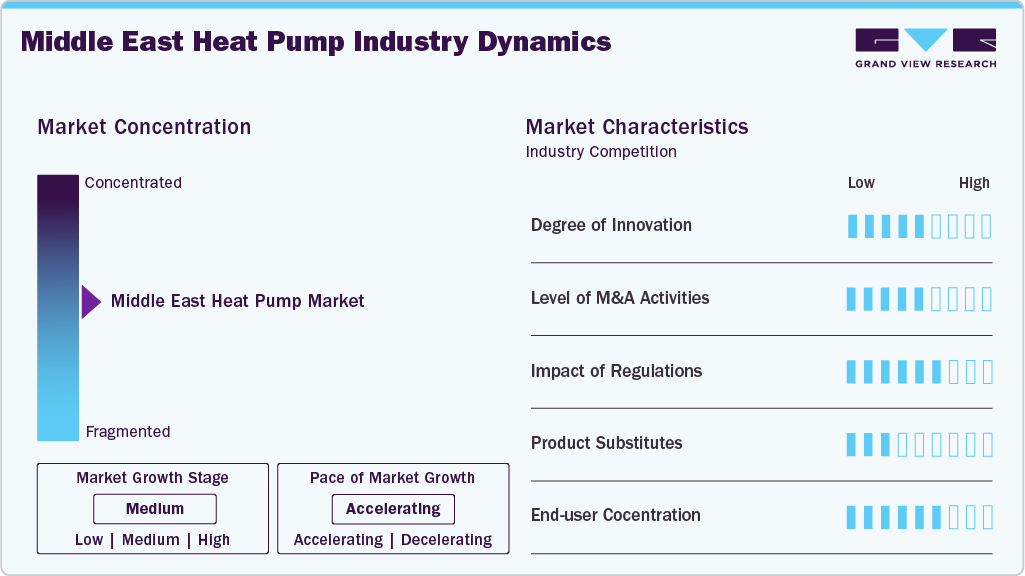
Mergers and acquisitions activities in the Middle East market are growing significantly, as companies aim to expand their market presence and technological capabilities. For instance, in August 2025 Bosch Group acquired Johnson Controls' residential and light commercial HVAC business. This strategic move will significantly help Bosch in expanding its market presence and product offerings.
Regulations are pivotal in shaping the heat pump market in the Middle East. Countries such as the UAE and Saudi Arabia have implemented stringent energy efficiency standards and building codes to promote sustainable construction practices. These regulations encourage the adoption of energy-efficient technologies, including heat pumps, by setting higher performance benchmarks and offering incentives for compliance.
Drivers, Opportunities & Restraints
Rising energy costs and increasing demand for energy-efficient cooling and heating solutions are key market drivers. Governments are promoting sustainable technologies to reduce carbon footprints, while the region's extreme temperatures create a strong need for reliable, cost-effective HVAC alternatives. These factors collectively boost adoption rates of heat pumps across residential, commercial, and industrial sectors.
The expanding construction sector in the Middle East, featuring smart cities and green building initiatives, offers a major opportunity for heat pump adoption. A prime example is NEOM, Saudi Arabia’s USD 500 billion megacity project focused on transforming urban living through sustainability, advanced technology, and innovation, aiming to establish a futuristic, eco-friendly city that sets new benchmarks for smart and sustainable development.
High upfront costs and a lack of widespread consumer awareness pose challenges to the Middle East heat pump market. In addition, extreme climate conditions require specialized, robust systems, increasing complexity and installation costs. Limited local manufacturing and reliance on imports also affect pricing and supply chain stability, potentially hindering rapid market growth and adoption.
Technology Insights
Air Source dominated the market in 2024, accounting for the highest revenue share at 81.6%due to its affordability, relatively simple installation, and compatibility with the region’s climate. It efficiently provides heating and cooling by extracting heat from the air, making it suitable for residential and commercial buildings. In addition, its lower upfront costs and widespread availability than other technologies drive higher adoption rates, reinforcing its market leadership.
The geothermal segment is expected to witness significant growth during the forecast period due to its high energy efficiency and environmental benefits. By utilizing stable underground temperatures, geothermal systems provide consistent heating and cooling with minimal energy consumption. Increasing government focus on sustainability and long-term cost savings in commercial and industrial projects is boosting investments in geothermal technology.
Capacity Insights
10-20 kW dominated the market in 2024, accounting for the highest revenue share at 37.9%because it efficiently meets the heating and cooling needs of small to medium residential and commercial buildings. This range balances power and energy efficiency, making it cost-effective and practical. Its versatility across various applications and compatibility with regional climate conditions have driven widespread adoption.
The upto 10 kW segment is expected to witness significant growth during the forecast period due to rising demand for compact, energy-efficient solutions in smaller residential units and offices. Its lower upfront cost and suitability for limited space installations appeal to urban consumers. Increasing awareness of sustainable heating and cooling, along with government incentives, further accelerates adoption in this segment.
Operation Type Insights
Electric heat pumps dominated the market in 2024, accounting for the highest revenue share at 88.0% due to their simplicity, reliability, and widespread availability of electricity. They are easy to install, require less maintenance, and are compatible with both residential and commercial applications. As many buildings already rely on electric infrastructure, this operation type is cost-effective and scalable, making it the preferred choice for developers, especially in urban areas with growing energy efficiency goals.
The hybrid segment is expected to witness steady growth during the forecast period driven by increasing interest in combining traditional and renewable energy sources for improved efficiency. Hybrid heat pumps integrate electric and gas or solar systems, offering flexible operation in varying climate conditions. They provide higher energy savings and reliability, especially in areas with unstable power supply or extreme temperatures.
Application Insights
The residential segment dominated the heat pump market in 2024, holding the largest revenue share at 82.5% due to rising urbanization, increasing housing developments, and growing awareness of energy-efficient technologies among homeowners. Heat pumps offer an effective alternative to traditional air conditioning systems, providing both heating and cooling in one solution. Government incentives and stricter energy regulations in new housing projects further drive residential adoption, making this segment the largest contributor to market demand.
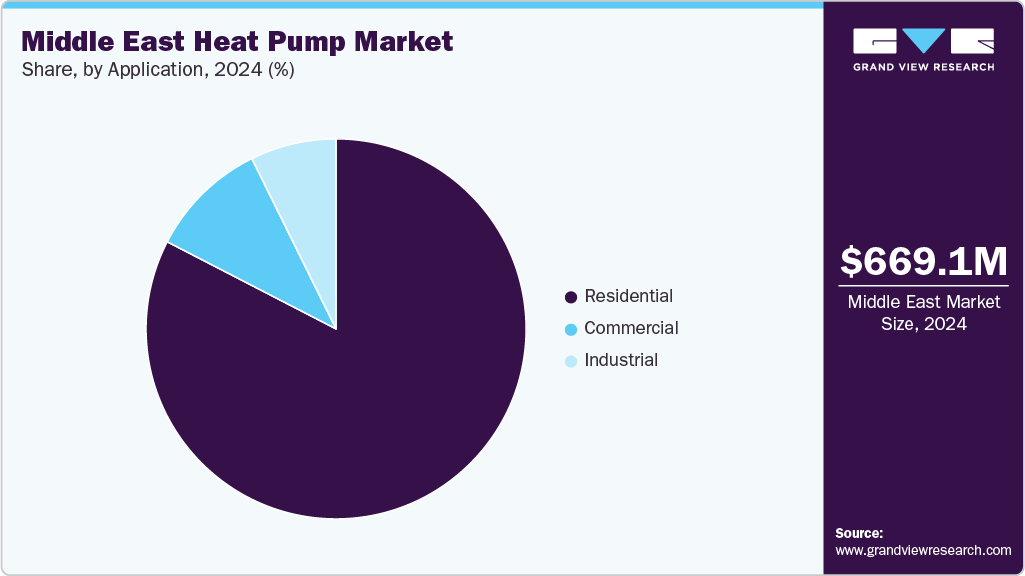
The industrial segment is expected to grow in the heat pump market fueled by increasing demand for sustainable process heating and cooling in sectors such as food processing, chemicals, and manufacturing. As industries face mounting pressure to reduce emissions and energy costs, heat pumps offer a low-carbon, energy-efficient alternative. Large-scale infrastructure projects and ESG commitments in the region are further accelerating the adoption of heat pump systems in industrial applications.
Country Insights
Saudi Arabia Heat Pump Market Trends
Saudi Arabia dominated heat pump market over the forecast period accounting for 50.5% market share in 2024, driven by its Vision 2030 goals, focus on sustainable infrastructure, and major projects such as NEOM. Increasing energy efficiency regulations, expanding construction, and rising awareness of low-emission HVAC solutions are accelerating heat pump adoption across residential and commercial sectors.
UAE Heat Pump Market Trends
The heat pump market in the UAE is expected to grow at a CAGR of 5.7% from 2025 to 2033, supported by its ambitious green building regulations, smart city initiatives, and rising demand for sustainable cooling and heating systems. Government incentives, high urbanization rates, and a push toward net-zero carbon emissions are fostering increased use of efficient heat pump technologies.
Key Middle East Heat Pump Company Insights
Some of the key players operating in the market include Carrier, Daikin Industries, Ltd, Robert Bosch GmbH
-
Carrier is a global provider of heating, ventilation, and air conditioning (HVAC), refrigeration, and building automation solutions. Founded in 1915 by Willis Carrier, the company is known for its wide range of HVAC products designed for residential, commercial, and industrial use. Carrier focuses on energy efficiency and sustainability, offering smart climate control systems that help reduce environmental impact.
-
Daikin Industries, Ltd. is a Japanese multinational company specializing in air conditioning, refrigeration, and climate control systems. Established in 1924, Daikin manufactures a wide portfolio of HVAC equipment for residential, commercial, and industrial markets. The company emphasizes energy-efficient and environmentally conscious technologies, including inverter-based systems and heat pumps.
Key Middle East Heat Pump Companies:
- Carrier
- Daikin Industries, Ltd
- Robert Bosch GmbH
- Lennox International
- Johnson Controls, Inc.
- Midea Group
- Hitachi, Ltd.
- Ingersoll Rand Plc.
- Rheem Manufacturing Company
- HAIER(GENERAL ELECTRIC)
Recent Developments
-
In February 2025, Bosch introduced a new line of residential heat pumps using inverter ducted split (IDS) technology. These systems offer efficient, quiet heating and cooling by adjusting compressor speed based on demand, improving energy savings and indoor comfort. They're designed for flexible installation in modern homes.
-
In May 2024, Daikin partnered with Almoayyed Contracting Group as its new distributor in Bahrain, aiming to strengthen its Middle East presence. This alliance supports Daikin’s global strategy to deliver advanced HVAC solutions and enhance customer access across the region
Middle East Heat Pump Market Report Scope
|
Report Attribute
|
Details
|
|
Market size value in 2025
|
USD 696.4 million
|
|
Revenue forecast in 2033
|
USD 1,075.2 million
|
|
Growth rate
|
CAGR of 5.6% from 2025 to 2033
|
|
Actual data
|
2021 - 2024
|
|
Forecast period
|
2025 - 2033
|
|
Quantitative units
|
Revenue in USD million, volume in thousand units, CAGR from 2025 to 2033
|
|
Report coverage
|
Revenue forecast, company ranking, competitive landscape, growth factors, and trends
|
|
Segments covered
|
Technology, capacity, operation type, application, country
|
|
Country scope
|
Saudi Arabia; UAE; Qatar; Oman
|
|
Key companies profiled
|
Carrier; Daikin Industries, Ltd; Robert Bosch GmbH; Lennox International; Johnson Controls, Inc.; Midea Group; Hitachi, Ltd.; Ingersoll Rand Plc.; Rheem Manufacturing Company; HAIER (GENERAL ELECTRIC)
|
|
Customization scope
|
Free report customization (equivalent up to 8 analysts working days) with purchase. Addition or alteration to country, regional & segment scope.
|
|
Pricing and purchase options
|
Avail customized purchase options to meet your exact research needs. Explore purchase options
|
Middle East Heat Pump Market Report Segmentation
This report forecasts revenue growth at regional and country levels and provides an analysis of the latest industry trends in each of the sub-segments from 2021 to 2033. For this study, Grand View Research has segmented the Middle East heat pump market report based on technology, capacity, operation type, application, and country:
-
Technology Outlook (Volume Thousand Units; Revenue, USD Million, 2021 - 2033)
-
Air Source
-
Water Source
-
Geothermal
-
Capacity Outlook (Volume Thousand Units; Revenue, USD Million, 2021 - 2033)
-
Upto 10 kW
-
10 - 20 kW
-
20 - 50 kW
-
50 - 100 kW
-
100 - 200 kW
-
200 - 500KW
-
500 - 1000KW
-
Above 1000 KW
-
Operation Type Outlook (Volume Thousand Units; Revenue, USD Million, 2021 - 2033)
-
Application Outlook (Volume Thousand Units; Revenue, USD Million, 2021 - 2033)
-
Residential
-
Industrial
-
Commercial
-
Country Outlook (Volume Thousand Units; Revenue, USD Million, 2021 - 2033)
-
Saudi Arabia
-
UAE
-
Qatar
-
Oman
Frequently Asked Questions About This Report
b. The Middle East heat pump market size was estimated at USD 669.1 million in 2024 and is expected to be USD 696.4 million in 2025.
b. The Middle East heat pump market, in terms of revenue, is expected to grow at a compound annual growth rate of 5.6% from 2025 to 2033 to reach USD 1075.2 million by 2033.
b. Air Source dominated the market in 2024, accounting for the highest revenue share at 81.6% due to its affordability, relatively simple installation, and compatibility with the region’s climate. It efficiently provides heating and cooling by extracting heat from the air, making it suitable for residential and commercial buildings. Additionally, its lower upfront costs and widespread availability compared to other technologies drive higher adoption rates, reinforcing its market leadership.
b. Some of the key players operating in the Middle East heat pump market include Carrier, Daikin Industries, Ltd, Robert Bosch GmbH, Lennox International, Johnson Controls, Inc., Midea Group, Hitachi, Ltd., Ingersoll Rand Plc., Rheem Manufacturing Company, HAIER (GENERAL ELECTRIC)
b. Key factors driving the Middle East heat pump market include rising energy efficiency demands, government sustainability initiatives, growing construction activities, increased awareness of eco-friendly HVAC systems, and the region’s shift toward renewable energy to reduce carbon emissions and energy costs.

 Download Sample Report
















