
- Home
- »
- Power Generation & Storage
- »
-
Middle East Lithium-ion Battery Market Size Report, 2033GVR Report cover

Middle East Lithium-ion Battery Market (2025 - 2033) Size, Share & Trends Analysis Report By Product, By Application (Automotive, Consumer Electronics, Industrial, Energy Storage Systems), By Country, And Segment Forecasts
Middle East Lithium-ion Battery Market Summary
The Middle East lithium-ion battery market size was estimated at approximately USD 0.89 billion in 2024 and is projected to reach USD 3.47 billion by 2033, growing at a CAGR of 16.4% from 2025 to 2033. Demand is fueled by rapid advancements in electric mobility, renewable energy integration, and grid modernization, with lithium-ion batteries serving as a critical enabler of the region’s clean energy transition.
Key Market Trends & Insights
- The Saudi Arabia lithium-ion battery market held the largest revenue share of 42.83% in 2024.
- The lithium-ion battery market in the Middle East is expected to grow significantly from 2025 to 2033.
- By product, Lithium iron phosphate (LFP) held the highest market share of 38.13% in 2024.
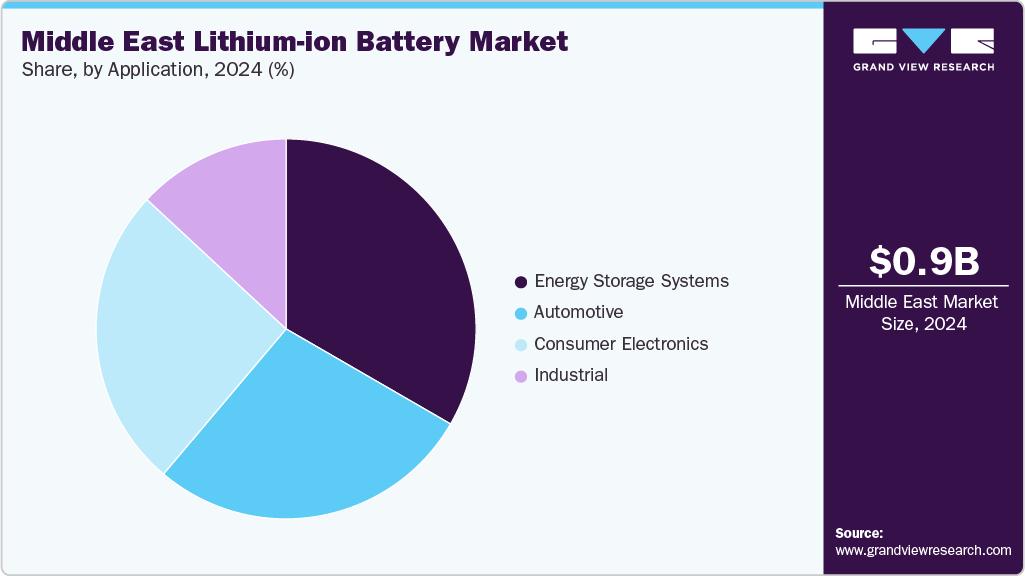
- By application, the automotive segment held the highest market share in 2024.
Market Size & Forecast
- 2024 Market Size: USD 0.89 Billion
- 2033 Projected Market Size: USD 3.47 Billion
- CAGR (2025-2033): 16.4%
- Saudi Arabia: Largest Market in 2024
Prism AI by Grand View Research Free to tryAsk a question about the middle east lithium-ion battery marketTry asking✓Every figure cited from GVR research Prefer the report? Download free sample →
National strategies such as Saudi Vision 2030, the UAE’s Energy Strategy 2050, and Egypt’s renewable expansion plans are accelerating investments in energy storage solutions to support solar, wind, and hydrogen projects. Countries such as Saudi Arabia, the UAE, Egypt, and Israel increasingly prioritize battery projects to strengthen electric vehicle (EV) adoption, stabilize renewable-heavy grids, and power industrial applications, creating a diverse demand landscape across sectors. Source: Grand View Research, IR Documents, Primary Interviews, Paid DatabasesTo learn more about this report,
 Download Free Sample Report
Growth in the Middle East lithium-ion battery industry is driven by rising EV adoption, large-scale renewable integration, and strong government support for localized battery manufacturing and supply chain development. Technological advancements in solid-state batteries, recycling solutions, and grid-scale storage systems are improving performance, cost efficiency, and sustainability. Integrated storage networks connecting renewable energy plants, industrial hubs, and residential deployments are becoming critical to balancing electricity demand while reducing carbon emissions. Strategic partnerships between regional developers and global battery leaders are accelerating the deployment of lithium-ion systems across transportation, industrial, and utility applications. With leading companies such as Tesla, CATL, Samsung SDI, Panasonic, and regional players like Masdar and ACWA Power spearheading large-scale investments, the market is set for steady and long-term growth over the next decade.
Drivers, Opportunities & Restraints
The Middle East lithium-ion battery market is primarily driven by the region’s accelerating push toward renewable energy integration, electric mobility, and grid modernization. National initiatives such as Saudi Vision 2030, the UAE Energy Strategy 2050, and Egypt’s renewable expansion programs position energy storage as a cornerstone of clean energy adoption. Rising demand for electric vehicles (EVs), large-scale solar and wind deployment, and the need for backup power in industrial and commercial sectors further fuel adoption. Additionally, government-backed investments in localized manufacturing and recycling infrastructure strengthen regional supply chains and reduce reliance on imports. Lithium-ion batteries emerge as a key enabler of energy security and decarbonization goals as nations diversify energy portfolios.
Opportunities in the market include the expansion of EV charging infrastructure, partnerships for localized gigafactory developments, and integrating grid-scale storage solutions to stabilize renewable-heavy power networks. Advancements in solid-state battery technology, second-life battery applications, and recycling solutions offer significant potential to reduce costs and improve sustainability. Moreover, initiatives to integrate lithium-ion batteries with hydrogen and hybrid storage systems present avenues for next-generation energy solutions. However, the market faces restraints such as high upfront costs, dependence on imported raw materials, and supply chain vulnerabilities in critical minerals like lithium, cobalt, and nickel. Geopolitical risks, policy uncertainties, and the rapid pace of global technological change also challenge regional adoption. Despite these hurdles, continued investment momentum, strategic partnerships with international players, and strong government support are expected to keep the market on a robust growth trajectory.
Product Insights
The lithium iron phosphate (LFP) segment held the largest revenue share of 38.13% in 2024, driven by its superior thermal stability, long cycle life, and cost-effectiveness compared to other chemistries. LFP batteries are increasingly adopted in stationary energy storage projects, electric mobility, and renewable energy integration across the region. With countries such as the UAE, Saudi Arabia, and Egypt accelerating investments in solar-plus-storage and grid stabilization projects, LFP technology offers the durability and safety profile needed for large-scale deployment in hot desert climates. Additionally, the chemistry’s lower risk of thermal runaway compared to nickel-rich alternatives has made it a preferred choice for regional utilities and industrial operators prioritizing safety and reliability.
The growth of the LFP segment is further fueled by rising adoption of electric vehicles (EVs), government-backed renewable energy initiatives, and demand for cost-efficient storage systems to balance intermittent renewable generation. Manufacturers are increasingly localizing supply chains and partnering with Middle Eastern stakeholders to expand deployment, particularly in grid-connected and off-grid storage projects. While other chemistries such as nickel manganese cobalt (NMC) and lithium titanate (LTO) continue to serve high-performance applications, LFP’s balance of safety, affordability, and scalability positions it as the leading battery chemistry in the region. As the Middle East intensifies its shift toward decarbonization and energy diversification, the LFP segment will remain at the forefront of lithium-ion battery adoption throughout the forecast period.
Application Insights
The automotive segment led the Middle East lithium-ion battery industry with the largest revenue share of 33.34% in 2024, underscoring the region’s accelerating transition toward electric mobility. With governments such as Saudi Arabia, the UAE, and Egypt unveiling ambitious EV adoption targets and incentives, demand for advanced lithium-ion batteries has surged to power electric cars, buses, and two-wheelers. Automakers and battery manufacturers are increasingly collaborating with regional stakeholders to establish EV assembly plants, charging infrastructure, and localized supply chains to meet the growing need for sustainable transport solutions. The strong performance of the automotive segment also reflects rising consumer awareness, declining EV costs, and national strategies that align with global decarbonization goals.
 To learn more about this report, Download Free Sample Report
Growth in this segment is further supported by large-scale investments in battery innovation, longer driving ranges, and improved charging efficiency, which are key to encouraging mass adoption of EVs across the Middle East. Countries like the UAE and Saudi Arabia are spearheading flagship projects, such as electrified public transport fleets and smart city initiatives, where lithium-ion batteries are central in reducing carbon emissions and dependence on fossil fuels. While industrial and energy storage applications continue to expand, the automotive sector remains the dominant driver of lithium-ion battery demand, positioning it as the cornerstone of the region’s energy transition. With continued policy support and private sector investment, the automotive segment is expected to sustain its leadership throughout the forecast period.
Country Insights
The Saudi Arabia lithium-ion battery market accounted for the largest share of 42.83% in 2024, driven by robust demand from the electric mobility, renewable energy storage, and industrial sectors. The Kingdom's Vision 2030 strategy has accelerated large-scale adoption of energy storage technologies to support its renewable energy targets, including projects under the National Renewable Energy Program (NREP) and giga-developments such as NEOM. Saudi Aramco and SABIC investments, along with partnerships with global battery manufacturers, are expanding the domestic supply chain for advanced battery technologies. Government-backed incentives for EV adoption and energy storage integration also solidify Saudi Arabia's leadership position.
The Kingdom's geographic advantage and financial strength enable it to spearhead regional lithium-ion battery adoption across diverse applications, from grid-scale storage to consumer electronics. The Ministry of Energy supports the expansion of localized manufacturing, which aims to reduce import dependency and foster a competitive domestic industry. With clear regulatory frameworks and strategic capital allocation, Saudi Arabia will remain the dominant market player throughout the forecast period.
The lithium-ion battery market in the UAE represents a rapidly growing regional landscape, underpinned by its strong clean energy agenda and technological innovation. Driven by the UAE Energy Strategy 2050, the country integrates lithium-ion storage solutions into large-scale solar and wind projects, particularly in Abu Dhabi and Dubai. Initiatives such as the Mohammed bin Rashid Al Maktoum Solar Park and pilot EV infrastructure programs highlight the UAE's commitment to energy storage as a key enabler of its net-zero ambitions.
The government's proactive approach to smart grid deployment and incentives for EV adoption and energy storage R&D positions the UAE as a regional hub for advanced energy technologies. Strategic collaborations between ADNOC, Masdar, and international players foster new battery pilot projects and localized production facilities. With strong policy support and rising demand across renewable and mobility applications, the UAE is expected to remain a fast-growing market within the region.
Israel is emerging as an innovation-driven market in the Middle East lithium-ion battery sector, supported by its advanced R&D ecosystem and thriving startup culture. The country invests heavily in battery technology development, including next-generation lithium-ion cells and solid-state innovations, led by universities and private companies. Given Israel's strong high-tech and military-industrial base, domestic demand is fueled by EV adoption, renewable energy integration, and defense applications.
The government's commitment to reducing fossil fuel dependency and strong venture capital backing have created opportunities to commercialize advanced battery technologies. Partnerships with global players for scaling local innovations into mass production strengthen Israel's regional market role. Despite its smaller geographic size, Israel's technology leadership ensures it plays an outsized role in shaping the future of lithium-ion battery adoption in the Middle East.
The Turkey lithium-ion battery market is steadily growing, supported by rising EV adoption, renewable energy integration, and industrial applications. The country's automotive sector, a critical pillar of its economy, is increasingly shifting toward electric mobility, creating significant demand for domestic lithium-ion battery production. Establishing large-scale battery factories, such as TOGG's initiatives in collaboration with Farasis Energy, underscores Turkey's ambition to become a regional manufacturing hub.
In addition to mobility, Turkey's energy transition strategy, including expanding solar and wind capacity, drives the integration of grid-scale storage solutions. Supportive government policies and foreign investments enhance the country's battery supply chain and infrastructure. With its strategic geographic position bridging Europe and the Middle East, Turkey is expected to play a vital role in domestic and export-oriented lithium-ion battery markets.
Egypt is in the early stages of lithium-ion battery adoption but is witnessing growing demand due to its renewable energy expansion and electrification programs. Projects such as the Benban Solar Park and the government's National Energy Strategy are increasing the need for energy storage systems to stabilize intermittent renewable supply. Egypt's plans to establish a domestic EV market and expand charging infrastructure are gradually creating opportunities for lithium-ion battery deployment.
The government is also encouraging partnerships with foreign technology providers to build localized energy storage and battery assembly expertise. While challenges such as high upfront costs and limited supply chain capabilities persist, Egypt's long-term renewable energy commitments position it as a future growth market. With rising investment in clean energy projects and strategic location as a North African hub, Egypt is expected to emerge as an important market for lithium-ion batteries in the coming years.
Key Middle East Lithium-ion Battery Company Insights
The key players operating in the Middle East lithium-ion battery market actively engage in supplying advanced lithium-ion battery technologies for applications spanning electric vehicles (EVs), renewable energy storage, and grid stabilization projects across the region.
Key Middle East Lithium-ion Battery Companies:
- Samsung SDI Co., Ltd.
- LG Energy Solution, Ltd.
- Panasonic Energy Co., Ltd.
- CATL
- BYD Company Ltd.
- Tesla, Inc.
- Toshiba Corporation
- Hitachi Energy Ltd.
- Siemens Energy AG
- Leclanché SA
Recent Developments
-
In March 2025, LG Energy Solution, Ltd. announced the launch of a large-scale lithium-ion battery assembly facility in the United Arab Emirates, aimed at catering to the region’s growing demand for energy storage and electric mobility solutions. The facility focuses on producing high-capacity battery packs for renewable integration projects, electric buses, and grid stabilization initiatives.
Middle East Lithium-ion Battery Market Report Scope
Report Attribute
Details
Market size value in 2025
USD 1.03 billion
Revenue forecast in 2033
USD 3.47 billion
Growth rate
CAGR of 16.4% from 2025 to 2033
Base year for estimation
2024
Historical data
2021 - 2023
Forecast period
2025 - 2033
Quantitative units
Volume in GWh, Revenue in USD million/billion, and CAGR from 2025 to 2033
Report coverage
Revenue forecast, competitive landscape, growth factors, and trends
Segments covered
Product, application, country
Country scope
Saudi Arabia; UAE; Israel; Turkey; Egypt
Key companies profiled
Samsung SDI Co., Ltd.; LG Energy Solution, Ltd.; Panasonic Energy Co., Ltd.; CATL; BYD Company Ltd.; Tesla, Inc.; Toshiba Corporation; Hitachi Energy Ltd.; Siemens Energy AG; Leclanché SA
Customization scope
Free report customization (equivalent up to 8 analysts working days) with purchase. Addition or alteration to country, regional & segment scope.
Pricing and purchase options
Avail customized purchase options to meet your exact research needs. Explore purchase options
Middle East Lithium-ion Battery Market Report Segmentation
This report forecasts volume & revenue growth at the regional and country levels and provides an analysis of the latest industry trends in each of the sub-segments from 2021 to 2033. For this study, Grand View Research has segmented the Middle East Lithium-ion Battery market report on the basis of product, application, and country:
-
Product Outlook (Volume, GWh; Revenue, USD Million, 2021 - 2033)
-
Lithium cobalt oxide (LCO)
-
Lithium iron phosphate (LFP)
-
Lithium Nickel Cobalt Aluminum Oxide (NCA)
-
Lithium Manganese Oxide (LMO)
-
Lithium Titanate
-
Lithium Nickel Manganese Cobalt (LMC)
-
-
Application Outlook (Volume, GWh; Revenue, USD Million, 2021 - 2033)
-
Automotive
-
Consumer Electronics
-
Industrial
-
Energy Storage Systems
-
-
Country Outlook (Volume, GWh; Revenue, USD Million, 2021 - 2033)
-
Middle East
-
UAE
-
Saudi Arabia
-
Israel
-
Turkey
-
Egypt
-
-
Frequently Asked Questions About This Report
The Middle East lithium-ion battery market size was estimated at USD 0.89 billion in 2024 and is expected to reach USD 1.03 billion in 2025.
The Middle East lithium-ion battery market is expected to grow at a compound annual growth rate of 16.4% from 2025 to 2033 to reach USD 3.47 billion by 2033.
Based on the application segment, Automotive held the largest revenue share of 33.34% in the Middle East Lithium-ion Battery market in 2024.
Some of the key vendors operating in the Middle East lithium-ion battery market include Samsung SDI Co., Ltd.; LG Energy Solution, Ltd.; Panasonic Energy Co., Ltd.; Contemporary Amperex Technology Co. Limited (CATL); BYD Company Ltd.; Tesla, Inc.; Toshiba Corporation; Hitachi Energy Ltd.; Siemens Energy AG; and Leclanché SA, among others.
The key factors driving the Middle East lithium-ion battery market include the region’s accelerating adoption of electric vehicles, large-scale integration of renewable energy, and the rising demand for advanced energy storage solutions to support grid stability.
About the Author(s)
Power Generation & Storage Research Team
Energy & Power · Power Generation & StorageThis report was authored by the power generation & storage research team at Grand View Research - comprising two research analysts, one senior research analyst, and one industry expert - with specialized expertise in the power generation & storage segment of the energy & power industry. All findings are based on proprietary energy & power databases, executive interviews, and regulatory analysis, subject to internal peer review prior to publication.
Last Updated:
Speak to Analyst

Customize this report to your needs - add regions, segments, or data points, with 20% free customization.
Or view our licence options:


ISO 9001:2015 & 27001:2022 Certified
We are GDPR and CCPA compliant! Your transaction & personal information is safe and secure. For more details, please read our privacy policy.


