Middle East Lubricant Additives Market Summary
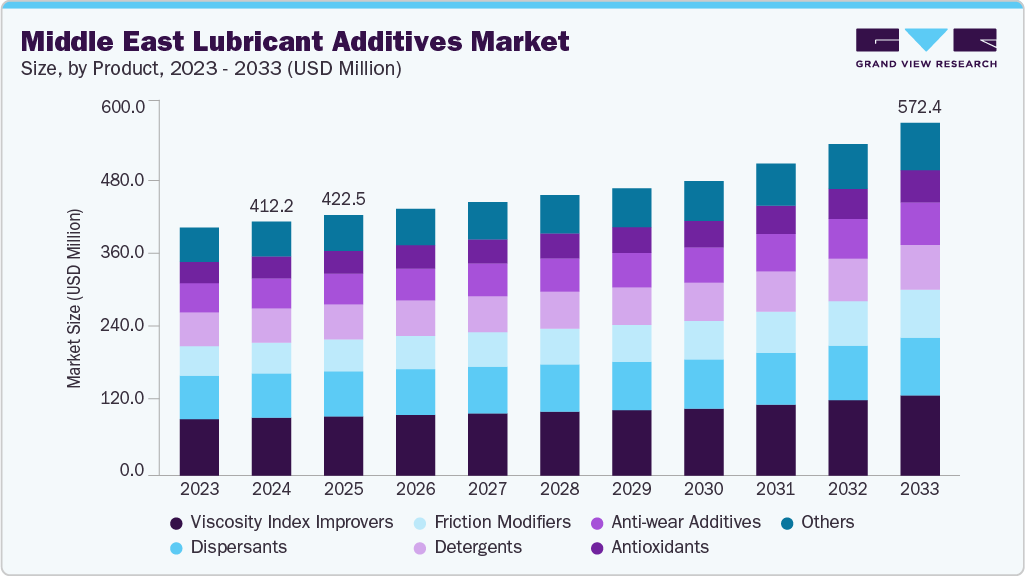
The Middle East lubricant additives market size was estimated at USD 412.2 million in 2024 and is projected to reach USD 572.4 million by 2033, growing at a CAGR of 3.9% from 2025 to 2033. The market is driven by a growing automotive fleet in non-GCC countries, rising penetration of high-performance synthetic lubricants in the GCC, and expanding industrial activities across refining, petrochemicals, utilities, and construction sectors.
Key Market Trends & Insights
- The lubricant additives market in Oman is expected to grow at the fastest CAGR of 4.8% from 2025 to 2033 in terms of revenue.
- By product, the friction modifiers segment is expected to grow at the fastest CAGR of 5.1% from 2025 to 2033 in terms of revenue.
- By product, the viscosity index improvers segment dominated the market with the largest revenue share of 22.8% in 2024.
- By application, the automotive lubricants segment captured the largest revenue share of 65.1% in 2024.
Market Size & Forecast
- 2024 Market Size: USD 412.2 Million
- 2033 Projected Market Size: USD 572.4 Million
- CAGR (2025-2033): 3.9%
OEM specifications for extended drain intervals and warranty compliance further boost the demand for advanced additive formulations, while regional infrastructure and marine expansion enhance consumption in industrial lubricants. Significant opportunities exist in localized additive package blending and technical service hubs within the GCC, which can reduce supply chains and enhance responsiveness to market needs. The growing trend toward low-SAPS and fuel-efficient formulations opens up possibilities for innovation in friction modifiers, antioxidants, and VI improvers. Moreover, partnerships with national oil companies and fleet operators offer strong avenues for co-development and premium product positioning.
The market faces challenges due to price sensitivity in non-GCC countries, counterfeiting and unauthorized imports that harm brand integrity, and inconsistent fuel sulfur standards across the region, which complicate additive strategies. Additionally, regulatory shifts toward cleaner fuels and compatibility with after-treatment systems may limit the use of traditional high-ZDDP and high-TBN additives, while the steady adoption of electric and hybrid vehicles presents a long-term volume risk in the automotive sector.
Market Concentration & Characteristics
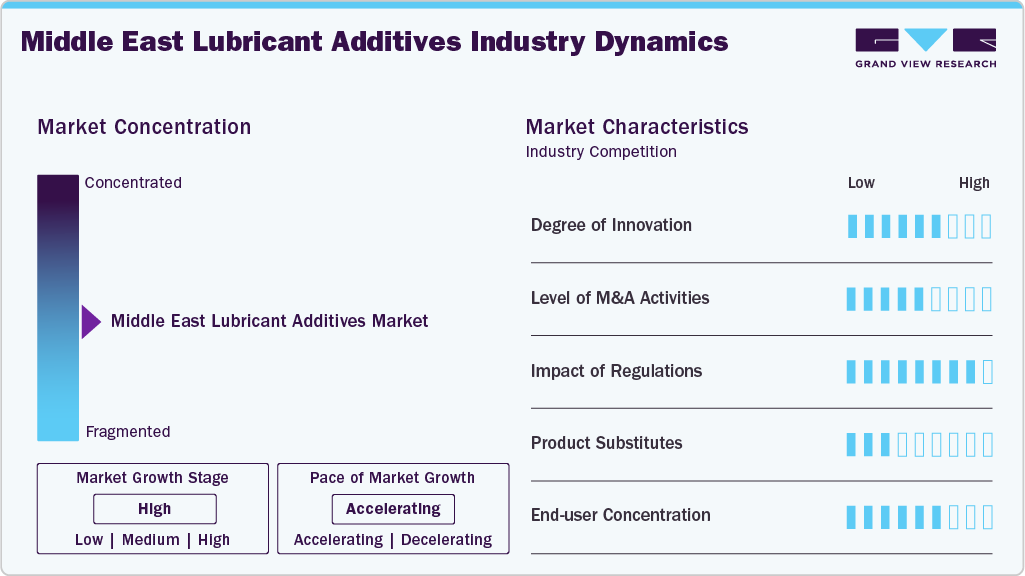
The Middle East lubricant additives market is moderately fragmented. The industry is dominated by global majors such as Lubrizol, BASF SE, Chevron Oronite Company LLC, Afton Chemical Corp., and Afton Chemical Corp. These players hold strong market positions through their established global supply networks, extensive product portfolios covering dispersants, detergents, VI improvers, antioxidants, and friction modifiers, and robust technical support infrastructure. Regional blenders and national oil company-affiliated brands leverage strategic partnerships with these additive suppliers to expand their offerings and meet evolving performance specifications.
Leading companies are focusing on expanding local blending and distribution facilities, especially in the GCC, to decrease lead times and boost cost competitiveness. They are actively collaborating on co-development projects with regional blenders and OEMs to create customized additive packages that meet local fuel quality and emission standards. Strategic investments are being made in technical service centers, oil analysis laboratories, and field testing programs to strengthen customer relationships, ensure compliance with API and ACEA standards, and promote high-quality additive formulations. Furthermore, partnerships, mergers, and acquisitions are being used to improve market access and drive growth in the industrial and marine lubricant segments.
Product Insights
Viscosity index improvers dominated the Middle East lubricant additives market in 2024, accounting for the largest revenue share of 22.8%. This leadership is driven by the growing use of multigrade lubricants in both passenger car motor oils (PCMO) and heavy-duty motor oils (HDMO), where maintaining consistent viscosity is vital due to extreme temperature variations common in the region. The strong demand for synthetic and semi-synthetic lubricants in the GCC, along with evolving OEM standards emphasizing longer drain intervals, thermal stability, and fuel efficiency, has further boosted the adoption of high-performance VI improvers. Their ability to improve shear stability and preserve lubricant quality under tough operating conditions sustains their dominant market position.
Beyond viscosity index improvers, dispersants and detergents are in high demand because of their key role in keeping engines clean and neutralizing acidic by-products, especially in heavy-duty diesel fleets and industrial engines. Anti-wear additives, like ZDDP and ashless formulas, are essential for protecting engine and machinery parts in high-load and high-temperature conditions, while antioxidants provide resistance to oxidation in both automotive and industrial uses. Friction modifiers are gradually gaining traction, driven by OEM fuel economy targets and the increasing presence of luxury and high-performance vehicles in the GCC. Other products, such as pour-point depressants, corrosion inhibitors, anti-foam agents, and extreme-pressure additives, meet specialized needs in marine, metalworking, and power generation industries, helping diversify the regional lubricant additives portfolio.
Application Insights
General industrial oil lubricants dominated the Middle East lubricant additives market in 2024, capturing the largest revenue share of 65.1%. This lead is mainly driven by the large on-road vehicle fleet across both passenger and commercial sectors, with heavy-duty motor oils (HDMO) dominating demand in markets like Saudi Arabia and Iraq. Meanwhile, passenger car motor oils (PCMO) show strong growth in the GCC due to increased adoption of synthetic and semi-synthetic lubricants. Rising vehicle ownership, along with OEM requirements for advanced formulations that offer longer drain intervals, low-SAPS properties, and better engine protection, has increased additive treatment rates. The growth of logistics, construction, and public transport fleets across the region continues to support strong demand for automotive lubricants, reinforcing this segment's dominant position.
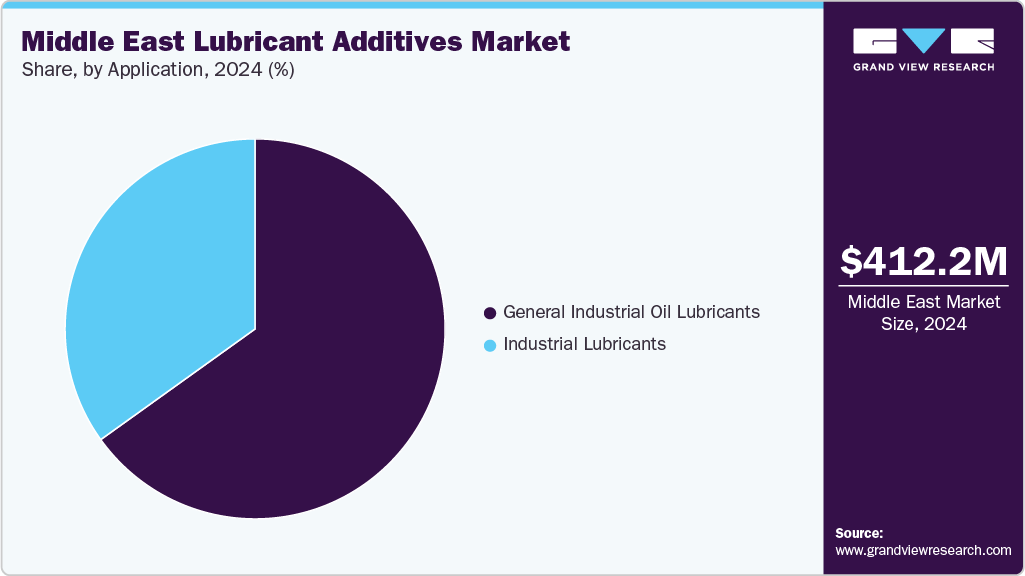
Industrial lubricants are a growing segment, fueled by large investments in refining, petrochemicals, power generation, mining, and marine industries across the Middle East. General industrial oils, such as hydraulic, turbine, and compressor oils, make up a significant part of this market, followed by industrial engine oils used in gas-fired and stationary engines in utilities and manufacturing. Metalworking fluids are steadily increasing in fabrication and metal processing centers, especially in the UAE and Saudi Arabia, supported by infrastructure and industrial development projects. Other types of industrial lubricants, including marine cylinder oils, industrial gear oils, and specialty greases, continue to grow with expanding port operations, offshore projects, and regional energy initiatives, offering long-term opportunities for lubricant additive suppliers.
Regional Insights
The Middle East lubricant additives market is driven by a mix of mature GCC economies with a strong preference for high-performance lubricants and emerging markets characterized by large on-road fleets and growing industrial activities. GCC nations, led by the UAE, Qatar, and Kuwait, are experiencing increased adoption of synthetic and semi-synthetic lubricants, fueling higher demand for advanced additive formulations such as viscosity index improvers, antioxidants, and friction modifiers. Meanwhile, countries like Iraq and Iran continue to produce significant volumes through heavy-duty motor oil consumption, supported by large-scale logistics and infrastructure projects. The region’s expanding power generation, petrochemical, and marine industries further support the steady growth of industrial lubricants, creating opportunities for suppliers to localize blending operations and improve supply chain responsiveness.
Saudi Arabia Lubricant Additives Market Trends
Saudi Arabia is the largest market for lubricant additives in the Middle East, fueled by its extensive commercial vehicle fleet, high usage of off-highway equipment in construction and mining, and a strong industrial sector. Heavy-duty motor oils are the main drivers of additive demand, with dispersants, detergents, and anti-wear additives essential for maintaining engine cleanliness and durability in tough conditions. The country is gradually shifting toward higher-quality lubricant formulations, including synthetic and low-SAPS oils, as OEM standards become more stringent and longer drain intervals are more widely accepted. Continuous investments in refining, petrochemicals, and industrial infrastructure, along with government efforts to improve transportation and logistics networks, help position Saudi Arabia as a key hub for lubricant additive consumption in the region.
Key Middle East Lubricant Additives Company Insights
Some of the key players operating in the Middle East Lubricant Additives market include Lubrizol, Afton Chemical Corp. and BASF SE.
-
Lubrizol is a leading global supplier of lubricant additives with a strong footprint in the Middle East, serving both automotive and industrial lubricant segments. The company leverages its extensive portfolio of dispersants, detergents, viscosity index improvers, anti-wear additives, and antioxidants to cater to the diverse needs of regional blenders, OEMs, and industrial end users. Through strategic partnerships with local distributors and collaborations with national oil companies, Lubrizol focuses on delivering high-performance additive packages that comply with API, ACEA, and OEM specifications. Its investments in technical service centers, oil analysis programs, and field testing initiatives across the GCC enhance customer engagement and support the growing demand for synthetic and low-SAPS formulations. This proactive approach positions Lubrizol as a key enabler of the region’s transition towards premium and extended-drain lubricant solutions.
Key Middle East Lubricant Additives Companies:
- Afton Chemical Corp.
- BASF SE
- Lubrizol
- BRB International B.V.
- Chevron Oronite Company LLC
- Daelim Co. Ltd.
- Evonik Industries AG
- Dorf-Ketal Chemicals India Pvt. Ltd.
- Dover Chemical Corp.
- LANXESS
Middle East Lubricant Additives Market Report Scope
|
Report Attribute
|
Details
|
|
Market size value in 2025
|
USD 422.5 million
|
|
Revenue forecast in 2033
|
USD 572.4 million
|
|
Growth rate
|
CAGR of 3.9% from 2025 to 2033
|
|
Base year for estimation
|
2024
|
|
Historical data
|
2018 - 2023
|
|
Forecast period
|
2025 - 2033
|
|
Quantitative units
|
Revenue in USD million/billion, Volume in Kilotons, and CAGR from 2025 to 2033
|
|
Report coverage
|
Revenue forecast, company ranking, competitive landscape, growth factors, and trends
|
|
Segments covered
|
Product, application, country
|
|
Country scope
|
Oman; Kuwait; Saudi Arabia; UAE; Qatar; Bahrain; Israel; Rest of Middle East
|
|
Key companies profiled
|
Afton Chemical Corp.; BASF SE; Lubrizol; BRB International B.V.; Chevron Oronite Company LLC; Daelim Co. Ltd.; Evonik Industries AG; Dorf-Ketal Chemicals India Pvt. Ltd.; Dover Chemical Corp.; LANXESS
|
|
Customization scope
|
Free report customization (equivalent to up to 8 analysts’ working days) with purchase. Addition or alteration to country, regional & segment scope.
|
|
Pricing and purchase options
|
Avail customized purchase options to meet your exact research needs. Explore purchase options
|
Middle East Lubricant Additives Market Report Segmentation
This report forecasts revenue growth at global, regional, and country levels and provides an analysis of the latest industry trends in each of the sub-segments from 2018 to 2033. For this study, Grand View Research has segmented the Middle East lubricant additives market report based on product, application, and country:
-
Product Outlook (Revenue, USD Billion; Volume, Kilotons; 2018 - 2033)
-
Application Outlook (Revenue, USD Billion; Volume, Kilotons; 2018 - 2033)
-
Country Outlook (Revenue, USD Billion; Volume, Kilotons; 2018 - 2033)
-
Oman
-
Kuwait
-
Saudi Arabia
-
UAE
-
Qatar
-
Bahrain
-
Israel
-
Rest of Middle East
Frequently Asked Questions About This Report
b. The Middle East lubricant additives market size was estimated at USD 412.2 million in 2024 and is expected to reach USD 422.5 million in 2025.
b. The Middle East lubricant additives market is expected to grow at a compound annual growth rate of 3.9% from 2025 to 2033 to reach USD 572.4 million by 2033.
b. Viscosity index improvers segment held the largest revenue share in 2024 due to their critical role in enhancing lubricant performance across varying temperatures, ensuring optimal engine protection and fuel efficiency. Rising demand for high-performance automotive and industrial lubricants, driven by evolving emission regulations and extended oil drain intervals, further accelerated their adoption in the Middle East market.
b. Some of the key players operating in the Middle East lubricant additives market include Afton Chemical Corp., BASF SE, Lubrizol, BRB International B.V., Chevron Oronite Company LLC, Daelim Co. Ltd., Evonik Industries AG, Dorf-Ketal Chemicals India Pvt. Ltd., Dover Chemical Corp., and LANXESS.
b. The Middle East lubricant additives market is driven by the rising demand for high-performance lubricants in automotive and industrial sectors and the growing emphasis on fuel efficiency and emission reduction. Increasing vehicle parc and expanding manufacturing activities further bolster market growth.

 Download Sample Report
















