Middle East Nanocomposites Market Summary
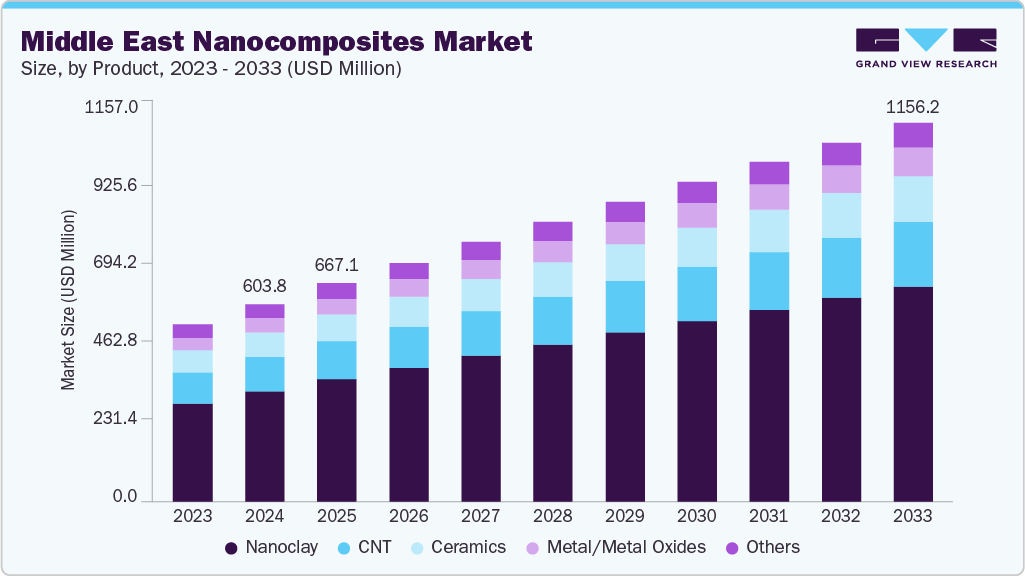
The Middle East nanocomposites market size was estimated at USD 603.8 million in 2024 and is projected to reach USD 1156.2 million by 2033, growing at a CAGR of 7.1% from 2025 to 2033. The demand for nanocomposites in the Middle East is increasing primarily due to their superior mechanical, thermal, and barrier properties compared to conventional materials.
Key Market Trends & Insights
- Saudi Arabia dominated the Middle East nanocomposites market with the largest revenue share of 32.4% in 2024.
- By product, the nanoclay segment held the highest revenue market share of 55.9% in 2024.
- By application, the electronics & electrical segment held the highest revenue market share of 17.3% in 2024.
Market Size & Forecast
- 2024 Market Size: USD 603.8 Million
- 2033 Projected Market Size: USD 1,156.2 Million
- CAGR (2025-2033): 7.1%
Industries such as automotive, construction, aerospace, energy, and healthcare are increasingly adopting nanocomposites for light weighting, durability, and enhanced performance. The surge in infrastructure development projects, coupled with the growth of renewable energy and oil & gas sectors, is also pushing demand. In packaging, nanocomposites are finding applications for improving shelf life and product protection.
Key drivers of demand for nanocomposites in the Middle East include rising investments in smart infrastructure, expansion of automotive manufacturing, and a shift towards lightweight and fuel-efficient materials. The oil & gas sector relies heavily on nanocomposites for corrosion resistance and high-strength applications in pipelines and drilling equipment. In addition, the healthcare sector is adopting nanocomposites for biomedical implants, coatings, and drug delivery systems. Growing awareness of sustainable and recyclable materials is also driving their adoption in packaging.
Middle Eastern governments are actively supporting the adoption of nanocomposites through policies that promote research and innovation. Countries like Saudi Arabia, the UAE, and Qatar are investing in nanotechnology research centers and collaborations with global universities to strengthen domestic manufacturing. National strategies, such as Saudi Vision 2030 and UAE’s Strategy for Advanced Industries, emphasize the development of advanced materials including nanocomposites. Governments are also pushing initiatives for energy efficiency, sustainability, and industrial diversification, where nanocomposites play a crucial role.
Market Concentration & Characteristics
The Middle East nanocomposites market is moderately concentrated, with a mix of international players and local manufacturers. Large multinational companies dominate high-value applications in aerospace, automotive, and healthcare, while regional firms focus on construction, packaging, and industrial uses. The market is characterized by strategic collaborations, technology licensing, and joint ventures with research centers. Since nanocomposites require advanced production capabilities, barriers to entry are relatively high, making the market less fragmented compared to conventional composites.
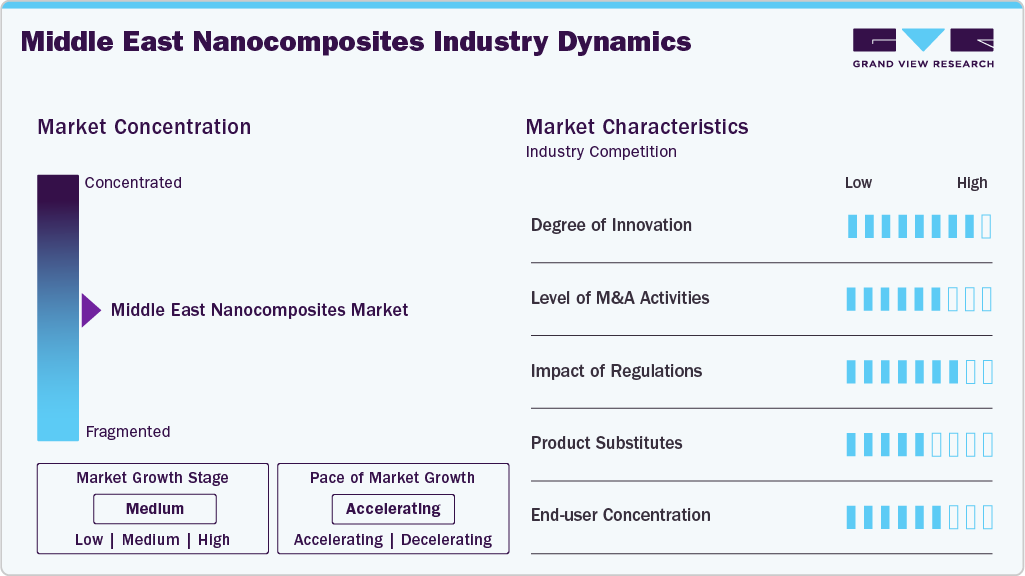
The threat of substitutes for nanocomposites in the Middle East remains moderate. Traditional composites and advanced polymers can sometimes act as substitutes, especially when cost is a concern. However, nanocomposites offer unmatched properties such as high strength, lightweighting, superior barrier performance, and multifunctionality that conventional alternatives struggle to match. Substitution risk is higher in low-performance packaging or construction applications where cheaper plastics or standard composites suffice.
Product Insights
The nanoclay segment held the highest revenue market share of 55.9% in 2024, due to its widespread applications across packaging, automotive, and construction industries. Its ability to enhance barrier properties, mechanical strength, and thermal stability makes it highly preferred by manufacturers seeking cost-effective and scalable solutions. The material’s compatibility with polymers further boosts its adoption in lightweight components and flexible packaging, aligning with the region’s growing demand for durable and sustainable materials.
The metal/metal oxides segment is expected to grow significantly at a CAGR of 7.5% over the forecast period in the Middle East due to their superior antimicrobial, electrical, and catalytic properties. Industries such as healthcare, electronics, and energy storage are increasingly adopting these nanocomposites to enhance performance, particularly in applications like coatings, sensors, and renewable energy technologies. Their role in environmental applications, including water treatment and air purification, is also driving rapid demand growth in the region. Continuous R&D investments and government-backed innovation programs are further accelerating their adoption, making them the most dynamic segment in the market.
Application Insights
The electronics & electrical segment held the highest revenue market share of 17.3% in 2024, owing to the rising integration of advanced materials in semiconductors, conductive films, sensors, and circuit boards. Nanocomposites enhance electrical conductivity, thermal stability, and miniaturization, making them highly valuable in the region’s growing electronics manufacturing and infrastructure development. With the increasing demand for smart devices, 5G technology, and advanced electrical systems, industries are adopting nanocomposites to achieve higher efficiency and reliability, which has positioned this segment as the leading consumer in the market.
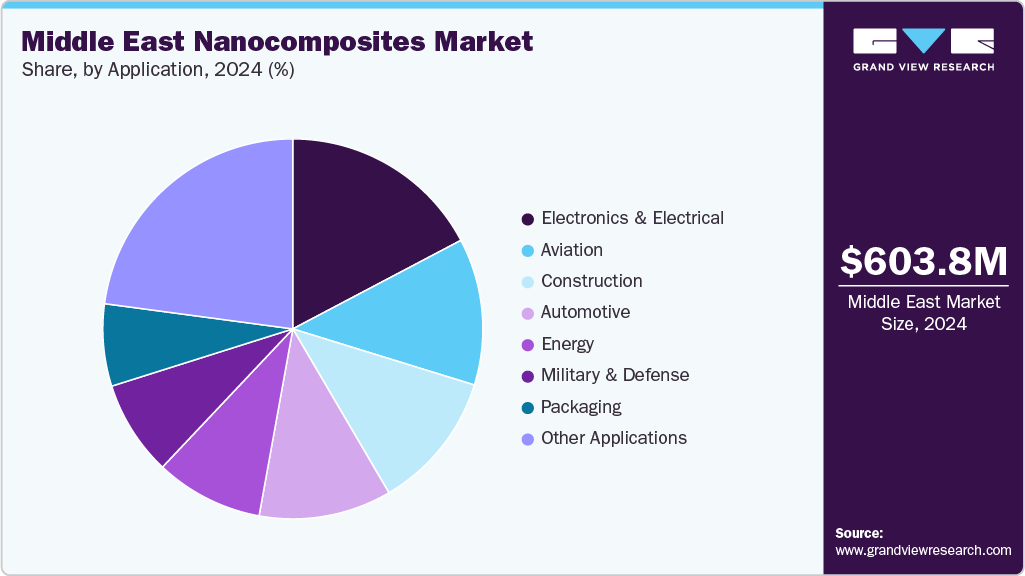
The energy segment is expected to grow at a significant CAGR of 7.9% over the forecast period, as nanocomposites are increasingly utilized in renewable energy systems, energy storage devices, and oil & gas applications. Their use in fuel cells, batteries, wind turbines, and solar panels improves durability, efficiency, and cost-effectiveness. The Middle East’s strong focus on diversifying energy sources and investing in clean energy projects is further driving adoption. Additionally, nanocomposites are being explored for pipeline coatings, corrosion resistance, and thermal insulation, aligning with the region’s energy transition goals and accelerating growth in this segment.
Country Insights
The Middle East nanocomposites market is witnessing strong growth, driven by infrastructure expansion, industrial diversification, and the adoption of advanced materials in oil & gas, automotive, and aerospace. Governments are investing heavily in R&D and partnerships to encourage local nanocomposite production. While the UAE and Saudi Arabia are leading in adoption, smaller markets like Egypt and Qatar are catching up through construction and packaging applications.
Saudi Arabia Nanocomposites Market Trends
Saudi Arabia dominated the Middle East market with a revenue market share of 32.4% in 2024, owing to its strong focus on diversifying industries under Vision 2030. Investments in nanotechnology centers and collaborations with global universities are boosting nanocomposite applications in oil & gas, aerospace, and automotive. The country is leveraging nanocomposites to enhance material performance in harsh environments, particularly in pipeline coatings and industrial infrastructure.
UAE Nanocomposites Market Trends
The UAE is emerging as a hub for advanced materials research, with strong government initiatives supporting innovation in nanotechnology. Nanocomposites are being adopted in aerospace, construction, renewable energy, and defense applications. Dubai and Abu Dhabi are leading adoption through partnerships with global companies, focusing on lightweight and sustainable materials for infrastructure and transport.
Egypt Nanocomposites Market Trends
Egypt’s nanocomposites market is growing steadily, driven by construction, packaging, and automotive industries. Government support for industrial modernization and partnerships with academic institutions are encouraging R&D in nanomaterials. Local manufacturers are beginning to integrate nanocomposites in infrastructure development and low-cost packaging solutions.
Qatar Nanocomposites Market Trends
Qatar is investing in nanocomposites for infrastructure and oil & gas applications. The government’s focus on advanced material innovation and collaborations with international firms are boosting adoption. Nanocomposites are particularly being used for corrosion-resistant coatings in oilfield applications, as well as in smart infrastructure projects aligned with Qatar National Vision 2030.
Kuwait Nanocomposites Market Trends
Kuwait’s adoption of nanocomposites is currently at a nascent stage but is gaining traction in oil & gas, construction, and healthcare. The government is encouraging innovation in advanced materials through R&D programs, while private companies are exploring nanocomposites for industrial uses. Growing interest in lightweight automotive and packaging materials is expected to further drive demand.
Key Middle East Nanocomposites Company Insights
Some of the key players operating in the market include Arkema S.A., DuPont de Nemours, Inc.
-
Arkema is a French specialty chemicals company recognized as a global leader in advanced materials, including polymer nanocomposites. In the Middle East, its nanocomposites are widely used in construction, automotive, packaging, and coatings due to their strength, durability, and lightweight properties. The company focuses on sustainability and innovation, aligning with regional goals for advanced industrial diversification.
-
DuPont is a leading U.S.-based science and technology company with a strong portfolio in high-performance materials, including nanocomposites. Its solutions are integral to Middle Eastern industries such as aerospace, electronics, automotive, and healthcare. DuPont’s nanocomposites are valued for their multifunctionality, offering enhanced barrier properties, mechanical strength, and thermal stability.
Cabot Corporation and Zyvex Technologies are some of the emerging market participants in the nanocomposites market.
-
Cabot, headquartered in the U.S., is a major provider of specialty chemicals and performance materials, with a strong footprint in nanocomposites. It is especially known for its expertise in carbon black and carbon nanotube-based composites, which support applications in automotive, energy, and construction sectors in the Middle East. Cabot’s innovations are helping regional industries enhance material performance and energy efficiency.
-
Zyvex Technologies, based in the U.S., is recognized as one of the pioneers in commercializing nanomaterials, particularly carbon nanotube-based nanocomposites. In the Middle East, its technologies are used in aerospace, defense, and oil & gas sectors, where high strength-to-weight ratios and advanced mechanical properties are critical. Zyvex is known for pushing nanocomposites into practical, scalable industrial applications.
Key Middle East Nanocomposites Companies:
- Arkema S.A.
- BASF SE
- Cabot Corporation
- DuPont de Nemours, Inc.
- Evonik Industries AG
- Nanocyl SA
- Zyvex Technologies
- Mineral Technologies Inc.
- Powdermet Inc.
- RTP Company
Recent Developments
-
In May 2024, Evonik Industries AG signed an MoU with Qatar Free Zones Authority (QFZ) at the Qatar Economic Forum to explore investments, including establishing a manufacturing plant to serve GCC/Middle East industry sectors.
-
In February 2025, BASF SE introduced HySorb B 6610 ZeroPCF, the first superabsorbent polymer featuring a product carbon footprint of zero, using renewable energy and biomass balance.
Middle East Nanocomposites Market Report Scope
|
Report Attribute
|
Details
|
|
Market size value in 2025
|
USD 667.1 million
|
|
Revenue forecast in 2033
|
USD 1,156.2 million
|
|
Growth rate
|
CAGR of 7.1% from 2025 to 2033
|
|
Base year for estimation
|
2024
|
|
Actual data
|
2021 - 2023
|
|
Forecast period
|
2025 - 2033
|
|
Quantitative units
|
Revenue in USD million and CAGR from 2023 to 2033
|
|
Report coverage
|
Revenue forecast, company ranking, competitive landscape, growth factors, and trends
|
|
Segments covered
|
Product, application, country
|
|
Regional scope
|
Middle East
|
|
Country scope
|
Saudi Arabia, UAE, Egypt, Qatar, Kuwait
|
|
Key companies profiled
|
Arkema S.A., BASF SE, Cabot Corporation, DuPont de Nemours, Inc., Evonik Industries AG, Nanocyl SA, Zyvex Technologies, Mineral Technologies Inc., Powdermet Inc., RTP Company
|
|
Customization scope
|
Free report customization (equivalent up to 8 analysts working days) with purchase. Addition or alteration to country, regional & segment scope.
|
|
Pricing and purchase options
|
Avail customized purchase options to meet your exact research needs. Explore purchase options
|
Middle East Nanocomposites Market Report Segmentation
This report forecasts revenue growth at the regional & country levels and provides an analysis on the industry trends in each of the sub-segments from 2021 to 2033. For the purpose of this study, Grand View Research has segmented the Middle East nanocomposites market report on the basis of product, application, and country:
-
Product Outlook (Revenue, USD Million, 2021 - 2033)
-
CNT
-
Nanoclay
-
Metal/Metal Oxides
-
Ceramics
-
Other Products
-
Application Outlook (Revenue, USD Million, 2021 - 2033)
-
Packaging
-
Automotive
-
Electronics & Electrical
-
Aviation
-
Energy
-
Construction
-
Military & Defense
-
Other Applications
-
Country Outlook (Revenue, USD Million, 2021 - 2033)
-
Middle East & Africa
-
Saudi Arabia
-
UAE
-
Egypt
-
Qatar
-
Kuwait
Frequently Asked Questions About This Report
b. The Middle East nanocomposites market size was estimated at USD 603.8 million in 2024 and is expected to reach USD 667.1 million in 2025.
b. The Middle East nanocomposites market is expected to grow at a compound annual growth rate of 7.1% from 2025 to 2033 to reach USD 1,156.2 million by 2033.
b. The nanoclay segment held the highest revenue market share of 55.9% in 2024, due to its widespread applications across packaging, automotive, and construction industries.
b. Some of the key players operating in the nanocomposites market include Arkema S.A., BASF SE, Cabot Corporation, DuPont de Nemours, Inc., Evonik Industries AG, Nanocyl SA, Zyvex Technologies, Mineral Technologies Inc., Powdermet Inc., and RTP Company.
b. Rising demand for lightweight, durable, and high-performance materials across automotive, construction, packaging, electronics, and energy industries is driving the Middle East nanocomposites market.

 Download Sample Report
















