
- Home
- »
- Renewable Energy
- »
-
Middle East Offshore Wind Market Size & Share Report, 2033GVR Report cover
![Middle East Offshore Wind Market Size, Share & Trends Report]()
Middle East Offshore Wind Market (2025 - 2033) Size, Share & Trends Analysis Report By Installation (Fixed Structure, Floating Structure), By Capacity, By Water Depth, By Country, And Segment Forecasts
- Report ID: GVR-4-68040-732-2
- Number of Report Pages: 110
- Format: PDF
- Historical Range: 2021 - 2023
- Forecast Period: 2025 - 2033
- Industry: Energy & Power
- Report Summary
- Table of Contents
- Segmentation
- Methodology
- Download FREE Sample
-
 Download Sample Report
Middle East Offshore Wind Market Summary
The Middle East offshore wind market size was estimated at USD 74.66 million in 2024 and is projected to reach USD 165.41 million by 2033, growing at a CAGR of 9.4% from 2025 to 2033. The market is emerging as a key component of the region’s broader clean energy transition.
Key Market Trends & Insights
- Saudi Arabia offshore wind market held the largest share of 27% of the Middle East market in 2024.
- The offshore wind market in the Middle East is expected to grow significantly over the forecast period.
- By installation, fixed structure segment held the highest market share of 94.65% in 2024.
- Based on capacity, 3 MW to 5 MW segment held the highest market share in 2024.
- Based on water depth, the shallow sater (<30 M Depth) segment held the highest market share in 2024.
Market Size & Forecast
- 2024 Market Size: USD 74.66 Million
- 2033 Projected Market Size: USD 165.41 Million
- CAGR (2025-2033): 9.4%
Deployment in the region spans fixed-bottom and floating wind projects across shallow and deep-water sites, supporting grid-connected renewable power, hybrid generation, and industrial-scale clean hydrogen production. National strategies such as Saudi Vision 2030, the UAE’s Energy Strategy 2050, and Oman’s National Energy Strategy create momentum for offshore wind investments to diversify energy portfolios, reduce reliance on fossil fuels, and meet ambitious decarbonization targets. Early-stage offshore wind projects are being explored along the Red Sea, Arabian Gulf, and Mediterranean coastlines, with increasing focus on floating wind to harness deeper water wind resources.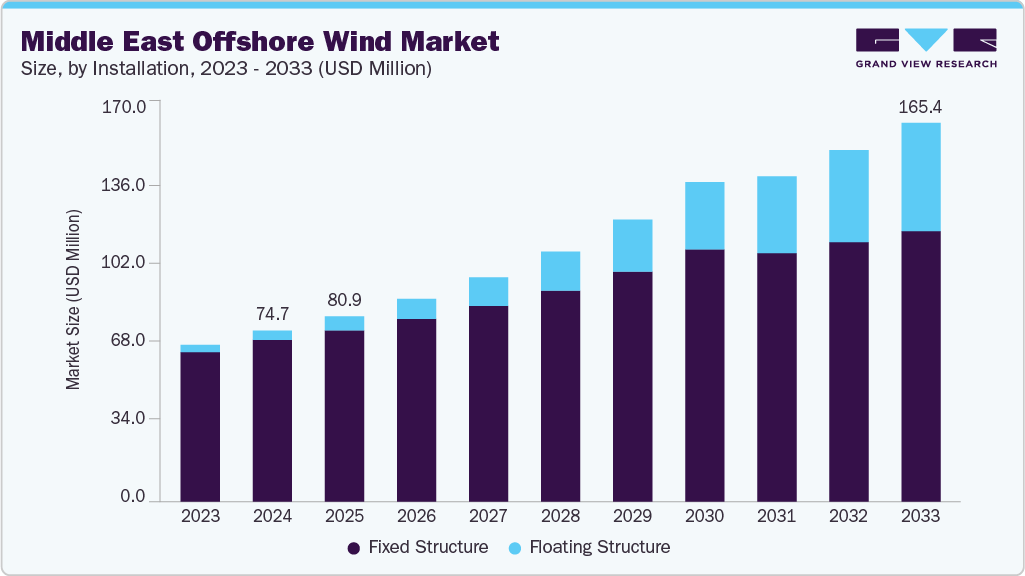
Growth in the market is fueled by abundant offshore wind potential, declining levelized cost of electricity (LCOE), and strong government-led initiatives supported by public-private partnerships (PPPs) and concessional financing. Offshore wind also plays a key role in large-scale green hydrogen and ammonia production, with co-location opportunities near desalination plants and energy-intensive industrial hubs. Advances in turbine design, subsea cabling, and floating foundation technologies enable more cost-effective deployment in complex geographies, while digital monitoring systems improve efficiency and reliability. Cross-border energy cooperation, including potential interconnections between the GCC and Europe, could open up export opportunities for clean power. With major players like Masdar, ACWA Power, EDF Renewables, and Siemens Gamesa entering the offshore wind market, the Middle East is set for rapid growth, driven by increasing investor confidence and ongoing policy support.
Drivers, Opportunities & Restraints
Ambitious clean energy targets, government-led diversification strategies, and strong offshore wind potential across the Red Sea, Arabian Gulf, and Eastern Mediterranean coasts drive the Middle East offshore wind market. Countries such as Saudi Arabia, the UAE, and Oman are increasingly exploring offshore wind to complement their solar and onshore wind portfolios, reduce reliance on fossil fuel-based power, and enable large-scale renewable integration. The global decline in offshore wind costs and advances in floating turbine technologies make the sector more viable in deeper waters where wind resources are stronger. In parallel, the growing demand for renewable electricity to power green hydrogen projects, desalination plants, and industrial hubs provides a structural push for offshore wind adoption across the region.
Opportunities exist in positioning offshore wind as a core element for clean hydrogen and ammonia production, with potential exports to Europe and Asia through planned interconnection projects. Beyond 5 MW capacity with solar and storage, the development of energy islands and AI-enabled grid management systems open pathways for expanding offshore capacity and enhancing system flexibility. International partnerships and technology transfer agreements are likely to speed up project implementation and reduce costs, as top developers and turbine manufacturers enter the Middle Eastern market. However, challenges include high capital costs for offshore installations, especially floating projects, along with issues in subsea infrastructure, port upgrades, and supply chain readiness. Harsh marine conditions, environmental permitting obstacles, and regulatory uncertainties across jurisdictions may also introduce risks, possibly delaying investments and affecting the bankability of early-stage projects.
Installation Insights
The Fixed Structure segment dominated the Middle East offshore wind market, accounting for a revenue share of 94.65% in 2024. This overwhelming share reflects the region’s reliance on shallow to transitional water depths, particularly in areas like Saudi Arabia’s Red Sea coast, the UAE, Oman, and Egypt, where seabed conditions are well-suited for fixed-bottom foundations. Fixed structures such as monopiles and jackets provide cost-effective, proven solutions that align with current regional project economics, enabling stable electricity generation for coastal cities, industrial clusters, and desalination plants. Large-scale initiatives under Saudi Vision 2030 and the UAE Energy Strategy 2050 further drive deployment, with governments prioritizing fixed-bottom offshore wind to diversify energy portfolios and enhance long-term energy security.
Meanwhile, floating offshore wind remains in early stages, limited by higher technology costs, scarce local expertise, and deep-water site issues in the Mediterranean and Arabian seas. Still, regional interest in floating structures is slowly growing, supported by international collaborations and pilot projects to tap into deeper-water wind resources. Over the forecast period, hybrid offshore systems combining fixed-bottom foundations with solar or storage assets are expected to develop, further strengthening the role of fixed structures as the foundation of Middle Eastern offshore wind growth.
Capacity Insights
The 3 MW to 5 MW segment dominated the Middle East offshore wind market, accounting for a revenue share of 49.70% in 2024. This range has become the preferred capacity class for regional developers because of its balance of cost efficiency, proven reliability, and suitability for the shallow to mid-depth waters common in the Red Sea, Arabian Gulf, and Mediterranean coastlines. Countries such as Saudi Arabia, Egypt, and the UAE are leading projects in this category to provide renewable energy for urban centers, industrial zones, and desalination plants. Turbines in this capacity range are also easier to install and maintain, making them attractive for initial offshore projects and pilot deployments that lay the groundwork for long-term renewable energy growth in the region.
The dominance of this segment is reinforced by government-led renewable energy targets and the growing demand for mid-scale offshore wind farms that can be quickly commissioned without the logistical complexities of ultra-large turbines. While higher-capacity turbines (above 5 MW) are being explored for future utility-scale projects, and smaller capacities (up to 3 MW) remain relevant for localized or hybrid microgrid applications, the 3 MW to 5 MW range offers the optimal balance for current project economics. Over the forecast period, technological improvements, rising private investments, and integration with smart grid and storage solutions are expected to sustain the 3 MW to 5 MW segment’s stronghold, cementing its role as the backbone of offshore wind capacity additions in the Middle East.
Water Depth Insights
The shallow water (<30 m depth) segment led the Middle East offshore wind market, capturing a significant revenue share of 59.16% in 2024. This leadership is mainly due to the favorable coastal geography of the Arabian Gulf, Red Sea, and Eastern Mediterranean, where shallow seabeds enable more cost-effective installation of fixed-bottom offshore wind turbines. Countries like Saudi Arabia, Egypt, and the UAE are taking advantage of these ideal conditions to speed up offshore wind development, as shallow waters make foundation design simpler, cut construction costs, and lower operational risks. These features position the segment as the most practical for near-term deployment, especially as governments seek to diversify power sources, reduce reliance on fossil fuels, and achieve ambitious renewable energy goals.
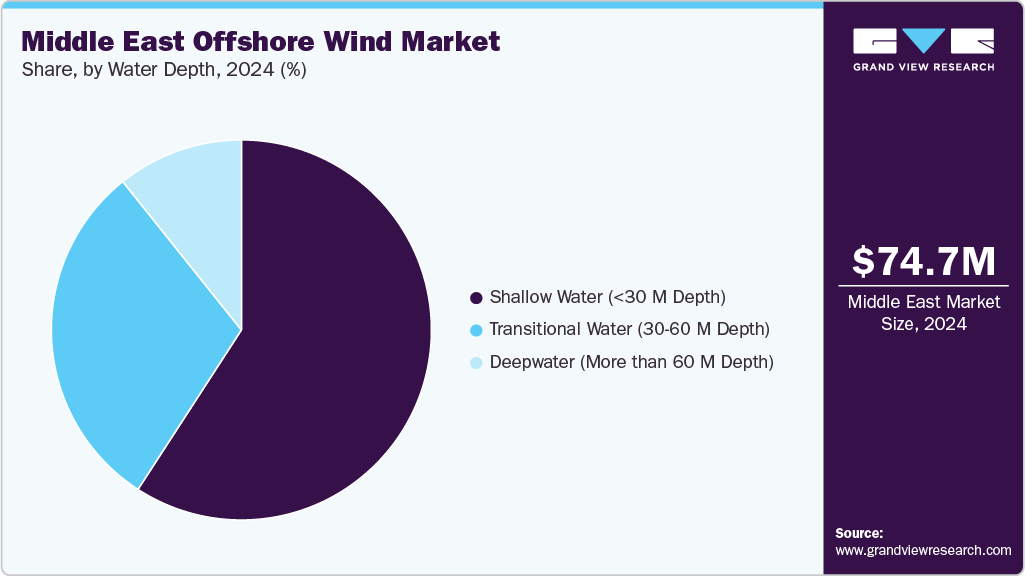
Growth in the shallow-water segment is further driven by the compatibility of these sites with mid-capacity turbines (3-5 MW), streamlined logistics, and shorter transmission distances to coastal demand centers. Strategic government-backed initiatives, including offshore pilot projects and hybrid developments combining wind with solar and storage, reinforce the segment’s position. While transitional (30-60 m) and deepwater (>60 m) projects hold long-term potential through floating wind technologies, shallow waters currently represent the fastest and most economical path for scaling offshore wind capacity in the Middle East. Over the forecast period, supportive regulatory frameworks, advancements in turbine technology, and public-private investment partnerships are expected to sustain shallow water’s market leadership, making it the cornerstone of the region’s offshore wind expansion.
Country Insights
Saudi Arabia Offshore Wind Market Trends
Saudi Arabia holds the largest revenue share of the Middle East offshore wind market in 2024, accounting for over 27%, driven by its ambitious energy diversification strategy under Vision 2030 and its long-term commitment to becoming a global clean energy hub. The Kingdom’s Red Sea and Arabian Gulf coastlines are being mapped for offshore wind development, with feasibility studies already underway to assess wind potential and grid integration. These efforts complement large-scale renewable initiatives such as NEOM and the Green Hydrogen Project, where offshore wind is expected to be crucial in supporting green ammonia and hydrogen production. Saudi Arabia’s strong regulatory framework, sovereign-backed funding, and competitive bidding mechanisms through the Renewable Energy Project Development Office (REPDO) position it as the frontrunner in regional offshore wind capacity expansion.
With world-class wind corridors in the northwest and ongoing partnerships with international developers, Saudi Arabia is well-positioned to attract large-scale offshore investments. Continued focus on localization, technology transfer, and infrastructure upgrades will cement its offshore wind development leadership. As execution accelerates, the Kingdom is expected to set a benchmark for regional offshore projects, providing reliable clean energy and supporting decarbonization goals.
UAE Offshore Wind Market Trends
The UAE is emerging as a key player in the Middle East offshore wind market, complementing its global leadership in solar energy deployment. Through its UAE Energy Strategy 2050, the country actively diversifies its renewable portfolio to include offshore wind alongside solar PV, CSP, and green hydrogen. Coastal areas along the Arabian Gulf are under evaluation for offshore wind potential, with pilot projects expected to precede larger-scale investments. Abu Dhabi and Dubai, already leaders in clean energy innovation, prioritize offshore wind as part of their broader strategy to enhance grid flexibility, reduce emissions, and position the UAE as a clean energy exporter.
Strong government backing, favorable financing mechanisms, and partnerships with European offshore wind developers are enabling the UAE to accelerate its entry into this segment. The country is also aligning offshore projects with industrial decarbonization efforts by integrating offshore wind with hydrogen production hubs and desalination plants. These initiatives underscore the UAE’s commitment to regional renewable energy leadership beyond solar dominance.
Israel Offshore Wind Market Trends
Israel’s offshore wind market is nascent but is gaining traction with government-led initiatives to diversify its renewable mix. Building on its Integrated Sustainable Energy Strategy (ISES), which targets a significant increase in renewable share by 2035, Israel conducts offshore wind feasibility studies along its Mediterranean coast. The government has already launched initial tenders for offshore wind exploration zones, attracting interest from European and Asian developers. These efforts are supported by Israel’s well-developed regulatory framework and its growing role as an energy innovation hub in the region.
Once integrated with Israel’s solar-heavy grid, offshore wind is expected to provide crucial balancing capacity and strengthen cross-border interconnections with Europe. By promoting Independent Power Producers (IPPs) and adopting global best practices in offshore energy development, Israel is positioning itself as a future growth hub for offshore wind in the eastern Mediterranean.
Oman Offshore Wind Market Trends
Oman is steadily establishing itself as a promising offshore wind market in the Middle East, leveraging its extensive coastline and strong wind potential, especially in the Arabian Sea. Under Oman Vision 2040, the country seeks to combine offshore wind with its ambitious renewable energy and green hydrogen initiatives. Pilot studies are currently in progress to find suitable offshore zones, with Dhofar emerging as a key area due to favorable wind conditions. Oman’s Hydrogen Oman (Hydrom) program is expected to boost demand for large-scale offshore wind capacity to support hydrogen electrolysis projects.
While grid capacity and policy implementation remain challenges, ongoing regulatory reforms, international collaborations, and sovereign support are laying the foundation for offshore wind deployment. With growing investor interest and alignment with hydrogen ambitions, Oman is expected to emerge as a significant offshore wind contributor in the region over the next decade.
Egypt Offshore Wind Market Trends
Egypt is fast becoming one of the most promising offshore wind markets in the Middle East and North Africa (MENA), leveraging its Mediterranean and Red Sea coastlines, which boast some of the world’s best wind resources. Through the New and Renewable Energy Authority (NREA), the government has signed agreements with European and Asian developers to explore large-scale offshore wind projects, with several gigawatt-scale proposals under consideration. These projects align with Egypt’s Integrated Sustainable Energy Strategy (ISES 2035), which targets 42% renewable energy in the national mix by 2035.
Strategically located between Africa, Europe, and the Middle East, Egypt is positioning offshore wind for domestic energy needs and for green hydrogen and electricity exports via interconnectors. Recent MoUs signed with international investors highlight Egypt’s strong policy push and favorable investment climate. With its geographical advantage, robust regulatory framework, and ambitious energy diversification plans, Egypt is set to become a regional offshore wind leader in the coming years.
Key Middle East Offshore Wind Company Insights
Some of the key players operating in the Middle East offshore wind market include Ørsted, Siemens Gamesa Renewable Energy, Vestas, GE Renewable Energy, Goldwind, RWE Renewables, Equinor, Shell, Masdar, and Lamprell. These companies are actively engaged in the development of offshore wind farms, supply of advanced turbine technologies, and integration of grid connection solutions to strengthen the region’s renewable power infrastructure.
Key Middle East Offshore Wind Companies:
- Ørsted
- Siemens Gamesa Renewable Energy
- Vestas
- GE Renewable Energy
- Goldwind
- RWE Renewables
- Equinor
- Shell
- Masdar
- Lamprell
Recent Developments
-
In March 2025, Ørsted advanced its footprint in the Middle East offshore wind market by partnering with Masdar and Saudi Arabia’s Public Investment Fund (PIF) to initiate feasibility studies for a 1.2 GW offshore wind project along the Red Sea coast. The project is designed to supply clean electricity to upcoming smart city and industrial developments under Vision 2030, including NEOM and associated green hydrogen facilities.
Middle East Offshore Wind Market Report Scope
Report Attribute
Details
Market size value in 2025
USD 80.91 million
Revenue forecast in 2033
USD 165.41 million
Growth rate
CAGR of 9.4% from 2025 to 2033
Base year for estimation
2024
Historical data
2021 - 2023
Forecast period
2025 - 2033
Quantitative Units
Volume in MW, Revenue in USD million, and CAGR from 2025 to 2033
Report coverage
Revenue forecast, competitive landscape, growth factors, and trends
Segments covered
Installation, capacity, water depth, country
Country scope
UAE; Saudi Arabia; Israel; Oman; Egypt
Key companies profiled
Ørsted; Siemens Gamesa Renewable Energy; Vestas; GE Renewable Energy; Goldwind; RWE Renewables; Equinor; Shell; Masdar; Lamprell
Customization scope
Free report customization (equivalent up to 8 analysts working days) with purchase. Addition or alteration to country, regional & segment scope.
Pricing and purchase options
Avail customized purchase options to meet your exact research needs. Explore purchase options
Middle East Offshore Wind Market Report Segmentation
This report forecasts revenue growth at regional & country levels and provides an analysis of the latest industry trends in each of the sub-segments from 2021 to 2033. For the purpose of this study, Grand View Research has segmented the Middle East offshore wind market report on the basis of installation, capacity, water depth, and country.
-
Installation Outlook (Volume, MW; Revenue, USD Million; 2021 - 2033)
-
Fixed Structure
-
Floating Structure
-
-
Capacity Outlook (Volume, MW; Revenue, USD Million; 2021 - 2033)
-
Up to 3 MW
-
3 MW to 5 MW
-
Above 5 MW
-
-
Water Depth Outlook (Volume, MW; Revenue, USD Million; 2021 - 2033)
-
Shallow Water (<30 M Depth)
-
Transitional Water (30-60 M Depth)
-
Deepwater (More than 60 M Depth)
-
-
Country Outlook (Volume, MW; Revenue, USD Million; 2021 - 2033)
-
UAE
-
Saudi Arabia
-
Israel
-
Oman
-
Egypt
-
Frequently Asked Questions About This Report
b. The Middle East offshore wind market size was estimated at USD 74.66 million in 2024 and is expected to reach USD 80.91 million in 2025.
b. The Middle East offshore wind market is expected to grow at a compound annual growth rate of 9.4% from 2025 to 2033 to reach USD 165.41 billion by 2033.
b. Based on the installation segment, fixed structure offshore wind farms held the largest revenue share of 94.65% in the Middle East offshore wind market in 2024.
b. Some of the key vendors operating in the Middle East offshore wind market include Ørsted; Siemens Gamesa Renewable Energy; Vestas; GE Renewable Energy; Goldwind; RWE Renewables; Equinor; Shell; Masdar; and Lamprell, among others.
b. The key factors driving the Middle East offshore wind market include ambitious clean energy transition strategies, favorable wind resources in coastal regions, and increasing government support for renewable diversification.


Share this report with your colleague or friend.
Need a Tailored Report?
Customize this report to your needs — add regions, segments, or data points, with 20% free customization.


ISO 9001:2015 & 27001:2022 Certified
We are GDPR and CCPA compliant! Your transaction & personal information is safe and secure. For more details, please read our privacy policy.
Trusted market insights - try a free sample
See how our reports are structured and why industry leaders rely on Grand View Research. Get a free sample or ask us to tailor this report to your needs.













