
- Home
- »
- Pharmaceuticals
- »
-
Middle East Pharmaceutical Excipient Market Report, 2033GVR Report cover
![Middle East Pharmaceutical Excipient Market Size, Share & Trends Report]()
Middle East Pharmaceutical Excipient Market (2025 - 2033) Size, Share & Trends Analysis Report By Product (Polymers, Alcohols, Sugar & Others, Minerals), By Formulation (Oral, Topical), By Function (Binders, Lubricants & Glidants), By Country, And Segment Forecasts
- Report ID: GVR-4-68040-727-8
- Number of Report Pages: 150
- Format: PDF
- Historical Range: 2021 - 2023
- Forecast Period: 2025 - 2033
- Industry: Healthcare
- Report Summary
- Table of Contents
- Segmentation
- Methodology
- Download FREE Sample
-
 Download Sample Report
Market Size & Trends
The Middle East pharmaceutical excipient market size was estimated at USD 278.93 million in 2024 and is projected to reach USD 354.71 million by 2033, growing at a CAGR of 2.69% from 2025 to 2033. The increasing prevalence of chronic diseases such as diabetes, cancer, and cardiovascular disorders has led to a higher demand for effective formulations that rely on advanced excipients. Rising health awareness and greater access to medical treatments are increasing prescription volumes across the region. Excipients are gaining importance as they enhance solubility, bioavailability, and stability of drugs in challenging formulations. With more patients requiring long-term therapies, controlled release and patient-friendly dosage forms are seeing higher demand. This trend is creating opportunities for excipients that improve drug delivery and compliance. As the need for innovative medicines grows, excipients are emerging as essential components in regional drug development.
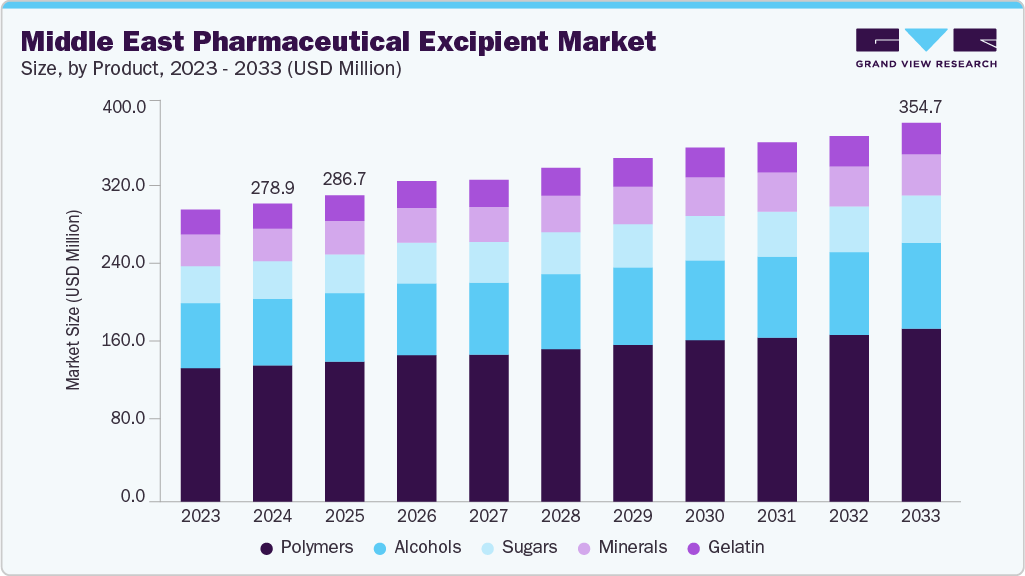
Another factor driving the growth of the market is the rapid advancement of pharmaceutical technologies and formulation science. Co-processed excipients are being adopted to simplify production processes, reduce variability, and improve product performance. The shift towards complex biologics and sensitive drug molecules has accelerated the need for specialized excipients with enhanced compatibility. Nanotechnology-based excipients are enabling precise targeting and efficient delivery of active ingredients. Oral solid dosage forms remain dominant in the region, and the innovation of excipients tailored for tablets and capsules is fueling consistent demand.
For instance, in November 2023, Roquette introduced three new excipients, Lycatab CT-LM, Microcel 103 SD, and Microcel 113 SD, during the October CPHI Barcelona trade show. Lycatab CT-LM, a pre-gelatinized starch, was highlighted as a multifunctional excipient functioning as a filler, binder, and disintegrant, with an extremely low water activity (Aw) of no more than 0.1%, making it suitable for dry granulation, hard capsule filling, and direct compression processes.
In addition, the company expanded its Microcel microcrystalline cellulose line, which it had acquired through its 2022 Crest Cellulose acquisition. The new variants, Microcel 103 SD and Microcel 113 SD, offered Aw values of up to 0.2% and 0.1%, respectively, and were lactose-, gluten-, and sugar-free, designed to improve hard tablet production and enhance stability throughout shelf life. With the presence of Roquette in the Middle East, nutraceutical manufacturers in the region are likely to bolster penetration of excipients. Injectable formulations are also expanding, creating opportunities for sterile and multifunctional excipients. These advancements are reshaping formulation strategies and strengthening the role of excipients in pharmaceutical innovation.
Market Concentration & Characteristics
The Middle East pharmaceutical excipient industry demonstrates steady innovation driven by demand for advanced drug formulations. Companies are investing in co-processed excipients and multifunctional polymers that improve drug solubility and stability. Innovation is focused on developing excipients for controlled release, taste-masking, and enhanced bioavailability. Key players such as BASF, Ashland, and Roquette are expanding portfolios with specialized polymers and sugar-based excipients. Alcohol- and mineral-based excipients are also being tailored for parenteral and topical formulations. This ongoing product development enhances treatment outcomes and supports a competitive market landscape.
New entrants in the Middle East excipient market face moderate to high barriers due to stringent quality requirements and established supplier dominance. Global companies like BASF, JRS Pharma, and DFE Pharma have strong distribution networks and brand trust. Local manufacturing capacity is limited, leading to heavy reliance on imports that favor existing multinational players. Securing regulatory approvals for excipients involves complex compliance with international standards. High investment in technology, testing, and supply chain capabilities further restricts entry. These factors collectively create a challenging environment for smaller or regional players.
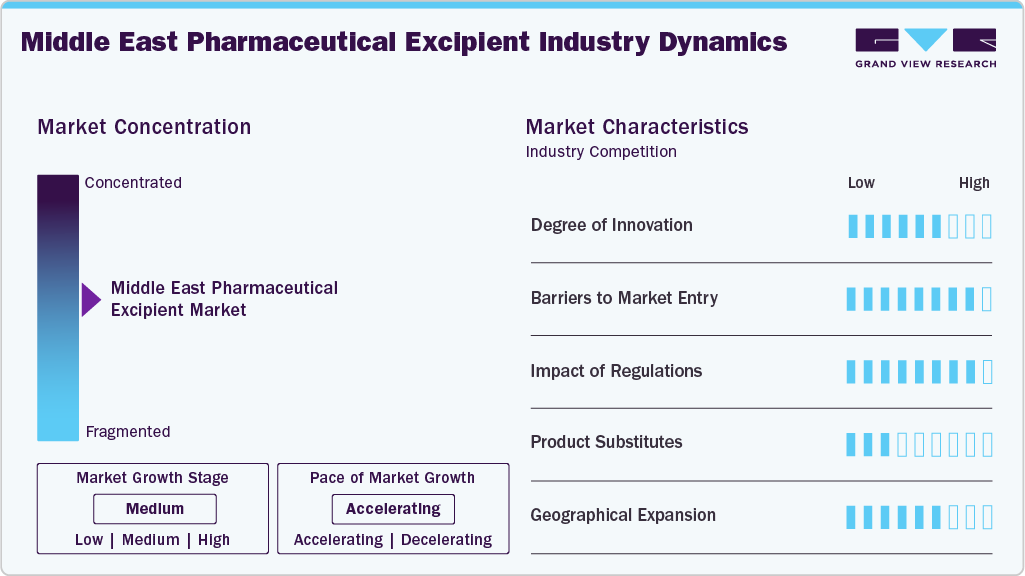
Regulatory frameworks significantly shape the pharmaceutical excipient market across the Middle East. Authorities require adherence to international pharmacopeias such as USP, EP, and JP, ensuring quality and consistency in drug formulations. Multinational suppliers comply with these standards, making them preferred partners for regional manufacturers. Regulations also demand safety testing and validation for excipients used in oral, parenteral, and topical drugs. Compliance increases product credibility but raises costs for new entrants. This regulatory rigor ultimately safeguards patient health while influencing competitive dynamics in the excipient industry.
The scope for substitutes in pharmaceutical excipients is relatively limited due to strict formulation requirements. While multiple polymers, sugars, or minerals may serve similar roles, each excipient must meet safety, stability, and compatibility standards. Substitution depends on therapeutic application, such as oral tablets requiring lactose or MCC versus parenterals requiring PEG or glycerin. Functional categories such as binders, disintegrants, or coating agents have defined performance profiles that restrict interchangeability. Innovation is leading to more versatile excipients, but complete replacement is uncommon. This limited substitutability ensures continued reliance on established excipient categories.
Geographical expansion plays a vital role in strengthening the excipient market in the Middle East. Multinational companies such as Colorcon, Lubrizol, and Shin-Etsu Chemical extend their reach through distribution networks in Saudi Arabia, the UAE, and Egypt. Regional hubs like Dubai serve as strategic gateways for supply across the Middle East and North Africa. Growing pharmaceutical production capacity in Saudi Arabia and Egypt increases demand for reliable excipient suppliers. Companies are also expanding by forming partnerships with local distributors to ensure product availability. This trend is positioning the Middle East as an attractive growth destination for global excipient manufacturers.
Product Insights
The polymers segment dominated the market with the largest revenue share of 45.70% in 2024, driven by their versatile role in controlled release, stabilization, and solubility enhancement. Pharmaceutical manufacturers in the Middle East are increasingly adopting polymers in both solid and liquid formulations to support better patient compliance. Demand for HPMC, MCC, and ethyl cellulose remains strong due to their ability to improve tablet hardness and dissolution. In June 2025, Lubrizol announced that a novel drug formulation using its Apisolex polymer excipient entered Phase I clinical trials, showcasing up to 50,000-fold solubility enhancement for poorly soluble APIs. This advancement highlights the rising importance of high-performance polymers in addressing challenges of solubility, bioavailability, and formulation stability. Expanding production capacity by global excipient players is further reinforcing the market growth of polymers in the region.
The alcohol segment is projected to grow at a significant CAGR of 2.84% over the forecast period, fueled by rising usage as solvents and preservatives in liquid and topical formulations. Increasing demand for stable oral syrups and suspensions in chronic disease management is creating a steady stream of opportunities. A recent example includes a novel oral suspension of an antispasmodic agent that employs sugar alcohols, specifically sorbitol (70% liquid dispersion) combined with glycerin, to enhance solubility and stability. These alcohol-based excipients also improve patient experience by enabling smoother, more tolerable liquid dosage forms. Their application in disinfectants and sanitizers across healthcare settings further contributes to market expansion. Growing investments in liquid dosage manufacturing and continuous improvements in purity standards are enhancing market trust and reinforcing demand for alcohol excipients.
Formulation Insights
The oral segment dominated the market with the largest revenue share of 55.43% in 2024, driven by the widespread use of tablets, capsules, and syrups in the Middle East. A growing prevalence of diabetes, cardiovascular disorders, and other chronic conditions is fueling higher consumption of oral medications. Manufacturers are prioritizing excipients that improve disintegration, taste masking, and controlled release to enhance patient compliance. In 2025, IFF Pharma Solutions introduced next-generation excipients such as Ac-Di-Sol for orally disintegrating tablets (ODTs), along with METHOCEL (HPMC) and ETHOCEL (ethylcellulose) for controlled release and taste masking. These advancements emphasize the global shift toward patient-friendly, high-performance oral formulations. Expanding generics further reinforces regional oral excipient demand.
The topical segment is projected to grow at a steady CAGR of 2.64% over the forecast period due to rising demand for dermatological treatments and cosmetic formulations. The increasing prevalence of skin disorders and higher consumer spending on personal care are driving excipient adoption. Alcohols, polymers, and stabilizers are gaining traction for their role in creams, gels, and ointments. Continuous advancements in formulation technologies are enabling better absorption and longer-lasting effects. Pharmaceutical and cosmetic manufacturers are expanding product lines to cater to regional consumer needs. This is creating consistent growth opportunities for excipients in topical applications across Middle Eastern markets.
Function Insights
The binders segment dominated the market with the largest revenue share of 12.95% in 2024, driven by its crucial role in enhancing mechanical strength and stability of solid dosage forms. Growing demand for tablets and capsules in therapeutic areas such as oncology and cardiology is driving excipient consumption. Polymers, starch derivatives, and cellulose-based binders are widely used due to their compatibility with diverse APIs. Increased focus on controlled release and modified release formulations is further supporting binder adoption. Pharmaceutical manufacturers are emphasizing excipients that improve compressibility and uniformity. Regional market expansion by global binder producers is strengthening supply availability.
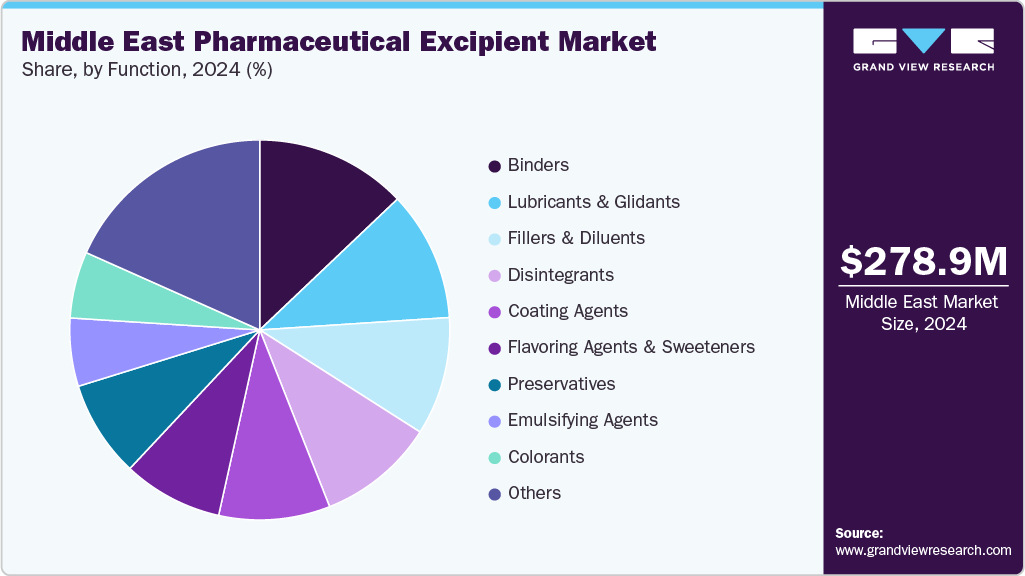
The lubricants and glidants segment is projected to grow at a consistent CAGR of 2.85% over the forecast period due to rising demand for efficient tablet manufacturing. These excipients reduce friction, enhance powder flow, and ensure smooth production processes. The rapid expansion of generics manufacturing in Saudi Arabia, the UAE, and Egypt is creating opportunities for this category. Magnesium stearate and talc remain widely used, while new alternatives are being developed to meet quality standards. Increasing production of complex oral dosage forms is expanding the role of lubricants and glidants. This functional category is expected to see steady demand across regional pharmaceutical plants.
Country Insights
UAE Pharmaceutical Excipient Market Trends
The UAE pharmaceutical excipient industry held a notable market share in 2024, driven by the rapid expansion of pharmaceutical manufacturing and formulation facilities. Increasing demand for oral solid dosage forms is boosting the need for polymers, binders, and fillers. The country’s strong private healthcare sector and rising chronic disease prevalence are fueling consistent excipient consumption. Multinational excipient suppliers are strengthening their footprint in the UAE through distribution partnerships. Growth in nutraceuticals and dietary supplements is also supporting excipient adoption. Continuous investments in innovative dosage forms are enhancing the UAE’s role as a hub for advanced formulations.
Saudi Arabia Pharmaceutical Excipient Market Trends
The Saudi Arabia pharmaceutical excipient industry held the largest revenue share of 35.44% in 2024, spurred by the country’s large-scale pharmaceutical production base. Heightened demand for generics and biosimilars is boosting the consumption of excipients across multiple therapeutic segments. The Vision 2030’s focus on healthcare diversification is encouraging private investments in drug manufacturing. Polymers, cellulose derivatives, and alcohol-based excipients are widely used for oral and injectable formulations. A strong presence of international excipient suppliers is ensuring a steady supply across local plants. Growing patient demand for advanced therapies is further driving excipient adoption in Saudi Arabia.
Kuwait Pharmaceutical Excipient Market Trends
The Kuwait pharmaceutical excipient industry held a single-digit share in 2024, mainly attributed to the increasing prevalence of chronic diseases and growing pharmaceutical imports. Rising focus on generic drug production is fueling demand for high-quality excipients in oral formulations. Partnerships with multinational excipient companies are strengthening supply chain reliability in the country. Local distributors are playing a key role in making diverse excipient categories accessible to manufacturers. Expansion of private sector pharmaceutical investments is further creating opportunities for excipient adoption. The market is witnessing stable growth supported by rising healthcare demand.
Qatar Pharmaceutical Excipient Market Trends
The Qatar pharmaceutical excipient industry is projected to grow at the fastest CAGR of 4.41% over the forecast period, impelled by surging demand for innovative formulations in oncology and chronic care therapies. The country is witnessing increased adoption of excipients for oral solid and injectable drug development. International suppliers are collaborating with local distributors to strengthen excipient availability. Growth in research-driven healthcare projects is supporting the use of advanced excipient technologies. Rising imports of finished formulations are encouraging demand for multifunctional excipients in repackaging and local production. Continuous expansion in hospital infrastructure is fueling long-term excipient consumption.
Oman Pharmaceutical Excipient Market Trends
The Oman pharmaceutical excipient industry held a modest share in 2024, driven by expanding investments in local drug manufacturing. Rising demand for oral dosage forms and over-the-counter medications is supporting excipient consumption. The growing presence of regional pharmaceutical companies is fueling steady imports of binders, fillers, and polymers. International players are targeting Oman with cost-effective excipients tailored for generics and OTC production. Increasing focus on patient-centric dosage innovations is boosting the adoption of multifunctional excipients. The country’s strengthening healthcare infrastructure is expected to sustain robust growth in the excipient market.
Key Middle East Pharmaceutical Excipient Company Insights
The Middle East market is highly competitive, with BASF SE recognized for its wide excipient portfolio and strong regional networks. Ashland Inc. and Avantor Performance Materials, LLC are expanding through advanced solutions for oral and injectable formulations. Meanwhile, Roquette and Colorcon Inc. focus on partnerships with local manufacturers while promoting multifunctional excipients that enhance formulation efficiency. Lubrizol Corporation and Eastman Chemical Corporation are active in specialty polymers and cellulose derivatives for controlled-release systems. JRS Pharma and Shin-Etsu Chemical Co., Ltd. address rising demand for MCC and HPMC in solid dosage forms, while DFE Pharma and Finar Limited emphasize cost-effective, quality excipients, supporting regional pharmaceutical growth.
Key Middle East Pharmaceutical Excipient Companies:
- Eastman Chemical Corporation
- P&G Chemicals
- Avantor Performance Materials, LLC
- BASF SE
- Ashland Inc.
- Roquette
- Colorcon Inc.
- Lubrizol Corporation
- JRS Pharma
- Shin-Etsu Chemical Co., Ltd.
- DFE Pharma
- Finar Limited
Recent Developments
-
In May 2025, Roquette announced the successful completion of its acquisition of IFF Pharma Solutions. The deal expands Roquette’s excipient portfolio and strengthens its position in advanced pharmaceutical formulations. This milestone enhances its global reach and supports innovation across the pharma markets.
-
In May 2024, Roquette unveiled LYCAGEL Flex, a plasticizer-free pea-starch premix designed for soft gel capsules that enhances flexibility for formulators while serving as a gelatin-free alternative. This launch underscores Roquette’s innovation in plant-based excipients, empowering manufacturers with greater customization and stability in softgel formulations.
-
In June 2023, Ashland unveiled Polyplasdone Plus, a co-processed multifunctional direct compression super-disintegrant integrating both a glidant and a lubricant. It streamlines development by enhancing powder flow and lubrication, reducing manufacturing steps while improving tablet quality.
Middle East Pharmaceutical Excipient Market Report Scope
Report Attribute
Details
Market size value in 2025
USD 286.76 million
Revenue forecast in 2033
USD 354.71 million
Growth rate
CAGR of 2.69% from 2025 to 2033
Base year for estimation
2024
Historical data
2021 - 2023
Forecast period
2025 - 2033
Quantitative units
Revenue in USD million, and CAGR from 2025 to 2033
Report coverage
Revenue forecast, company ranking, competitive landscape, growth factors, trends
Segments covered
Product, formulation, function, country
Country Scope
UAE; Saudi Arabia; Kuwait; Qatar; Oman; Rest of Middle East
Key company profiled
Eastman Chemical Corporation; P&G Chemicals; Avantor Performance Materials, LLC; BASF SE; Ashland Inc.; Roquette; Colorcon Inc.; Lubrizol Corporation; JRS Pharma; Shin-Etsu Chemical Co., Ltd.; DFE Pharma; Finar Limited.
Customization scope
Free report customization (equivalent up to 8 analysts working days) with purchase. Addition or alteration to country, regional & segment scope.
Pricing and purchase options
Avail customized purchase options to meet your exact research needs. Explore purchase options
Middle East Pharmaceutical Excipient Market Report Segmentation
This report forecasts revenue at country levels and provides an analysis of the latest industry trends in each of the sub-segments from 2021 to 2033. For this study, Grand View Research has segmented the Middle East pharmaceutical excipient market report based on product, formulation, function, and country:
-
Product Outlook (Revenue, USD Million, 2021 - 2033)
-
Polymers
-
MCC
-
HPMC
-
Ethyl Cellulose
-
Methyl Cellulose
-
CMC
-
Croscarmellose Sodium
-
Povidone
-
Pregelatinized starch
-
Sodium starch glycolate
-
Polyethylene Glycol
-
Acrylic Polymers
-
-
Alcohol
-
Glycerin
-
Propylene Glycol
-
Sorbitol
-
Mannitol
-
Others
-
-
Sugar & Others
-
Lactose
-
Sucrose
-
Others
-
-
Minerals
-
Calcium Phosphate
-
Calcium Carbonate
-
Clay
-
Silicon Dioxide
-
Titanium Dioxide
-
Others
-
-
Gelatin
-
-
Formulation Outlook (Revenue, USD Million, 2021 - 2033)
-
Oral
-
Topical
-
Parenteral
-
Others
-
-
Function Outlook (Revenue, USD Million, 2021 - 2033)
-
Fillers and Diluents
-
Suspending & Viscosity Agents
-
Coating Agents
-
Binders
-
Flavoring Agents & Sweeteners
-
Disintegrants
-
Colorants
-
Lubricants and Glidants
-
Preservatives
-
Emulsifying Agents
-
Others
-
-
Country Outlook (Revenue, USD Million, 2021 - 2033)
-
UAE
-
Saudi Arabia
-
Kuwait
-
Qatar
-
Oman
-
Rest of Middle East
-
Frequently Asked Questions About This Report
b. The Middle East pharmaceutical excipient market size was estimated at USD 278.93 million in 2024 and is projected to reach USD 354.71 million by 2033, growing at a CAGR of 2.69% from 2025 to 2033.
b. The Middle East pharmaceutical excipient market is projected to grow at a CAGR of 2.69% from 2025 to 2033 to reach USD 354.71 million by 2033.
b. Based on product, polymers segment dominated the market with the largest revenue share of 45.70% in 2024, driven by their versatile role in controlled release, stabilization, and solubility enhancement.
b. Key players operating in the Middle East pharmaceutical excipient market include, Eastman Chemical Corporation, P&G Chemicals, Avantor Performance Materials, LLC, BASF SE, Ashland Inc., Roquette, Colorcon Inc., Lubrizol Corporation, JRS Pharma, Shin-Etsu Chemical Co., Ltd., DFE Pharma, Finar Limited.
b. Key factors that are driving market growth include increasing prevalence of chronic diseases such as diabetes, cancer, and cardiovascular disorders have led to higher demand for effective formulations that rely on advanced excipients. Raising health awareness and greater access to medical treatments are increasing prescription volumes across the region.


Share this report with your colleague or friend.
Need a Tailored Report?
Customize this report to your needs — add regions, segments, or data points, with 20% free customization.


ISO 9001:2015 & 27001:2022 Certified
We are GDPR and CCPA compliant! Your transaction & personal information is safe and secure. For more details, please read our privacy policy.
Trusted market insights - try a free sample
See how our reports are structured and why industry leaders rely on Grand View Research. Get a free sample or ask us to tailor this report to your needs.













