
- Home
- »
- Advanced Interior Materials
- »
-
Middle East Self-Healing Material Market Size Report, 2033GVR Report cover
![Middle East Self-Healing Material Market Size, Share & Trends Report]()
Middle East Self-Healing Material Market (2025 - 2033) Size, Share & Trends Analysis Report By Application (Energy Generation, Building & Construction), By Technology, By Product, By Region, And Segment Forecasts
- Report ID: GVR-4-68040-758-3
- Number of Report Pages: 101
- Format: PDF
- Historical Range: 2018 - 2024
- Forecast Period: 2025 - 2033
- Industry: Advanced Materials
- Report Summary
- Table of Contents
- Segmentation
- Methodology
- Download FREE Sample
-
 Download Sample Report
Middle East Self-Healing Material Market Summary
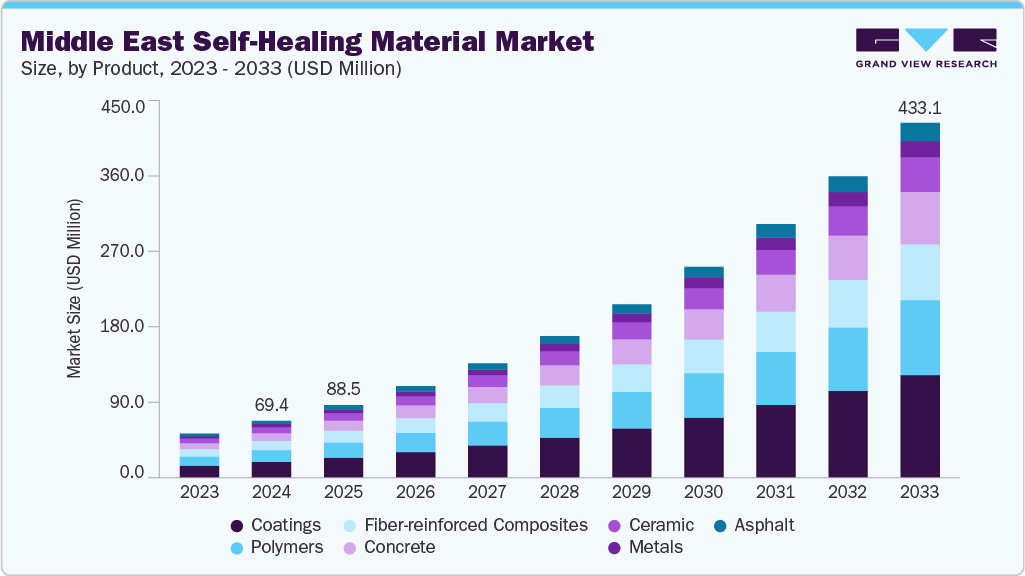
The Middle East self-healing material market size was estimated at USD 69.4 million in 2024 and is projected to reach USD 433.1 million by 2033, growing at a CAGR of 22.0% from 2025 to 2033. The rapid pace of infrastructure development in the Middle East is a fundamental market driver.
Key Market Trends & Insights
- By product, concrete segment is expected to grow at fastest CAGR of 22.9% over the forecast period.
- By application, building & construction segment is expected to grow at fastest CAGR of 22.7% over the forecast period.
- By technology, microencapsulation segment is expected to grow at fastest CAGR of 22.7% over the forecast period.
- Egypt is expected to grow at the fastest CAGR of 22.6% over the forecast period.
Market Size & Forecast
- 2024 Market Size: USD 69.4 Million
- 2033 Projected Market Size: USD 433.1 Million
- CAGR (2025-2033): 22.0%
With countries such as Saudi Arabia, the United Arab Emirates, and Qatar investing in large-scale urban and industrial projects, there is a growing demand for durable construction materials. Self-healing concrete and coatings offer extended service life and reduced maintenance, which are critical in mega-infrastructure projects. Given the region’s harsh environmental conditions, such materials are particularly attractive for ensuring long-term structural integrity. This makes them a strategic choice in national development plans.Growing emphasis on sustainability and environmental resilience is also accelerating market growth. Governments across the region are increasingly prioritizing eco-friendly solutions aligned with long-term climate goals and green building standards. Self-healing materials support these initiatives by reducing material waste, minimizing repair cycles, and extending the functional life of assets. This not only lowers construction's carbon footprint but also enhances resource efficiency. As environmental regulations tighten, the demand for smart and sustainable materials is expected to rise significantly.
The advancement of material science and regional R&D capabilities is another critical factor supporting market expansion. Academic institutions, research centers, and private sector players in the Middle East are collaborating to develop cost-effective and high-performance self-healing polymers, composites, and coatings. Breakthroughs in nanotechnology and bio-based healing agents make these materials more adaptable to local needs. The region can increasingly customize solutions for specific industrial and climatic challenges as innovation becomes more localized.
Market Concentration & Characteristics
The Middle East self‑healing material industry exhibits moderate to high innovation intensity, with R&D efforts concentrated among a relatively small number of large chemical and material science firms, supplemented by universities and research institutions. Nanotechnology, bio‑based healing agents, and improvements in concrete, polymer, and coating formulations are driving innovation. While global players hold many patents, regional research centers increasingly collaborate on technology transfer and local adaptation. Despite this, the cost and complexity of developing reliable self‑healing mechanisms (especially for harsh environmental conditions) create high technical entry barriers, limiting the number of firms that can compete on a scale.
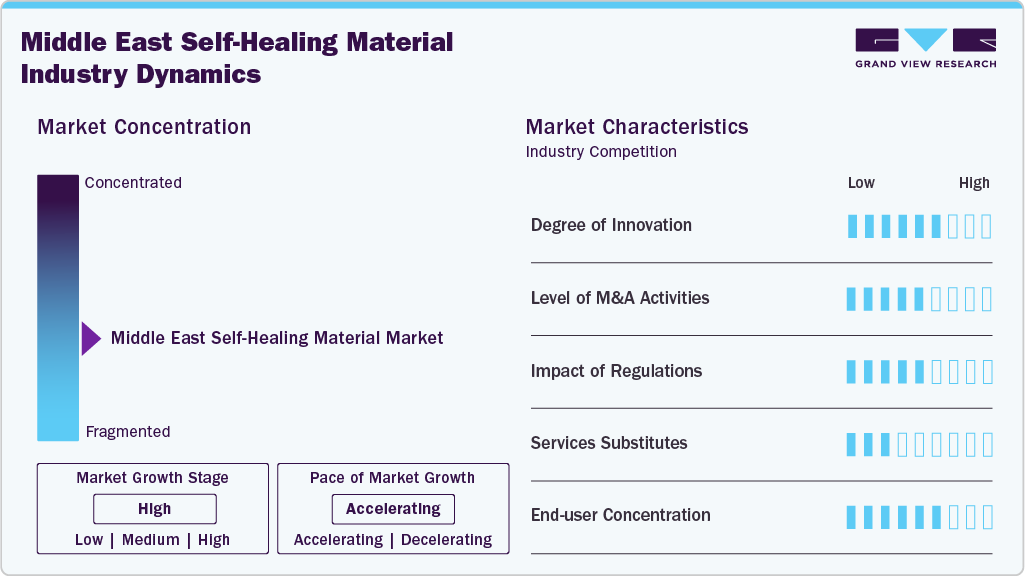
Regulatory frameworks and demand-side characteristics play a strong shaping role in the market’s structure. Though policies encouraging sustainable materials and green building practices are increasing in regulation, there remains a lack of standardization in testing, certification, and performance metrics for self‑healing materials in many Middle Eastern jurisdictions. This regulatory uncertainty slows commercialization and raises risk for new entrants. Conventional materials (standard concrete, coatings, metals) remain viable substitutes because of lower upfront costs, familiarity, and lower perceived risk. However, self-healing materials increasingly displace substitutes in sectors with high performance and life‑cycle cost sensitivity (infrastructure, aerospace, oil & gas). In terms of end‑user concentration, demand is concentrated among certain sectors-building & construction, infrastructure, transportation, automotive, and aerospace-rather than diffuse. Large government projects and institutional purchasers constitute a large portion of demand, further strengthening the bargaining power of key suppliers who are capable of meeting performance, certification, and volume requirements.
Product Insights
The coatings segment dominated the market and accounted for the largest revenue share of 27.9% in 2024. Coatings that can autonomously repair micro‑damage reduce downtime and cost, especially for automotive, maritime, infrastructure, and metallic structures. Innovation in microencapsulation of healants, nanocomposite additives, and stimulus‑responsive polymers (e.g., heat, UV, and moisture-triggered) is driving improved performance.
Concrete is expected to grow at the fastest CAGR of 22.9% over the forecast period, driven by the need to manage cracks and micro‑fractures that naturally occur due to shrinkage, thermal stress, load, and environmental exposure; such self‑repair capabilities help extend structural lifespan and reduce maintenance. Government and private sector infrastructure programs for roads, bridges, tunnels, and public works increasingly seek lower life‑cycle costs, making self‑healing concrete attractive. Technologies such as embedding healing agents in capsules, bacteria‑based mineral precipitation, and other chemistries make concrete self‑healing more viable.
Application Insights
The building & construction segment dominated the market and accounted for the largest revenue share of 37.8% in 2024, driven by the need for infrastructure that demands less maintenance over its lifetime; self‑healing materials reduce repair frequency for buildings, bridges, and roads, especially in regions with harsh climates or frequent mechanical stress. Urbanization and growth in public infrastructure investment are increasing demand for resilient, durable materials. Regulatory pushes for sustainability and green building codes encourage materials with longer lifespans and lower environmental footprints.
The electronics & semiconductors segment is expected to grow at a CAGR of 22.2% over the forecast period. In electronics and semiconductors, miniaturization and increased integration create finer structures where microcracks or thermal fatigue can degrade performance; self‑healing materials help restore functionality and reliability. Consumer demand for longer‑lasting electronics and lower failure rates (especially in wearables, flexible electronics, and sensors) is raising interest in self-repair materials.
Technology Insights
The reversible polymers segment dominated the market and accounted for the largest revenue share of 39.6% in 2024, driven by advancements in chemistries-such as Diels-Alder reactions, disulfide exchange, boronic ester exchange, and other dynamic covalent bond systems-which are expanding performance in terms of healing speed, mechanical strength, and environmental stability. These polymers allow for smart materials that recover from damage under mild conditions, which is increasingly demanded in sectors sensitive to energy consumption and thermal stress.
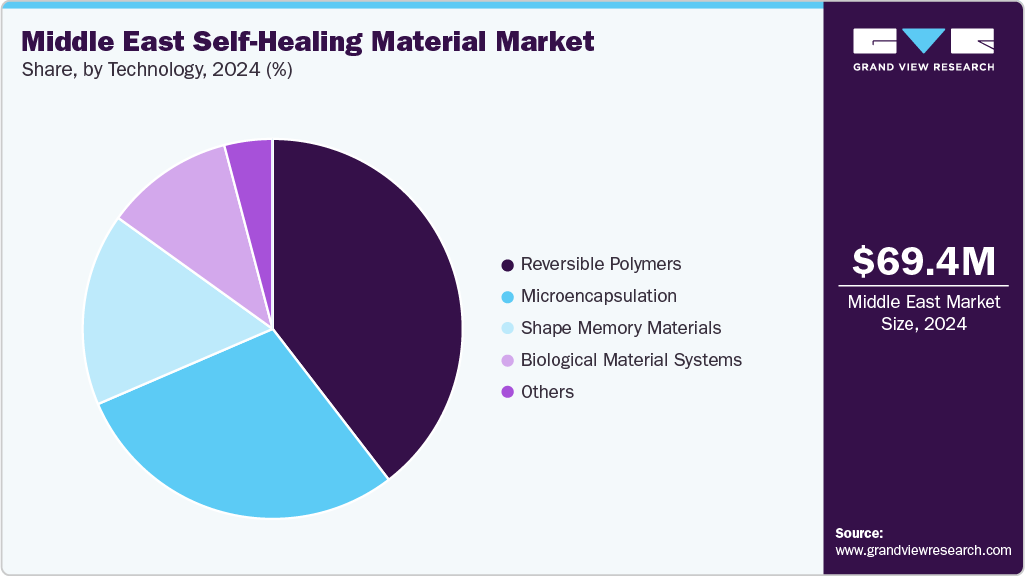
The biological material systems segment is expected to grow significantly at a CAGR of 22.1% over the forecast period, driven by bio‑inspired healing agents (e.g., bacteria, enzymes) or systems that mimic biological repair, offering more natural, low‑energy self‑repair. Interest in reducing chemical or synthetic healing agents is pushing the adoption of biological systems that are more sustainable and less toxic. In concrete, for example, bacteria capable of precipitating minerals to heal cracks are becoming more researched and used.
Regional Insights
Saudi Arabia Self-Healing Material Market Trends
The self-healing material market in Saudi Arabia is witnessing robust growth, primarily driven by its ambitious infrastructure and smart city projects under Vision 2030. Mega-developments like NEOM, the Red Sea Project, and Qiddiya require advanced, long-lasting materials to withstand the kingdom's extreme desert climate. Self-healing concrete and coatings offer resilience to temperature fluctuations and sand abrasion, making them ideal for large-scale applications. Saudi Aramco’s interest in advanced pipeline and facility maintenance materials also boosts industrial demand. Government support for technology transfer and innovation further strengthens the adoption outlook. The push for sustainability in public infrastructure aligns well with these materials' long-term performance.
UAE Self-Healing Material Market Trends
The self-healing material market in the United Arab Emirates is driven by its strategic emphasis on sustainable, high-performance buildings and smart infrastructure. The country has adopted stringent green building codes like Estidama and Dubai’s Green Building Regulations, which encourage using materials that extend lifecycles and reduce environmental impact. With a strong focus on luxury real estate, tourism, and aviation infrastructure, the UAE requires premium materials that ensure structural reliability and aesthetic durability. In addition, the country's reputation as a hub for technology and innovation fosters quicker adoption of next-generation materials like self-healing polymers and coatings. The advanced construction sector and favorable regulatory environment make the UAE a natural early adopter.
Egypt Self-Healing Material Market Trends
The self-healing material market in Egypt is expected to grow at the fastest CAGR over the forecast period. Egypt is experiencing increasing interest in self-healing materials as it undergoes significant urban expansion and industrial development, particularly in constructing the New Administrative Capital and various infrastructure megaprojects. These developments demand cost-effective and durable materials, especially given the challenges with high temperatures and water scarcity. The need for infrastructure that requires less frequent maintenance is a key market driver. Furthermore, Egypt’s growing partnerships with international research institutions and material suppliers are improving access to advanced construction technologies. As public and private investment increases, demand for longer-lasting, lower-maintenance materials is expected to rise steadily.
Qatar Self-Healing Material Market Trends
The self-healing material market in Qatar is growing significantly as the government is keen to adopt advanced construction materials to reduce long-term maintenance costs, particularly considering high humidity and coastal corrosion risks. Self-healing coatings and concrete are gaining attention in public sector projects, including road networks and metro systems. In addition, Qatar’s focus on sustainability and resource efficiency, as reflected in its National Vision 2030, supports the integration of smart and self-sustaining materials. Strategic collaborations with global suppliers are also improving market accessibility.
Kuwait Self-Healing Material Market Trends
The self-healing material market in Kuwait presents a growing opportunity, driven by its efforts to modernize public infrastructure and industrial facilities. Harsh environmental conditions-such as sandstorms, saline air, and extreme heat-place high stress on conventional materials. This creates strong incentives for using advanced materials that reduce repair frequency and operational downtime, particularly in oil and gas, transportation, and public works sectors. Government initiatives under Kuwait Vision 2035 also prioritize innovation and sustainability, aligning with self-healing technologies' advantages. As infrastructure spending increases, so does the appetite for high-performance, low-maintenance construction solutions.
Key Middle East Self-Healing Material Company Insights
Some key players operating in the market include AkzoNobel N.V. and BASF SE.
-
AkzoNobel N.V. provides advanced coatings and specialty chemicals that are increasingly incorporating self‑healing functionalities. Their R&D focuses on making coatings that can autonomously repair micro‑damage (such as scratches or wear) to extend maintenance intervals in harsh environments. They collaborate with regional partners to adapt formulations for high UV exposure and elevated temperatures typical of Gulf climates.
-
BASF SE is a global chemical leader offering a wide range of materials, including concrete admixtures, polymers, and specialty additives. In the self‑healing materials domain, BASF has developed agents that can trigger crack sealing (via chemicals or biotic agents) and self‑healing coatings that restore barriers after damage. Their presence in the Middle East includes projects where waterproofing admixtures and resilient coatings are essential.
Covestro AG and Autonomic Materials, Inc. are some emerging market participants.
-
Covestro AG specialises in high‑performance polymers and specialized composites that respond to environmental stimuli. Their portfolio includes materials with self‑healing properties for automotive, electronics, and construction sectors. They invest in nanotechnology and smart material systems to enable self‑repair, particularly suited for regions with extreme climatic stressors such as thermal cycling, sand abrasion, and UV degradation.
-
Autonomic Materials, Inc. designs materials that have self‑repairing capabilities for coatings and structural elements. Their technology often uses microencapsulation or reversible chemical bonds, allowing materials to heal cracks or micro‑damage without external intervention. Their offerings are relevant to infrastructure, transportation, and industrial coatings, where maintenance downtime is costly.
Key Middle East Self-Healing Material Companies:
- AkzoNobel N.V.
- BASF SE
- Covestro AG
- Autonomic Materials, Inc.
- NEI Corporation
- Acciona S.A.
- Arkema S.A.
- The Dow Chemical Company
- Evonik Industries AG
MEA Self-Healing Material Market Report Scope
Report Attribute
Details
Market size value in 2025
USD 88.5 million
Revenue forecast in 2033
USD 433.1 million
Growth rate
CAGR of 22.0% from 2025 to 2033
Actual data
2018 - 2024
Forecast period
2025 - 2033
Quantitative units
Revenue in USD million/billion and CAGR from 2025 to 2033
Report coverage
Revenue forecast, company ranking, competitive landscape, growth factors, and trends
Segments covered
Application, product, technology, region
Region scope
Middle East
Country scope
Saudi Arabia; UAE; Egypt; Qatar; Kuwait
Key companies profiled
AkzoNobel N.V., BASF SE, Covestro AG, Autonomic Materials, Inc., NEI Corporation, Acciona S.A., Arkema S.A., The Dow Chemical Company, Evonik Industries AG.
Customization scope
Free report customization (equivalent up to 8 analysts’ working days) with purchase. Addition or alteration to country, regional & segment scope.
Pricing and purchase options
Avail customized purchase options to meet your exact research needs. Explore purchase options
Middle East Self-Healing Material Market Report Segmentation
This report forecasts revenue growth at global, regional, and country levels and provides an analysis of the latest industry trends in each of the sub-segments from 2021 to 2033. For this study, Grand View Research has segmented the Middle East self-healing material market report based on product, application, technology, and region:
-
Application Outlook (Revenue, USD Million, 2021 - 2033)
-
Energy generation
-
Building & Construction
-
Automotive & Transportation
-
Electronics & Semiconductors
-
Medical
-
Others
-
-
Technology Outlook (Revenue, USD Million, 2021 - 2033)
-
Reversible Polymers
-
Microencapsulation
-
Shape Memory Materials
-
Biological Material Systems
-
Others
-
-
Product Outlook (Revenue, USD Million, 2021 - 2033)
-
Concrete
-
Coatings
-
Polymers
-
Asphalt
-
Fiber-reinforced Composites
-
Ceramic
-
Metals
-
-
Regional Outlook (Revenue, USD Million, 2021 - 2033)
-
Middle East
-
Saudi Arabia
-
UAE
-
Egypt
-
Qatar
-
Kuwait
-
-
Frequently Asked Questions About This Report
b. The Middle East self-healing material market size was estimated at USD 69.4 million in 2024 and is expected to reach USD 88.5 million in 2025.
b. The Middle East self-healing material market is expected to grow at a compound annual growth rate of 22.0% from 2025 to 2033 to reach USD 433.1 million by 2033.
b. Biulding & construction segment dominated the market and accounted for the largest revenue share of 37.8% in 2024, driven by the need for infrastructure that demands less maintenance over its lifetime
b. Some of the prominent companies in the Middle East self-healing material market include AkzoNobel N.V., BASF SE, Covestro AG, Autonomic Materials, Inc., NEI Corporation, Acciona S.A., Arkema S.A., The Dow Chemical Company, Evonik Industries AG.
b. Key factors driving the Middle East self-healing material market include rapid advancements in material science, increasing demand for extended material lifespan, and government support for sustainable and durable construction materials.


Share this report with your colleague or friend.
Need a Tailored Report?
Customize this report to your needs — add regions, segments, or data points, with 20% free customization.


ISO 9001:2015 & 27001:2022 Certified
We are GDPR and CCPA compliant! Your transaction & personal information is safe and secure. For more details, please read our privacy policy.
Trusted market insights - try a free sample
See how our reports are structured and why industry leaders rely on Grand View Research. Get a free sample or ask us to tailor this report to your needs.













