
- Home
- »
- Distribution & Utilities
- »
-
Middle East Solar Hybrid Inverter Market Size Report, 2033GVR Report cover
![Middle East Solar Hybrid Inverter Market Size, Share & Trends Report]()
Middle East Solar Hybrid Inverter Market (2025 - 2033) Size, Share & Trends Analysis Report By End Use (Commercial, Residential), By Product, By Country, And Segment Forecasts, Key Companies And Competitive Analysis
- Report ID: GVR-4-68040-762-0
- Number of Report Pages: 110
- Format: PDF
- Historical Range: 2021 - 2023
- Forecast Period: 2025 - 2033
- Industry: Energy & Power
- Report Summary
- Table of Contents
- Segmentation
- Methodology
- Download FREE Sample
-
 Download Sample Report
Middle East Solar Hybrid Inverter Market Summary
The Middle East solar hybrid inverter market size was estimated at USD 741.16 million in 2024 and is projected to reach USD 1,236.36 million by 2033, growing at a CAGR of 5.7% from 2025 to 2033. The rising integration of renewable energy, particularly solar PV, into residential, commercial, and industrial sectors is fueling demand for hybrid inverter solutions capable of managing multiple energy sources, including solar, storage, and grid supply.
Key Market Trends & Insights
- Saudi Arabia dominated the Middle East solar hybrid inverter market with the largest revenue share of 36.5 % in 2024.
- The solar hybrid inverter market in Israel is expected to grow at the fastest CAGR over the forecast period.
- By product, the three-phase hybrid segment led the market with the largest revenue share of 72.61% in 2024.
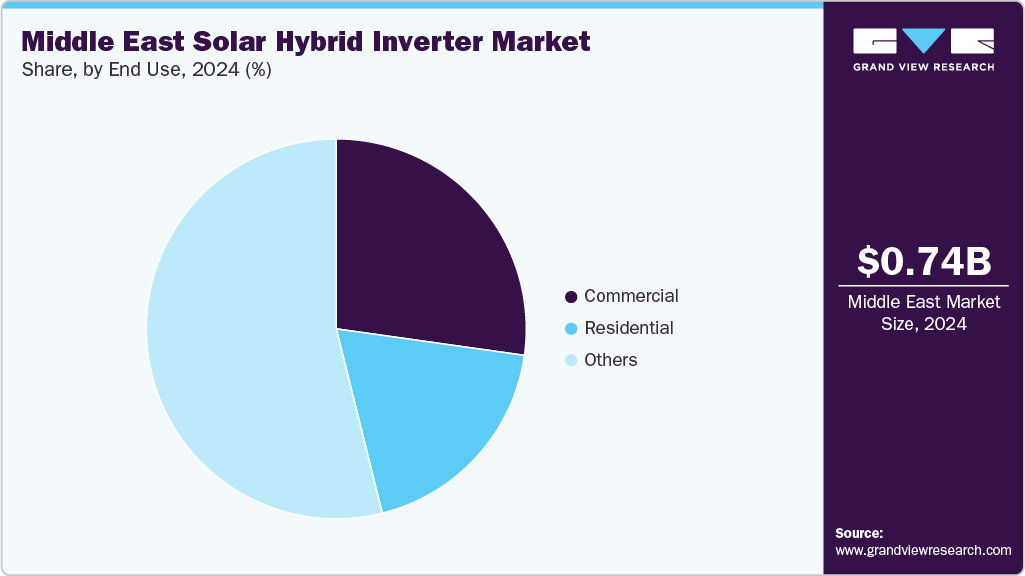
- Based on end use, the others segment accounted for the largest market revenue share in 2024.
Market Size & Forecast
- 2024 Market Size: USD 741.16 Million
- 2033 Projected Market Size: USD 1,236.36 Million
- CAGR (2025-2033): 5.7%
- Saudi Arabia: Largest market in 2024
- Israel: Fastest growing market
Hybrid inverters offer a cost-effective pathway to improve energy reliability and efficiency while reducing dependency on fossil-based generation. Governments across the region actively support solar adoption under frameworks such as Saudi Vision 2030, UAE Energy Strategy 2050, and Oman Vision 2040, emphasizing diversification of energy mixes, carbon reduction, and sustainable infrastructure development. As a result, hybrid inverter solutions are increasingly being deployed to support both on-grid and off-grid applications, aligning with regional decarbonization and energy security goals.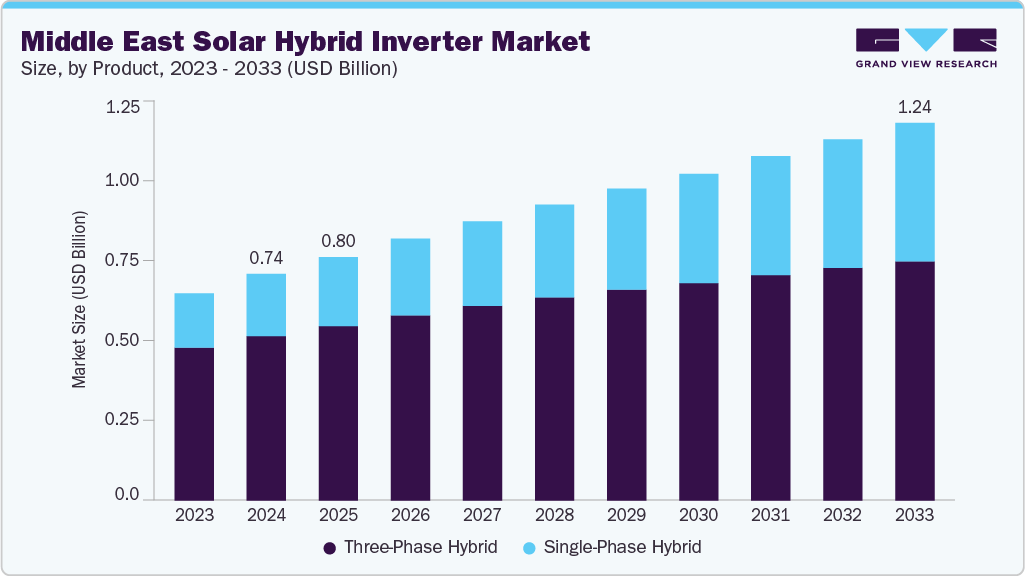
The Middle East solar hybrid inverter industry also benefits from rapidly growing electricity demand, high solar irradiance, and ongoing energy infrastructure modernization. Hybrid inverters are widely adopted in commercial complexes, residential projects, industrial facilities, and critical infrastructure, enabling seamless energy storage integration, load optimization, and backup power reliability during outages. Technological innovations such as AI-based energy management systems, IoT-enabled monitoring, and advanced MPPT (Maximum Power Point Tracking) algorithms enhance inverter performance and widen adoption. Furthermore, favorable financing models, supportive government incentives, and corporate sustainability initiatives are spurring investments in solar hybrid inverter projects across the Middle East. With strong participation from global leaders, including Huawei, Sungrow, SMA Solar Technology, and Schneider Electric, along with regional manufacturers such as DEYE, Growatt, and GoodWe, the Middle East solar hybrid inverter industry is set to play a pivotal role in advancing renewable energy integration and building resilient distributed power networks.
Drivers, Opportunities & Restraints
The Middle East solar hybrid inverter industry is primarily driven by the rising demand for reliable and sustainable power solutions, increasing solar energy adoption, and ambitious national renewable energy targets. Governments in Saudi Arabia, the UAE, and Oman actively promote distributed solar projects and storage integration, creating favorable conditions for hybrid inverter deployment. Adoption is further fueled by commercial, industrial, and residential sectors seeking to reduce grid dependency, enhance energy resilience, and optimize electricity costs. Declining costs of solar PV modules, batteries, and inverter technologies, coupled with innovations in MPPT efficiency, digital monitoring, and grid support functions, are strengthening the role of hybrid inverters as a cornerstone of the Middle East’s clean energy transition.
Opportunities in the Middle East solar hybrid inverter industry are expanding across both on-grid and off-grid applications, supported by growing investments in distributed energy and smart infrastructure. Integrating AI-enabled predictive analytics, IoT-based monitoring platforms, and cloud-based energy management systems enables end-users to optimize solar utilization, improve system reliability, and maximize cost savings. Hybrid inverter adoption is particularly attractive for energy-intensive industries, remote sites, and residential communities aiming to combine solar PV with battery storage for backup and load balancing. Green financing initiatives, public-private partnerships, and corporate decarbonization commitments are unlocking new funding channels, accelerating deployments, and creating avenues for regional players to collaborate with global technology leaders.
However, the Middle East solar hybrid inverter industry faces several restraints, including high upfront installation costs compared to conventional inverters, limited regional manufacturing capabilities, and heavy reliance on imported technologies. Fragmented regulatory frameworks across Middle Eastern countries, with inconsistent subsidy schemes and grid codes, add to project uncertainties. In addition, cybersecurity risks associated with connected inverter systems and the shortage of skilled technicians for installation, operation, and maintenance pose barriers to large-scale adoption. Dependence on foreign suppliers for critical components further exposes the market to supply chain disruptions and price volatility, potentially slowing down the pace of widespread hybrid inverter integration in the region.
Product Insights
The three-phase hybrid segment led the market with the largest revenue share of 72.61% 2024. This dominance is attributed to the strong demand from commercial, industrial, and utility-scale applications, where three-phase hybrid inverters provide superior power handling capacity, efficiency, and grid compatibility. With the Middle East experiencing rapid industrial expansion and the integration of large-scale solar projects, businesses and utilities are increasingly adopting three-phase systems to manage higher loads, optimize distributed energy integration, and ensure grid stability. Countries such as Saudi Arabia, the UAE, and Oman are leading commercial and industrial solar hybrid systems deployment, supported by their national clean energy roadmaps and infrastructure modernization programs. The ability of three-phase hybrid inverters to balance energy supply across phases, support high-capacity storage integration, and provide backup power for critical operations underpins their market leadership.
Supportive government incentives, corporate sustainability mandates, and the push for industrial decarbonization further accelerate the segment's adoption. Technological advancements, including advanced MPPT algorithms, AI-based energy management, and IoT-enabled monitoring, enhance system efficiency and reliability, reinforcing the segment's dominance. In addition, growing penetration of hybrid projects combining solar PV with battery storage and backup diesel/gas generators highlights the role of three-phase inverters in enabling seamless energy switching, peak load management, and uninterrupted operations. While single-phase hybrid inverters continue to expand in the residential sector, especially in small- to medium-scale rooftop projects, the three-phase segment remains the backbone of the Middle East market, ensuring resilience and cost efficiency for large-scale deployments. Its entrenched position ensures sustained leadership throughout the forecast period.
End Use Insights
The others segment led the market with the largest revenue share of 53.89% in 2024 and is expected to grow at the fastest CAGR throughout the forecast period. This segment, which includes industrial facilities, data centers, remote operations, and critical infrastructure, is driving demand due to the need for reliable, uninterrupted, and cost-optimized energy solutions. These applications often involve high power consumption and sensitivity to outages, making hybrid inverters essential for ensuring a stable power supply and efficient integration of solar PV with energy storage. Countries such as Saudi Arabia, the UAE, and Qatar, which are witnessing rapid industrialization and large-scale infrastructure projects, are at the forefront of deploying hybrid inverter solutions in non-residential segments to enhance energy resilience and reduce dependence on conventional generation. The ability of hybrid inverters to provide backup support, optimize load management, and facilitate seamless switching between solar, grid, and storage further reinforces their adoption across this segment.
The leadership of the other segments is further strengthened by regional economic diversification strategies that prioritize industrial sustainability, smart city initiatives, and digital infrastructure growth. Businesses and institutions increasingly leverage hybrid inverters to align with ESG goals, achieve carbon reduction targets, and manage rising electricity costs. Partnerships between global inverter manufacturers and local stakeholders are accelerating the deployment of advanced hybrid systems featuring AI-based controls, IoT-enabled monitoring, and predictive maintenance capabilities. While residential and commercial adoption continues to rise steadily, particularly with rooftop solar installations, the Others segment remains the backbone of the Middle East solar hybrid inverter industry, offering operational efficiency, cost savings, and energy security to mission-critical and large-scale applications.
Country Insights
Saudi Arabia dominated the Middle East solar hybrid inverter market with the largest revenue share of 36.50% in 2024, driven by rapid clean energy diversification, giga-projects, and ambitious initiatives under Vision 2030. The Kingdom is leading the deployment of large-scale solar and hybrid energy solutions across commercial, industrial, and residential sectors, with mega-infrastructure projects such as NEOM, The Line, and Red Sea integrating advanced hybrid inverter systems. Supportive government frameworks, sovereign investments, and strong corporate ESG commitments accelerate hybrid inverter adoption for reliable, resilient, and cost-efficient power management. With abundant solar resources, favorable policies, and large-scale demand, Saudi Arabia is set to remain the regional hub for hybrid inverter innovation and deployment.
The UAE solar hybrid inverter industry ranks just behind Saudi Arabia, supported by progressive renewable policies and an advanced clean energy ecosystem. Under the UAE Energy Strategy 2050, the country is scaling solar integration across urban centers such as Dubai and Abu Dhabi, with hybrid inverters playing a crucial role in commercial buildings, industrial zones, and critical infrastructure. Programs like Dubai’s Shams initiative and smart energy projects in Abu Dhabi encourage deploying hybrid inverter solutions that combine solar PV, storage, and advanced monitoring. Strong public-private partnerships and sustainable city developments such as Masdar City further reinforce the UAE’s position as a leader in hybrid inverter adoption.
The solar hybrid inverter market in Israel is expected to grow at the fastest CAGR over the forecast period, fueled by its strong emphasis on renewable R&D, grid modernization, and clean energy policies. With ambitious targets to expand solar generation and reduce fossil fuel reliance, Israel is deploying hybrid inverters across residential rooftops, commercial complexes, and high-tech industrial facilities. The country’s advanced digital infrastructure supports the integration of IoT-enabled monitoring, AI-based energy optimization, and battery storage systems, making hybrid inverters a cornerstone of distributed energy solutions. Israel’s growing startup ecosystem and strong collaboration between government, academia, and private companies accelerate innovation in hybrid inverter technologies, ensuring its steady rise in regional market share.
The Oman solar hybrid inverter market is steadily expanding under Vision 2040 and national renewable energy programs. Hybrid inverters are deployed in remote areas, industrial parks, and commercial establishments to reduce reliance on costly grid extensions and diesel generation. Regions such as Dhofar and Al Wusta are witnessing growing adoption, particularly as hybrid inverters enable integration of solar PV, battery storage, and backup power for stable operations. Initiatives like Hydrogen Oman (Hydrom) also present opportunities for linking hybrid inverters with green hydrogen production facilities. Although regulatory frameworks are evolving, increased private sector involvement and international collaborations are expected to accelerate Oman’s hybrid inverter adoption through 2033.
The solar hybrid inverter market in Qatar is gaining momentum under the Qatar National Vision 2030, with increasing investments in solar infrastructure and clean energy diversification. Hybrid inverters are integrated into commercial, industrial, and institutional sectors, helping organizations optimize solar utilization while ensuring reliable backup power. Projects like Al Kharsaah Solar PV Plant highlight the country’s growing reliance on hybrid inverter solutions for balancing renewable generation with grid stability. While natural gas remains dominant in Qatar’s energy mix, the push for sustainability-linked projects, smart energy management systems, and corporate ESG reporting creates steady opportunities for hybrid inverter adoption.
Key Middle East Solar Hybrid Inverter Company Insights
Some of the key players operating in the Middle East solar hybrid inverter industry include Huawei Technologies, Sungrow Power Supply, SMA Solar Technology, Schneider Electric, ABB, GoodWe, DEYE, Growatt, Delta Electronics, and Fimer, among others. These companies are driving the deployment of hybrid inverter solutions that integrate solar PV, battery storage, and grid connectivity to meet the region’s rising demand for resilient and sustainable energy systems.
Key Middle East Solar Hybrid Inverter Companies:
- Huawei Technologies Co., Ltd.
- Sungrow Power Supply Co., Ltd.
- SMA Solar Technology AG
- Schneider Electric SE
- ABB Ltd.
- GoodWe Technologies Co., Ltd.
- DEYE (Ningbo Deye Inverter Technology Co., Ltd.)
- Growatt New Energy Technology Co., Ltd.
- Delta Electronics, Inc.
- Fimer S.p.A.
Recent Developments
-
In April 2025, Huawei Technologies strengthened its footprint in the Middle East solar hybrid inverter industry by launching its next-generation SUN2000 series hybrid inverters in Saudi Arabia. The product line supports seamless integration of solar PV with battery storage and grid systems, offering advanced features such as AI-driven smart energy management and enhanced MPPT efficiency.
Middle East Solar Hybrid Inverter Market Report Scope
Report Attribute
Details
Market size value in 2025
USD 796.47 million
Revenue forecast in 2033
USD 1,236.36 million
Growth rate
CAGR of 5.7% from 2025 to 2033
Base year for estimation
2024
Historical data
2021 - 2023
Forecast period
2025 - 2033
Quantitative units
Revenue in USD million/billion, and CAGR from 2025 to 2033
Report coverage
Revenue forecast, competitive landscape, growth factors, and trends
Segments covered
End use, product, country
Regional scope
Middle East
Country scope
UAE; Saudi Arabia; Israel; Oman; Qatar
Key companies profiled
Huawei Technologies Co., Ltd.; Sungrow Power Supply Co., Ltd.; SMA Solar Technology AG; Schneider Electric SE; ABB Ltd.; GoodWe Technologies Co., Ltd.; DEYE (Ningbo Deye Inverter Technology Co., Ltd.); Growatt New Energy Technology Co., Ltd.; Delta Electronics, Inc.; Fimer S.p.A.
Customization scope
Free report customization (equivalent up to 8 analysts working days) with purchase. Addition or alteration to country, regional & segment scope.
Pricing and purchase options
Avail customized purchase options to meet your exact research needs. Explore purchase options
Middle East Solar Hybrid Inverter Market Report Segmentation
This report forecasts revenue growth at country levels and provides an analysis of the latest industry trends in each of the sub-segments from 2021 to 2033. For this study, Grand View Research has segmented the Middle East solar hybrid inverter market report based on the end use, product, and country.
-
End Use Outlook (Revenue, USD Million, 2021 - 2033)
-
Commercial
-
Residential
-
Others
-
-
Product Outlook (Revenue, USD Million, 2021 - 2033)
-
Single-Phase Hybrid
-
Three-Phase Hybrid
-
-
Country Outlook (Revenue, USD Million, 2021 - 2033)
-
Middle East
-
UAE
-
Saudi Arabia
-
Israel
-
Oman
-
Qatar
-
-
Frequently Asked Questions About This Report
b. The Middle East solar hybrid inverter market was estimated at USD 0.74 billion in 2024 and is expected to reach USD 0.80 billion in 2025.
b. The Middle East solar hybrid inverter market is expected to grow at a compound annual growth rate of 5.7% from 2025 to 2033 to reach USD 1.24 billion by 2033.
b. Based on the product segment, Three-Phase Hybrid inverters held the largest market share of 72.61% in 2024 in the Middle East Solar Hybrid Inverter market.
b. Some of the key vendors operating in the Middle East solar hybrid inverter market include Huawei Technologies, Sungrow Power Supply, SMA Solar Technology, Schneider Electric, ABB, GoodWe, DEYE, Growatt, Delta Electronics, and Fimer, among others.
b. The key factors driving the Middle East Solar Hybrid Inverter market include the region’s rapid adoption of solar energy, supportive government renewable energy policies, and the increasing demand for reliable, efficient, and resilient power solutions across residential, commercial, and industrial sectors.


Share this report with your colleague or friend.
Need a Tailored Report?
Customize this report to your needs — add regions, segments, or data points, with 20% free customization.


ISO 9001:2015 & 27001:2022 Certified
We are GDPR and CCPA compliant! Your transaction & personal information is safe and secure. For more details, please read our privacy policy.
Trusted market insights - try a free sample
See how our reports are structured and why industry leaders rely on Grand View Research. Get a free sample or ask us to tailor this report to your needs.













