
- Home
- »
- Medical Devices
- »
-
Middle East Tumor Ablation Market Size, Share Report, 2030GVR Report cover
![Middle East Tumor Ablation Market Size, Share & Trends Report]()
Middle East Tumor Ablation Market (2025 - 2030) Size, Share & Trends Analysis Report By Technology (Radiofrequency, Microwave), By Treatment (Surgical, Laparoscopic), By Application (Liver Cancer), By Country, And Segment Forecasts
- Report ID: GVR-4-68040-804-0
- Number of Report Pages: 175
- Format: PDF
- Historical Range: 2021 - 2023
- Forecast Period: 2025 - 2030
- Industry: Healthcare
- Report Summary
- Table of Contents
- Segmentation
- Methodology
- Download FREE Sample
-
 Download Sample Report
Middle East Tumor Ablation Market Summary
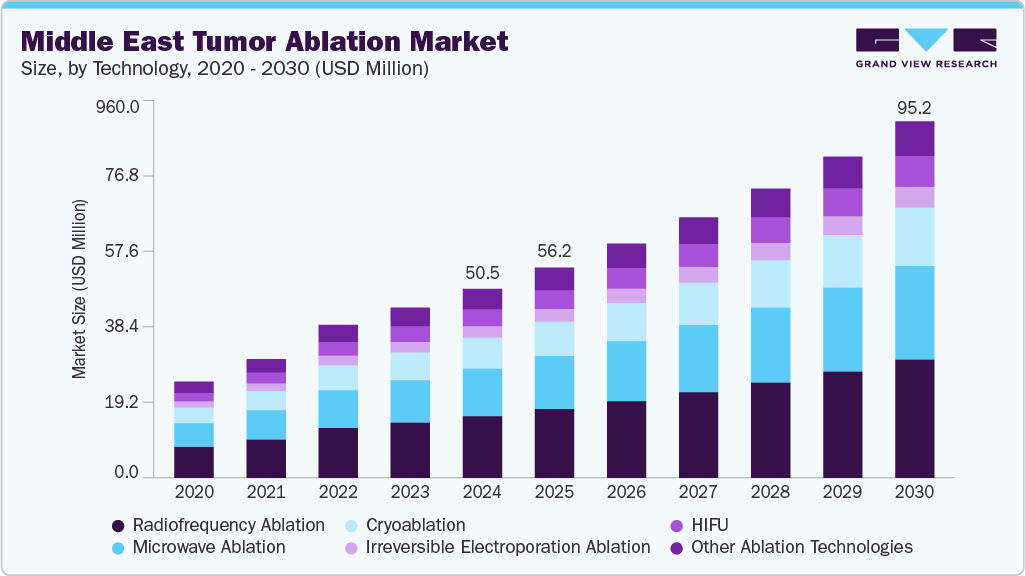
The Middle East tumor ablation market size was estimated at USD 50.5 million in 2024 and is projected to reach USD 95.2 million in 2030, growing at a CAGR of 11.1% from 2025 to 2030. The cancer burden in the region, along with increased investments in oncology and the rising demand for non-invasive treatment methods, are the major factors driving this market's growth. The demand for new local treatments using such methods as radiofrequency, microwave, cryoablation, or irreversible electroporation is growing as medical workers look for safer and more effective treatment methods for cancer.
According to a study published in September 2024 by John Wiley & Sons, Inc., the Gulf Cooperation Council (GCC) countries registered 42,475 new cancer cases and 19,895 deaths in 2020. The cancer incidence is predicted to increase by 116% in Saudi Arabia and by up to 270% in Qatar by 2040. This alarming increase underscores the growing need for efficient and less-invasive cancer therapies. Tumor abolition methods that enable the targeted destruction of tumors, with less time needed for recovery and reduced hospital stays, are becoming more popular in the Middle East. As governments and private medical establishments continue to invest in advanced oncology centers and widen the scope of interventional radiology, the Middle East tumor ablation industry will be experiencing high growth in the near future.
Moreover, cancer hospitals and oncology networks, which are often financed by governments and large private healthcare groups in the Middle East, are expanding their capacity, thereby creating a demand for image-guided ablation services. For instance, The Hamdan Bin Rashid Cancer Hospital in Dubai is scheduled to launch in 2026 as part of Dubai Health’s academic health system. In June 2024, Dubai Health collaborated with The Royal Marsden NHS Foundation Trust to expedite clinical development and establish first-class cancer care and research facilities in the region.
Physicians are progressively choosing tumor ablation to treat liver, kidney, lung, and bone tumors as this method is said to be more beneficial than surgery in terms of a shorter hospital stay, quicker recovery, and it is a viable solution when surgery cannot be done. These reasons are attractive to both patients and healthcare payers seeking cost-efficient, high-quality outcomes. Technological advances, such as the reduction in size of ablation probes, the increased speed of the energy delivery system, the enhancement of imaging guidance, and the growing popularity of interventional radiology training, are making operations safer, more accurate, and more reliable. All these factors together enhance the region’s capacity to deliver state-of-the-art, minimally invasive cancer treatments, making tumor ablation a crucial element of modern oncology care.
Market Concentration & Characteristics
The Middle East tumor ablation industry is gaining strong momentum, driven by rise of cancer cases, quick acceptance of minimally invasive methods and large expenditures on oncology infrastructures. The countries like the UAE, Saudi Arabia, and Qatar are becoming the main regional centers of advanced interventional oncology procedures, which is made possible by the development of healthcare infrastructure and government initiatives. Hospitals in Dubai, Abu Dhabi, and Riyadh are increasingly investing in image-guided ablation therapies such as radiofrequency, microwave, and cryoablation to replace traditional surgery which is riskier and less accurate, in general, for the treatment of liver, kidney, and lung tumors.
The Middle East tumor ablation industry is rapidly advancing, driven by innovations in energy delivery systems, imaging technologies, and precision-guided tools. Countries like the UAE and Saudi Arabia are leading with investments in real-time imaging, robotic-assisted surgeries, and thermal monitoring systems that enhance safety and accuracy. Continuous improvements in radiofrequency, microwave, cryoablation, and irreversible electroporation are enabling more precise and minimally invasive tumor treatments.
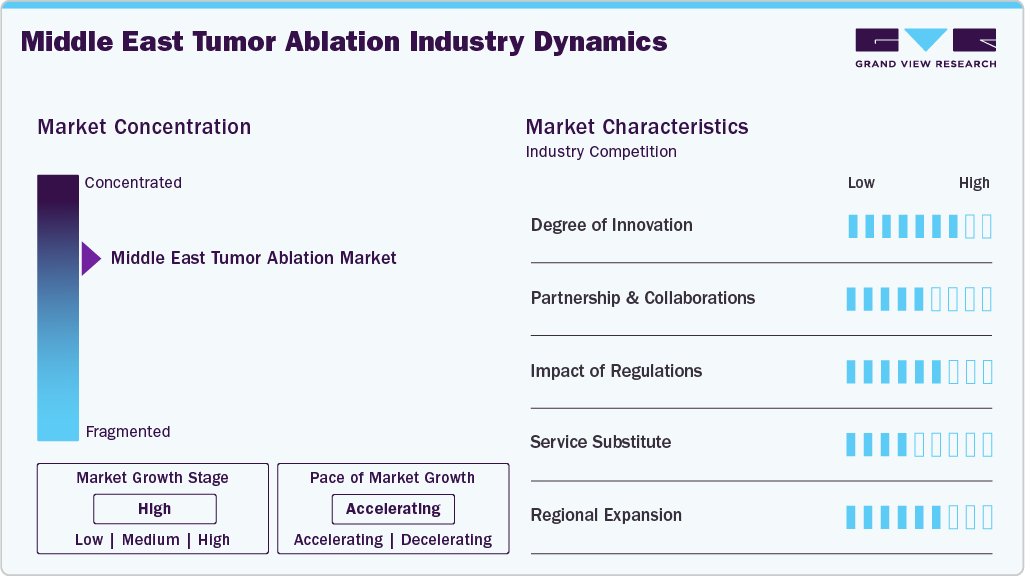
Mergers and acquisitions in the Middle East tumor ablation industry are primarily concentrated among healthcare providers, oncology networks, and diagnostic service groups rather than medical device manufacturers. Regional hospital chains and specialized oncology centers in the UAE and Saudi Arabia are pursuing strategic collaborations and acquisitions to expand access to advanced interventional oncology and ablation services. For instance, in February 2025, Burjeel Holdings PLC announced its intention to establish a leading radiation oncology network across the GCC, following its acquisition of an 80% stake in the Dubai-based Advanced Care Oncology Center (ACOC). This initiative will leverage ACOC’s expertise in radiation therapy and integrate advanced technologies to enhance access and outcomes for cancer patients in underserved regional markets.
The Middle East embraces the use of tumor ablation under its very strict regulations which are designed to ensure safety and quality. In the United Arab Emirates, the Ministry of Health and Prevention (MOHAP) and Dubai Health Authority (DHA) require that ablation be carried out only by certified specialists in facilities that are not only accredited but also well-equipped. Likewise, the Food and Drug Authority (FDA) of Saudi Arabia is responsible for the oversight of the import, testing, and approval of the ablation systems that conform to the set international standards. These rules increase the confidence of the patients, allow the use of sophisticated technology, and facilitate the provision of high-quality, minimally invasive cancer care throughout the region.
Although tumor ablation is gaining strong momentum across the Middle East, it faces competition from both traditional and advanced cancer treatment alternatives. In public hospitals in countries surgical tumor removal and radiation therapy remain common because they are more affordable and widely available. Chemotherapy and targeted drugs also continue to dominate in some cancer types. Meanwhile, Gulf nations such as the UAE, Saudi Arabia, and Qatar are adopting robotic surgery and stereotactic radiotherapy as premium options for localized tumors. However, with better access to technology and improved training, tumor ablation is increasingly becoming a preferred, minimally invasive, and cost-effective treatment choice across the region.
The regional expansion is the result of a combined effort between government-led initiatives and private sector investments. The Gulf countries, including the UAE, Saudi Arabia, and Qatar, are extensively developing next-generation oncology centers equipped with advanced interventional radiology and ablation technologies. Thus, hospitals such as Burjeel Medical City in Abu Dhabi and King Faisal Specialist Hospital in Riyadh are going the extra mile to become the front-runners of the region in minimally invasive cancer care, providing a wide range of ablation treatments in addition to global-standard oncology services.
Technology Insights
The radiofrequency ablation (RFA) segment led the market with the largest revenue share of 32.7% in 2024, driven by its growing adoption as a minimally invasive and reliable treatment for liver, lung, kidney, and thyroid tumors. Its dominance is supported by the region’s increasing demand for faster recovery and outpatient-based cancer care, along with a rising cancer burden, expanding healthcare capacity, and greater clinician expertise in percutaneous procedures. According to the International Agency for Research on Cancer (IARC), Saudi Arabia recorded 28,113 new cancer cases in 2022, with a five-year prevalence of 94,951. This high disease burden is fueling demand for advanced and compliant imaging systems that meet international standards, further supporting the growth of the segment. RFA’s precision and effectiveness in treating solid tumors, particularly in the liver and kidney, along with its ability to treat multiple tumors simultaneously using multiple electrodes, enhance procedural efficiency and treatment outcomes. These factors are fueling the growth of RFA segment in the Middle East tumor ablation industry.
The microwave ablation (MWA) segment is expected to grow at the fastest CAGR of 11.9% over the forecast period, driven by its shorter procedure times, deeper and more consistent heating, and suitability for outpatient and image-guided cancer treatments. MWA emits electromagnetic waves of at least 900 MHz to destroy tumors most efficiently, resulting in faster heating, larger ablation volumes, less pain, and shorter treatment durations compared to radiofrequency ablation. In fact, the operation at higher temperatures results in consistent and effective tissue destruction with minimal impact from the heat sink effect. Besides that, treatment outcomes are being further enhanced by technological advancements, such as the image-guided precision integrated by Varian’s IntelliBlate system. Clinical evidence, including the COLLISION trial, which shows comparable results to surgical resection for colorectal liver metastases, is stabilizing MWA as a trustworthy, minimally invasive standard. This not only facilitates patient safety but also quickens recovery and increases the number of tumor types that precision-guided interventions can treat.
Treatment Insights
The percutaneous ablation segment accounted for the largest market revenue share in 2024, driven by the growing clinical preference for minimally invasive alternatives to traditional open surgeries. Percutaneous ablation treatment eliminates the need for open procedures by inserting a probe through the skin and using energy sources such as heat or cold guided by imaging technologies like ultrasound, CT, or MRI to destroy or shrink tumor tissue. Thermal ablation of localized solid tumors can be achieved using methods such as high-intensity ultrasound, laser, microwave, and radiofrequency, with radiofrequency ablation (RFA) being one of the most established options due to its predictable results and cost-effectiveness. A report by Medical Tourism Magazine highlighted that global clinics specializing in hepatic tumor ablation are gaining recognition in the Middle East market for their advanced and minimally invasive treatment approaches, reflecting the region’s growing focus on high-quality, technology-driven cancer care.
The laparoscopic ablation segment is expected to experience at the fastest CAGR during the forecast period, driven by its precision, minimally invasive nature, and effectiveness in treating liver and renal cancers. It is a method that achieves precise tumor destruction while causing minimal side effects, recovery time, and hospital stays, thereby, making it a patient-friendly as well as a cost-effective procedure. This growth is fueled by the increasing hospital expenditures on advanced laparoscopic and robotic systems in the whole of Saudi Arabia and the UAE. Numerous clinical trials are conducting and finding laparoscopic ablation as a safe and effective solution, especially in cases of hepatocellular carcinoma and renal malignancies. In October 2025, The American Journal of Gastroenterology published a report on a significant increase in liver cancer incidence due to hepatitis B, C, and alcohol-associated disease, thereby, emphasizing the demand for efficient, minimally invasive treatment methods. These factors are leading to the stabilization of laparoscopic ablation as a key player in cancer care of the future.
Application Insights
The liver cancer segment accounted for the largest market revenue share in 2024. The growth is driven by the rising prevalence of hepatocellular carcinoma (HCC), the most common type of liver cancer across Middle Eastern countries. The increasing incidence of HCC is linked to chronic viral hepatitis, non-alcoholic fatty liver disease, and other lifestyle-related factors. According to recent research, HCC represents the majority of liver cancer cases in Saudi Arabia, with many patients diagnosed at intermediate or advanced stages, thereby limiting curative options and fueling demand for locoregional therapies such as tumor ablation. Techniques like radiofrequency ablation (RFA) and microwave ablation (MWA) are gaining significant traction due to their effectiveness and minimally invasive nature.
For instance, in February 2024, a peer-reviewed study published in the Journal of Hepatocellular Carcinoma highlighted the vital role of percutaneous ablation for early-stage HCC patients who are not surgical candidates, underscoring its expanding adoption across the Gulf region’s advanced interventional radiology landscape.
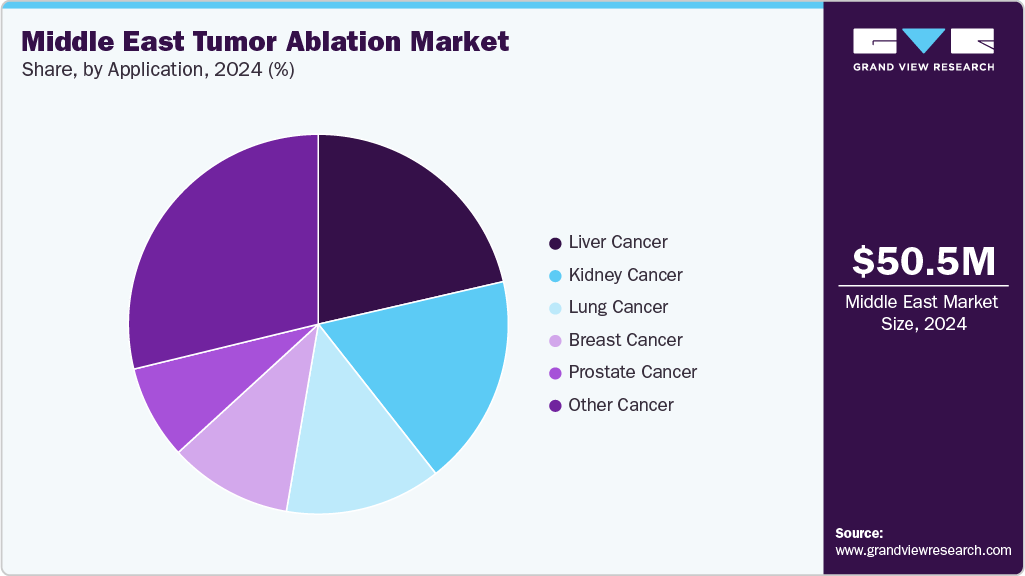
The lung cancer segment is expected to witness at the fastest CAGR during the forecast period, driven by the rising incidence of the disease and the growing number of related hospitalizations across the region. According to regional estimates, around 72,000 deaths from trachea, bronchus, and lung cancers were reported in the Middle East and North Africa in 2022, highlighting a substantial unmet medical need. Lung cancer often presents at advanced stages, making minimally invasive approaches such as tumor ablation increasingly important for treatment and palliation.
Techniques such as radiofrequency, microwave, and cryoablation are gaining momentum due to their ability to target tumors precisely, while also reducing recovery time and hospital stays. As healthcare systems in the region continue to strengthen diagnostic capacity and invest in interventional oncology, the adoption of these ablation technologies is expected to accelerate, supporting improved access to advanced cancer care and better patient outcomes.
Country Insights
Saudi Arabia Tumor Ablation Market Trends
Saudi Arabia dominated the Middle East tumor ablation market with the largest revenue share of 49.01% in 2024, and is projected to grow at the fastest CAGR during the forecast period, supported by strong economic development, rising healthcare spending, and an increasing demand for advanced treatment options. The growing cancer burden, driven by lifestyle changes such as increased consumption of processed foods and sedentary habits, is a major factor fueling market expansion. According to the International Agency for Research on Cancer (IARC), Saudi Arabia reported 28,113 new cancer cases in 2022, with a five-year prevalence of 94,951. The Saudi Vision 2030 initiative, which emphasizes healthcare innovation and infrastructure development, is also contributing to this growth by promoting advanced research and the adoption of technology. Increasing preference for minimally invasive surgical procedures and technological advancements in tumor ablation devices are further driving adoption. However, limited awareness of ablation techniques among patients and clinicians remains a challenge. Continued investment in healthcare modernization and local innovation is expected to strengthen market potential over the forecast period.
Qatar Tumor Ablation Market Trends
The Qatar tumor ablation market is gaining momentum as the country faces a rising cancer burden and an increased demand for minimally invasive treatment options. According to the Qatar National Cancer Registry, there were approximately 1,733 new cancer cases and 782 deaths in 2022, highlighting the urgent need for advanced therapies. Key factors driving market growth include government investment in healthcare infrastructure, the country’s strategic focus on early detection and oncology care optimization, and an increasing preference for outpatient, image-guided tumor-ablation treatments such as radio-frequency, microwave, and cryo-ablation. As awareness expands and clinical capabilities develop, Qatar’s tumor ablation market is well-positioned for sustained growth in the forecast period.
Oman Tumor Ablation Market Trends
The tumor ablation market in Oman is poised for growth, driven by the expansion of healthcare capacity and a rising cancer burden. According to data from the International Agency for Research on Cancer (IARC), Oman reported 4,045 new cancer cases and 13,006 five-year prevalent cases in 2022. With cancer now the third leading cause of hospital death in the country, minimally invasive technologies such as radio-frequency, microwave, and cryo-ablation are gaining relevance. In addition, the rising demand for outpatient procedures, shorter recovery times, and growing clinician adoption of interventional oncology techniques are enhancing market momentum. However, broader awareness and training remain critical to fully realize the potential of tumor-ablation therapies in Oman’s evolving healthcare landscape.
UAE Tumor Ablation Market Trends
The UAE tumor ablation market is growing rapidly, driven by strong healthcare infrastructure, expanding hospital networks, and rising medical tourism. With over 160 hospitals, including leading centers like Cleveland Clinic Abu Dhabi and American Hospital Dubai, the country is becoming a regional hub for advanced, minimally invasive cancer treatments. In 2023, Dubai attracted about 691,000 medical tourists, generating USD 280.4 million (AED 1.03) billion in healthcare spending. A young, health-aware population and widespread insurance coverage especially in Abu Dhabi and Dubai are boosting access to advanced therapies. Government investments in healthcare quality and technology continue to strengthen the UAE’s position in the tumor ablation market.
Kuwait Tumor Ablation Market Trends
The tumor ablation market in Kuwait is driven by evolving patient preferences, technological advancements, and shifts in healthcare infrastructure. Kuwait offers a favorable investment outlook for tumor ablation, driven by strong government initiatives and private-sector participation under the New Kuwait Vision 2035. The country is modernizing healthcare infrastructure and expanding advanced cancer treatment facilities, such as the Kuwait Cancer Control Center (KCCC), which is adopting image-guided ablation systems. Programs like the National Cancer Awareness Campaign (CAN) are increasing awareness of early detection, while high healthcare spending and demand for minimally invasive treatments are boosting adoption. Growing screening efforts and technology upgrades are improving access to precise, targeted therapies for cancers such as liver and kidney.
Bahrain Tumor Ablation Market Trends
The Bahrain tumor ablation market is poised for growth, driven by an increasing cancer burden and the rising adoption of minimally invasive treatments. In 2022, Bahrain has recorded 1,383 new cancer cases and 607 cancer-related deaths, which is an indication of the need for targeted therapies. As the country's healthcare infrastructure is getting better and more doctors are inclined to go for image-guided ablation technologies like radiofrequency ablation (RFA), microwave ablation (MWA), and cryoablation, a lot of potential comes up for device developers and service providers. The main factors contributing to the market growth are the progression of interventional oncology, government funding for medical innovations, and an increasing number of patients opting for treatments with a shorter recovery period and fewer side effects.
Key Middle East Tumor Ablation Company Insights
Leading players such as Medtronic plc., Boston Scientific Corporation, Johnson & Johnson Service Inc. (Ethicon, Inc.), AngioDynamics, and Bioventus Inc. (Misonix Inc.) are propelling the growth of the Middle East tumor ablation industry. These companies leverage advanced technologies and targeted marketing to enhance product efficacy and appeal. Their strategic expansions and strong distribution networks are boosting accessibility, meeting rising consumer demand for minimally invasive aesthetic treatments, and solidifying their competitive presence in the region’s rapidly evolving beauty and wellness sector.
Key Middle East Tumor Ablation Companies:
- Medtronic plc.
- Boston Scientific Corporation
- Johnson & Johnson Service Inc. (Ethicon, Inc.)
- AngioDynamics
- Bioventus Inc. (Misonix Inc.)
- EDAP TMS
- Chongqing Haifu Medical Technology Co., Ltd
- Mermaid Medical
- HealthTronics, Inc.
- H.S. Hospital Service S.p.A
Recent Developments
-
In January 2023, Tawam Hospital, a part of Abu Dhabi Health Services Company (SEHA), introduced a novel treatment for benign thyroid nodules using thyroid radiofrequency and microwave ablation, performed under local anaesthesia. This minimally invasive procedure enables patients to be discharged within an hour, offering significant symptom relief and reduction in nodule size, and presents a viable alternative to traditional surgery.
Middle East Tumor Ablation Market Report Scope
Report Attribute
Details
Market size value in 2025
USD 56.2 million
Revenue forecast in 2030
USD 95.2 million
Growth rate
CAGR of 11.1% from 2025 to 2030
Base year for estimation
2024
Historical data
2021 - 2023
Forecast period
2025 - 2030
Quantitative units
Revenue in USD million/billion and CAGR from 2025 to 2030
Report coverage
Revenue forecast, company ranking, competitive landscape, growth factors, and trends
Segments covered
Technology, treatment, application, country
Regional scope
Middle East
Country scope
Qatar; Saudi Arabia; UAE ; Kuwait; Oman; Bahrain
Key companies profiled
Medtronic plc.; Boston Scientific Corporation; Johnson & Johnson Service Inc. (Ethicon, Inc.); AngioDynamics; Bioventus Inc. (Misonix Inc.); EDAP TMS; Chongqing Haifu Medical Technology Co., Ltd; Mermaid Medical; HealthTronics, Inc.; H.S. Hospital Service S.p.A
Customization scope
Free report customization (equivalent to 8 analysts working days) with purchase. Addition or alteration to the segment scope.
Pricing and purchase options
Avail customized purchase options to meet your exact research needs. Explore purchase options
Middle East Tumor Ablation Market Report Segmentation
This report forecasts revenue growth at country levels and analyzes the latest industry trends in each sub-segments from 2021 to 2030. For this study, Grand View Research has segmented the Middle East tumor ablation market report based on technology, treatment, and application.
-
Technology Outlook (Revenue, USD Million, 2021 - 2030)
-
Radiofrequency Ablation
-
Microwave Ablation
-
Cryoablation
-
Irreversible Electroporation Ablation
-
HIFU
-
Other Ablation Technologies
-
-
Treatment Outlook (Revenue, USD Million, 2021 - 2030)
-
Surgical Ablation
-
Laparoscopic Ablation
-
Percutaneous Ablation
-
-
Application Outlook (Revenue, USD Million, 2021 - 2030)
-
Kidney Cancer
-
Liver Cancer
-
Breast Cancer
-
Lung Cancer
-
Prostate Cancer
-
Other Cancer
-
-
Region Outlook (Revenue, USD Million, 2021 - 2030)
-
Middle East
-
Qatar
-
Saudi Arabia
-
UAE
-
Kuwait
-
Oman
-
Bahrain
-
-

Share this report with your colleague or friend.
Need a Tailored Report?
Customize this report to your needs — add regions, segments, or data points, with 20% free customization.


ISO 9001:2015 & 27001:2022 Certified
We are GDPR and CCPA compliant! Your transaction & personal information is safe and secure. For more details, please read our privacy policy.
Trusted market insights - try a free sample
See how our reports are structured and why industry leaders rely on Grand View Research. Get a free sample or ask us to tailor this report to your needs.













