
- Home
- »
- Electronic & Electrical
- »
-
Minibar Refrigerators Market Size & Share Report 2026-2033GVR Report cover

Minibar Refrigerators Market (2026 - 2033)
Size, Share & Trends Analysis Report By Technology (Absorption, Compression, Thermoelectric/Peltier), By Application (Transportation, Hospitality, Offices, Household), By Region, And Segment Forecasts
Market Size, 2025
$369.2MMarket Estimate, 2026
$380.7MMarket Forecast, 2033
$478.1MCAGR, 2026–2033
3.3%Minibar Refrigerators Market Summary
The global minibar refrigerators market size was valued at USD 369.2 million in 2025 and is projected to grow from USD 380.7 million in 2026 to USD 478.1 million by 2033, at a CAGR of 3.3% from 2026 to 2033. The market in Europe dominated with a revenue share of 30.6% in 2025. The hospitality industry, particularly hotels, emphasizes unique designs, personalized services, and immersive themes, all of which contribute to market expansion.
 Source: Grand View Research, IR Documents, Primary Interviews, Paid DatabasesTo learn more about this report,
 Download Free Sample Report
 Key Market Trends & Insights
- By application: Hospitality segment held the largest market share of 68.9% in 2025.
- By technology: Absorption segment held the largest market share of 56.0% in 2025.
Regional Highlights
- Largest regional market: Europe (30.6% revenue share, 2025)
- Fastest-growing regional market: Asia Pacific (highest CAGR, 2026-2033)
- By country: Germany held the largest market share in 2025
Market Size & Forecast
- Market size in 2025: USD 369.2 Million
- Estimated market size in 2026: USD 380.7 Million
- Projected market size by 2033: USD 478.1 Million
- CAGR (2026-2033): 3.3%
Three ways to get this report
Buy it, customize it, or ask a question.Ask an Analyst
Analyst response in 1 business day
- AccessReport author, directly
- Reply timeWithin 1 working day
- No sales callDirect answer only
- FormatEmail reply
- CostFree, no cost
Get the Full Report
What the study covers
- FormatsPDF · Excel · Dashboard
- Timeline2026–2033 annual, 2025 base
- Coverage20+ countries, 5 regions
- Companies10+ key players profiled
Customize the Report
20% free customization
- IncludeCountries, segments, points
- TailorTo your product definition
- ExtendDeeper competitor detail
- OrA fully bespoke study
- Turnaround5–10 working days
According to the Q4 year-end global construction pipeline trend report by Lodging Econometrics (LE), the global hotel construction pipeline at the end of 2022 stood at 14,267 properties with 2,298,846 rooms, marking a 4% year-over-year increase. In this market, hotels prioritize high-quality minibar offerings that align with their brand identity, catering to guests who seek exclusivity and premium amenities. As a result, the rising number of hotels and resorts worldwide has benefited the minibar refrigerators industry.Technological advancements have transformed minibar refrigerators from simple cooling devices into sophisticated appliances equipped with cutting-edge features and smart functionalities. For instance, smart minibar refrigerators can be remotely controlled, monitored, and stocked, allowing hotels to streamline operations and enhance the guest experience. Moreover, these appliances provide real-time consumption data, enabling commercial establishments to optimize restocking and minimize waste.
 To learn more about this report, Download Free Sample Report
 Market players are increasingly offering energy-efficient minibar refrigerators. For instance, Dometic Group AB’s HiPro series features premium minibars that consume less energy and are free from chromate, a commonly used corrosion inhibitor for absorption minibars recently flagged by the EU. The Dometic HiPro minibar refrigerators are designed to rapidly chill drinks without overcooling. Furthermore, their transparent door racks accommodate 1.5-liter bottles, while the adjustable and removable shelves allow for versatile storage of various products.
The growing trend of gatherings and house parties among the U.S. households has increased demand for extra cold storage to keep beverages and frozen snacks handy for outdoor dining in backyards, terraces, and gardens. Homeowners' preference for dedicated cold storage has driven the adoption of minibar fridge in residential settings. In addition, rising participation of millennials in outdoor recreation and the expansion of hospitality sector, particularly in hotels, are expected to fuel the portable mini fridge market in the U.S. Many hotels now offer personalized amenities, catering to guests seeking comfort and convenience.
Portable mini fridges in hotel rooms provide guests with convenient storage for snacks, drinks, and medication, enhancing their overall experience. This feature is set to boost product adoption rate in the hospitality sector. Bartech Systems International Inc. specializes in providing automatic minibar solutions to hotels globally, which are designed to enhance guest experience and optimize revenue opportunities for hoteliers.
Market Dynamics
The global minibar refrigerator market is primarily driven by the expansion of the hospitality sector, increasing hotel room modernization programs, and rising guest expectations for in-room convenience. Demand is particularly strong in premium hotels, business hotels, serviced apartments, cruise ships, and healthcare facilities, where minibars contribute to guest satisfaction and ancillary revenue. However, market growth is being reshaped by rising energy-efficiency regulations, changing consumer beverage consumption patterns, and the hospitality industry's focus on reducing operating costs. The market is also witnessing a gradual shift from traditional absorption minibars to compressor- and thermoelectric-based models that offer improved energy efficiency and temperature control.
The primary driver of minibar refrigerators is the ongoing refurbishment of hotels and the expansion of premium hospitality infrastructure. Hotel operators are increasingly replacing older minibar units with energy-efficient and quieter models to improve guest satisfaction while reducing electricity consumption. Growing tourism, business travel, and investments in luxury and upper-midscale hotel segments are further supporting demand for compact refrigeration solutions integrated into guest rooms.
Market growth is constrained by declining minibar purchases among hotel guests, who increasingly rely on food delivery services, convenience stores, and hotel lobby retail options for beverages and snacks. In addition, inventory replenishment, product spoilage, maintenance, and energy expenses add to operational costs, prompting some midscale and budget hotels to reduce or eliminate traditional minibar offerings.
A significant opportunity exists in the growing demand for energy-efficient and technologically advanced minibar refrigerators. Hotels are increasingly investing in low-power compressor-based units, smart inventory monitoring systems, and environmentally compliant refrigerant technologies to meet sustainability targets and lower operating expenses. Demand is also expanding beyond hotels into healthcare facilities, senior living residences, corporate accommodations, and serviced apartments, creating new growth avenues for manufacturers.
Analyst Perspective
The minibar refrigerator market is primarily driven by hotel construction, renovation cycles, and systematic replacement of aging units across hospitality properties. Demand is concentrated in upscale, upper-midscale, and luxury hotels, where in-room refrigeration is a standard amenity, while budget and economy hotels increasingly opt for reduced or unstocked minibar setups due to cost pressures and low utilization. As a result, procurement is shifting away from revenue-generating minibar models toward energy-efficient, low-noise, and low-maintenance units, making operating cost efficiency, durability, and sustainability compliance the key competitive differentiators.
Technology Insights
Based on technology, absorption segment led the market with the largest revenue share of 56.0% in 2025 due to its silent operation, energy efficiency, and widespread adoption in the hospitality industry. Hotels and cruise ships favor absorption refrigerators because they operate without compressors, ensuring a noise-free experience for guests. In addition, their ability to function on multiple energy sources, including electricity and gas, makes them highly versatile. The growing demand for compact, reliable cooling solutions in premium accommodations has further propelled the dominance of absorption technology in this market.
The Thermoelectric/Peltier segment is anticipated to grow at the fastest CAGR of 3.7% over the forecast period, attributed to its compact design, eco-friendly operation, and technological advancements. Unlike traditional cooling methods, thermoelectric refrigerators use solid-state technology, eliminating the need for refrigerants and compressors. This makes them lightweight, energy-efficient, and ideal for modern hospitality settings. As sustainability becomes a priority, the demand for Peltier-based cooling solutions is rising, positioning this segment for rapid growth in hotels, offices, and residential spaces.
Application Insights
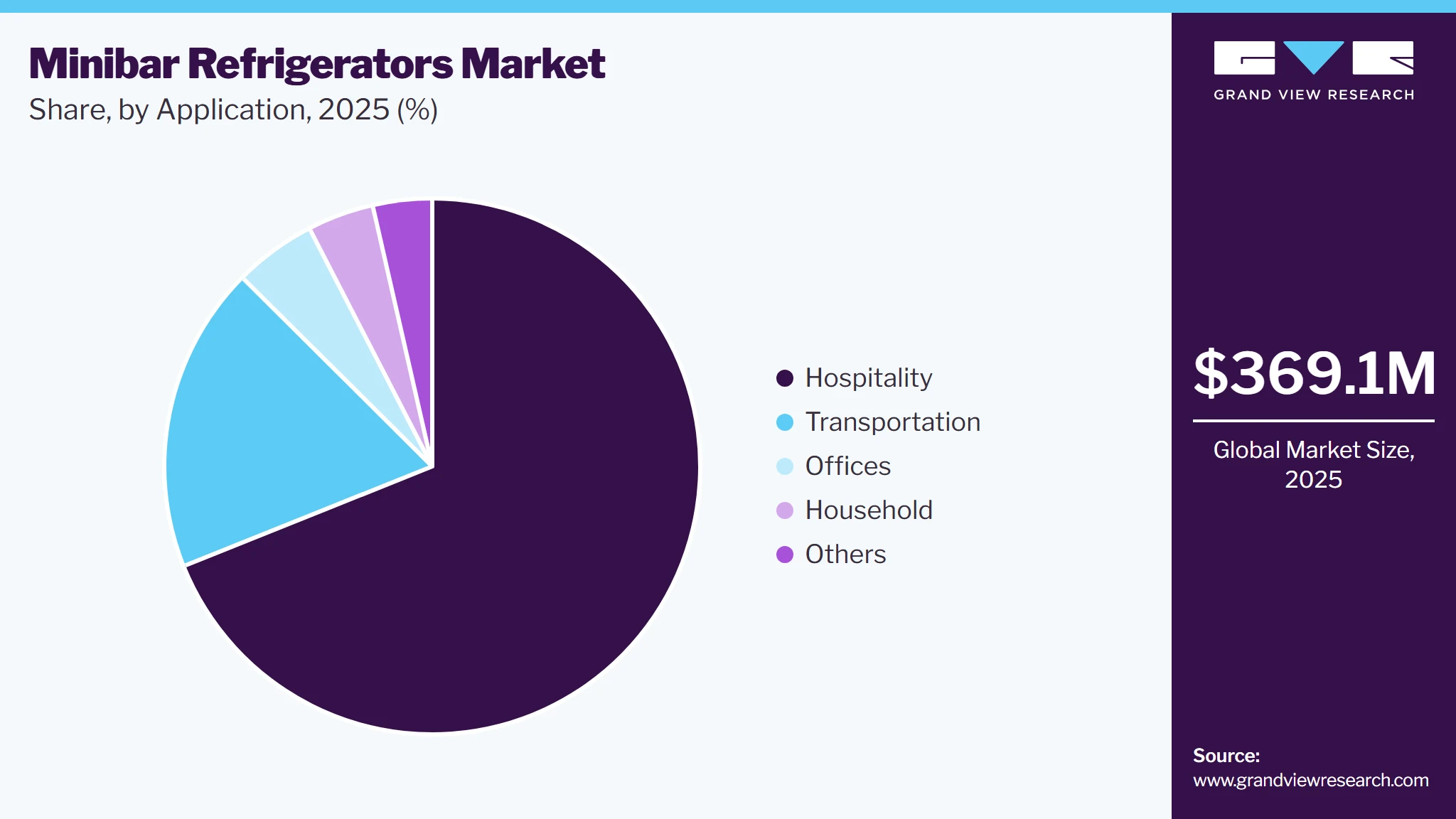
Based on application, minibar refrigerators for hospitality led the market with the largest revenue share of 68.9% in 2025, owing tothe rising number of hotels and resorts worldwide. Hotels prioritize minibar refrigerators as essential in-room amenities, enhancing guest convenience and luxury experiences. The demand for compact, energy-efficient, and technologically advanced minibars has surged, and smart features, especially remote monitoring and automated restocking, have gained traction. As the hospitality industry continues to expand, particularly in premium accommodation, the need for high-quality minibar refrigerators remains strong, strengthening the dominance of this segment in the market.
 To learn more about this report, Download Free Sample Report
 The transportation segment is projected to be the fastest-growing segment during the forecast period, driven by the surging demand for portable cooling solutions in travel and tourism. Minibar refrigerators are increasingly integrated into campervans, cruise ships, and other transport modes, catering to travelers seeking convenience and comfort. Their compact size, energy efficiency, and ability to store beverages and snacks make them ideal for on-the-go use. As the global travel industry grows, the transportation sector is set to drive significant growth in the minibar refrigerators industry.
Regional Insights
North America minibar refrigerators market is set to grow significantly during the forecast period due to the rising adoption of minibar refrigerators in residential spaces, along with strong demand from the hospitality industry. Homeowners are increasingly incorporating compact refrigerators for convenience and personal use, fueling market expansion. Moreover, hotels and resorts continue to invest in high-quality minibars to offer enhanced experience to their guests. With evolving consumer preferences and the hospitality sector’s focus on premium services, the market is expected to witness steady growth, particularly with advancements in smart and energy-efficient minibar technologies.
U.S. Minibar Refrigerators Market Trends
The U.S. minibar refrigerators market held the largest share in the regional market in 2025, owing to the rise in luxury tourism and the increasing focus on sustainability. Upscale hotels and resorts are investing in premium minibar solutions to cater to high-end travelers who seek convenience and personalized experiences. Furthermore, the hospitality industry is prioritizing energy-efficient minibar refrigerators to align with sustainability goals and reduce operational costs. This shift toward smart, eco-friendly minibars is leading to eco-conscious innovation. The factors mentioned above and widespread adoption of minibars across establishments are expected to propel market expansion.
Europe Minibar Refrigerators Market Trends
Europe dominated the minibar refrigerators market with the largest revenue share of 30.6% in 2025, fueled bythe surge in use of smart minibars and health-focused innovations. Hotels are integrating automated inventory tracking and billing systems, enhancing efficiency and guest convenience. In addition, minibars with antimicrobial surfaces and smart sensors for food freshness align with growing health-conscious trends, ensuring hygiene and quality. As the hospitality sector prioritizes cutting-edge features, demand for technologically advanced and health-centric minibar solutions is increasing, fueling market expansion. This shift reflects a broader industry movement toward sustainability and superior guest experiences.
 To learn more about this report, Download Free Sample Report
 The minibar refrigerators market in Germany held the largest share in the Europe region in 2025, attributed to urbanization and the increasing trend of home entertainment. As city dwellers embrace compact living, there is a surge in demand for space-efficient cooling solutions that fit seamlessly into modern apartments. Moreover, the rise of home bars and entertainment spaces has fueled the need for dedicated minibars, allowing consumers to keep beverages and snacks conveniently chilled. Hotels and serviced apartments are also upgrading in-room amenities to meet the expectations of urban travelers, further expanding the size of the minibar refrigerators industry.
Asia Pacific Minibar Refrigerators Market Trends
Asia Pacific minibar refrigerators market is anticipated to grow at the fastest CAGR of 4.3% from 2026 to 2033, propelled by the dominance of absorption technology and the rising popularity of thermoelectric/Peltier models, propelled bythe dominance of absorption technology and the rising popularity of thermoelectric/Peltier models. Absorption technology remains the preferred choice in luxury hotels and cruise ships, thanks to its silent operation and reliability. In addition, thermoelectric minibars are gaining traction among residential users and budget accommodations due to their energy efficiency and compact design. As sustainability concerns grow, manufacturers are investing in these technologies to meet diverse consumer needs, driving steady market expansion across the region.
China minibar refrigerators market is projected to grow at the fastest rate in the regional market over the forecast period, driven bythe rise in cruise and marine applications and tech-driven transformation. As China expands its cruise tourism sector, there is a surge in the demand for compact, energy-efficient minibar refrigerators on luxury liners and recreational boats. Furthermore, AI-powered minibar innovations, such as smart cooling adjustments and predictive maintenance, are revolutionizing both hospitality and residential markets. Hotels and resorts are embracing touchless, Wi-Fi-enabled minibar solutions, boosting market size.
Key Minibar Refrigerators Company Insights
Some of the key companies in the minibar refrigerators industry include Minibar Systems, Indel B S.p.A., Royal Minibars, Koolatron, and Bartech.
-
Royal Minibars specializes in silent hotel minibar refrigerators using absorption cooling technology. Its minibars are environment-friendly, energy-efficient, and maintenance-free. They are designed for hotels, resorts, and hospitality spaces with customizable features such as glass doors, locks, and LED lighting.
-
Bartech provides automated minibar solutions for hotels, enhancing guest experience and revenue. Its smart minibars feature AI-powered inventory tracking, touchless controls, and real-time analytics, helping hotels streamline operations while offering personalized, efficient minibar management.
Key Minibar Refrigerators Companies:
The following are the leading companies in the minibar refrigerators market. These companies collectively hold the largest market share and dictate industry trends.
- ISM Makine Elektrik Sanayi ve Ticaret A.Ş.
- Dometic Group AB (PUBL)
- Felix Storch (Summit Appliance)
- Minibar Systems
- Indel B S.p.A.
- HISENSE
- OMNITEC SYSTEMS SL
- Royal Minibars
- TEFCOLD A/S
- Koolatron
- Bartech
Competitive Benchmarking
Category
Operating Strategies
Competitive Edge
Weakness
Established Players (Dometic Group AB (PUBL), HISENSE, Indel B S.p.A., TEFCOLD A/S, Bartech, Minibar Systems, OMNITEC SYSTEMS SL)
- Focus on large-scale manufacturing, hospitality OEM contracts, smart minibar systems, and continuous innovation in energy efficiency, noise reduction, and IoT-enabled minibar solutions.
- Strong global presence, established hospitality partnerships, diversified refrigeration portfolios, and advanced technological capabilities.
- High operating costs, slower customization for niche hotel requirements, and sensitivity to hospitality sector demand cycles.
Emerging Players (ISM Makine Elektrik Sanayi ve Ticaret A.Ş., Felix Storch (Summit Appliance), Koolatron, Royal Minibars)
- Focus on cost-competitive minibar units, regional hospitality supply, private-label manufacturing, and flexible OEM solutions tailored to small and mid-scale hotels.
- Pricing flexibility, agility in customization, and ability to serve niche/regional markets with shorter lead times.
- Limited global brand visibility, smaller economies of scale, and weaker R&D and distribution networks compared to established players.
Recent Developments
-
In April 2025,Smyths introduced the So Chill Mini Fridge Infinity, a stylish and compact cooling solution designed for gamers, students, and style enthusiasts. Featuring a mirrored door with 12-color LED lights, a 4-litre capacity, and efficient cooling that lowers temperature by 15-20 degrees, it offers convenience, functionality, and a bold aesthetic upgrade.
-
In October 2024, Bartech introduced the Flat eFridge, a wall-mounted minibar designed to improve hotel design and operational efficiency. With its sleek, modern, and minimalist aesthetic, this innovative solution aims to enhance in-room F&B services, boosting guest satisfaction and hotel profitability.
Minibar Refrigerators Market Report Scope
Report Attribute
Details
Market size in 2025
USD 369.2 million
Estimated market size in 2026
USD 380.7 million
Projected market size by 2033
USD 478.1 million
Growth rate
CAGR of 3.3% from 2026 to 2033
Base year for estimation
2025
Historical data
2021 - 2024
Forecast period
2026 - 2033
Quantitative units
Revenue in USD million/billion and CAGR from 2026 to 2033
Report coverage
Revenue forecast, company ranking, competitive landscape, growth factors, and trends
Segments covered
Technology, application, region
Regional scope
North America; Europe; Asia Pacific; Central & South America; Middle East & Africa
Country scope
U.S.; Canada; Mexico; Germany; UK; France; Italy; Spain; China; Japan; India; South Korea; Australia & New Zealand; Brazil; South Africa
Key companies profiled
ISM Makine Elektrik Sanayi ve Ticaret A.Ş.; Dometic Group AB (PUBL); Felix Storch (Summit Appliance); Minibar Systems; Indel B S.p.A.; HISENSE; OMNITEC SYSTEMS SL; Royal Minibars; TEFCOLD A/S; Koolatron; and Bartech.
Customization scope
Free report customization (equivalent up to 8 analysts' working days) with purchase. Addition or alteration to country, regional & segment scope.
Pricing and purchase options
Avail customized purchase options to meet your exact research needs. Explore purchase options
Global Minibar Refrigerators Market Report Segmentation
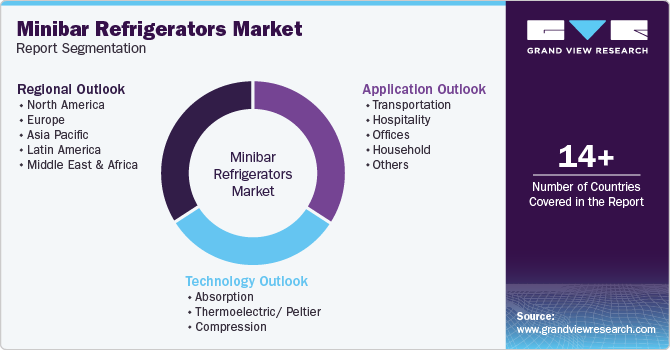
This report forecasts revenue growth at global, regional, and country levels and provides an analysis of the latest industry trends in each of the sub-segments from 2021 to 2033. For the purpose of this study, Grand View Research has segmented the global minibar refrigerators market report based on technology, application, and region:
 To learn more about this report, Download Free Sample Report
 -
Technology Outlook (Revenue, USD Million, 2021 - 2033)
-
Absorption
-
Thermoelectric/ Peltier
-
Compression
-
-
Application Outlook (Revenue, USD Million, 2021 - 2033)
-
Transportation
-
Marines
-
Cruise Ships
-
Campervans/RVs
-
Others
-
Light Duty Vehicles
-
Medium Duty Vehicles
-
Heavy Duty Vehicles
-
Jets
-
-
Hospitality
-
Offices
-
Household
-
Others
-
-
-
Regional Outlook (Revenue, USD Million, 2021 - 2033)
-
North America
-
U.S.
-
Canada
-
Mexico
-
-
Europe
-
Germany
-
U.K.
-
France
-
-
Asia Pacific
-
China
-
Japan
-
India
-
-
Latin America
-
Brazil
-
-
Middle East & Africa
-
South Africa
-
Türkiye
-
-
Research Methodology
The minibar refrigerators market figures in this report are based on a proven research process that combines executive interviews with secondary research from proprietary databases, company filings, and recognized regulatory and institutional sources. Market size is built through value-chain sizing - reconciling supply-side and demand-side estimates - and triangulated with bottom-up and top-down approaches. Every estimate passes multiple levels of expert validation before publication, with each minibar refrigerators segment quantified using the revenue-capture definitions in the table below.
Segment Definition
Segment - Technology
Revenue capture definition
Absorption
Revenue is generated from the sale of absorption minibar refrigerators that utilize heat-based cooling technology. Revenue includes sales to hotels, resorts, cruise ships, healthcare facilities, and other commercial establishments, as well as replacement and refurbishment-related purchases.
Thermoelectric / Peltier
Revenue is generated from the sale of thermoelectric (Peltier) minibar refrigerators that use semiconductor-based cooling systems. Revenue includes sales to hospitality establishments, offices, educational institutions, and residential users through commercial distributors, retailers, and e-commerce channels.
Compression
Revenue is generated from the sale of compressor-based minibar refrigerators that operate using vapor-compression cooling technology. Revenue includes purchases by hotels, serviced apartments, healthcare facilities, corporate accommodations, and residential consumers, including both new installations and replacement units.
Estimation Model
Layer Name
Key Question
Description
Infrastructure Layer
Who forms the base installation pool?
Total guest rooms and accommodation units across hotels, resorts, serviced apartments, cruise ships, healthcare facilities, senior living residences, and other commercial establishments where compact refrigeration can be installed.
Eligible Property Layer
Where can minibar refrigerators be deployed?
Properties with sufficient room standards, electrical infrastructure, and amenity requirements to support minibar refrigerator installation. This layer primarily includes upscale, upper-midscale, luxury hotels, serviced residences, and selected institutional facilities.
Adoption Layer
Where are minibar refrigerators actively installed?
Properties and rooms that currently utilize minibar refrigerators, filtered by hotel category, brand standards, guest experience requirements, and replacement demand. This layer captures both new installations and existing installed units requiring upgrades or replacement.
Monetization Layer
How much revenue is generated?
Revenue is derived from annual sales of new and replacement minibar refrigerators multiplied by average selling prices. This includes absorption, thermoelectric, and compressor-based units purchased through hospitality procurement contracts, commercial appliance distributors, and institutional equipment suppliers.
Delivered Customizations
This report has been delivered with the following In-depth customizations
Client Request
Customization Delivered
Value Adds
Technology-Based Performance & End Use Adoption Mapping
Assessed minibar refrigerator technologies (Absorption, Thermoelectric/Peltier, Compression) and their performance across key end-use environments, including Hospitality, Transportation, Cruise Ships, Offices, Household, and Institutional applications, based on operating conditions such as noise tolerance, energy efficiency, cooling performance, and installation constraints.
Identifies which technologies are structurally preferred across different environments and why, highlighting technology-level positioning gaps and enabling manufacturers to align product design with application-specific performance requirements.
End-Use Demand Concentration and Revenue Density Analysis
Evaluated minibar refrigerator demand intensity across application segments based on installation density, room penetration rates, infrastructure scale, and replacement frequency across hospitality chains, cruise operators, transport fleets, offices, and residential settings.
Reveals where revenue is structurally concentrated in the market, highlighting high-volume demand hubs such as hospitality and cruise ships versus low-penetration discretionary segments like households and vehicles, supporting prioritization of scalable and recurring demand channels.
Procurement Behavior and Commercial Buying Pattern Analysis
Analyzed purchasing behavior across hotel chains, independent hotels, cruise operators, transport OEMs, and institutional buyers based on procurement structure, decision criteria, CAPEX vs replacement cycles, and supplier selection preferences.
Explains how minibar refrigerators are actually bought in the market, identifying key decision drivers such as energy efficiency, lifecycle cost, noise performance, brand standards, and sustainability compliance, enabling stronger GTM strategy, pricing alignment, and contract positioning.
Frequently Asked Questions About This Report
Asia Pacific is the fastest-growing region over the forecast period.
Absorption minibar refrigerator technology led with a 56.0% revenue share in 2025, while thermoelectric/ peltier minibar refrigerator technology is the fastest-growing segment.
Minibar refrigerators for hospitality held the largest revenue share in 2025, and minibar refrigerators for transportation is the fastest-growing segment.
The global minibar refrigerators market size was valued at USD 369.2 million in 2025 and is estimated at USD 380.7 million for 2026.
The global minibar refrigerators market is expected to grow at a CAGR of 3.3% from 2026 to 2033, reaching USD 478.1 million in 2033.
Key factors that are driving the minibar refrigerators market growth include rapid expansion of the hospitality sector. The hospitality industry, particularly hotels, emphasizes unique designs, personalized services, and immersive themes, all of which contribute to market expansion.
Europe dominated with a 30.6% revenue share in 2025.
Germany minibar refrigerators market is the fastest growing country in Europe
Key players ISM Makine Elektrik Sanayi ve Ticaret A.Ş.; Dometic Group AB (PUBL); Felix Storch (Summit Appliance); Minibar Systems; Indel B S.p.A.; HISENSE; OMNITEC SYSTEMS SL; Royal Minibars; TEFCOLD A/S; Koolatron; and Bartech.
About the Author(s)
Electronic & Electrical Research Team
Consumer Goods · Electronic & ElectricalThis report was authored by the electronic & electrical research team at Grand View Research - comprising two research analysts, one senior research analyst, and one industry expert - with specialized expertise in the electronic & electrical segment of the consumer goods industry. All findings are based on proprietary consumer goods databases, executive interviews, and regulatory analysis, subject to internal peer review prior to publication.
Last Updated:
Speak to Analyst

Customize this report to your needs - add regions, segments, or data points, with 20% free customization.
Or view our licence options:


ISO 9001:2015 & 27001:2022 Certified
We are GDPR and CCPA compliant! Your transaction & personal information is safe and secure. For more details, please read our privacy policy.


