
- Home
- »
- Next Generation Technologies
- »
-
Missile Canister Market Size, Share & Trends Report, 2033GVR Report cover

Missile Canister Market (2026 - 2033)
Size, Share & Trends Analysis Report By Launch Mechanism (Cold Launch Canister, Hot Launch Canister), By Structure, By Canister Type, By Material (Metallic, Composite, Hybrid), By End-use (Navy, Army), By Region, And Segment Forecasts
Market Size, 2025
$783.2MMarket Estimate, 2026
$838.1MMarket Forecast, 2033
$1,418.2MCAGR, 2026–2033
7.8%Missile Canister Market Summary
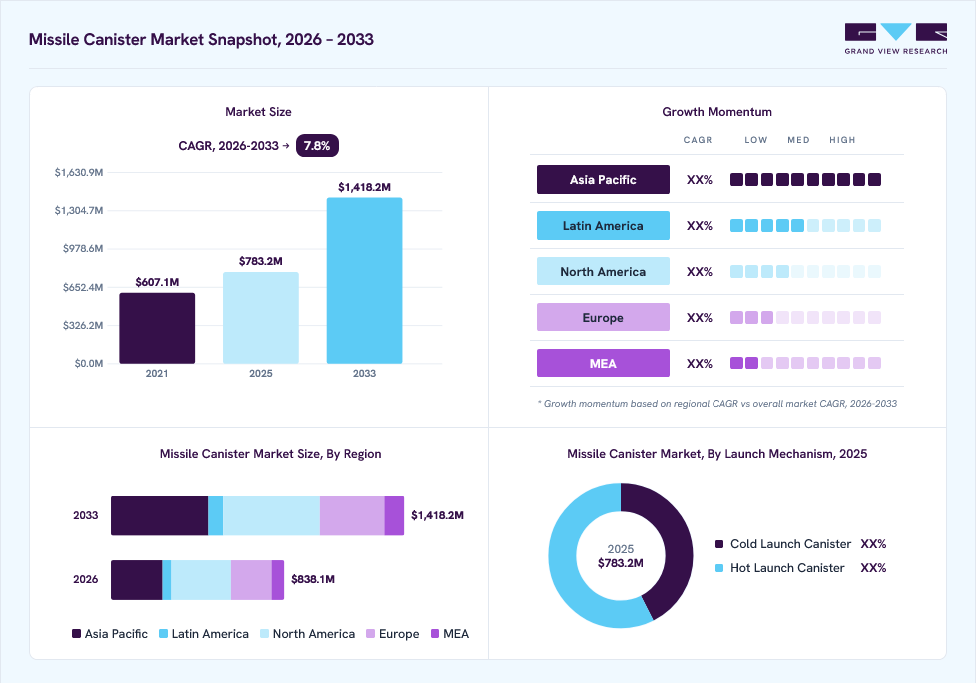
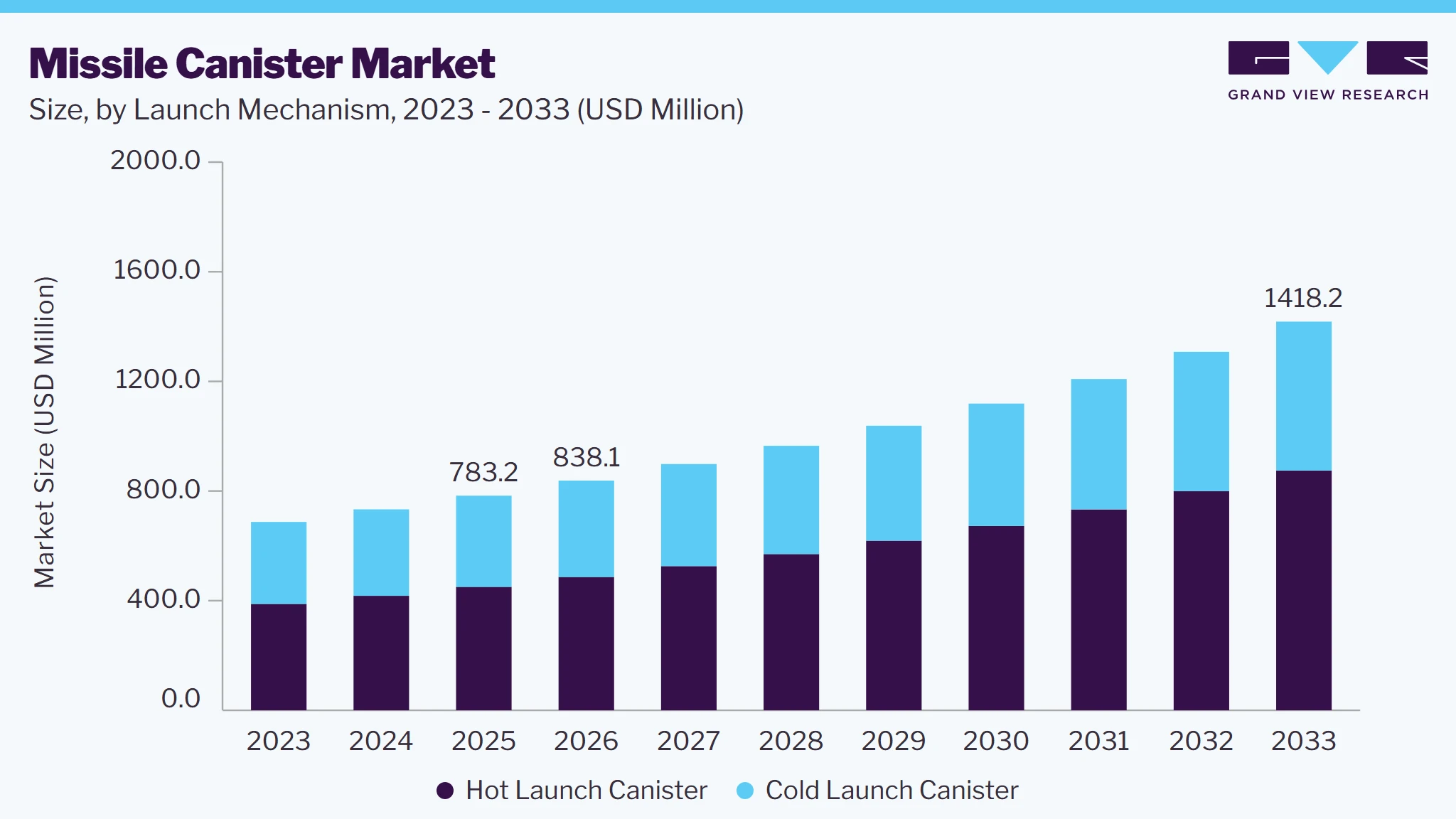
The global missile canister market size was valued at USD 783.2 million in 2025 and is projected to grow from USD 838.1 million in 2026 to USD 1,418.2 million by 2033, at a CAGR of 7.8% from 2026 to 2033. North America dominated the market, accounting for a revenue share of 34.4% in 2025. The global market growth is driven by rising geopolitical tensions, increasing procurement of advanced missile systems, and growing adoption of vertical launch systems (VLS).
 Source: Grand View Research, IR Documents, Primary Interviews, Paid DatabasesTo learn more about this report,
 Download Free Sample Report
Key Market Trends & Insights
- By launch mechanism: Hot launch canister held the largest revenue share of 57.5% in 2025.
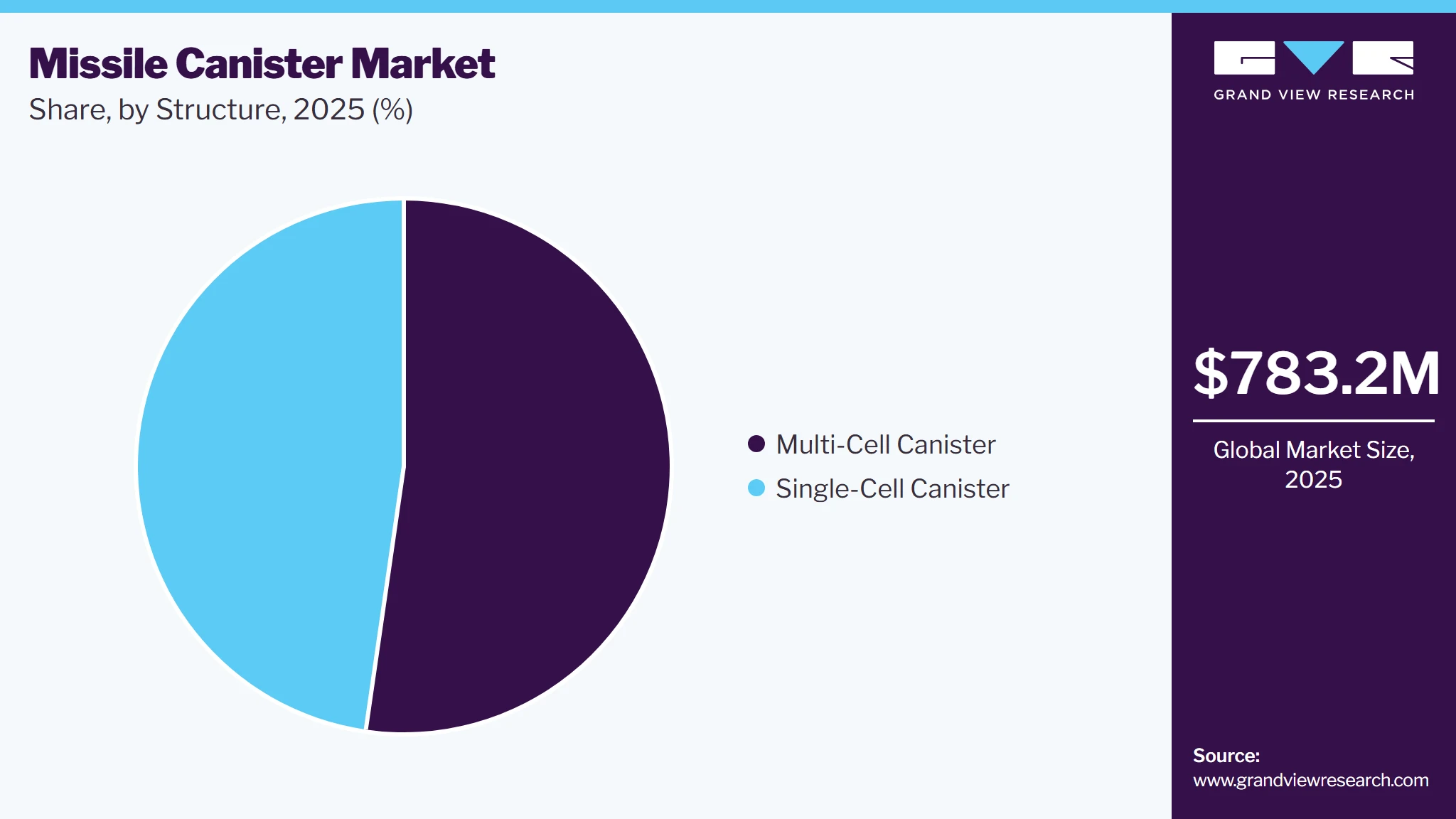
- By structure: Multi-cell canister held the largest revenue share of 52.3% in 2025.
- By canister type: Launch canister held the largest revenue share of 43.0% in 2025.
- By material: Metallic segment held the largest market share of 66.1% in 2025.
- By end-use: Army segment held the largest revenue share of 53.4% in 2025.
Regional Highlights
- Largest regional market: North America (34.4% revenue share, 2025)
- Fastest-growing regional market: Asia Pacific (highest CAGR, 2026-2033)
- By country: The U.S. held the largest market share in 2025.
Market Size & Forecast
- Market size in 2025: USD 783.2 Million
- Estimated market size in 2026: USD 838.1 Million
- Projected market size by 2033: USD 1,418.2 Million
- CAGR (2026-2033): 7.8%
Prism AI by Grand View Research Free to tryAsk a question about the missile canister marketTry asking✓Every figure cited from GVR research Prefer the report? Download free sample →
The expansion of hypersonic, precision-guided, and air-defense missile programs, along with investments in naval modernization and land-based missile systems, is accelerating demand for modular, lightweight, and high-performance missile canisters.The growth of the missile canister industry is driven by the increasing adoption of modular missile storage and launch architectures, rising demand for rapid missile deployment, and the growing need for integrated missile protection during storage, transportation, and launch operations. The shift toward modular vertical launch systems, multi-cell configurations, sealed canister designs, environmental protection, and improved handling capabilities is encouraging defense forces to deploy advanced canister solutions across naval vessels and land-based missile platforms. In addition, the modernization of existing missile launch infrastructure and demand for flexible canister systems compatible with multiple missile types are supporting market expansion.
 To learn more about this report, Download Free Sample Report
The increasing deployment of mobile and containerized missile systems, expansion of land-based air-defense networks, and growing requirement for rapid-response missile deployment are strengthening demand for missile canisters. Defense forces are increasingly adopting canisterized missile architectures that keep missiles sealed and ready for deployment while simplifying transportation, storage, handling, and field operations. The growing use of transporter-erector-launchers (TELs), mobile coastal defense systems, and road-mobile air defense platforms is further driving demand for durable canisters that support rapid repositioning and operational readiness.
Additionally, the increasing emphasis on missile shelf-life extension, environmental protection, and reduced maintenance requirements is accelerating the adoption of advanced missile canisters. Modern canisters are designed to protect missiles from moisture, dust, temperature fluctuations, corrosion, vibration, and other environmental conditions during prolonged storage and transportation. Improved sealing technologies, pressure-control mechanisms, insulation, and structural protection are enabling defense organizations to preserve missile reliability over extended periods while reducing the need for frequent inspection and maintenance. These capabilities are important for strategic missile stockpiles and geographically dispersed defense installations.
Moreover, the growing integration of advanced composite materials, lightweight structures, and smart monitoring technologies is creating new opportunities for missile canister manufacturers. Developers are increasingly focusing on high-strength, corrosion-resistant, and lightweight materials to reduce handling and transportation requirements. The incorporation of sensors and condition-monitoring technologies can also support real-time assessment of temperature, humidity, and canister condition. These developments are encouraging the transition toward more durable, lightweight, and technologically advanced canister systems that improve missile readiness and lifecycle management.
Market Dynamics
The missile canister market is experiencing significant growth, driven by the increasing adoption of modular missile launch architectures and growing demand for flexible missile integration across land and naval platforms. Defense forces are increasingly adopting canisterized launch solutions that can accommodate different missile types while supporting standardized integration with existing launch infrastructure. The ability of modular canister systems to improve platform flexibility, simplify missile handling, and support multiple mission requirements is encouraging defense manufacturers to develop adaptable canister configurations for modern combat platforms.
The increasing adoption of modular vertical launch systems, multi-cell configurations, and interchangeable missile architectures is driving demand for missile canisters. Modern launch platforms increasingly require standardized solutions capable of accommodating different missile configurations while supporting efficient storage, handling, integration, and deployment. Canister-based architectures also enable greater flexibility in platform design and weapon loading, encouraging procurement across naval vessels and mobile launch platforms.
The ability to integrate canisters across multiple launch systems further strengthens their importance in platform modernization programs. Standardized canister configurations can support different weapon types within common launch architectures, allowing operators to improve weapon-load flexibility without requiring entirely separate launcher infrastructure. This interoperability is particularly relevant for VLS platforms, where individual canisters provide dedicated missile containment while enabling rapid firing from multiple cells.
Stringent structural, thermal, environmental, safety, and reliability qualification requirements are restraining the missile canister market. Canisters must withstand demanding conditions during prolonged storage, transportation, handling, and launch while maintaining missile integrity. Requirements involving pressure resistance, moisture prevention, vibration, temperature variations, corrosion protection, exhaust-gas management, and structural loading increase engineering complexity and testing requirements, making development and certification more demanding for manufacturers.
The complexity increases further for canisters designed for advanced missile systems, where launch conditions can generate substantial thermal, mechanical, and pressure loads. Manufacturers must conduct extensive qualification and acceptance testing to demonstrate reliable performance under operational conditions. These requirements can lengthen development cycles, increase production costs, and create barriers for smaller suppliers seeking to enter programs requiring highly specialized manufacturing capabilities and stringent quality assurance processes.
The increasing use of lightweight composite materials, corrosion-resistant structures, and advanced layered protection technologies presents an important opportunity for missile canister manufacturers. Composite architectures can reduce structural weight while maintaining the strength required for storage, transportation, and launch applications. They can enhance corrosion resistance in maritime environments, enabling lighter canister designs that facilitate easier handling, improve platform efficiency, and extend service life.
Opportunities are emerging from the development of composite canisters capable of supporting high-temperature launches, modular configurations, and demanding environmental conditions. Advanced materials can be engineered to withstand thermal exposure, mechanical loads, and harsh storage environments while reducing maintenance requirements. Research into lightweight layered protection is supporting designs that improve survivability during transportation and storage, encouraging manufacturers to expand composite-based solutions for next-generation launch platforms.
Market Concentration & Characteristics
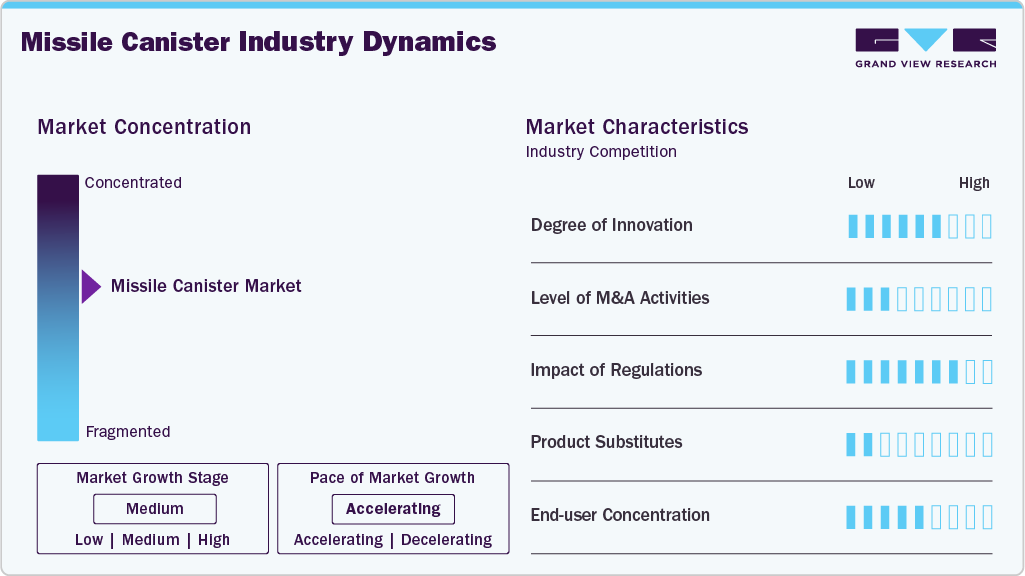
The missile canister market is moderately concentrated, comprising major defense contractors, missile-system manufacturers, launch-system developers, specialized canister manufacturers, and component suppliers competing across naval, land-based, air-defense, anti-ship, strategic, and tactical missile applications. The market is shaped by the increasing adoption of vertical launch systems, modernization of missile launch infrastructure, demand for secure missile storage and transportation, and the integration of modular canister architectures. Long-term defense contracts, platform-specific qualification, technology partnerships, government procurement programs, and established relationships with armed forces enable leading companies to strengthen their positions across international defense markets.
 To learn more about this report, Download Free Sample Report
The market is characterized by a moderate level of innovation, supported by advancements in lightweight composite structures, thermal protection, corrosion resistance, modular configurations, and compatibility with next-generation missile systems. The market witnesses relatively low merger and acquisition activity, as established defense contractors generally expand capabilities through strategic partnerships, joint ventures, and internal development rather than frequent acquisitions of dedicated canister manufacturers. Competition from alternative launcher architectures is limited because canisterized systems offer specialized protection, storage, and launch-integration capabilities. Increasing demand for multi-mission launch platforms, longer missile storage periods, improved efficiency, and compatibility with advanced missile technologies continue to strengthen competitive positioning.
Analyst Perspective
The missile canister market is advancing through the increasing adoption of modular launch architectures, expansion of vertical launch systems, and rising demand for rapid-response missile deployment across naval and land-based platforms. Manufacturers are strengthening their portfolios through lightweight composite structures, enhanced sealing, thermal protection, reloadable configurations, and compatibility with multiple missile systems. The growing deployment of hypersonic, precision-guided, air-defense, and anti-ship missiles is encouraging demand for canisters capable of supporting demanding launch environments while protecting missiles during prolonged storage and transportation.
Launch Mechanism Insights
The hot launch canister segment dominated the missile canister industry, accounting for the largest revenue share of 57.5% in 2025, propelled by increasing deployment of naval vertical launch systems, air-defense platforms, and high-readiness missile architectures requiring rapid and reliable missile deployment. Hot-launch canisters are increasingly used in systems where missile propulsion operates during launch, requiring robust thermal protection, exhaust management, and reliable sealing. Growing naval fleet modernization, expansion of integrated air-defense networks, and adoption of multi-missile launch configurations continue to strengthen the segment’s position in the missile canister industry.
The cold launch canister segment is expected to witness a significant CAGR of over 6.0% from 2026 to 2033. The segment growth is driven by the increasing adoption of mobile missile systems, strategic launch platforms, and applications that require reduced thermal exposure to launch infrastructure. Cold launch configurations enable missiles to be ejected before propulsion activation, reducing direct exhaust effects on launch equipment and supporting flexible deployment. Rising demand for survivable mobile launchers, rapid repositioning capabilities, protected missile deployment, and platform durability is expected to accelerate the adoption of cold-launch canisters.
Canister Type Insights
The launch canister segment accounted for the largest market share of 43.0% in 2025, driven by increasing deployment of integrated missile launch systems, naval vertical launch systems, and ground-based air-defense platforms requiring protected, launch-ready missile containment. Defense forces increasingly utilize launch canisters to combine missile protection, handling efficiency, and rapid deployment within standardized launcher architectures. The ongoing modernization of naval fleets, the expansion of layered air-defense systems, and the adoption of modular missile launch platforms continue to strengthen the position of launch canisters within the market.
The transporter-erector-launcher canister (TEL) segment is expected to grow at the fastest CAGR from 2026 to 2033, driven by rising demand for mobile missile deployment, rapid repositioning, survivability, and flexible launch operations. Defense forces are increasingly deploying transporter-based systems capable of moving missiles, elevating launch assemblies, and conducting operations from dispersed locations. The growing emphasis on mobile air defense, coastal defense systems, precision-strike capabilities, and distributed military operations is accelerating the adoption of TEL-integrated canister systems in modern defense platforms.
Material Insights
The metallic segment dominated the missile canister market, accounting for the largest revenue share of 66.1% in 2025, fueled by high structural strength, established manufacturing processes, proven durability, and strong resistance to demanding storage, transportation, and launch conditions. Defense manufacturers continue to use steel, aluminum, and specialized metallic alloys for missile canisters that require reliable structural integrity, impact resistance, environmental protection, and thermal performance. Extensive integration with existing naval VLS, mobile launchers, and established missile platforms continues to strengthen demand for metallic canisters across defense applications.
The composite segment is expected to grow at the fastest CAGR from 2026 to 2033, driven by increasing demand for lightweight missile systems, improved mobility, corrosion resistance, and enhanced strength-to-weight performance. Manufacturers are increasingly incorporating advanced fiber-reinforced composites to reduce canister weight while maintaining structural durability under demanding operational conditions. The growing deployment of mobile launch platforms, reduced handling requirements, and increasing emphasis on transport efficiency are accelerating the adoption of composite canisters for next-generation missile storage.
End-use Insights
The army segment dominated the missile canister industry, accounting for the largest revenue share of 53.4% in 2025, driven by rising investments in land-based missile defense, precision-strike capabilities, and mobile missile systems. Defense forces are increasingly deploying transportable launchers and multi-pack canister configurations to enable rapid deployment, extended storage, and improved battlefield survivability. Growing demand for surface-to-surface, surface-to-air, and tactical ballistic missile systems, along with the need for protected storage, safer handling, reduced maintenance, and rapid launch readiness, is strengthening the adoption of missile canisters across army platforms.
The navy segment is expected to grow at the fastest CAGR from 2026 to 2033, driven by expanding procurement of vertical launch systems (VLS), ship-based air-defense capabilities, and long-range anti-ship and land-attack missiles. Naval forces are increasingly integrating modular canisters into destroyers, frigates, corvettes, and other vessels to enable safe missile storage, rapid launch, exhaust-gas containment, and compatibility with multiple missile types. Increased emphasis on multi-mission naval platforms, hypersonic and precision-guided weapons, layered defense, and standardized canister designs is expected to drive the rapid growth of the navy segment.
Structure Insights
The multi-cell canister segment dominated the missile canister market, accounting for the largest revenue share of 52.3% in 2025, driven by rising demand for greater missile capacity, more efficient launcher utilization, and rapid deployment across modern naval and land-based platforms. Defense forces are increasingly adopting multi-cell configurations to accommodate multiple missiles within standardized launch architectures, improving firepower density while reducing platform space requirements. The growing deployment of vertical launch systems, integrated air-defense platforms, and modular missile launchers continues to strengthen the position of multi-cell canisters in the missile canister industry.
 To learn more about this report, Download Free Sample Report
The single-cell canister segment is expected to grow at a significant CAGR from 2026 to 2033, driven by increasing demand for specialized missile configurations, flexible platform integration, and dedicated missile containment. Single-cell canisters provide greater configuration flexibility for missile systems with different dimensions, launch requirements, and operational specifications. Rising adoption of precision-guided weapons, mobile launch platforms, specialized naval systems, and customized missile architectures is supporting demand for individually configured canisters across defense applications.
Regional Insights
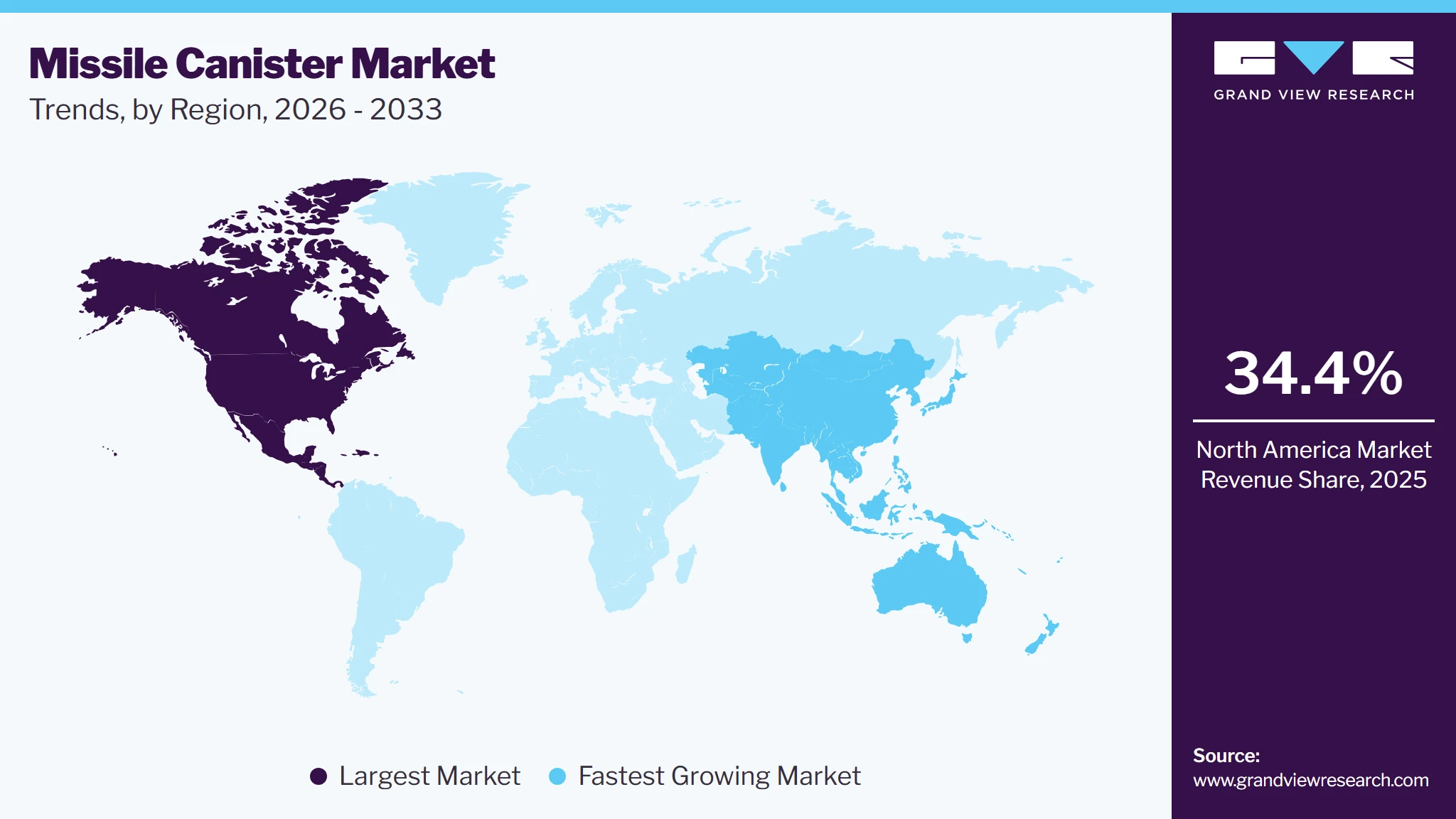
The North America missile canister market held the largest revenue share of 34.4% in 2025, driven by extensive naval VLS infrastructure, sustained defense procurement, and modernization of existing missile launch systems. The U.S. Navy's continued procurement of Mk 41 VLS canisters, including contracts supporting surface ships, is generating recurring demand for replacement and new-production canisters. The investments in precision-strike capabilities, hypersonic weapons, and land-based missile systems are increasing demand for ruggedized canisters that support rapid deployment and withstand demanding launch environments.
 To learn more about this report, Download Free Sample Report
U.S. Missile Canister Market Trends
The U.S. missile canister industry dominated with the largest revenue share of 87.5% in 2025, driven by the extensive deployment of the Mk 41 VLS architecture, ongoing naval fleet modernization, and the procurement of advanced missile systems. The U.S. Navy continues to procure Mk 41 and Mk 29 canisters for surface ships, while Foreign Military Sales programs for countries such as Japan and Australia are also supporting domestic production volumes. The increasing integration of hypersonic and precision-strike weapons is further encouraging the development of canisters with enhanced thermal protection, sealing, and structural capabilities.
Europe Missile Canister Market Trends
The Europe missile canister industry is expected to grow at a significant CAGR of 6.8% from 2026 to 2033. The market growth is driven by increasing defense spending, modernization of naval fleets, strengthening of integrated air defense capabilities, and development of long-range precision strike systems. European countries are increasingly seeking greater missile capacity, improved launch flexibility, and interoperability across allied platforms. The adoption of Mk 41 and SYLVER VLS architectures, together with multinational missile programs, is supporting demand for compatible canister systems and standardized launch solutions in the market.
The UK missile canister market is expected to grow significantly in the coming years, driven by naval fleet modernization, expansion of long-range strike capabilities, and efforts to increase weapon flexibility across future surface combatants. The Royal Navy's adoption of Mk 41 VLS for future warship classes is creating requirements for compatible launch infrastructure, while ongoing evaluation of Aster 30 integration with Mk 41 demonstrates increasing emphasis on interoperability between missile families and launch systems. Investments in next-generation stealth and high-speed missiles are further driving the need for advanced canister configurations.
The missile canister market in Germany is supported by efforts to increase naval strike capabilities, upgrade existing frigates, and strengthen long-range precision engagement capabilities. The German Navy's consideration of Tomahawk integration is encouraging greater utilization of existing VLS infrastructure. Germany's cooperation with the UK on a future deep-precision strike missile program is strengthening requirements for modern launch architectures capable of supporting advanced long-range weapons. These initiatives are encouraging greater emphasis on flexible missile storage and launch integration.
Asia Pacific Missile Canister Market Trends
The Asia Pacific missile canister market is expected to grow at the fastest CAGR of 9.5% from 2026 to 2033, driven by naval modernization, expansion of integrated air defense capabilities, territorial security requirements, and increased procurement of shipborne missile systems. Countries across the region are strengthening their surface combatant fleets and adopting vertical-launch architectures capable of supporting multiple missile types. Increasing interoperability with allied missile systems, Foreign Military Sales programs, and development of indigenous launch platforms are further supporting demand for standardized, environmentally protected, and rapidly deployable missile canisters.
The Japan missile canister market is gaining traction owing to increasing investment in maritime missile defense, modernization of Aegis-equipped destroyers, and procurement of advanced interceptor systems. Japan's planned acquisition of SM-6 missiles includes MK 21 Mod 3 VLS canisters, directly supporting demand for compatible canister systems. Continued strengthening of integrated air-and-missile defense capabilities, together with cooperation with the U.S. on missile technologies, is encouraging the adoption of advanced canisters designed for standardized VLS integration and reliable long-term storage.
The missile canister market in China is expanding alongside rapid naval modernization, development of advanced surface-to-air missile systems, and increasing deployment of vertically launched missile architectures. China's growing fleet of modern surface combatants is incorporating vertical-launch systems capable of supporting multiple missile types, while land-based air-defense systems are also adopting mobile launch vehicles with multiple missile pods. The increasing emphasis on multi-target engagement, 360-degree launch coverage, mobility, and rapid-response capabilities is supporting demand for sealed, modular missile containment solutions.
Key Missile Canister Company Insights
Some of the key players operating in the market are Lockheed Martin Corporation and BAE Systems plc.
-
Lockheed Martin Corporation is a major player in the missile canister industry through its extensive portfolio of vertical launching systems, transportable launchers, and missile canister technologies. The company develops and supports the Mk 41 VLS, which uses modular launch cells and accommodates a broad range of missile types for both naval and land-based applications. Lockheed Martin develops new canister-based launching capabilities, including its JAGM Quad Launcher, enabling the company to address requirements for flexible, multi-platform missile deployment.
-
BAE Systems plc is a major player in the missile canister market through its long-standing role in the development, production, and support of Mk 41 VLS canisters. The company is the U.S. Navy's exclusive design agent and worldwide supplier of Mk 41 VLS canisters, providing sealed containers for missile storage, transportation, and launch. Its Mk 25 Quad-Pack canister also accommodates four Evolved Sea Sparrow Missiles within a single standard canister space, strengthening its position in naval launch applications.
Rafael Advanced Defense Systems Ltd. and General Dynamics Ordnance & Tactical Systems are some of the emerging participants in the missile canister market.
-
Rafael Advanced Defense Systems Ltd. is an emerging player in the missile canister industry through its development of advanced air-defense and precision missile systems that require specialized launch and containment architectures. The company's missile portfolio, including systems designed for mobile and naval applications, supports demand for compact, protected, and rapidly deployable launcher configurations. Rafael's emphasis on multi-layered air defense and the integration of missile systems with mobile launch platforms provides opportunities to expand its participation in advanced canisterized weapon architectures.
-
General Dynamics Ordnance & Tactical Systems is an emerging player in the missile canister industry through its capabilities in composite aerospace structures, missile subsystems, naval platform systems, and advanced protection technologies. The company specializes in developing composite aerospace containers and structures, as well as missile-related technologies, providing capabilities for lightweight, durable, and environmentally resistant canister applications. Its combination of composite manufacturing, missile subsystems, and defense-platform expertise positions the company to participate in specialized next-generation canister requirements.
Key Missile Canister Companies:
The following key companies have been profiled for this study of the missile canister market.
-
Lockheed Martin Corporation
-
BAE Systems plc
-
RTX Corporation
-
Kongsberg
-
Thales Group
-
MBDA
-
Rafael Advanced Defense Systems Ltd.
-
General Dynamics Ordnance & Tactical Systems
-
Israel Aerospace Industries
Competitive Benchmarking
Category
Operating Strategies
Competitive Edge
Weakness
Established Players (Lockheed Martin Corporation, BAE Systems plc, Kongsberg)
- Focus on expanding integrated missile-launch ecosystems through canister, launcher, and missile-system capabilities.
- Invest heavily in R&D to deliver durable, standardized canisters supporting advanced naval and land platforms.
- Strong defense relationships, extensive qualification experience, and established production capabilities support market leadership.
- Ability to provide reliable, platform-integrated canister solutions for complex missile storage, handling, and launch requirements.
- Dependence on lengthy defense procurement cycles can delay product deployment across new missile programs.
- Large organizational structures may reduce agility when responding to specialized canister requirements from emerging platforms.
Emerging Players (Rafael Advanced Defense Systems Ltd., General Dynamics Ordnance & Tactical Systems, Israel Aerospace Industries)
- Emerging players are focusing on developing lightweight, modular canisters compatible with evolving missile launch architectures.
- Invest in advanced composites, thermal protection, and specialized manufacturing for next-generation canister applications.
- Specialized engineering capabilities enable flexible, customized canister solutions for emerging missile platforms.
- Greater organizational agility supports faster adaptation to evolving missile integration and launch requirements.
- Limited qualification history can restrict access to large-scale government missile procurement programs.
- Smaller production capacities may constrain their ability to fulfill complex, high-volume defense contracts.
Recent Developments
-
In May 2026, Lockheed Martin Corporation continued advancing its missile and launch-system portfolio, including the Precision Strike Missile (PrSM), which is compatible with HIMARS and M270 launchers and supports two missiles per launch pod. The company’s broader development of containerized and vertical-launch solutions, together with continued investment in advanced missile programs, supports demand for specialized launch containers and canisterized architectures compatible with mobile and naval platforms.
-
In November 2025, BAE Systems plc received a USD 22 million U.S. Navy contract to produce Mk 41 Vertical Launching System missile canisters, with the contract potentially reaching USD 317 million if all options are exercised. The award followed a USD 738 million Mk 41 VLS canister contract, reinforcing BAE Systems' position as a key supplier of missile canisters for U.S. and allied naval platforms for the missile canister industry.
-
In August 2025, Kongsberg Defense Australia secured a major export order for Australian-made Naval Strike Missile launcher systems for two European nations. The company is manufacturing the NSM launcher systems locally, strengthening its regional production capabilities. The NSM launcher architecture incorporates protective launcher canisters, while Kongsberg's broader multi-missile launcher portfolio supports rapid deployment of different missile types, strengthening its relevance to the missile-canister market.
Missile Canister Market Report Scope
Report Attribute
Details
Market size in 2025
USD 783.2 million
Estimated market size in 2026
USD 838.1 million
Projected market size by 2033
USD 1,418.2 million
Growth rate
CAGR of 7.8% from 2026 to 2033
Base year for estimation
2025
Historical data
2021 - 2024
Forecast period
2026 - 2033
Quantitative units
Revenue in USD million and CAGR from 2026 to 2033
Report Product
Revenue forecast, company ranking, competitive landscape, growth factors, and trends
Segments covered
Launch mechanism, structure, canister type, material, end-use, region
Region scope
North America; Europe; Asia Pacific; Latin America; Middle East & Africa
Country scope
U.S.; Canada; Mexico; UK; Germany; France; China; Japan; India; South Korea; Australia; Brazil; Saudi Arabia; UAE; South Africa
Key companies profiled
Lockheed Martin Corporation; BAE Systems plc; RTX Corporation; Kongsberg; Thales Group; MBDA; Rafael Advanced Defense Systems Ltd.; General Dynamics Ordnance & Tactical Systems; Israel Aerospace Industries
Customization scope
Free report customization (equivalent to up to 8 analyst’s working days) with purchase. Addition or alteration to country, regional & segment scope.
Pricing and purchase options
Avail customized purchase options to meet you exact research needs. Explore purchase options
Global Missile Canister Market Report Segmentation
This report forecasts revenue growth at the global, regional, and country levels and provides an analysis of the latest technological trends in each of the sub-segments from 2021 to 2033. For this study, Grand View Research has segmented the missile canister market report based on launch mechanism, structure, canister type, material, end-use, and region:
-
Launch Mechanism Outlook (Revenue, USD Million, 2021 - 2033)
-
Cold Launch Canister
-
Hot Launch Canister
-
-
Structure Outlook (Revenue, USD Million, 2021 - 2033)
-
Single-Cell Canister
-
Multi-Cell Canister
-
-
Canister Type Outlook (Revenue, USD Million, 2021 - 2033)
-
Transport Canister
-
Storage Canister
-
Launch Canister
-
Transporter-Erector-Launcher Canister (TEL)
-
-
Material Outlook (Revenue, USD Million, 2021 - 2033)
-
Metallic
-
Composite
-
Hybrid
-
-
End-use Outlook (Revenue, USD Million, 2021 - 2033)
-
Navy
-
Army
-
Strategic Forces
-
-
Regional Outlook (Revenue, USD Million, 2021 - 2033)
-
North America
-
U.S.
-
Canada
-
Mexico
-
-
Europe
-
UK
-
Germany
-
France
-
-
Asia Pacific
-
China
-
Japan
-
India
-
South Korea
-
Australia
-
-
Latin America
-
Brazil
-
-
Middle East and Africa (MEA)
-
Saudi Arabia
-
UAE
-
South Africa
-
-
Research Methodology
The missile canister market figures in this report are based on a proven research process that combines executive interviews with secondary research from proprietary databases, company filings, and recognized regulatory and institutional sources. Market size is built through value-chain sizing-reconciling supply-side and demand-side estimates-and triangulated with bottom-up and top-down approaches. Every estimate passes multiple levels of expert validation before publication, with each missile canister segment quantified using the revenue-capture definitions in the table below.
Segment Definition
Segment - Launch Mechanism
Revenue capture definition
Cold Launch Canister
Revenue is generated from missile canisters designed for cold-launch systems, where missiles are ejected from the canister using gas pressure, compressed gas, or other launch mechanisms before the missile's propulsion system activates. These canisters provide structural protection while supporting safe missile ejection and reducing direct exposure of the launch platform to missile exhaust.
Hot Launch Canister
Revenue is generated from missile canisters designed for hot-launch systems, where the missile's propulsion system ignites inside or immediately upon exiting the canister. These canisters incorporate thermal protection, exhaust management, structural reinforcement, and other features required to withstand high temperatures and pressure during missile launch.
Segment - Structure
Revenue capture definition
Single-Cell Canister
Revenue is generated from individual missile canisters designed to contain and protect a single missile. These canisters are used across naval and land-based launch systems, providing dedicated containment, environmental protection, transportation, storage, handling, and launch integration for individual missiles.
Multi-Cell Canister
Revenue is generated from canister configurations designed to accommodate multiple missiles or multiple launch cells within a common structural arrangement. These systems improve missile storage density, launcher utilization, and deployment efficiency while supporting modular configurations across naval vertical launch systems and land-based missile platforms.
Segment - Canister Type
Revenue capture definition
Transport Canister
Revenue is generated from canisters designed primarily to protect missiles during transportation between manufacturing facilities, storage locations, military bases, and deployment areas. These canisters provide structural protection against vibration, impact, moisture, dust, and temperature variations during movement.
Storage Canister
Revenue is generated from canisters designed for prolonged missile storage while maintaining missile integrity and operational readiness. These systems provide controlled environmental protection against humidity, corrosion, contamination, temperature fluctuations, and other conditions that could affect missile reliability during extended storage periods.
Launch Canister
Revenue is generated from canisters specifically designed to contain missiles during launch operations while providing protection, structural support, and integration with missile launch systems. These canisters are commonly incorporated into naval VLS, mobile launchers, and other platforms requiring rapid missile deployment.
Transporter-Erector-Launcher
Canister (TEL)
Revenue is generated from canister systems integrated with transporter-erector-launcher platforms, enabling missiles to be transported, elevated into launch position, and deployed from mobile ground-based systems. These canisters support rapid repositioning, protected missile storage, and launch readiness in geographically distributed operational environments.
Segment - Material
Revenue capture definition
Metallic
Revenue is generated from missile canisters manufactured primarily using metals such as steel, aluminum, or specialized alloys. Metallic canisters provide high structural strength, impact resistance, thermal durability, and reliability for demanding storage, transportation, and missile launch applications.
Composite
Revenue is generated from missile canisters manufactured using composite materials that combine high strength with reduced structural weight. Composite canisters can provide corrosion resistance, improved durability, and reduced handling requirements, making them suitable for advanced naval, mobile, and next-generation missile launch applications.
Hybrid
Revenue is generated from missile canisters combining metallic and composite materials to balance structural strength, weight, thermal resistance, corrosion protection, and manufacturing requirements. Hybrid designs enable manufacturers to optimize specific sections of the canister according to storage, transportation, environmental, and launch-performance requirements.
Segment - End Use
Revenue capture definition
Navy
Revenue is generated from missile canisters deployed across naval vessels, including destroyers, frigates, cruisers, submarines, and other combat platforms. These canisters support missile storage, environmental protection, handling, and launch through vertical launch systems and other shipborne missile-launch architectures.
Army
Revenue is generated from missile canisters used with land-based missile systems, including mobile air-defense platforms, coastal-defense systems, transporter-erector-launchers, and other ground-based launch vehicles. These canisters support protected missile transportation, storage, rapid deployment, and launch in diverse operational environments.
Strategic Forces
Revenue is generated from missile canisters supporting strategic missile systems requiring secure storage, transportation, environmental protection, and rapid deployment. These canisters are designed for demanding operational requirements associated with strategic missile readiness, including long-term containment and integration with specialized launch infrastructure.
Estimation Model
Layer Name
Key Question
Description
Defense Procurement Layer
Who are the potential end users?
Identifies national defense ministries, armed forces, naval forces, air defense units, strategic forces, and other government defense organizations that require missile canisters for missile storage, transportation, handling, protection, and launch operations.
Missile Canister Development Layer
Who can provide missile canisters?
Missile canister development involves defense contractors, missile manufacturers, launch-system developers, specialized canister manufacturers, aerospace companies, composite-material suppliers, and engineering firms supporting canister design, structural protection, thermal management, sealing, environmental protection, and missile-launch integration.
Launch Platform Integration Layer
Where are missile canisters deployed?
Missile canisters are deployed across naval vessels, vertical launch systems, transporter erector launchers, mobile ground-based launch platforms, air-defense systems, coastal-defense systems, and other platforms requiring protected missile storage and rapid deployment capabilities.
Revenue Generation Layer
How is revenue generated?
Revenue is generated through government procurement contracts, new canister production, replacement canisters, lifecycle support, maintenance, modernization programs, export orders, platform integration, refurbishment, upgrades, and long-term defense agreements for missile storage and launch systems.
Delivered Customizations
This report has been delivered with the following In-depth customizations
Client Request
Customization Delivered
Value Adds
Missile Canister Platform Integration & Launch Architecture Assessment
Conducted detailed evaluation of missile canister systems across naval VLS, mobile launchers, air-defense platforms, and coastal-defense systems, assessing modularity, missile compatibility, structural protection, thermal management, and launch integration requirements.
Improves platform compatibility, strengthens launch readiness, supports system selection, and reduces integration complexity.
Lightweight Canister Materials & Structural Performance Assessment
Assessed the adoption of composite materials, lightweight structures, corrosion-resistant alloys, thermal protection, and advanced sealing technologies to improve canister durability across storage, transportation, handling, and demanding missile launch environments
Reduces structural weight, improves durability, extends service life, and supports operational efficiency.
Missile Canister Procurement & Lifecycle Management Strategy
Evaluated government procurement programs, replacement requirements, stockpile modernization, maintenance cycles, refurbishment activities, export opportunities, and long-term lifecycle support requirements across naval and land-based missile platforms.
Supports procurement planning, optimizes lifecycle costs, strengthens supply continuity, and improves readiness.
Frequently Asked Questions About This Report
The global missile canister market size was valued at USD 783.2 million in 2025 and is estimated at USD 838.1 million in 2026.
The global missile canister market is expected to grow at a CAGR of 7.8% from 2026 to 2033, reaching USD 1,418.2 million by 2033.
The hot launch canister segment dominated with a 57.5% revenue share in 2025, while cold launch canister segment is the fastest growing launch mechanism.
North America dominated the missile canister market with a share of 34.4% in 2025.
Key factors that are driving the market growth include increasing procurement of advanced missile systems and growing adoption of vertical launch systems (VLS). The expansion of hypersonic, precision-guided, and air-defense missile programs, along with investments in naval modernization and land-based missile systems, is accelerating demand for modular, lightweight, and high-performance missile canisters.
Some key players operating in the missile canister market include Lockheed Martin Corporation, BAE Systems plc, RTX Corporation, Kongsberg, Thales Group, MDBA, Rafael Advanced Defense Systems Ltd., General Dynamics Ordnance & Tactical Systems, Israel Aerospace Industries
Asia Pacific is the fastest-growing region over the forecast period.
The launch canister segment accounted for the largest market share of 43.0% in 2025, while transporter-erector-launcher canister (TEL) segment is the fastest growing canister type.
The army segment dominated the market with a share of 53.4% in 2025, while navy segment is the fastest growing end-use.
About the Author(s)
Next Generation Technologies Research Team
Technology · Next Generation TechnologiesThis report was authored by the next generation technologies research team at Grand View Research - comprising two research analysts, one senior research analyst, and one industry expert - with specialized expertise in the next generation technologies segment of the technology industry. All findings are based on proprietary technology databases, executive interviews, and regulatory analysis, subject to internal peer review prior to publication.
Last Updated:
Speak to Analyst

Customize this report to your needs - add regions, segments, or data points, with 20% free customization.
Or view our licence options:


ISO 9001:2015 & 27001:2022 Certified
We are GDPR and CCPA compliant! Your transaction & personal information is safe and secure. For more details, please read our privacy policy.


