
- Home
- »
- Next Generation Technologies
- »
-
Mobile Forensics Market Size And Share Report, 2026-2033GVR Report cover

Mobile Forensics Market (2026 - 2033)
Size, Share, & Trends Analysis Report By Type (Mobile Operating System Forensics, SIM Card Forensics, Cloud & Backup Forensics, Mobile Network Forensics), By Component, By Deployment, By Operating System, By End Use, And Segment Forecasts
Market Size, 2025
$4.3BMarket Estimate, 2026
$4.8BMarket Forecast, 2033
$10.1BCAGR, 2026–2033
11.4%Mobile Forensics Market Summary
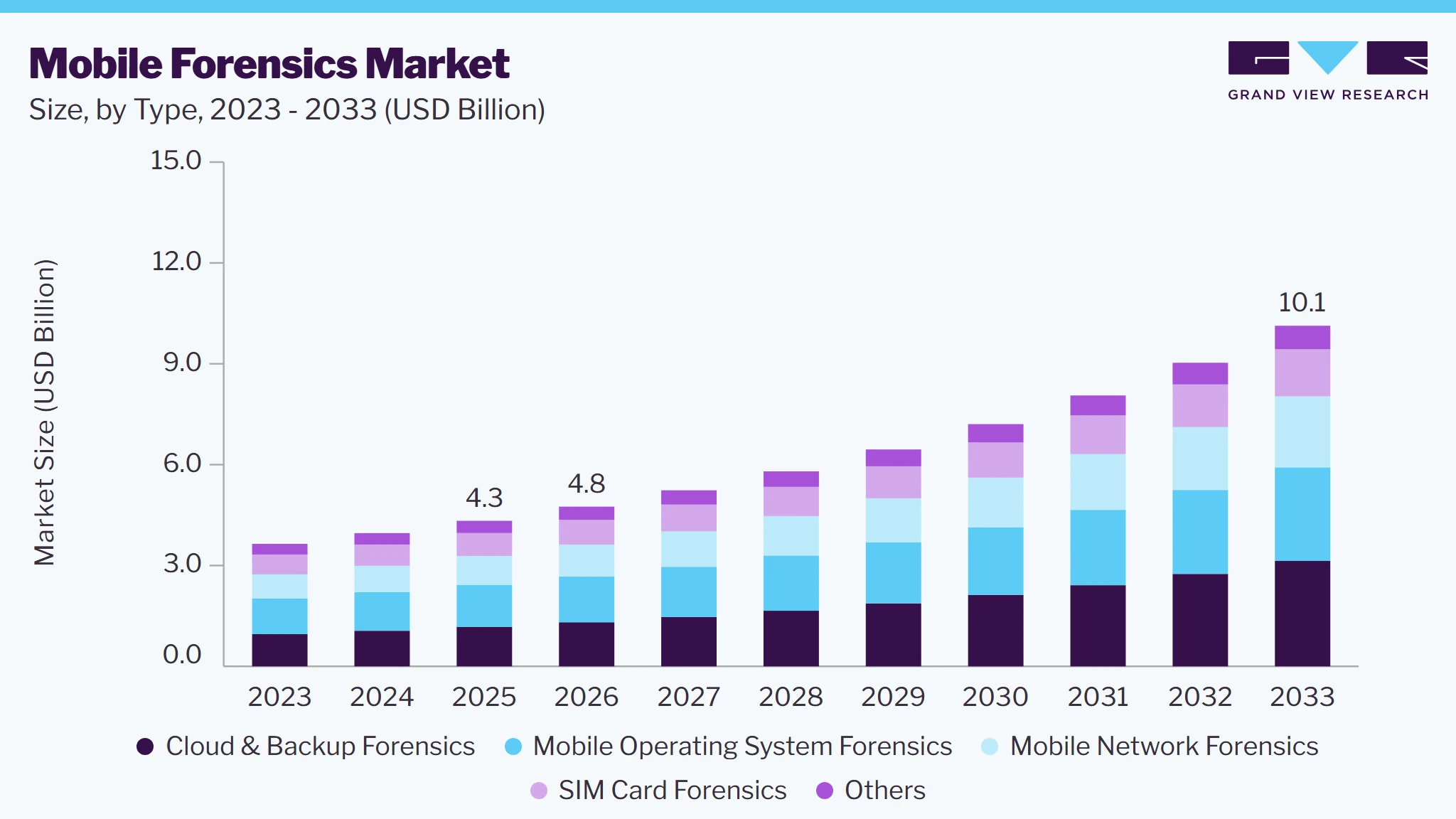
The global mobile forensics market size was valued at USD 4.3 billion in 2025 and is projected to grow from USD 4.8 billion in 2026 to USD 10.1 billion by 2033, at a CAGR of 11.4% from 2026 to 2033. North America dominated the market, accounting for a revenue share of 34.9% in 2025. Increasing use of smartphones in criminal and cybercrime activities is driving market growth.
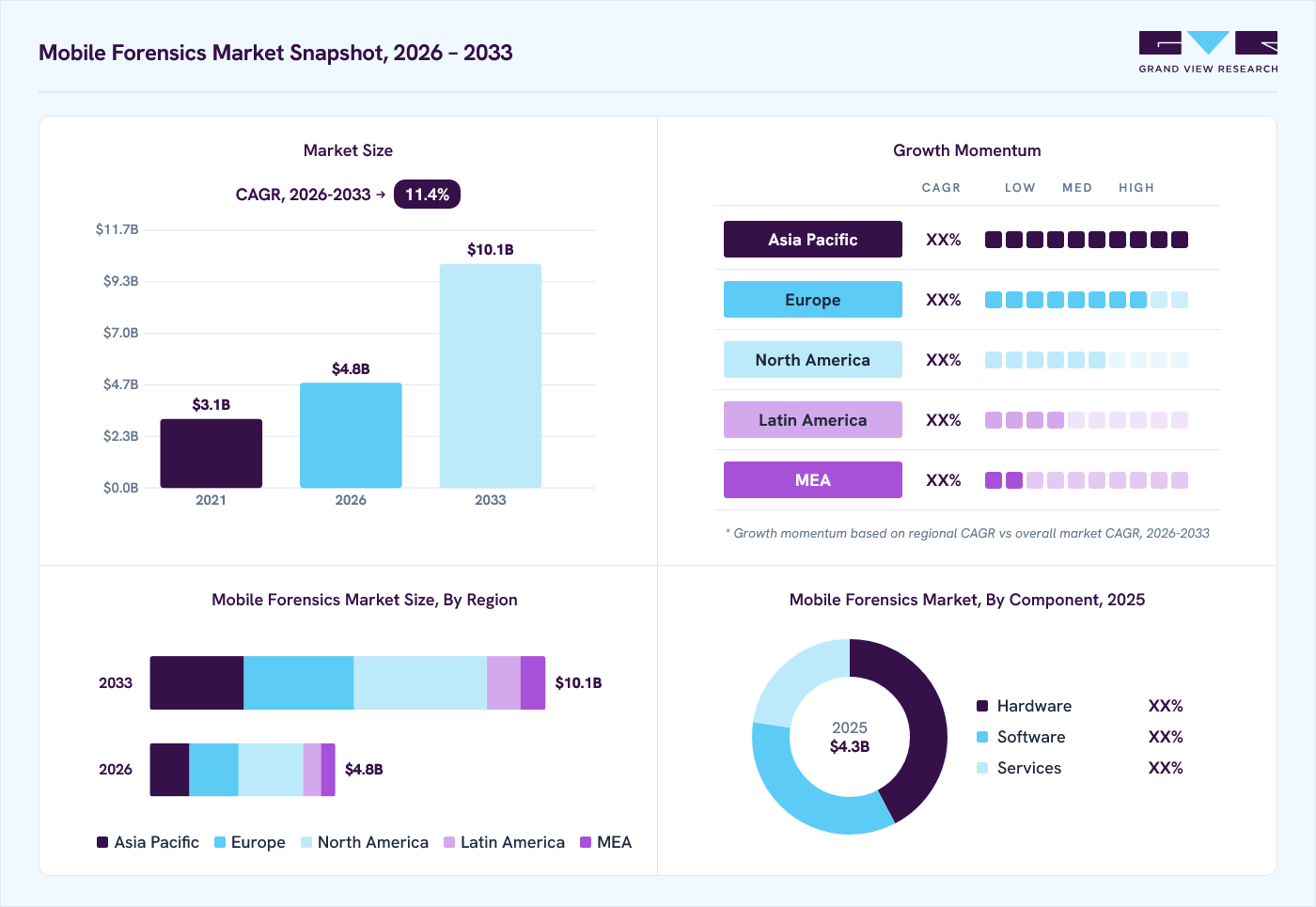 Source: Grand View Research, IR Documents, Primary Interviews, Paid DatabasesTo learn more about this report,
 Download Free Sample Report
 Key Market Trends & Insights
- By type: The mobile operating system forensics segment held the largest market share of 28.8% in 2025
- By component: The hardware segment held the largest market share of 42.3% in 2025
- By deployment: The cloud segment held the largest market share of 62.4% in 2025
- By operating system: The android segment held the largest market share of 48.3% in 2025
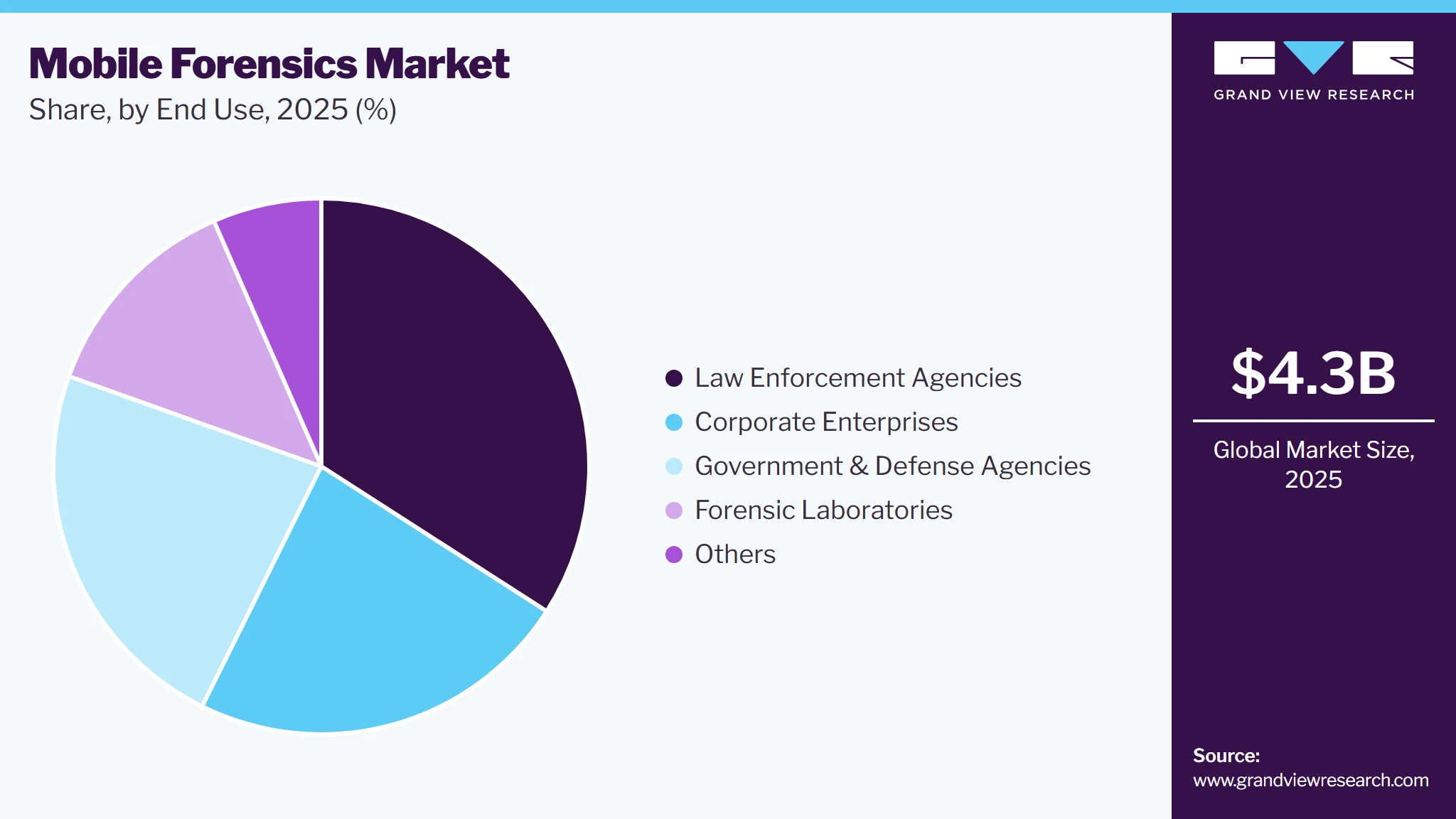
- By end use: The law enforcement agencies segment held the largest revenue share in 2025
Regional Highlights
- Largest regional market: North America (34.9% revenue share, 2025)
- Fastest-growing regional market: Asia Pacific (highest CAGR, 2026-2033)
- By country: The U.S. held the largest market share in 2025.
Market Size & Forecast
- Market size in 2025: USD 4.3 Billion
- Estimated market size in 2026: USD 4.8 Billion
- Projected market size by 2033: USD 10.1 Billion
- CAGR (2026-2033): 11.4%
Three ways to get this report
Buy it, customize it, or ask a question.Ask an Analyst
Analyst response in 1 business day
- AccessReport author, directly
- Reply timeWithin 1 working day
- No sales callDirect answer only
- FormatEmail reply
- CostFree, no cost
Get the Full Report
What the study covers
- FormatsPDF · Excel · Dashboard
- Timeline2026–2033 annual, 2025 base
- Coverage20+ countries, 5 regions
- Companies10+ key players profiled
Customize the Report
20% free customization
- IncludeCountries, segments, points
- TailorTo your product definition
- ExtendDeeper competitor detail
- OrA fully bespoke study
- Turnaround5–10 working days
The increasing number of mobile devices involved in criminal investigations is driving market growth, as smartphones and tablets increasingly contain information relevant to criminal, civil, corporate, and national security investigations.Modern mobile devices can store communication records, photographs, videos, application data, location information, browser activity, cloud access credentials, and other forms of digital evidence. The growing dependence on mobile devices for communication and daily activities is increasing the amount of investigative information available through mobile evidence. Investigators, therefore, require specialized forensic tools capable of collecting, preserving, analyzing, and presenting data from mobile devices. The expanding role of mobile devices in investigations is propelling demand for mobile forensic solutions.
 To learn more about this report, Download Free Sample Report
 The growing use of encrypted messaging applications is driving growth in the mobile forensics industry, as investigators increasingly encounter evidence stored within applications that employ advanced encryption and privacy mechanisms. Mobile devices can contain information from messaging platforms, social applications, email applications, and secure communication tools. Investigators require specialized forensic capabilities to identify legally accessible evidence, analyze available artifacts, and reconstruct relevant communication activity. The growing complexity of application-level data is contributing to the demand for advanced mobile forensic technologies. This trend is increasing the need for forensic solutions capable of handling diverse application environments and evolving data structures.
The rising adoption of cloud-connected mobile devices is contributing to market growth as mobile devices increasingly interact with cloud storage, online accounts, backup services, and synchronized applications. Relevant evidence may be distributed between a physical device and associated cloud environments. Forensic investigators increasingly require tools that can analyze mobile device data alongside legally obtained cloud and backup information. This creates demand for integrated approaches to mobile application forensics, cloud and backup forensics, and device-level evidence analysis. The growing connection between mobile devices and cloud services is driving market growth for broader mobile forensic platforms.
The rising number of investigations into social media activity is driving market growth, as mobile devices increasingly serve as the primary access point for social networking platforms. Social media applications can contain conversations, media files, account information, location references, and interaction histories. Investigators require specialized tools capable of identifying and organizing relevant application artifacts. The increasing importance of social media evidence is driving demand for forensic solutions with extensive support for mobile applications and social platforms. This trend is contributing to greater demand for application-level forensic analysis.
The growing adoption of mobile device management and enterprise mobility programs is driving market growth by increasing the number of mobile devices used across organizations. Businesses increasingly manage employee smartphones and tablets for communication, authentication, productivity, and remote access. These devices may become relevant during internal investigations, compliance reviews, security incidents, or legal disputes. The growth of enterprise mobility is driving demand for mobile forensic tools capable of examining business-related mobile data. This trend is driving the adoption of mobile forensic software by corporate enterprises and investigative teams.
Market Dynamics
The mobile forensics industry is expanding as the widespread use of smartphones, tablets, mobile applications, and cloud-connected devices continues to generate large volumes of digital evidence relevant to criminal investigations, corporate security incidents, and legal proceedings. Law enforcement agencies, government organizations, enterprises, and forensic laboratories are increasingly adopting specialized tools to acquire, preserve, analyze, and recover data from mobile devices, including deleted files, application data, communications, location information, and cloud-linked records. The growing sophistication of cybercrime, digital fraud, organized crime, and mobile-based criminal activity is increasing the need for advanced forensic capabilities capable of handling complex device ecosystems and rapidly evolving operating systems. Furthermore, the increasing use of encrypted applications, biometric security, and cloud backups is driving demand for more advanced data extraction and analysis technologies.
The rising number of cybercrime and digital fraud investigations is driving market growth in the mobile forensics industry as smartphones increasingly become connected to financial accounts, corporate systems, digital payment platforms, cloud services, and online identities. Cybercriminals frequently use mobile devices for communication, authentication, account access, transaction approvals, and coordination of fraudulent activities. Investigators are therefore increasingly examining smartphones and tablets to identify evidence of unauthorized access, phishing campaigns, identity theft, payment fraud, and other digital crimes. Mobile forensic tools can help extract and analyze device artifacts that may reveal communication patterns, application activity, browser records, authentication information, and links to connected digital services. The growing dependence of cybercrime investigations on mobile evidence is propelling demand for specialized mobile forensic software, hardware, and services.
High costs of advanced forensic tools are restraining the market growth, as sophisticated extraction, decryption, recovery, and analysis platforms often require substantial investment. Modern mobile devices use advanced encryption, secure hardware, biometric authentication, protected operating environments, and frequently changing software architectures. Forensic agencies may need specialized hardware, software licenses, technical support, training, and laboratory infrastructure to examine such devices effectively. The financial burden becomes particularly challenging for smaller law enforcement agencies, regional forensic laboratories, corporate investigation teams, and organizations with limited technology budgets. These high acquisition costs can delay technology upgrades and restrict access to advanced mobile forensic capabilities.
The expansion of AI-powered mobile evidence analysis is creating substantial opportunities in the global market as investigators increasingly face large volumes of data extracted from smartphones, tablets, SIM cards, applications, cloud backups, and connected digital services. Traditional manual examination becomes increasingly difficult when investigations involve thousands of messages, media files, application records, location artifacts, documents, and system logs. AI-powered platforms can help organize large datasets, identify recurring patterns, classify evidence, and prioritize information relevant to a specific investigation. The growing need to process mobile evidence more efficiently is creating opportunities for forensic technology providers to develop intelligent platforms that combine extraction, analysis, correlation, and reporting capabilities. This opportunity is propelling market growth by increasing the value of advanced software-based forensic solutions.
Analyst Perspective
The mobile forensics industry is evolving from a device-extraction business into a complex digital evidence intelligence ecosystem shaped by encryption, fragmented data environments, and the rapid pace of mobile technology change. Competitive differentiation increasingly depends on the ability to support a broad range of devices and operating systems while preserving forensic integrity, maintaining the evidentiary chain of custody, and extracting actionable insights from increasingly distributed data sources. Vendors that can continuously adapt to new smartphone models, application updates, security architectures, and cloud environments are likely to maintain a stronger competitive position. As mobile devices become central repositories of personal, financial, location, and communication data, the market is expected to place increasing emphasis on advanced analytics, automation, and legally defensible evidence processing rather than extraction capabilities alone.
Type Insights
The mobile application forensics segment led the market with the largest revenue share of 28.8% in 2025. The growth of social media applications is creating opportunities in mobile application forensics, as these platforms increasingly generate evidence related to identity theft, impersonation, online fraud, harassment, extortion, organized crime, and the coordination of cybercrime. Social media applications can contain direct messages, profile activity, shared media, account information, interaction records, and other digital artifacts. Investigators may require application-specific analysis to understand how accounts were created, managed, and used. The continuous evolution of social media features is driving demand for forensic tools that can adapt to changing application structures. The growing investigative importance of social media evidence is creating opportunities for specialized applications of forensic capabilities.
The cloud & backup forensics segment is anticipated to grow at the fastest CAGR during the forecast period. The expansion of multi-device synchronization is creating opportunities as users increasingly access the same digital accounts through smartphones, tablets, computers, and other connected devices. Data generated on one device may be synchronized with another device or stored within a connected cloud account. Investigators can examine these relationships to identify the origin, timing, and movement of digital evidence. Cloud and backup forensics can help connect information from multiple devices into a broader investigative picture. The growing use of interconnected personal and enterprise devices is creating opportunities for cross-device evidence analysis.
Component Insights
The hardware segment led the market with the largest revenue share of 42.3% in 2025. The rising use of advanced encryption and hardware-based security features is creating continuous demand for specialized mobile forensic equipment. Modern smartphones increasingly use secure chips, trusted execution environments, hardware-backed key storage, and protected boot systems. Investigators may require specialized acquisition systems capable of interacting with different device architectures and security configurations. Hardware providers are developing more advanced extraction interfaces and laboratory equipment to address these technical requirements. The growing sophistication of mobile security technologies is driving growth in the hardware segment.
The software segment is expected to grow at the fastest CAGR from 2026 to 2033. The growing need for cross-device evidence analysis is driving demand for software that can correlate data from smartphones, tablets, computers, wearable devices, and other connected systems. Investigations increasingly involve multiple devices associated with the same person, account, organization, or activity. Software can help identify shared contacts, duplicate files, synchronized information, common accounts, and connected events across different devices. This can improve the ability of investigators to understand broader digital relationships. The growing interconnection between digital devices is propelling demand for advanced forensic software.
Deployment Insights
The cloud segment accounted for the largest market revenue share in 2025. The increasing use of distributed forensic teams is driving market growth for cloud-based mobile forensic platforms. Law enforcement agencies, corporate investigation teams, forensic laboratories, and cybersecurity groups may operate across different offices and geographical locations. Cloud platforms can provide authorized users with centralized access to case data, analytical tools, and investigative workflows. This can improve collaboration between investigators working on the same case from different locations. The growing need for coordinated digital investigations is contributing to the demand for cloud-enabled forensic software.
The on-premise segment is expected to grow at the fastest CAGR from 2026 to 2033. The increasing need for isolated forensic environments is driving the adoption of on-premise infrastructure. Mobile evidence may need to be processed within restricted networks separate from general-purpose information technology environments. Dedicated on-premise systems can provide controlled processing environments for device extraction, evidence examination, analysis, and storage. This arrangement can help organizations design infrastructure around specific forensic workflows. The growing demand for isolated investigative environments is contributing to the expansion of on-premise mobile forensic deployment.
Operating System Insights
The android segment led the market with the largest revenue share of 48.3% in 2025. The increasing use of Android smartphones in enterprise environments is driving demand for Android-focused forensic tools. Businesses use Android devices for communication, field operations, workforce management, customer service, logistics, sales, and access to enterprise applications. Corporate investigations may require analysis of device activity, business communications, application usage, and data movement. Forensic software capable of examining Android devices can help organizations investigate internal security incidents and misconduct. The growing integration of Android devices into business operations is propelling market growth in the segment.
The iOS segment is expected to grow at the fastest CAGR from 2026 to 2033. The expansion of encrypted communication across iOS applications is driving demand for specialized forensic technologies. Users increasingly rely on secure messaging, encrypted communication applications, and protected data storage for personal and professional interactions. Investigations may require examination of available device artifacts, application records, metadata, notifications, backups, and related evidence sources. The technical complexity of extracting and interpreting evidence from protected iOS environments creates continuous demand for advanced forensic capabilities. The growing adoption of secure communication technologies is driving market growth in the iOS segment.
End Use Insights
The law enforcement agencies segment led the market with the largest revenue share of 34.1% in 2025.The expansion of organized criminal networks using digital communication is driving demand for mobile forensic capabilities. Criminal groups may use messaging applications, social platforms, encrypted communication services, and mobile payment tools to coordinate activities. Investigators require methods to examine available device artifacts and identify relationships between individuals, communications, transactions, and locations. Mobile forensic analysis can help reveal connections that may not be visible through conventional investigative methods. The growing digital coordination among organized crime groups is driving market growth in the law enforcement segment.
 To learn more about this report, Download Free Sample Report
 The corporate enterprises segment is anticipated to grow at the fastest CAGR during the forecast period. The expansion of bring-your-own-device policies is driving market growth for mobile forensic solutions in corporate enterprises. Employees may use personal smartphones to access business email, enterprise applications, corporate messaging platforms, and company information. These arrangements can create complex investigative requirements when a security incident involves a device that is not fully owned or managed by the enterprise. Corporate security and legal teams may require specialized methods for examining relevant business evidence while maintaining structured investigative procedures. The increasing use of personal devices for professional activity is propelling demand for corporate mobile forensic technologies.
Regional Insights
North America dominated the global mobile forensics market with the largest revenue share of 34.9% in 2025. The growing volume of mobile evidence generated during civil litigation and corporate disputes is driving demand in North America. Mobile devices may contain messages, emails, photographs, application records, location information, and documents relevant to employment disputes, intellectual property cases, contractual disagreements, and regulatory matters. Legal teams and corporate investigation departments increasingly require structured methods for identifying and analyzing mobile evidence. The need to examine large volumes of digital information within formal investigative processes is propelling demand for mobile forensic platforms. The growing importance of mobile evidence in legal and corporate proceedings is contributing to regional market growth.
 To learn more about this report, Download Free Sample Report
 U.S. Mobile Forensics Market Trends
The mobile forensics market in the U.S. accounted for the largest market revenue share in North America in 2025. The increasing use of smartphones in transportation and mobility services is driving market growth in the U.S. Mobile devices are widely used for navigation, ride coordination, delivery management, fleet communication, travel services, and operational tracking. Investigations involving accidents, theft, fraud, unauthorized activity, and disputes may require examination of device activity, location data, communication records, and application information. Mobile forensic tools can help investigative teams organize evidence generated through these interconnected services. The expanding role of smartphones in transportation-related activities is propelling demand for mobile forensic technologies.
Asia Pacific Mobile Forensics Market Trends
The mobile forensics market in Asia Pacific is expected to grow at the fastest CAGR from 2026 to 2033. The expansion of mobile-first digital economies is driving demand for advanced forensic solutions in the region. Many consumers and small businesses across emerging Asian markets access banking, commerce, government services, entertainment, education, and communication primarily through smartphones. This creates a large digital evidence environment in which mobile devices may become central to investigations. Organizations require forensic tools that can handle a wide variety of operating systems, applications, languages, and device models. The development of mobile-centered digital economies is driving demand for mobile forensics across the Asia-Pacific region.
The China mobile forensics market is projected to grow significantly during the forecast period. The expansion of super-app ecosystems is driving market growth in China. Many mobile users access messaging, payments, shopping, transportation, financial services, and other digital functions through highly integrated mobile platforms. This creates complex evidence environments in which a single device can contain information linked to multiple aspects of an individual’s personal and commercial activity. Investigators require specialized technologies capable of organizing and analyzing evidence generated across interconnected applications and services. The growing concentration of digital activity within mobile ecosystems is propelling demand for advanced mobile forensic solutions.
The mobile forensics market in India is projected to grow at a significant CAGR during the forecast period. The rising use of smartphones for identity verification and authentication is driving market growth in India. Mobile numbers, authentication applications, biometric services, digital identity systems, and device-based verification are increasingly integrated into financial, government, enterprise, and consumer services. Investigations involving identity theft, unauthorized account access, fraudulent registrations, and credential misuse may require examination of mobile device records and authentication activity. Forensic teams require specialized tools to analyze device artifacts connected with digital identities and account activity. The expanding role of smartphones in identity-driven digital services is propelling demand for mobile forensic solutions.
Europe Mobile Forensics Market Trends
The mobile forensics market in Europe is anticipated to grow steadily from 2026 to 2033. The expansion of cross-border digital commerce is driving demand for mobile forensic technologies in Europe. Consumers increasingly use smartphones to access online marketplaces, payment applications, delivery services, and international retail platforms. Investigations involving fraudulent sellers, counterfeit goods, payment manipulation, account takeovers, and identity misuse may require analysis of mobile application activity and communication records. Investigative agencies and corporate security teams require technologies capable of examining digital evidence generated across multiple platforms and jurisdictions. The increasing integration of mobile devices with international e-commerce activity contributes to market growth.
The UK mobile forensics market is anticipated to grow rapidly during the forecast period. The growing adoption of mobile-based digital identity systems is driving market growth in the UK. Smartphones increasingly function as access points for authentication, identity verification, banking, healthcare, government services, and enterprise systems. Investigations involving identity theft, credential misuse, fraudulent registrations, and unauthorized account access may require examination of device activity and application records. Forensic technologies can help investigators connect mobile identity activity with broader digital events. The expanding importance of smartphone-based identity management is propelling demand for mobile forensic capabilities.
The mobile forensics market in Germany is expected to grow significantly during the forecast period. The increasing importance of intellectual property protection is driving demand for mobile forensics in Germany. The country’s automotive, engineering, chemicals, pharmaceutical, electronics, software, and industrial sectors manage large volumes of proprietary information. Smartphones increasingly function as communication and access points for technical documents, project information, research data, and corporate systems. Investigations involving unauthorized disclosure, industrial espionage, data leakage, and employee activity may require examination of mobile evidence. The rising value of digitally accessible intellectual property contributes to market growth.
Key Mobile Forensics Company Insights
Some prominent players in the mobile forensics market include Kroll, LLC, and MSAB, among others.
-
Kroll, LLC is a global risk and financial advisory company that provides investigative, cybersecurity, digital forensics, compliance, and business intelligence services to corporations, law firms, financial institutions, governments, and other organizations. Kroll provides specialized forensic investigation and digital evidence services focused on the collection, preservation, examination, and analysis of data from mobile devices. Its mobile forensics capabilities support investigations involving smartphones, tablets, mobile applications, messaging platforms, cloud-linked accounts, and other connected digital ecosystems.
-
MSAB is a technology company specializing in digital forensics and mobile device investigation solutions. MSAB provides a comprehensive portfolio of hardware and software products designed to support mobile device evidence collection and investigation. Its key mobile forensics products include XRY, XAMN, and XEC, which together support different stages of the forensic investigation process. XRY is used for the forensic extraction and recovery of data from mobile devices, while XAMN provides tools for analyzing and investigating extracted digital evidence.
Key Mobile Forensics Companies
The following key companies have been profiled for this study on the mobile forensics market
-
Belkasoft
-
CavetTek, LLC
-
CCL Solutions Group
-
Compelson
-
CYFOR Forensics
-
Data Chasers
-
Eclipse Forensics
-
Jamf
-
Kroll, LLC
-
MSAB
-
Open Text Corporation
-
Surge Avalon Holdings
Competitive Benchmarking
Operating Strategies
Competitive Edge
Weakness
Mature Players: Cellebrite; Magnet Forensics; MSAB; Oxygen Forensics; Grayshift
- Established players focus on providing end-to-end mobile evidence extraction, analysis, recovery, and reporting solutions for law enforcement, government agencies, corporate investigations, and forensic laboratories.
- Their strategies emphasize continuous support for new smartphone models, operating systems, encryption methods, cloud applications, and advanced investigative workflows to maintain forensic relevance as mobile technology evolves.
- Established players benefit from extensive forensic databases, validated extraction methodologies, strong relationships with investigative agencies, and long-standing expertise in handling complex mobile evidence.
- Their broad device coverage, trusted forensic workflows, and established institutional relationships strengthen adoption among organizations that require reliable and defensible digital evidence examination.
- Established players face continuous pressure to update their technologies as smartphone hardware, operating systems, encryption methods, and application architectures evolve rapidly.
- Maintaining broad device compatibility requires significant investment in research, product development, testing, and validation, while increasing technical complexity can raise development costs and extend product update cycles.
Emerging Players: Belkasoft; ElcomSoft; Passware; SalvationDATA; Hancom WITH
- Emerging players focus on specialized mobile forensic capabilities such as advanced data recovery, password analysis, encryption investigation, cloud evidence acquisition, and AI-assisted examination tools.
- Their strategies emphasize focused product development and flexible deployment models to address specific investigative challenges created by fragmented mobile platforms and increasingly complex digital evidence environments.
- Emerging players gain competitive strength through specialized technologies that address specific forensic gaps and support faster innovation in areas such as encrypted data recovery, artifact analysis, and cloud evidence examination.
- Their focused product portfolios and agile development approaches enable them to respond quickly to emerging investigative requirements and evolving digital evidence formats.
- Emerging players face challenges related to limited institutional reach, smaller validation ecosystems, and lower brand recognition among major law enforcement and government agencies.
- Maintaining compatibility with rapidly changing mobile platforms requires substantial technical resources, while limited distribution networks and fewer large-scale customer relationships can restrict broader market penetration.
Recent Developments
-
In July 2026, Cellebrite DI Ltd. partnered with SkySafe to integrate drone detection and airspace intelligence with digital forensic capabilities. The collaboration combines SkySafe’s advanced drone detection and airspace intelligence technology with Cellebrite’s digital investigation platform, enabling agencies to connect real-time and historical unmanned aerial vehicle (UAV) flight data with mobile forensic evidence. This integration supports more comprehensive investigations by allowing investigators to correlate drone activity with digital evidence and gain deeper insights into incidents.
-
In July 2025, CCL Solutions Group collaborated with Cellebrite to offer its suite of digital investigative solutions. Through this collaboration, CCL strengthens its ability to support law enforcement, intelligence, defense, and legal organizations across the UK and international markets. The partnership combines Cellebrite’s advanced capabilities in mobile data extraction and evidence management with CCL’s established expertise and operational reach, bringing together two highly respected names in digital forensics to deliver an enhanced solution for efficient, effective digital evidence handling.
Mobile Forensics Market Report Scope
Report Attribute
Details
Market size in 2025
USD 4.3 billion
Estimated market size in 2026
USD 4.8 billion
Projected market size by 2033
USD 10.1 billion
Growth rate
CAGR of 11.4% from 2026 to 2033
Base year for estimation
2025
Historical data
2021 - 2024
Forecast period
2026 - 2033
Quantitative units
Revenue in USD million/billion, and CAGR from 2026 to 2033
Report coverage
Revenue forecast, company share, competitive landscape, growth factors, and trends
Segments covered
Type, component, deployment, operating system, end use, region
Regional scope
North America; Europe; Asia Pacific; Latin America; Middle East & Africa
Country scope
U.S.; Canada; Mexico UK; Germany; France; China; India; Japan; Australia; South Korea; Brazil; UAE; Saudi Arabia; South Africa
Key companies profiled
Belkasoft; CavetTek, LLC; CCL Solutions Group; Compelson; CYFOR Forensics; Data Chasers; Eclipse Forensics; Jamf; Kroll, LLC; MSAB; Open Text Corporation; Surge Avalon Holdings
Customization scope
Free report customization (equivalent to 8 analysts working days) with purchase. Addition or alteration to country, regional & segment scope.
Pricing and purchase options
Avail customized purchase options to meet your exact research needs. Explore purchase options
Global Mobile Forensics Market Report Segmentation
This report forecasts revenue growth at global, regional, and country levels and provides an analysis of the latest industry trends in each of the sub-segments from 2021 to 2033. For this study, Grand View Research has segmented the global mobile forensics market report based on type, component, deployment, operating system, end use, and region.
-
Type Outlook (Revenue, USD Million, 2021 - 2033)
-
Mobile Operating System Forensics
-
SIM Card Forensics
-
Cloud & Backup Forensics
-
Mobile Network Forensics
-
Others
-
-
Component Outlook (Revenue, USD Million, 2021 - 2033)
-
Hardware
-
Software
-
Services
-
-
Deployment Outlook (Revenue, USD Million, 2021 - 2033)
-
Cloud
-
On-premise
-
-
Operating System Outlook (Revenue, USD Million, 2021 - 2033)
-
Android
-
iOS
-
Windows
-
Others
-
-
End Use Outlook (Revenue, USD Million, 2021 - 2033)
-
Law Enforcement Agencies
-
Government & Defense Agencies
-
Corporate Enterprises
-
Forensic Laboratories
-
Others
-
-
Regional Outlook (Revenue, USD Million, 2021 - 2033)
-
North America
-
U.S.
-
Canada
-
Mexico
-
-
Europe
-
Germany
-
UK
-
France
-
-
Asia Pacific
-
China
-
India
-
Japan
-
South Korea
-
Australia
-
-
Latin America
-
Brazil
-
-
Middle East & Africa
-
UAE
-
Saudi Arabia
-
South Africa
-
-
Research Methodology
The mobile forensics market figures in this report are based on a proven research process that combines executive interviews with secondary research from proprietary databases, company filings, and recognized regulatory and institutional sources. Market size is built through value-chain sizing - reconciling supply-side and demand-side estimates - and triangulated with bottom-up and top-down approaches. Every estimate passes multiple levels of expert validation before publication, with each mobile forensics segment quantified using the revenue-capture definitions in the table below.
Segment Definition
Segment - Type
Revenue capture definition
Mobile Application Forensics
The largest type segment, capturing value through tools that extract, decode, analyze, and preserve data from smartphones and tablets, including messages, application records, media, call logs, and system artifacts. Vendors monetize through specialized forensic software licenses, recurring platform subscriptions, hardware-enabled acquisition tools, and advanced investigation capabilities that support complex device examinations.
SIM Card Forensics
Market activity is driven by solutions that recover and analyze subscriber identity information, contacts, stored messages, network identifiers, and other artifacts contained within SIM cards. Demand remains relevant for investigations where SIM data can provide independent evidence or help establish links between devices, subscribers, and communication activity.
Cloud & Backup Forensics
Commercial opportunities arise from technologies that acquire and analyze synchronized cloud data, device backups, application backups, and remotely stored digital evidence. The segment is expanding as users increasingly store communications, photographs, application data, and personal information across cloud ecosystems rather than solely on physical devices.
Mobile Network Forensics
Value is created through the analysis of mobile network records, communication metadata, location information, signaling data, and network activity associated with mobile devices. Law enforcement and intelligence organizations invest in these capabilities to reconstruct communication patterns, identify device movements, and support investigations involving large volumes of network data.
Others
This category includes mobile application forensics, wearable device forensics, encrypted data analysis, mobile malware investigations, and specialized evidence recovery solutions. The segment continues to expand as mobile ecosystems become more diverse and digital evidence increasingly originates from connected devices beyond conventional smartphones.
Segment - Component
Revenue capture definition
Hardware
Revenue is captured through forensic workstations, mobile extraction devices, specialized acquisition systems, write-blocking equipment, and other hardware used to securely collect and process digital evidence. Demand is supported by investigative organizations requiring high-performance tools for handling large volumes of mobile evidence and complex device architectures.
Software
The dominant component segment, generating value through mobile data extraction, decoding, analysis, reporting, case management, and evidence visualization platforms. Vendors increasingly adopt subscription and recurring licensing models while expanding capabilities for encrypted applications, cloud synchronization, deleted data, and advanced operating system environments.
Services
Commercial activity encompasses forensic examination, evidence recovery, expert analysis, consulting, training, technical support, and managed investigation services. Organizations often engage specialized providers when internal teams lack the expertise or tools required to process highly complex or damaged mobile devices.
Segment - Deployment
Revenue capture definition
Cloud
Adoption is supported by cloud-based forensic platforms that enable centralized case management, remote collaboration, scalable evidence processing, and access to continuously updated forensic capabilities. This model is particularly valuable for organizations managing distributed investigative teams and large digital evidence repositories.
On-Premise
Spending is concentrated among law enforcement, defense, forensic laboratories, and enterprises requiring direct control over sensitive evidence and investigative infrastructure. On-premise deployments remain important where data sovereignty, restricted network environments, and strict chain-of-custody requirements limit the use of externally hosted systems.
Segment - Operating System
Revenue capture definition
Android
The largest operating system segment, supported by the broad global installed base of Android devices and the diversity of manufacturers, device configurations, and software versions requiring forensic examination. Vendors invest heavily in expanding compatibility with fragmented hardware environments and evolving security architectures.
iOS
Market value is driven by the widespread use of Apple smartphones and tablets in consumer, enterprise, and government environments. Forensic providers focus on secure acquisition and analysis of protected device data, application artifacts, backups, and synchronized information within Apple’s tightly controlled ecosystem.
Windows
Demand originates from Windows-based smartphones and legacy mobile devices that remain relevant in certain enterprise, institutional, and historical investigations. The segment also benefits from forensic workflows involving mobile devices connected to broader Windows-based computing environments.
Others
This category includes legacy mobile operating systems, specialized enterprise platforms, Linux-based mobile environments, and operating systems used in niche or embedded connected devices. Although smaller in scale, these systems create specialized demand for compatibility and evidence recovery capabilities.
Segment - End Use
Revenue capture definition
Law Enforcement Agencies
The largest end-use segment, with agencies deploying mobile forensics for criminal investigations, evidence collection, suspect identification, fraud cases, and digital crime investigations. Investment is directed toward reliable acquisition, evidence preservation, rapid analysis, and legally defensible reporting capabilities.
Government & Defense Agencies
Government and defense organizations utilize mobile forensics for intelligence analysis, national security investigations, counterterrorism operations, border security, and sensitive internal investigations. Procurement often prioritizes advanced extraction capabilities, secure deployment, and support for highly protected devices and communication environments.
Corporate Enterprises
Companies adopt mobile forensic capabilities to investigate insider threats, intellectual property theft, employee misconduct, corporate fraud, data leakage, and incident response cases. Growing dependence on mobile devices for business communications is increasing the need for enterprise-grade digital investigation tools.
Forensic Laboratories
Forensic laboratories invest in high-performance acquisition, analysis, validation, and reporting platforms capable of processing diverse device types and large evidence volumes. Their spending is often focused on advanced tools, specialized services, software updates, and technologies that support legally defensible forensic workflows.
Others
This category includes legal firms, private investigators, cybersecurity companies, insurance organizations, academic institutions, and specialized digital investigation providers. These users increasingly adopt mobile forensic capabilities to support litigation, corporate investigations, cyber incident analysis, insurance claims, and research activities.
Estimation Model
Layer
Question
Analysis
Digital Evidence Generation Layer
Where does demand for mobile forensics originate?
Identify investigations and legal proceedings where mobile devices may contain critical digital evidence, including criminal investigations, cybercrime cases, fraud investigations, corporate misconduct, national security operations, and civil litigation. The market is shaped by the growing role of smartphones, tablets, mobile applications, cloud-synchronized data, and connected devices in documenting communications, transactions, locations, and user activity.
Evidence Accessibility Layer
What determines whether mobile data can be recovered and analyzed?
Assess the technical challenges associated with device operating systems, encryption, locked devices, deleted data, application-level security, damaged hardware, cloud backups, and rapidly changing smartphone architectures. Forensic laboratories and investigative organizations require specialized tools, extraction methods, and technical expertise to lawfully acquire, preserve, decrypt where legally permitted, and validate data while maintaining evidentiary integrity.
Forensic Workflow Integration Layer
How is mobile forensic technology incorporated into investigations?
Analyze the use of mobile device extraction tools, application analysis, SIM and network data examination, cloud and backup forensics, deleted-data recovery, geolocation analysis, and automated evidence processing. These capabilities are increasingly integrated with digital evidence management platforms, case management systems, forensic laboratories, and broader law enforcement workflows to accelerate examination and improve the organization of large volumes of digital evidence.
Evidence Intelligence & Service Value Layer
How is commercial value generated within the mobile forensics ecosystem?
Evaluate revenue streams from forensic hardware, software licenses, cloud-based investigation platforms, technical support, training, laboratory services, evidence analysis, and device-specific tool updates. Additional value is generated through recurring software subscriptions, specialized extraction capabilities, professional forensic services, and continuous technology upgrades required to address new mobile operating systems, device architectures, applications, encryption techniques, and evolving digital evidence formats.
Delivered Customization
This report has been delivered with the following In-depth customizations
Client Request
Customization Delivered
Value Adds
Mobile Evidence Acquisition & Digital Investigation Trends
Conducted a focused analysis of mobile forensics solutions covering data extraction from smartphones, tablets, SIM cards, and removable storage, including logical, file-system, and physical acquisition methods used in law enforcement and corporate investigations.
Helps stakeholders identify high-demand forensic capabilities, evaluate evidence acquisition trends, and assess commercialization opportunities in mobile digital investigation technologies. Encrypted Data, Application Evidence & Cloud-Connected Investigation Trends
Evaluated adoption trends for advanced mobile forensic capabilities supporting encrypted device analysis, deleted data recovery, application artifact examination, messaging evidence, location history, and cloud-linked data investigation across evolving mobile ecosystems.
Provides insights into changing investigative requirements, technology development priorities, and commercially attractive solutions for extracting and analyzing complex digital evidence. Digital Evidence Management & Forensic Workflow Opportunity Assessment
Assessed demand for integrated forensic platforms covering evidence preservation, automated analysis, case management, reporting, chain-of-custody documentation, and collaboration between investigators, forensic laboratories, and legal teams, along with challenges related to device fragmentation, encryption, privacy regulations, and rapidly changing operating systems.
Supports investment and expansion strategies by identifying workflow automation opportunities, evaluating forensic technology readiness, and strengthening long-term growth potential in secure, scalable, and interoperable mobile investigation ecosystems. Frequently Asked Questions About This Report
The global mobile forensics market size was estimated at USD 4.3 billion in 2025 and is expected to reach USD 4.8 billion in 2026.
The global mobile forensics market is expected to grow at a compound annual growth rate of 11.4% from 2026 to 2033 to reach USD 10.1 billion by 2033.
Key factors include increasing volume of mobile devices involved in criminal investigations, the growing use of encrypted messaging applications, and the rising adoption of cloud-connected mobile devices.
North America dominated the market with 34.9% revenue share in 2025.
Asia Pacific is the fastest-growing region over the forecast period.
The mobile application forensics segment led with an 28.8% revenue share in 2025, while cloud & backup forensics segment is the fastest-growing segment.
The hardware segment led with an 42.3% revenue share in 2025, while software segment is the fastest-growing segment.
The cloud held the largest share (over 62.4%) and it is the fastest-growing segment.
Key players operating in the mobile forensics market include Belkasoft; CavetTek, LLC; CCL Solutions Group; Compelson; CYFOR Forensics; Data Chasers; Eclipse Forensics; Jamf; Kroll, LLC; MSAB; Open Text Corporation; Surge Avalon Holdings.
About the Author(s)
Next Generation Technologies Research Team
Technology · Next Generation TechnologiesThis report was authored by the next generation technologies research team at Grand View Research - comprising two research analysts, one senior research analyst, and one industry expert - with specialized expertise in the next generation technologies segment of the technology industry. All findings are based on proprietary technology databases, executive interviews, and regulatory analysis, subject to internal peer review prior to publication.
Last Updated:
Speak to Analyst

Customize this report to your needs - add regions, segments, or data points, with 20% free customization.
Or view our licence options:


ISO 9001:2015 & 27001:2022 Certified
We are GDPR and CCPA compliant! Your transaction & personal information is safe and secure. For more details, please read our privacy policy.


