
- Home
- »
- Semiconductors
- »
-
NAND Flash Memory Market Size & Share Report 2026-2035GVR Report cover

NAND Flash Memory Market (2026 - 2035)
Size, Share & Trends Analysis Report By Type (SLC, MLC, TLC), By Structure (2D Planar NAND, 3D NAND), By Interface (SATA, PCIe/NVMe), By Application, By End Use, By Region, And Segment Forecasts
Market Size, 2025
$69.6BMarket Estimate, 2026
$72.3BMarket Forecast, 2035
$105.8BCAGR, 2026–2035
5.4%NAND Flash Memory Market Summary
The global NAND flash memory market size was valued at USD 69.6 billion in 2025 and is projected to grow from USD 73.3 billion in 2026 to USD 105.8 billion in 2035, at a CAGR of 5.4% from 2026 to 2035. North America dominated the market, accounting for the largest revenue share of 40.0% in 2025. NAND flash memory is a critical segment of the semiconductor memory industry, driven by increasing demand for high-capacity, fast, energy-efficient, and non-volatile storage solutions across consumer electronics, enterprise and data center infrastructure, automotive, and industrial applications.
Key Market Trends & Insights
- By type: The TLC segment held the largest market share of around 50.0% in 2025
- By structure: The 3D Planar segment held the largest market share of around 80.0% in 2025
- By interface: The PCIe/NVMe segment held the largest market share of around 55.0% in 2025
- By end use: The consumer electronics segment held the largest market share of around 45.0% in 2025
Regional Highlights
- Largest regional market: North America (40.0% revenue share, 2025)
- Fastest-growing regional market: Asia Pacific (highest CAGR, 2026-2035)
Market Size & Forecast
- Market size in 2025: USD 69.6 Billion
- Estimated market size in 2026: USD 73.3 Billion
- Projected market size by 2035: USD 105.8 Billion
- CAGR (2026-2035): 5.4%
Prism AI by Grand View Research Free to tryAsk a question about the NAND flash memory marketTry asking✓Every figure cited from GVR research Prefer the report? Download free sample →The industry is increasingly influenced by technological advancements in NAND architecture, particularly the transition from 2D planar NAND to 3D NAND. By vertically stacking memory cells across multiple layers, 3D NAND enables higher storage density, improved performance, and lower cost per bit. Continued development of high-layer-count NAND architectures is further supporting the production of higher-capacity SSDs for data centers, enterprise systems, PCs, and other intensive storage applications. The increasing adoption of advanced 3D NAND is therefore expected to remain a key factor shaping the competitive landscape of the industry.
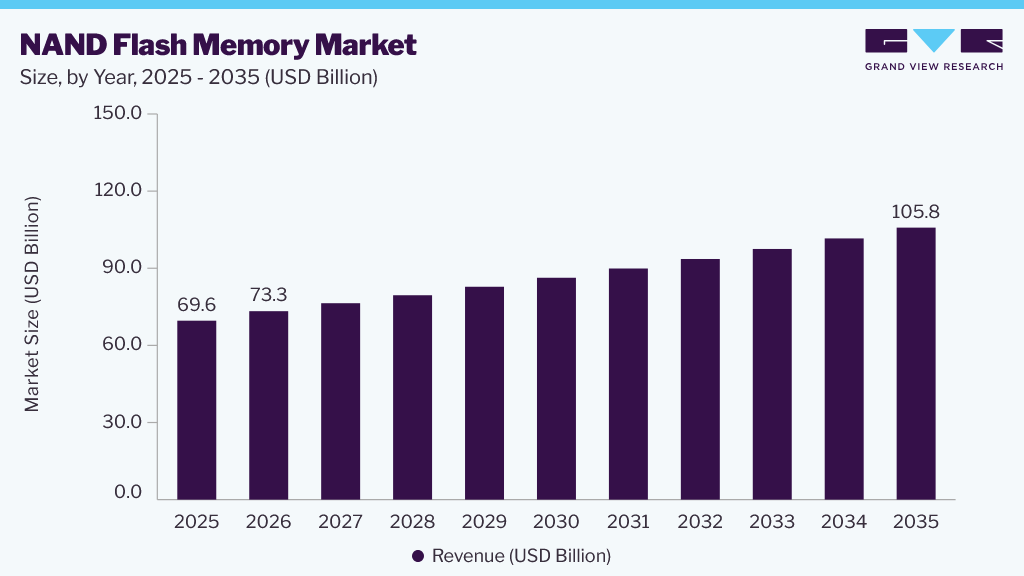 Source: Grand View Research, IR Documents, Primary Interviews, Paid DatabasesTo learn more about this report,
 Download Free Sample Report
Enterprise and data center applications represent an important growth opportunity as hyperscale cloud providers and enterprises expand their cloud infrastructure, artificial intelligence (AI) platforms, high-performance computing, and big data processing capabilities. The increasing deployment of NVMe SSDs, hyperscale data centers, and edge computing infrastructure is driving demand for higher-capacity, higher-performance NAND storage. AI workloads are particularly significant because they require rapid access to large datasets and increasingly rely on high-performance storage infrastructure. Meanwhile, consumer applications, including smartphones, gaming consoles, PCs, tablets, and other connected devices, continue to provide a substantial underlying demand base for NAND flash memory.
The industry is expected to sustain expansion as data generation increases, digital transformation accelerates, and semiconductor manufacturers advance memory architectures and fabrication technologies. However, market growth will continue to be influenced by semiconductor supply-demand cycles, NAND pricing fluctuations, inventory levels, fabrication costs, and manufacturers' capacity-management decisions. Leading NAND manufacturers are focusing on higher-layer 3D NAND architectures, process-node improvements, advanced packaging, and strategic capacity investments to increase bit density, reduce cost per bit, and meet the growing storage requirements of AI, cloud computing, enterprise SSDs, and next-generation consumer electronics.
Analyst Perspective
The industry is growing as demand for high-capacity and high-performance storage increases across smartphones, SSDs, data centers, automobiles, industrial systems, and AI-enabled applications. Technological advancements in 3D NAND, particularly the development of higher-layer architectures, are creating opportunities for manufacturers to increase storage density while improving cost efficiency. However, the market remains highly sensitive to fluctuations in NAND ASPs, inventory corrections, supply-demand imbalances, and capital-intensive fabrication requirements. Manufacturers, therefore, need to balance capacity expansion with market demand while continuing to invest in higher-density NAND technologies.
Type Insights
The TLC (Triple-Level Cell) NAND segment held the largest market share of around 50.0% in 2025, driven by its blend of capacity, speed, durability, and cost-effectiveness. TLC NAND stores three bits per cell, resulting in higher storage density than other forms of NAND memory, such as SLC or MLC, while maintaining competitive prices. The high adoption rate of TLC NAND in consumer SSDs, smartphones, memory cards, and embedded storage devices reflects its position as the first choice for mass-market applications.
The QLC (Quad-Level Cell) NAND segment is expected to experience the fastest growth during the forecast period, driven by rising demand for cost-effective, high-capacity storage solutions across data centers, consumer SSDs, and cloud infrastructure. QLC NAND stores four bits of data per cell, enabling manufacturers to achieve significantly higher storage capacity at a lower cost per gigabyte than TLC NAND. Although SSDs offer lower endurance and write performance, advancements in SSD controllers, firmware optimization, and error-correction technologies are improving their reliability for read-intensive workloads. The growing need for affordable, high-capacity SSDs for AI, analytics, and enterprise storage environments is accelerating QLC adoption.
Structure Insights
The 3D NAND segment held the largest market share of around 80.0% in 2025, owing to its ability to deliver higher storage density, improved performance, and greater cost efficiency than conventional 2D NAND technology. Unlike 2D NAND, where memory cells are placed side by side on the same surface, 3D NAND stacks cells vertically, allowing manufacturers to expand storage capacity while minimizing the physical footprint of storage devices. It is now the standard technology used in SSDs, smartphones, enterprise storage, and high-performance computing systems. Continuous innovation in layer stacking, memory architecture, and fabrication processes is enabling manufacturers to improve storage efficiency, enhance endurance, and lower production costs, further strengthening 3D NAND's commercial adoption. For instance, in May 2026, TechInsights' NAND Technology Roadmap highlighted advancements across the industry toward increasingly complex 3D NAND designs, including Samsung's V9/V10, Micron's 276-layer architecture, Kioxia–Western Digital's BiCS10, and YMTC's Xtacking, all aimed at developing next-generation NAND for AI applications.
The 2D (Planar) NAND segment is driven largely by sustained demand from cost-conscious and legacy applications. Planar NAND places memory cells within a single horizontal level, making it easier to produce for certain low-capacity or embedded storage needs, and it remains in use in industrial devices and consumer electronics that prioritize cost over capacity. It will, however, continue to face headwinds from reduced investment, limited scalability, and the industry-wide shift toward vertical stacking.
Interface Insights
The PCIe/NVMe segment held the largest market share, at around 55.0%, in 2025. PCIe/NVMe interfaces deliver significantly higher data transfer speeds and lower latency than legacy SATA connections by communicating directly with the CPU over the PCIe bus, making them the standard choice for high-performance consumer SSDs, gaming systems, and enterprise storage. Adoption has accelerated further as enterprise and data center operators have aggressively transitioned away from SATA, with the majority of new laptop and desktop models now shipping standard with NVMe SSDs as the default configuration. Meanwhile, SATA-based storage continues to see declining adoption, as its comparatively lower throughput makes it increasingly unsuitable for AI-driven and data-intensive workloads.
The UFS (Universal Flash Storage) segment is expected to witness the fastest growth during the forecast period, driven by rising demand for high-speed, power-efficient storage in smartphones, automotive infotainment systems, and edge AI devices. UFS delivers substantially higher read/write speeds and lower power consumption than legacy eMMC interfaces, making it the preferred choice for flagship mobile devices and, increasingly, for automotive applications, as systems migrate from eMMC to UFS 4.0 and beyond to support high-resolution multi-display environments and on-device AI processing. For instance, in May 2025, SK Hynix introduced a UFS 4.1 solution based on 321-layer NAND, offering faster sequential read speeds, improved random read/write performance, and reduced power consumption for next-generation smartphones.
End Use Insights
The consumer electronics segment held the largest market share of around 45.0% in 2025, owing to the extensive deployment of NAND flash in phones, tablets, computers, game consoles, smart TVs, digital cameras, wearables, and other connected devices. Responding to growing consumer demand for higher-capacity, faster memory, manufacturers have been embedding state-of-the-art 3D NAND across a wide range of consumer devices. The rise of 5G phones, consumer AI devices, and 4K/8K video content, among other factors, has increased demand for NAND flash memory, while constant product innovation and shorter device replacement cycles continue to support steady demand. For instance, in May 2025, SK Hynix introduced its UFS 4.1 solution based on 321-layer NAND, offering higher performance and lower power consumption for next-generation smartphones and mobile devices.
The enterprise & data center segment is expected to register the fastest growth during the forecast period, powered by the rapid adoption of cloud computing, artificial intelligence, machine learning, and hyperscale data centers. Businesses are increasingly turning to NAND flash SSDs to boost data processing capabilities while minimizing latency and improving energy efficiency, driven by the sheer volume of digital data generated today and by rising investment in AI infrastructure and edge computing. Advances in high-layer 3D NAND flash technology are further supporting this growth by delivering higher storage densities and improved reliability.
Regional Insights
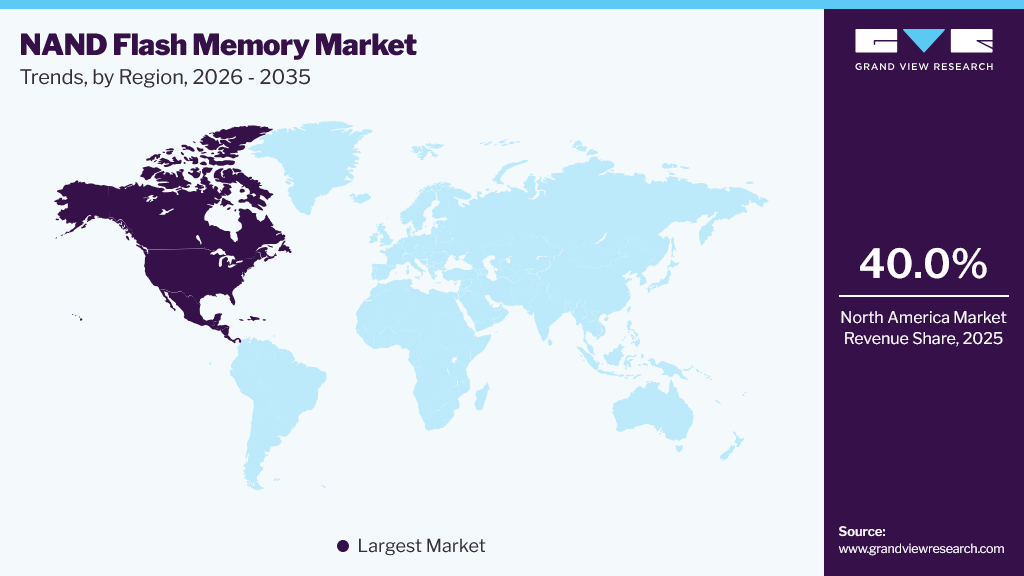
The North America NAND flash memory market held the largest share, at around 40.0% in 2025, due to rapid innovation in hyperscale data centers, cloud computing systems, artificial intelligence (AI), and high-performance computing. The region is dominated by major cloud service providers and IT companies that require high-capacity storage solutions for applications such as AI training, enterprise workload management, and big data analytics. Increasing investments in semiconductor manufacturing under the United States' CHIPS and Science Act, as well as the use of enterprise SSDs and other advanced memory technologies, have been supporting market growth. Moreover, R&D efforts and collaboration among semiconductor companies are also fueling innovation in NAND flash technologies.
 To learn more about this report, Download Free Sample Report
Asia Pacific NAND Flash Memory Market Trends
The NAND flash memory market in Asia Pacific is expected to grow at the fastest rate during the forecast period. The region’s growth is driven by the strong presence of leading semiconductor manufacturers, well-established electronics manufacturing ecosystems, and high consumer demand for smartphones, laptops, and other digital devices. Countries such as South Korea, China, Japan, and Taiwan play a pivotal role in NAND flash production and innovation, with major companies including Samsung Electronics, SK Hynix, Kioxia, and Western Digital operating advanced manufacturing facilities in the region. In addition, increasing investments in semiconductor fabrication, AI-enabled consumer electronics, and data storage technologies continue to strengthen regional market leadership. Supportive government initiatives aimed at expanding domestic semiconductor capabilities are also contributing to sustained market growth across the Asia Pacific.
Key NAND Flash Memory Companies Insights
The NAND flash memory market is highly competitive, with major players focused on boosting storage density, advancing 3D NAND technology, and expanding production capacity to meet rising demand from consumer electronics, enterprise SSDs, and AI-driven data centers. Substantial investment in R&D, strategic collaborations, manufacturing process improvements, and the development of high-layer NAND technology continues to define competitive positioning across the industry.
Key NAND flash memory Companies
The following key companies have been profiled for this study on the NAND flash memory market:
-
Samsung Electronics Co., Ltd.
-
SK Hynix Inc.
-
Kioxia Holdings Corporation
-
Micron Technology, Inc.
-
Solidigm
-
Yangtze Memory Technologies Co., Ltd. (YMTC)
-
SanDisk Corporation
-
GigaDevice Semiconductor Inc
-
Phison Electronics Corporation
-
Kingston Technology Company, Inc.
-
ADATA Technology Co., Ltd.
-
Transcend Information, Inc.
Recent Developments
-
In July 2026, Kioxia commenced sample shipments of its 10th-generation BiCS FLASH 3D NAND products and began production of 10th-generation 3D flash memory at Kitakami Plant Fab 2. The company is also expanding production capacity at the facility to support growing demand for high-capacity NAND, particularly from AI and data-center applications.
-
In April 2026, Yangtze Memory Technologies (YMTC) planned to build two additional NAND fabrication plants in China, which, together with its existing expansion plans, could more than double its wafer production capacity. The expansion is aimed at supporting growing demand for NAND-based storage, including SSDs and AI-related applications.
NAND Flash Memory Market Report Scope
Report Attribute
Details
Market size in 2025
USD 69.6 billion
Estimated market size in 2026
USD 73.3 billion
Projected market size by 2035
USD 105.8 billion
Growth rate
CAGR of 5.4% from 2026 to 2035
Base year for estimation
2025
Actual data
2021 – 2024
Forecast period
2026 – 2035
Quantitative units
Revenue in USD billion, and CAGR from 2026 to 2035
Report coverage
Revenue forecast, company ranking, competitive landscape, growth factors, and trends
Segments covered
Type, structure, interface, end use, region
Regional scope
North America; Europe; Asia Pacific; Latin America; Middle East & Africa
Country scope
U.S.; Canada; Mexico; UK; Germany; France; Italy; Spain; China; Japan; India; Australia; South Korea; Brazil; Argentina; South Africa; Saudi Arabia; UAE
Key companies profiled
Samsung Electronics Co., Ltd.; SK hynix Inc.; Kioxia Holdings Corporation; Micron Technology, Inc.; Solidigm; Yangtze Memory Technologies Co., Ltd. (YMTC); SanDisk Corporation; GigaDevice Semiconductor Inc.; Phison Electronics Corporation; Kingston Technology Company, Inc.; ADATA Technology Co., Ltd.; Transcend Information, Inc.
Customization scope
Free report customization (equivalent to 8 analyst working days) with purchase. Addition or alteration to country, regional & segment scope.
Pricing and purchase options
Avail of customized purchase options to meet your exact research needs. Explore purchase options
NAND Flash Memory Market Report Segmentation
This report forecasts revenue growth at the global, regional, and country levels and provides an analysis of the latest industry trends and opportunities across each sub-segment from 2021 to 2035. For this study, Grand View Research has segmented the global NAND flash memory market report based on type, structure, interface, end use, and region:
-
Type Outlook (Revenue, USD Billion, 2021 - 2035)
-
SLC (Single-Level Cell)
-
MLC (Multi-Level Cell)
-
TLC (Triple-Level Cell)
-
QLC (Quad-Level Cell)
-
Others
-
-
Structure Outlook (Revenue, USD Billion, 2021 - 2035)
-
2D (Planar) NAND
-
3D NAND
-
-
Interface Outlook (Revenue, USD Billion, 2021 - 2035)
-
SATA
-
PCIe/NVMe
-
UFS
-
eMMC
-
USB
-
Other Interfaces
-
-
End Use Outlook (Revenue, USD Billion, 2021 - 2035)
-
Enterprise & Data Centers
-
Automotive
-
Consumer Electronics
-
Industrial
-
Healthcare
-
Others
-
-
Regional Outlook (Revenue, USD Billion, 2021 - 2035)
-
North America
-
U.S.
-
Canada
-
Mexico
-
-
Europe
-
UK
-
Germany
-
France
-
Italy
-
Spain
-
-
Asia Pacific
-
China
-
Japan
-
India
-
Australia
-
South Korea
-
-
Latin America
-
Brazil
-
Argentina
-
-
Middle East and Africa
-
South Africa
-
Saudi Arabia
-
UAE
-
-
Frequently Asked Questions About This Report
The global NAND flash memory market size was valued at USD 69.6 billion in 2025 and is estimated at USD 73.3 billion for 2026.
The global NAND flash memory market is expected to grow at a CAGR of 5.4% from 2026 to 2035, reaching USD 105.8 billion by 2035.
North America dominated with approximately 40.0% revenue share in 2025.
The TLC (Triple-Level Cell) segment accounted for the largest revenue share of approximately 50.0% in 2025.
Key players in the market include Samsung Electronics Co., Ltd., SK Hynix Inc., Kioxia Holdings Corporation, Micron Technology, Inc., Solidigm, Yangtze Memory Technologies Co., Ltd. (YMTC), SanDisk Corporation, GigaDevice Semiconductor Inc., Phison Electronics Corporation, Kingston Technology Company, Inc., ADATA Technology Co., Ltd., Transcend Information, Inc, and others.
About the Author(s)
Semiconductors Research Team
Semiconductors & Electronics · SemiconductorsThis report was authored by the semiconductors research team at Grand View Research - comprising two research analysts, one senior research analyst, and one industry expert - with specialized expertise in the semiconductors segment of the semiconductors & electronics industry. All findings are based on proprietary semiconductors & electronics databases, executive interviews, and regulatory analysis, subject to internal peer review prior to publication.
Last Updated:
Speak to Analyst

Customize this report to your needs - add regions, segments, or data points, with 20% free customization.
Or view our licence options:


ISO 9001:2015 & 27001:2022 Certified
We are GDPR and CCPA compliant! Your transaction & personal information is safe and secure. For more details, please read our privacy policy.


