
- Home
- »
- Communications Infrastructure
- »
-
Network Emulator Market Size And Share Report, 2026-2033GVR Report cover
![Network Emulator Market Size, Share & Trends Report]()
Network Emulator Market (2026 - 2033) Size, Share & Trends Analysis Report By Offering (Hardware, Software), By Technology (SD-WAN, IoT, Cloud), By Test (Performance Testing, Application Testing), By Application, By Region, And Segment Forecasts
Market Size, 2025
$308.6MMarket Estimate, 2026
$332.1MMarket Forecast, 2033
$563.1MCAGR, 2026–2033
7.8%Network Emulator Market Summary
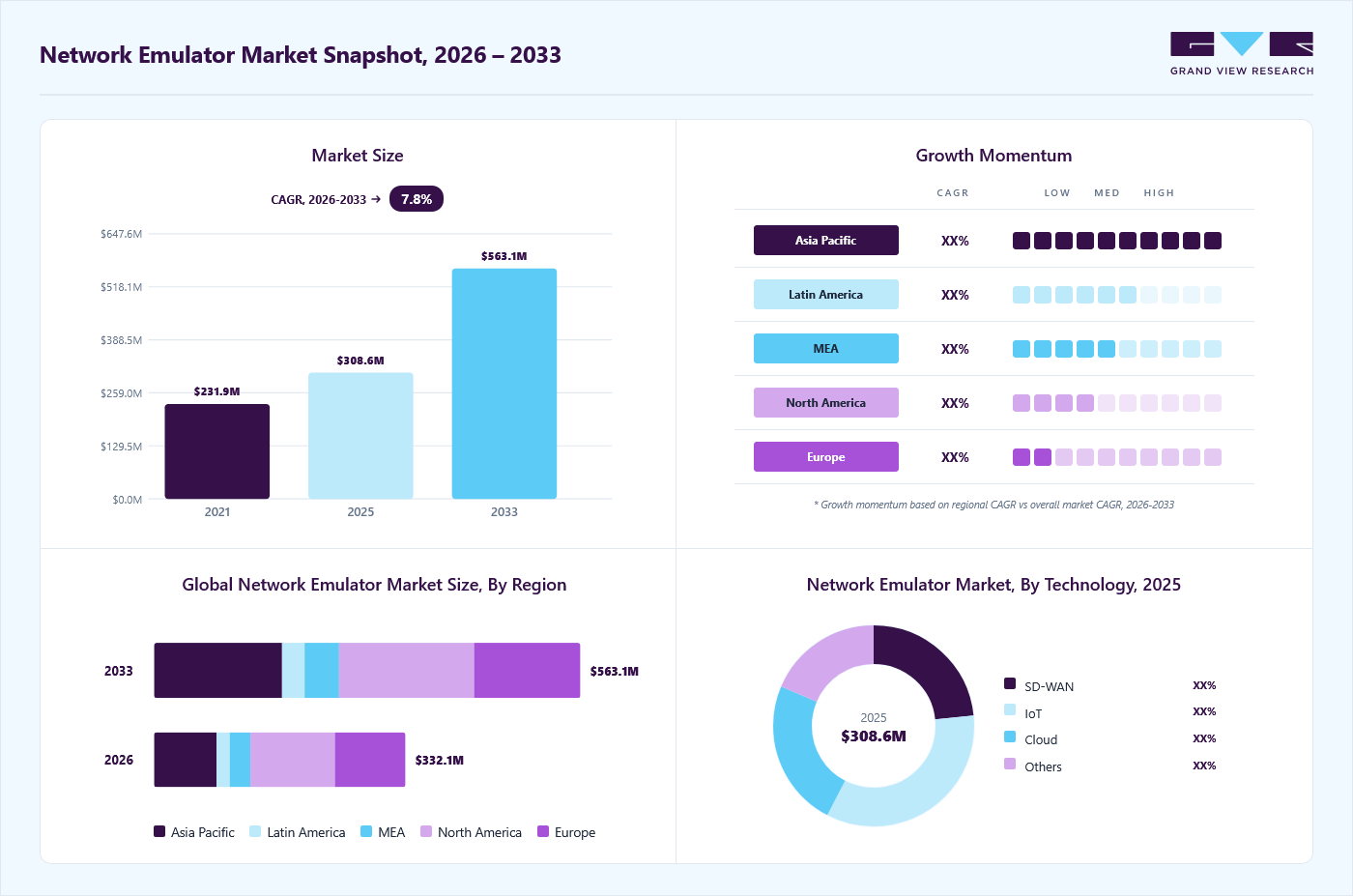
The global network emulator market size was valued at USD 308.6 million in 2025 and is projected to grow from USD 332.1 million in 2026 to USD 563.1 million by 2033, at a CAGR of 7.8% from 2026 to 2033. North America dominated the global market with the largest revenue share of 33.9% in 2025. Furthermore, as organizations migrate their workloads to the cloud, they face the challenge of ensuring their applications perform optimally under varying network conditions.
Key Market Trends & Insights
- By offering: Software segment held the largest revenue share of 54.4% in 2025.
- By technology: IoT segment held the largest market share of 34.2% in 2025.
- By test type: Application testing segment held a significant market share in 2025.
- By application: Telecommunication segment accounted for the largest revenue share in 2025.
Regional Highlights
- Largest regional market: North America (33.9% revenue share, 2025)
- Fastest growing regional market: Asia Pacific (highest CAGR, 2026-2033)
- By country: The U.S. held the largest market share in 2025.
Market Size & Forecast
- Market size in 2025: USD 308.6 Million
- Estimated market size in 2026: USD 332.1 Million
- Projected market size by 2033: USD 563.1 Million
- CAGR (2026-2033): 7.8%
Network emulators enable them to simulate real-world network scenarios, including bandwidth constraints and latency, helping organizations identify and address potential performance issues before deploying their applications in cloud environments. This proactive testing approach is crucial in ensuring a seamless transition to the cloud, driving the demand for network emulation solutions.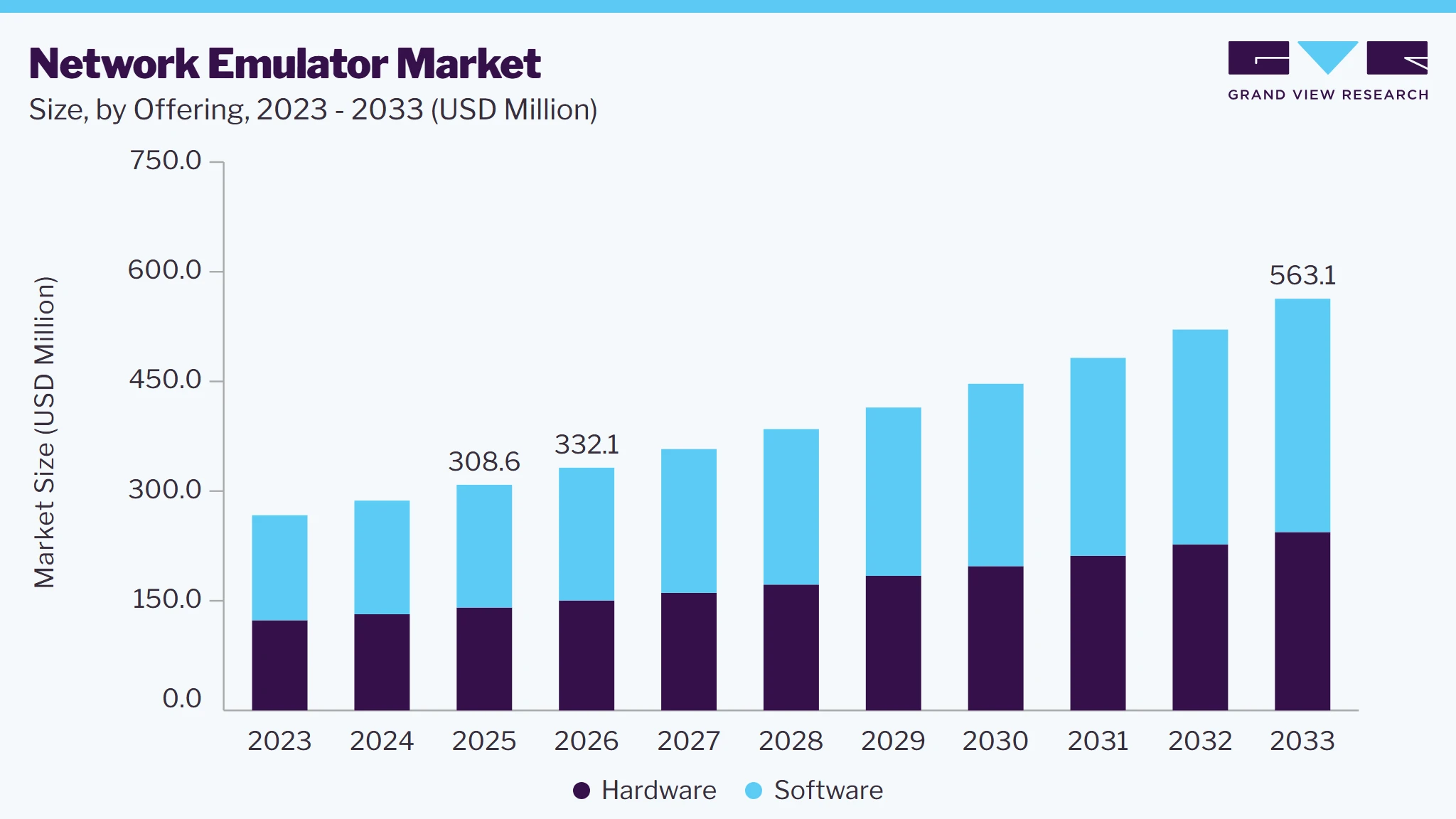
The proliferation of Internet of Things (IoT) devices and the deployment of 5G networks are further fueling the growth of the network emulator market. For instance, as IoT devices become increasingly integrated across industries such as healthcare, manufacturing, and smart cities, the need to test and validate their performance under diverse network conditions becomes crucial. In addition, network emulators allow organizations to assess how these devices will behave on real networks, helping them optimize their IoT solutions and ensure reliable connectivity. Moreover, the rollout of 5G networks introduces new complexities, including ultra-low latency and high bandwidth requirements. Thereby, network emulators play a vital role in testing and fine-tuning applications and services to meet the demands of 5G networks.
The rising importance of cybersecurity testing and training is another major driver fueling the growth of the network emulator industry. With the increasing frequency and sophistication of cyberattacks, organizations are required to evaluate the resilience of their networks and security infrastructure. Network emulators enable organizations to replicate various cyber threat scenarios and test their network defenses, helping them identify vulnerabilities and improve their cybersecurity posture. Furthermore, these emulators are used for training security professionals, allowing them to simulate realistic attack scenarios and practice incident response procedures in a controlled environment. As cybersecurity remains a top priority for organizations across industries, the demand for network emulation solutions continues to grow.
Another key factor driving the market growth is the increasing reliance on remote work and virtual collaboration tools. With the global shift towards hybrid work models, organizations are investing heavily in solutions that ensure robust and reliable network performance. Network emulators are instrumental in testing and optimizing virtual private networks (VPNs) and other remote access technologies, enabling businesses to maintain high productivity and seamless communication among distributed teams. As remote work becomes a permanent fixture in the corporate landscape, the demand for advanced network emulation solutions is expected to rise significantly.
However, despite the promising growth prospects, the market faces challenges such as the high cost of deployment and the complexity of integrating these solutions into existing IT infrastructure. Smaller enterprises, in particular, may find it difficult to allocate the necessary resources for comprehensive network testing. However, this restraint can be mitigated by adopting scalable, cloud-based network emulation solutions that offer flexible pricing models and easier integration. By lowering the barriers to entry, vendors can expand their customer base and support the long-term market growth.
Market Dynamics
The network emulator market is driven by the rapid expansion of 5G networks, increasing adoption of cloud-native architectures, and growing demand for reliable network performance testing across telecom, enterprise, and data center environments. The rising deployment of IoT devices, edge computing infrastructure, and software-defined networking (SDN) is increasing the need for advanced network emulation tools that can simulate real-world network conditions, including latency, packet loss, and bandwidth constraints, before deployment. The market is also benefiting from accelerated digital transformation initiatives, increased investments in hyperscale data centers, and the growing complexity of multi-cloud and hybrid network environments, which require robust validation and performance-optimization solutions.
The growing deployment of software-defined wide area networking (SD-WAN), network function virtualization (NFV), and software-defined networking (SDN) solutions is a major driver accelerating the growth of the network emulator market. Enterprises and telecom operators are increasingly modernizing network infrastructure to support dynamic traffic management, multi-cloud connectivity, and application-aware routing. For instance, according to the National Institute of Standards and Technology (NIST), enterprise network environments have changed significantly because of access to multiple cloud services, geographically distributed IT resources, and microservices-based applications, while ETSI describes transport SDN as being applied to WAN infrastructure to handle bandwidth demand and real-time capacity and QoS changes. In this environment, network emulators are becoming essential for validating the performance, scalability, and interoperability of virtualized network architectures before large-scale deployment.
Organizations are utilizing network emulation platforms to replicate complex enterprise and carrier-grade network environments, enabling accurate assessment of packet loss, jitter, congestion handling, and routing behavior. The increasing focus on reducing network downtime and improving user experience across distributed digital ecosystems is further strengthening the demand for advanced network emulation solutions.
A major restraint affecting the growth of the network emulator market is the shortage of skilled professionals capable of designing, configuring, and interpreting complex network simulation environments. Advanced network emulation requires expertise in networking protocols, traffic engineering, automation frameworks, and performance analytics. Many organizations, particularly small and medium-sized enterprises, face challenges in operating advanced emulation platforms due to limited technical capabilities and training resources. In addition, the growing complexity of hybrid and multi-vendor network infrastructures increases the difficulty of accurately configuring realistic testing scenarios. These operational challenges lead to longer deployment cycles and reduced adoption rates, especially among organizations with constrained IT resources.
The increasing development of autonomous vehicles, connected transportation systems, and intelligent mobility infrastructure is creating significant growth opportunities for the network emulator market. Automotive manufacturers and mobility technology providers are increasingly relying on network emulation solutions to test vehicle-to-vehicle (V2V), vehicle-to-infrastructure (V2I), and edge communication systems under varying network conditions. As connected vehicles require highly reliable, low-latency communication for navigation, safety systems, and real-time data exchange, network emulators play a critical role in validating communication stability and performance before commercial deployment. Furthermore, the expansion of smart transportation ecosystems and edge-based automotive applications is expected to increase demand for high-precision network testing environments, creating new revenue opportunities for network emulator vendors.
Market Concentration & Characteristics
The network emulator market is moderately fragmented, with the presence of global network testing solution providers, telecom equipment vendors, cybersecurity firms, and specialized network performance testing companies competing across enterprise, telecom, cloud, and defense sectors. Major players maintain strong market positions through advanced network simulation platforms, strategic technology partnerships, and comprehensive testing capabilities. The market is also witnessing increasing participation from emerging vendors specializing in AI-driven network analytics, virtualized testing environments, and cloud-based network emulation solutions.
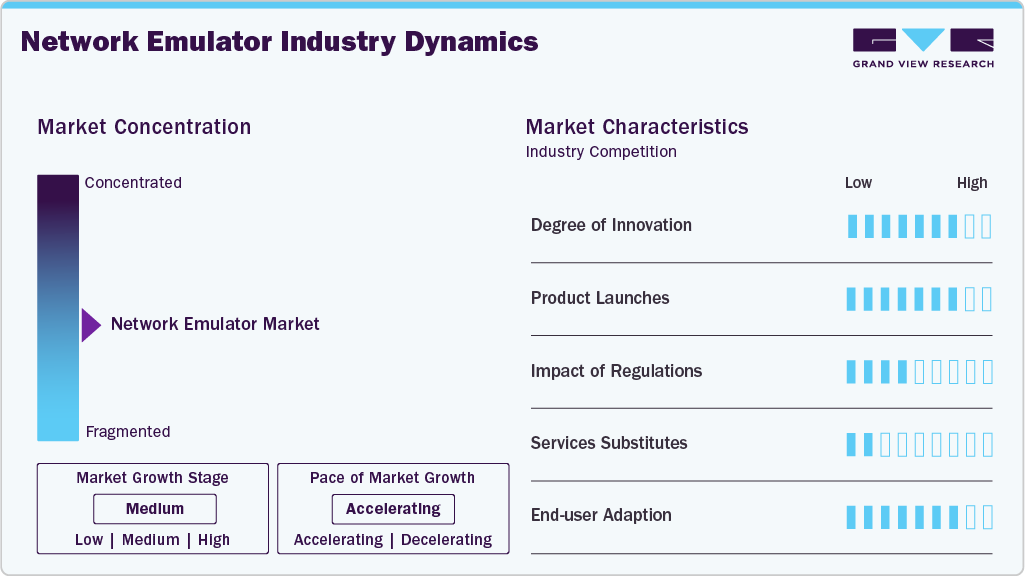
The network emulator industry is characterized by rapid technological advancements, growing adoption of cloud-native and virtualized network testing environments, and increasing demand for high-performance network validation solutions. Companies are focusing on enhancing real-time traffic simulation, protocol testing, scalability, and automation capabilities to support complex networking environments and next-generation communication technologies. Strategic investments in 5G testing, cybersecurity validation, edge computing infrastructure, and AI-powered network optimization tools are further shaping the competitive landscape across the industry.
Analyst Perspective
The network emulator market is positioned for sustained growth as organizations increasingly prioritize network reliability, performance optimization, and seamless connectivity across complex digital environments. The market is transitioning from traditional hardware-centric testing toward software-defined, cloud-native, and virtualized emulation solutions as enterprises accelerate adoption of multi-cloud architectures, SD-WAN, IoT ecosystems, and edge computing. Telecom operators remain the primary growth engine due to ongoing 5G deployment and early-stage 6G research activities, while enterprise demand is expanding rapidly as application performance and user experience become critical competitive differentiators.
Offering Insights
The software segment led the network emulator market, accounting for 54.4% of the global revenue share in 2025, and is expected to retain its dominance over the forecast period. Software-based network emulators are computer programs or applications meticulously designed to replicate real-world network conditions and behaviors within a controlled virtual environment. Their primary function is to allow users to imitate a range of network parameters, including bandwidth limitations, latency, and packet loss. Software-based network emulators serve as indispensable tools for validation, quality assurance, and development processes, enabling the early identification of issues and the optimization of performance.
The hardware segment is expected to register a significant CAGR from 2026 to 2033. The segment’s growth is driven by the increasing demand for high-performance, real-time network testing solutions. Hardware-based network emulators offer superior precision and reliability, essential for applications requiring rigorous testing under specific network conditions. The growing complexity of modern networks and the need for comprehensive performance evaluation in sectors such as telecommunications and defense further fuel the expansion of this segment.
Technology Insights
The IoT segment accounted for the largest revenue share of the network emulator industry in 2025. The segment’s growth is driven by the growing integration of IoT devices across industries such as healthcare, manufacturing, and smart cities. The increasing need to test and validate the performance of IoT solutions under diverse network conditions propels the demand for network emulators. These emulators enable organizations to optimize IoT connectivity, ensuring reliability and robust performance, thereby contributing significantly to the segment’s growth.
The SD-WAN segment is expected to grow at a significant CAGR of 6.9% from 2026 to 2033. This growth can be attributed to the widespread adoption of SD-WANs worldwide. The surge in SD-WAN adoption is driven by the remarkable capabilities of SD-WAN technology, including enhanced network flexibility, optimized performance, and reduced operational costs. As businesses increasingly pivot toward cloud-based applications and services, SD-WANs have emerged as a highly efficient solution for managing intricate and multifaceted networks, driving the segment’s growth.
Test Insights
The application testing segment accounted for a significant revenue share 34.2% in 2025. The application testing segment's growth is driven by the increasing complexity of modern applications and the need to ensure their seamless performance under varied network conditions. Market consumers are adopting application testing to identify and address potential issues early in the development cycle, enhancing user experience and reducing post-deployment failures. This proactive approach to quality assurance is crucial for maintaining a competitive advantage in the fast-paced technology landscape.
The performance testing segment is expected to register significant growth from 2026 to 2033. The performance testing segment is expanding due to the rising demand for high-quality network performance in critical applications such as online gaming, streaming, and enterprise communications. Consumers are adopting performance testing to ensure their networks can handle peak loads and provide consistent, reliable service. This focus on optimizing network performance helps organizations meet user expectations and maintain operational efficiency, driving the segment's growth.
Application Insights
The telecommunication segment accounted for the largest revenue share of the network emulator market in 2025. The constant technological advancements and innovations in the IT & telecommunications industry drive the demand for network emulators. These tools are essential for testing and validating complex network environments characterized by intricate devices, protocols, and services. The industry's introduction of new technologies such as 5G, IoT, and cloud-based solutions further amplifies the demand for emulators to assess performance and security. Moreover, the critical focus on network security, regulatory compliance, and cost savings in this sector solidifies the central role of network emulators in maintaining network integrity and driving their prominence in the market.
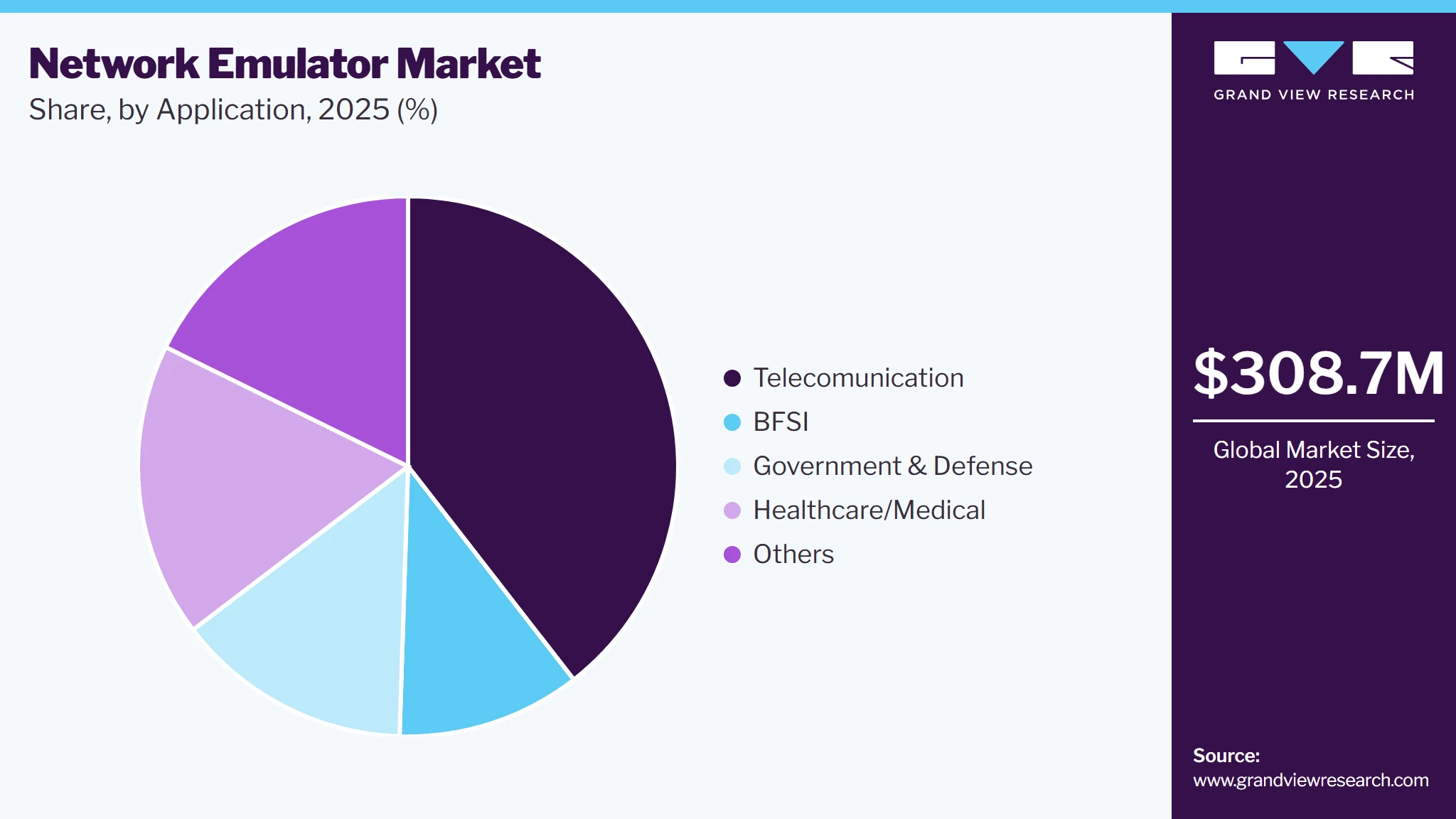
The government & defense segment is expected to grow at the fastest CAGR of 8.9% from 2026 to 2033. The segment’s growth is driven by the increasing need for robust and secure network infrastructure to support critical operations. The adoption of network emulators in this segment is fueled by the necessity to simulate and test network conditions for mission-critical applications, ensuring resilience against cyber threats and optimizing communication systems. This focus on security and reliability underpins the segment's expansion.
Regional Insights
The North American network emulator market dominated the global market with the market share of 33.9% in 2025. The North American region, encompassing technologically advanced countries with strong infrastructures, serves as a major driver for the demand for network emulator solutions. The region's market dominance is a direct result of its well-established industries, which are capable of making substantial investments in advanced IT infrastructures, creating fertile ground for the adoption of network emulators. Moreover, the region's technological advancements, including the deployment of 5G networks, encourage telecom providers to incorporate network emulators across various network layers.

U.S. Network Emulator Market Trends
The U.S. network emulator industry is thriving amid the rapid rollout of 5G networks and the growing focus on cybersecurity. The need to ensure seamless connectivity and robust network security across critical sectors like healthcare, finance, and defense drives the demand for network emulation. Moreover, the presence of a large number of tech startups and established firms emphasizes advanced network testing capabilities, fostering market growth.
Europe Network Emulator Market Trends
Europe's network emulator industry is experiencing growth driven by the region's commitment to digital transformation and the enhancement of telecommunication infrastructure. The EU's stringent regulatory frameworks for network reliability and data protection necessitate advanced testing solutions. Additionally, initiatives such as Industry 4.0 and the development of cross-border digital services create a substantial need for network emulation to ensure seamless and secure operations.
The UK network emulator market is witnessing strong growth driven by the country’s accelerating 5G infrastructure modernization, rising investment in Open RAN architectures, and increasing focus on secure next-generation telecom ecosystems. Telecom operators, cloud service providers, and defense agencies are increasingly deploying advanced network emulation platforms to validate latency-sensitive applications, virtualized network functions, and cybersecurity resilience before live deployment. The emergence of AI-enabled telecom testing and cloud-native network environments is further increasing the demand for scalable emulation solutions across the enterprise and telecom sectors.
The network emulator market in Germany is expanding steadily due to the country’s strong focus on Industry 4.0, industrial automation, and smart manufacturing initiatives. Manufacturing enterprises are increasingly using network emulators to test industrial IoT connectivity, real-time communication systems, and edge computing infrastructure in digitally connected factories. The growing deployment of private 5G networks across the automotive, manufacturing, and logistics sectors is driving significant demand for network performance validation and protocol testing solutions.
Asia Pacific Network Emulator Market Trends
The Asia Pacific network emulator industry is expected to grow at the fastest CAGR of 10.7% during the forecast period, due to significant investments in digital infrastructure and the extensive rollout of 5G technology. Countries such as China, Japan, and South Korea lead in adopting smart technologies and IoT applications, driving the need for comprehensive network testing. Furthermore, the region's diverse and rapidly growing internet user base demands robust network performance, thereby increasing the demand for network emulators.
China’s network emulator market is experiencing rapid expansion fueled by aggressive 6G research initiatives, large-scale telecom infrastructure investments, and the country’s leadership in next-generation network innovation. Research institutions, telecom equipment manufacturers, and hyperscale cloud providers are increasingly deploying advanced network emulation platforms to test ultra-high-speed communication systems, AI-native network slicing, and digital twin-enabled wireless networks. The country’s ongoing development of pre-6G testing environments and experimental nationwide research networks is significantly accelerating the need for high-capacity network simulation and validation technologies.
The network emulator market in India is emerging as a high-growth region, due to rapid telecom expansion, widespread 5G rollout, and increasing investments in AI-ready data centers and cloud infrastructure. Telecom operators, enterprises, and government-backed research institutions are increasingly adopting network emulation platforms to test 5G core networks, cloud applications, and low-latency digital services. The rapid growth of cloud gaming, OTT streaming, and digital financial services is also increasing the need for real-world network condition testing to ensure seamless user experiences across diverse connectivity environments.
Key Network Emulator Company Insights
Key players operating in the network emulator market include Keysight Technologies; Spirent Communications; VIAVI Solutions Inc.; Apposite Technologies; Calnex Solutions; Polaris Networks; PacketStorm Communications, Inc.; Aukua Systems Inc.; InterWorking Labs, Inc.; and GigaNet Systems. The key market players are focusing on various strategic initiatives, including new product development, mergers & acquisitions, partnerships & collaborations, and agreements, to gain a competitive advantage.
-
Spirent Communications develops network testing, assurance, and automation solutions used for validating the performance, security, and reliability of communication networks. The company is widely recognized for its expertise in 5G, cloud, edge computing, and cybersecurity testing technologies.
-
VIAVI Solutions Inc. provides network testing, monitoring, and assurance solutions for telecom operators, data centers, enterprises, and government organizations. Its portfolio includes network emulators, fiber testing systems, and service assurance platforms supporting 5G and next-generation network deployments.
-
Apposite Technologies specializes in WAN and application performance testing solutions designed to emulate real-world network conditions. The company’s products are widely used by enterprises, government agencies, and technology vendors to evaluate application performance across complex network environments.
Key Network Emulator Companies
The following key companies have been profiled for this study on the network emulator market.
-
Keysight Technologies
-
Spirent Communications
-
VIAVI Solutions Inc.
-
Apposite Technologies
-
Calnex Solutions
-
Polaris Networks
-
PacketStorm Communications, Inc.
-
Aukua Systems Inc.
-
InterWorking Labs, Inc.
-
GigaNet Systems
Competitive Benchmarking
Operating Strategies
Competitive Edge
Weaknesses
Mature Players: Keysight Technologies; Spirent Communications; VIAVI Solutions Inc.; Calnex Solutions
- Focus on expanding advanced network emulation portfolios supporting 5G, cloud-native networking, SD-WAN, and cybersecurity testing.
- Invest in AI-driven testing automation, strategic telecom partnerships, and next-generation network validation solutions.
- Strong global presence with extensive telecom, enterprise, and government customer bases.
- Broad technological expertise across network emulation, protocol testing, synchronization, and performance analytics solutions.
- High R&D and deployment costs associated with advanced testing infrastructure.
- Complex integration requirements with legacy telecom and enterprise network environments.
Emerging Players: Apposite Technologies; Polaris Networks; PacketStorm Communications, Inc.; Aukua Systems Inc.; InterWorking Labs, Inc.; GigaNet Systems
- Focus on specialized network emulation, traffic generation, and protocol validation technologies for enterprise and telecom applications.
- Expand through flexible testing platforms, cloud-based network validation tools, and niche technology partnerships.
- Strong specialization in WAN emulation, Ethernet testing, protocol simulation, and network impairment analysis.
- Agile product development and customizable testing solutions for specific customer requirements.
- Limited global market penetration and smaller customer networks compared to established industry leaders.
- Intense competition from larger integrated telecom testing and network assurance providers.
Recent Developments
-
In October 2025, Keysight Technologies completed the acquisition of Spirent Communications to strengthen its network emulation, wireless testing, and automated assurance capabilities across 5G, cloud, satellite, and AI-driven networking environments.
-
In October 2025, VIAVI Solutions Inc. acquired Spirent’s high-speed Ethernet, network security, and channel emulation testing business to expand its advanced network validation and AI-ready infrastructure testing portfolio.
Network Emulator Market Report Scope
Report Attribute
Details
Market size value in 2025
USD 308.6 million
Estimated Market size in 2026
USD 332.1 million
Projected Market size by 2033
USD 563.1 million
Growth rate
CAGR of 7.8% from 2026 to 2033
Base year for estimation
2025
Actual data
2021 - 2024
Forecast period
2026 - 2033
Quantitative units
Revenue in USD million and CAGR from 2026 to 2033
Report coverage
Revenue forecast, company market share, competitive landscape, growth factors, and trends
Segments covered
Offering, technology, test, application, region
Regional scope
North America; Europe; Asia Pacific; Latin America; MEA
Country scope
U.S.; Canada; Mexico; Germany; UK; France; China; India; Japan; South Korea; Australia; Brazil; Kingdom of Saudi Arabia (KSA); UAE; South Africa
Key companies profiled
Keysight Technologies; Spirent Communications; VIAVI Solutions Inc.; Apposite Technologies; Calnex Solutions; Polaris Networks; PacketStorm Communications, Inc.; Aukua Systems Inc.; InterWorking Labs, Inc.; GigaNet Systems
Customization scope
Free report customization (equivalent to up to 8 analysts working days) with purchase. Addition or alteration to country, regional & segment scope
Pricing and purchase options
Avail customized purchase options to meet your exact research needs. Explore purchase options
Global Network Emulator Market Report Segmentation
The report forecasts revenue growth at the global, regional, and country levels and provides an analysis of the latest industry trends in each of the sub-segments from 2021 to 2033. For this study, Grand View Research has segmented the network emulator market report based on offering, technology, test type, application, and region:
-
Offering Outlook (Revenue, USD Million, 2021 - 2033)
-
Hardware
-
Software
-
-
Technology Outlook (Revenue, USD Million, 2021 - 2033)
-
SD-WAN
-
IoT
-
Cloud
-
Others
-
-
Test Outlook (Revenue, USD Million, 2021 - 2033)
-
Performance Testing
-
Application Testing
-
Others
-
-
Application Outlook (Revenue, USD Million, 2021 - 2033)
-
Telecommunication
-
BFSI
-
Government & Defense
-
Healthcare/Medical
-
Others
-
-
Regional Outlook (Revenue, USD Million, 2021 - 2033)
-
North America
-
U.S.
-
Canada
-
Mexico
-
-
Europe
-
Germany
-
UK
-
France
-
-
Asia Pacific
-
China
-
India
-
Japan
-
South Korea
-
Australia
-
-
Latin America
-
Brazil
-
-
Middle East & Africa (MEA)
-
UAE
-
Kingdom of Saudi Arabia (KSA)
-
South Africa
-
-
Research Methodology
(a) Segment Definition
Segment - Offering
Revenue capture definition
Hardware
Revenue captured under the hardware segment in the Network Emulator Market includes revenue generated from the sale of physical network emulation appliances, dedicated testing devices, rack-mounted systems, portable testing equipment, interface modules, traffic generation hardware, and specialized equipment used to simulate network conditions and validate network performance.
Software
Revenue captured under the software segment includes earnings from network emulation software platforms, virtualized network emulators, cloud-based network testing solutions, simulation engines, subscription-based platforms, and software suites used for network performance testing and validation.
Segment - Technology
Revenue capture definition
SD-WAN
The SD-WAN (Software-Defined Wide Area Network) segment in the Network Emulator Market refers to network emulation solutions used to test, validate, and optimize software-defined networking environments that intelligently route traffic across multiple WAN connections.
IoT
The IoT (Internet of Things) segment includes network emulation technologies used to simulate large-scale connected device ecosystems and test communication performance across IoT networks.
Cloud
The cloud segment refers to network emulation solutions deployed to test and validate cloud-native, hybrid cloud, and multi-cloud networking environments.
Others
The others segment includes telecom core networks, 5G/6G testing environments, cybersecurity validation, edge computing, enterprise networking, and others.
Segment - Test
Revenue capture definition
Performance Testing
The performance testing segment in the network emulator market refers to the use of network emulation solutions to assess and validate network behavior, throughput, latency, bandwidth utilization, packet loss, jitter, and overall system performance under various real-world conditions.
Application Testing
The application testing segment includes network emulation solutions used to evaluate the performance, responsiveness, and reliability of applications operating across different network environments.
Others
This segment includes security testing, protocol testing, interoperability testing, device validation, network resilience testing, and others.
Segment - Application
Revenue capture definition
Telecommunication
The telecommunication segment in the network emulator market refers to the use of network emulation solutions by telecom operators, network equipment vendors, and service providers to test, validate, and optimize communication networks and services.
BFSI
The BFSI segment includes the use of network emulators to validate the performance, reliability, and security of financial applications and digital banking infrastructure operating across distributed networks.
Government & Defense
The government & defense segment covers the use of network emulation technologies for testing secure communications, mission-critical networks, cybersecurity infrastructure, and defense communication systems.
Healthcare/Medical
The healthcare/medical segment refers to the application of network emulators in validating healthcare IT infrastructure, telemedicine platforms, connected medical devices, hospital networks, and digital health applications.
Others
This segment includesend-use applications such as manufacturing, retail, transportation and logistics, education, media and entertainment, automotive, energy and utilities, and enterprise IT environments.
(b) Estimation Model
Layer No.
Layer Name
Key Question
Description
01
Network Infrastructure Demand Layer
What forms the demand base?
Identify global demand drivers for network emulation solutions across major end-use industries including telecommunications, cloud service providers, enterprises, government & defense, healthcare, automotive, manufacturing, and data centers. This layer establishes the total addressable demand created by increasing network complexity, 5G deployment, cloud adoption, IoT expansion, and digital transformation initiatives.
02
Technology & Deployment Penetration Layer
Where are network emulators utilized?
Estimate adoption across deployment environments including on-premise, cloud, virtualized environments, and hybrid infrastructures. Assess penetration across technologies such as SD-WAN, cloud networking, IoT ecosystems, enterprise networking, telecom infrastructure, and emerging next-generation communication networks.
03
Network Testing & Validation Intensity Layer
How extensively are network emulators used?
Analyze network testing volumes, simulation frequency, infrastructure complexity, traffic validation requirements, application testing intensity, and performance benchmarking needs across industries. Utilization intensity is influenced by network scale, latency requirements, cybersecurity validation, protocol complexity, and increasing reliance on distributed infrastructure environments.
04
Revenue Generation Layer
How is market revenue generated?
Market revenue is quantified through sales of network emulator hardware appliances, software licenses, cloud-based emulation platforms, subscription services, maintenance contracts, analytics tools, and professional services. Revenue generation is supported by recurring demand from telecom operators, cloud providers, enterprises, network equipment manufacturers, government agencies, and research organizations requiring continuous network validation and optimization.
Delivered Customizations
This report has been delivered with the following In-depth customizations
Client Request
Customization Delivered
Value Adds
Network Performance Testing & Validation Assessment
Evaluation of advanced network emulation platforms for latency, packet loss, and bandwidth simulation
Analysis of cloud-native and virtualized network testing capabilities
Assessment of real-time traffic simulation and protocol validation tools
Identified opportunities to improve network reliability and testing efficiency
Supported deployment strategy for next-generation network infrastructure
Telecom & 5G Network Emulation Analysis
Analysis of 5G, SD-WAN, and NFV testing requirements across telecom environments
Benchmarking of network impairment and scalability testing solutions
Evaluation of automated network validation and monitoring platforms
Supported investment planning for advanced telecom testing infrastructure
Identified high-growth opportunities in 5G and virtualized network ecosystems
Cloud & Enterprise Network Optimization Strategy
Assessment of hybrid cloud and enterprise network emulation solutions
Analysis of application performance testing and cybersecurity validation capabilities
Benchmarking of AI-enabled network monitoring and predictive analytics tools
Enabled optimization of enterprise network performance and security testing
Supported adoption of intelligent network management and automation solutions
Frequently Asked Questions About This Report
North America dominant with a 33.91% market share in 2025.
Some key players operating in the network emulator market include Keysight Technologies, Spirent Communications, VIAVI Solutions Inc., Apposite Technologies, Calnex Solutions, Polaris Networks, PacketStorm Communications, Inc., Aukua Systems Inc., InterWorking Labs, Inc., GigaNet Systems
The market growth can be attributed to several driving factors, including the rapid adoption of cloud computing and the migration of critical applications and services to cloud environments.
Asia Pacific is the fastest growing region over the forecast period.
The software segment lead with the 54.44% revenue share in 2025, while hardware segment is expected to grow at a significant CAGR over the forecast period.
The IoT segment held the largest revenue share in 2025, while cloud is the fastest growing area.
The telecommunication segment held the largest revenue share (39.0)% revenue share in 2025, while government & defense segment is expected to grow at fastest CAGR over the forecast period.
The global network emulator market size was estimated at USD 308.6 million in 2025 and is expected to reach USD 332.1 million in 2026.
The global network emulator market is expected to grow at a compound annual growth rate of 7.8% from 2026 to 2033 to reach USD 563.1 million by 2033.
About the Author(s)
Communications Infrastructure Research Team
Technology · Communications InfrastructureThis report was authored by the communications infrastructure research team at Grand View Research - comprising two research analysts, one senior research analyst, and one industry expert - with specialized expertise in the communications infrastructure segment of the technology industry. All findings are based on proprietary technology databases, executive interviews, and regulatory analysis, subject to internal peer review prior to publication.
Last Updated:
Speak to Analyst


Customize this report to your needs — add regions, segments, or data points, with 20% free customization.
Or view our licence options:


ISO 9001:2015 & 27001:2022 Certified
We are GDPR and CCPA compliant! Your transaction & personal information is safe and secure. For more details, please read our privacy policy.


