
- Home
- »
- Next Generation Technologies
- »
-
Network Management System Market Size Report, 2033GVR Report cover

Network Management System Market (2026 - 2033)
Size, Share & Trends Analysis Report By Component (Solutions, Services), By Deployment (On-premise, Cloud-based), By Enterprise, By Vertical (IT & Telecom, BFSI), By Region, And Segment Forecasts
Market Size, 2025
$10.9BMarket Estimate, 2026
$12.1BMarket Forecast, 2033
$23.6BCAGR, 2026–2033
10.1%Network Management System Market Summary
The global network management system market was valued at USD 10.9 billion in 2025 and is projected to grow from USD 12.1 billion in 2026 to USD 23.6 billion in 2033, at a CAGR of 10.1% from 2026 to 2033. North America dominated the network management systems market in 2025, accounting for more than 33.0% of revenue. Network management systems (NMS) provide several benefits to companies and their users, including network visibility, downtime detection, performance optimization, and fault detection, among others
Key Market Trends & Insights
- By component: The solutions segment dominated the market in 2025 and accounted for a revenue share of more than 68.0%.
- By deployment: The on premise deployment segment dominated the market in 2025 and accounted for a revenue share of more than 66.0%.
- By enterprise: The large enterprises segment dominated the market in 2025 and accounted for a revenue share of more than 61.0%.
Regional Highlights
- Largest regional market: North America (over 33.0% revenue share, 2025)
- Fastest-growing regional market: Asia Pacific (highest CAGR, 2026-2033)
Market Size & Forecast
- Market size in 2025: USD 10.9 Billion
- Estimated market size in 2026: USD 12.1Billion
- Projected market size by 2033: USD 26.3 Billion
- CAGR (2026-2033): 10.1%
Three ways to get this report
Buy it, customize it, or ask a question.Ask an Analyst
A direct answer, usually in 1 working day
- AccessReport author, directly
- Reply timeWithin 1 working day
- No sales callDirect answer only
- FormatEmail reply
- CostFree, no cost
Get the Full Report
What the study covers
- FormatsPDF · Excel · Dashboard
- Timeline2026–2033 annual, 2025 base
- Coverage20+ countries, 5 regions
- Companies10+ key players profiled
Customize the Report
20% free customization
- IncludeCountries, segments, points
- TailorTo your product definition
- ExtendDeeper competitor detail
- OrA fully bespoke study
- Turnaround5–10 working days
The growing investments made in IT network infrastructure, continuous 5G rollouts, and growing use of networks for the organization’s internal and external operations are expected to drive the market’s growth over the forecast period. Network management is a process of managing and administering computer networks within an enterprise. Some of the key functions provided by network management systems include performance management, fault management, security management, and account management. The key role of network management systems is to ensure the smooth functioning of the network and to ensure that users have access to network resources efficiently, effectively, and quickly. It leverages various component solutions to optimize the network’s health. The growing use of network management systems for network optimization is driving the market’s growth.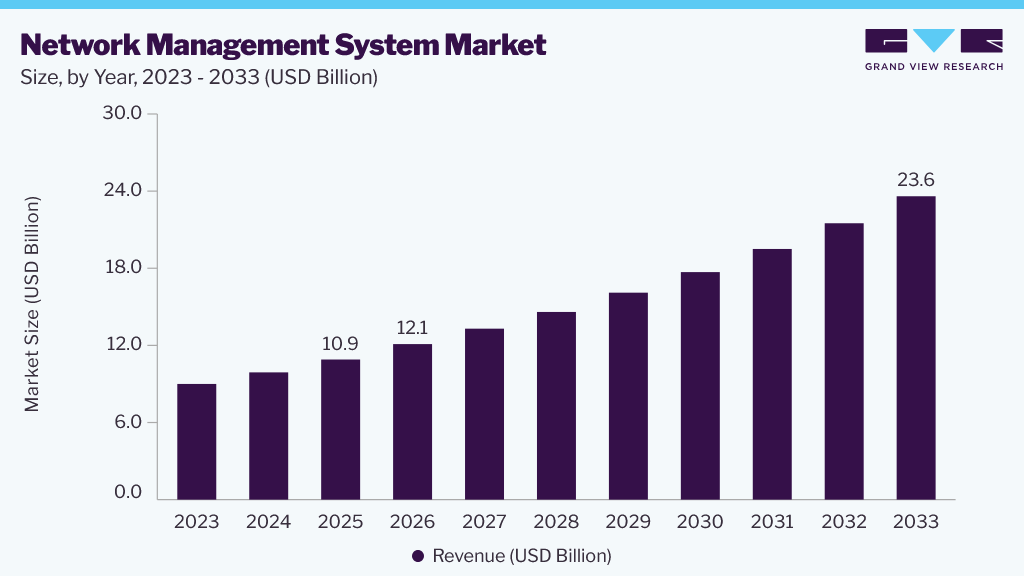 Source: Grand View Research, IR Documents, Primary Interviews, Paid DatabasesTo learn more about this report,
 Download Free Sample Report
 Network management systems are cost-effective as they automate the process and reduce overhead IT costs. IT staff can be freed up to do other tasks, which can significantly increase the efficiency of an enterprise. Moreover, since NMS automates the process, enterprises can save time and additional costs, which leads to more productivity in an enterprise. Additionally, the network management systems reduce downtime and improve flexibility. These are some of the prominent benefits provided by NMS, which are contributing to the growing demand in the market.
The overall IT infrastructure sector is witnessing a huge investment inflow, which is contributing to innovations in the network management systems market. Software-Defined Networking (SDN) is one of such innovative emerging technologies in NMS, which is getting popular among enterprises all over the globe. SDN uses software-based controllers to communicate with underlying hardware infrastructure and direct the traffic on the network. Spiraling demand for SDN monitoring tools can be attributed to their ability to prevent unplanned failures and provide fault detection and correction management capabilities in real-time. Such innovations are expected to drive the market’s growth over the forecast period.
A survey conducted by the Oracle Corporation in 2022 suggests that, out of the total number of respondents, 76% said network complexities were one of the management’s biggest challenges. Companies are adopting network management systems to overcome these challenges. However, there are some restraints related to the deployment and maintenance of network management software. NMS are complex to deploy and learning how to operate the software can take time. Additionally, the initial costs of deployment of network management software are high. However, enterprises are looking at it as an initial investment, as it yields high benefits in the future.
Market Dynamics
The growing investments made in network infrastructure developments and enhancements, continuous 5G rollouts, and growing use of networks for the internal and external operations by various industries primarily contribute to the growth experienced by this market. Network management is a process of managing and administering computer networks within an enterprise. Some of the key functions provided by network management systems include performance management, fault management, security management, and account management. The key role of network management systems is to ensure the smooth functioning of the network and to ensure that users have access to network resources efficiently, effectively, and quickly. It leverages various component solutions to optimize the network’s health. The growing use of network management systems for network optimization is driving the market’s growth.
The overall IT infrastructure sector is witnessing significant investment inflows, which are driving innovation in the network management systems market. Software-Defined Networking (SDN) is one of such innovative emerging technologies in NMS, which is getting popular among enterprises all over the globe. SDN uses software-based controllers to communicate with the underlying hardware infrastructure and direct the traffic on the network. Spiraling demand for SDN monitoring tools careal-time fault detection and correction. Such innovations are expected to drive the market’s growth over the forecast period.
Deployment of sophisticated technology-powered network monitoring, automation, and analytics involves heavy investments and high initial costs. Multiple factors are involved in this, such as hardware, software licensing, and ongoing maintenance, which add up to high costs. Such initial investments may act as restraints for several small and medium-scale companies. Network management systems comprise software, hardware, and protocols utilized to monitor and maintain a secure network. High costs associated with FCAPS Framework, SNMP (Simple Network Management Protocol), routers and switches, firewalls, servers, and others may impose challenges.
With rising cyber threats and complex network environments, demand for NMS solutions is likely to grow at a rapid pace. NMS solutions featuring advanced technologies that combine real-time traffic analysis, threat alerts, and anomaly detection are anticipated to dominate the competitive scenario in this market over the forecast period. Growing transitions to cloud deployments from on-premises, the increasing inclusion of automation and AI-powered tools, and the underserved SME market are expected to present lucrative growth opportunities for this market.
Analyst Perspective
Growing dependability on complex networks, computing, hybrid cloud architectures, rapid deployment of connected internet-of-things devices, has developed unprecedented need for efficient NMS solutions. In additions, issues such as vendor lock-in and platform fatigue have also been adding to growing demand for Standardized Application Programming Interfaces (APIs), enabling seamless communication. The hyper-distribution of modern corporate infrastructure is primary growth factor for advanced network management systems (NMSs).
COVID-19 Impact Analysis
The outbreak of the COVID-19 pandemic is expected to play a vital role in driving the network management systems market’s growth. The COVID-19 pandemic led to fundamental changes in business models and pushed them to adopt more digitized models, which was long overdue. The digital transformation led by the pandemic is expected to continue over the forecast period. With this overdue transformation. The pandemic accelerated remote working, customer demand for online shopping, use of advanced technologies in operations, migration of assets to the cloud, spending on data security, use of fast networks, and use of advanced technologies in business decision-making. All of these transformations require a robust network system which entails the use of network management systems.
Component Insights
The solutions segment dominated the market in 2025, accounting for more than 68.0% of revenue. The solutions segment is further bifurcated into configuration management, performance management, security management, fault management, and account management. The launch of standalone solutions and customizable offerings that can be tailored to client requirements is projected to contribute to the growth of the segment. Rising concerns over the security of data are prompting enterprises to opt for solutions such as network security management, which can secure their network from data breaches and cyber-attacks, thereby fueling the demand for network management solutions over the forecast period.
The services segment is anticipated to register the fastest growth over the forecast period. The services segment is further bifurcated into consulting, integration & implementation, and training, support & maintenance. Deployment of network management systems is a complex process, and it often requires professional assistance. Network management services take care of the deployment, integration, maintenance, and upgradation of the software. These services can reduce the enterprise’s software deployment burden and ensure that the software is compatible with the organization’s existing systems. The ease of use provided by network management services is expected to drive the segment’s growth over the forecast period.
Deployment Insights
The on premise deployment segment dominated the market in 2025 and accounted for a revenue share of more than 66.0%. On-premise deployment allows better customization and control of the software according to the company’s needs. Moreover, deploying the software on premise cuts access to the network for any third parties, thus increasing the security of the network. However, internal management of the software can require additional IT staff and resources, and as the software ages, the company needs to upgrade or replace it. The security and customization offered by the on premise deployment of the network management system have contributed to the dominant share of the segment in the market.
The cloud-based deployment segment is anticipated to register the fastest growth over the forecast period. Cloud software deployment removes the deployment, maintenance, and upgradation hassle for the enterprise’s internal IT staff, which frees them from other tasks, thus improving the overall productivity of the enterprise. Additionally, for cloud deployments, network management system providers offer additional services that handle deployment, maintenance, and upgradation. Additionally, the cloud can allow access to network information from many locations, and all applications can be viewed from one, comprehensive, robust platform. The flexibility, loss prevention, and cost savings offered by cloud deployment are expected to drive the segment’s growth over the forecast period.
Enterprise Insights
The large enterprises segment dominated the market in 2025, accounting for more than 61.0% of revenue. Large enterprises have a larger network of devices and employees. Often, large enterprises have their offices at multiple locations, which need to be connected to the company's server. For such companies, NMS is a viable solution to keep networks intact. Network downtime adversely affects revenue and can reduce employee productivity. Adopting NMS can reduce revenue loss and increase employee productivity. Moreover, factors such as a reduction in human errors, the ability to identify and resolve the root cause of network malfunctioning, and reducing security risks because of fewer manual processes, meaning fewer configuration errors, are some of the crucial benefits due to which large enterprises are adopting network management systems.
The small and medium enterprises segment is anticipated to register the fastest growth over the forecast period. Even though small and medium enterprises have smaller networks than large enterprises, security threats target organizations of all sizes, leaving SMEs vulnerable. In such instances, network security management (a component of network management systems) plays a crucial role in SMEs' networks. Additional security provided by NMS for SMEs is driving the adoption, thereby propelling the segment’s growth.
The small and medium enterprises segment is anticipated to register the fastest growth over the forecast period. Even though small and medium enterprises have smaller networks than large enterprises, security threats target organizations of all sizes, leaving SMEs vulnerable. In such instances, network security management (a component of network management systems) plays a crucial role in SMEs' networks. Additional security provided by NMS for SMEs is driving the adoption, thereby propelling the segment’s growth.
The IT & telecom segment dominated the market in 2025 and accounted for a revenue share of over 25.0%. IT & Telecommunication companies need a robust network infrastructure to support their day-to-day operations. The industry needs to transmit data, signals, and messages through a reliable network means. Network management systems ensure the smooth functioning of the network, enhance security, and detect faults at early stages, preventing network downtime, which results in cost reduction and enhanced productivity. Additionally, the IT & Telecom industry verticals use large networks, which are next to impossible to keep track of. Hence, automating the tracking, updating, maintenance, and problem-solving capabilities by deploying NMS is essential, which is driving the segment’s growth.
The healthcare segment is anticipated to register significant growth over the forecast period. The healthcare industry is increasingly leveraging machine-to-machine connectivity to obtain patient information accurately and in real time. NMS solutions can be a part of the overall healthcare systems to ensure uninterrupted connectivity and enhance service delivery efficiency. Implementation of new regulations, such as the Health Information Technology for Economic and Clinical Health (HITECH) Act, which addresses privacy and security issues associated with the electronic exchange of health-related data, is compelling the key players in the healthcare industry to adopt better security measures. Such acts bode well for the growth of the healthcare segment.
Regional Insights
North America dominated the network management systems market in 2025, accounting for more than 33.0% of revenue. North American is home to several modern technology businesses and various multinational companies that rely on large networks to facilitate services and maintain intra-department communication. To carry out these operational functions effectively, companies are deploying network management systems across North America. Moreover, the growing demand for fault management, security management, account management, and performance management is expected to drive the market's growth over the forecast period.
 To learn more about this report, Download Free Sample Report
 U.S. Network Management System Market Trends
The network management system market in the U.S. dominated the regional market, accounting for the largest revenue share in 2025. The growth of this market is mainly driven by factors such as the presence of multiple IT companies in the U.S., the rollout of 5G networks, increasing cybersecurity incidents, and the growing complexity of network and IT infrastructure. These aspects have spurred the development of novel solutions and new launches. For instance, in April 2025, Hewlett Packard Enterprise Development LP announced the expansion of its AI-powered network management solution, HPE Aruba Networking Central. This included new deployment options comprising a virtual private cloud (VPC). Such developments highlight the growth potential of this market.
Asia Pacific Network Management System Market Trends
Asia Pacific is anticipated to register the fastest growth over the forecast period. Asia Pacific has been witnessing rapid growth in the deployment of Long-term Evolution (LTE) infrastructure. Meanwhile, several governments in the region have been undertaking initiatives to promote digitalization in line with rapid urbanization and the subsequent proliferation of the internet. Moreover, some of the countries in APAC, such as India, China, and Japan, are also bracing for the launch of 5G. The overall aggressive investment in network infrastructure is poised to pave the way for the aggressive adoption of network management systems across the region and create significant opportunities for NMS vendors over the forecast period.
Key Network Management System Company Insights
The network management systems market is fragmented, characterized by the strong presence of multiple players. The vendors operating in the network management systems market are mainly adopting partnerships and product launches as a strategy to cater to the increased demand. The demand can be attributed to the ability of network management systems to enhance basic connectivity, quality, continuity of service, and enhanced collaboration.
Key Network Management System Companies:
The following key companies have been profiled for this study on the network management system market
-
SolarWinds Worldwide
-
International Business Machines Corporation
-
Broadcom.
-
Riverbed Technology.
-
Cisco Systems, Inc.
-
BMC Software, Inc.
-
Nokia
-
ORACLE
-
Paessler GmbH
-
VIAVA SOLUTIONS INC
-
NETSCOUT
-
Colasoft.
-
Huawei Technologies Co., Ltd.
-
Hewlett Packard Enterprise Development LP
-
Dell Inc.
Recent Developments
-
In May 2026, a division of Zoho Corporation, ManageEngine, announced its latest addition of native support for gNMI and OpenConfig streaming telemetry and improved observability platform, OpManager Nexus.
-
In June 2025, Google LLC consulting announced an autonomous network framework. designed to assist communications service providers (CSPs) in improving service reliability, quicker resolution of network issues, and others.
Network Management System Market Report Scope
Report Attribute
Details
Market size in 2025
USD 10.9 Billion
Estimated market size in 2026
USD 12.1 Billion
Projected market size by 2033
USD 23.6 Billion
Growth rate
CAGR of 10.1% from 2026 to 2033
Base year for estimation
2025
Historical data
2021 - 2024
Forecast period
2026 - 2033
Quantitative units
Revenue in USD billion, and CAGR from 2026 to 2033
Report coverage
Revenue forecast, company ranking, competitive landscape, growth factors, and trends
Segments covered
Component, deployment, enterprise, vertical, and region
Regional Scope
North America; Europe; Asia Pacific; Latin America; Middle East & Africa
Key companies profiled
SolarWinds Worldwide; International Business Machines Corporation; Broadcom.; Riverbed Technology.; Cisco Systems, Inc.; BMC Software, Inc.; Nokia; ORACLE; Paessler GmbH; VIAVA SOLUTIONS INC; NETSCOUT; Colasoft.; Huawei Technologies Co., Ltd.; Hewlett Packard Enterprise Development LP; Dell Inc.
Customization scope
Free report customization (equivalent up to 8 analysts working days) with purchase. Addition or alteration to country, regional & segment scope.
Pricing and purchase options
Avail of customized purchase options to meet your exact research needs. Explore purchase options
Global Network Management System Market Report Segmentation
This report forecasts revenue growth at the regional, and country levels and provides an analysis on the latest industry trends and opportunities in each of the sub-segments from 2021 to 2033. For the purpose of this study, Grand View Research has segmented the global network management system market report on the basis of component, deployment, enterprise, vertical, and region:
-
Component Outlook (Revenue, USD Billion, 2021 - 2033)
-
Solutions
-
Configuration management
-
Performance management
-
Security management
-
Fault management
-
Accounting management
-
-
Services
-
Consulting
-
Integration & Implementation
-
Training, Support & Maintenance
-
-
-
Deployment Outlook (Revenue, USD Billion, 2021 - 2033)
-
On-Premises
-
Cloud-Based
-
-
Enterprise Outlook (Revenue, USD Billion, 2021 - 2033)
-
Large Enterprises
-
Small & Medium Enterprises
-
-
Vertical Outlook (Revenue, USD Billion, 2021 - 2033)
-
IT & Telecom
-
BFSI
-
Government
-
Manufacturing
-
Healthcare
-
Transportation & Logistics
-
Retail
-
Media & communication
-
Others
-
-
Regional Outlook (Revenue, USD Billion, 2021 - 2033)
-
North America
-
U.S.
-
Canada
-
Mexico
-
-
Europe
-
U.K.
-
Germany
-
France
-
Spain
-
Italy
-
-
Asia Pacific
-
China
-
India
-
Japan
-
South Korea
-
-
South America
-
Brazil
-
Argentina
-
-
Middle East & Africa
-
Frequently Asked Questions About This Report
The global network management system market size was valued at USD 10.9 billion in 2025 and is estimated at USD 12.1 billion for 2026.
The global network management system market is expected to grow at a CAGR of 10.1% from 2026 to 2033, reaching USD 23.6 billion.
North America dominated with a 33.0% revenue share in 2025.
Some key players operating in the network management system market include SolarWinds Inc.; IBM Corporation; Broadcom, Inc. (CA Technology); Riverbed Technologies, Inc.; Cisco Systems, Inc.; BMC Software, Inc.; Nokia Corporation; Oracle Corporation; Paessler AG; VIAVI Solutions, Inc.; NetScout Systems, Inc.; Colasoft, Inc.; Huawei Technologies Co. Ltd.; HPE; and Juniper Networks, Inc.
Key factors that are driving the market growth include continued roll out of 5G mobile infra in developed countries and aggressive investments made in building new data centers.
Solutions segment dominated the network management system market with a share of 68.0% in 2025, while on premise deployment is the fastest-growing segment.
About the Author(s)
Next Generation Technologies Research Team
Technology · Next Generation TechnologiesThis report was authored by the next generation technologies research team at Grand View Research - comprising two research analysts, one senior research analyst, and one industry expert - with specialized expertise in the next generation technologies segment of the technology industry. All findings are based on proprietary technology databases, executive interviews, and regulatory analysis, subject to internal peer review prior to publication.
Last Updated:
Speak to Analyst

Customize this report to your needs - add regions, segments, or data points, with 20% free customization.
Or view our licence options:


ISO 9001:2015 & 27001:2022 Certified
We are GDPR and CCPA compliant! Your transaction & personal information is safe and secure. For more details, please read our privacy policy.


