
- Home
- »
- Next Generation Technologies
- »
-
Security Market Size, Share & Growth Report, 2026-2033GVR Report cover

Security Market (2026 - 2033)
Size, Share & Trends Analysis Report By Component (System, Service), By End-use (Military & Defense, Transportation), By Region ( Asia Pacific, North America, Europe), And Segment Forecasts
Market Size, 2025
$156.2BMarket Estimate, 2026
$169.1BMarket Forecast, 2033
$270.5BCAGR, 2026–2033
6.9%Security Market Summary
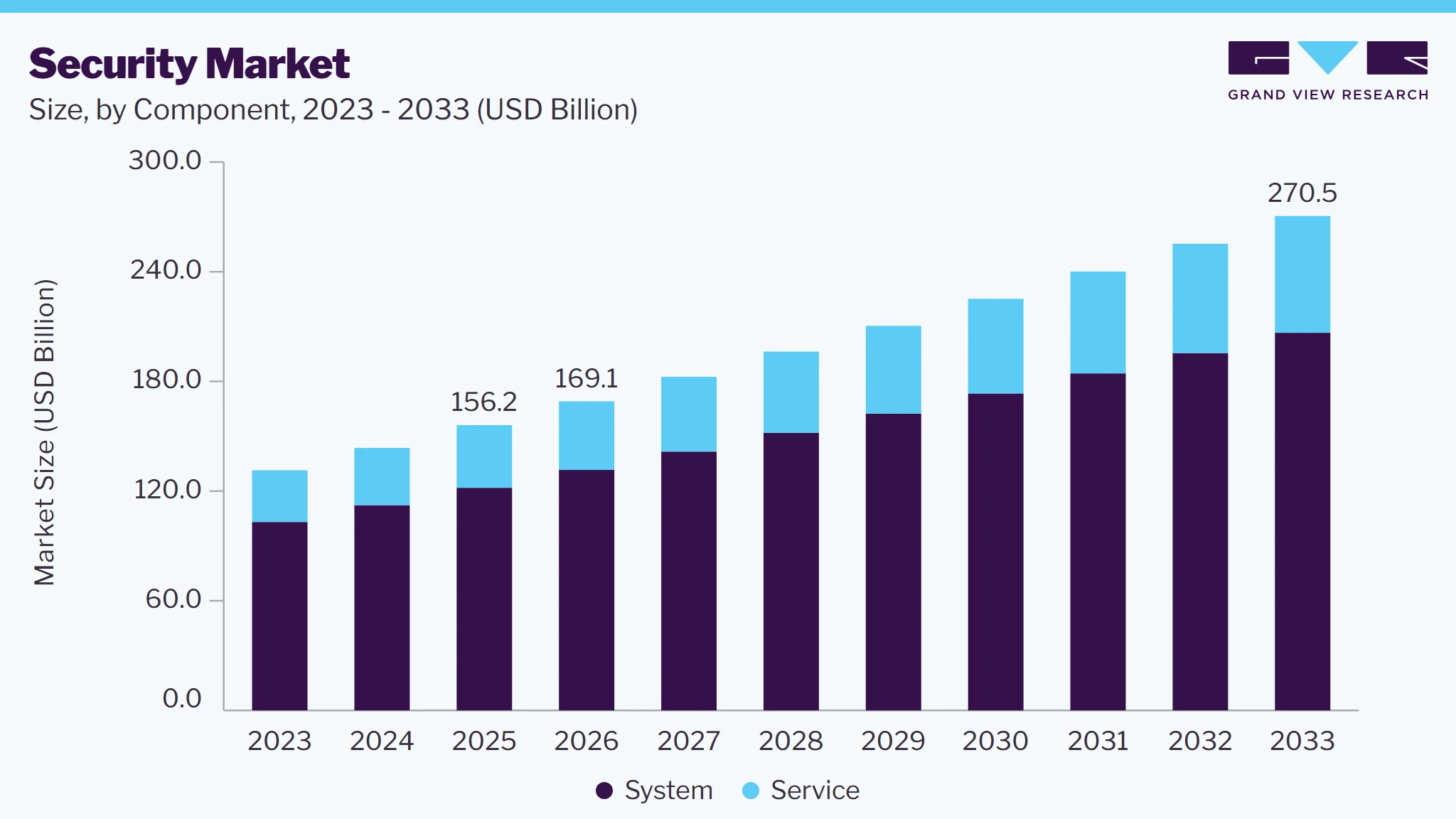
The global security market size was valued at USD 156.2 billion in 2025 and is projected to grow from USD 169.1 billion in 2026 to USD 270.5 billion by 2033, at a CAGR of 6.9% from 2026 to 2033. Asia Pacific dominated the global market, accounting for a revenue share of 33.1% in 2025. Rising concerns over terrorism, fraud, cyber threats, unauthorized activities, and the protection of critical infrastructure, coupled with stringent government security requirements, are driving the adoption of advanced security systems worldwide.
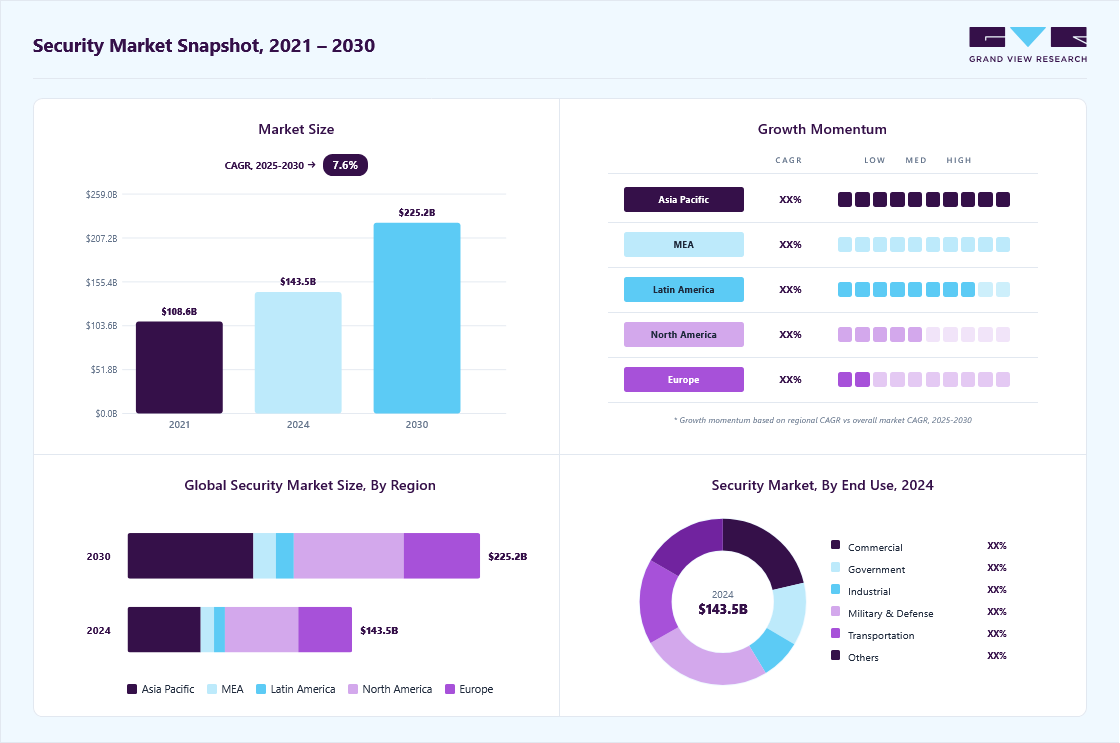 Source: Grand View Research, IR Documents, Primary Interviews, Paid DatabasesTo learn more about this report,
 Download Free Sample Report
 Key Market Trends & Insights
- By component: System segment held the largest revenue share of 78.0% in 2025.
- By end use: Military & defense segment held the largest revenue share of 25.4% in 2025.
Regional Highlights
- Largest regional market: Asia Pacific (33.1% revenue share, 2025)
- Fastest-growing regional market: Asia Pacific (highest CAGR, 2026-2033)
- By country: China held the largest share of Asia Pacific in 2025.
Market Size & Forecast
- Market size in 2025: USD 156.2 Billion
- Estimated market size in 2026: USD 169.1 Billion
- Projected market size by 2033: USD 270.5 Billion
- CAGR (2026-2033): 6.9%
Three ways to get this report
Buy it, customize it, or ask a question.Ask an Analyst
Analyst response in 1 business day
- AccessReport author, directly
- Reply timeWithin 1 working day
- No sales callDirect answer only
- FormatEmail reply
- CostFree, no cost
Get the Full Report
What the study covers
- FormatsPDF · Excel · Dashboard
- Timeline2026–2033 annual, 2025 base
- Coverage20+ countries, 5 regions
- Companies10+ key players profiled
Customize the Report
20% free customization
- IncludeCountries, segments, points
- TailorTo your product definition
- ExtendDeeper competitor detail
- OrA fully bespoke study
- Turnaround5–10 working days
Stringent security requirements and investments in smart infrastructure are accelerating the deployment of advanced, connected security systems across public- and private-sector environments. The security industry is a dynamic and rapidly evolving sector, supported by growing requirements for physical protection, cybersecurity, surveillance, and data security across residential, commercial, industrial, and government environments. Security systems enable organizations to monitor activities, control access, maintain security records, and protect people, facilities, and critical assets. Their adoption is particularly significant in military and defense applications, where surveillance, threat detection, access control, and perimeter protection are used to address risks posed by terrorism, cross-border intrusions, and other security threats.The market encompasses a broad range of solutions, including video surveillance, access control, intrusion detection, biometrics, cybersecurity, and integrated security platforms. Increasing convergence between physical and digital security is further expanding the scope of these solutions. Technological advancements are transforming conventional security systems into connected, intelligent platforms that enable real-time monitoring and automated threat detection. Internet-connected surveillance equipment, IoT-enabled devices, AI-powered video analytics, and cloud-based platforms are enabling organizations to monitor remote and critical locations with greater visibility and responsiveness.
 To learn more about this report, Download Free Sample Report
 These developments are also improving system functionality through features such as automated alerts, remote management, and advanced analytics. In addition, the use of surveillance and automated monitoring technologies can reduce the need for personnel to perform certain tasks in hazardous or difficult-to-access environments, supporting their deployment across critical infrastructure, industrial facilities, transportation networks, and defense applications. The ability to integrate multiple security functions into centralized platforms is also improving coordination between surveillance, access control, and threat detection systems. Furthermore, real-time data and analytics enable security teams to identify unusual activities more quickly, support faster response decisions, and improve overall operational efficiency across distributed facilities.
Market Dynamics
The security market is expanding rapidly as organizations face an increasingly complex threat driven by cyberattacks, data breaches, physical security risks, and geopolitical uncertainties. The adoption of cloud platforms, IoT devices, AI-enabled surveillance, and connected security infrastructure is creating sustained demand for integrated and real-time security solutions. However, the shortage of skilled cybersecurity and security management professionals can limit organizations’ ability to deploy, manage, and optimize increasingly complex systems, particularly among smaller businesses. The convergence of physical and digital security presents opportunities for unified platforms, managed services, and AI-driven monitoring solutions. As organizations seek scalable protection across distributed environments, demand for integrated security technologies and specialized services is expected to increase.
The increasing integration of digital technologies into business operations is reshaping how organizations manage physical facilities, networks, applications, and data. Cloud platforms, remote operations, edge computing, and connected infrastructure are creating more interconnected environments that require continuous visibility and coordinated security management. At the same time, the deployment of IoT-enabled equipment, smart devices, industrial control systems, and other connected assets is expanding the scale and complexity of enterprise security environments.
Organizations are placing greater emphasis on securing identities, endpoints, networks, and connected devices throughout their operational ecosystems. This trend is supporting demand for integrated security solutions that combine access management, endpoint protection, network monitoring, threat detection, and real-time analytics. Organizations are transferring critical workloads to cloud environments, digitizing business processes, and enabling remote and hybrid work models, thereby expanding the potential attack surface and making the protection of digital assets, networks, applications, and sensitive data a strategic priority for businesses of all sizes. As digital and physical infrastructure become increasingly interconnected, businesses are also seeking scalable security platforms capable of providing centralized monitoring and improving visibility across distributed environments.
The rapid expansion of connected security infrastructure is increasing the need for specialized expertise across system deployment, security operations, data management, and incident response. Organizations adopting AI-enabled surveillance, cloud-based platforms, IoT-connected devices, and integrated physical-digital security systems require personnel capable of configuring, maintaining, and continuously optimizing these technologies. However, specialized skills are not developing at the same pace as technology adoption, creating challenges in recruiting professionals with expertise across multiple security domains.
The shortage can increase implementation timelines and operating costs, particularly when organizations require external specialists for system integration, monitoring, and technical support. Smaller organizations may face greater challenges in maintaining dedicated security teams and managing complex platforms internally. As a result, demand for managed security services, outsourced monitoring, consulting, and technical support is likely to increase, although limited availability of qualified personnel may constrain the effective deployment and scalability of advanced security solutions.
The rise in both the scale and complexity of cyber and physical security threats is creating notable opportunities for AI-based threat detection technologies. There is a growing trend among organizations to utilize machine learning and behavioral analytics tools to boost threat visibility and expedite response times. While traditional security systems struggle to analyze massive amounts of data in real time, artificial intelligence can rapidly identify anomalies, suspicious behavior, and emerging attack patterns.
As security operations centers face persistent talent shortages and alert fatigue, autonomous security solutions are becoming increasingly valuable. AI-powered platforms have the capability to automate routine monitoring, incident triage, and threat remediation, allowing security teams to concentrate on more critical risks. With advancements in generative AI, predictive analytics, and automated response capabilities, vendors have a major opportunity to deliver more proactive, scalable, and cost-effective security solutions across enterprise, government, and critical infrastructure environments.
Market Concentration & Characteristics
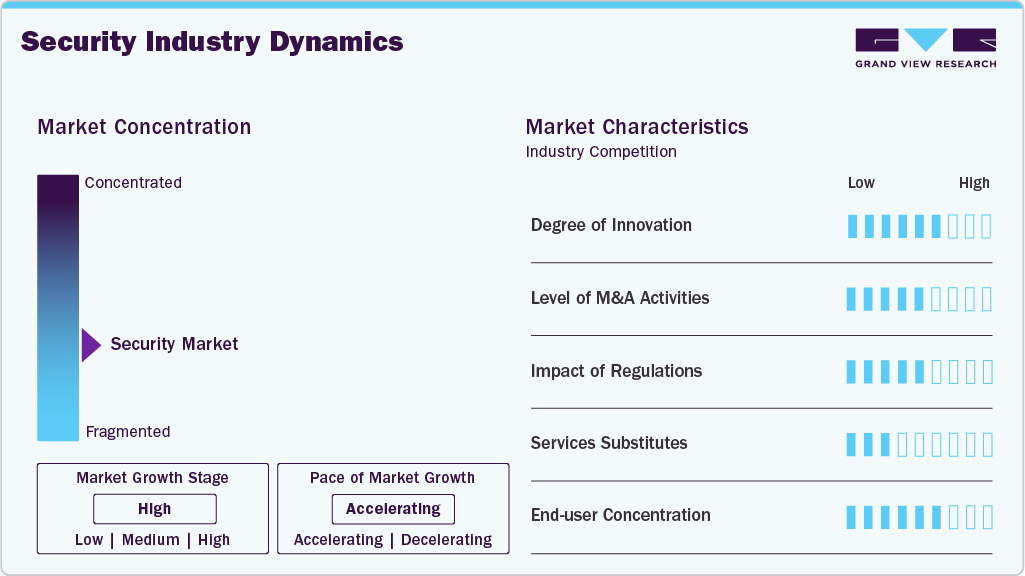
The security market exhibits a high degree of innovation, driven by the rapid evolution of cyber threats and the need for advanced protection mechanisms. Vendors continuously invest in artificial intelligence, machine learning, behavioral analytics, zero-trust architectures, and cloud-native security platforms to improve threat detection and response capabilities. The emergence of generative AI security tools, autonomous security operations, and predictive threat intelligence is further accelerating innovation across the industry. As attack surfaces expand with cloud computing, IoT, and hybrid work environments, continuous product development remains a critical competitive differentiator for market participants.
 To learn more about this report, Download Free Sample Report
 Mergers and acquisitions play an important role in the security industry as companies seek to strengthen technology portfolios, expand customer bases, and gain access to specialized security capabilities. For instance, in June 2026, ASSA ABLOY acquired Sentinel Dock & Door, a Canada-based commercial dock-and-door service provider, as part of its strategy to expand complementary offerings within its core access and entrance systems business. Large cybersecurity providers frequently acquire startups focused on niche areas such as identity security, AI-based threat detection, cloud security, and security orchestration. These transactions help accelerate innovation and enable vendors to offer more integrated security platforms.
Analyst Perspective
The global security market is being shaped by connected infrastructure, increasing convergence of physical and cybersecurity systems, and investment in advanced protection technologies. The market is shifting from standalone deployments toward integrated, intelligent, and continuously managed security systems. AI-enabled video analytics, biometric authentication, connected sensors, and cloud platforms are improving automated threat detection, real-time monitoring, and remote management. Smart cities, critical infrastructure, connected transportation, and digitally enabled industrial facilities are supporting demand for interoperable security solutions. Regulatory requirements and complex threats are also driving demand for risk assessment, system integration, managed security, and incident-response services. Subscription-based models may gain traction, while vendors combining AI, cybersecurity, physical security, analytics, and services are expected to strengthen market differentiation.
Component Insights
The system segment led the security industry with a revenue share of 78.0% in 2025 and is expected to grow at the fastest CAGR over the forecast period. The segment includes access control, alarm and notification systems, intrusion detection, video surveillance, barrier systems, and other security technologies deployed across commercial, government, industrial, residential, and transportation environments. Growing investments in physical and digital security infrastructure are supporting demand for advanced surveillance, access management, and threat-detection systems. The integration of AI-driven video analytics, biometric authentication, IoT connectivity, and cloud-based platforms is enhancing real-time monitoring, automated threat detection, and remote system management. In addition, investments in smart cities, critical infrastructure, transportation networks, and facility modernization are encouraging the deployment of integrated security systems. Meanwhile, the service segment is expected to register the fastest CAGR, supported by increasing demand for system integration, managed security, risk assessment, monitoring, maintenance, and other specialized services.
The service segment is expected to grow at the fastest CAGR from 2026 to 2033. Organizations are increasingly engaging specialized providers to manage complex security requirements, strengthen operational resilience, and reduce the burden of maintaining in-house capabilities. Services including system integration, security consulting, risk assessment, 24/7 monitoring, maintenance, and managed security are gaining importance as businesses seek to protect physical facilities, connected infrastructure, and digital assets. The growing complexity of security environments is also increasing demand for continuous monitoring, incident response, and security management services. In addition, subscription-based and managed service models are gaining traction by providing ongoing support, system updates, and scalable security capabilities. The integration of cloud platforms, AI-enabled analytics, and connected security systems is further expanding opportunities for service providers.
End Use Insights
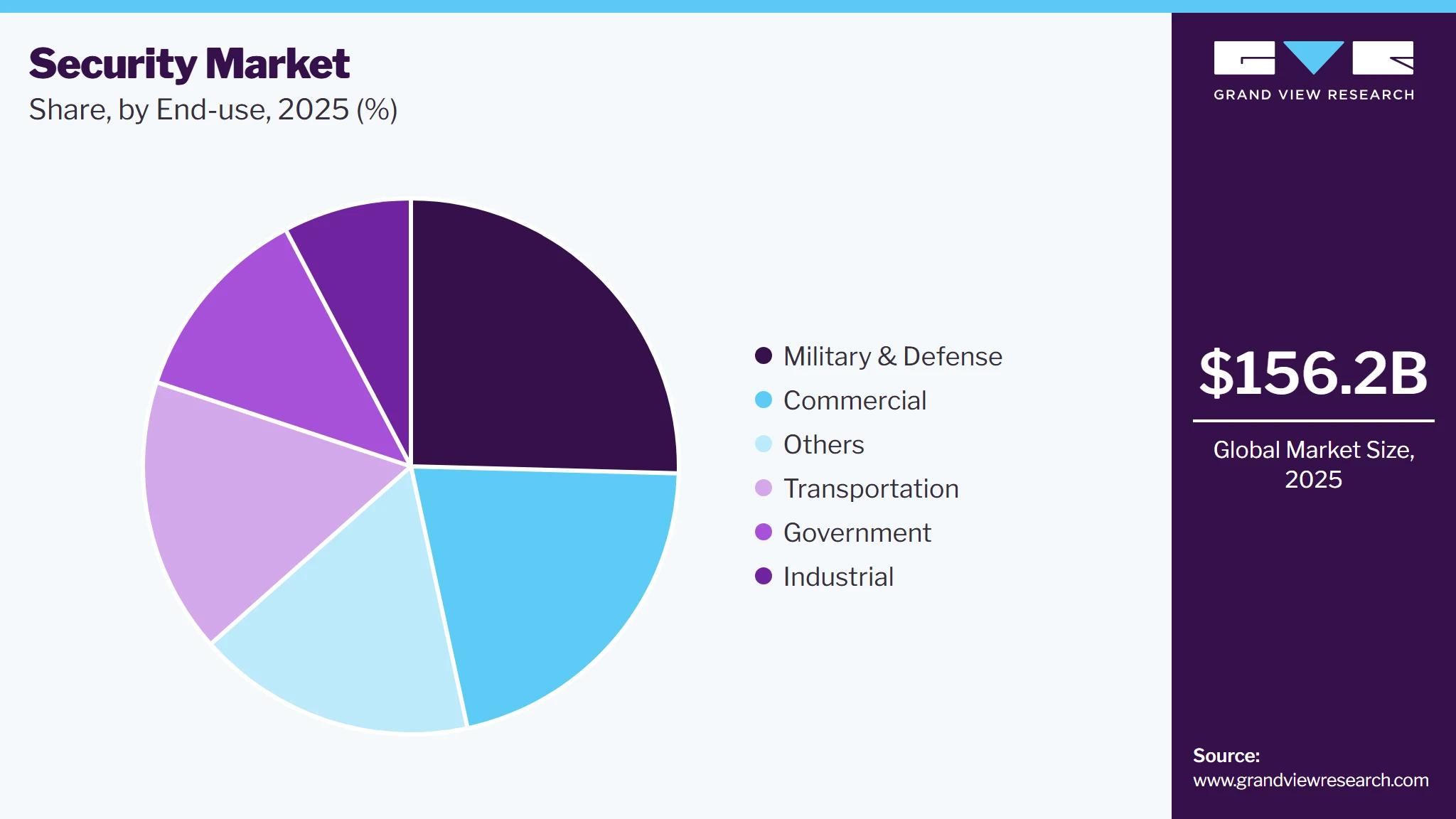
The military & defense segment led the security market with the largest revenue share of 25.4% in 2025. Governments across the world are increasing investments in surveillance, threat detection, access control, secure communications, and cybersecurity to strengthen the protection of personnel, facilities, and strategic assets. The adoption of AI-enabled analytics, unmanned systems, advanced monitoring, and integrated security platforms is enhancing situational awareness and threat detection capabilities. Rising investments in border protection, military infrastructure, and critical assets are further supporting demand for advanced security solutions. The growing need to secure military networks and connected defense infrastructure is also increasing demand for integrated physical and cybersecurity solutions.
 To learn more about this report, Download Free Sample Report
 The transportation segment is expected to grow at the fastest CAGR during the forecast period. Airports, seaports, rail networks, and other transportation facilities are increasing investments in surveillance, biometric access control, intrusion detection, screening, and automated monitoring systems. Growing passenger and cargo volumes, along with the need to protect transportation infrastructure and maintain operational continuity, are supporting the adoption of integrated security solutions. The increasing use of AI-enabled analytics and connected security systems is further creating opportunities for real-time monitoring and automated threat detection across transportation facilities. The modernization of smart airports, rail systems, and connected transit infrastructure is further driving demand for scalable and centralized security platforms.
Regional Insights
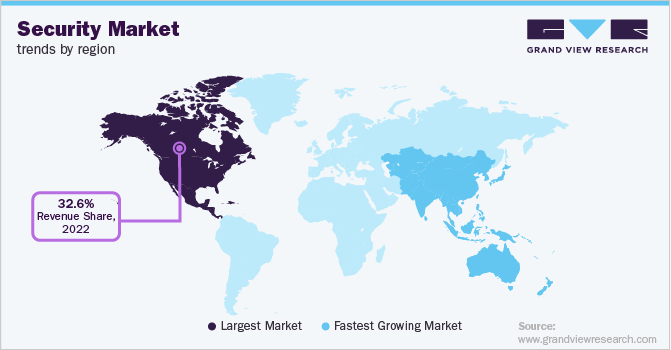
Asia Pacific dominated the security industry, with the largest revenue share of 33.1% in 2025, supported by rapid infrastructure development, digital transformation, and rising investment in integrated security systems. China, India, and Japan are expanding surveillance, access control, intrusion detection, and other security infrastructure across commercial, government, industrial, and transportation applications. The growing deployment of connected devices and smart-city infrastructure is also increasing demand for networked security solutions capable of real-time monitoring and automated threat detection. Video surveillance remains a key component of regional security spending, while AI-enabled analytics and cloud-connected platforms are gaining traction. In addition, investments in critical infrastructure and border protection are supporting demand for advanced physical-security technologies. These trends, combined with rising cybersecurity requirements as organizations digitize operations, are expected to sustain the region's leading position in the global market.
 To learn more about this report, Download Free Sample Report
 The China security market accounted for the largest share of Asia Pacific in 2025, supported by continued urbanization, infrastructure investment, and the expansion of smart-city initiatives. Government and commercial organizations are increasingly deploying networked surveillance, access control, and monitoring systems, with AI-enabled video analytics supporting automated identification and real-time event detection. The country's large-scale digital infrastructure development is also encouraging the integration of physical security systems with connected platforms. Demand for security solutions is expanding across commercial, industrial, residential, and public-sector application areas as organizations seek centralized security management and improved situational awareness. In parallel, investments in border and maritime security are supporting the adoption of surveillance, thermal imaging, and monitoring technologies. China's expanding cybersecurity requirements are also encouraging organizations to strengthen the protection of connected security infrastructure and associated data.
North America Security Market Trends
The North America security industry held a revenue share of 32.4% in 2025, supported by strong demand for physical and cybersecurity solutions across government, defense, commercial, industrial, and critical infrastructure sectors. The U.S. represents the region’s largest market, with increasing investments in surveillance, access control, intrusion detection, and cybersecurity systems. Growing cyber threats, protection requirements for critical infrastructure, and the need to strengthen operational resilience are encouraging organizations to upgrade security capabilities. In addition, widespread adoption of AI, IoT, cloud platforms, and advanced analytics is enabling automated threat detection, real-time monitoring, and integrated security management. The expansion of connected infrastructure and hybrid environments is further driving demand for solutions that combine physical and digital security.
The U.S. security market dominated North America in 2025, with rising investments in critical infrastructure, transportation, government facilities, and commercial establishments, where integrated surveillance, access control, and intrusion detection systems are increasingly deployed. In addition, the growing adoption of cloud-based security platforms and AI-enabled analytics is supporting the shift toward more connected and automated security solutions. Rising concerns over cyberattacks, terrorism, and national security threats have driven significant investments in advanced security technologies, including AI-powered surveillance, biometric access control, and cybersecurity systems. The U.S. is also home to numerous leading security solution providers and has a strong focus on research and development, fostering innovation.
Europe Security Market Trends
The Europe security industry accounted for a share of approximately 23.0% in 2025, supported by increasing investments in critical infrastructure protection, digital transformation, and advanced security technologies. European organizations are expanding the deployment of video surveillance, access control, intrusion detection, and integrated security systems across banking, transportation, healthcare, energy, and other critical sectors. Growing cybersecurity requirements are also encouraging investments in technologies that protect connected infrastructure and digital assets.
The implementation of the EU’s NIS2 framework and other cybersecurity initiatives is strengthening requirements for cybersecurity risk management and resilience across entities operating in critical sectors. In addition, the European Commission’s July 2026 guidance on critical infrastructure resilience addresses physical and digital threats, including drone attacks and hybrid threats, and encourages critical entities to strengthen physical protection, monitoring, and resilience measures. These regulatory and infrastructure-protection initiatives are supporting demand for integrated security solutions that address both physical and digital risks.
Key Security Company Insights
Key companies in the security industry include ASSA ABLOY and specialized providers such as Apex Perimeter Protection.
-
ASSA ABLOY is a global provider of access solutions, offering mechanical and electronic locks, access control systems, smart locks, entrance automation, and identification technologies. The company serves residential, commercial, institutional, and industrial applications and continues to expand its portfolio through connected, cloud-enabled, and digital access solutions. Its focus on electronic access control, mobile credentials, and smart security technologies supports its presence across the evolving security landscape.
-
Apex Perimeter Protection specializes in physical perimeter-security solutions designed to protect properties and critical sites from unauthorized access. Its offerings include perimeter barriers and related protection systems for applications requiring controlled access and enhanced physical security. The company's focus on perimeter protection complements the broader shift toward integrated physical-security solutions that combine barriers, access control, detection, and surveillance technologies.
Key Security Companies
The following key companies have been profiled for this study of the security market.
-
ASSA ABLOY
-
Apex Fabrication & Design, Inc.
-
Apex Perimeter Protection
-
Anixter Inc.
-
Perimeter Protection Germany GmbH
-
Johnson Controls
-
Honeywell International, Inc.
-
ZABAG Security Engineering GmbH
-
Teledyne FLIR LLC
-
Axis Communications AB
Competitive Benchmarking
Operating Strategies
Operating Strategies
Operating Strategies
Established Players (ASSA ABLOY, Johnson Controls, Honeywell International, Inc., Teledyne FLIR LLC, Axis Communications AB)
- Focus on integrated security portfolios combining physical security and cybersecurity capabilities.
- Expand through acquisitions, global distribution networks, and long-term enterprise contracts.
- Strong brand recognition, extensive installed customer base, and broad geographic presence. Significant R&D resources enabling continuous product innovation and platform integration.
- Large organizational structures can slow product development and deployment cycles.
- Higher solution costs may limit penetration among small and mid-sized customers.
Emerging Players (Apex Fabrication & Design, Inc., Apex Perimeter Protection, Perimeter Protection Germany GmbH, ZABAG Security Engineering GmbH)
- Concentrate on specialized security, including perimeter protection, fencing systems, and site-specific solutions. Focus on customized deployments and project-based engagements for targeted customers.
- Greater flexibility in addressing unique customer requirements and industry-specific applications. Strong expertise in niche security domains with focused product offerings.
- Limited global reach and smaller networks than those of established competitors. Lower financial resources may constrain expansion and technology development initiatives.
Recent Developments
-
In September 2026, Axis Communications announced the AXIS D2124-VE Radar, an AI-powered radar solution designed for 360-degree area protection and perimeter surveillance. The system provides object classification and can integrate with Axis PTZ cameras for automated visual verification, supporting security applications across critical infrastructure, industrial, and remote sites.
-
In March 2026, Honeywell announced a collaboration with Rhombus to expand its cloud-connected security portfolio with AI-powered video and access solutions. The companies plan to integrate cloud video management and access control, enabling centralized security management across distributed commercial facilities and supporting the growing adoption of AI-enabled and cloud-based security systems.
-
In August 2024, Robert Bosch GmbH, a leading provider of innovative security and safety solutions, launched its India assembly line for video systems, featuring the FLEXIDOME IP Starlight 5000i cameras. This strategic initiative underscores Bosch India's commitment to localization and strengthens its position across various product verticals.
-
In May 2024, Hanwha Vision launched the AIB-800 AI Box, enabling existing ONVIF-compatible surveillance cameras to support AI-based analytics without requiring complete camera replacement. The solution allows organizations to add capabilities such as object detection and classification to existing video surveillance infrastructure, supporting the modernization of installed security systems.
-
In January 2024, Johnson Controls, the U.S.-based global leader in smart security solutions, launched its latest range of advanced security cameras, the Ilustra Standard Gen3. Designed and manufactured in India with over 75% localization, this new product line aligns with the company’s goal of fully producing its security solutions in the country in the coming years, supporting the government’s Make-in-India initiative.
Security Market Report Scope
Report Attribute
Details
Market size in 2025
USD 156.2 billion
Estimated market size in 2026
USD 169.1 billion
Projected market size by 2033
USD 270.5 billion
Growth rate
CAGR of 6.9% from 2026 to 2033
Base year for estimation
2025
Historical data
2021 - 2024
Forecast period
2026 - 2033
Quantitative units
Revenue in USD million/billion and CAGR from 2026 to 2033
Report coverage
Revenue forecast, company ranking, competitive landscape, growth factors, and trends
Segments covered
Component, end use, region
Regional scope
North America; Europe; Asia Pacific; Latin America; MEA
Country scope
U.S.; Canada; Mexico; Germany; UK; France; China; Japan; India; South Korea; Australia; Brazil; Saudi Arabia; South Africa; UAE
Key companies profiled
ASSA ABLOY; Apex Fabrication & Design, Inc.; Apex Perimeter Protection; Anixter International, Inc.; Perimeter Protection Germany GmbH; Johnson Controls.; Honeywell International, Inc.; ZABAG Security Engineering GmbH; Teledyne FLIR LLC; Axis Communications AB.
Customization scope
Free report customization (equivalent up to 8 analysts' working days) with purchase. Addition or alteration to country, regional & segment scope.
Pricing and purchase options
Avail customized purchase options to meet your exact research needs. Explore purchase options
Global Security Market Report Segmentation
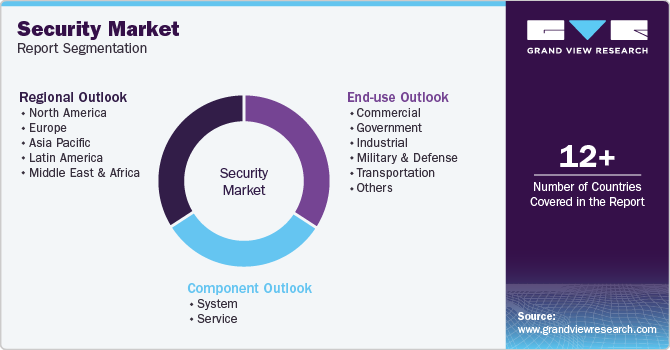
This report forecasts revenue growth at global, regional & country levels and provides an analysis of the latest trends in each of the sub-segments from 2021 to 2033. For this report, Grand View Research has segmented the global security market report based on component, end use, and region:
 To learn more about this report, Download Free Sample Report
 -
Component Outlook (Revenue, USD Million/Billion, 2021 - 2033)
-
System
-
Access Control Systems
-
Alarm & Notification Systems
-
Intrusion Detection Systems
-
Video Surveillance Systems
-
Barrier Systems
-
Others
-
-
Service
-
System Integration & Consulting
-
Risk Assessment & Analysis
-
Managed Security Services
-
Maintenance & Support
-
-
-
End Use Outlook (Revenue, USD Million/Billion, 2021 - 2033)
-
Commercial
-
Government
-
Industrial
-
Military & Defense
-
Transportation
-
Others
-
-
Regional Outlook (Revenue, USD Million/Billion, 2021 - 2033)
-
North America
-
U.S.
-
Canada
-
Mexico
-
-
Europe
-
UK
-
Germany
-
France
-
-
Asia Pacific
-
China
-
India
-
Japan
-
Australia
-
South Korea
-
-
Latin America
-
Brazil
-
-
Middle East and Africa
-
UAE
-
Saudi Arabia
-
South Africa
-
-
Research Methodology
The security market figures in this report are based on a proven research process that combines executive interviews with secondary research from proprietary databases, company filings, and recognized regulatory and institutional sources. Market size is built through value-chain sizing - reconciling supply-side and demand-side estimates - and triangulated with bottom-up and top-down approaches. Every estimate passes multiple levels of expert validation before publication, with each security segment quantified using the revenue-capture definitions in the table below.
Segment Definition
Segment - Component
Revenue capture definition
System
Revenue generated from systems includes sales of hardware and software platforms designed to prevent, detect, monitor, and respond to security threats across physical and digital environments. This segment captures revenue by enterprises and government organizations.
Service
Revenue generated from services includes consulting, integration, deployment, monitoring, maintenance, managed security, and incident response activities provided by security vendors and third-party service providers. This segment captures recurring and project-based revenue that support the effective utilization of security technologies.
Segment - End Use
Revenue capture definition
Commercial
Revenue from the commercial segment includes security solutions deployed across offices, retail stores, data centers, hospitality facilities, educational institutions, and corporate campuses. It covers spending on cybersecurity software and managed security services used to protect business operations and assets.
Government
This segment captures spending by federal, state, and local government agencies on cybersecurity infrastructure, public safety systems, identity management solutions, and critical infrastructure protection. Revenue is driven by national security priorities, data protection mandates, and modernization of government IT environments.
Industrial
Industrial revenue includes security solutions deployed across manufacturing facilities, energy plants, utilities, mining operations, and industrial automation environments. Adoption is influenced by the need to secure operational technology (OT) networks, industrial control systems, and connected production assets from cyber and physical threats.
Military & Defense
The military and defense segment comprises expenditures on advanced cybersecurity systems, intelligence security platforms, secure communications, surveillance technologies, and defense-grade protection solutions. Market revenue reflects ongoing investments in safeguarding defense networks, classified information, and mission-critical infrastructure.
Transportation
Revenue within the transportation segment is derived from security deployments across airports, railways, seaports, logistics hubs, and public transit networks. Organizations invest in surveillance, access management, threat monitoring, and cybersecurity solutions to maintain operational continuity and passenger safety.
Others
The others segment includes security spending across healthcare institutions, educational facilities, residential complexes, entertainment venues, and non-profit organizations. Revenue generation is supported by increasing awareness of cyber risks, physical security requirements, and protection of sensitive operational data.
Estimation Model
Audience Layer
Deployment Layer
Protection Layer
Monetization Layer
Who Needs Security Solutions?
Who deploys Security Solutions?
How Much Security Is Utilized?
How Much Revenue Is Generated?
Identify consumers open to security risks. Calculate the installed base of assets and environments that require protection.
Apply security adoption rates and evaluate deployment, identity management platforms, and managed security services among target users.
Measure the breadth and intensity of security implementation through protected endpoints and service utilization levels.
Apply average spending per customer and aggregate revenues across software and hardware deployments to estimate total market revenue.
Delivered Customizations
This report has been delivered with the following In-depth customizations
Client request
Customization delivered
Value Adds
Market Entry & Expansion Assessment
Regional demand sizing and forecasting
Customer segmentation and buying behavior analysis
Competitive landscape benchmarking
Regulatory and distribution channel assessment
Identified high-growth market opportunities
Supported go-to-market strategy development
Highlighted investment priorities and risks
Enabled data-driven expansion planning
Technology & Innovation Assessment
Emerging technology trend analysis
Innovation pipeline
Technology adoption readiness assessment
Ecosystem and partnership mapping
Identified future growth areas
Supported innovation roadmap planning
Evaluated commercialization potential
Strengthened strategic partnership decisions
Product Positioning & Competitive Intelligence
Product benchmarking and feature comparison
Pricing and value proposition analysis
Brand perception and customer preference study
Competitor strategy evaluation
Improved product differentiation strategy
Supported pricing optimization
Identified unmet customer needs
Enhanced competitive positioning
Frequently Asked Questions About This Report
Key factors driving the growth of the security market include the increasing incidence of criminal activities, terrorism, and fraud worldwide, stringent government regulations and public safety mandates, the rapid development of smart city projects requiring advanced surveillance and monitoring solutions, and growing investments in critical infrastructure protection and cybersecurity systems.
The global security market size was estimated at USD 156.2 billion in 2025 and is expected to reach USD 169.1 billion in 2026.
The global security market is expected to grow at a compound annual growth rate of 6.9% from 2026 to 2033 to reach USD 270.5 billion by 2033.
The system segment led with a 78.0% revenue share in 2025, while service is the fastest growing segment.
Asia Pacific dominated the security market with a share of 33.1% in 2025. The rise in digital transformation across businesses and government sectors in the region has further fueled the need for robust cybersecurity measures.
Military & defense segment led the market with the largest revenue share of 25.4% in 2025.
Prominent players dominating the security market include ASSA ABLOY, Apex Fabrication & Design, Inc., Apex Perimeter Protection, Motorola Solutions, Inc., Perimeter Protection Germany GmbH, Johnson Controls, Honeywell International, Inc., ZABAG Security Engineering GmbH, Teledyne FLIR LLC, and Axis Communications AB.
The video surveillance systems segment led the market with a 47.0% revenue share in 2025, while the intrusion detection systems segment is witnessing significant growth during the forecast period.
About the Author(s)
Next Generation Technologies Research Team
Technology · Next Generation TechnologiesThis report was authored by the next generation technologies research team at Grand View Research - comprising two research analysts, one senior research analyst, and one industry expert - with specialized expertise in the next generation technologies segment of the technology industry. All findings are based on proprietary technology databases, executive interviews, and regulatory analysis, subject to internal peer review prior to publication.
Last Updated:
Speak to Analyst

Customize this report to your needs - add regions, segments, or data points, with 20% free customization.
Or view our licence options:


ISO 9001:2015 & 27001:2022 Certified
We are GDPR and CCPA compliant! Your transaction & personal information is safe and secure. For more details, please read our privacy policy.


